


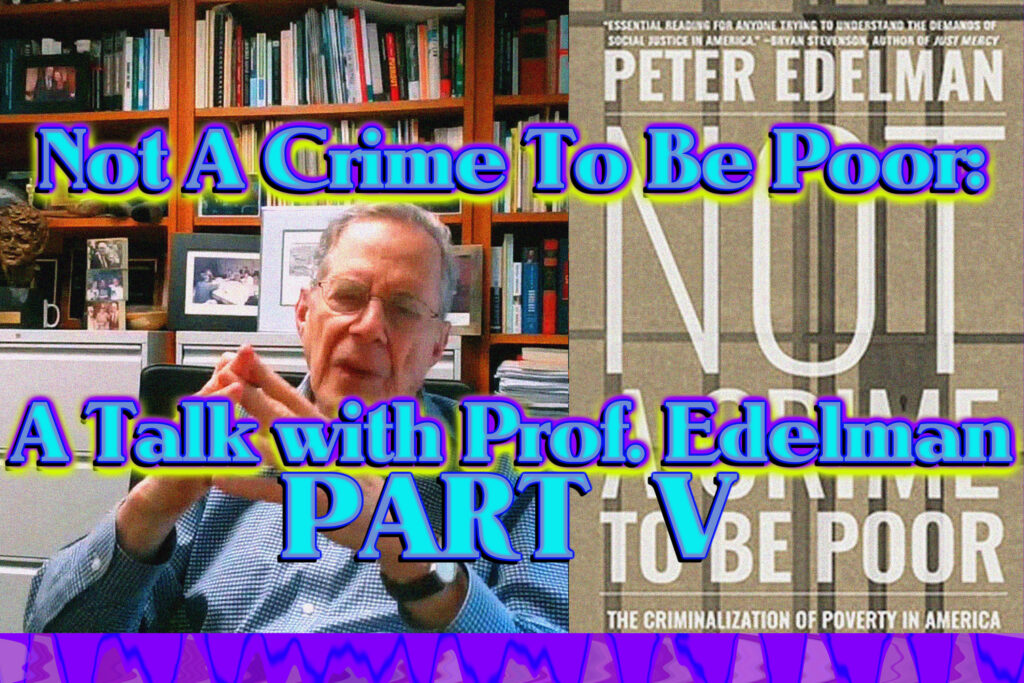
This is the fifth part of the interview with Professor Edelman, author of Not A Crime To Be Poor: The Criminalization of Poverty in America and So Rich, So Poor: Why It’s So Hard To End Poverty In America.

In this portion of the interview, Professor Edelman discusses the criminalization of homelessness that exists in many states, along with the standard eviction procedures around the country, where many states have no protections for tenants whatsoever. For those living in New York City, along with larger cities such as California, Detroit, and Chicago, it is difficult to comprehend the life of a tenant with no protections.
Starting with the criminalization of homelessness, many states have policies on the books in the municipal code where, for example, sleeping on the street is illegal. Such a policy takes a homeless person who is living on the street due to their poverty, and it puts them in jail instead. This does not help anyone, particularly the homeless person struggling with either a low income or a complete absence of income, often driven by not having a job. Being homeless in itself is very stigmatized in most places, making it difficult for them to get another job, which could end the cycle of poverty and homelessness.
Moving on, we discussed the issues related to evictions across the country. In many states, tenants have no legal right to remain in their apartment or house as soon as they haven’t paid the rent. In some cases, they can be evicted after as little as four days, when the landlord contacts the court, who sends the sheriff or marshal in their town, who then locks the tenant out of their apartment.
This is quite a shock for those who believed that Detroit, California, and New York City were seen as models for other cities across the country. In fact, they are the outliers. As some people know, it can be nearly impossible to evict a tenant, including a squatter who has never paid any rent, in Detroit. In New York City, it is not so drastic, but a tenant has the right to be taken to court, where a judge will often give between one and six months for them to find a new apartment.
This can lead to its own issues, where many landlords will not accept a tenant who has been through the Housing Court, for any reason at all. In NYC and other states, a tenant can also take a landlord to the same housing court for legitimate claims, such as no heat or hot water, plumbing issues, broken refrigerators, and other issues that undesirable landlords often ignore and allow to fester. It is often the case, then, that a tenant will be punished by future landlords for exercising their rights, but they still have them.
In places such as Alabama and Mississippi, which were specifically mentioned by the professor, tenants have less rights. While they do have the right to a livable dwelling, which includes properly functioning plumbing and electricity, there is not much else they can expect. In Mississippi, a landlord can take a tenant to court three days after not receiving the rent payments. Similarly to Mississippi, if a tenant has not paid their rent in Alabama in seven days, they will have seven days after being served with papers from a landlord to vacate the premises. Other reasons for eviction that don’t have to do with paying rent allow the tenant fourteen days to correct in Alabama.
While many people who are not low income would be able to address an issue of rent being in arrears rather easily, this can be a real challenge for low income people, especially if they have recently lost their job or had a different type of problem. It can, quite literally, ruin their lives. All that has to happen is an illness, a surgery that they need and cannot pay for due to a lack of health insurance, or a family emergency that costs more than they can afford, and they lose their home in less than two weeks. This significantly increases the risk of homelessness which, as mentioned previously, is usually criminalized in these same states.
So these tenant laws, or the lack thereof, can have devastating consequences on the low income population of various cities.
When you look at soaring levels of poverty and homelessness in the Appalachia states , for example, it becomes easier to understand why. They lost their jobs as miners; soon after that they often lost their homes, and they are now living in poverty. This is a common story in that area, where the major mining operations and other employers left those states, leaving behind a massive open wound consisting of the people who moved there for a better life, who are very often now living in poverty.
Other issues in this particular area were the utter dependence on the corporations who were doing the mining operations, where they provided not only the jobs but also the housing for their workers, their food and sundries through debt to stores selling products on the plantations, along with discouraging education and civic engagement while they were there. This led to a decline in the overall social and economic stratification in the area, where it is still the case that many are living in poverty. The states where RFK visited with Professor Edelman, as described in a previous video, were the Appalachian states. These visits occurred after John F. Kennedy had campaigned there and witnessed the astounding poverty of the residents.
When you couple these issues with the issues related to SNAP, there are many people in these areas who are barely surviving, where the next tragedy could be their last. However, in these states, there are inroads being made to improving the rights and lives of tenants. In some of these states, laws have been passed to require 30 days of notice to a tenant who has not paid their rent on time. That is the case in Kentucky and West Virginia, where a landlord must give thirty days written notice for a tenant to leave for any reason, after which they can approach the court for assistance. So, things are improving in some places, while they remain poor in other places.
Professor Edelman mentioned how devastating the lack of tenants’ rights in those states without them can be on a low income person. Similarly to issues of tickets and debt to the court, the lack of tenants’ rights can also ruin many lives. Being evicted with nowhere to go, particularly when children are involved, can be devastating to a low-income family, especially if they don’t have relatives that are able to help. Often these same states are those with the worst track record for providing assistance to low income people through SNAP and other programs.
But there are solutions. There are states who are working to improve the lives of low-income residents in their state. A crucial starting point in all of these places is removing the stigma of poverty. Reducing the urge of people to say that someone is poor or homeless through their own fault; if they had just worked harder, this would not have happened to them. While this may be the case for a small few, the vast majority of low-income people work very hard, but they don’t have the tools or often the education to be able to lift themselves out of poverty.
This is a sad state of affairs, and some of the red states can learn from the blue states what solutions have worked and what is promising. Because when you lift up the low-income people in an area, it can have the beneficial affect of lifting everyone else up, too. So, where selfishness is a motive, this is a perfect reason to improve the system in those areas. It will actually benefit everyone, not just the low-income people themselves.
Staten Islander News Service Staff Writer


This byline indicates that this article was penned by a member/members of the Staten Islander News Organization office team. Our staff writers are the backbone of our newspaper, performing all sorts of important tasks like conducting interviews, investigating leads, besides writing the news stories you see.