


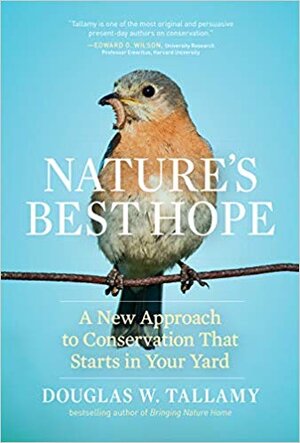
While you may underestimate your own capacity to restore insect life, thus enabling birds and other members of food webs to thrive, this forward-thinking book teaches you how to do just that – in the process helping with species extinction, desertification of landscapes, and other man-made catastrophes
Review and summary of Douglas Tallamy’s book Nature’s Best Hope
As mentioned in a previous article, insects and other species are disappearing at an alarming rate. We are projected to lose about 40% of our worldwide insect species over the next decade, according to research by entomologists. Not only this, but multiple species, including some that have yet to be identified and classified, are disappearing every year, and this number is predicted to increase as humans continue their endless march toward eradicating every pest insect known to man – along with the predator bugs, pollinators, and other essential species.
However, this mass extinction, termed the anthropocene extinction due to its causation and continuation by humans, also heavily affected birds. You may ask, as I did, why this is so, and why it is so important. Here is what this book explains: birds who are feeding their babies rely exclusively, or nearly exclusively, on insects to feed them, primarily caterpillars.
Why caterpillars, you may ask? That question is not completely answered, although it likely has to do with their defenselessness and abundance in a given area. When I talk about abundance, maybe a little clarification from this book would be in order.
First of all, how many caterpillars does a mommy and daddy bird feed to their babies? That number is not easy to determine, but what IS known is the number of trips made to give the babies the food. Between two parents, in the researched species delineated, chickadee moms visit the nest between 550-600 times PER DAY, while daddy-birds visit the nest between 250-300 times. The reason it is so difficult to determine the number of insects fed is that each trip brings a variable number of caterpillars. One time, they might find two, the next time three, and the next time one. The cameras aren’t really sharp enough to make a definite determination. But what we know for sure is that it is at least a thousand PER DAY for ONE nest of five baby birds. If you have multiple bird nests in an area during breeding season, that is a LOT of caterpillars.
Where do they get the food they need for their babies?
The next part of this equation is where humans have disrupted things, and where they can swoop in to fix them. Where do all these caterpillars come from? Native plants! What is a native plant? Let’s save that question for a little bit later. But what is the problem with introduced or invasive plants? They do not host nearly as many caterpillars as the native plants they have squeezed out of the landscape.
The issue with non-native plants, and why it has been so hard for our native plants to recover, is the WAY in which they were introduced, and what happened to the plants they replaced. A perfect example is a planned community (with attendant homeowners’ association and the rules that brings) which is constructed in an area.
Let’s say it is in New Jersey, as they are quite plentiful there, however, this applies to nearly all residential communities, as this land did not start out with houses and condominiums everywhere; it started with forests, trees, grasslands, and prairies, although it can also apply to vacant lots and repurposed industrial locations, which themselves started out as forests and other natural areas.
The construction company gets their required permits from the municipality. The bulldozers, backhoes, and chainsaws come in first, reducing the previously forested land to a flat, desolate landscape with a few stacks of wood chips on it. (*This is not ALWAYS the case in today’s era of sustainability and appreciation for natural beauty – today there are planned communities where they are much more delicate, leaving behind the beautiful oak or willow trees between the homes and lining the streets, but most of the homes we see today were not created in this way).
What happens next depends on the purpose of the area. Since our example is a planned residential community, after the wood chips are removed, houses are constructed, and streets are paved, the builder will come in and plant some non-native ornamental trees that produce no seeds and host very few if any caterpillar species.
Such a place will have very few birds attempting to live there. This is the case in a great many of our residential communities. Birds may visit, and people may even feed them in their backyards, but they will not nest there. Why? Because they would have to travel much further to find sufficient quantities of caterpillars to feed to their babies.
It is much easier for the birds to build a nest very close to a source of insects, as they are already going to be visiting the nest a thousand times between the two parents. It would simply be exhausting to have to fly miles back and forth thousands of times a day, so they are smart: they build the nest where the food is.
In terms of food sources, most berries, nuts, and seeds, have a protein to fat ratio that is not good for feeding the young of most bird species. With few exceptions, birds will eat seeds themselves, but their babies need to have insects.
So how do we know what is native, and does it have to be there for thousands of years to qualify?
As the author explains, there is a huge difference between native plants and introduced plants. Seeing the way in which plants from elsewhere have been introduced, it is no wonder that many of the native plants did not survive, or if they survived they are not thriving. This is the way in which invasive plants were brought here. The native species were ripped out and replaced with the foreign decorative species.
As for why this is problematic, it comes down to science. The science of the study of bugs, to be precise. Evolutionarily, insects have evolved with the plant species that they can thrive on. All plants have what are known as defense mechanisms. Any insect that wants to eat a plant has to overcome these defense mechanisms. In most cases, these fall into certain types of defenses, such as an abundance of a particular chemical.
Over generations of time, a given insect will be able to adapt to eating a small range of plants. In the case of the monarch butterfly, for example, they can ONLY eat milkweed. But, they are one of only a small number of butterflies that can eat milkweed. Another butterfly would be able to eat a different species of plant, but not the milkweed plants.
The same is true of all other insects. Each insect evolved to consume a handful of plants. If most or all of those plants are taken away, the insect will not be able to evolve quickly enough to replace their need for their chosen plant to a different, introduced plant. As a result, that species may go extinct, or diminish severely in numbers.
Fortunately, science is catching up now, but many insects have already gone extinct, so humans have to hurry. This is why we now know the actual harm of introduced plants. One striking example is the autumn olive. Their berries are somewhat nutritionally deficient in terms of protein, but they’re high in lycopene. While birds can eat them, it would be similar to a human eating a donut instead of a high protein meal. It tastes good, but it is not good for you, and in the long run this can be damaging to your health.
Generalist Pollinators, and Making Your Backyard Bee- and Butterfly-Friendly
One of the most important takeaways from this book is that YOU have a large part to play, if you will accept it. You can make your backyard a haven for caterpillars, bees, and birds with very little effort and a small amount of space.
The first thing to do is plant native plants that will attract a wide variety of bees to your yard. Many bees are generalists, and some of them are specialists, but if you plant for the specialists, the generalists will follow, and you will have lots of them in your yard.
Very fortunately, for those non-scientists among us, one of the author’s colleagues spent some time developing lists of native species in each area of the United States, which were then compiled and placed on the National Audubon Society and the National Wildlife Federation’s Plant Finder
After you plant the correct species, you can make your backyard welcoming for pollinators. Leave a small leaf pile and some fallen branches in a particular area of your yard so that the ground bees can build their nests there.
Most species of bees nest individually in the ground. You can bury half of a toilet paper roll with the paper on it, or you can buy several miniature bee hotels (not the large ones, which just become targets for predators waiting for an easy meal), and then place them in various places around your yard.
Most important for those who are afraid of bees: most bees will ignore you while going about their business, and most bees do not sting unless they are in imminent danger (because, unlike yellow jackets, who are not bees, when a bee stings you, they are going to die, so it is a last resort). This means that encouraging bees in your yard is unlikely to be dangerous for most people.
It is also important to leave some spots in your yard untrimmed to allow the bees to overwinter. So if, for example, you planted sunflowers and black-eyed susans, leave them to decay instead of cutting them back. If you have encouraged bees to come to your yard, they will often be attempting to overwinter in these sources of softwood. It would be counterproductive to prune them, as you would likely kill the bees in the process. This is discussed in great detail in the book, including what to cut back, how to keep your backyard bee-friendly, and much more.
But, be aware, you need to provide food for the bees as well. One of the easiest (and prettiest) examples of flowers to grow for bees and caterpillars is goldenrod. It is native to our area, and will support about over 200 species of caterpillars. For reference, oak trees (the very best caterpillar-supporter) can host about 570+ species.
Goldenrod is a great choice for those with smaller yards who want to support their bird and bee populations. Other flower species that are good for specialist bees include asters, evening primrose, and blueberries. If you have these in your yard, there is a good chance you will attract many bees, thus contributing to restoration of the bees in North America.
Most caterpillar-friendly plants for your landscape
As mentioned previously, goldenrods are beautiful, productive for a long period of time, and great at supporting bees and caterpillars alike. However, if you have a larger yard, you can do even more for your local bird populations.
Oak trees, which produce acorns in abundance every few seasons, support over 570 species of caterpillars! This is an astonishing number, and they are among the best trees to plant if you want birds to come and visit.
Due to the presence of an oak tree, they are likely to build their nest there as well. If you plant understory plants beneath your oak tree, then the caterpillars will have a place to overwinter, and you will help them complete their life cycle, allowing them to emerge as a butterfly from their cocoon the next year.
Second to the oak tree are cherry trees and willow trees. These also support many species of caterpillars, while also allowing nesting sites for birds and chrysalis sites for the caterpillars.
Some homeowners might be concerned that the trees would fall on their house. A simple preventive for that is to plant two or three of the trees close to one another, so that their roots will tangle together as they grow. This helps to anchor them into the ground, similarly to what they do in a forest, so they are very unlikely to blow over in a damaging wind storm. As a precaution, they should be planted a bit farther from the house.
Birds will live in your yard, coming to the oak tree to get caterpillars to feed their young, and you can easily have a thriving ecosystem in your backyard. Add in a compost pile behind the trees, and you will soon notice worms, spring tails, and all kinds of harmless insects among the plants. If given the right conditions, nature can fix itself. And it may not even take that long.
A Native Plant Oasis In the Midst of the City
Have you ever been to the High Line, the former rail line by Greenwich Village in New York City, that was converted into a pedestrian park area? If you go there in the warmer months and pay attention, you may notice what the author saw: a thriving ecosystem with visiting pollinators among the plants and people.
One day in June several years back, just while looking, he saw: four species of native bees foraging on butterfly weed and three monarch butterflies feasting on milkweed, which the author could not even find in more densely planted milkweed areas including in his own yard.
Not only this, but the park is also planted with understory plants that will encourage the bees that are foraging on them to build a nest and stay around to raise their young.
Before he made this visit, he was also of the mind that this could not happen in a densely populated city. Why would pollinators come there with all the cars and humans around, and most importantly, how would they find it?
Apparently, these were not actual problems. The bees and butterflies, and presumably the birds, were able to find it just fine. So, even if you live in the heart of Manhattan, you can build an oasis for pollinators on your balcony or in your tiny yard or roof area.
Homeowners and city residents across America can encourage their homeowner’s associations to change their rules, allowing them to plant native plants and remove lawns and invasive ornamentals, which are stifling insect life.
Pushing city councils and local lawmakers to require that the city plant only native species when replacing dead trees on city streets or when building new streets and developments would be a great start. Look at the incredible beauty already present where Staten Islanders can see lovely oak trees lining their streets. These and other native plants can contribute to the beauty of the area, along with creating a thriving ecosystem of birds and insect life.
One important point that has not been mentioned is the incredible destruction caused by street lights and house lights to bug life. For reasons we have yet to understand, bugs are attracted to lights. These lights, which could be connected to a motion sensor instead of being on at all times, cause an incredible amount of insect death in one of three ways: insects bang into the lights and die, they fly incessantly around the light until they die of exhaustion, or they sit by the light and are snatched up by a predator. For these reasons, lights should be on motion sensors.
What we can do
The author lists a number of things we can each do. They are:
- Shrink the lawn
- Remove invasive species
- Plant keystone genera
- Be generous with your plantings
- Plant for the specialist pollinators
- Network with neighbors
- Build a conservation hardscape
- Create caterpillar pupation sites under your trees
- Do not spray or fertilize
- Educate your neighborhood civic association (as well as local politicians in cities)
In Conclusion
The author’s idea for Homegrown National Park is a very real possibility. We all have to do our part, though, planting native plants in our landscapes, removing invasives so they don’t choke out the natives, setting up suitable understory so that they insects we’ve invited will stay to complete their life cycles, and learning to garden in a way that encourages and nourishes insects. This will go a long way toward restoring bug-life on planet Earth.
The author shared some success stories at the end of the book, of places where Homegrown National Park is taking root, making changes in the landscape, and bringing back thriving species once again. It is possible, and this book can act as your roadmap to helping humanity get there.
I would give this book five stars, and I highly recommend you read it and use it as a guidebook for your own backyard.

*His website Homegrown National Park is very inspiring, and can guide you along with the book to make REAL change in this world.
Banner Image: Nature’s Best Hope book cover. Image Credit – Douglas Tallamy

