


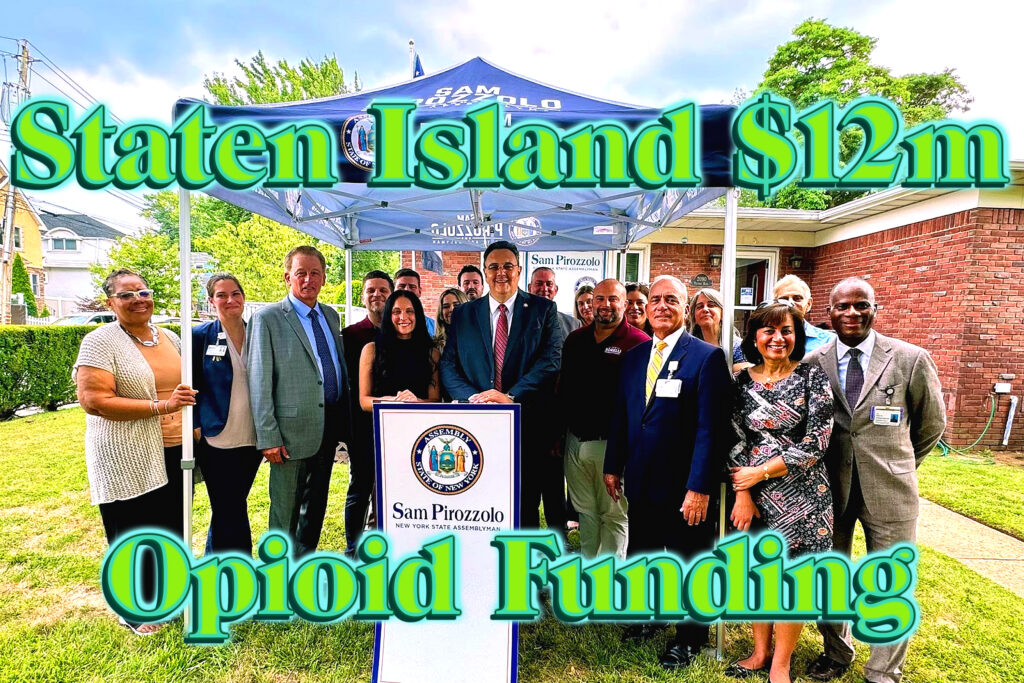
Last week, Asm. Pirozzolo and his local political colleagues held a press conference during which they were pleased to announce that 8 Staten Island providers would be awarded funds from the opioid settlement fought for by NY’s Attorney General. This settlement was part of the lawsuit against Purdue Pharma over deceptive marketing practices and encouraging the over-prescribing of opioid medications.

The deceptive marketing practices are related to the fact that it was known by the company executives that OxyContin (generically oxycodone) were just as addictive, if not more so, than other forms of opioid medications and even than heroin. When this was first coming to light, the solution put forward and passed was a political one: they made it incredibly difficult for patients to obtain the medicines, whether it was for legitimate or illegitimate uses. This led to a glut of people who were addicted to the drugs needing to find a new source of the drugs, which naturally became street heroin.
There are legitimate uses for these medicines, including after a surgery or procedure, as well as for those suffering from chronic pain (which does exist).
One thing people who have never taken these drugs fail to understand is that the addiction they cause is a PHYSICAL addiction. What does that mean? It means that there are certain receptors in the human body that are designed for opioids to complete. In most people who haven’t taken these drugs, the body produces natural opioids to fill the receptors. This causes natural pain relief in a general sense.
From an NIH study on these receptors and the benefit of opioids for multiple sclerosis, “Endogenous opioids are a class of molecules that are produced in the brain and circulate widely throughout all organ systems. Endogenous opioids are neuropeptides and are derived from one of the two precursor genes—pre-proenkephalin A or pro-opiomelanocortin (POMC).”
However, the reason why addiction to heroin is considered a valid medical condition, outside of a person’s control, is because once an opioid is used on a regular basis (even just twice can cause it), their body loses the ability to make the natural opioids. Thus they become physically reliant and dependent on the drug, and they literally become sick (known as dopesick) when they don’t have the drug.
They get uncontrollable shaking, sweating, feverish, and many other physical symptoms that only subside upon consumption of the drug. This is why when the prescription availability is removed, they have a physical need to replace it with street heroin (or whatever form they can find). From a treatment center’s website, the following are the symptoms of withdrawal experienced with opioid addiction and subsequent attempts to break the addiction (dopesickness): “Insomnia, Vomiting, Nausea, Chills, Body aches, Diarrhea, and Night sweats”
From a paper on the neurobiology of addiction: “It is now firmly established, on the basis of countless studies in animals and humans, that drug addiction is a chronic neurobiological disease produced by repeated exposure to an addictive drug and characterized by loss of control over drug use. Neuronal pathways that form the so-called ‘‘reward circuits’’ play a central role in compulsive drug taking and addiction and are found within mesocorticolimbic dopamine systems originating in the ventral tegmental area and projecting to the nucleus accumbens, amygdala, and prefrontal cortex (Fig. 1). All addictive drugs act on this system, through different mechanisms, and activation causes euphoria and reinforcement of drug-seeking behaviors. Opioids induce dopamine release indirectly by decreasing GABA-inhibition via l-opioid receptors in the ventral tegmental area (Johnson and North, 1992; Bonci and Williams, 1997; Cami and Farre, 2003), as well as directly by interacting with opioid receptors in the nucleus accumbens (Nestler, 1996; Hyman and Malenka, 2001).”
The big issue with street heroin, as many islanders know, is that it is often laced with fentanyl in order to make it stronger and longer lasting (thus increasing drug dealer’s profits). But it also increases the risk of overdose by far. Whereas, when they were taking the pharmaceuticals, this particular risk was very low. They were regulated pills with a certain dose and no additives like fentanyl. Even heroin alone does not cause overdoses in the volume that is seen when fentanyl is added to the heroin (or even replaces it entirely).
When the politicians were discussing this remedy many years ago when this addiction problem came to light, they mentioned that it would probably spawn an overdose crisis, but they changed the laws and created the crisis anyway.
Now here we are, and Staten Island is bearing the brunt of the crisis with more overdose deaths than the other boroughs. At the same time, the island was not slated to get any of the opioid settlement money from the mayor’s office simply because we don’t have a NYC Health + Hospitals hospital on the island (Bailey-Seton having been removed on the island decades ago). We’ve reported on this very issue of the lack of a public hospital on Staten Island about 5 years ago .
When Asm. Pirozzolo heard this, he was outraged, and rightly so. His constituents were suffering, and here was a possible solution about to totally pass us by.
So, as stated in the announcement video, Asm. Pirozzolo, Senator Scarcella-Spanton, and BP Fossella were able to turn this situation around. Staten Island’s opioid treatment centers, the eight awardees, will each receive 350K over the course of the next four years to keep their programs running, and to help Islanders dealing with this dreadful physical addiction or disease of heroin addiction. Finally, Staten Island will get at least some semblance of its fair share, thanks to our local politicians working hard for their constituents.
Banner Image: Video cover. Image Credit – Staten Islander News

