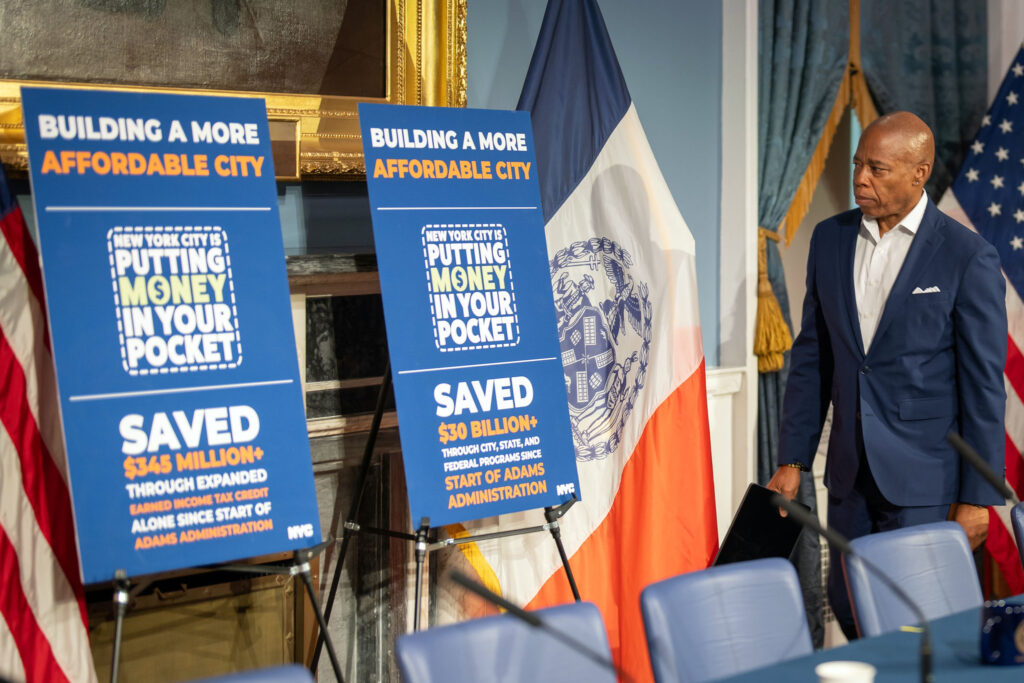
Editor’s note: Staten Islander recently reported on the approval of the FY 2025 City Budget that prioritizes affordability for more New Yorkers. Senator Gillibrand recently introduced legislation to invest $5 Billion annually in affordable housing for New York residents. Mayor Adams also recently announced the approval of a plan to create 7,000 new homes and 10,000 permanent jobs in the Bronx, while NY residents claimed $345M in EITC benefit payments.
Media availability questions regarding police scanner encryption; obtaining new trash bins and compost bins on Staten Island, other boroughs; and cell phone bans in schools:
Question: I want to ask about the NYPD police scanners. And I’ve heard your rationale, NYPD leaders, it’s a rational reason, logical. I get it. No doubt. But I think what community groups and journalists are asking for is maybe a little delay so communities who care about what happens in their neighborhoods, they’re not in the dark. Journalists can do their job. And to talk about what the job means, think about Amadou Diallo, Eric Garner, two stories the world knows their names because reporters had access to radios and could go report that. Why can’t they just get a little buffer so the police can stay safe and journalists and community groups can do what they got to do?
Mayor Adams: I still didn’t understand. You said the radios allow…
Question: Journalists listening to police radios knew to get to Staten Island, and report, and that reporter for the Daily News, that photographer was able to get the video of Eric Garner and his interaction with the police. And the world knows his name because of that.
So all we’re asking for, and I want to know why, what you think about that, what journalists are asking for, is to just get a little buffer so the police can have their communication secure and reporters and community groups also know what’s going on in their neighborhoods.
Mayor Adams: Yeah, and I think that was very thorough that you laid out those two cases. I think also the thoroughness should be in that there are municipalities all over this country that are doing this because they understand that at the top of this is public safety. I don’t think I’ve made any form of not articulating. That’s my top priority.
Being safe, to me, that’s the foundation of everything. And I view everything through that prism. After people being safe, I build on that. And when I speak to the commissioner and others, they say, listen, this is a public safety issue. Now we’re looking at other options. We’re not going to close the door and be so stubborn. But people have to come to me with something that’s not going to jeopardize the lives of police officers, responding officers, and responding to calls of service.
Deputy Mayor Levy: And Dan, I would just add Commissioner Weiner is here. Actually, the NYPD has caught people using this for criminality. So yeah, Weiner can speak to that.
Deputy Commissioner Weiner: So I think the bad guys using police as part of the equation, it’s not the whole story. But our commissioner, our chief of information technology have been very thoughtful in how they are rolling out encryption gradually. And one thing to keep clear is that the citywide stations are going to remain unencrypted. So a lot of the major jobs, the ones you’re talking about, are going to be unaffected by this rollout to encrypted channels.
And part of this is a very necessary upgrade to actually our technical infrastructure and interoperability with partners. So the mayor just mentioned, we’re not alone. We’re not even first to the table on this front at all. If we look at our neighboring partner agencies, many of them are already encrypted or going in that direction. So this is the wave of the future.
And just to give you a couple of examples, so apparently there were 60 incidents for radio interloping in 2023 and 2024, 180 arrests in the past five years of perps who had radios on them. One major pattern last year, an armed citywide robbery pattern that was mitigated after the migration to encryption.
So there’s certainly a public safety dividend, but also the transparency that is currently provided by having some encrypted and some open. And that’s a balance that I know our department and obviously City Hall are working very carefully through.
Question: I don’t doubt the interlopers. And I know those have been examples. My question is though, do you think the buffer or a delay would infringe on that safety issue on a precinct level?
Deputy Commissioner Weiner: And I think, well, I’m not the expert in our department on this issue, but I think we have to look very closely at industry standard among our partners and how they’re doing this rollout and mindful that there are so many ways that we all are getting our information.
The radio is among them. And this is not an all or nothing situation. People are very able to get information in real time through other means. And this allows our officers to be protected and to be doing the law enforcement mission that they really need to be doing.
Question: Mr. Mayor, we’ve heard from several older readers that they’re having issues ordering the newer trash bins, including the compost bin that was made free for people in Staten Island and in the Bronx. What other options do you want less tech-savvy New Yorkers to know about? And the importance of them being involved in this program to begin with, how important is it that everyone is involved in these new trash bins?
Mayor Adams: So just talk to me about…
Deputy Mayor Joshi: Yeah, first of all, just to be clear, the new trash cans are available for order. They wouldn’t be delivered until September, but they’re not mandatory until 2026. So people can use the residential containers they have right now, or if they don’t have one and they wanna buy one on their own, there will come a point where they are mandatory. And if you look around the nation in this area, we’re behind the curve. But if you look at other cities, they do have authorized containers for residential usage. So it’s a common practice and we’re gonna be adopting it.
On the composting, please, we can follow up with you on the rollout for the free containers. We wanna make sure that those are happening. The borough presidents have them, the electeds have them, and we’re doing giveaway events all the time. So I’m happy to connect with you afterwards to make sure that your readers have all the right contact numbers and dates of the giveaway events.
Mayor Adams: But that’s a good question to ask. Is the only way they can do it is ordering online?
Deputy Mayor Joshi: There is, I believe, also a telephone number, which I’m happy to get for you as well. So I know a lot of people are much more comfortable using the phone when they’re ordering because it’s a live person, hopefully at the other end. But we’ll make sure you have that information as well.
Mayor Adams: Yeah, but we’re gonna look at that, because it shouldn’t be just online. And then we’re gonna speak with Commissioner Cortés-Vázquez to really disseminate the information among our senior, our older adult homes. And then we’ll even dispatch our PEU to certain locations and use iPads to order for people. So we’re gonna zero in on it. I’m glad you brought that to our attention.
Deputy Mayor Levy: I actually got the number here. So it’s 855-692-2467. So anyone can call that number and order.
Mayor Adams: Yeah, great, great, great. But the bottom line is, we gotta get rid of Mickey, these darn rats. So containerizing the garbage is the best way. I think in Harlem, we saw like a 70-something percent decrease in rodent complaints. This is a huge win for the city putting garbage in containers.
Question: Hey, how are you doing?
Mayor Adams: Good.
Question: I have an education, another education question for you. So, you know, we’ve seen a lot of districts and states across the country moving towards these system-wide school cell phone bans. Recently, L.A. did it. We heard, you know, Chancellor Banks has been talking a lot about this, said at the end of the school year that there would be an announcement in a couple weeks.
We’re a week out from school. You know, a lot of schools really want to know, a lot of parents really want to know what’s going on. So, wondering if you could, you know, number one, give an update on that. And number two, could you talk about what you see as the pros and cons of a city-wide school cell phone ban?
Mayor Adams: Oh, great question. And New York is different from L.A. We’re a unique animal, trust me. And if you don’t do it right, you won’t get it right. And the previous administration attempted to do this, and they had to roll back. And the chancellor has been extremely thorough. Hats off to him. Our desire is that we should not have any distractions in our schools. And the number one distraction, not only to students, but even as I look around the room, some of you are deep in your phones. We are hooked on our phones. And we want to get it right.
We want to remove any distraction from our children. Right now, there are some schools that already have bans. But once you use the conversation or the terminology that it is a full ban coming from the chancellor, there’s a lot of things that will kick into play, including UFTs, who pays for the pouches, what mechanisms are being used. So we’ve been doing a lot of reviews. What are the best practices? How could it be done? There will be some action in the upcoming school year. But the extent of a full ban, we’re not there yet.
We want to make sure we have parents on board. When you talk about the hurdles, a lot of parents are concerned about not being able to be in contact with their children, especially after 9-11. They know it’s a distraction. We want to get there with everyone together. A lot of the educators are fully on board with some type of ban. So we say, this is New York City. Trust me, once you do a decision one way or another, you’re going to have those who are in favor and those who are opposed, and we just got to get it right. So I don’t want to go backwards after we make the determination.
Question: Yes, to follow up on that, Mr. Mayor. Yes. So would you have this done on a school-by-school basis where parents are involved in the schools? Or would this be a system-wide situation where there’s limitations on phones? What are you looking at regarding that? And my second question, did you get a chance to listen to Randy Mastro’s testimony in the Q&A? And how did you help him prepare for this today?
Mayor Adams: Speaking with the cell phones, I got to take my hat off to the chancellor. He has really been sensitive about speaking with teachers, parents, students. And what we find is that the overwhelming number of people would like to get the distractions out of school.
How to do it is another question. Do you take the phones? Do you lock them up? Do you put them in pouches? What happens if a phone is missing? What happens if a child refuses to cooperate? All of this stuff, you have to really work it out. And we’re learning from those who are already doing it. They have been very helpful. There has been a real examination on getting it right. And we’re learning from those who are doing it. Because we do have schools in the city that are doing it on their own. And so we want to make sure we get it right. And so we’re going to review the policy. We want to get it right. And we’re going to learn from people like L.A. and other places.
But chief counsel was part of the prep. Randy didn’t need a lot of prep. Randy is a great attorney. And I don’t know how people can say he’s not. Randy’s a great attorney. He has represented the city well. He’s a great New Yorker. And I’m just pleased when you see folks like Governor Paterson and others who are coming out talking about his record. He’s a great New Yorker, a great attorney. And I think we would all be proud to have him represent the City of New York. But that determination goes through the council. They have the right to vote on and confirm him. Did I miss anything, Lisa?
Lisa Zornberg, Chief Counsel to the Mayor and City Hall: I would just add that it’s… I don’t know that there’s ever been a candidate to appear in front of the City Council who’s had as much vocal support from every direction as Randy Mastro has.
There’s every single editorial board that I’m aware of that has opined in his favor. There are witnesses who I believe have interrupted their vacations who are waiting to testify before the City Council today across administrations, from the de Blasio administration, the Bloomberg administration, going back and back. It’s quite remarkable. I think the city would be very lucky to have someone who’s given so much to the city already return full-time in the passionate way he is about representing New York City’s interests.
MAYOR ADAMS LAUNCHES “MONEY IN YOUR POCKET” INITIATIVE ACROSS MORE THAN 20 NEIGHBORHOODS TO HELP DELIVER BENEFITS DIRECTLY TO NEW YORKERS, MAKE NEW YORK CITY MORE AFFORDABLE
Adams Administration Will Surge Underserved Neighborhoods with Hundreds of City Employees to Screen for Benefits On-the-Spot, Help New Yorkers Save Money on Food, Rent, Taxes, and Other Needs
Adams Administration Has Helped New Yorkers Save More Than $30 Billion Through Access to Programs and Benefits
NEW YORK – New York City Mayor Eric Adams today launched a citywide “Money in Your Pockets” initiative to help New Yorkers screen for or learn about more than 70 city, state, and federal programs that can make life in New York City more affordable. The New York City Public Engagement Unit (PEU) trained hundreds of staff from across city government and The City University of New York students, who will begin to visit more than 20 underserved neighborhoods and New York City Housing Authority (NYCHA) buildings, starting today and continuing on a weekly basis, to help thousands of New Yorkers find out which benefits they may be eligible to receive.
To help New Yorkers easily view and understand programs they may be eligible for, Mayor Adams today also released a “Money in Your Pocket Guide,” which directly links to eligibility requirements and relevant applications for over 40 of the benefits. Since taking office, the Adams administration has helped New Yorkers save more than $30 billion through launching, administering, and helping New Yorkers take advantage of programs across all levels of government from Big Apple Connect to Fair Fares to the Earned Income Tax Credit (EITC) and more.
“I was raised by a single mother who had to work several jobs to make sure my siblings and I had a roof over our heads and food on the table. The hustle was real. Unfortunately, many New Yorkers are still doing the same today, and far too many New Yorkers continue to feel that the deck is stacked against them. But our administration won’t allow that to be the case — we are looking out for New Yorkers and working to make this city more affordable,” said Mayor Adams. “Today, we are launching our ‘Money in Your Pockets’ initiative to help New Yorkers find out which benefits they are eligible for and build on the billions of dollars we have helped put into the pockets of hard-working families. We are building a city that expands opportunity and prosperity to every neighborhood and community because New Yorkers deserve their fair share, and we’re going to deliver that to them.”
“By connecting New Yorkers directly to critical resources and support, we’re taking another major step toward making our city more livable for everyone,” said Chief of Staff Camille Joseph Varlack. “We want every New Yorker to have access to the benefits that can make life more affordable and equitable, and that is why our dedicated team will be meeting people where they are to ensure that no one is left behind. Together, we’re not just creating opportunities — we’re building a more inclusive city where every resident can thrive.”
“Government is at its best when it’s working in the best interest of the people we are elected or appointed to serve,” said Chief Advisor Ingrid P. Lewis-Martin. “The ‘Money in Your Pocket’ initiative does exactly that by helping to ensure that New Yorkers receive every single benefit and service for which they are entitled and deserve. Additionally, it enables the Adams administration to build a more affordable and equitable New York City. I am proud of our strives to put New Yorkers first.”
“Since the start of the Adams administration, we have been squarely focused on ensuring that hard-working New Yorkers receive all available benefits, and that every eligible dollar goes back into their pockets,” said First Deputy Mayor Sheena Wright. “After successfully increasing the EITC in our first year in office and boosting enrollment of thousands more children in child care services, today’s announcement underscores our ongoing, citywide commitment to working to enroll every New Yorker in every eligible benefit, fulfilling our promise to support working-class New Yorkers, and ensuring that everyone, across our communities, can thrive.”
“Today, we’re knocking on doors, talking with fellow New Yorkers on the block, and focusing in on key neighborhoods with one goal: helping more people eligible for services receive those benefits,” said Deputy Mayor for Health and Human Services Anne Williams-Isom. “Whether it is food assistance, child care, or housing support, among others, we want to help you navigate how you may be able to access these critical services. Take a moment today and interact with city staff to see if you or your family could benefit.”
“The ‘Money in Your Pocket’ initiative is just another example of the concrete actions the Adams administration is taking to help working families keep costs down and increase their bottom line,” said Deputy Mayor for Strategic Initiatives Ana J. Almanzar. “Whether it’s facilitating access to benefits and tax credits, enrolling their kids in free child care and afterschool programs, or connecting families with low-cost health care, we are taking proactive measures to ensure families have access and opportunity to tap into every resource available to them.”
“This administration has made it a major priority to put money back in New Yorkers’ pockets, and proactive public outreach to help New Yorkers find benefits is key to that work,” said Deputy Mayor for Housing, Economic Development, and Workforce Maria Torres-Springer. “This cross-government, on-the-ground action is how we improve the lives of working-class people and improve affordability in New York City.”
“Too often, New Yorkers don’t access benefits because they don’t know they’re available to them or they think they’re too difficult to access,” said PEU Executive Director Adrienne Lever. “We are thrilled to lead this citywide effort to proactively engage New Yorkers and help connect them to benefits that can help put money back in their pockets.”
“New Yorkers have access to a comprehensive array of federal, state, and city public benefits that can assist them with everything from remaining in their homes, to buying food and other essentials, to managing transportation costs, and much more,” said New York City Human Resources Administration Administrator Scott French. “And while we have made great strides in making it easier to access our benefits online, we want to ensure all New Yorkers who could benefit from these programs are aware of them, which is why direct, community-centered outreach events like this initiative are critical to our efforts to support low-income communities, make the city more affordable, and help New Yorkers keep more of their hard-earned money in their pockets.”
“Our benefits access efforts have helped millions of residents connect with and learn about city, state, and federal public programs,” said Mayor’s Office for Economic Opportunity Executive Director Carson Hicks. “This initiative is important because, through a combination of digital tools and dedicated on-the-ground staff, it helps New Yorkers in every part of the city to identify and apply for the assistance they qualify for in an easy and seamless way.”
“Affordability is a top priority for many New Yorkers, including the one in 17 who call NYCHA home,” said NYCHA Chief Executive Officer Lisa Bova-Hiatt. “We commend the Adams administration on launching the ‘Money in Your Pocket’ initiative to help New Yorkers find and access the programs and resources available to them, thereby making our great city more equitable and livable.”
Millions of New Yorkers have access to a range of programs and financial benefits through the city, but many who are eligible have yet to apply. Programs like Fair Fares — which offers a 50 percent discount on transit — and Freeze Your Rent — which prevents rent increases for eligible older adults and those with disabilities — can make living in the five boroughs more affordable for New Yorkers. Despite the availability of these programs and constant outreach from the administration, many New Yorkers still remain unaware of them, leaving many programs undersubscribed.
Since taking office, the Adams administration has launched, administered, and advocated for a broad range of benefits that have saved New Yorkers more than $30 billion dollars. Highlights of these savings include:
- Big Apple Connect: Free high-speed internet and basic TV for public housing residents – $153 million.
- Child Care Vouchers: Vouchers for affordable child care – $1.9 billion.
- Direct Property Tax Relief: A range of tax abatements for seniors, disabled homeowners, and other New Yorkers – $1 billion.
- EITC: Returns tax dollars to qualifying families and individuals – $345 million.
- Groceries to Go: Monthly credits to purchase Supplemental Nutrition Assistance Program eligible groceries for delivery or pickup – $8 million.
- NYC Financial Empowerment Centers: Free one-on-one professional financial counseling and coaching to help increase savings, reduce debts, and support New Yorkers’ financial goals – $26 million.
- Year-round free tax prep services for individuals, families, and self-employed New Yorkers – $220 million.
- Medical Debt Relief: The elimination of medical debt for 500,000 New Yorkers – $1.8 billion.
- Summer Rising: Free summer programming, including free meals, transportation, and medical and social services support for K-8 students – $1.9 billion.
- Transportation for Older New Yorkers: Free transportation to help older New Yorkers get to critical medical appointments, social service appointments, and more – $1.5 million.
“We are going directly to New Yorkers across all 5 boroughs to help them access benefits. Our ‘Money in Your Pocket’ Tour provides unprecedented engagement with our fellow New Yorkers to help them enroll in key benefits programs like Big Apple Connect and Fair Fares,” said New York State Assemblymember Jenifer Rajkumar. “In Albany, I was proud to champion the Earned Income Tax Credit, and we are deploying trained staff to 30 underserved communities to inform people of the money EITC can save them. This will allow more New Yorkers to put food on the table, keep a roof over their heads, and provide for their families. I am now working with my Albany colleagues to pass the One City Act which will expedite benefits access by allowing agencies to share data and streamline applications. Together, we will reach every New Yorker and provide them the support they deserve.”
“I fully support Mayor Adams “Money In Your Pocket Tour” as it brings essential benefits directly to our hardworking New Yorkers,” said New York State Assemblymember Eddie Gibbs. “This initiative is a crucial step toward ensuring that everyone in our city has access to the resources they need to thrive. By making these benefits more accessible, we are not only empowering our residents but also strengthening the economic fabric of our communities.”
MAYOR ADAMS ANNOUNCES CITY HALL, OTHER CITY BUILDINGS TO BE LIT YELLOW [August 23rd] IN HONOR OF INTERNATIONAL DAY FOR THE REMEMBRANCE OF THE SLAVE TRADE AND ITS ABOLITION
NEW YORK – New York City Mayor Eric Adams announced that City Hall and other municipal buildings will be lit up yellow [August 23rd] in honor of International Day for the Remembrance of the Slave Trade and its Abolition.
“Today, we reflect on the inhumanity of slavery, remember those in Haiti who fought in the name of the justice to abolish it, and recommit ourselves to the shared principles of liberty, dignity, and equality for all,” said Mayor Adams. “Now, more than ever, to build a better future, we must reconcile with our troubled past. Let us all work together to remember our collective history and use it as a lesson to turn a painful moment into a purposeful one.”
Designated by the United Nations Educational, Scientific and Cultural Organization (UNESCO) in 1998, International Day for the Remembrance of the Slave Trade and its Abolition commemorates the start of a 1791 uprising among the enslaved people of Haiti that would culminate in both the Haitian Revolution and the abolition of the slave trade. Mayor Adams acknowledges both the harrowing tragedy of the transatlantic slave trade as well as the vital role the uprising played in ending it.
In addition to City Hall, the following city buildings will be lit up yellow starting tonight at sundown:
- Bronx Borough Hall: 851 Grand Concourse, Bronx, NY 10451
- Brooklyn Borough Hall: 209 Joralemon Street, Brooklyn, NY 11201
- The David N. Dinkins Manhattan Municipal Building: 1 Centre Street, New York, NY 10007
- Gracie Mansion: East 88th Street & East End Avenue, New York, NY 10028
- Queens Borough Hall: 120-55 Queens Boulevard, Kew Gardens, NY 11424
- Staten Island Borough Hall: 10 Richmond Terrace, Staten Island, NY 10301
Banner Image: Mayor Eric Adams and senior administration officials hold an in-person media availability. City Hall. Tuesday, August 27, 2024. Image Credit: Ed Reed/Mayoral Photography Office.