

NYC DOT Updates: Washington Bridge Safety Project, Broadway Redesign Completed With New Plaza, Two-Way Bike Connections
Editor’s note: Staten Islander previously covered new rules for outdoor e-bike charging stations, along with a bicycle distribution event for underserved communities.
NYC DOT COMPLETES MAJOR SAFETY PROJECT ON WASHINGTON BRIDGE, DELIVERING SAFE CYCLING CONNECTION AND FASTER BUS COMMUTES BETWEEN MANHATTAN AND THE BRONX
Transformative Project Improves Crossings for Pedestrians and Adds Half a Mile of Bus and One Mile of Bike Lanes on a Critical Route Connecting Manhattan and the Bronx
With 68,000 Daily Bus Riders and Nearly 900 Daily Cyclists, Washington Bridge Is One of New York City’s Busiest Bike and Bus Routes.

NYC DOT redesign of Washington Bridge
NEW YORK – New York City Department of Transportation (NYC DOT) Commissioner Ydanis Rodriguez celebrated the completion of a major redesign of the Washington Bridge roadway to support safe, sustainable, and efficient transportation options between the Bronx and Manhattan. The completed project spans from Amsterdam Avenue in Manhattan to University Avenue in the Bronx. The project includes a redesign of the intersection leading up to the bridge approach, a new bus lane, and a two-way barrier-protected bike lane. The project will also deliver faster, more reliable bus service for 68,000 daily riders along the corridor.
“This transformative redesign of the Washington Bridge will protect pedestrians and cyclists, speed up bus service, and make the street safer for everyone,” said NYC DOT Commissioner Ydanis Rodriguez. “We are committed to ensuring that all New Yorkers benefit from our life-saving work, and this great project will make commutes quicker and safer for residents in working class communities in the Bronx and Northern Manhattan.”
“Dedicated bus lanes will bring faster and more reliable service for the thousands of Upper Manhattan and Bronx residents using this key thoroughfare every day,” said NYC Transit Senior Vice President of Buses Frank Annicaro. “We will continue to work with our partners at NYC DOT to expand bus priority and improve bus service across the city.”
Bus Upgrades
The half-mile bus lane expansion along the Washington Bridge serves five bus routes and connects to NYC DOT’s 181st Street busway in Manhattan and the Edward L. Grant Highway and University Avenue bus lanes in the Bronx. The redesign builds on the success of the busway, installed in 2021, which has sped up bus service at all times of the day—including as much as 30 percent for Manhattan-bound traffic during morning and evening rush hours.
NYC DOT added an automated-camera-enforced bus lane to the Bronx-bound side of the span, which will help make commutes even faster and more reliable, while still maintaining two travel lanes for vehicles heading to the Bronx.
Pedestrian and Cycling Upgrades
The addition of dedicated, safe cycling space improves conditions for both cyclists and pedestrians, which previously shared a narrow bridge pathway. NYC DOT added two-way barrier-protected paths in Manhattan to create safe cycling access to the bridge. Riders can connect to the bridge via a new two-way barrier-protected path at Amsterdam Avenue and West 182nd Street, as well as a new two-way barrier-protected path on Laurel Hill Terrace, between McNally Plaza and Amsterdam Avenue. The agency will also deliver upgrades to Amsterdam Avenue and West 181st Street to improve safety near the span. These upgrades include a Leading Pedestrian Interval (LPI) to give pedestrians crossing the street a head start, a signal phase for turning vehicles, as well as new and better organized turn lanes. These are expected to be implemented by the end of the year.
On the Bronx side, the agency added a two-way barrier-protected bike lane to one of the entrance ramp lanes from University Avenue to create seamless safe cycling access and separate pedestrian and cycling traffic. The project also connects to protected bicycle lanes on University Avenue and Edward L. Grant Highway. This critical link in the bike network connects northern Manhattan to the protected lanes on Edward L. Grant and University Aves and creates a safe, well-lighted, 24-hour connection that complements the High Bridge. NYC DOT will continue its work to build connections to the George Washington Bridge and integrate this link into the Harlem River Greenway.
“The Washington Bridge redesign is a huge improvement for bus riders, cyclists, and pedestrians moving between Washington Heights and the West Bronx. In 2022, I called for a reimagining of the bridge, and I’m thrilled that shorter bus commute times and a safer streetscape are now a reality,” said Manhattan Borough President Mark Levine. “Thank you to Commissioner Rodriguez and the DOT team for prioritizing a better bridge experience.”
“The transformation of the Washington Bridge stands as a significant stride in unifying our neighborhoods and elevating the quality of our transit from the Bronx to Manhattan, said State Senator Robert Jackson. “With the NYC DOT at the helm, their foresight and dedication are ushering in a new era of transit for countless New Yorkers, especially those I represent in District 31. We’re looking forward to expedited bus services, enhanced bike safety, and a greener, more sustainable future.”
“We celebrate the completion of pedestrian and cyclist safety improvements along the Washington Bridge that also prioritize the use public transportation along one of our busiest traffic corridors,” said Councilmember Carmen De La Rosa. “Earlier this year, cyclists lost their lives on this bridge, underlying the immense need for safety upgrades like protected bike lanes. We have conducted walkthroughs with our transportation chair and transportation commissioner on several occasions and will continue to hone in on these unsafe corridors to explore additional solutions and education that allow pedestrians, cyclists, and commuters alike to share our streets with confidence.”
“The transformation of the Washington Bridge is an outstanding success story for bus riders, bicyclists, and pedestrians in the Bronx and northern Manhattan, said Betsy Plum, executive director of The Riders Alliance. “This project should serve as a model for other bridges and streets across the city, particularly in areas where transit and safety infrastructure hasn’t always been a top priority. Riders are so grateful to the grassroots advocates at Transportation Alternatives, the dedicated New York City Department of Transportation team, and Commissioner Ydanis Rodriguez for making it happen.”
“This multifaceted project will make life easier and safer for so many New Yorkers,” said Sara Lind, co-executive director at Open Plans. “By prioritizing space for bus service and safe cycling, DOT has transformed the Washington Bridge into a modern thoroughfare. This is exactly the type of project that not only keeps pedestrians and cyclists safe, but encourages more New Yorkers to use active and public transit to get where they’re going, which reduces congestion and pollution and makes for a more livable city overall.”
“Regional Plan Association (RPA) joins NYC DOT in celebrating the redesign of the Washington Bridge roadway,” said Tiffany-Ann Taylor, VP of transportation at RPA. “Prioritizing upgrades for pedestrians, cyclists, and bus riders is key to promoting safe, sustainable, and efficient transportation options in NYC. We applaud NYC DOT for implementing important upgrades to infrastructure outside of the central business district, continuing to prioritize access for vulnerable road users, and increasing bus speeds.”
“We’re thrilled that the redesign of Washington Bridge is now complete,” said Eric McClure, executive director of StreetsPAC. The bridge’s new bus lane will improve commutes for tens of thousands of commuters every day, and its protected bike lanes and upgraded approaches and pedestrian space are certain to become heavily used connections between the Bronx and Manhattan. We’re grateful to NYC DOT for bringing this important project to fruition.”
“I Challenge Myself, a nonprofit that uses cycling to empower youth, commends the commissioner on creating a safer cycling path for both Bronx and Manhattan residents. We passionately believe that cycling creates opportunities for transportation and exploration that might not otherwise exist,” said Quentin Ball, executive director of I Challenge Myself.
“Completing this bold redesign of the Washington Bridge roadway significantly strengthens the connection between the Bronx and Manhattan with safer bicycling and walking and faster bus service,” said Ken Podziba, CEO of Bike New York. “We’re thankful to Commissioner Rodriguez and the Department of Transportation for prioritizing the need for better bridge access for all, which improves New Yorkers’ quality of life, public safety, and environmental health.”
“New Yorkers need streets – and bridges – for people, and we’re glad to join DOT to cut the ribbon on the Washington Bridge redesign, delivering faster bus service for 68,000 daily riders and a new protected bike lane between the Bronx and Manhattan,” said Jada Yeboah, Bronx/Uptown organizer for Transportation Alternatives. “Not only does this project give New Yorkers new sustainable and reliable ways to get around, it will also make our streets safer for everyone using it. After years of organizing with our activists and community members, we’re thrilled that a new connection between boroughs is now open.”
BROADWAY VISION: NYC DOT COMPLETES LATEST PHASE OF BROADWAY REDESIGN WITH NEW PLAZA, TWO-WAY BIKE CONNECTIONS ABOVE UNION SQUARE
Transformational Redesign of Broadway, From East 17th Street to East 21st Street, Dramatically Improves Safety and Experience for Pedestrians and Cyclists With New Plaza, Public Seating, Shared Streets, and Two-Way Bike Connections
City To Begin Public Engagement Later This Year on Next Phase of Broadway Upgrades
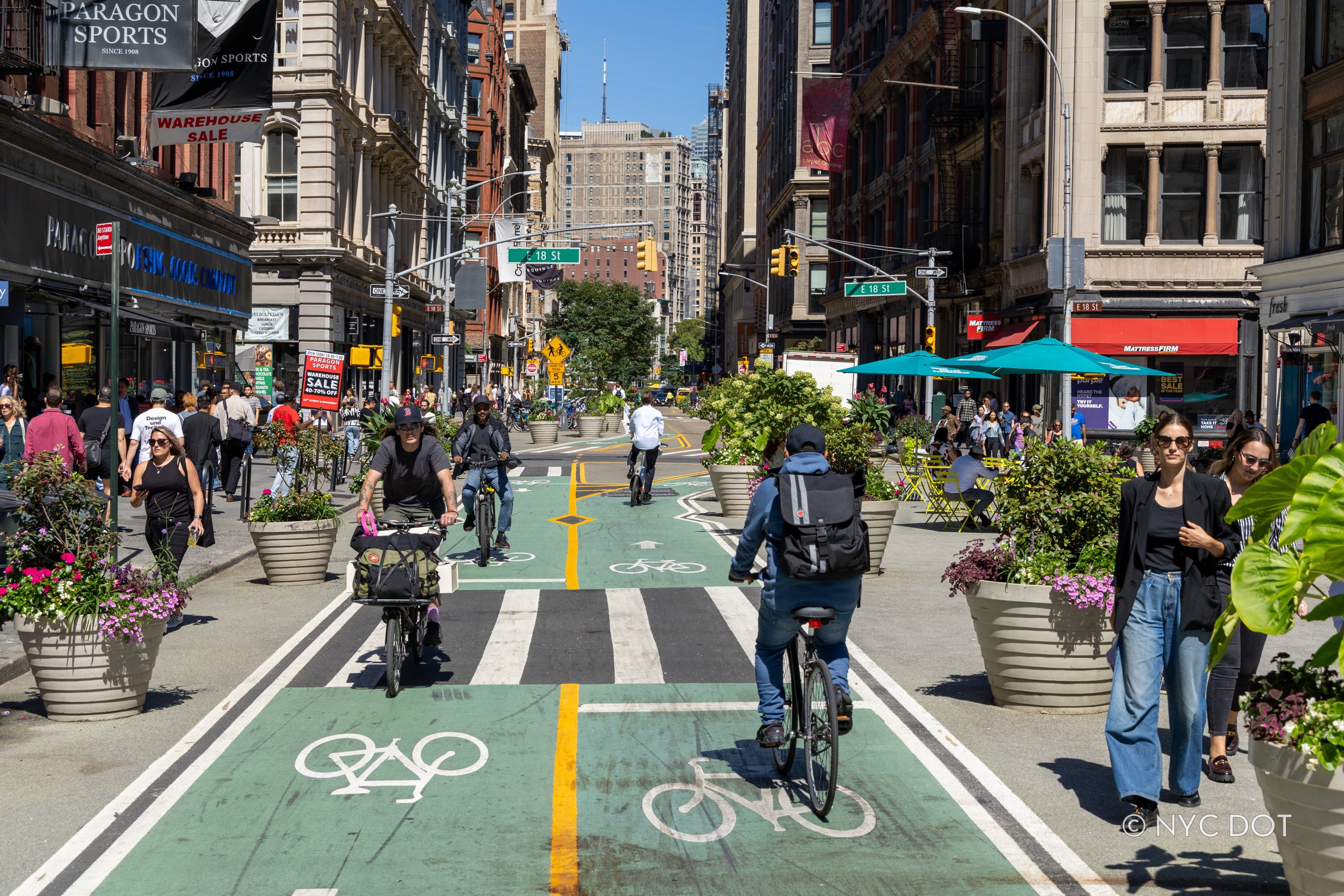
Cyclists and pedestrians travel along the newly redesigned plaza block on Broadway, from East 17th Street to East 18th Street. Credit: NYC DOT
NEW YORK – New York City Department of Transportation (NYC DOT) Commissioner Ydanis Rodriguez announced the completion of the latest phase of the city’s transformative redesign of Broadway, known as Broadway Vision. The phase included the installation of a new plaza with public seating, two-way bike connections, and Shared Streets, which naturally slow traffic and increase pedestrian space, between East 17th Street and East 21st Street. These new spaces will be maintained by NYC DOT’s partners, the Union Square Partnership and the Flatiron NoMad Partnership. The transformative redesign will dramatically improve safety and the experience for pedestrians and cyclists.
“Through Broadway Vision, we are transforming streets that were once choked with vehicle traffic into calm, welcoming places for New Yorkers and visitors to relax, dine out, shop, and meet one another,” said NYC DOT Commissioner Ydanis Rodriguez. “This latest phase dramatically expands pedestrian space just north of Union Square, with public seating, improved pedestrian crossings, and two-way bike connections. These changes make our streets safer, support businesses, and bring New Yorkers together.”
The dramatic improvements are the latest in the city’s nationally acclaimed transformation of Broadway as a pedestrian- and cycling-first corridor from, Union Square to Columbus Circle, with safe and vibrant public spaces. The stretch of Broadway between East 17th to East 21st streets now includes several traffic-calming treatments and public space enhancements:
- A new Pedestrian Plaza between17th and 18th streets;
- Curb extensions and narrower turns to reduce speeding and create safer turning movements;
- Shortened crossings and wider crosswalks to enhance pedestrian safety;
- Two-way bike boulevard treatments, along with related signage and signals;
- Reconfigured curb lanes to facilitate loading and pickups/drop offs; and
- Additional public space and cycling amenities, like seating, planters, and additional bike parking.
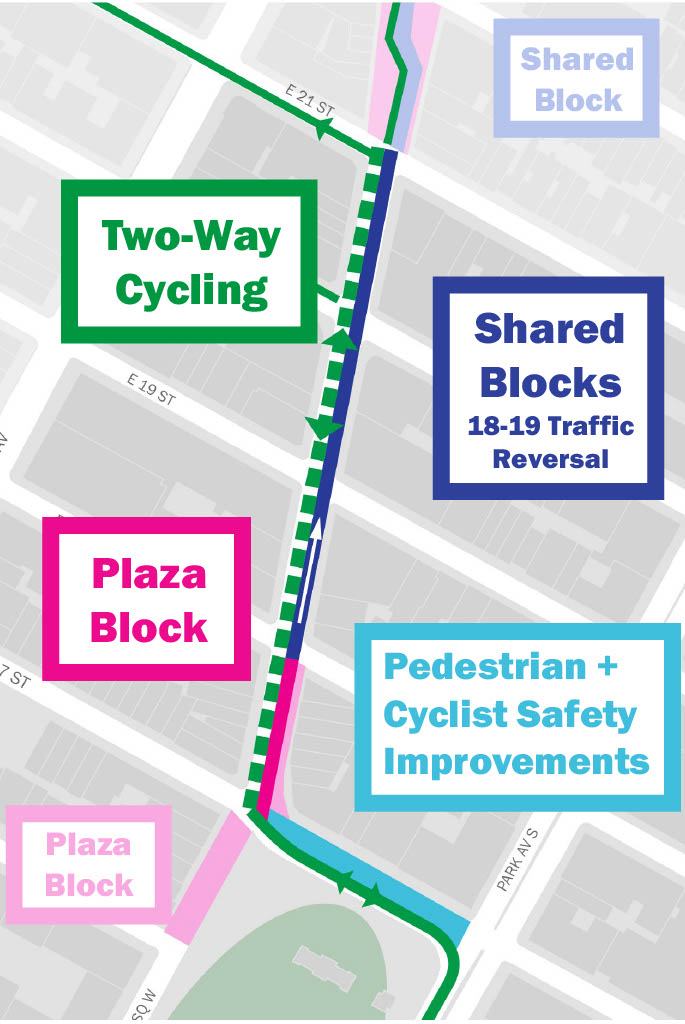
An illustration of the implemented redesign of Broadway Vision, from East 17th Street to East 21st Street. Credit: NYC DOT
The completion of this project marks 19 blocks along Broadway that have been transformed into plazas or shared/slow streets through the Broadway Vision plan — creating 17,000 new square feet of pedestrian space between Union Square and Columbus Circle, as well as 13,000 square feet of new shared space. Shared streets — also known as ‘pedestrian-priority’ streets — are roadways designed for slow travel speeds where pedestrians, cyclists, and motorists all share the right of way. Typically used on low vehicle-volume or high pedestrian-volume streets, vehicles are advised to drive five miles per hour.
NYC DOT plans to launch public engagement later this year to discuss future Broadway Vision upgrades with the public.
“The transformation of Broadway has created new world-class public space in Union Square, and the impact is already palpable. We are proud to invite folks to our new signature plaza block on Broadway between 17th and 18th Streets, one of New York City’s most picturesque destinations to shop, eat, and relax. On behalf of Union Square Partnership, I’d like to extend our heart-felt congratulations to NYC DOT for completing this phase of the project, connecting Union Square into a remarkable network of pedestrian-first spaces,” said Julie Stein, executive director, Union Square Partnership. “We look forward to advancing many more streetscape improvements and public space investments with the city, ultimately fulfilling our USQNext Vision Plan to modernize the public realm throughout our district.”
“As a leader in district management and innovation, we are thrilled to celebrate the latest pedestrian-friendly improvements of Broadway Vision,” said James Mettham, president of the Flatiron NoMad Partnership. “This extension builds on over a decade of innovation, transforming Broadway into a safer, more vibrant corridor. We are proud to be setting the gold standard for what a ‘New’ New York can be with our NYC DOT and BID partners.”
“For too long, our city has been dominated by cars, and treated pedestrians as second-class citizens,” said U.S. Representative Jerrold Nadler. “While closing Broadway to car traffic years ago was a revolutionary idea, we know it worked to enhance pedestrian and traffic safety. I applaud today’s completion of the Broadway Vision, which will bring our city another step closer to safer, calmer streets where pedestrians and bicyclists are the priority—not cars.”
“Every time a new stretch of Broadway Vision is unveiled, we’re reminded of the possibility our streets hold. Not only can our streets be successfully shared by pedestrians, cyclists, and drivers, but doing so makes the street grid safer, diversifies the way New Yorkers and visitors use this public space, and positively impacts the economy,” said Manhattan Borough President Mark Levine. “Thank you to the Department of Transportation, Union Square Partnership, and the Flatiron NoMad Partnership for working to transform Broadway into a more vibrant, multidimensional corridor.”
“The ongoing redesign of Broadway can serve as a model for the five boroughs and cities across the country to enhance safety and accessibility for all. By pedestrianizing spaces and opening our streets to people, we are supporting local businesses and making our communities stronger and more vibrant,” said Councilmember Carlina Rivera. “I commend the administration for their ongoing commitment and partnership to improve street safety and transform Broadway into a modern metropolitan corridor.”
“We love to see DOT continue to transform Broadway for the better,” said Jackson Chabot, director of advocacy and organizing at Open Plans. “What was once an unwelcoming, dangerous thoroughfare is now a destination thanks to a people-centered approach. New public seating, cycling infrastructure, traffic calming, plantings, and curb reform make it possible to utilize valuable city space much more efficiently, and serve far more New Yorkers than the old car-centric Broadway ever could. Kudos to DOT for their ongoing commitment to keeping New Yorkers safe, and to enhancing our experience of our streets; we can’t wait to see what’s next for Broadway.”
“The completion of the latest phase of the Broadway Vision project is another important step in making the transformed Broadway corridor one of the city’s most exciting public spaces. New Yorkers and out-of-town visitors alike flock to Broadway every day on foot and by bike to dine, shop, stroll, or to enjoy a low-stress segment of their bicycle commutes,” said Eric McClure executive director at StreetsPAC. “We applaud the Department of Transportation for the innovative work they’ve done along Broadway, and are grateful to the Union Square Partnership and the Flatiron NoMad Partnerships for their integral roles in maintaining and promoting this portion of the new Broadway.”
“We applaud Commissioner Rodriguez and DOT for continuing to transform this iconic street into a safer, more vibrant corridor that prioritizes people over cars,” said Ken Podziba, CEO of Bike New York. “A new public plaza, two-way bike connections, and shared streets are a major step forward that will enable New Yorkers to walk, bike, drive, and congregate much more safely and comfortably. ‘Broadway Vision’ is an excellent blueprint for reimagining public spaces and how we want the city to look in the future.”
“We’re glad to see Broadway — one of New York City’s most iconic streets — receive another upgrade with new pedestrian plazas, two-way bike boulevards, and smart street redesigns to slow down cars and discourage vehicle traffic,” said Elizabeth Adams, interim co-executive director at Transportation Alternatives. “This project makes it clear: Streets for people are an overwhelming success, and we’ll keep fighting for a car-free and people-first Broadway from Columbus Circle to Union Square.”
Banner Image: Broadway plaza block. Image Credit – NYC DOT
NYC DOT


The New York City Department of Transportation’s (NYC DOT) mission is to provide for the safe, efficient, and environmentally responsible movement of people and goods in the City of New York and to maintain and enhance the transportation infrastructure crucial to the economic vitality and quality of life of our primary customers, City residents.