



Have you ever wondered how politics influence dating habits? Cupid doesn’t have the statistics, but we do!
We surveyed 972 people to understand how politics affect their relationships and dating lives. The information we compiled, along with three infographics, can be found here: https://www.innerbody.com/political-differences-while-dating
To save you some time, here you have a preview of the most significant trends from our survey:
- Political Differences Are a Dealbreaker: 60.5% of respondents — 3 in 5 people — say they would dump their partner because of political differences.
- Few Accept Same-Sex Marriage Disagreements: Most people are willing to accept differences in views on healthcare policies, but only 20.1% think different opinions on same-sex marriage are acceptable.
- Political Leanings Influence Attitude Toward First-Date Sex: People who support current political leaders — especially former President Trump — are more likely to expect sex on the first date.
- Political Battles Brew in Most Relationships: Almost 75% of respondents have previously fought with their significant other about a political matter.
- Parties Influence Who We Date: A vast majority of Democrats are dating Democrats (86.7%), and Republicans are dating Republicans (84.4%).
Editor’s note: This study was conducted prior to the change in candidates for the Democratic party, making Kamala Harris the new Democratic candidate. In that regard, many of the survey respondents got what they wanted. We’ve previously covered another interesting study undertaken by this group. The headline for that study was NYC Falls To 36th On Top 50 List Of Highest STD Rates Nationwide – Well Behind Philadelphia, Memphis, San Francisco Across Nation
Political differences would make 3 in 5 people dump their partner. Learn how else it affects Americans’ dating habits.
Personal politics have polarized rapidly in the United States, faster than in all other democracies in the last few years. Our feelings are souring not only about the other side of the aisle but the establishment itself (with only 20% of Americans reporting trusting the government in 2022). In a survey of 972 people, we found that a staggering 6 out of 10 people regret voting for Joe Biden in 2020. This deepening gap brings tremendous changes to our daily lives and how we interact with others.
We asked people of all political affiliations about their relationships to find out whether or not these changes are stirring up the dating scene. Read on to find out if there’s a way to close the gap or if this divide is only relevant in a few situations.
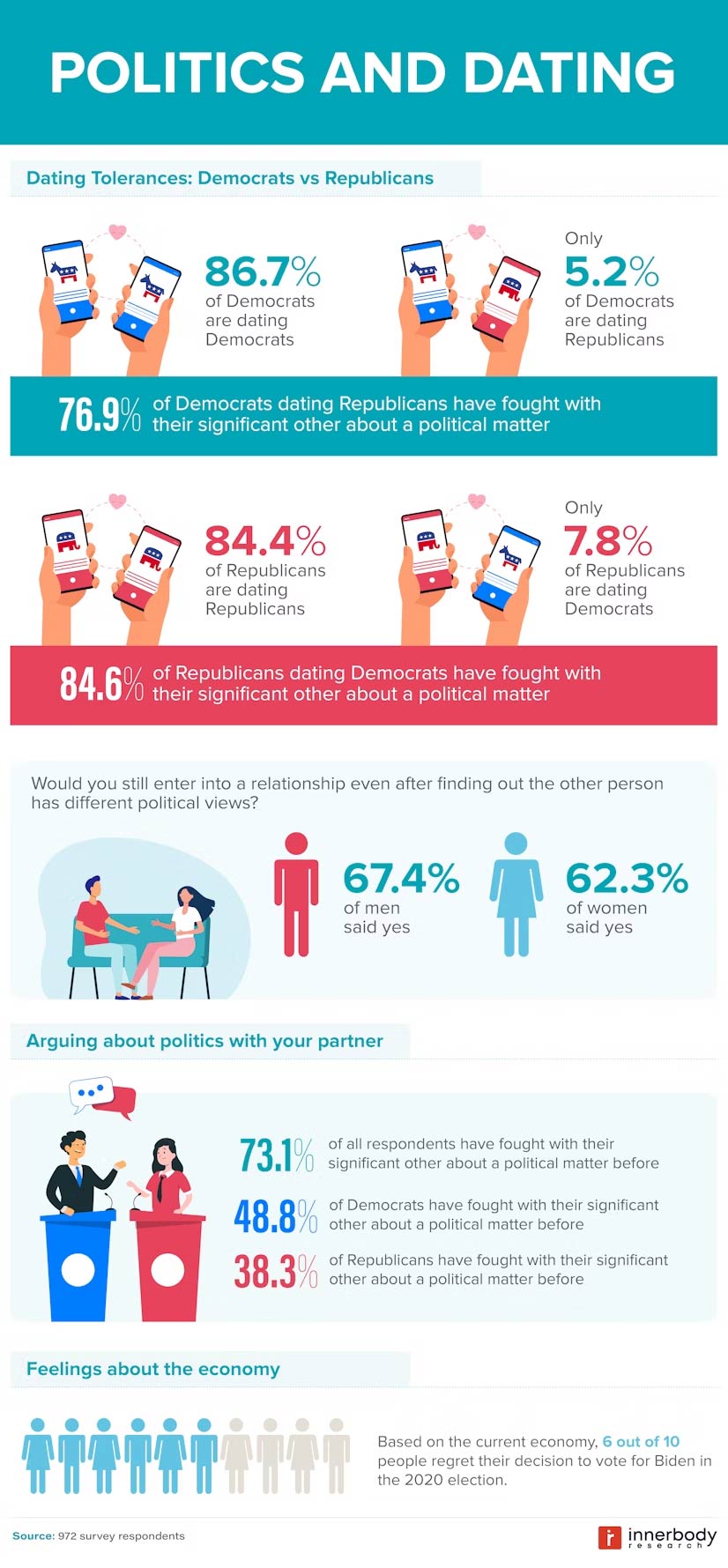
We surveyed 972 people of all ages and affiliations to determine how much influence politics has on our relationships. While we had slightly more women respond (52.4%) than men (47.5%), there was no clear relationship between age and political party affiliation. In fact, Gen X was the least likely to be Republican, while Gen Z was the most likely.
| Democrat | Republican | |
|---|---|---|
| Baby boomer | 51.9% | 29.6% |
| Gen X | 61.6% | 27.3% |
| Millennial | 51.2% | 31.5% |
| Gen Z | 40.2% | 53.3% |
These Gen Z numbers shocked us. Gen Z is one of the most diverse generations and, in national polls, is the most likely to have an unfavorable view of capitalism and to support a socialist candidate. These results may be slightly skewed because Gen Z — particularly left-leaning members — are shunning traditional party lines. Interestingly, 75.6% of Republican Gen Z participants in our survey were men, meaning there may be a bit of a gender bias among the latest generation’s politics.
Six out of 10 people we surveyed who voted for President Biden in the 2020 election regret that decision. There are many possibilities for this figure, from the impending recession to political tension across every branch of government. An astonishing 94% of people aged 18-29 would prefer a new Democratic nominee in 2024, which may also be reflected in this proportion. This regret may cause strife within otherwise content Democratic relationships or lead to harmony in a cross-party relationship.
Democrats vs. Republicans
A vast majority of people are dating someone within their political party. 86.7% of Democrats are dating other Democrats, and 84.4% of Republicans are dating other Republicans. Only 5.2% of Democrats reported dating Republicans, and 7.8% of Republicans are dating Democrats in our survey. Within these groups, slightly more Democrats have found themselves fighting with their partners about politics than Republicans (49.8% versus 38.3%, respectively).
The small fraction of people dating across the aisle report higher amounts of relationship tension. Within the 5.2% of Democrats dating Republicans, more than three-quarters (76.9%) report fighting with their significant other about something political. That number is even higher for Republicans who are dating Democrats — a whopping 84.6% report fighting about politics with their partner.
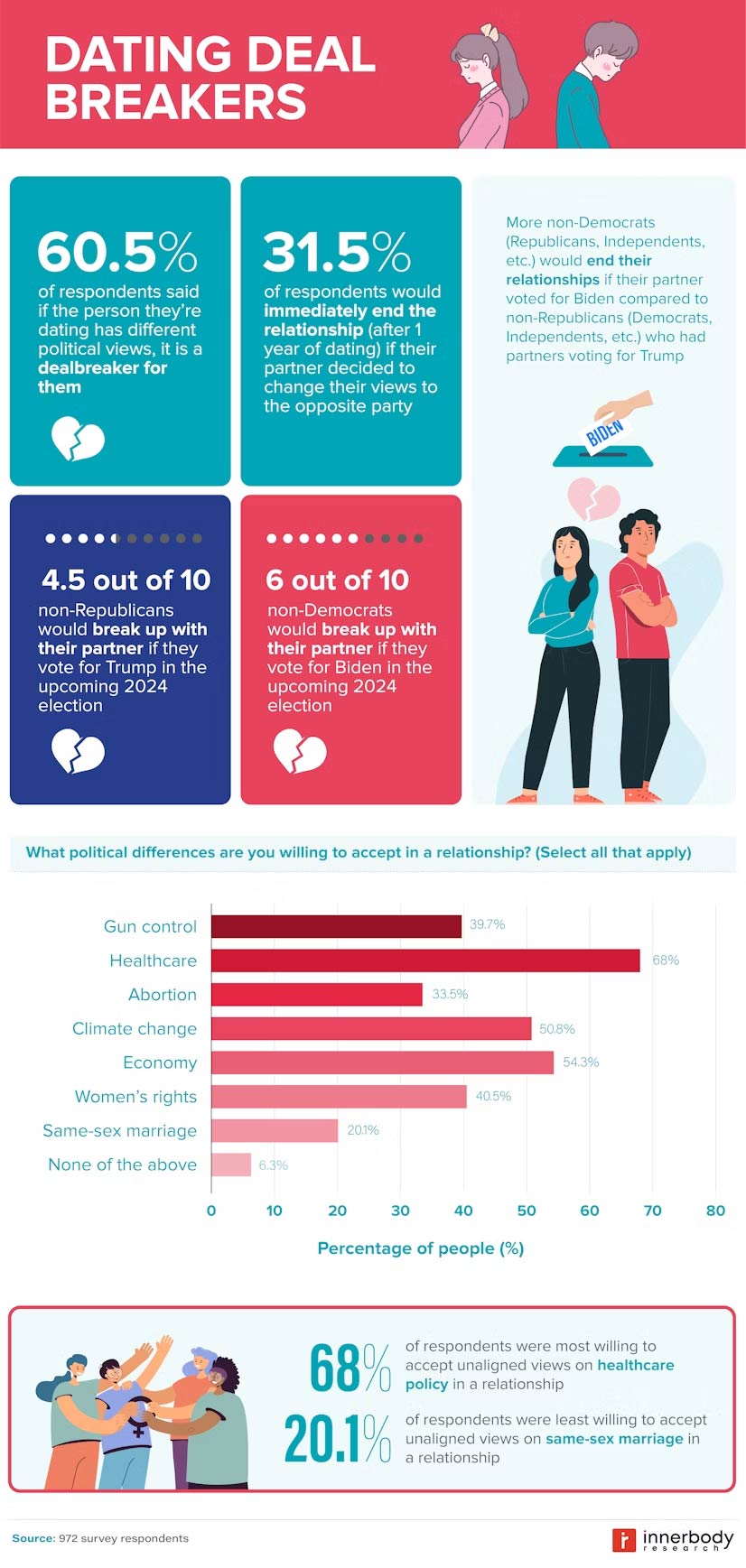
There’s a reason for these high rates of same-party relationships. Whether they want to avoid fighting or want to stick to their values for a family down the line, 60.5% of all respondents said that a potential partner having different political views is a dealbreaker. If they started dating someone who changed their views to the opposite party after a year, 10.9% said they’d have to re-evaluate the relationship. However, more than half (58.5%) of those respondents were women. Almost one-third (31.5%) would immediately end the relationship instead.
When we look at the near future, a clearer picture of political tension emerges. We posed the idea of a Trump vs. Biden ticket in the 2024 presidential election to our participants and asked what they’d do in various scenarios. The most provocative situation? Their partner voting for the presidential candidate of the opposite party. Only 4.5 out of 10 non-Republicans reported that they would break up with their partner if they voted for Trump in 2024, whereas 6 out of 10 non-Democrats would break up with their partner if they voted for Biden.
Policy deal-breakers and compromises
Talking about theoretical party platforms is one thing, but investigating actual policies can provide a clearer insight into what exactly people care about. We asked our participants to consider how different hot-button political topics would impact their feelings about their relationship. Specifically, we asked about:
- Gun control
- Healthcare
- Abortion
- Climate change
- Economy/economic policy
- Women’s rights
- Same-sex marriage
Almost every participant (93.7%) was willing to compromise on at least one policy with a partner. The easiest issue to come to an amicable agreement about is healthcare policy, where 68% of participants were willing to accept a difference in opinion. The economy (54.3%) and climate change (50.8%) were next, though there was a significant drop between these answers and healthcare.
Issues that have recently shone in the media spotlight were more likely to have fewer compromises between partners. Abortion (33.5%), gun control (39.7%), and women’s rights (40.5%) were all things that more than half of the participants couldn’t agree to disagree about. The issue that people were least willing to accept differences on is same-sex marriage, with 79.9% of participants needing total agreement from a partner.
Only 6.3% of people felt they must be politically on the same page as their partner. Most people are willing to compromise but think that the other political party is so separate from their core values that finding a middle ground would be impossible. This is a punishing take on how much political division has pushed us apart. It’s also worth it to note, though, that men in our survey were more likely to ignore this division. 64.7% of male respondents said they’d still enter a relationship even after learning about a partner’s different political views. (62.3% of women still would, too, proving that perhaps there’s more nuance to unpack than just general political views on dating differences.)
Political impact on sex lives
With politics’ intense impact on our serious relationships, we wanted to know if politics impacted our sex lives to the same extent.
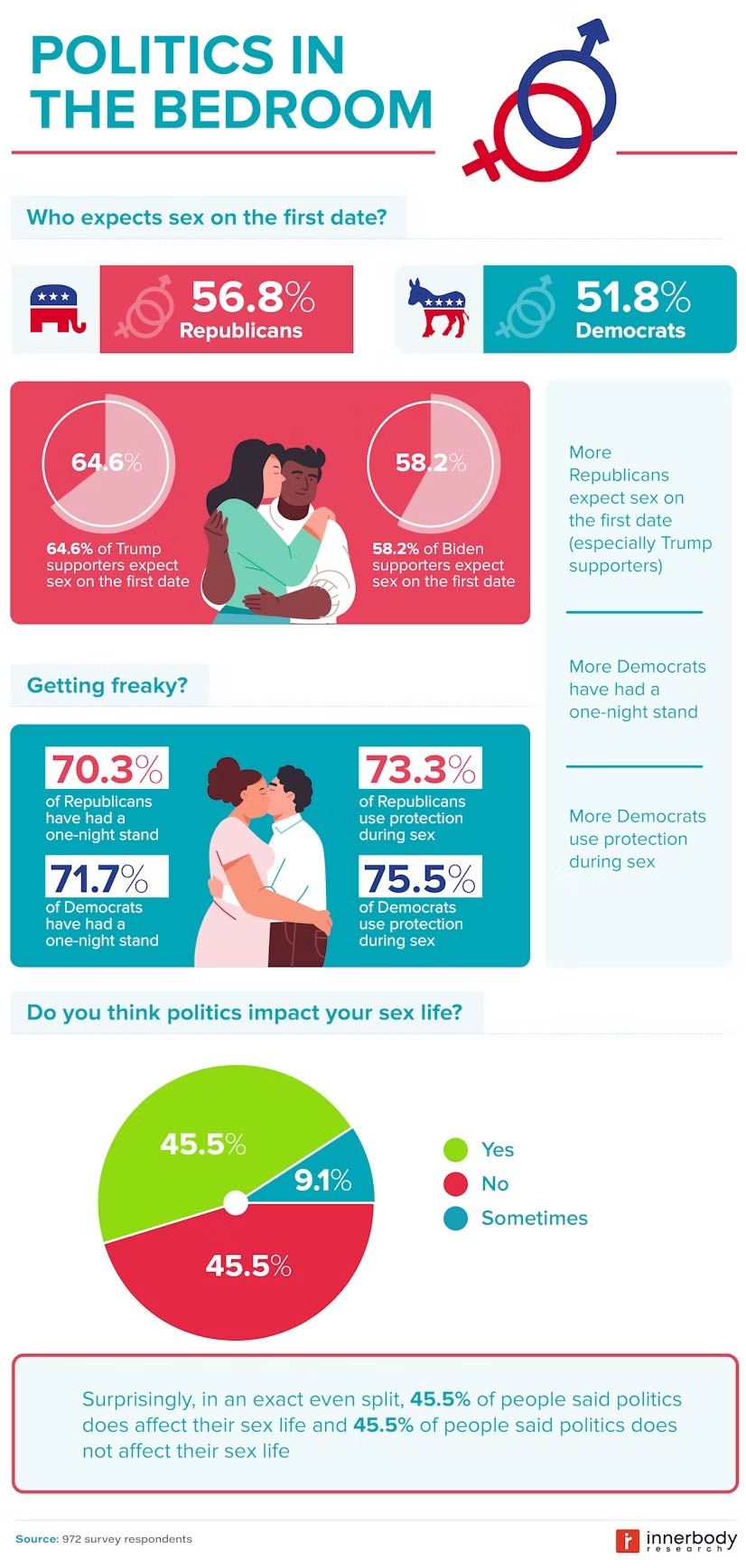
Ultimately, respondents were evenly split on the issue. 45.5% of respondents said politics don’t affect their sex life, and 45.5% said it does. The remaining 9% said that politics sometimes affect their sex life, meaning it can vary over time, with different partners, or on particular issues. Politics may significantly impact our long-term life decisions more than in-the-moment or short-term relationships, but they still play a role in how we pick our partners (and what we do with them).
Sexual expectations
It can be hard to know what to expect when meeting someone new. Unless, of course, you’re one of the 56.8% of Republicans or 51.8% of Democrats who expect sex on the first date.
Those who support established party heads — either President Biden or ex-President Trump — are more likely to expect sex on the first date than those who don’t. 58.2% of Biden supporters (up 6.4% from Democrats at large) and a whopping 64.6% of Trump supporters (up 7.8% from the general Republican population) expect a first date to end with sex.
When it comes to casual sex, Democrats and Republicans reported having short flings and practicing safe sex in roughly equal numbers. However, Democrats are more likely by a narrow margin to have had one-night stands (71.7% versus 70.3%) and use protection during sex (75.5% versus 73.3%). Participants’ political opinions made very little difference in their bedroom practices overall.
Methodology
We surveyed 972 people about how politics have affected their relationships and dating life. Since political affiliations are often close to personal identities, we wanted to investigate how politics can make or break your dating life. We focused on the dichotomy between traditional political parties (Democrats and Republicans) and how people in either group react to political differences in those they date.
This study was originally published by InnerBody Research.
Banner Image: Dating. Image Credit – NATHAN MULLET
InnerBody Research


We're Innerbody — researchers, scientists, and medical professionals with a shared mission: To provide objective, science-based information and advice that helps you make health-related decisions and enjoy a healthier, happier lifestyle. Our experienced research team tests, analyzes, and compares your best options, sparing you the time and money so you can make quick, confident progress toward your health goals. And together, we strive to put common health concerns in broader context with research studies and pertinent analyses that illuminate the complex picture of health in the United States.