


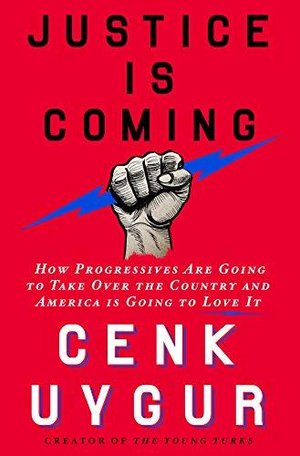
Book Review: Cenk Uygur’s Justice Is Coming: How Progressives are going to take over the country and America is going to love it, Provides An Honest, Open Look At What Is Wrong With Politics In America, How To Fix It
Book Review: Justice Is Coming: How Progressives Are Going to Take Over the Country and America is Going to Love It by Cenk Uygur provides a progressive’s look at what went wrong with this country’s political system, including how politicians became so disconnected with what the American people actually want. Unfortunately, the biggest issue can be summed up in the recent primary races for the House of Representatives in New York. We were all treated to a front row seat to how incredibly persuasive political advertising can be and has become in this country.
On an interesting side note, the statistic the book cited is that donations (and thus, generally, ad buys) are the deciding factor in 96% or so of races nationwide, usually including the presidential race. This number has increased over the years as well.
However, contrary to the statistics mentioned in the book, during the presidential campaign of 2024, where Donald Trump was elected to the presidency, these statistics were not a good predictor, and in fact, this race was one of only about 4% of races where money is not the deciding factor. In this instance, VP Harris outraised and outspent President Trump by a ratio of 3:1. 96% of the time this has happened in the past, the bigger spender would be the winner. That was, in fact, how former representatives in New York lost their primary races: by being outspent on advertising. Even with all of the spending on ads, and the constant bombardment in swing states of ads for both candidates, she still lost the race.
When we talk about money in politics meaning everything, a lot of readers might think of the Citizens United case, from 2010. But unless you know a lot about politics, you might not know that Citizens United was just another step on the path toward complete domination of politics by lobbying. By lobbying, what is meant is donations to political campaigns (or against them, in the Jamal Bowman race, for example) that are literally unlimited, as long as they come from domestic businesses or individuals. Since corporations are considered as people (more on that really odd precedent-setting scenario below), and thus they have freedom of speech as a person does, and since freedom of speech is represented as money that they can spend (like how the large corporations understand the value and return of effective marketing campaigns – which cost money), they can spend an unlimited amount of money donating to politicians. This all started many years ago, in the late seventies, and it has accelerated ever since.
Since today, both sides take these donations, although those who are considered Democrat or liberals are always given less, thus giving them a disadvantage nearly all of the time, this causes them to become ever more disconnected from the working people that they claim to represent, since they no longer represent them. The lobbyists have their ear, and they tell the politicians what the American people believe. They base these beliefs on what the corporation that is doing the talking wants to have happen politically.
For anyone with even a passing interest in politics, this is not news. If you know what lobbyists are (corporations legally allowed to essentially bribe politicians so they help them get in office), then you might be familiar with some of the topics discussed in the initial chapters of this book. Lobbying is the activity mentioned previously where business owners and businesses themselves give money to politicians and their campaigns.
While a political campaign must be very careful about how much money they take from anyone who is a foreign donor, whether individual, businessperson, or government official, there are no restrictions on how much money they can accept from domestic donors (mayor Adams link). If it is more than a certain amount of money from one individual, then they must report it.
Most people in America, though, are completely oblivious to this at all, and they do not investigate before or during an election who the campaign is taking money from. This is important to know because it has an influence over the laws that said politicians will then vote for. They want the money to keep flowing, and to win their next campaign with these big donor’s help. The help will only be forthcoming if they do a good job of voting for things that their donors want. Their donors, or corporate interests in most cases, want certain bills to be passed and certain bills to not pass.
What a corporation or its CEO wants would be expected to differ greatly from what the American people actually want. However, what you might find most astonishing is NOT just how much the American people want things to change (not surprising given the recent election), but more what the change they want is in reality.
For example, in survey after survey (some of which are referenced and footnoted in this book), the American people want universal healthcare. Seriously? Yes. They also want to help those who are less fortunate with strong government programs. They also almost universally support expansion of Medicare and Social Security programs. Does that surprise you? If you have been watching Fox News or even MSNBC for a while, it probably does.
Did you know that most Americans want paid parental leave for all mothers AND fathers. They want it in the level of around 70%. However, politicians think that no one wants this, and their donors (who would then have to pay the parental leave AND lose their employees with a guaranteed job when they return) would not be happy to have this actually pass. So it never gets to the floor, never gets voted on, and most importantly, the politicians never actually ask their constituents if they wanted it.
Imagine what would change if the people just voted on all of the bills themselves, and we had a more participatory process than they have now. That would be a straight democracy, though, not a democratic republic, which is what we actually have in America.
So, if you look at the world around you, and actually talk to real people who don’t have some political gain, it is not surprising. Something else the American people support: higher taxes for the wealthy. You read that right. Over 70% of Americans want the wealthy to pay their fair share. This means closing the loopholes in the tax law (which are usable by ANY business owner of ANY size, but most smaller businesses without an entourage of accountants and attorneys don’t know how to use them), and making the income tax percentage higher as the income levels go up.
While it is the case presently that the percentage goes higher as the wages and income increase, the portion of their salary that a low-income wage-earner pays versus what a wealthy person pays is larger for the lower income person. This makes absolutely no sense at all to the average American, and it is reflected in surveys.
Most people also want to expand the IRS, and also to ensure that they go after those with higher incomes first. As of this moment and moving forward, the IRS focuses its collection and audit efforts on small business owners, rather than the giant corporations who are undoubtedly cheating on their taxes. Why? Because those very corporations buy the politicians. Consequently, when a bill comes up for debate about hiring more IRS agents specifically to go after higher income earners to make sure they aren’t cheating on their taxes, the bills are either stalled in committee, rejected outright, or they will be so watered down that they are virtually worthless, and they will change nothing.
This has happened so many times to so many different bills that it is silly to think that politicians are at all capable of changing things in the ways that many Americans seem to want.
But How Did We Get Here?
Well, according to Cenk, one of the first things that happened was that back in 1971, there was a gentleman by the name of Lewis Powell. He was a business owner, and he put out a memo to other business owners in his circle of friends. His contention was that they, the business owners, were being singled out by politicians such as Ralph Nader and other Democrats, and that this was affecting their bottom line. The solution was simple: political donations would help them buy the politicians, thus making sure that only laws which benefitted them would be passed. This was something that was already happening on a small scale in politics, but this would mark a major turning point.
It became the norm for large multinational corporations to devote larger and larger portions of their budgets to buying political influence. Political influence would benefit their bottom line because they would always remind the politicians of what they wanted. If they didn’t get what they wanted from politician A, they would then back politician B in the next race to defeat politician A who wasn’t helping the big corporations.
Something that the author cites as a statistic that many constituents are not aware of is that in, for example, presidential races (along with pretty much all other candidate races), the amount of money that a candidate raises from their donors determines if they will get elected or defeated. It matters 96% of the time in most races. This number has grown and grown from the 1978 numbers, particularly after the Citizens United decision, which determined that corporations can spend an unlimited amount of money on political campaigns as an expression of their freedom of speech.
Corporations As Legal Fictions Or As Autonomous Humans With Constitutional Rights
Another fundamental way in which the system became broken is when there became appointed to various benches judges which the author calls “activist judges.” What is an activist judge? It is a judge who should have been a politician but instead decided to become a judge and legislate from the bench. The best example of corruption that I’ve ever heard of, though, is the way in which corporations gained these rights and abilities to control our government.
There was a court case involving trains, Santa Clara vs. Southern Pacific Railroad, where the railroad company maintained that it should have the same rights as an American citizen, i.e. the rights to freedom of speech and other rights. Remember, a corporation is a legal fiction. It exists only on paper, and it is not a human being or a citizen.
As one would expect, the court summarily rejected this argument. The judges disagreed with the railroad, that their corporation should be granted personhood. And this is where it gets really interesting.
In the court system, there is a person who writes a brief about cases. They still do this, although with the advent of recordings and transcripts, it is much less necessary. At the time, though, these court reporters had a very big job to do. And during this railroad case, J.C. Bancroft Davis the person who held this position was good friends with the owners of the railroad company who had just lost the case. And he decided to say that the railroad company had, in essence, won the case, and they had been declared to be the same as a human being, with the same fundamental rights as an American citizen. His exact words were, in the summary, “…corporations are persons within…the Fourteenth Amendment.”
Sorry if your head is spinning right now. But what happened next was that no one challenged this clerk’s glaring mistake. It was a giant error, staring everyone right in the face. However, this decision summary was picked up as a fact in the next case that was brought before the federal court, and this erroneous decision somehow became precedent. Once it was used as precedent in a real case (rather than in the case to which it was applied, where this was NOT the decision, remember), then it became true legal precedent. And this true legal precedent has continued to be referenced on and on down the line, until we have arrived at the place where we are today.
Where is that, you might ask? As you may have noticed, corporations actually have MORE rights than American citizens, and they also get many more benefits from the government than ordinary citizens do. Remember, they are also never pursued by the IRS because they make sure that there are never enough IRS agents to do the job they are assigned.
Going back to that job, they are here to make sure that big corporations don’t cheat on their taxes. However, in order to successfully pursue and compel the big corporations to submit to an audit and turn over their books in the first place, it takes many agents to force them to comply. It can take months or years, and these are the companies with teams of lawyers to help them (because they can afford it). They are the companies with the most favorable laws applied to them, and they are the most difficult to audit. So the IRS doesn’t bother with them. They just let them continue on their merry way, cheating on their taxes and paying less than anyone else in tax because they lack the resources and manpower to hold them to account, which is by design. It’s exactly what the big corporations (which could even be called in some cases monopolies) want the politicians to keep as the status quo. Keep the IRS going after small businesses who are easier to pursue and audit, and keep them off the trail of the companies practicing corruption and cheating on their taxes.
As Cenk points out multiple times in this book, taxes are important. Taxes that come into the government go right back out again (most of the time) in the form of services. Schools, roads, highway maintenance, and on and on. However, if the taxes are never paid, then the services cannot be provided because the money is not there. If all of the small corporations pay every penny in tax that they owe, it still doesn’t make up for the fact that the giant companies who would generate the most revenue instead are a drain on the system. This is just part of the problem, but it’s a pretty big one.
Accepting Donations Becomes The Norm In Both parties
At a certain point, after 1971, when the Republicans became bought and paid for by giant corporations, giving them favorable tax breaks, laws that made it impossible to protect the environment from their pollution (because the penalties for breaking the laws represent negligible costs to businesses that pollute), the Democrats decided that they wanted to get in on the action, too.
They wanted to take political donations from corporations and do their bidding, just like the Republicans did. However, the Democrats would never be given quite as much in donations as the Republicans would, by about a fifth less. This means that they decided to participate in a system that was completely rigged against them.
That’s not the worst part, though. Because they, in essence, sold their souls for money, they would no longer be the party of the people. Ralph Nader and others like him would begin to lose their campaigns and not be re-elected. Since 96% of the time, the amount of donations matters more than anything else, this became a self-selecting process. Until now, all we have are Democratic politicians that take money from giant corporations and do their bidding the same way as Republicans do.
Two examples of this in action, from Democrats: GMO Food Labeling law (under Pres. Obama), which essentially outlawed Vermont’s very strong GMO labeling requirements in favor of a pie-in-the-sky never-going-to-happen law that still has not been implemented. A law that most Americans, who want to know if there are GMO’s in their food (evidenced by the immense popularity of the Non-GMO project labels), were ignored. Their wishes were denied by the political establishment, and they were summarily rejected.
The second example is TANF (under Pres. Clinton). This has been one of the most devastating blows to the low-income sector in America, more so than nearly any other law. This is according to Professor Edelman, who we interviewed about this particular issue. Suffice it to say that if President Clinton had been a real Democrat, not beholden to donors, and really a person who was for the working class, he would never have signed this bill. He could have vetoed it, and many of his advisers, especially those who themselves worked with vulnerable populations, resigned when he signed it over their objections. Professor Edelman was one of them, but he was not the only one. This bill was what Republicans wanted, not what Democrats would have wanted.
First, it made the qualifications to obtain federal assistance for low-income families much more up to the individual states. States vary widely in what they require, and many of them require a recipient to either be provably looking for a job (spending eight hours a day looking for one at their site), or they must be assigned to work, in many cases work that pays them nothing but their benefits. This is what we had in New York City for low-income people ten years ago, and it is unlikely to have improved much.
The companies that benefit from this unpaid labor should be paying for it, as they are some of the most profitable companies in the country. The same companies, in many cases, that benefit and profit from prison labor, which is still quite alive and well in the modern day slavery legitimized by the exception to the Thirteenth Amendment which outlawed outright slavery.
The welfare and food stamps aid became known as TANF (Temporary Assistance for Needy Families) and WIC (Women Infants and Children), and it was turned into what is known as a “block grant.” Such a grant is disbursed by the federal government to be used, but is not REQUIRED to be spent. So, what does that mean?
Pretty much that only if you live in California or a very small number of states will you have an easy time getting help if you fall on rough times. Many people fall on rough times. Whether they recover or not becomes largely due to whether or not they are given help, either by the state or by family members. Maybe they need a surgery that they don’t have insurance for, and it will cost them $25,000, all of their savings. Then they become evicted from their home. Or any number of setbacks that ordinarily occur in the midst of one’s life. The question becomes: do they bounce back? Government aid has been essentially taken away as a replacement for those that do not have families. Charities can be useful as well, but many people are unaware of programs available, The programs are often simply not enough for them to survive. And there are never enough charities to help all of those that are in need.
So there is greater suffering overall caused by this policy that was ratified by a Democrat president, but was truly a dream for the Republicans. Because when the states that receive these block grants get them, they have multiple choices of what to do with them. Often, they will choose to let them go into certain kinds of bank accounts or investments that pay interest in return for the deposit. Other times, they will use them for other types of programs that fall under the broad definitions of what they can use these grants for, while ignoring those that have fallen through the cracks of society. These can include education and infrastructure in some cases. This can also be followed up by, such as in Oregon, the fining and eventual eviction from a state residents of the state who have become homeless, a practice now legitimized by SCOTUS in their recent decision.
But these are just examples of when the Democrats act like Republicans, and when literally all the politicians act like giant corporations. Because giant corporations don’t care about people, especially the people who work for them. They are the ones most likely to fight the hardest against their employees unionizing (such as Amazon with their multiple arguably union-busting activities over the past several years). Giant corporations are most likely to want to pay their workers as little as possible while keeping the highest returns from the profits into the hands of their wealthy shareholders. There are companies that are larger that try to lead by example, such as the employee-owned Johnny’s Selected Seeds and Welch’s Grape Juice Company (who distributes their profits to their small family-farm partners instead of to a centralized conglomerate company).
How Did Politics Become So Bad And Completely Lose Its Way?
While all of these things may be true, what has happened with the political system is that it is self selecting. Because the politicians who are nearly always elected are supported by big money donors, those who have integrity are automatically weeded out. In other words, they lose their races. As a result, the only politicians that win elections are those who are funded by these big donors. So it becomes a self selecting process, almost a self fulfilling situation.
This is why all of the politicians currently in power are supported by big money donors. If you’ve ever wondered why it seems like they’re always voting against common sense laws that are strongly supported by the American people (but fought against by these same corporations), this is the reason why. The politicians are elected by the easily manipulated public, and once they’re in, they do the bidding of their donors, not their constituents.
His Solution May Not Be Viable, But Is Presented Here: If You Can’t Beat Them, Join Them
Cenk concludes this book by presenting his solution to this problem. Justice Democrats and Wolf PAC. To become a Justice Democrat, a politician has to pledge to not take money from big donors and to fight for their constituents (working people). Several recently elected politicians are part of the Justice Democrats, including Rep. AOC and former Rep. Jamal Bowman. Wolf PAC is a PAC that helps to support these politicians and help them win their seats.
This is a very “If you can’t beat ‘rm, join ‘em” mentality that believes that the way to beat the system is from within. But even the author admits that any Justice Democrat that becomes elected can and maybe even will become corrupt. Same for the WolfPAC and other PACs with similar motivations. There is always the possibility for corruption.
I would have different solutions: Form your own charity, alone or with others, and start helping people who need help. Or help people in an informal way. Politics is corrupt, and it’s better to stay away from it. Of course, someone with a conscience, who sees what’s happening to our country and world as a result of this immense corruption, might not be able to stand idly by. They may want to wade right into the fray and try to change things from the inside out.
However, the amounts of money that are involved in successful political campaigns are in the millions of dollars. Such amounts could do a lot more good in the hands of a reputable charity that really does good in the community. There are charities like this that are well rated and give help directly to the community on a grassroots level instead of spending so much money in the black hole of political ads. What If the candidate you’re supporting loses? All that money is right down the drain.
The solutions offered by Cenk Uygur in response to the corruption is to form his own political party. But it is very difficult to change the system from within. At least it’s an attempt, though.
This book was an excellent read, and can act as a great primer for anyone not at all familiar with how this political system works. It’s well written and interesting to read. I would give it five stars.

Banner Image: Book Cover. Image Credit – Macmillan Publishing

