

Ethiopian Airlines Faces Turbulence at JFK Airport Over Cruel Monkey Imports
Editor’s note: Staten Islander has previously covered a protest with the same aims as the present one: to stop the cruel conditions witnessed during transportation of monkeys in crates by airlines and importers who will later be subjecting them to inhumane experiments.
The following questions were answered by PETA Senior Vice President Kathy Guillermo:
Has the airline itself been implicated in flying these monkeys in, or are there only independent third parties who are proven to be involved?
Evidence presented during a federal trial revealed that Ethiopian Airlines shipped monkeys alleged to have been smuggled and laundered by other parties.
What are the next steps PETA or the USDA (or other governmental organizations) are planning to take to prevent this from continuing?
PETA will continue to spotlight Ethiopian Airline’s actions related to animal transportation. We do not know what the USDA’s next steps may be.
Have these offences been discovered on a continuous basis, or is it more sporadic in nature (is it occurring on many of the flights by this airline, or has it occurred only a few times)?
The USDA/CDC/USFWS inspect a tiny fraction of the flights that are bringing animals into the U.S. It is telling that Ethiopian Airlines has been cited by the USDA for violations of the federal Animal Welfare Act both this year and last year.
What are some of the legal or other remedies that are available to animal rights organizations or the government?
The USDA can issue citations for violations of the Animal Welfare Act, and it can also impose civil fines and in certain circumstance seize animals.
In your opinion, are these remedies strong enough to deter this type of activity, or do they need to be strengthened? If so, in what ways?
The failure to inspect every incoming shipment of primates and the lack of coordination between the agencies responsible for ensuring that importations do not pose a risk to the public is concerning. I would encourage you to read this May 2023 GAO Federal Actions Needed to Improve Surveillance and Better Assess Human Health Risks Posed by Wildlife https://www.gao.gov/assets/gao-23-105238.pdf
From PETA about the protest:

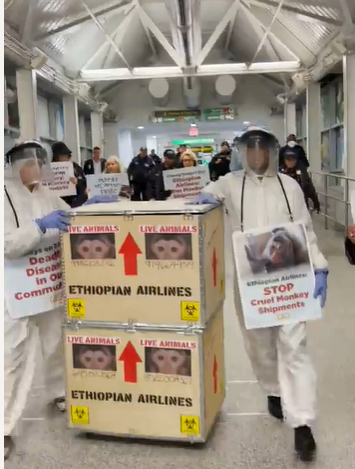

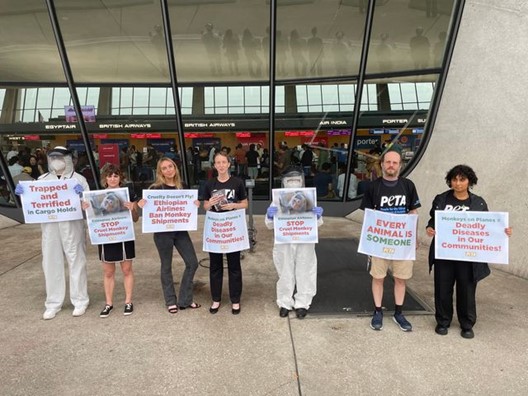
Ethiopian Airlines protest. Image Credit – PETA
People for the Ethical Treatment of Animals


People for the Ethical Treatment of Animals (PETA) is the largest animal rights organization in the world, and PETA entities have more than 9 million members and supporters globally. PETA opposes speciesism, a human-supremacist worldview, and focuses its attention on the four areas in which the largest numbers of animals suffer the most intensely for the longest periods of time: in laboratories, in the food industry, in the clothing trade, and in the entertainment business. We also work on a variety of other issues, including the cruel killing of rodents, birds, and other animals who are often considered “pests” as well as cruelty to domesticated animals. PETA works through public education, investigative newsgathering and reporting, research, animal rescue, legislation, special events, celebrity involvement, and protest campaigns.