


New York’s Seniors Impacted By Cuts To Agencies That Protect Seniors From Frauds, Scams; Budget Bill Impacts; Funding For Schools Withheld; Syracuse USDA Office Saved From Closure: Senator Gillibrand
Editor’s note: We are awaiting video from the press conference referenced below, which will be added shortly. Senator Gillibrand has also reintroduced the Older Americans Act, which recently expired and has benefited many seniors with useful programs, many of which are aimed at allowing them to keep their independence as they age. Elderly New Yorkers are likely to be disproportionately impacted by the budget bill’s cuts, since a good portion of seniors have the 20% of their healthcare costs that are not paid by Medicare taken care of by Medicaid. If they lose their Medicaid, as Senator Sanders has discussed, they will be unable to afford to keep their current healthcare.
The virtual press conference can be seen below:

GILLIBRAND, WARREN DEMAND ANSWERS ABOUT TRUMP ADMINISTRATION CUTS TO AGENCIES THAT PROTECT SENIORS FROM FRAUDS AND SCAMS
Americans lost more than $12.5 billion to fraud in 2024
WASHINGTON, D.C. – This week, Senators Kirsten Gillibrand, ranking member of the U.S. Senate Special Committee on Aging, and Elizabeth Warren, ranking member of the U.S. Senate Committee on Banking, Housing, and Urban Affairs, demanded answers from the Trump administration on the impact of federal cuts to agencies that protect seniors from financial frauds and scams. The senators’ letter follows the release of a Government Accountability Office (GAO) report detailing the need to enhance protections against frauds and scams through coordination among federal agencies such as the Federal Bureau of Investigation (FBI), the Treasury Department, the Federal Trade Commission (FTC), the Federal Reserve, and the Consumer Financial Protection Bureau (CFPB).
Even after the release of GAO’s report, the Trump administration has continued efforts to gut these agencies. For example, in April, the administration fired about 1,500 CFPB employees—or almost 90% of the agency’s staff. The so-called “Department of Government Efficiency” (DOGE) has also attempted to harass public servants throughout the federal government into leaving their jobs, decreasing personnel at the very agencies that GAO agrees are needed to protect older adults.
“GAO’s report detailed the need to enhance our nation’s response to scams, including through better coordination among federal agencies. Despite that need, President Trump allowed an out-of-touch billionaire to slash the very agencies that protect Americans from scams, including millions of older adults,” the senators wrote. “We ask GAO to examine the impact of these severe cuts on the ability of the federal government to address frauds and scams, and to carry out the recommendations in GAO’s report.”
American consumers reported losing more than $12.5 billion to fraud in 2024. Older Americans alone lost a record $4.8 billion to scammers last year, according to the FBI.
The full text of the letter can be found here or below.
Dear Mr. Dodaro,
We write today to request that the Government Accountability Office (GAO) follow up on its report, Consumer Protection: Actions Needed to Improve Complaint Reporting, Consumer Education, and Federal Coordination to Counter Scams (GAO-25-107088). GAO’s report detailed the need to enhance our nation’s response to scams, including through better coordination among federal agencies. Despite that need, President Trump allowed an out of touch billionaire to slash the very agencies that protect Americans from scams, including millions of older adults. We ask GAO to examine the impact of these severe cuts on the ability of the federal government to address frauds and scams, and to carry out the recommendations in GAO’s report.
American consumers reported losing more than $12.5 billion to fraud in 2024, and scams can have a particularly devastating impact on the mental and financial health of older adults. Older adults are more likely to have accumulated savings and housing wealth, making them targets for scammers who “steal everything,” and leave the older adults “emotionally and financially ruined.” One older adult testified about a scam that cost her late husband his job, his self-confidence, and forced him to ration his medications – setbacks that contributed to his declining health. Another older adult testified that she could not repair her home, afford air conditioning, and had to turn off her refrigerator and stove after losing $39,000 in a scam. Even as elder scams are devastating, they are also difficult to investigate because of their global nature. Frequently, such scams combine the efforts of overseas criminal organizations with operatives in the United States.
In April 2025, GAO released a report, Consumer Protection: Actions Needed to Improve Complaint Reporting, Consumer Education, and Federal Coordination to Counter Scams, that highlighted the scope of scams and the weaknesses in the federal government’s efforts to combat them. The report included several recommendations for the federal government, such as the need for the Federal Bureau of Investigations (FBI) to lead an effort to develop a national strategy to counter scams. Many of the recommendations made it clear that agencies such as FBI, the Department of Treasury, the Federal Trade Commission (FTC), the Federal Reserve, and the Consumer Financial Protection Bureau (CFPB) will need to work together to find solutions. The interagency cooperation envisioned by GAO’s report will require federal agencies that are well resourced and staffed with the proper expertise.
Although there is a need to enhance our nation’s response to scams, President Trump has empowered efforts to decimate the very agencies leading the response. On January 20, 2025, President Trump established the so-called “Department of Government Efficiency” (DOGE). The initial head of the DOGE, Elon Musk, the world’s richest man, does not need to worry about his basic needs and lives a life of unfettered influence and power. Yet, Mr. Musk and his cronies at the DOGE set a goal of cutting $1 trillion from agencies that serve working class Americans, older adults, and people with disabilities. Efforts by the DOGE include attempts to harass public servants throughout the federal government into leaving their jobs. DOGE efforts also include drastic cuts at agencies with a role in addressing scams, such as the CFPB, which has been subjected to mass firings. Consequently, we seek GAO’s assistance in understanding how DOGE’s actions affect key agencies’ efforts to address frauds and scams in general and implement GAO’s report recommendations in particular.
We understand that the DOGE’s efforts are ongoing and its efforts at the FBI, FTC, CFPB, the Department of Treasury, and the Federal Reserve may not be completed for many months. We also understand that GAO may receive some insight into the impact of DOGE’s actions at the five agencies when the agencies submit an action plan to Congress and GAO as part of the formal “180-day Letter” process that is in place for GAO recommendations to federal agencies. Therefore, we ask that GAO defer any work until it receives and initially analyzes the action plans from agencies that were targeted by the recommendations.
Once the agency action plans have been received and analyzed by GAO, and the DOGE’s efforts are sufficiently completed, we request that GAO examine and report on the following issues:
- In its April 2025 report, GAO identified five key agencies that play a role in addressing frauds and scams. Since January 20, 2025, how has the ability of the five agencies to address frauds and scams been impacted by firings, resignations, buyouts, agency restructurings, and other actions undertaken by the Trump Administration and the DOGE?
- What changes have occurred at the five agencies a year or less following the actions taken by the Trump Administration and the DOGE, and what, if any, observable impact have those changes had on efforts to address frauds and scams?
- What impacts may the changes have over multiple years on the five agencies and their efforts to address frauds and scams?
- GAO’s April 2025 report included 16 recommendations for the federal government to improve its response to frauds and scams. How have the changes implemented by the Trump Administration and DOGE impacted the ability of the five agencies identified in the April 2025 report to implement GAO’s recommendations? Further, if efforts are made to reverse the changes at any of the five agencies, please describe the success of those efforts. Please include any barriers the agencies have faced to restaffing and restoring efforts to combat frauds and scams.
We appreciate your attention to this request. Should you have any questions or need additional information, please contact Ranking Member Gillibrand’s staff with the Senate Special Committee on Aging or Ranking Member Warren’s staff with the Senate Committee on Banking, Housing, and Urban Affairs.
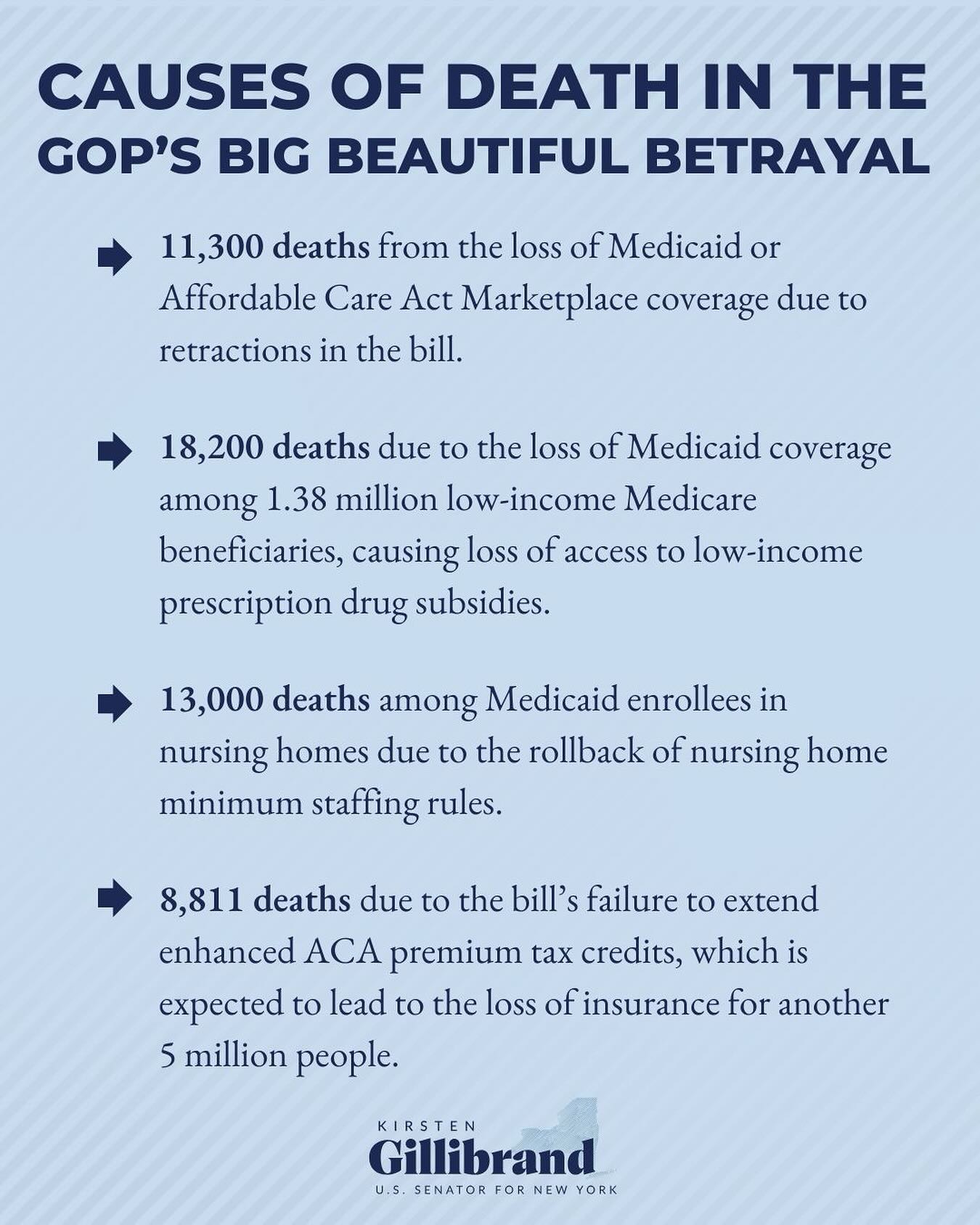
GILLIBRAND STATEMENT ON SENATE PASSAGE OF TRUMP’S BIG BEAUTIFUL BETRAYAL OF THE AMERICAN PEOPLE
WASHINGTON, D.C. – U.S. Senator Kirsten Gillibrand, a member of the Senate Appropriations Committee, issued the following statement after Senate passage of the One Big Beautiful Bill Act:
“This destructive bill is a big, beautiful betrayal of the American people. President Trump and Senate Republicans are cutting health care and food assistance for working families in order to give massive tax cuts to the wealthiest Americans. Just as bad, this bill will raise the cost of living for working families by thousands of dollars. It’s outrageous and I will continue fighting to defeat it.”

GILLIBRAND DEMANDS TRUMP ADMINISTRATION RELEASE $7 BILLION IN FEDERAL FUNDING FOR SCHOOLS
Withheld Funding Will Force Schools To Cancel Free And Affordable After-School Care For Low-Income Kids And Other Critical Programs
Last Year, New York State Received $464 Million From These Federal Programs
WASHINGTON, D.C. – U.S. Senator Kirsten Gillibrand held a virtual press conference demanding that the Trump administration release $7 billion in federal funding for schools nationwide. The administration is currently withholding the resources, which fund before- and after-school programs, professional development for teachers, STEM education, accelerated learning courses, college and career counseling, and school-based mental health services. Last year, this federal funding amounted to 13.5% of total K-12 funding for New York. Gillibrand sent a letter to Education Secretary Linda McMahon and OMB Director Russell Vought demanding answers on how long the administration plans to withhold this funding and when, if ever, they will release it.
“President Trump is once again playing games with our kids’ futures,” said Senator Gillibrand. “The funds he is withholding go toward commonsense programs that help our kids thrive in school and prepare to get good-paying jobs in the future. They pay for before– and after-school programs that let parents stay in the workforce and professional development programs that make sure teachers are using cutting-edge strategies to reach students. Losing this funding will be catastrophic for our schools, our kids, and our families. The Trump administration must release these funds immediately.”
Among others, the following grant programs are having their disbursements withheld by the Trump administration:
- Supporting Effective Instruction State Grants, which support professional development and other activities to improve the effectiveness of teachers and school leaders, including reducing class size. New York State received almost $126 million from this grant program last year.
- 21st Century Community Learning Centers, which support high-quality before- and after-school programs focused on providing academic enrichment opportunities for students. New York State received over $102 million from this grant program last year.
- Student Support and Academic Enrichment Grants, which provide flexible funding for school districts for a wide range of activities, including supporting STEM education, accelerated learning courses, college and career counseling, school-based mental health services, and improving school technology, among many others. New York State received over $107 million from this grant program last year.
The letter was also signed by Senator Chuck Schumer (D-NY) and Representatives Nydia Velázquez (D-NY-07), Hakeem Jeffries (D-NY-08), Adriano Espaillat (D-NY-13), Dan Goldman (D-NY-10), Paul Tonko (D-NY-20), Yvette Clarke (D-NY-09), Jerry Nadler (D-NY-12), Grace Meng (D-NY-06), George Latimer (D-NY-16), Gregory Meeks (D-NY-05), John Mannion (D-NY-22), Josh Riley (D-NY-19), Joe Morelle (D-NY-25), Alexandria Ocasio-Cortez (D-NY-14), Ritchie Torres (D-NY-15), Pat Ryan (D-NY-18), and Tom Suozzi (D-NY-03).
The full text of the letter is available here or below:
Dear Secretary McMahon and Director Vought:
As members of the New York congressional delegation, we write to respectfully raise urgent concerns regarding the Department of Education’s decision to withhold nearly $7 billion dollars in already enacted federal funding for Fiscal Year 2025 that states, local governments, and schools across the country rely on to provide critical resources and services to millions of students.
On June 30th, state educational agencies were informed that the following five grant programs authorized under the Every Student Succeeds Act1 and one program sixth under the Workforce Investment and Opportunity Act would not receive their anticipated disbursements on July 1st:
- Migrant Education Program (Title I, Part C) – State Grants: Funds support migratory children in reaching challenging academic standards and graduating from high school.
- Supporting Effective Instruction State Grants (Title II, Part A): Funds support increasing student achievement by improving the quality and effectiveness of educators and underserved students’ access to effective educators.
- English Language Acquisition State Grants; Title III, Part A: Funds help students learn English and meet challenging state academic standards.
- Student Support and Academic Enrichment Program (Title IV, Part A): Funds support improving student academic achievement, including by providing students with access to a well-rounded education, improving school conditions for student learning, and improving the use of technology.
- Nita M. Lowey 21st Century Community Learning Centers (Title IV, Part B): Funds provide academic enrichment opportunities such as literacy and other educational services during non-school hours (e.g., through after-school or summer programs) for students and families—particularly those in underserved and low-performing schools.
- Adult Basic and Literacy Education State Grants (including Integrated English Literacy and Civics Education State Grants): Funds support adult education and literacy services programs locally, including workplace literacy services; family literacy services; English literacy programs and integrated English literacy-civics education programs.
The funds currently being held up by review were not only approved by Congress in the FY24 appropriations law, but they were also extended under the FY25 full-year continuing resolution that President Trump signed into law. While summer programming can continue because New York public schools are funded through August, this reckless delay of over $400 million dollars 2 , which accounts for 10% of federal K-12 funding in New York is alarming local educators and program directors throughout the state. It is also disrupting school and district planning, jeopardizing programming for millions of students, and could result in layoffs and program cancellations.
Based upon a recent survey from Boys & Girls Clubs of America, 926 Boys & Girls Clubs could be forced to shut their doors, and more than 220,000 kids – including over 2,700 youth and teens in New York – will lose access to healthy meals, meaningful mentorship, and safe spaces during the most vulnerable hours of the day. It would also mean the loss of over 5,900 jobs at Boys & Girls Clubs around the country, specifically more than 182 youth development professionals in New York, that are currently operating current summer learning camps and fall learning programs.
In response to informal outreach from congressional offices, states, and stakeholders, the Department of Education has directed all questions to the Office of Management and Budget (OMB) as the source of the delay. However, this attempt to redirect inquiries does not abdicate the Department of its statutory obligation to distribute authorized and appropriated funds in a timely manner. As highlighted in a recent article from the non-partisan Learning Policy Institute3 , the Administration’s withholding of these funds appears to violate both the Impoundment Control Act and the plain language of the FY25 appropriations law.
Accordingly, we respectfully request the Department of Education and Office of Management and Budget to respond to the following questions:
- As of July 1st, current withholding of funds appears to violate the Impoundment Control Act. What legal justification is the Department and OMB relying on to delay disbursement of these formula grant funds, despite clear statutory direction?
- Are the Department and OMB aware of the service interruptions for students and educators in New York as funds are being reviewed?
- What communication has been shared with state educational agencies to help them and their partners navigate this period of uncertainty, especially regarding staffing and programming for September?
- When does the Administration anticipate it will have completed its review and will release the enacted funding to states to use for the school year starting next month? Or does the Administration plan to submit a request to Congress to rescind this enacted funding?
The Department of Education’s mission is to promote student achievement and ensure equal access to education. Delaying congressionally approved funding deeply undermines that goal and threatens to widen existing opportunity gaps particularly for English learners, low-income families, and communities of color.
We urge you to disburse all $6.9 billion dollars currently being reviewed and provide immediate clarity to states, districts, and community partners who are now facing chaos in their planning and programming. Our students deserve better.
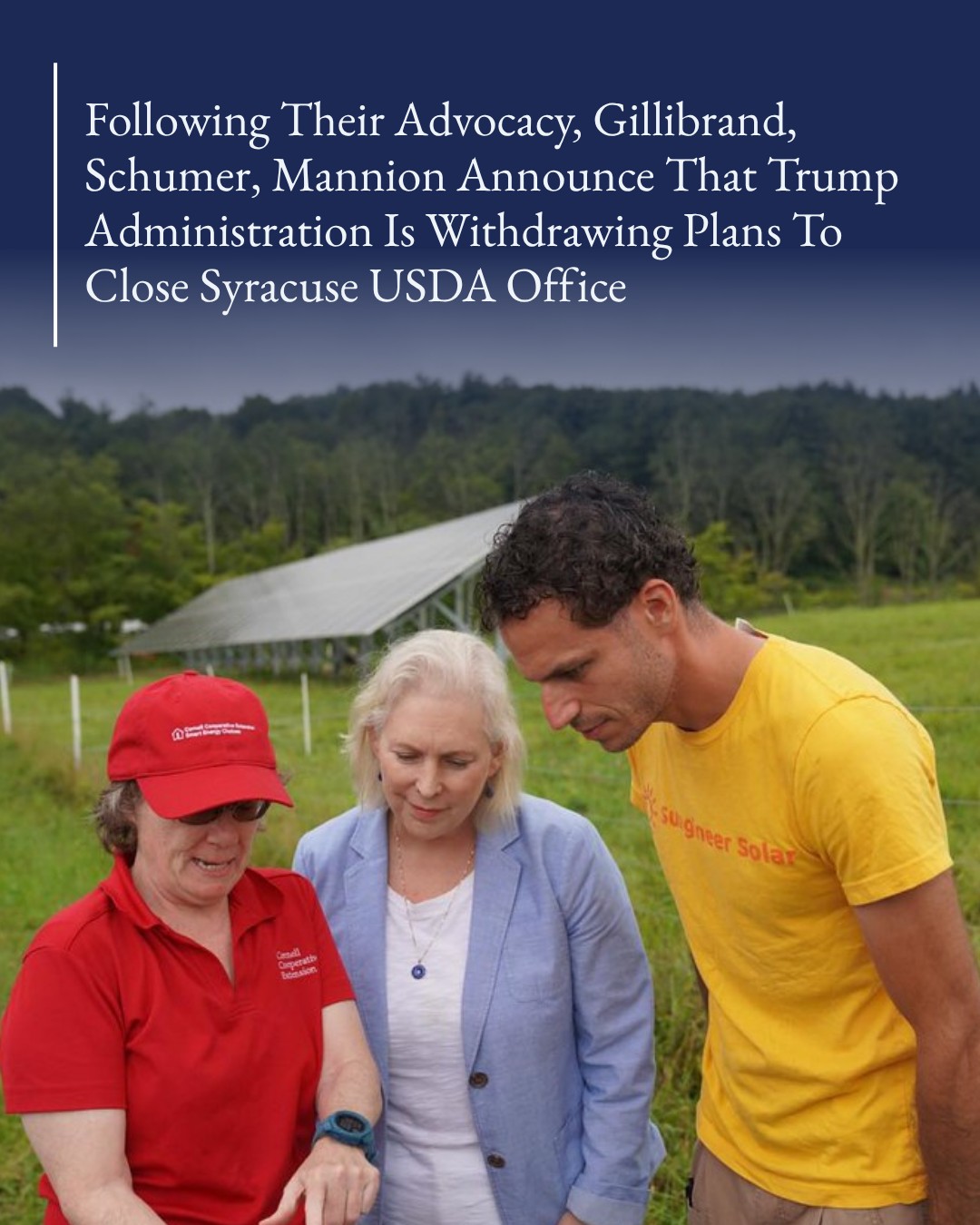
Syracuse USDA Office to Remain Open
This administration’s plans to close the USDA office in Syracuse would’ve left farmers, scientists, and rural communities without the support they need to secure crucial federal resources.
I pushed back, and I’m glad to see the administration is reversing course.

Banner Image: Senator Gillibrand on Juneteenth. Image Credit – Senator Gillibrand

