


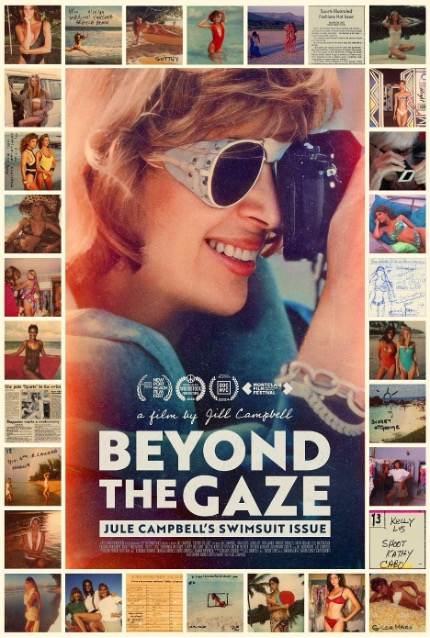
Beyond the Gaze Must See Movie Review: History Of Jule Campbell’s Swimsuit Issue Of Sports Illustrated

If you live in this culture, even if you’re a younger person, you’ve probably heard about the “Swimsuit Edition.” Maybe you have always been mildly interested in it, maybe you wondered what it was, or maybe you lived through the era when it all started. The story described in this excellent documentary follows the woman (yes, it was a woman, not a man, who was behind this story) who created and continued the Swimsuit Edition of Sports Illustrated.
Jule Campbell was a woman in a man’s world. She was pioneering in many ways, but what she did for models and women everywhere may never be fully recognized or understood. She took advantage of the fact that she knew the audience. She knew what they wanted, and she knew what would be right for them to see. Contrary to the outraged – and praising in about equal amounts – letters that came in, she was not creating smut. Far from it. She was an expert in understanding what people wanted to see and what the models should let them see
Another contrary to popular belief statement: the majority of the swimsuit issue’s audience was actually women, not men as one would expect.
A True Career Starter With Heart
Through this documentary we also learn that Jule Campbell knew what she was doing: she literally started the careers of models she thought had real potential. Have you ever heard of Christie Brinkley, Kathy Ireland, or Tyra Banks? It’s because of Jule and her swimsuit edition.
The movie delves deeply into the politics and sexism of the time, which hasn’t abated as much as many people think – particularly when it comes to pregnancy and childbirth. But in those days, it was very hard for a woman to be taken seriously – especially in the modeling and photography industries. Unfortunately, most female models have been sexually assaulted – in many cases by their photographers. This leads naturally to trust issues which were transferred to Jule and her photographers. But Campbell was able to take situations with scantily clad models and photographers, and she was able to keep them for the most part above board. She protected her models, and was a very motherly figure to many of them as well.
One interesting point about her career and the magazine is that she was the one deciding which photos were reviewed. There were many, many pictures that couldn’t be used. Maybe it made the model look sexual in an off-putting way, maybe it was too racy, maybe it was in poor taste the way it came out. In all these instances, she would just remove the photos. Then when they were reviewed by the men who were the editors, only the most beautiful and tasteful photos were even seen in the first place. She knew that if she gave them all the photos, it would quickly devolve into a raunchy, tasteless rag, and it wouldn’t have been the cultural phenomenon it became.
And even Jule herself couldn’t have imagined what the magazine would become. It’s a cultural phenomenon that has been known around the world, and it was so ahead of its time. It gave a woman the power to decide for herself who she wanted to be – on multiple levels. It gave this power and choice to Jule herself, but also to every model who wanted to take her life into her own hands and make a career out of something different and unusual. But they made it work, and here we are. Just look at the progress that has been made, and that was in a very real sense facilitated by Sports Illustrated Swimsuit Edition.
Of course, it wasn’t all easy. She faced many obstacles, including being the lowest paid editor on the staff due to being a woman, illuminated when her editor replied to her request for a raise with “You have a husband.” Nevermind that she made the magazine more money with that one issue than anyone else there with her efforts, to the tune of $35 million in advertising revenue. Imagine if the managing editor had said that to a man asking for a raise!
But she pressed on, and continued her work, giving models their careers and creating the supermodel. She did this by always crediting the models by name in the magazine issue. This gave them a voice and allowed them to do more than just be behind the lens. They went on to become prolific entrepreneurs in many instances. Including Kathy Ireland and Christi Brinkly, both of whom are household names because of Jule Campbell. They went on to found very successful companies, and all of them credit her with giving them a start.
The film was interwoven with scenes from her family life and toward the end of her life as the documentary was being made. The woman behind the documentary is her daughter in law, and offers a rare glimpse into the home life of this pioneering woman.
The End Of Her Story
Unfortunately, this was the world of publishing. A world of men and by men, where everyone is expendable. After about 30 years, the managing editor was retiring, and he decided that it was time for Jule Campbell to be finished. She wanted to keep her job. She wasn’t done. But in the end, she was in essence forced to train her replacement and step away from the beautiful creation she had pretty much made from scratch, out of nothing into something incredible.
The nice way to say it is that she was forced into retirement. But one of her coworkers was quite clear that he didn’t want to talk about it, presumably because it was so cruel to her. If she was, in fact, made to train her replacement, that makes it even more so.
While she developed a fondness and love for the woman who replaced her, who also didn’t believe it was very fair, it was never the same after that. The Swimsuit Edition did change after that. It had to move into the new idiom, and it became even more targeted to women, according to one of the latter editors in his retrospective of her life and the movie. It also became just a brand to be traded off for profit. It changed hands multiple times after Time decided to part with that aspect of its larger brand. Much of its character has changed as a result, but it still generates strong revenue for its current owners. The documentary was finished before Jule’s life ended in 2022.


Banner Image: Documentary promo. Image Credit – Falko Ink

