


In New York: Stalking, Harassment At Work, At Home, Or By Strangers – Current Laws, Future Changes Needed
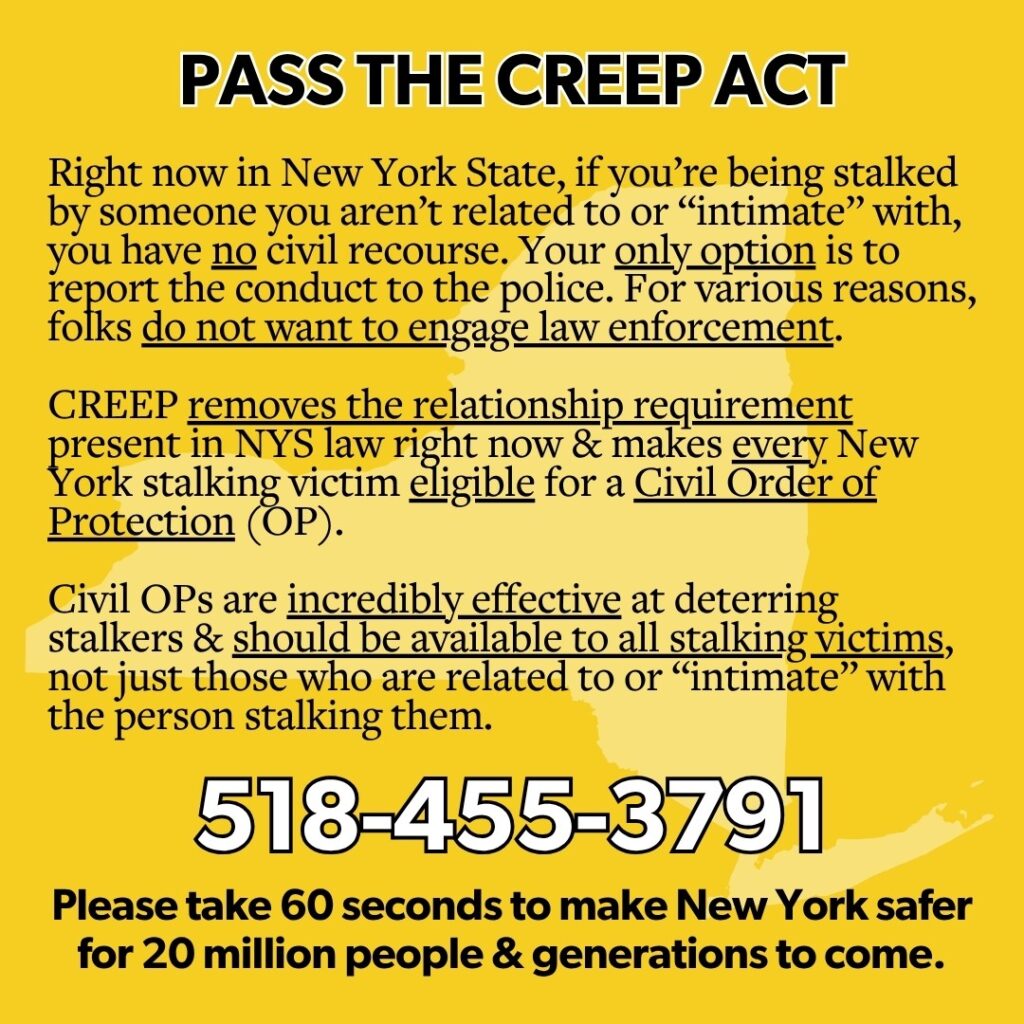
Legal protections currently exist only for those harassed or stalked at work, whether by a co-worker or outside individual, and those who are stalked or harassed by a relative or former significant other. All other types of stalking is presently not covered by the laws that protect victims in New York City.

On Staten Island and in New York City, there are a multitude of laws that cover stalking and harassment. Most of these laws apply to the workplace and domestic situations (where the perpetrator is a family member or former spouse), while there are very few if any protections available for those whose stalker or harasser is unknown to them or unrelated.
For people who have jobs in NYC, there are a variety of protections available. One cannot be harassed at work if it’s based on a protected characteristic (such as race, gender, or sexual orientation). In instances where such harassment is reported to an employer, the employer is legally obligated to take action, and retaliating against the reporting worker is specifically disallowed.
An individual also cannot be stalked at work, and victims of stalking can request reasonable accommodations from their employer. Such accommodations might include remote work, time off for court dates, and other non disruptive activities. They cannot place an unfair burden on the employer. People who are stalked cannot be removed from their job for being a victim of stalking.
For the sake of definitions, stalking involves a situation where a reasonable person would feel fear. So it might mean being followed on foot or by car, repeated and unwanted calls, dropping by their job, and other fear provoking activities.
On the contrary, harassment is more of an annoyance. It can also involve following or calling, but usually means unwanted attention rather than actually attempting to harm or instill a fear of harm in the victim. Sexual harassment at work would fit this category. The two differ primarily in the subjective feelings of the victim that a normal person in their situation would also feel, and are differentiating by whether the reasonable response is fear or annoyance.
When it comes to situations where someone is being harassed or stalked by a person not related to them and not in a prior relationship with them, there are very few options to help them. Whereas domestic partners and relatives can get a civil restraining order against someone harassing them, those stalked or harassed by strangers have no protections at all. Their only option is to involve the criminal justice system if it rises to the level of violence against the person or a repeated, provable pattern of behavior that appears to endanger the victim, where a reasonable person would fear for their safety. In most other situations involving a stranger, such as a neighbor damaging one’s property, pets, or possessions, their only option is to sue in civil court, and such a suit also doesn’t allow for a restraining order.
However, there is a law in the NY Senate that would change that. By simply changing the requirement that the victim seeking a restraining order be related to the perpetrator, it would pave the way for real protections for victims of stalking and harassment by neighbors or strangers. It would allow a restraining order to be obtained in those situations, and it has been shown that such orders are very effective in making harassment and stalking behaviors stop.
Readers will learn a lot from Ms. McCabe about stalking and harassment, how they’re similar and different, when it’s criminal vs. civil, and what people can do to protect themselves or to stop such behaviors in the future. Plans moving forward that are being pushed by advocates and politicians gives you an idea of the present legal landscape and the changes hoped for to make everyone safer from this type of crime.
The following resources were provided by Legal Momentum, and they provide resources for multiple topics mentioned during the conversation:
About Legal Momentum
Legal Momentum, founded in 1970, is a 501(c)(3) nonprofit and the nation’s first and longest-serving legal advocacy group for women in the United States. Betty Friedan and Muriel Fox were its co-founders and Muriel Fox is an ongoing leader of the organization.[2] Carol Baldwin Moody became President and CEO in April 2018. The organization, founded as the NOW Legal Defense and Education Fund,[3] became Legal Momentum in 2004. Legal Momentum is a multi-issue organization[4] dedicated to advancing women’s rights and gender equality, particularly in the areas of equal education opportunities; fairness in the courts; ending all forms of gender-based violence; workplace equality and economic empowerment. The organization employs three main strategies: impact litigation, policy advocacy, and educational initiatives. It is headquartered in New York City.[5][6][7]
About Maria McCabe
Maria McCabe is a Legal Fellow at Legal Momentum, where her work focuses on promoting workplace justice and economic empowerment for women, especially low-wage women workers and survivors of gender-based violence, through impact litigation, advocacy, and education initiatives.
Banner Image: CREEP Act banner. Image Credit – Legal Momentum
Staten Islander News Service Staff Writer


This byline indicates that this article was penned by a member/members of the Staten Islander News Organization office team. Our staff writers are the backbone of our newspaper, performing all sorts of important tasks like conducting interviews, investigating leads, besides writing the news stories you see.