


New Yorkers, Staten Islanders: Corporation For Public Broadcasting Shuts Down After Rescission Bill, Effects Of This Loss Likely To Impact Generations
In recent weeks, Staten Islanders have learned about the importance of public television for children’s educational programming, both in a Congressional hearing and political talk, as well as from Mister Rogers on multiple occasions. These all focused on the value of children’s programming, but that is only part of what public television and public radio offered. There is now a gap that commercial television will not be able to fill, mainly because of their focus on profitability at all costs. In the below video, hear from the CEO of Sesame Street Workshop, responsible for their educational programming, as well as the research they do to continue to be relevant and provide kids with what they need to learn and grow.

One study that the Sesame Street CEO cited mentioned that fourth grade reading level is the best predictor of high school graduation among many different populations of kids, and that high school graduation is directly tied to poverty in adulthood. Without PBS and the shows that it provides, many children across the country were missing out on these good outcomes. But as Sesame Street evolved over time, it became more and more useful, particularly to educators. Many teachers of small children use the programs in the classroom, and that includes programs for older children such as NOVA and other science-based television provided by PBS.
Without the critical seed money, as Vice President Al Gore calls it, also in the above video, that comes from the federal government, public broadcasting could not exist. Al Gore quoted Thomas Jefferson, who said, “If a nation expects to be ignorant and free, in a state of civilization, it expects what never was and never will be.”
Indeed, the question that was on everyone’s minds in the last few weeks was: What if Congress cuts funding for the Corporation for Public Broadcasting, and for all public television. Today, we are beginning to see the answer. Yesterday, the CPB announced that it will be winding down its operations, and can no longer carry on its mission of providing critical funding to local stations. In many communities, particularly larger rural communities, where the income is not high and perhaps there is no cable or FIOS (or it cannot be afforded), there will be no public television. There may be no news at all when the funding for public television goes away. Many stations across the nation who carry PBS or NPR will no longer be able to do so. In many communities, this would have been the only smaller news station, leaving behind only those corporate media giants who are able to broadcast into these less populous areas. As discussed in our previous video on this subject, 80% of Americans supported PBS and NPR. Over 50% of Americans believed it was an unbiased source of news.
The vast majority of Americans support CPB, PBS, NPR, and other public television and radio sources. Most of the generations alive now grew up on this type of television, and it informed their lives, in some cases taught them to read and write, and served as a source of local news that was not subject to the same biases and constraints of other networks. It was not as important that it be profitable, because this funding was there to make it so that they could succeed with assistance, particularly where they could not make it alone. As this unfolds over the course of the next couple of years, the effects of this rescission bill will become clearer, though today we can only guess.
Following is a quote from our own PBS broadcasting station, Thirteen/WNET:
Below, find statements from Senator Gillibrand, CPB, along with PBS and NPR about the devastating impact this loss is likely to have on our local and rural communities:
The following quote was provided by Senator Gillibrand after the rescission bill passed, along with helpful background info on her fight to keep public broadcasting funded:
“I’m appalled that Republican funding cuts to the programs that our rural communities rely on have forced the Corporation for Public Broadcasting (CPB) to wind down its operations. Their reckless decisions will endanger the local radio and television stations that families in New York and across the country depend on for lifesaving emergency alerts, high-quality educational content, and trusted news,” said Senator Gillibrand. “This will have a particularly devastating impact on our rural communities, where stations rely heavily on CPB funding to stay afloat. In the Senate, I will continue to fight for public broadcasting, to support rural communities, and to make sure that hardworking families have access to the vital resources and information they deserve.”
On Background: The State of New York already does distribute money to local public television and radio stations. The New York State Education Department grants $14 million to 25 public radio and television stations. But in comparison, CPB gave New York $42.556 million in FY24. Senator Gillibrand has long fought for CPB funding. She led Democrats in a letter to Majority Leader Thune opposing CPB rescissions, and she co-led the amendment that would have stripped out CPB from the rescissions package.
Corporation for Public Broadcasting Addresses Operations Following Loss of Federal Funding
WASHINGTON, D.C. (August 1, 2025) – The Corporation for Public Broadcasting (CPB) announced today that it will begin an orderly wind-down of its operations following the passage of a federal rescissions package and the release of the Senate Appropriations Committee’s FY 2026 Labor, Health and Human Services, Education, and Related Agencies (Labor-H) appropriations bill, which excludes funding for CPB for the first time in more than five decades.
For nearly 60 years, CPB has carried out its Congressional mission to build and sustain a trusted public media system that informs, educates, and serves communities across the country. Through partnerships with local stations and producers, CPB has supported educational content, locally relevant journalism, emergency communications, cultural programming, and essential services for Americans in every community.
“Despite the extraordinary efforts of millions of Americans who called, wrote, and petitioned Congress to preserve federal funding for CPB, we now face the difficult reality of closing our operations,” said CPB President and CEO Patricia Harrison. “CPB remains committed to fulfilling its fiduciary responsibilities and supporting our partners through this transition with transparency and care.”
CPB informed its employees today that the majority of staff positions will conclude with the close of the fiscal year on September 30, 2025. A small transition team will remain through January 2026 to ensure a responsible and orderly closeout of operations. This team will focus on compliance, final distributions, and resolution of long-term financial obligations, including ensuring continuity for music rights and royalties that remain essential to the public media system.
“Public media has been one of the most trusted institutions in American life, providing educational opportunity, emergency alerts, civil discourse, and cultural connection to every corner of the country,” Harrison said. “We are deeply grateful to our partners across the system for their resilience, leadership, and unwavering dedication to serving the American people.”
CPB’s Board of Directors and management are working closely to address the legal, financial, and operational requirements of the closure. CPB will provide regular updates and guidance to stations and producers navigating the profound challenges ahead.
About CPB
The Corporation for Public Broadcasting (CPB), a private, nonprofit corporation authorized by Congress in 1967, is the steward of the federal government’s investment in public broadcasting. It helps support the operations of more than 1,500 locally managed and operated public television and radio stations nationwide. CPB is also the largest single source of funding for research, technology, and program development for public radio, television, and related online services. For more information, visit www.cpb.org and follow us on Facebook, LinkedIn, and subscribe for email updates.
PBS Statement on the Senate Approval of the Rescissions Package
ARLINGTON, VA; July 17, 2025 —PBS President and CEO Paula Kerger released the following statement after the Senate voted to pass the rescissions bill that will claw back previously approved federal funding for public media.
“The Senate just approved a rescissions package that goes against the will of the American people, the vast majority of whom trust PBS and believe we provide excellent value to their communities.
“These cuts will significantly impact all of our stations, but will be especially devastating to smaller stations and those serving large rural areas. Many of our stations which provide access to free unique local programming and emergency alerts will now be forced to make hard decisions in the weeks and months ahead.
“There is nothing more American than PBS. Despite today’s setback, we are determined to keep fighting to preserve the essential services we provide to the American public.”
Statement from Katherine Maher, NPR President & CEO, on Closure of Corporation for Public Broadcasting
dcasting (CPB) has been a cornerstone of public broadcasting in the United States for more than half a century. It has served as a vital source of funding for local stations, a champion of educational and cultural programming, and a bulwark for independent journalism — enabling organizations like ours to deliver essential news and culture across the nation.
CPB upheld the core values of the Public Broadcasting Act, including support for diverse voices, promotion of excellence and creative risk, and advancing service for the unserved and underserved. It empowered countless journalists, producers, and educators to create programming that has enriched lives, fostered understanding, and held power accountable. The ripple effects of this closure will be felt across every public media organization and, more importantly, in every community across the country that relies on public broadcasting.
The closure of CPB represents the loss of a major institution and decades of knowledge and expertise; an immediate consequence of the passage of H.R. 4, the Rescissions Act of 2025. We’re grateful to CPB staff for their many years of service to public media.
As an independent, nonprofit news organization, NPR remains resolute in our pursuit of our mission: to create an informed and inspired public in partnership with our Member stations. We will continue to respond to this crisis by stepping up to support locally owned, nonprofit public radio stations and local journalism across the country, working to maintain public media’s promise of universal service, and upholding the highest standards for independent journalism and cultural programming in service of our nation.”
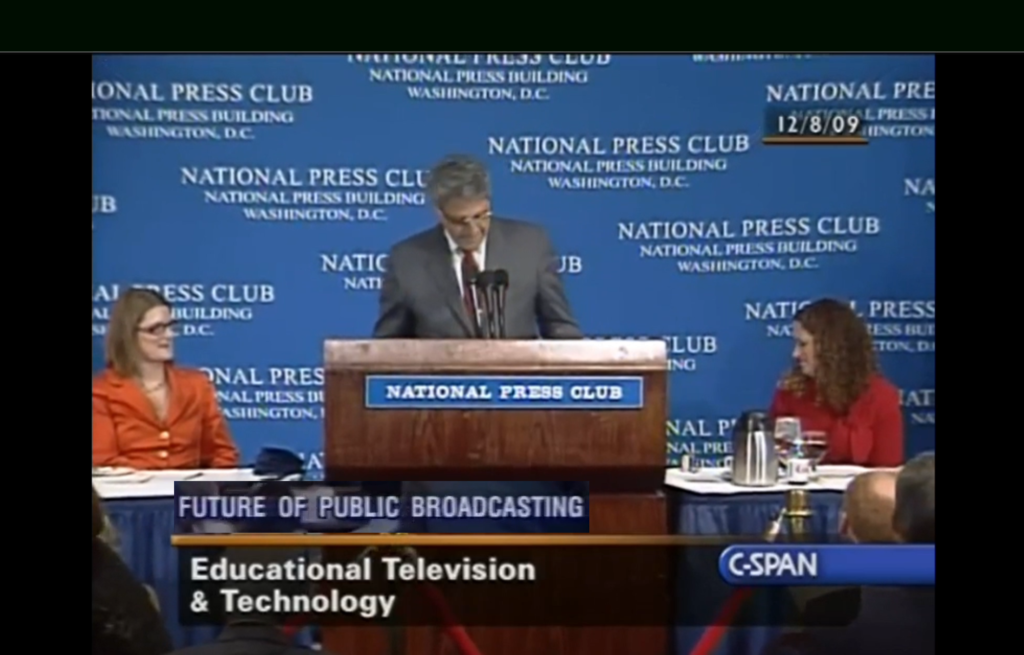
Banner Image: Video cover. Image Credit – C-Span
Staten Islander News Service Staff Writer


This byline indicates that this article was penned by a member/members of the Staten Islander News Organization office team. Our staff writers are the backbone of our newspaper, performing all sorts of important tasks like conducting interviews, investigating leads, besides writing the news stories you see.