


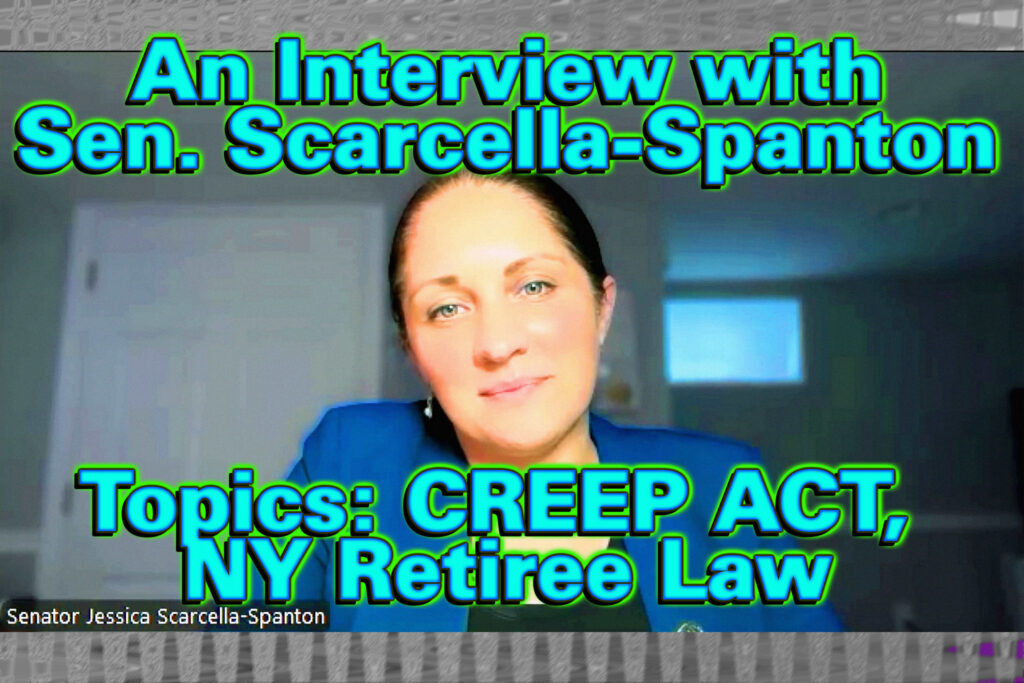
Staten Island’s Senator Scarcella-Spanton: CREEP Act To Protect Victims Of Stalking, Harassment; Retiree Healthcare Can Be Protected By NY Senate
Editor’s note: For Staten Islanders interested in learning more about harassment and stalking as it relates to the workplace and present laws around employer responsibility, check out our interview with Legal Momentum.

Senator Jessica Scarcella-Spanton, also known as Senator Jess, represents Staten island and parts of Brooklyn in the New York State Senate. We talked with the senator about the CREEP Act and about healthcare for Retirees and the Senate bill that can protect them.
The CREEP Act is an acronym for Ceasing Repeated Extremely Egregious Predatory Behavior. Its aim is simple: to provide victims of stalking and harassment whose perpetrators aren’t related to or formerly in a relationship with them with a way to protect themselves.
Stalking is a real thing. For many people, it’s all too real. One day, out of nowhere, someone decides they hate you – and want to ruin your life and everything they can in it. And you don’t know them, and you’ve never done anything to them. Welcome to the weird world of stranger/ neighbor harassment and stalking.
One of the reasons it is so prevalent is that there IS right now nothing you can do about it. If your neighbor knocks on your door a hundred times (it’s not illegal to knock on a door)… if they call your phone every day…. it’s not illegal to call someone…if they show up at your job… There are many examples from celebrities, politicians, and ordinary Americans. Keep in mind, this is someone you don’t actually know. Often it’s a neighbor. Sometimes it’s random strangers. It can even happen to elected officials and celebrities, perhaps most famously Pete Davidson and Taylor Swift. But they do things that are within the law, that they know they can’t get arrested for. So they can shine a light into your doorway or a camera from their yard. As long as they don’t come into your house to install it, it’s legal. If they follow you around the neighborhood, that, too, isn’t illegal.
In some states, however, these things can be demonstrated as a pattern of harassment or stalking. It is the pattern that makes the behavior rise to the level of warranting a civil restraining order. However, in New York State, there is no such law. As long as there is no violence, there is nothing that police or other law enforcement can do.
The perpetrators of stalking and harassment are often people who are very familiar with the law. For example, did you know that going into someone else’s car, as long as there’s no obvious evidence of forced entry such as a broken window, is not an arrestable offense. Not only that, but if you accost such a person, putting your hands on them even just to keep them there until police arrive, YOU can be arrested, and they won’t be. This is in New York right now how the law is written.
This new law, the CREEP Act, would change that. In the same way as someone who is in a domestic relationship and is being stalked can present their evidence before a judge, so could someone who isn’t related or in a relationship, with this new law. When going before a judge, such victims will often have a preponderance of evidence, actual proof that the stalking is happening. But instead of being required to wait until violence occurs, you can protect yourself. A judge can issue a restraining order against the perpetrator.
As it stands today, police are powerless to help a stalking victim until they become violent. However, in domestic situations, it is understood that one should not have to wait until that point. Without family restraining orders, those who want to cause harm to their significant other would find it much easier to escalate their harassment into violence. But in order to protect primarily women and children – and some men who are abused – these types of restraining orders were put in place.
As it turns out, they are very effective. Between 30 and 80% of the time, the perpetrator does not become violent when this is present, and often stops bothering the victim when a restraining order is granted. They don’t want to go to jail. Of course, there are cases where this doesn’t happen. In New Jersey recently, a man shot his ex, her new boyfriend, and himself. This was recently in the news. In the case of Nathaniel Deen, whose story we have covered, a restraining order did not prevent the tragic end his mother suffered at the hands of his father. There are people in relationships that are unhealthy, where they believe themselves to possess another, and if they can’t have them, no one can.
It has become understood that people who stalk others have boundary issues, and in most cases, it does escalate to either heavier harassment or outright violence. It rarely stays as it is. That’s why this law is so essential. It gives victims of stalking a way to protect themselves, by simply allowing them to obtain civil restraining orders if a judge agrees with them.
This bill also provides options for victims of online stalking and harassment. The individual responsible can be ordered to stop doing whatever it is they’re doing, whether sending hundreds of emails, posting falsehoods or verbal attacks on social media, or other forms of cyber bullying and harassment. This gives options to people who have been subjected to these kinds of abuse, up until now with impunity.
This bill has already passed the Senate almost unanimously, and New York is following other states who have already done this. The Assembly bill will be in the next legislative session, and Senator Jess is looking forward to working with her Assembly colleagues to get this bill passed.
Retiree Healthcare Battle Could Be Finished Today With Senate’s Help
For those of our readers who have been following the retiree healthcare battle over the past multiple years (basically since 2021, during the pandemic), you are aware that the war is not over. Right now, retired municipal workers at the state and city level are in political limbo. Several of the current Mayoral candidates have stated publicly that they won’t continue to pursue forcing retirees onto Medicare Advantage. But these are just political promises. Without Intro 1096, which is a City Council bill seeking more signers, there is no protection at the city level from a future administration using retired workers as a bargaining chip for better pay and benefits for active workers. None at all. Just political promises.
If the bill before the NY Senate is amended to reflect that date in 2021 before they started being charged illegal copays, and if it is passed, it will solve the question for future generations. No other group of retirees will have to mobilize, organize, and sue the city or state in order to keep the healthcare choice that was orally promised to them. Since the promise wasn’t in actual writing, the court has declared that it isn’t binding.
So every new group of retired city or state workers is at the whim of incoming politicians and their unions looking for ways to pay for active worker raises and other benefits. Since retired workers are not active workers, they have no protections. These labor laws were written when people didn’t live to retirement quite so often, and many union employees didn’t live to an old age either. So now, no one protects them.
In addition, no one could protect them as an umbrella group if they wanted to. Unions are given complete access to the names and personally identifying information of all employees of a company or the city. A group that wants to protect retired workers is on their own. They have to find the people themselves through other means that are really difficult, especially for older people. Or the people can find them. But as it is today, there is no law allowing retired workers to form an actual union to protect themselves. Marianne was able to form the organization she runs, and was able to find many retired workers through their younger relatives, Facebook posts, Youtube videos, and many other methods. The retired workers who are members are basically paying lawyer’s fees to defend their healthcare choice. They want to have the choice between traditional Medicare and Medicare Advantage.
And, at the time in 2021, their unions used the retired workers’ health insurance after retirement as a bargaining chip to get raises for their active workers. The unions used the fund that was supposed to pay that 20% insurance premium left over with traditional Medicare. With Medicare Advantage, this isn’t the case. The premium is free.
The catch is that the Advantage insurers make their money by charging the federal government a premium for each person – while also denying most claims, regardless of how necessary they might be. In addition, they try to encourage healthy habits- such as with gym memberships and other perks. However, as anyone with older relatives knows, this can be very difficult to do. And most older adults aren’t willing to be proactive about their health. They prefer to wait until they get sick and then take medicine. The problem with that is that with Medicare Advantage, the company denies everything, while at the same time requiring preapproval in most cases. So this delays care which might be life saving.
Traditional Medicare doesn’t pay premiums to insurance companies for enrollees. They pay when services are provided, and they negotiate directly with providers for the best possible price. Consequently, Medicare Advantage not only costs the government more than traditional Medicare, but it also provides less care overall and lower quality of care due to denials and delays. It also made it so that private insurance companies could get involved in Medicare, which was previously a directly government run type of healthcare for decades. Instead, they allow private insurance companies to become gatekeepers for the medical care those on their plans can receive. While this may be fine for some people, others need actual health insurance that pays for their claims. This is what traditional Medicare provides. Readers can learn more about this aspect of the question below:
View the video above to learn more about both of these topics.
Banner Image: Video cover. Image Credit – Staten Islander News
Staten Islander News Service Staff Writer


This byline indicates that this article was penned by a member/members of the Staten Islander News Organization office team. Our staff writers are the backbone of our newspaper, performing all sorts of important tasks like conducting interviews, investigating leads, besides writing the news stories you see.