


Editor’s note: As noted below, residents of Bayonne interested in planting one of the trees offered can do so by contacting the city. The cost of $250, and the beautification they offer can make it worthwhile. If you’re looking at these from an ecosystem support point of view, notes were added below in [] regarding their capacity to support birds and insects. Only one is not useful for that purpose (the Kwanzan Cherry), but all the others will benefit the local ecosystem.
The following questions were provided by the City of Bayonne, in answer to our questions about the Tree Initiative and the Backpack donation:
Concerning the backpacks, the Board of Education will be in charge of distribution. In Bayonne, the Board of Education is a separate entity from the City of Bayonne. It’s different in New York City, where the school system has been under the mayors since the Bloomberg Administration. The Board of Education runs the lunch program. You could speak to them about additional details concerning lunch programs, method of backpack distribution, etc. I do not know which specific items will be in the backpacks.
In terms of the tree questions, much depends on demand. The Public Works Department plants trees every year. There are two seasons for planting – spring and autumn. Due to the limited number of Forestry Division personnel, the City program can plant up to 35 trees in the spring and up to 35 trees in the autumn. We can order trees from the nursery in response to demand up to the numbers of 35 in the spring and 35 in the autumn.
Bayonne Announces Tree Initiative
Mayor Jimmy Davis announced that Bayonne’s Department of Public Works is now offering eight trees to the public for planting in Bayonne. Mayor Davis said, “Trees provide shade and add greenery to our neighborhoods. I urge Bayonne residents and businesses to take advantage of this great program from our Department of Public Works.”
The trees available from the Department of Public Works are the Red Sunset Maple [food source for many birds and insects], the Autumn Blaze Maple [feeds a few birds but many insects], the Prunus Canada Red [red chokecherry – provides fruit for birds], the Pin Oak [birds eat the acorns while Oaks support many insects acc. to. Doug Tallamy], the American Elm [important ‘soft mast’ for birds and mammals], the Kwanzan Cherry [ornamental only – not food for birds or insects], the Accolade Cherry Blossom [food source for birds], and the Sycamore [food source for birds, muskrats, beavers,etc]. The price for a six-to-seven-foot tree is $250. The price includes planting and a watering bag to promote healthy growth. Property owners are responsible for providing any concrete cutouts needed for tree-plantings. The spring and the autumn are tree-planting seasons.
Since 1998, the City of Bayonne has been proud to be designated a Tree City USA by the Arbor Day Foundation. Having a municipal tree program is one of the qualifications for being a Tree City USA.
For more information on planting trees, please contact the Department of Public Works at 201-858-6131.

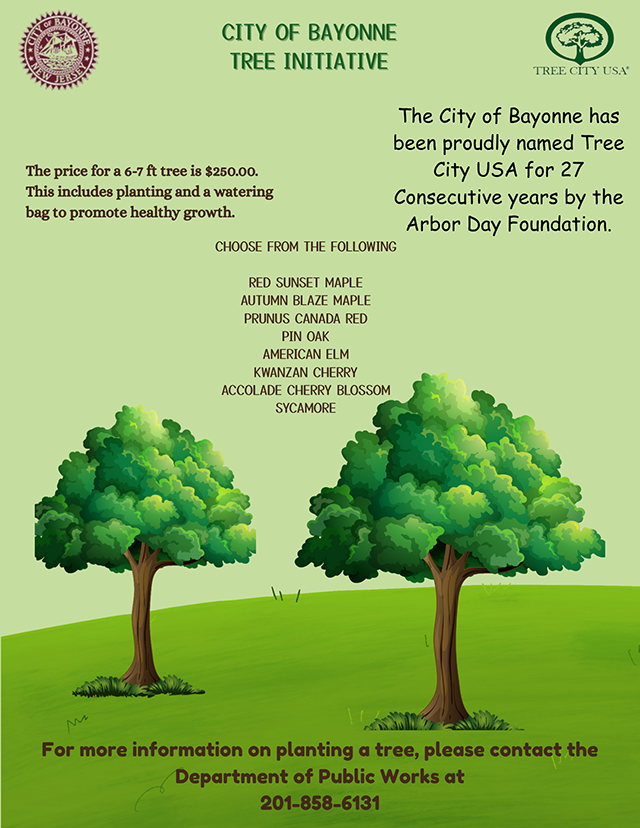
Bayonne Tree Initiative. Image Credit – City of Bayonne

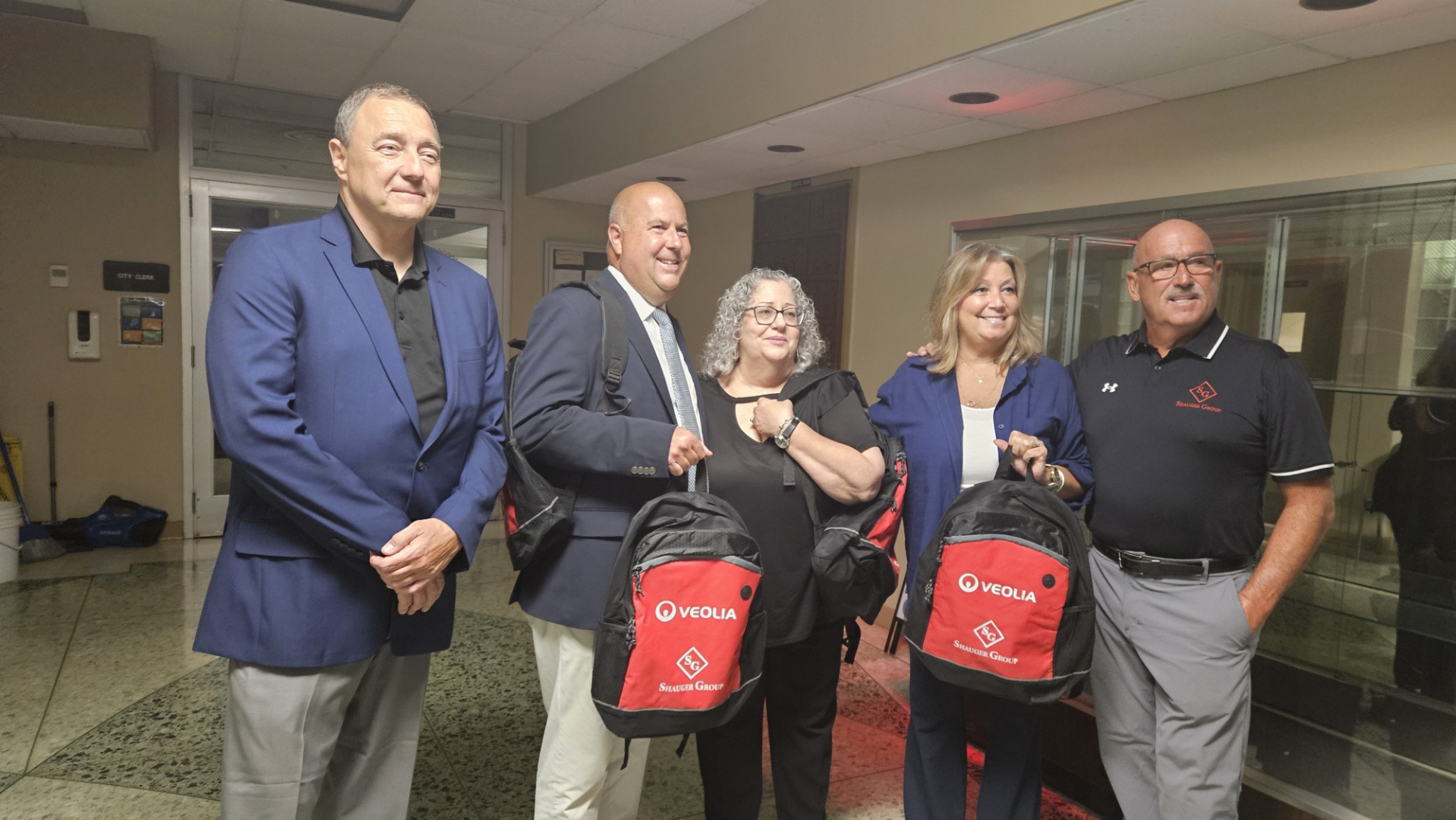
Pictured left to right: John Libitz, Program Manager, Veolia Water; Dr. Dennis Degnan, Assistant Superintendent, Curriculum and Instruction, Federal and State Programs, Bayonne Board of Education; Kim DeMedici, Supervisor, Special Services, Bayonne Board of Education; Suzanne Cavanaugh, Director of the Department of Municipal Services, City of Bayonne; and Donald Shauger, Executive Vice President, the Shauger Group. Image Credit – City of Bayonne
Backpack donations for Bayonne children in need: The Shauger Group and Veolia Water have donated 75 backpacks to the Bayonne Board of Education. The backpacks are filled with school supplies. They will be distributed to needy children. Veolia Water manages Bayonne’s water-sewer utility. The Shauger Group works in construction, maintenance, and underground utilities.

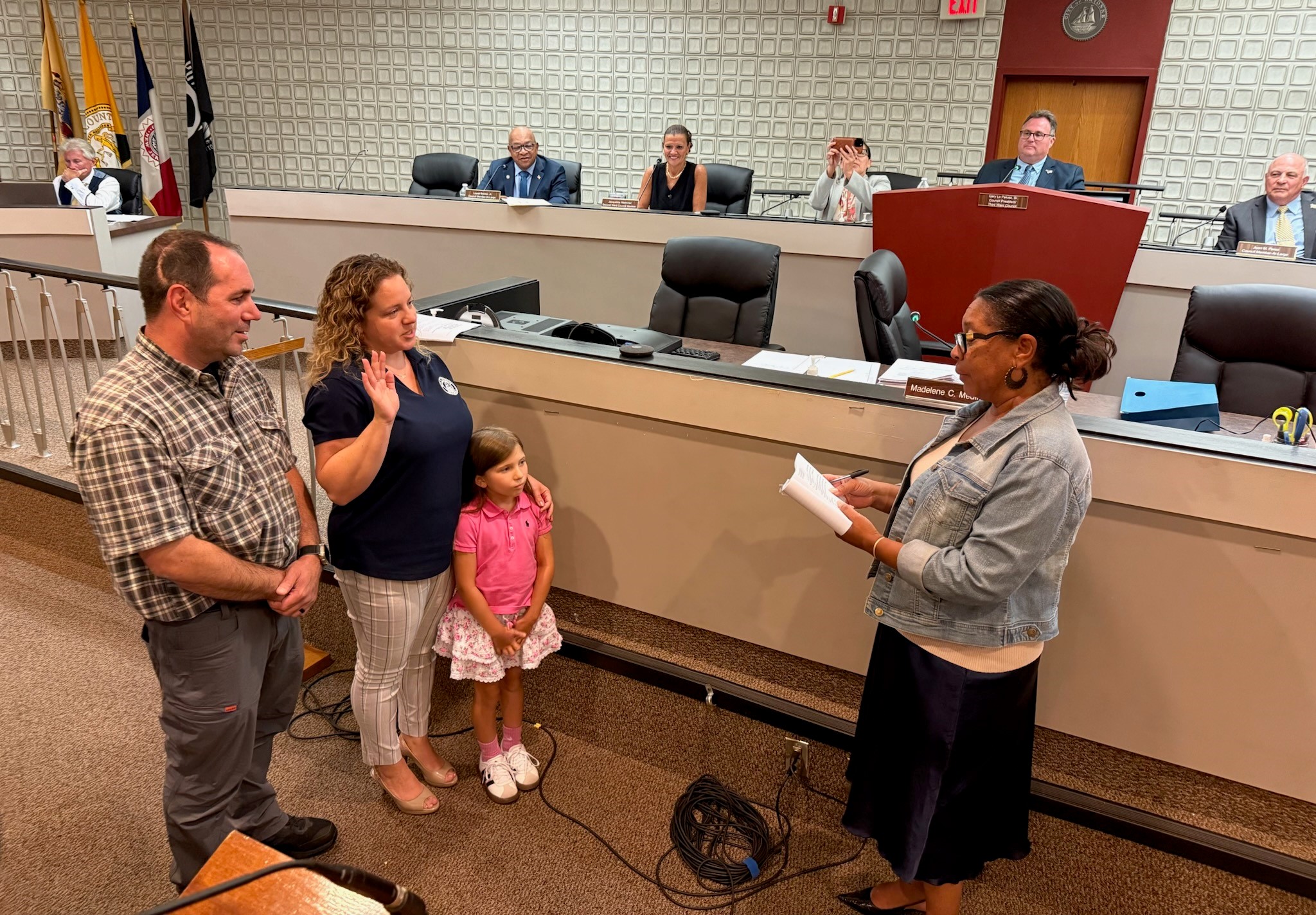
Tina Siciliano was sworn in as Bayonne’s new Health Officer at the City Council meeting on August 13. Image Credit – City of Bayonne
Bayonne’s New Health Officer:
Tina Siciliano was sworn in as Bayonne’s new Health Officer at the City Council meeting on August 13. City Clerk Madelene Medina administered the oath of office. Pictured left to right in the foreground: Gary Parlatti (Building Inspector, City of Bayonne), the Health Officer’s husband; McKayla (Ms. Siciliano’s daughter), and City Clerk Medina. Pictured left to right the background: City Law Director Jay Coffey; City Council Member At-Large Loyad Booker; Second Ward Council Member Jacqueline Weimmer; Assistant City Attorney Karla Garcia (with camera); City Council President Gary LaPelusa; and City Council Member At-Large Juan Perez.
In New Jersey, a Health Officer is responsible for evaluating health problems and planning appropriate actions to address those problems. A Health Officer must have either a doctorate or a master’s degree in a health-related field.
A candidate for Health Officer must have at least two years of full-time employment, which provides administrative experience in three of five recognized public health activities. A successful candidate for Health Officer must pass a state-administered, two-part examination.
Ms. Siciliano, who served previously as a Registered Environmental Health Specialist, earned a master’s degree in Public Health (MPH) at William Paterson University.
Ms. Siciliano said, “I am very excited to assume the duties of Health Officer. I look forward to working with colleagues in Bayonne and around the state to safeguard the health of our residents.”
Super Trans AM to Perform in the Summer Sounds Concert on Wednesday, August 20
Mayor Jimmy Davis announced that Super Trans AM will perform in the Summer Sounds by the Bay concert on Wednesday, August 20, at 7:00 p.m. Super Trans AM is a unique and innovative theme band, playing all of your favorite arena anthems and chart-topping radio hits of the 1970’s. Super Trans AM combines unparalleled musicianship with artistic and inspired A/V production. You’ll enjoy revisiting classic sing-alongs from one of the most definable decades in American history.
The concert will take place at the amphitheater on the lower level of DiDomenico-16th Street Park. The concert site is located below the foot of West 16th Street, between Avenue A and Newark Bay. The Recreation Division provides only a limited number of chairs. It is recommended that you bring your own chairs.
On music days during the summer concert season, in the event of inclement weather, please call 201-471-7590, or visit www.leaguelineup.com/bayonnerec, or view the City of Bayonne’s Facebook page to check on the status of that night’s performance. For more information about the concerts, please contact Pete Amadeo at 201-858-6129, or email BAYONNEREC@AOL.COM.
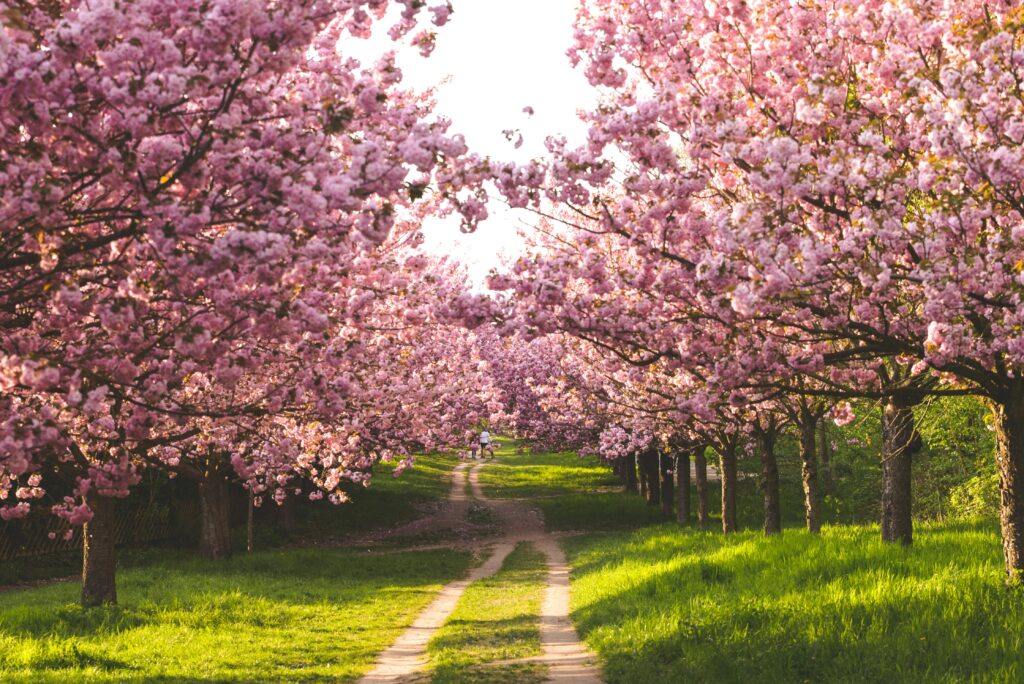
Banner Image: Cherry blossoms. Image Credit – Maud Bocquillod
City of Bayonne


Bayonne is a community that retains many of the elements of a small town. One and two family homes, small apartment buildings, and small business predominate. There is a population of 62,000 people who take pride in their hometown and its history. Bayonne residents and their ancestors moved to the city from many parts of the world. During colonial times and the first century of the American Republic, the Dutch, British, and Africans were the first groups to arrive after the Native Americans. Subsequent waves of immigrants came from all over Europe, especially between the 1880s and the 1920s. In recent decades, sources of immigration have largely been represented from countries in Latin America, the Middle East, and Southeastern Asia. Each group has left its mark on the cultural, religious and political life of the community.