


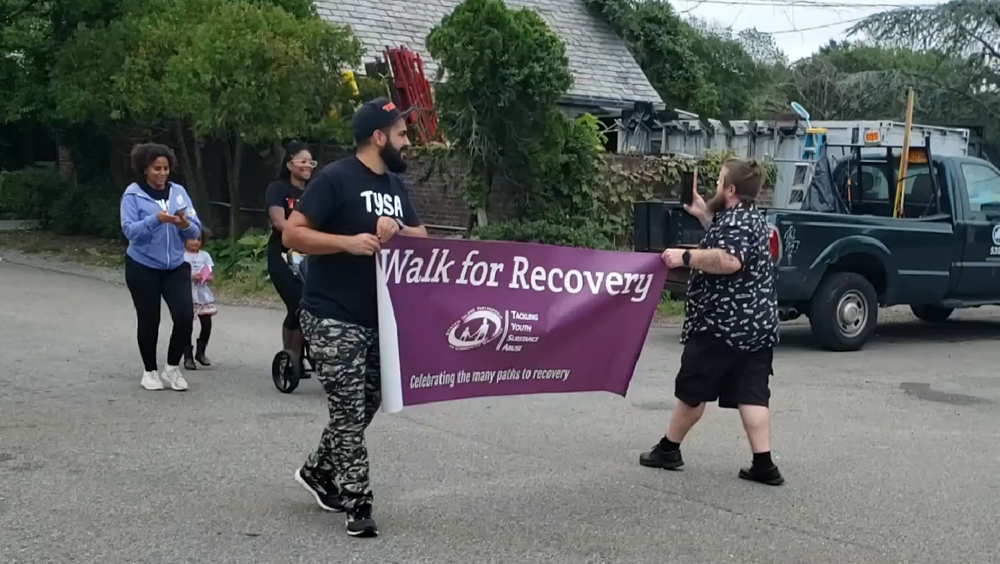

The following was provided by Northwell Health about the walk and the program:
-
What is the program and how does it work? The Hotspotting the Overdose Epidemic Program is led by Staten Island PPS, in close partnership with Staten Island University Hospital (part of Northwell Health) and supported by advocates such as Former Representative Max Rose, who has championed overdose prevention nationally. The program uses AI-driven predictive analytics to identify Staten Islanders most at risk of overdose and engages them with a personalized support system. At its core, Certified Recovery Peer Advocates (CRPAs)—people with lived recovery experience—work directly with clients to connect them to harm reduction tools (naloxone kits, fentanyl/xylazine test strips, syringe exchange), recovery support, and critical medical and social services. A digital platform also rewards participants for sticking to care plans, increasing treatment success.
-
When did it start on Staten Island, and are there other locations it was implemented in before here? The program launched on Staten Island in April 2022, making the borough the first place in the nation to pilot this predictive, peer-led model. It was designed in partnership with MIT Sloan but implemented here first, with SI PPS and SIUH leading the charge. Its strong results have now sparked expansion across New York City and discussions about scaling nationally through a new Hotspotting advisory board, where Max Rose continues to be a strong voice for spreading this model.
-
What are the types of engagement offered to people participating?
-
CRPA-led peer support and outreach
-
Harm reduction supplies (naloxone, test strips, sterile syringes)
-
Social needs screenings and referrals to behavioral health, medical, housing, and other supports
-
Contingency Management rewards via a digital platform that provides incentives for medication adherence, therapy participation, and self-care
-
Continuous care coordination so participants are never left without support
-
-
How does it work to reduce overdoses and deaths? By using data to spot individuals most at risk, SI PPS and SIUH intervene before crisis hits. CRPAs provide constant engagement, ensuring people have naloxone on hand, are supported in treatment, and have their social needs addressed. Max Rose has called the program “the leading overdose prevention initiative in the nation,” underscoring its proven ability to save lives. This has led to extraordinary results:
-
77% reduction in fatal overdoses among those engaged
-
36% reduction in non-fatal overdoses
-
63% reduction in ER visits for substance use disorder
-
-
Is it part of a larger strategy for the island? Yes. This is a flagship initiative of Staten Island’s broader opioid response, with SI PPS coordinating partners across healthcare, behavioral health, law enforcement, and community organizations, and SIUH providing hospital-based leadership. Supported by opioid settlement funding and philanthropy partners like Robin Hood, the strategy is designed not only to save lives locally but to establish Staten Island as a national model for overdose prevention.
-
Do you have success stories you can share?
-
In Year 1, only 2 overdose deaths among engaged clients, compared to 11 deaths in the non-engaged group.
-
In Year 2, engaged participants saw a 77% drop in fatal overdoses, while also dramatically cutting ER visits.
-
Nearly every client received harm reduction supplies and peer support at the point of engagement.
-
Below is the release about the program:
Staten Island Performing Provider System (SIPPS) Hotspotting the Overdose Epidemic Program Achieves a 77% Reduction in Fatal Overdoses and Announces Year 3 Expansion with AI-Driven Solutions
Staten Island, NY – The Staten Island Performing Provider System (SI PPS) is proud to announce the continued success of its Hotspotting the Overdose Epidemic program, which has achieved record Year 2 results in overdose prevention. Launched in 2022 and supported by AI-based predictive analytics, the program focuses on identifying and supporting individuals at the highest risk of overdose – leading to significant strides in saving lives, reducing healthcare costs, and improving health outcomes.
Since the program’s launch, the outcomes for those engaged in the program have been notable. In its second year (April 2023 – April 2024), the Hotspotting Program delivered:
- A 77% reduction in fatal overdoses among individuals engaged in the program.
- A 36% reduction in non-fatal overdoses in the engaged group.
- A 63% reduction in substance use disorder-related emergency room visits, reflecting the program’s success in preventing overdose crises that could lead to hospitalization.
In addition to the reductions in overdose-related incidents, Year 2 also saw an increase in the program’s outreach and engagement:
- 98% of clients received harm reduction services, including naloxone kits, xylazine and fentanyl test strips, sterile syringes and access to syringe exchange programs.
- 100% of clients had a Certified Recovery Peer Advocate (CRPA) assigned at initial engagement, with 99% completing social care screenings. These screenings help to ensure that clients are connected not only to addiction treatment but also necessary behavioral health, medical, and social services.
Building on these successes, SI PPS is expanding the program from four to nine partners in Year 3, with additional growth planned for Year 4. The expansion will increase the program’s reach across New York City, continuing its mission to save lives, improve health outcomes, and address the broader public health crisis created by the opioid epidemic.
To further support this expansion, a national Hotspotting advisory board is being formed, bringing together prominent program advocates, the Hotspotting initiative developers, and healthcare leaders to help other communities implement similar life-saving initiatives. SIPPS is proud to announce that Robin Hood, New York City’s largest local poverty-fighting philanthropy, will join this national Hotspotting advisory board as a founding member. Robin Hood, a leading force in deploying innovative tools to address systemic issues that affect underserved communities, brings invaluable expertise and a shared commitment to improving health outcomes. Robin Hood’s involvement will help strengthen the efforts of the Hotspotting program and enhance its impact throughout the nation.
Program Leaders and Experts Weigh In:
Joseph Conte, PhD, Executive Director of the Staten Island PPS, said:
“Hotspotting continues to produce dramatically positive results in the second phase of the program: a 77% mortality risk reduction for individuals who have been engaged. These results demonstrate that actively engaged individuals in the Hotspotting Program who suffer from substance misuse disorder (SUD), with CRPA-led and technology-enabled solutions, saved lives and reduced overall overdose rates for our community members. While national trends for fatal overdoses are down, the crisis is as much a five-alarm fire as it was last year and the year before. We are grateful to the Silverman Family, Elevance Foundation, and the $12 million in Opioid Settlement Funding secured by Assemblyman Sam Pirozzolo to continue supporting this evidence-making program.”
Brahim Ardolic, MD, Senior Vice President and Deputy Market President, Northwell Western Market, and President, Staten Island University Hospital, stated:
“Overdose rates demand urgent, data-driven solutions. The Hotspotting Program proves that predictive analytics and targeted care save lives—Staten Island is leading the way, and this model must expand across New York. A 63% reduction in substance use-related emergency room visits shows just how effective this approach is, not only in saving lives but also in alleviating the burden on our healthcare system. Every life saved is a step toward breaking the cycle of addiction and strengthening our communities.”
Staten Island District Attorney Michael E. McMahon, said:
“As the five-alarm fire of the fentanyl and overdose crisis continues to rage, we must leave no stone unturned in our pursuit to save lives and put an end to this deadly epidemic. An innovative approach to combating the opioid crisis, our Hotspotting Initiative has prevented countless overdoses while ensuring that some of Staten Island’s most at-risk populations are given the treatment and holistic support, they need to improve their lives for the better. I commend our partners in the Staten Island Performing Provider System and local health professionals and treatment providers for their dedication and creative approach to beating back this dire public safety and health crisis and look forward to the continuation of this most important initiative over the next year and beyond.”
Ileana Acosta, Program Director of the Hotspotting the Overdose Epidemic Program, said:
“As we reflect on Year 2 of our Hotspotting Program, these results represent more than just numbers—they represent lives saved and families kept intact. Overdose deaths are down across the country, but the crisis remains urgent, and our work is far from over. By engaging those at the highest risk, we are preventing crises before they escalate and ensuring people receive the support they need. While these results are promising, we must keep narrowing the gap until preventable overdose deaths are eliminated.”
Adena Hernandez, Director of Health and Mental Health at Robin Hood, said:
“There is an opioid-related death every three hours in New York City – and the highest rate of fatalities occur in very-high poverty neighborhoods. This ongoing crisis continues to cut short the lives of too many New Yorkers, destabilizing families and communities in the process. As a member of this national Hotspotting advisory, we aim to scale and sustain this life-saving initiative that takes a proactive approach, identifying the most vulnerable individuals and engaging them in responsive, holistic care.”
Max Rose, Former U.S. Representative and Advocate for Overdose Prevention, added:
“The Hotspotting program has now clearly demonstrated that it is the leading overdose prevention initiative in the nation. With this demonstrable success in the program’s phase 2, we urge payors and health systems to adopt this innovative approach.”
About the Hotspotting the Overdose Epidemic Program:
The Hotspotting the Overdose Epidemic Program (Hotspotting Program) is a data-driven program implemented by the Staten Island Performing Provider System (SI PPS) in partnership with nine organizations across Staten Island, including the Richmond County District Attorney’s Office, local hospitals, and various community-based organizations. The program identifies at-risk individuals by analyzing key risk factors using an algorithm developed in collaboration withMIT Sloan School of Management’s Initiative for Health Systems Innovation.
The program focuses on value-based care coordination for opioid use disorder (OUD) and overdose prevention, offering a comprehensive model that combines harm reduction, social care, and recovery support. Key components include Certified Recovery Peer Advocates (CRPAs), personalized care plans, and Contingency Management (CM) for Medication-Assisted Treatment patients.
For more information, visit hotspottingtheoverdoseepidemic.com.
About Staten Island Performing Provider System (SI PPS)
The Staten Island Performing Provider System (SI PPS) is the lead Social Care Network for Richmond County. We are an integrated network of medical, behavioral, academic partners, and social service agencies. SI PPS aims to improve the quality of care, reduce costs, and improve health outcomes for Staten Island’s Medicaid and uninsured populations. Originally formed under the DSRIP program, SI PPS continues to refine its transformative work to reduce health disparities, enhance population health outcomes, and improve health equity. Learn more at www.statenislandpps.org.
Banner Image: Video cover. Image Credit – Staten Islander News
Staten Islander News Service Staff Writer


This byline indicates that this article was penned by a member/members of the Staten Islander News Organization office team. Our staff writers are the backbone of our newspaper, performing all sorts of important tasks like conducting interviews, investigating leads, besides writing the news stories you see.