
Expanding Affordable Care Act, Bronx Waterfront Affordable Housing, Connecting Homeless With Housing, Queens Quality of Life Teams, Higher Test Score Data, Supporting NYers With Mental Illness, Jamaica Neighborhood Plan, Involuntary Transport Dashboard: Mayor Adams
Editor’s note: Readers learned about the involuntary commitment changes recently. You can learn more about the changes coming in the next year to the student loan system. The webinar, along with several answered questions, will be included, and publishes tomorrow. You can see last week’s mayoral rundown here, and the op-ed is here.
CITY OF NEW YORK LEADS COALITION OF LOCAL GOVERNMENTS TO PROTECT AFFORDABLE CARE ACT COVERAGE FOR MILLIONS OF AMERICANS
NEW YORK – New York City Mayor Eric Adams and New York City Corporation Counsel Muriel Goode-Trufant today announced that the City of New York is leading a coalition of local governments in filing an amicus brief supporting plaintiffs in California v. Kennedy et al., fighting to protect patient coverage under the Patient Protection and Affordable Care Act (ACA). The lawsuit — brought by a coalition of states, including New York — challenges a recently finalized federal rule that will create obstacles to enrollment in the ACA, result in millions more uninsured and underinsured people across the nation, and ban gender-affirming care as an essential health benefit. The coalition’s amicus details the harmful effects of the rule and supports the states’ effort to stop the U.S. Department of Health and Human Services (HHS) from implementing the rule on August 25.
“Access to health care is a human right codified into law by the historic passage of the Affordable Care Act, which has provided health coverage to millions of Americans. At a time when too many New Yorkers and people across the country are struggling with high costs, stripping away that coverage will only take us backwards,” said Mayor Adams. “Government should do everything in its power to provide and expand access to health care and other essential services, not restrict it, but this federal rule only serves to jeopardize health coverage for New Yorkers and Americans all across the nation. New York City is proud to lead this coalition of localities fighting to protect health coverage for the people we represent.”
“The sweeping regulatory changes to the Affordable Care Act adopted by the federal government are unlawful and a major step backwards for public health,” said Corporation Counsel Goode-Trufant. “As detailed in our brief, this misguided new federal rule will cause millions of people to lose their health insurance and force them to turn to severely strained public hospitals for care, exacting a tremendous human and financial cost on us all.”
The coalition’s brief argues that public hospitals will be rocked by the new rule at a time when steep staffing shortages, as well as soaring demand and costs, are already causing widespread hospital closures across the nation. The brief details how the new federal rule will undermine the ability of local officials to protect public health with devastating consequences across the board, including decreased trust in public hospitals as they are forced to stretch resources to deal with increased number of patients.
The brief further contends that when low-income individuals lose affordable coverage, their medical costs do not simply disappear, as the federal government assumes; they are shifted onto the backs to public health care systems and localities. For example, hundreds of thousands of the nearly 400,000 patients that New York City’s public health care system serves every year are uninsured, and most other patients are insured by public payers that reimburse at below-cost rates, resulting in more than $1 billion in uncompensated costs for the health systems seeing these patients.
If the new rule is allowed to take effect, some safety-net providers will surely buckle under the burden of caring for millions of newly uninsured people and billions of additional dollars in unpaid bills.
Filed in the U.S. District Court for the District of Massachusetts by 16 states, California v. Kennedy et al. alleges HHS Secretary Robert Kennedy’s actions violate federal laws such as the Administrative Procedure Act, the Separation of Powers doctrine, and the Spending Clause.
Joining the City of New York and NYC Health + Hospitals in filing this amicus are Santa Clara County, California and King County, Washington, as well as the city and county of San Francisco, California.


New York City Mayor Eric Adams attends Pakistani American Law Enforcement Society’s Pakistan Independence Day flag raising in Brooklyn on Thursday, August 14, 2025. Michael Appleton/Mayoral Photography Office
MOST PRO-HOUSING ADMINISTRATION IN CITY HISTORY: MAYOR ADAMS ANNOUNCES VISION FOR OVER 900 NEW AFFORDABLE HOMES ON BRONX WATERFRONT
Adams Administration Moves Forward With Plan to Build “Fordham Landing South,” Create Vibrant Mixed-Use Community on Underused Stretch of Harlem River
Project Builds on Recent Announcement That Adams Administration HasCreated, Preserved, or Planned Over 426,000 Homes for New Yorkers Through Efforts to Date
NEW YORK – New York City Mayor Eric Adams today announced the city will move forward with “Fordham Landing South,” a transformative affordable housing development along the Bronx waterfront that will create more than 900 affordable homes for New Yorkers. Along with developers Dynamic Star and Lettire, the Adams administration will advance this project along an underused stretch of the Harlem River, creating a new mixed-use community with approximately 927 affordable homes and waterfront public access area. Today’s announcement reinforces Mayor Adams’ ongoing commitment to creating new homes across the entire city, with over 426,000 homes already created, preserved, or planned through the Adams administration’s efforts to date.
“This stretch of the Bronx waterfront has led many lives but will soon be home to over 900 families. Our vision for Fordham Landing South will create nearly a thousand 100-percent affordable units along with a vibrant mixed-use community and new access to the Metro North transit hub,” said Mayor Adams. “When we took office three years ago, our housing situation was at a breaking point: too many families were being pushed out of the housing market and too many plots of land like this one lay empty. So, our administration turned inaction into initiative, shattering affordable housing records year after year after year and passing the first citywide rezoning in six decades to unlock new housing across every neighborhood. The key to your own front door is the key to unlocking the American Dream, and in the Bronx, we are making sure that dream stays strong and affordable.”
“Once again, Mayor Adams and his team deliver on longstanding dreams and opportunities not achieved by previous administrations,” said Deputy Mayor for Housing, Economic Development, and Workforce Adolfo Carrion, Jr. “When I was a city planner, district manager, and councilmember in the 1990s, we were envisioning housing here on Fordham Landing. Now it will finally get done! Working with Dynamic Star, Lettire Construction, and in partnership with New York state, we will provide over 900 units of affordable housing to New Yorkers and beautiful public waterfront space, all adjacent to mass transit easily accessible to the central business district of our global city. Terrific!”
The vision for Fordham Landing South includes the creation of over 900 new homes — all 100 percent affordable — along the Harlem River waterfront, as well as the construction of two mixed-use buildings, structured parking, a waterfront public access area, a new road, and new access to Metro North to redevelop a vacant riverfront site that is immediately south of the University Heights Bridge. The 927 affordable units will serve a variety of income levels, with at least 15 percent dedicated to formerly homeless families. The project will be financed, in part, by both the New York City Department of Housing Preservation and Development, and additionally, the project has received a $55 million award from New York state, administered by Empire State Development (ESD), to assist with site infrastructure.
Since entering office, Mayor Adams has made historic investments to create more affordable housing and ensure more New Yorkers have a place to call home. Last week, Mayor Adams announced that his administration has created, preserved, or planned approximately 426,800 homes for New Yorkers through its work to date. Mayor Adams also announced that, in Fiscal Year 2025, the Adams administration created the most affordable rental units in city history and celebrated back-to-back-to-back record-breaking years for producing permanently-affordable homes for formerly-homeless New Yorkers, placing homeless New Yorkers into housing, and connecting New Yorkers to housing through the city’s housing lottery.
In addition to creating and preserving record amounts of affordable and market-rate housing for New Yorkers, the Adams administration has also passed ambitious plans that will create tens of thousands of new homes as well. Last December, Mayor Adams celebrated the passage of “City of Yes for Housing Opportunity,” the most pro-housing proposal in city history that will build 80,000 new homes over 15 years and invest $5 billion towards critical infrastructure updates and housing.
The Adams administration is also advancing several robust neighborhood plans that, if adopted, would deliver nearly 50,000 units over the next 15 years to New York neighborhoods. In addition to the Bronx-Metro North Station Area Plan and the Atlantic Avenue Mixed-Use Plan, both of which have been passed by the New York City Council, the Adams administration is advancing plans in Midtown South in Manhattan, as well as Jamaica and Long Island City in Queens.
Building on the success of City of Yes for Housing Opportunity, Mayor Adams unveiled his “City of Yes for Families” strategy in his State of the City address earlier this year to build more homes and create more family-friendly neighborhoods across New York City. Under City of Yes for Families, the Adams administration is advancing more housing on city-owned sites, creating new tools to support homeownership, and building more housing alongside schools, playgrounds, grocery stores, accessible transit stations, and libraries.
In addition to creating more housing opportunities, the Adams administration is actively working to strengthen tenant protections and support homeowners. The “Partners in Preservation” program was expanded citywide in 2024 through a $24 million investment in local organizations to support tenant organizing and combat harassment in rent-regulated housing. The Homeowner Help Desk, a trusted one-stop shop for low-income homeowners to receive financial and legal counseling from local organizations, was also expanded citywide in 2024 with a $13 million funding commitment.
Finally, Mayor Adams and members of his administration successfully advocated for new tools in the 2024 New York state budget that will spur the creation of urgently needed housing. These tools include a new tax incentive for multifamily rental construction, a tax incentive program to encourage office conversions to create more affordable units, lifting the arbitrary “floor-to-area ratio” cap that held back affordable housing production in certain high-demand areas of the city, and the ability to create a pilot program to legalize and make safe basement apartments.
“I applaud the steadfast commitment to create safe and affordable housing for Bronx residents through the Fordham Landing South project, securing nearly 1,000 new homes to our community,” said U.S. Representative Adriano Espaillat. “Investing in affordable housing is an investment in a more vibrant, inclusive future along our borough’s waterfront. I look forward to continuing our work to ensure every New Yorker has a place to call home.”
“Fordham Landing South represents a bold step forward in reimagining the Bronx waterfront as a place where families can thrive,” said New York State Assemblymember Yudelka Tapia. “It will deliver over 900 affordable homes, new open space, and long overdue investment to our community. This is what it looks like when we put the needs of Bronx residents first.”
“Opportunities like Fordham Landing are rare in New York City — large-scale sites where we can meet our urgent need for affordable housing in ways that are holistic, community-centered, and aligned with local vision,” said New York City Councilmember Pierina Ana Sánchez, chair, Committee on Housing and Buildings. “That’s why I have championed, and in December, secured a commitment from the Adams administration for a neighborhood planning study for Community Board 7 in the Bronx, including Fordham Landing. We must ensure that any future development reflects what the people of this community want and need: housing that is deeply affordable, good jobs, accessible public spaces, and long-term investment in our neighborhoods. I’m happy to see Fordham Landing South moving forward and look forward to shaping a shared future for Fordham Landing North, driven by community priorities.”
“With today’s announcement, the long-held dream of transforming this neglected stretch of Bronx waterfront into a vibrant, accessible community is finally becoming a reality,” said Gary Segal, co-founder and CEO, Dynamic Star. “What was once deserted will soon be a destination — a place where families can live, work, and thrive for generations to come.”
“We’re grateful for this opportunity to join Dynamic Star on this journey, bringing high-quality and sustainable affordable housing to the Bronx,” said Nick Lettire, president, Lettire Construction Corp. “Thank you to all our community and government partners, especially Mayor Adams, for allowing us to Get Stuff Built while creating jobs and strengthening the community.”
“We’re proud to be part of the Fordham Landing team and the creation of a new Bronx Landmark,” said Matt Gross, partner, Urban Builders Collaborative. “Thank you to all our private and public partners for their perseverance and commitment to make this transformational project a reality.”

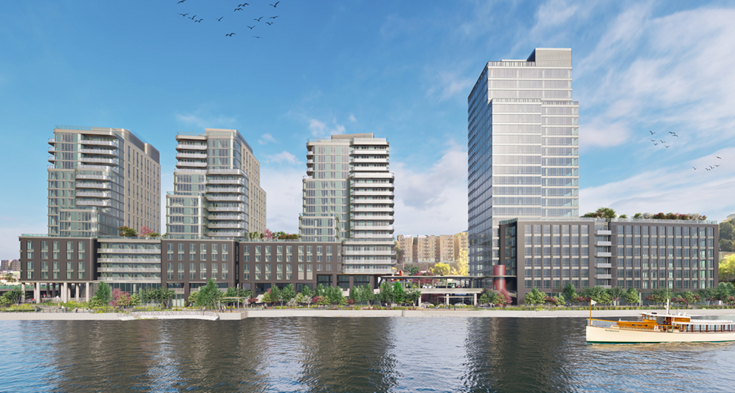
Fordham Landing South will bring over 900 new affordable homes,
as well as a vibrant mixed-use community, to the Bronx waterfront. Credit: Perkins Eastman
MAYOR ADAMS ANNOUNCES CITY HAS CONNECTED 3,500+ HOMELESS NEW YORKERS FROM STREETS AND SUBWAYS TO PERMANENT HOUSING
Figure Includes 1,000+ New Yorkers Moved From Subway to Permanent Homes Thanks to Mayor Adams’ Subway Safety Plan
City Continues to Aggressively Expand Safety Net with 400 New Safe Haven Beds Coming Online by End of 2025
Announcement Launches Administration’s “End Culture of Anything Goes” Campaign, Highlighting Mayor Adams’ Efforts to Change Culture, Laws, and Investments That Improve Quality of Life and Prevent Public Disorder on City Streets
NEW YORK – New York City Mayor Eric Adams and New York City Department of Social Services (DSS) Commissioner Molly Wasow Park today celebrated major progress in the city’s efforts to connect New Yorkers experiencing homelessness to permanent housing, announcing the placement of more than 3,500 New Yorkers who were previously living unsheltered in permanent homes. The milestones come as a result of key Adams administration initiatives — like Mayor Adams’ Subway Safety Plan, which conducts targeted outreach across end-of-line subway stations to engage harder-to-reach New Yorkers experiencing homelessness — as well as historic investments in housing and services for this population.
More specifically, the city has placed over 1,000 New Yorkers who were living unsheltered in the subway system into permanent homes since early 2022. In total, since the start of this administration, the city has also helped more than 3,500 New Yorkers transition from living on city streets and subways to permanent housing through the aggressive expansion of and investment in Safe Haven and stabilization beds, both of which offer specialized transitional housing support for individuals experiencing unsheltered homelessness.
Today’s announcement also kicks off Mayor Adams’ “End Culture of Anything Goes” campaign, the administration’s commitment to end the culture of ‘anything goes’ and improve quality of life on city streets. The campaign will highlight the work the administration has done to date to change the culture and laws that prevented people with severe mental illness from getting the help they needed, while simultaneously making the investments necessary to support outreach, harm reduction, wraparound services, and housing — all in an effort to make lasting impacts in lives and communities. Mayor Adams is bringing the same energy and approach that proved to be successful in carving a new path to help people with severe mental illness to addressing other health crises playing out on city streets and will soon lay out how he plans to realize that vision.
“From the beginning, we said we needed to build trust with the city’s unsheltered population, whether outside, on our subways, or in our shelters, and in the three years since our administration began this work, we have now connected more than 3,500 homeless individuals to permanent housing, and thousands more to shelter,” said Mayor Adams. “This success would not be possible without our historic investments in Safe Haven and stabilization beds, our record-breaking creation of affordable housing, and a laser-focus on addressing homelessness on our streets and in our subways. More work remains, but it’s clear that the years of walking by New Yorkers in need are over and this milestone is further proof that we’re continuing to make New York City a safer, more affordable city.”
“As we mark important progress strengthening pathways to stable housing for New Yorkers experiencing unsheltered homelessness, we resolve to keep building on person-centered solutions that meet our vulnerable neighbors where they are,” said DSS Commissioner Wasow Park. “Through the city’s vital investments in the Safe Haven model and the dedication of hundreds of outreach workers who prioritize dignity, trust, and compassion every step of the way, we were able to help more than 3,500 New Yorkers who were living unsheltered move into permanent homes. The ongoing expansion of Safe Havens will further reinforce our efforts to break the cycle of homelessness for New Yorkers who have been consistently failed by society at large.”
In February 2022, Mayor Adams launched the Subway Safety Plan to intensify multi-agency outreach efforts across end-of-line subway stations. As part of this plan, Mayor Adams also made unprecedented investments in a comprehensive continuum of care designed to meet the unique needs of New Yorkers experiencing unsheltered homelessness, including individuals experiencing mental health and substance use challenges in the subway system. Since the start of the Subway Safety Plan, more than 8,600 New Yorkers have been connected to shelter, with over 1,000 now in permanent, affordable housing. These efforts complement the city’s 24X7 above-ground HOME-STAT outreach efforts — one of the most comprehensive outreach programs in the nation — which have also resulted in vital connections to shelter services for thousands of New Yorkers experiencing unsheltered homelessness across city streets, parks, and other public places. As of today, DSS has approximately 400 outreach staff canvassing the five boroughs around-the-clock; this includes a reliable network of contracted outreach workers from not-for-profit human services providers with extensive experience addressing unsheltered homelessness.
The city continues to build on the aggressive expansion of Safe Haven and stabilization beds, which have proven effective in facilitating connections to permanent housing for vulnerable New Yorkers who tend to cycle in and out of the traditional shelter system. The city has opened nearly 1,400 new Safe Haven and stabilization beds during this administration, bringing the overall capacity to 4,000 low-barrier beds as of today. Last year alone, nearly 1,200 New Yorkers experiencing unsheltered homelessness were placed in permanent housing from low-barrier beds reflecting a 19 percent increase year over year. More than 3,500 unsheltered New Yorkers have been able to transition from living on the streets and subways to permanent housing since the start of this administration. Additionally, since January 2022, over 14,000 individuals have checked into a low-barrier shelter bed thanks to the Adams administration’s efforts.
Building on all these efforts, earlier this year in his State of the City address, Mayor Adams announced a historic $650 million plan to tackle homelessness, which includes a dramatic expansion of the city’s capacity to serve people experiencing unsheltered homelessness by adding 900 Safe Haven shelter beds and 100 Runaway and Homeless Youth Beds — offering intensive wraparound services and specialized resources that drastically increase success rates. Additionally, under a new, innovative model, “Bridge to Home,” that is also part of this $650 million plan, NYC Health + Hospitals will offer supportive, home-like environments to patients with serious mental illness who are ready for discharge from the hospital but do not yet have a place to go. By offering patients intensive treatment and comprehensive support, Bridge to Home aims to keep patients on a path toward sustained success, reducing unnecessary emergency room visits and inpatient hospitalizations, decreasing street homelessness and reliance on shelters, and lowering interactions with the criminal justice system.
Building on his efforts to connect homeless New Yorkers to permanent housing, Mayor Adams recently announced that the city broke multiple records for producing and connecting New Yorkers to affordable homes in Fiscal Year (FY) 2025, delivering the affordable housing that New Yorkers need and reinforcing the Adams administration’s position as the most pro-housing administration in city history. Among the numerous records broken in the most recent fiscal year were producing the most affordable housing units for formerly homeless households, placing the most homeless New Yorkers into permanent affordable housing, and connecting the most New Yorkers to affordable homes through the city’s affordable housing lottery — all three records broken three fiscal years in a row.
Between historic efforts by the Adams administration to finance the creation and preservation of housing, speed up the production of new homes, rehabilitate public housing, pass landmark rezoning initiatives, successful advocacy in Albany to pass a historic housing deal last year, initiatives to build new homes on city-owned sites, and much more, the Adams administration has created, preserved, or planned for approximately 426,800 homes for New Yorkers — including at least 250,000 affordable homes — over the next 15 years.
MAYOR ADAMS AND NYPD COMMISSIONER TISCH EXPAND QUALITY OF LIFE TEAMS ACROSS ALL OF QUEENS FOLLOWING SUCCESSFUL PILOT LAUNCH
Since Inception, Q-Teams Have Responded to Over 31,500 Quality-of-Life Calls
Pilot Commands Reduced Non-Emergency Response Times by Average of 47 Minutes
Announcement Launches Administration’s “End Culture of Anything Goes” Campaign, Highlighting Mayor Adams’ Efforts to Change Culture, Laws, and Investments That Improve Quality of Life and Prevent Public Disorder on City Streets
NEW YORK – New York City Mayor Eric Adams and New York City Police Department (NYPD) Commissioner Jessica S. Tisch today announced the expansion of the NYPD’s Quality of Life Division “Q-Teams” across the entire borough of Queens. The expansion of Q-Teams across Queens doubles down on the NYPD’s focus on tackling the daily issues that impact New Yorkers’ sense of safety and well-being, including cracking down on illegal mopeds, towing abandoned and derelict vehicles, cleaning up encampments, addressing outdoor drug use, and responding to noise complaints.
Starting this past April, the NYPD launched Q-Teams in six pilot commands, and to date, these teams have improved non-emergency response times by an average of 47 minutes citywide, while towing 701 vehicles and seizing 318 illegal e-bikes, scooters, and mopeds. Following the success of the pilot program, the NYPD expanded Q-Teams to every precinct in Manhattan on July 14 and throughout the Bronx on July 21 and Brooklyn on July 28. To date, Q-Teams have responded to more than 31,500 911 and 311 calls. The NYPD will continue to expand these efforts to every precinct in Staten Island on August 18 and to all housing commands on August 25.
Today’s announcement also kicks off Mayor Adams’ “End Culture of Anything Goes” campaign. The campaign will highlight the work the administration has done to date to change the culture and laws that prevented people with severe mental illness from getting the help they needed, while simultaneously making the investments necessary to support outreach, harm reduction, wraparound services, and housing — all in an effort to make lasting impacts in lives and communities. Mayor Adams is bringing the same energy and approach that proved to be successful in carving a new path to help people with severe mental illness to addressing other health crises playing out on city streets, and will soon lay out how he plans to realize that vision.
“Every New Yorker deserves to have a level of security, whether it’s taking their kids to school, walking in their neighborhood, going to work, or visiting loved ones. That is why, earlier this year, we created the new NYPD Quality of Life Division and launched a pilot program to address quality-of-life issues across our city, and since expanding the program to Manhattan, the Bronx, and Brooklyn, the results have got even better,” said Mayor Adams. “These teams answered more than 31,500 calls for service and cut average non-emergency response times by about 47 minutes. With the expansion of the NYPD’s Quality of Life Division across all of Queens, we are doing everything we can to ensure that New York City remains the safest big city in America and the best place to raise a family.”
“When the Quality of Life Division launched earlier this year, our goal was clear and concise: build a team focused entirely on addressing the conditions that make daily life harder for New Yorkers — and that’s exactly what we have done,” said NYPD Commissioner Tisch. “Our Q-Teams solve the daily problems that add up and chip away at a community’s sense of order. These teams are towing the abandoned vehicle on your block, responding to the noise complaints at late hours, and addressing the illegal parking that has persisted for too long. New Yorkers should feel safe on every block, in every community, and throughout every borough, and with this expansion to every precinct in Queens, we are one step closer to making that a goal reality.”
Program Results
On April 14, the NYPD launched Q-Teams across six pilot commands: the 13th, 40th, 60th, 75th, and 101st precincts, along with Police Service Area 1. Since the launch and through August 7, Q-Teams have responded directly to communities and made significant improvements to New Yorkers’ quality-of-life concerns.
Six Pilot Commands:
- Responded to 17,341 911 and 311 calls.
- Towed 701 abandoned and derelict vehicles.
- Seized 318 illegal e-bikes, scooters, and mopeds.
Manhattan Q-Teams:
- Responded to 4,903 911 and 311 calls.
- Towed 106 abandoned and derelict vehicles.
- Seized 124 illegal e-bikes, scooters, and mopeds.
Bronx Q-Teams:
- Responded to 4,789 911 and 311 calls.
- Towed 56 abandoned and derelict vehicles.
- Seized 65 illegal e-bikes, scooters, and mopeds.
Brooklyn Q-Teams:
- Responded to 4,548 911 and 311 calls.
- Towed 188 abandoned and derelict vehicles.
- Seized 59 illegal e-bikes, scooters, and mopeds.
In addition to Q-Team operations, the following NYPD units also contributed to addressing quality-of-life concerns in the pilot commands, as well as in Manhattan, the Bronx, and Brooklyn through August 7, with the results below:
- Vehicle Response Team: Towed 5,650 abandoned or derelict vehicles.
- Smoke Shop Task Force: Executed 1,085 inspections and padlocked 198 smoke shops.
- Encampment Team: Resolved 1,412 homeless conditions.
Q-Teams are comprised of officers from across the NYPD who undergo specialized training on how to address non-emergency, quality-of-life concerns, including noise complaints, illegal vending, outdoor drug use, unregistered vehicles, encampments, and reckless e-bike and scooter riding. Each team receives additional instruction in discretionary responses to specific conditions as an alternative to using enforcement tools.
The NYPD holds monthly Q-Stat meetings — modeled after the NYPD’s main crime data tracker, “CompStat” — to analyze precinct and public service data related to 311 calls and requests. This process helps examine operation outcomes, identify neighborhoods that are most susceptible to recurring quality-of-life issues, and hold precincts accountable. New York City’s 311 system, NYC311, is a non-emergency service that allows New Yorkers to report non-emergency issues, request city services, and discover information about government programs.
“I welcome the expansion of the NYPD’s Quality of Life Q-Teams across the borough of Queens,” said Queens District Attorney Melinda Katz. “Residents are rightly concerned about unlicensed smoke shops, abandoned vehicles and unregistered scooters. By focusing on these issues, we help improve public safety in this borough block by block and erase the notion that some portions of the city are more important than others.”
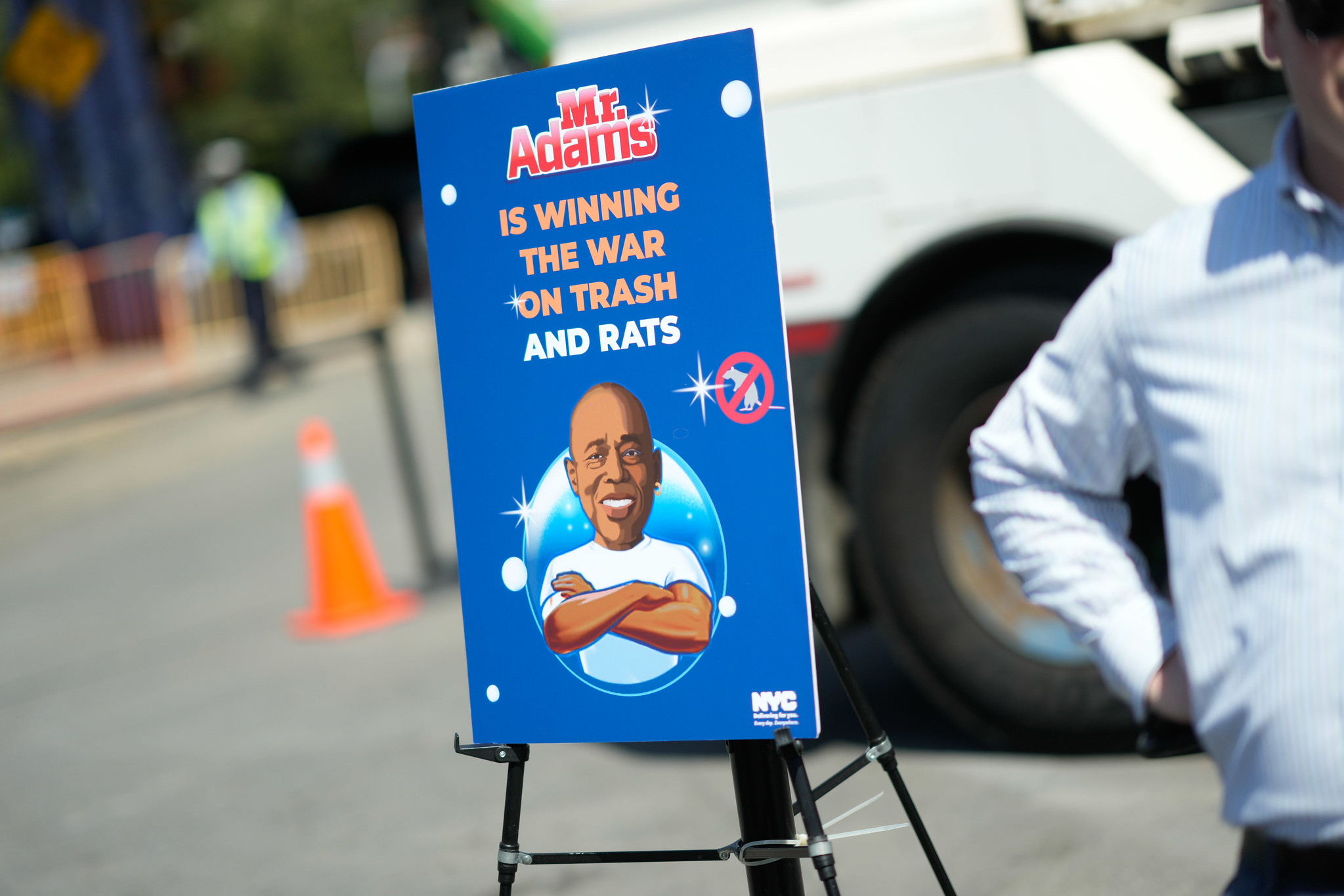
New York City Mayor Eric Adams New York City Mayor Eric Adams and New York City Department of Sanitation (DSNY) Acting Commissioner Javier Lojan today announced three major milestones in their efforts to fight rats and deliver a cleaner city to all New Yorkers on Tuesday, August 19, 2025. Michael Appleton/Mayoral Photography Office
MAYOR ADAMS, CHANCELLOR AVILES-RAMOS CELEBRATE GRADES 3-8 STATE TEST SCORE DATA SHOWING INCREASED PROFICIENCY FOR 2024-2025 SCHOOL YEAR
English Language Arts Proficiency Increased 7.2 Points, Math Proficiency Increased 3.5 Points
City Proficiency Rates Higher Than New York State, Reached Highest Level Since 2012
Increases Align with Citywide Investment in Evidence-Based Reading Instruction for Public School Students
NEW YORK – New York City Mayor Eric Adams and New York City Public Schools Chancellor Melissa Aviles-Ramos today celebrated newly-released test data from the state showing a substantial increase in reading and math scores for public school children, grades 3 through 8, in the 2024-2025 school year. New York state data shows the overall percentage of New York City students meeting the state’s bar for English Language Arts (ELA) proficiency increased by 7.2 points since 2024, from 49.1 percent to 56.3 percent. In math, the overall percentage of proficient students in New York City increased by 3.5 points since 2024, from 53.4 percent to 56.9 percent. These rates are higher than New York state in both math and ELA and reflect the highest percentage of students meeting proficiency standards, as set by New York state Education Department since 2012. New York City Public Schools’ analysis also shows that reading and math scores increased across all grades, with the largest gains coming in grades 3 and 5 in ELA.
“These academic gains in English Language Arts and math are a testament to what’s possible when we invest in our young people and believe in their potential, and we are proud of our students, teachers, and the entire school community,” said Mayor Adams. “A 7.2 point increase in ELA and a 3.5 point increase in math show growth in the number of students performing above the state — and we’re just getting started. Our administration is committed to continuing this critical work next school year, ensuring every student in our city has access to the education and skills they need to succeed, thrive, and lead.”
“These results show that when we set high expectations for our students and give our educators the right tools, our kids rise to the occasion,” said Public Schools Chancellor Aviles-Ramos. “The gains we’re seeing are proof that initiatives like NYC Reads and NYC Solves are delivering for our children. We are closing gaps, raising achievement in every borough, and making sure more students than ever are on track for long-term success. This is what happens when we stay focused on evidence-based instruction and never lose sight of what’s possible for our young people.”

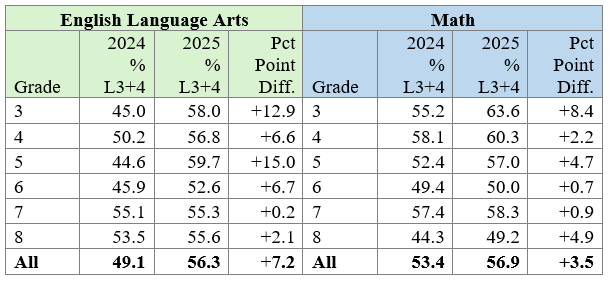
This table shows the percentage of students who are proficient in ELA and math in 2024 and 2025 by grade level.
This growth coincides with the full citywide implementation of NYC Reads, which Mayor Adams launched in 2023 to strengthen literacy. This initiative relies on standardized curriculum implementation across all schools in each district, with curricula options limited to those that are rooted in evidence-based practices. Grounded in the science of reading, NYC Reads Phase 1 schools that have been in the program for two years saw a higher increase — 11.6 percent in grades 3-5 — compared to Phase 2 schools, which increased 10.4 percent.
These increases align with the trends seen with the K-5 academic screener results. These increases reflect accelerated growth from spring-to-spring in the percentage of students above the national median. The screener growth from 2024 to 2025 — an increase of 2.5 points — more than doubled the 0.9-point growth from 2023 to 2024. Schools that were part of Phase 1 of NYC Reads and had two years of curriculum implementation saw an even greater growth of 3.0 percent compared to the 2.3 percent growth for Phase 2 schools that started earlier this year.
In spring 2025, Mayor Adams and Chancellor Aviles-Ramos announced the expansion of NYC Reads and NYC Solves to an additional 186 schools across 14 districts, totaling over 490,000 students benefiting from this critical initiative.
In addition to overall growth, there were increases across subgroups for grades 3-8.

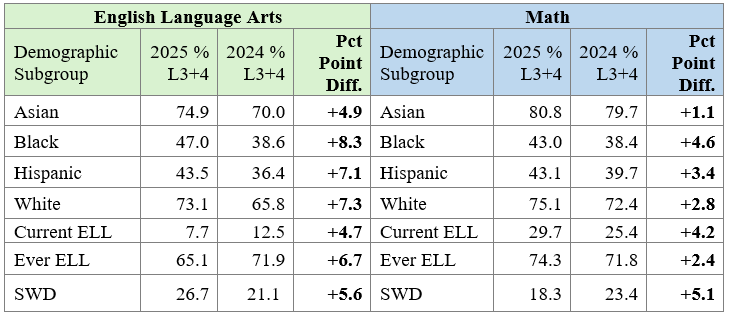
Table showing the percentage of students who are proficient in
ELA and math in 2024 and 2025 by demographic subgroup.
Today’s announcement builds off two years of core educational accomplishments under the Adams administration, including instituting nation-leading dyslexia screening for all students, adding 57 Gifted and Talented programs, opening seven new schools for the 2025-2026 school year alone, helping 8,662 students secure a total of 23,000 job placements through FutureReadyNYC, cementing new labor contracts for teachers and other education officials, investing $167 million in new funding to secure critical early childhood education programs, dramatically increasing early childhood education enrollment to 150,000 children across the city’s system, and securing mayoral accountability twice in three years while investing $180 million to implement a comprehensive class size reduction plan.
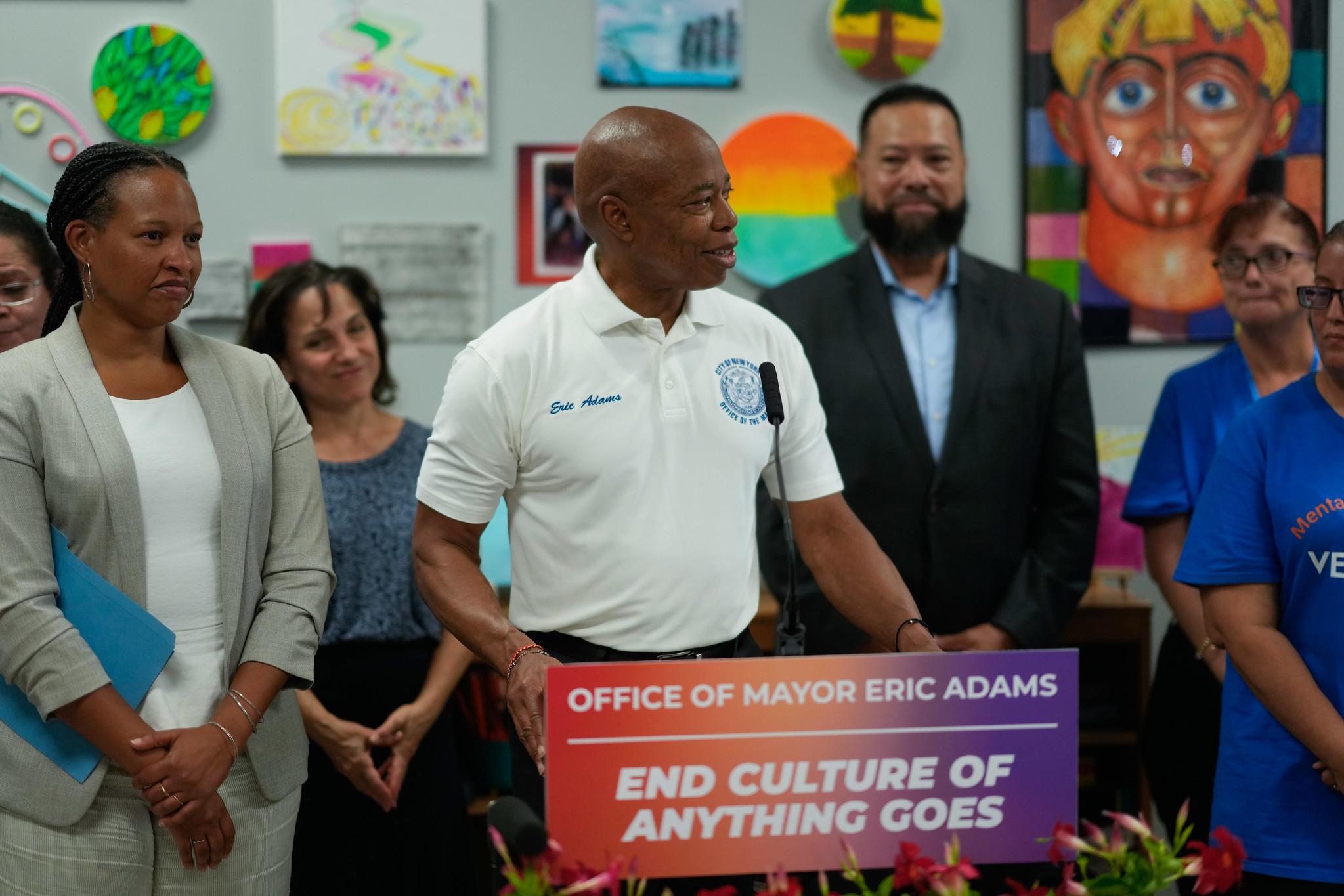
New York City Mayor Eric Adams in the Bronx today announced the opening of 13 clubhouses across the five boroughs to engage adults living with severe mental illness, thanks to a $30 million investment of city and state dollars. In 2023, the New York City Department of Health and Mental Hygiene (DOHMH) began the process to expand the clubhouse model — for the first time in nearly 30 years — through a city-state investment that doubled previous funding. Of the 13 newly contracted clubhouses, there are seven new sites opening, and six are being granted contracts to continue operations. The new clubhouses will expand opportunities for people with serious mental illness to participate in the unique community-driven environment that clubhouses offer. The additional clubhouses will more than double enrollment to 6,600 members by 2027, allowing the city to expand capacity, especially in high-need neighborhoods on Tuesday August 12, 2025. Michael Appleton/Mayoral Photography Office
MAYOR ADAMS ANNOUNCES OPENING OF 13 NEW CLUBHOUSES TO SUPPORT NEW YORKERS LIVING WITH SERIOUS MENTAL ILLNESS
Adams Administration’s Recent $30 Million Investment Supports Increased Capacity and Improved Quality of Services for City-Supported Clubhouses
Continues Administration’s “End Culture of Anything Goes” Campaign, Highlighting Mayor Adams’ Efforts to Change Culture, Laws, and Investments That Have Allowed for Public Disorder on City Streets
Builds on Mayor Adams’ Commitment to Support Those Experiencing Severe Mental Illness
NEW YORK – New York City Mayor Eric Adams today announced the opening of 13 clubhouses across the five boroughs to engage adults living with severe mental illness, thanks to a $30 million investment of city and state dollars. In 2023, the New York City Department of Health and Mental Hygiene (DOHMH) began the process to expand the clubhouse model — for the first time in nearly 30 years — through a city-state investment that doubled previous funding. Of the 13 newly contracted clubhouses, there are seven new sites opening, and six are being granted contracts to continue operations. The new clubhouses will expand opportunities for people with serious mental illness to participate in the unique community-driven environment that clubhouses offer. The additional clubhouses will more than double enrollment to 6,600 members by 2027, allowing the city to expand capacity, especially in high-need neighborhoods.
Today’s announcement continues Mayor Adams’ “End the Culture of Anything Goes” campaign, highlighting the work the administration has done to change the culture and laws that prevented people with severe mental illness from getting the help they needed while making the investments necessary to support outreach, harm reduction, wraparound services, and housing to make lasting impacts in lives and communities. Mayor Adams is bringing the same energy and approach that proved to be successful in carving a new path to help people with severe mental illness to addressing other health crises playing out on city streets, and will soon lay out how he plans to realize that vision.
“For those struggling with mental illness, clubhouses are a game-changer. These are free member-led spaces where New Yorkers can do everything from accessing health or legal benefits to finding employment or educational services. Most importantly, clubhouses decrease social isolation, create thriving communities, and they are proven to be effective. That’s why our administration took bold steps to expand this model for the first time in nearly 30 years,” said Mayor Adams. “Thanks to our efforts, alongside a $30 million investment of city and state dollars, New Yorkers will now have 13 high-quality clubhouses to join. This will expand enrollment to 6,600 members by 2027, increasing access and care. From day one, we promised we would tackle the issue of serious mental illness in our city. From housing with wraparound services to outreach on the subways, we have taken the steps needed to help our fellow New Yorkers in need. We are excited to welcome even more New Yorkers to these life-changing programs, and we thank our providers for the great work they continue to do to improve New Yorkers’ lives each and every day.”
“Everyone deserves access to spaces where they feel seen, safe, and supported, and clubhouses offer that and more,” said DOHMH Acting Commissioner Dr. Michelle Morse. “At the New York City Department of Health and Mental Hygiene, we are committed to expanding access to high-quality resources like clubhouses for our neighbors living with serious mental illness. I look forward to continuing this work with our valued partners.”
Clubhouses are free, member-led spaces for adults experiencing severe mental illness that facilitate social connections and provide access to resources like benefits, health and legal services, and employment and educational services through a supportive community of peers. Clubhouses vary by location and are shaped by the local neighborhoods and the members who create community within their spaces. Activities are designed based on member interests or skills, which could include language lessons, creating a group newsletter, or cooking meals that reflect members’ heritage, and more. Several newly contracted sites are in the process of building permanent spaces, allowing old and new members to have further input in shaping their communities.
The 13 newly contracted clubhouses are:
Bronx:
- Fountain House Bronx
- Goodwill Industries of Greater New York and New Jersey: Lantern House
- Venture House
Brooklyn:
- Brooklyn Community Services Greater Heights Clubhouse
- Services for the Underserved: Brooklyn Clubhouse
- Venture House
Manhattan:
- Fountain House Midtown
- Fountain House Harlem
- New York Disaster Interfaith Services: Elements House
- Phoenix House Harlem.
Queens:
- Goodwill Industries of Greater New York and New Jersey: Citiview Connections
- Venture House
Staten Island:
- Venture House
All 13 providers were selected through a competitive request for proposals process.
Numerous factors can impact mental health, including stress, environment, and social isolation. DOHMH’s 2024 report, “The State of Mental Health of New Yorkers” found that less than half of adult New Yorkers said they had someone they could count on for emotional support most or all of the time. According to estimates from the 2023 “NYC Neighborhood Wellness Survey,” of those who have been diagnosed by a health care professional, approximately 1 percent of adult New Yorkers have been diagnosed with schizophrenia, schizoaffective disorder, or psychosis; 3 percent have been diagnosed with bipolar disorder, mania, or manic depression; 5 percent have been diagnosed with Post Traumatic Stress Disorder; and 11 percent have been diagnosed with Major Depressive Disorder or severe depression.
Mayor Adams has made supporting New Yorkers with severe mental illness a top priority. In 2022, the Adams administration announced an ambitious plan to support unsheltered New Yorkers struggling with untreated severe mental illness, which included a new city protocol on involuntary removals and a package of proposed state legal reforms to maximize the city’s ability to serve this population. Since then, the Adams administration has developed new programs, like Subway Co-Response Outreach Teams (SCOUT) and Partnership Assistance for Transit Homelessness; added 1,400 new safe haven and stabilization beds, and successfully advocated for changes to state law passed in 2025 that remove barriers to psychiatric care for those unable to recognize their own need for it. All this work comes in tandem with the collection and public reporting of new data on involuntary hospital transports to increase transparency in the process.
New Yorkers can find a clubhouse near them by visiting DOHMH’s “Serious Mental Illness” page for a list of locations or calling 311 for assistance. Those looking for mental health and substance use support information or referrals can call or text 988 24/7 to speak with a trained professional.
“Our city is experiencing a growing mental health crisis that demands a unified, compassionate response from all of us,” said Bronx Borough President Vanessa Gibson. “It’s essential that we come together as elected officials and service providers to support our residents and families with comprehensive, holistic care that addresses their mental, emotional, and physical well-being. I want to thank Mayor Adams for expanding the clubhouse model and for making mental health a priority in our city’s care infrastructure.”
“Access to mental health support is not a luxury, it is a necessity,” said New York State Assemblymember George Alvarez. “I’m proud to stand with Mayor Adams in opening these 13 new clubhouses across our city, including right here in the Bronx. This investment is a powerful step toward ensuring that New Yorkers living with serious mental illness have a safe, welcoming space to find community, stability, and hope. I commend the administration for prioritizing this long overdue expansion and look forward to the positive impact it will bring to our neighborhoods.”
“Clubhouses have been proven to be the best model for addressing the myriad issues of homelessness, mental illness, and substance use in an integrated and comprehensive way,” said State Assemblymember Jo Anne Simon. “They provide essential community-based support systems for New Yorkers living with serious mental illness and co-existing disorders, helping people connect and thrive. Expanding access to these spaces means more New Yorkers can get the resources and relationships they need closer to home. I applaud the Mayor for expanding this program, which will make a real difference in our communities.”
“New York City’s investment in mental health clubhouses last year has helped to create an ecosystem of community-based organizations working with New Yorkers who live with serious mental illness across the city. In doing so, the city has not only taken steps to benefit individuals but also strengthen the broader system of support by filling in one of the major missing pieces,” Ken Zimmerman, CEO, Fountain House. “Unfortunately, isolation is one of the most harmful effects of living with serious mental illness and also one of the least addressed when it comes to our mental health support infrastructure. Clubhouses play a crucial role in filling this gap by putting members on the road to meaningful recovery while also using public resources efficiently and effectively. Together with city leaders, our fellow clubhouses, and our members, we are cementing clubhouses as a key part of voluntary, community-based care across these five boroughs.”
“Goodwill Industries of New York and New Jersey is excited to be a part of the New York City expansion of the evidence-based, community-focused Behavioral Health Clubhouse in the Bronx and Queens,” said Katy Gaul-Stigge, president and CEO, Goodwill Industries of Greater NY and New Jersey. “The clubhouse membership keeps our neighbors healthy and connected to work, which is core to the goal for everyone.”
“We’re grateful to the Department of Health and Mental Hygiene for awarding New York Disaster Interfaith Services this contract, specifically on the Lower East Side — a diverse neighborhood where our organization has a long history with its Chinese and Puerto Rican roots,” said Peter Gudaitis, executive director and CEO, New York Disaster Interfaith Services. “We’re excited to continue that tradition and build new partnerships as we grow our clubhouse. People living with serious mental illness in this part of the city often face cultural and language barriers to care, and we’re committed to creating a space that feels accessible, familiar, and rooted in the needs of the community.”
“The opening of the Phoenix House Clubhouse marks a transformative step forward in our mission to empower individuals on their journey from mental health challenges to mental wellness,” said Ann-Marie Foster, president and CEO, Phoenix House New York and Long Island. “This innovative model fosters connection, purpose, and hope by offering a supportive, peer-led space where members can access resources, build coping skills, and thrive as part of a caring community. We are proud to partner with the New York City Department of Health and Mental Hygiene to expand access to vital mental health services for New Yorkers and create new opportunities for recovery and resilience.”
“We’re thrilled to commemorate the opening of these clubhouses,” said Perry Perlmutter, president and CEO, Services for the UnderServed. “Clubhouses have served a crucial role in the city for decades, providing a free, safe place for thousands of adults with mental illness to eat, socialize, and focus on issues related to living in the community. Not only do clubhouse members learn valuable skills and get support managing their wellness, they also overcome stigma and build community to maximize their potential. I applaud the city’s role in expanding this essential program.”
“After a long, complex journey of travelling the boroughs in search of property, staff, furnishings, and information technology, we have settled into our starter homes while building our permanent spaces nearby,” said Juliet Douglas, CEO, Venture House. “We have developed new partnerships with community stakeholders, and together we shall serve the mission, bringing the greatest good to the greatest number. We are thrilled to see the excitement, positive energy and engagement of our new membership across the boroughs!”
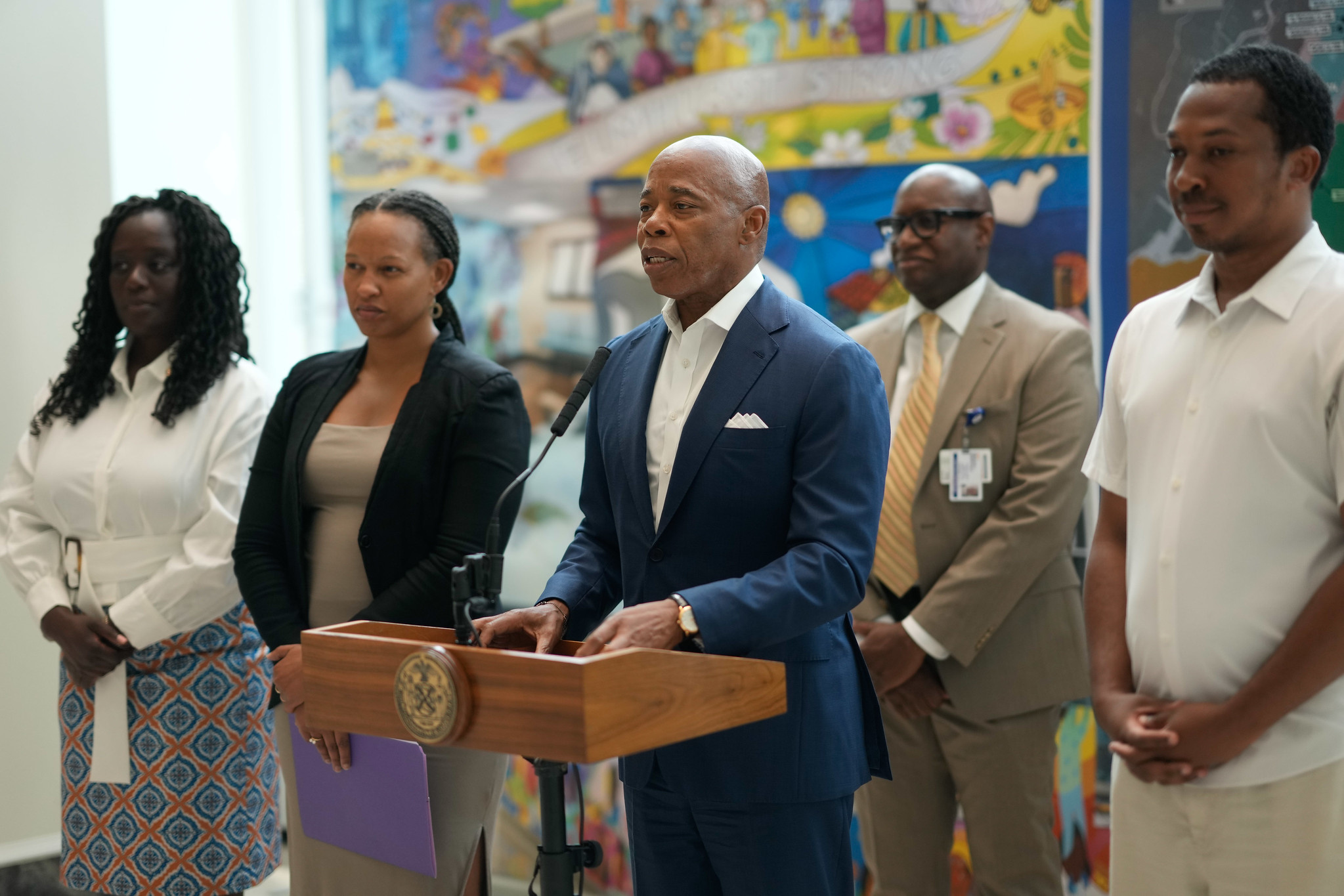
New York City Mayor Eric Adams makes a public health-related announcement about the recent Legionnaires’ disease outbreak with New York City Department of Health and Mental Hygiene Interim Commissioner Dr. Michelle Morse and NYC Health + Hospitals CEO Dr. Mitchell Katz Harlem Hospital on Thursday, August 14, 2025. Michael Appleton/Mayoral Photography Office
MOST PRO-HOUSING ADMINISTRATION IN CITY HISTORY: MAYOR ADAMS CELEBRATES CITY PLANNING COMMISSION’S APPROVAL OF JAMAICA NEIGHBORHOOD PLAN TO CREATE 12,000 NEW HOMES, 7,000 NEW JOBS
Plan Would Create 4,000 Permanently Affordable Homes, Establish Largest Mandatory Inclusionary Housing Area in City
Would Also Unlock New Commercial Space and Industrial Space, Invest Over $300 Million in Sewer Upgrades and New Public Space
Plan Now Heads to City Council for Review and Final Vote
Thanks to Initiatives Like Jamaica Neighborhood Plan, Adams Administration Has Created, Preserved, or Planned Over 426,000 Homes for New Yorkers to Date
NEW YORK – New York City Mayor Eric Adams and New York City Department of City Planning (DCP) Director and City Planning Commission (CPC) Chair Dan Garodnick today celebrated the CPC’s vote in favor of the Jamaica Neighborhood Plan, a bold vision to bring thousands of homes and jobs as well as hundreds of millions of dollars in infrastructure and other investments to Jamaica, Queens. The transformative plan would update the area’s zoning code to create over 12,000 new homes across 230 blocks of this transit-accessible neighborhood. By mapping Mandatory Inclusionary Housing (MIH) in the neighborhood at scale for the first time and requiring new developments to include affordable housing, the plan will ensure that approximately 4,000 of the new homes are permanently affordable, creating the largest MIH area in the city to date. Additionally, by creating more commercial and industrial space, the plan will unlock new economic opportunities for residents and businesses and generate 7,000 new permanent jobs. In addition to updating the neighborhood’s zoning, the proposal also includes strategic investments to support the community’s growth, including over $300 million for sewer improvements. As the planning process advances, the city will continue to consider further investments in transit access, open space, job training, and cultural institutions with key stakeholders. Along with four additional neighborhood plans and “City of Yes for Housing Opportunity” — the first citywide rezoning in 60 years — the Jamaica Neighborhood Plan is a key part of the Adams administration’s work to create, preserve, or plan over 426,000 homes for New Yorkers.
“With its rich diversity of culture, cuisine, music, and more, Jamaica represents so much of what makes our city great. Unfortunately, the neighborhood’s outdated zoning code is not one of them. For decades, Jamaica’s zoning has curtailed new housing and limited new businesses; it’s made it harder for working-class families to work and stay in the area. But our Jamaica Neighborhood Plan will help change that,” said Mayor Adams. “With this ambitious vision, we’ll bring thousands of new homes and jobs to Jamaica and make sure that working-class families can live in the city they love. Whether it’s crafting neighborhood plans like this one, passing the most pro-housing zoning reform in city history, or shattering affordable housing records year after year after year, we are proud to be the most pro-housing administration in city history.”
“With Jamaica’s central location and incredible access to jobs and transit, it is time for us to support the local community with affordable homes, jobs, and hundreds of millions of dollars in infrastructure investments,” said DCP Director and CPC Chair Garodnick. “With today’s vote, Jamaica is one step closer to a more affordable and prosperous future. Thanks to the City Planning Commissioners for their overwhelming support.”
Creating More Affordable Housing
Under Jamaica’s current zoning rules, there are no requirements for affordable housing in the neighborhood while industrial businesses are stymied from growing and reaching their full potential. The Jamaica Neighborhood Plan directly responds to these long-term challenges. Tailored to respect the unique character of each of the neighborhood’s different hubs and corridors, the Jamaica Neighborhood Plan would update zoning to spur the development of 12,000 new homes. Approximately 4,000 of those homes would be permanently income-restricted affordable through a combination of MIH — making these 230 blocks of Jamaica the largest geographic area in New York City where this policy would be mapped to date — and through city financing of affordable homes on public land. As part of these efforts, the Adams administration has committed to building a total of nearly 120 income-restricted affordable homes across five city-owned sites along Guy R. Brewer Boulevard and Union Hall Street in Queens.
The Jamaica Neighborhood Plan would bring additional updates to:
- The Downtown Core: The plan would allow high-density mixed-use developments with permanently affordable housing, active ground floor retail, and community services along Jamaica Avenue and Archer Avenue, a transit-rich area served by the E, J, and Z trains. Densities would slightly decrease further north, between Jamaica Avenue and Hillside Avenue.
- Transit Corridors: Through updated zoning, the plan would encourage mixed-use, mid-rise developments with locally-serving retail and community facilities along Hillside Avenue, western Jamaica Avenue, Liberty Avenue, Sutphin Boulevard, Guy R. Brewer Boulevard, and Merrick Boulevard.
- South Core: For the first time in 60 years, the plan would allow new housing immediately to the south of Jamaica Station and the Jamaica Center – Parsons/Archer subway station. It would also encourage commercial and light manufacturing near world-class transit resources.
- Industrial Growth Area: New growth manufacturing zoning would support new employment and local businesses.

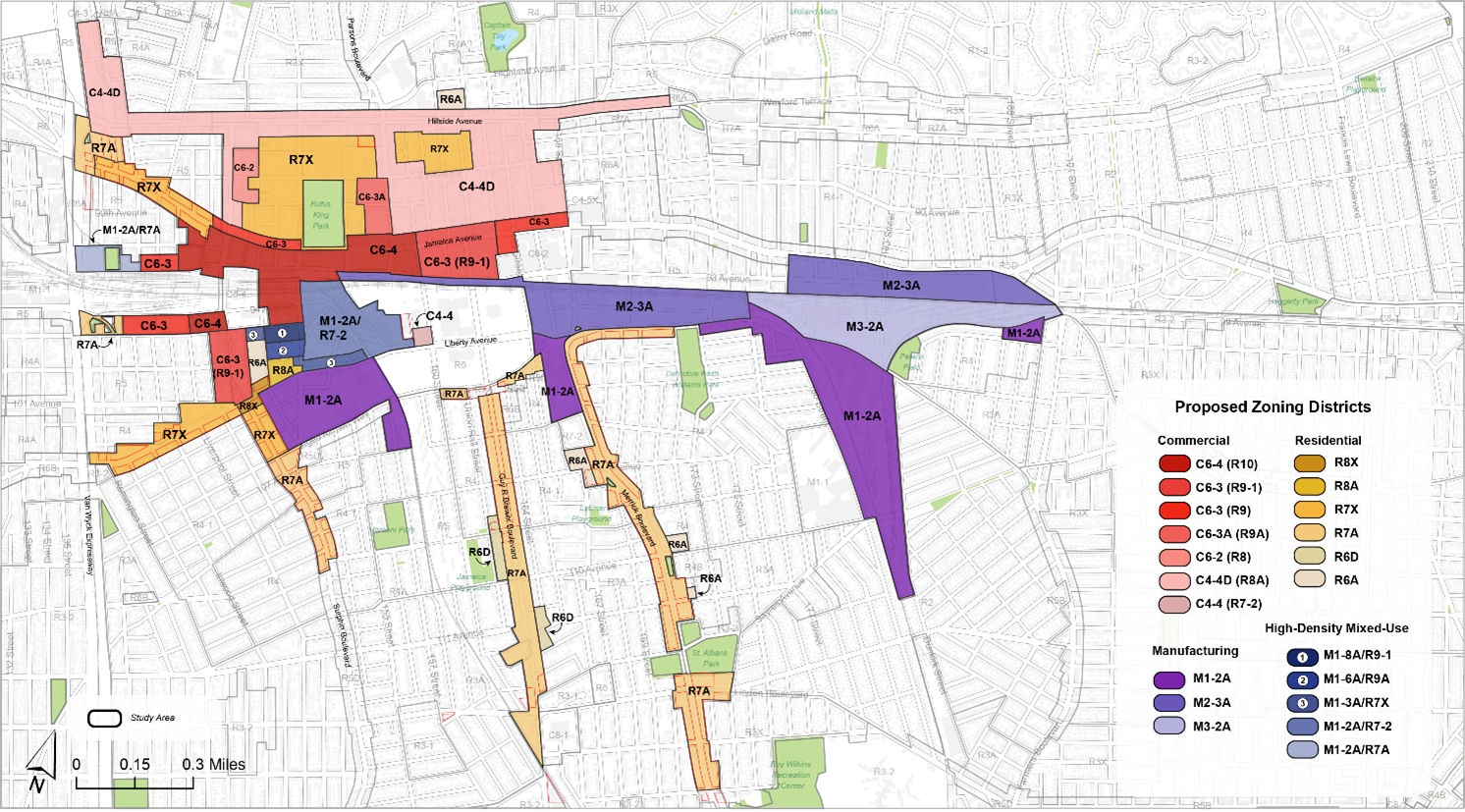
Building on over two years of public engagement, the Jamaica Neighborhood Plan
is tailored to respect the unique character of each of Jamaica’s hubs and corridors. Credit: DCP.
Delivering More Jobs, Improved Public Space, and Infrastructure Investments
The Jamaica Neighborhood Plan would also generate over 2 million square feet of new commercial and community facility space, ultimately creating over 7,000 new jobs for New Yorkers and strengthening Jamaica’s role as a live-work neighborhood where residents can find good jobs close to home.
To facilitate this community’s growth, the plan will also invest over $300 million in sewer infrastructure upgrades, building on the $2.64 billion the Adams administration has already committed to installing storm sewers and creating a comprehensive drainage system in Southeast Queens. The plan also seeks to bolster the streetscape and public spaces in order to make the neighborhood more walkable and welcoming, including through improvements by the New York City Department of Transportation along Jamaica Avenue as part of the Jamaica NOW plan and two new public plazas next to Jamaica Station.
Crafted With the Community
Building on two years of public engagement, the Jamaica Neighborhood Plan reflects the priorities of local residents, stakeholders, and elected officials. The outreach process was guided by a steering committee with over 50 neighborhood stakeholders — including elected officials, Queens Community Boards 8 and 12, and many local advocacy groups — and also included 40 in-person and virtual public meetings that received approximately 3,000 comments. DCP also worked with the Massachusetts Institute of Technology on Voice to Vision, an online tool that visualized how feedback gathered through community engagement shaped the plan’s vision and goals. Finally, the proposal received a favorable recommendation from Queens Borough President Donovan Richards during the formal Uniform Land Use Review Procedure (ULURP). The proposal now goes to the New York City Council for a public hearing and vote.
“The City Planning Commission’s approval of the Jamaica Neighborhood Plan marks a major step forward in revitalizing Jamaica after decades of disinvestment,” said Queens Borough President Donovan Richards Jr. “As the fourth-busiest transit hub in the nation, this approval paves the way for much-needed transit-oriented development, affordable housing, and much-needed investment in our community. I commend the Adams administration and the City Planning Commission for paving the way for a brighter future for Southeast Queens residents.”
“The City Planning Commission’s vote marks an important milestone for the Jamaica Neighborhood Plan and one of the most significant investments in Southeast Queens in decades. With the potential for thousands of new homes, including permanently affordable units, new jobs, and critical infrastructure upgrades, this plan must deliver on its promise in a way that reflects the priorities of the people who call Jamaica home,” said New York City Councilmember Natasha Williams. “That’s why I’ve called for a local oversight task force of residents, business owners, and community leaders to keep this process transparent and accountable, and to make certain that commitments made are kept and realized. As the proposal comes before the City Council, I will continue fighting to ensure it centers our residents, strengthens our small businesses, and builds a Jamaica where current and future generations can live, work, and thrive.”
“The Jamaica Neighborhood Plan is a bold and forward-looking blueprint that will create thousands of new homes — including much-needed affordable housing — while also providing opportunities for local businesses and good jobs for residents of southeast Queens,” said Thomas J. Grech, president and CEO, Queens Chamber of Commerce. “With strategic investments in infrastructure, transit, and open space, Jamaica is poised to thrive for generations to come. We are proud to stand with our community in celebrating this historic milestone. We applaud the Planning Commission, Mayor Adams, and all the local stakeholders for their dedication to making this plan a reality.”
“When Jamaica was rezoned in 2007, the public and private sector investment in the area over the following years was more than $2 billion. The 2025 rezoning has the potential to exceed that and make Jamaica a destination for businesses and visitors, while bolstering neighborhood pride among existing residents,” said Justin Rodgers, president & CEO, Greater Jamaica Development Corporation. “The Jamaica Neighborhood Plan will ensure the area remains a home for working-class residents, expanded job opportunities, much-needed infrastructure improvements, new green spaces, and enhancements to the public realm. We appreciate the Adams Administration, the Department of City Planning, Borough President Richards, and Councilmember Williams for their commitment to Jamaica.”
To learn more about this initiative, visit Jamaica Plan’s website.

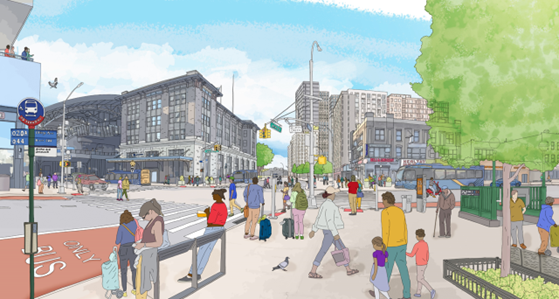
By updating old zoning rules across 230 blocks, the Jamaica Neighborhood Plan
will ultimately create more than 12,000 new homes and 7,000 new jobs. Credit: DCP.
MAYOR ADAMS ANNOUNCES PROGRESS IN SUPPORTING INDIVIDUALS WITH SEVERE MENTAL ILLNESS, RELEASES CITY’S FIRST-EVER INVOLUNTARY TRANSPORTS DASHBOARD PROVIDING NEW YORKERS WITH UNPRECEDENTED ACCOUNTING OF PROGRAM
Dashboard Allows New Yorkers to Track Trends in Involuntary Transports, Better Understand How City Connects Individuals With Emergency Psychiatric Care
Nearly 11,800 Involuntary Transports Reported Since January 2024, Including Over 1,600 Originating from New York City’s Public Transportation System
New York City’s Subway Outreach Program Reached 17,700 Contacts and Provided Services Over 5,400 Times
Part of Administration’s “End Culture of Anything Goes Campaign,” Highlighting Mayor Adams’ Efforts to Change Culture, Laws, and Investments That Have Allowed for Public Disorder on City Streets
NEW YORK – New York City Mayor Eric Adams and New York City Mayor’s Office of Community Mental Health (OCMH) Executive Director Eva Wong today released the city’s first-ever Involuntary Transports Dashboard, offering the public unprecedented access to data on involuntary transports for hospital evaluation of individuals appearing to be mentally ill and behaving in a manner likely to result in serious harm to themselves or others. The new dashboard reflects the Adams administration’s commitment to transparency on involuntary transports, providing data that no previous administration has ever shared before. Mayor Adams has implemented a bold vision to do everything in the city’s power to support those with severe mental illness by, among other things, launching new outreach programs, like Subway Co-Response Outreach Teams (SCOUT) and Partnership Assistance for Transit Homelessness, to connect with the hardest to reach New Yorkers. Since launching PATH, the city has made over 17,700 contacts with unhoused New Yorkers, providing services over 5,400 times.
The launch of the dashboard continues Mayor Adams’ “End the Culture of Anything Goes” campaign, which highlights the work the administration has done to change the culture and laws that prevented people with severe mental illness from getting the help they needed while making the investments necessary to support outreach, harm reduction, wraparound services, and housing to make lasting impacts in lives and communities. Mayor Adams is bringing the same energy and approach that proved to be successful in carving a new path to help people with severe mental illness to address other health crises playing out on city streets, and he will soon lay out how he plans to realize that vision. As part of the week-long campaign, Mayor Adams already announced the expansion of the New York City Police Department’s Quality of Life Division across Queens, as well as the city’s milestone achievement of connecting over 3,500 homeless New Yorkers to permanent housing, and the opening of 13 clubhouses across the five boroughs to engage adults living with severe mental illness.
“Since the beginning, our administration has said that the days of ignoring people in need of help were over. We have made major strides in accomplishing that vision by implementing effective programs at the city level, getting key amendments passed to state law, and changing the very culture that is now allowing more people to get the help they need and deserve, even when they don’t recognize that need themselves. But a key part of this work requires a level of transparency and accountability that we have also always been committed to,” said Mayor Adams. “We are the first administration to ever report on involuntary transports, and now, we are taking that one step further, with the creation of the Involuntary Transports Dashboard, which will be a public resource where anyone can look at data from multiple agencies over time. We are working every day to make New York a safer city, and it’s clear that our laser focus on supporting people with severe mental illness from the very start has not only done just that, but has also made our city a more compassionate and supportive one for our most vulnerable.”
“The Adams administration continues to build on its unwavering commitment to our city’s most vulnerable, ensuring that those facing mental health crises — from acute episodes to chronic conditions leading to severe self-neglect — receive the critical care they deserve, while safety for all New Yorkers in public spaces remains a significant priority,” said OCMH Executive Director Wong. “The launch of the Involuntary Transports Dashboard reflects the city’s strategic focus on transparency, accountability, and continuous improvement in coordinated agency response to urgent and multifaceted needs.”
The dashboard aggregates data from multiple city and state agencies — including the New York City Police Department, the Metropolitan Transit Authority Police, the New York City Department of Homeless Services, the New York City Department of Health and Mental Hygiene, and NYC Health + Hospitals, which all respond to mental health emergencies. By analyzing involuntary transport data over time, the city aims to identify patterns, assess the impact of interventions, and inform future mental health and public safety policies. As seen in the dashboard, the number of 9.58 clinician-led transports increased each month since launching the city’s PATH and SCOUT programs. In addition, the majority of 9.41 NYPD officer-led transports are the result of calls to 911 for help.
In January 2025, the Adams administration released the first Involuntary Transports Annual Report, which showed that, in 2024, there were 7,700 involuntary transports to the hospital for emergency psychiatric evaluation. The dashboard takes this report a step further, showing monthly data on how and from where these transports were initiated and subsequently ended. Between January 2024 — when the city started tracking this data — and May 2025, there have been nearly 11,800 involuntary transports reported across agencies, including over 1,600 originating in the public transit system.
The data in the dashboard represents transports — not individuals — as the same person can be transported multiple times. Likewise, a large portion of such transports originate from 911 calls, and the vast majority come from 911 calls originating from private dwellings. In contrast, Mayor Adams has launched outreach programs, such as PATH, which operate in the subway system, in an effort to reach the hardest to reach New Yorkers and offer services to unsheltered New Yorkers, including facilitating involuntary transports to a hospital, when necessary. Data on the dashboard will be updated every month, however, because of how agencies collect and report data, users should expect a three-month lag.
Mayor Adams was one of the first – and loudest – voices to call for wider use of involuntary transports and commitments, when appropriate, to help people get help when they don’t recognize their own need for it. In the second month of the Adams administration, the city announced its “Subway Safety Plan” to address unsheltered homelessness. Later that year, the administration released a major policy shift for the city that expanded the city’s efforts to get people who need care but don’t realize it help involuntarily. Following three years of relentless advocacy by the Adams administration in Albany, the administration was successful this year in passing amendments to the state’s involuntary commitment law that now make the guidance more explicit under state law.
The Adams administration has undertaken many efforts to strengthen mental health operations and transparency over the last three years. Since the launch of Mayor Adams’ “Subway Safety Plan,” over 8,400 New Yorkers have been connected to shelter, and over 1,000 are now in permanent affordable housing. Further, in 2025, the Adams administration opened 1,400 Safe Haven and stabilization beds and invested in a $650 million homelessness and mental health plan to give those receiving treatment supportive and therapeutic places to go after being discharged from the hospital.
Alongside the Adams administration’s focus on mental health, in 2023, Mayor Adams launched “HealthyNYC,” an ambitious plan to extend the average lifespan of all New Yorkers to 83 by 2030. The effort sets ambitious targets to address the greatest drivers of premature death, including chronic and diet-related diseases, screenable cancers, maternal mortality, and reducing the impact of mental health-related deaths like overdoses, suicide, and violence. Additionally, HealthyNYC expands access to culturally-responsive mental health care and social support services, including early intervention for communities of color and LGBTQIA+ youth, and helps address the impact of social media on youth mental health and suicidal ideation to reduce suicide deaths.
Banner Image: New York City Mayor Eric Adams in the Bronx today announced the opening of 13 clubhouses across the five boroughs to engage adults living with severe mental illness, thanks to a $30 million investment of city and state dollars. In 2023, the New York City Department of Health and Mental Hygiene (DOHMH) began the process to expand the clubhouse model — for the first time in nearly 30 years — through a city-state investment that doubled previous funding. Of the 13 newly contracted clubhouses, there are seven new sites opening, and six are being granted contracts to continue operations. The new clubhouses will expand opportunities for people with serious mental illness to participate in the unique community-driven environment that clubhouses offer. The additional clubhouses will more than double enrollment to 6,600 members by 2027, allowing the city to expand capacity, especially in high-need neighborhoods on Tuesday August 12, 2025. Image Credit – Michael Appleton/Mayoral Photography Office