Prime Minister Netanyahu’s Address At UN, Hear From the Mayor, Speeding Affordable Housing Creation, Pursuing Opioid Manufacturers, Capital Commitment Plan, Social Bonds Sale Show Financial Stability, Opposing Military In Cities, Protecting Counterterrorism Funding For NYC: Mayor Adams
Editor’s note: Last week’s articles focused heavily on the addition of affordable housing in NYC. This partly continues this week, as the Mayor now has limited time in which to accomplish the goals that were set for this administration.
MAYOR ADAMS’ STATEMENT AFTER ISRAELI PRIME MINISTER BENJAMIN NETANYAHU’S ADDRESS AT THE UNITED NATIONS GENERAL ASSEMBLY
NEW YORK – New York City Mayor Eric Adams today issued the following statement after meeting with Israeli Prime Minister Benjamin Netanyahu following the prime minister’s address at the United Nations General Assembly this morning:
“For decades, world leaders have convened in New York City for the United Nations General Assembly to pursue diplomacy and peace. While we may not always agree with these leaders, New York City has always been a place where all are welcome, regardless of their beliefs. Allowing everyone to speak freely is who we are as a city and as a nation — and while many may try to reject that notion today, I will continue to embrace it.
“That is why, of all the world leaders we have greeted this week, I was particularly proud to meet with Israeli Prime Minister Benjamin Netanyahu after his address to the United Nations, to thank him for defending the western world and our way of life.
“As your mayor, my oath is to protect New Yorkers against all enemies, both foreign and domestic, and Prime Minister Netanyahu laid out a clear case that those who call for the death of Jews across the globe are also calling for the death of Americans.
“At a time when much of the world is turning its back on the Jewish State of Israel, the mayor of the largest Jewish community outside of Israel must remain steadfast in our support for Israel, its right to defend itself, eliminate Hamas, and bring every single one of their hostages home.”


New York City Mayor Eric Adams meets with
Prime Minister of Israel, Benjamin Netanyahu
in Jerusalem on the second day of a 3-day visit to Israel on Tuesday, August 22, 2023. Michael Appleton/Mayoral Photography Office
TRANSCRIPT FROM SUNDAY, SEPTEMBER 28, 2025: MAYOR ADAMS HOSTS “HEAR FROM THE MAYOR” RADIO SHOW ON WBLS 107.5 FM
Gary Byrd: Well, as you know, normally it’s each and every second Sunday of the month we have the chance to welcome the 110th mayor of New York City. And the second mayor of color and the first hip-hop mayor in the city’s history. But it’s campaign season and the mayoral race for New York is under way. So our mayor is back with us this morning.
It’s time to hear from the mayor. Mayor Eric L. Adams, right here from 107.5 WBLS. Mr. Mayor, good morning and welcome.
Mayor Eric Adams: Hey, thank you, Gary. I was just sharing with the team how many years I have been on the air and the radio with you on different topics throughout decades. So it’s good to continue. We really wanna welcome back the listeners to Hear from the Mayor. I’m your mayor, Eric Adams, and if this is your first time tuning in, the purpose of the show is just to have a dialogue on what is on the mind of you as a New Yorker.
Listeners should give me a call and hear directly from me, or you can sign up to hear more from me in my office at nyc.gov/HearFromEric. You can sign up on your website to text from Eric and talk with me on WhatsApp. But, this morning, you can hit me up on (212) 545-1075.
Today, I wanna talk some trash with you. You know, not the verbal one, but the trash that’s on our streets and what we’re doing about it with this trash revolution. You know I hate rats, and that was one of my public enemy number one items that we wanted to go after, and we’re doing just that. And there’s so much we have done. Everything from changing set out times to getting trash bags off the streets and into rat resistant containers. And we’re seeing cleaner streets and sidewalks and just a better quality of life with a massive decline in rodent activity.
Someone stopped me the other day and said, “I don’t know what you did but where the heck are all the rats. So, what we’re doing, it’s working. When you think about it, nine straight months, we have led to a five-year low in rat sightings. At five-year lows for nine straight months, the 311 complaints have dropped. And so while they’re crashing out, we are ramping up and we have a great team to do just that.
I’m here with the commissioner of the Department of Sanitation, just a 26-year vet and just a good human being, really dedicated to our city. And I just thank him for taking over the helm and continuing our success and making sure we have cleaner streets. Commissioner Javier Lojan is here with us, and so I’m going to turn it over to him. And I want to start with commissioner, can you talk about the trash revolution and what that means?
Acting Commissioner Javier Lojan, Department of Sanitation: Good morning, Mr. Mayor. Thank you for having me. It’s a pleasure to be here. So, the trash revolution means everything you just mentioned, but I think what is most important to residents, like you said, is the tangible difference they see on the streets. They don’t see the black bags anymore. When I do walkthroughs or any kind of events, people come up to me and they thank me that we’ve been doing a lot of these things. There was some resistance in the beginning, but once they see the tangible results, I think they really appreciate it. So I think people really, really appreciate that. I think that’s why it’s working so well.
Mayor Adams: And 26 years, you know, like what motivates you? How did you start? Were you like me? You know, my mom said, listen, go take the civil service test.
Acting Commissioner Lojan: Yeah. So a funny story about that. I actually wanted to be an electrician. So I went to Queens Vocational High School when I wanted to be. I love working with my hands. I still like to do stuff. And my shop teacher at the time, Mr. Turman, an old school guy, said, take every civil service exam. And I really, really wanted to be a cop. I really did. So I know I needed some college credits for that.
But I took sanitation, police, you know, and fire tests and some other ones. And sanitation called me first. And, you know, at the time back then, it wasn’t that people didn’t aspire to be a sanitation worker. I was in one of these shops like, alright, let me try it out, see what happens. And, you know, it was a decision I made. And now people obviously we’ve been at the forefront of a lot of things, things like this. So people want to be in this job now. But back then it wasn’t one of these things.
So, going back then and seeing how things were in 1999, and I actually started in Harlem and Manhattan 10. But back then, before the revolution, a lot of things happened where things have changed. It was a different world back then. And now, you know, last Sunday being up there and things have changed a lot. And a lot of rats, you don’t see sightings anymore. So it’s really great to see that, you know.
Mayor Adams: And, you know, what’s interesting, you know, I know we’re talking about trash, but we also talking about civil service work and how it is a good foundation of work. I think all of the young people back then got that same message from someone, go take the civil service exam, good pensions, good salaries, steady work. And, you know, just to see you rise all the way through the ranks, I assume you started out on the trucks, you know, and you rise now to head the department. So that teacher, you still remember his name?
Acting Commissioner Lojan: Mr. Turman, yeah, man.
Mayor Adams: You know, it says a lot. Just let’s go into some of the areas for a moment. The trash bins, the rat-proof bins. Who must have them? And what are we doing to assist low-income New Yorkers or seniors on purchasing them?
Acting Commissioner Lojan: Sure. So anybody that lives in a one-to-nine unit building has to have their trash put out in a secure 55-gallon trash bin. We have made a really good concession with a company, and they have designed a bin, cheapest quality of its kind, under $55, and you can purchase them at bins.nyc.
And then as far as, you know, who we’re doing to help, so I know, you know, you, Mr. Mayor, have allocated, you know, over $14 million to help those people, and we are starting to have those checks go out next month. And if you purchase, if you live in a one-to-two unit family home, and you’re STAR or E-STAR eligible, and you purchase a bin through that company, you will receive a check. So, we are working with the Department of Finance. Those checks will be going out next month.
And if you haven’t purchased one yet, you can go buy one right now, and then they’re going to send you a letter in the mail explaining to you how to receive that money back. So that’s a great program, and it’s going to assist a lot of people in need.
Mayor Adams: Yes, and it’s so important. It’s all part of our Money in Your Pocket series. $30 billion we put back in the pockets of working-class New Yorkers, no-income or working class New Yorkers, paying off college tuition for foster care children, a free high-speed broadband for NYCHA residents, excusing medical debts in the billions of dollars. These are all the creative ways we come up with how to put money back in the pockets of New Yorkers.
Think about it. If you’re a NYCHA resident, you’re not paying $159, $169 a month in cable bills. You’re getting it for free because of what Matt Frazier, our chief technology officer, has put together. When you think about it also, I want to go into what we’re doing around these things called no-man lands. What did we do when we came into office around these areas, and what is a no-man land?
Acting Commissioner Lojan: A no-man’s land is an area that has different types of jurisdictions. You think of an underpass that might be an MTA property or DOT or Parks. For many years, we would try to work with the brothers and sister agencies and try to see if we could coordinate the cleanup, but that really was very time-consuming. If somebody calls 311, they don’t want to hear that, no, that’s DOT jurisdiction, that’s Parks, no.
When this administration committed to us the resources to just say, you know what, whoever it is, we’ll just clean it. Over 1,700 locations we’ve identified, and we go out and we do daily, weekly, monthly cleanings in these areas, and we make sure we stay on top of them. It’s been a great quality of life improvement to so many residents across the five boroughs.
Mayor Adams: It was interesting. You had these different locations where there wasn’t one specific agency that you could point to and say, hey, why isn’t this cleaned up? Residents would see it over and over again, and when you called one agency, they said, no, you have to go to the other agency. We identified those locations, you guys zeroed in, and you’re seeing the impact of that.
Talk about highways. We used to see so much trash on the highways, and now there’s a real science to clean it up. We also want to encourage New Yorkers, stop throwing stuff out the door and car window. It doesn’t go into the magical trash bin when you throw it out your window. When I hear New Yorkers say, why are these highways so dirty? Why are you throwing stuff out your window? hat are we doing around the highway cleanings?
Acting Commissioner Lojan: All the main beds, all the on and off ramps, the interchanges, we have a dedicated team, and we go out and we try to hit every highway at least once a month. Some of them, depending on the frequency, we notice that areas that have a lot of high traffic areas are where people, like you said, just like they’re stopped in traffic, they’ll throw something out the window, which obviously frustrates us.
But those are the areas then we may have to have increased frequency in those areas, but at least once a month we’re going out and we’re cleaning them, and the results are great. Everybody loves seeing a clean highway. I love seeing a clean highway. It makes my ride home a lot smoother and calmer, so everybody’s appreciating that.
Mayor Adams: Dude, have you noticed certain highways that seem to be more dirty than others? Because for whatever reason, the Van Wyck in Queens, it seems like there’s always an abundance of trash in that area.
Acting Commissioner Lojan: Yeah, the Van Wyck, the BQE, the Cross Bronx, those are the ones that really get me. The Belt Parkway is another one. Those are the ones where we try to be more strategic, and it might not be the entire stretch. We’ll see certain stretches in there, and we’ll just try to hop around and try to make sure that those concentrated areas are cleaned.
Obviously, the areas around our airports, we want to make sure that those are clean, because that’s the first thing people see when they come into the city, whether they live here already or they’re traveling from somewhere else, and we make sure that those are maintained a lot more.
Mayor Adams: That’s important. The JFK Expressway, the Van Wyck, that is your welcome mat, and if people come into your city and all they see is trash lined on the highways, they begin to believe, okay, this city is not well taken care of.
We did something that I thought was amazing in the beginning of the administration with the encampments, and DSNY played a major role with the Police Department, with HRA, and all the other agencies, because we wanted a compassionate approach to stopping the encampments in our city.
It’s not like other cities. If you just Google other cities, you’ll see people living on the streets, cooking on the streets, relieving themselves on the streets, and we really zeroed in on it. What was DSNY’s role in the successful encampment removal initiative?
Acting Commissioner Lojan: So I think what you mentioned before was the coordination with NYPD, DHS, and all the other agencies involved. I think the Quality of Life Task Force has done a tremendous job at going out and making sure that we’re all on the same page, and we go, rather than before we used to have to meet different teams, and it would be very time-consuming.
Now they identify locations, we work with them, we’re all a team, and we go out, and obviously PD has a role, DHS, and then we make sure that anything, any mess that’s left off, we clean it up and make sure that it’s in good shape for anybody that’s living in the area.
Mayor Adams: Some of the questions that people often wonder and ask, you know, the hidden secrets of the profession. Where the heck does all the trash go? And how much do we produce?
Acting Commissioner Lojan: So, 12,000 tons a day we produce, which is, it’s a lot. Obviously, one of the things I do want to highlight is, you know, this administration, you, Mr. Mayor, your commitment to the curbside composting program.
In FY25, we diverted a record-high amount of waste, diverted away from landfills, so over 166,000 tons have been diverted away from landfills, and that’s because of the universal curbside composting program. So now you don’t have to sign up, you just put your, you know, your brown bin or secure bin at the curb, it will come out weekly. We have over 400 smart bins that, if, you know, you have the app, you can put your composting there. So I think that’s been very successful.
So, you know, we’re going to continue that effort. And we’ve been doing some outreach, too. So people, we’ve been going out, over 41,000 households have been going out, just making sure they’re aware of the program and how to set out their waste.
Mayor Adams: The composting program, the bins are–- how does one get a bin, I should say?
Acting Commissioner Lojan: So when we rolled out each borough, we did give out free bins to every resident that wanted a free bin. Right now, if you want a bin, you’re going to have to purchase one, you can go to bins.nyc and you can get one.
But, the great thing about this program is that you don’t need a specific bin for that, it has to be in a secure bin, 55 gallons or less, and I think that makes it a lot easier. So yes, the bin we have and we give away and we sell is lockproof and secure, but you don’t have to have that bin, so it’ll make it easier for everybody.
Mayor Adams: And when we turn in our composting items, what do we use them for? Do we sell it?
Acting Commissioner Lojan: Yeah, so we take a lot, a big portion of that goes to our Staten Island Compost Facility and we make composting, we have giveaways where we give away millions of pounds of fresh made compost and we had sites in Queens and Brooklyn and Staten Island where we gave away free compost to residents, and we also do sell them to landscapers, we sell them at a really competitive price, so it’s going to beneficial use, which is great, right? You put something out, you get something back, and I think people appreciate that.
Mayor Adams: And we’re never stuck with a bunch of compost, there’s always those who want it?
Acting Commissioner Lojan: There’s always those that want it, like I said, landscapers always purchase it, I mean it’s a real competitive price, and we do these giveaways, so I think that people use it for their gardens, I mean the season’s starting to wrap down, but at the height of season people were coming out, we were giving them free bags, you know, just to show, look, this is what you put it in, this is what you’re getting back, and I think people really appreciate that.
Mayor Adams: Love it, love it, it’s a win-win. And the rest of our garbage, do we ship it out of the city? Where is it?
Acting Commissioner Lojan: So, some of it does end up, goes to landfills outside of New York, some of it goes to waste to energy plants in New Jersey, so depending on which waste shed we go to, it goes to different parts outside of New York City.
Mayor Adams: It’s a whole science, managing garbage, people believe when you throw it away, you put it in your garbage, it goes to the garbage heaven somewhere, but in reality, it’s a process.
Acting Commissioner Lojan: It’s a process, quite a process. So, we’re going to take a break, I hear that music, we’re going to take a break, we’re going to do the piano twice again, or what? We’ll be back.
[Commercial Break.]
Byrd: Well, the program is Hear from the Mayor and the mayor wants to hear from you. 212-545-1075. Give your name and where you’re calling from and whatever question or comment you have for our mayor, Eric L. Adams, and his special guest here at 107.5 WBLS. Mr. Mayor, you’re in the air.
Mayor Adams: Thank you. Thank you. Let’s go to the first caller. Let’s go to the phone’s caller. You’re in the air.
Question: Yes, hey guys, this is [Mary Anne]. I have a great question for the mayor. He recently had a birthday and he is 65 years old and qualifies for Medicare. Many retirees who have worked decades for this city have had the promise of Medicare for their entire work life and were looking forward to that benefit when they retired.
However, due to some decisions that the mayor has made, that decision, that health care benefit is at risk. And many of them, due to co-pays that he forced on us in January, have put us in medical debt. I would like to know right now that there is a bill before the City Council called Intro 1096 that would protect their vested Medicare benefits from being taken away from them in retirement since we are no longer in unions and no longer employees. And it would also prevent us from further getting into medical debt, which many of our people would not qualify for the program that the mayor had recently discussed.
So I’d like to know, he recently did an executive order to protect the horses in Central Park and urged the council, in a letter of necessity, to get this bill to a hearing in Ryder’s Law. Would he do the same thing for retirees in support of Intro 1096?
Mayor Adams: Sister, thank you. And let’s peel that back a little because you had a little inaccuracy in what you commented on. And no one has done more for civil servants and retirees in this city as a mayor but me because the retirement plan you’re talking about is my retirement plan. And the city, prior to me, went to court. We won in court. We won in court.
I told the corp counsel and the labor that we are not going to change the health care plan. That’s what I said. So I did not do anything to hurt your health care plan. In fact, I did just the opposite. I said we are not going to hurt the health care plan. Although we won in court, we’re not moving forward.
Now you have a City Council speaker and you have City Council persons. Get on them. They don’t have a radio station. They hide out. You can come and ask me questions all the time because I’m always outside. Call your speaker, call your council person and tell them, get the bill passed. It is up to them. I do not control the City Council. I control City Hall. And thank you for your call.
Question: I’m calling about affordable housing. I live in Bed-Stuy. When they advertise affordable housing, often it’s not affordable to the people that live in the neighborhood. For instance, in my neighborhood, I would say the average income is about $40,000 to $50,000. But when they put up signs saying affordable housing, it’s $85,000 to $100,000 which is not affordable to the people living in the neighborhood.
This is accelerating gentrification in our neighborhoods because we can’t afford the housing that they’re putting up saying it’s affordable. I have a niece that works for the city. She’s been living at home since she got out of college because she can’t move out. The affordable housing that they advertise isn’t affordable to us in our community.
Byrd: Let’s let the mayor respond.
Mayor Adams: First of all, let’s break that down quickly because we’re going to run out of time. I don’t want to do that. Number one, we have built more affordable housing in year one, two, and three of our administration in the recorded history of the city. We have preserved, financed, and zoned 426,000 units. That is more than 12 years of Bloomberg, eight years of de Blasio combined. I did it in three and a half years.
We need more housing. It’s not only low income for those who make $40,000, but we need it for those who make $80,000 also. We’re losing middle income New Yorkers because they can’t afford housing. It’s an inventory problem. That’s the problem we’re facing. That’s why I passed the City of Yes. That’s why we’re starting to build housing in every community because when you have 500 units of housing that we’re developing in one location, for example, but we have 35,000 people putting in an application for it, you’ve got an inventory problem.
So, brother, I agree. This is not a new argument and it’s not a new fight. No one has kept up with building more housing like we have kept up in building more housing. That is why you’re seeing more people get housing under this administration. I’m the most pro-housing mayor in the history of this city.
When I was a police officer, I was hearing people complaining about affordable housing. I heard it as a state senator. I heard it as the borough president. I’m hearing that as a mayor. This is not a problem that started with Mayor Adams. This is a problem that Mayor Adams started fixing. Thank you for your call.
Byrd: Before we wrap things up, I want to make sure, Eric, that you give those other numbers as well for people to contact you for that direct connection that you talked about.
Mayor Adams: As always, you can go to NewYorkCity.gov/HearFromEric. You can also go to our website to text with Eric and talk with me on WhatsApp. I look forward to seeing you. If you see me in the street, I’ll give you my cell phone so you can call me directly. But, if I do it on radio, I’ll get those 3 a.m. calls to try to come visit me. I know you guys are calling something else.
Byrd: Many thanks, my brother, as well. Most appreciated. God bless you. Take care of yourself.
Mayor Adams: Alright brother.

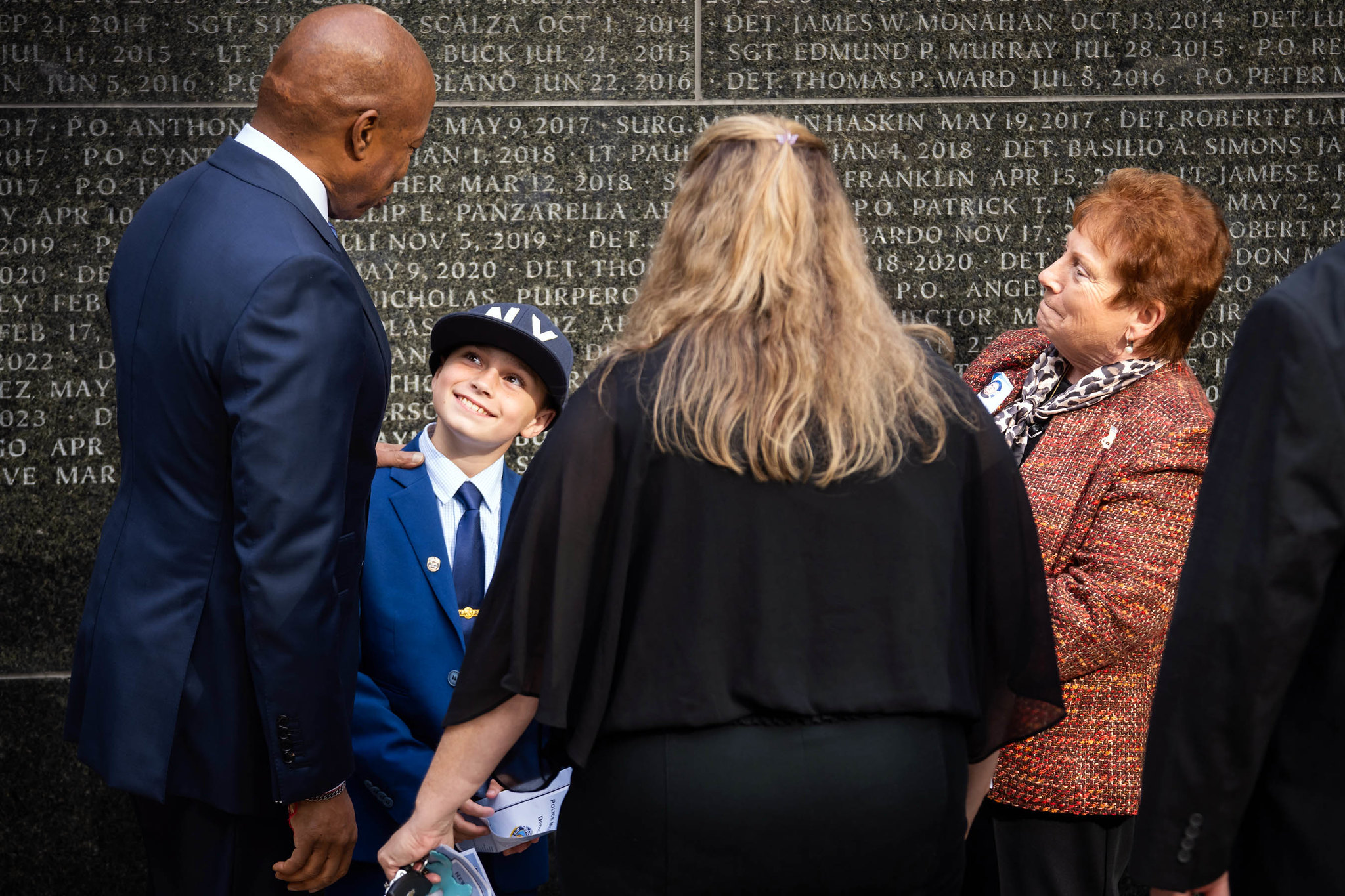
New York City Mayor Eric Adams delivers remarks at the annual Police Memorial Wall unveiling with NYPD Commissioner Jessica S. Tisch on Wednesday, October, 15, 2025. Ed Reed/Mayoral Photography Office
MOST PRO-HOUSING ADMINISTRATION IN CITY HISTORY: MAYOR ADAMS WILL INVEST ADDITIONAL $1.8 BILLION THIS FISCAL YEAR TO SPEED UP CREATION OF THOUSANDS OF NEW AFFORDABLE HOMES
Adams Administration Will Accelerate Additional $1.5 Billion in HPD and $300 Million in NYCHA in FY 2026 to Expedite Construction and Rehabilitation of Nearly 6,500 Homes
City Investing Total of $25.8 Billion in Affordable Housing Through the Upcoming 10-Year Capital Plan
Adams Administration Has Already Created, Preserved, or Planned Over 426,000 Homes for New Yorkers Through Efforts to Date
Announcement Part of Mayor Adams’ “Affordable Autumn” Initiative, Series of Announcements to Create a More Affordable City for Working-Class New Yorkers
NEW YORK – New York City Mayor Eric Adams today announced that his administration will invest an additional $1.8 billion this fiscal year alone to speed up the development of thousands of affordable homes in New York City. By increasing the New York City Department of Housing Preservation and Development’s (HPD) Fiscal Year (FY) 2026 budget by $1.5 billion and the New York City Housing Authority’s (NYCHA) Section 8 Conversions FY 2026 budget by $300 million, the Adams administration will be able to expedite the creation and rehabilitation of nearly 6,500 more homes across more than 10 projects. The new projects, which will be prioritized to serve the most vulnerable New Yorkers, will increase the amount of new affordable housing financed by HPD in FY26 by approximately 25 percent and reinforce, once again, the Adams administration’s position as the most pro-housing administration in city history as the administration has already created, preserved, or planned over 426,000 homes through its efforts to date alone. Today’s announcement continued Mayor Adams’ “Affordable Autumn” initiative, a series of announcements throughout the season focused on the Adams administration’s work to put money back into the pockets of working-class New Yorkers and create a more affordable city.
“We’ve invested record amounts of money into new housing, created record amounts of homes for New Yorkers, and passed historic zoning reform to open the door to more housing across the entire city. With this $1.8 billion investment, we’ll deepen our commitment to creating the housing New Yorkers need and the affordable future they deserve,” said Mayor Adams. “We’re not just talking about solving the city’s housing crisis; we’re putting our money where our mouth is to build more housing more quickly and proving once again why we are the most pro-housing administration in city history.”
“We are in a housing crisis that makes it difficult for New Yorkers to live the life they need and want to live,” said Deputy Mayor for Housing, Economic Development, and Workforce Adolfo Carrion, Jr. “That is why this administration has worked hard to be the most pro-housing administration in the history of the city. This acceleration of investment further builds on the monumental accomplishments we have made and will be pivotal in creating more affordable housing and getting more New Yorkers housed.”
The new funding — which will be moved from the out years of the capital plan into FY26 — underscores the Adams administration’s continued commitment to tackling New York’s housing crisis; by moving this funding to FY 2026, HPD will be able to close on additional housing developments in the near term and build approximately 4,000 affordable homes more quickly than originally planned. Moreover, with the infusion of an additional $300 million into FY26, NYCHA will be able to convert approximately 2,500 units from traditional public housing to Section 8 through the Permanent Affordability Commitment Together (PACT) program. PACT conversions bring in much-needed funding to facilitate repairs and upgrade residential units, building systems, and outdoor spaces.
Since entering office, Mayor Adams has made historic investments to create more affordable housing and ensure more New Yorkers have a place to call home. Earlier this year, Mayor Adams announced that his administration has already created, preserved, or planned approximately 426,800 homes for New Yorkers through its work to date. Mayor Adams also announced that, in Fiscal Year 2025, the Adams administration created the most affordable rental units in city history and celebrated back-to-back-to-back record-breaking years for producing permanently-affordable homes for formerly-homeless New Yorkers, placing homeless New Yorkers into housing, and connecting New Yorkers to housing through the city’s housing lottery.
In addition to creating and preserving record amounts of affordable and market-rate housing for New Yorkers, the Adams administration has also passed ambitious plans that will create tens of thousands of new homes as well. Last December, Mayor Adams celebrated the passage of “City of Yes for Housing Opportunity,” the most pro-housing proposal in city history that will build 80,000 new homes over 15 years and invest $5 billion towards critical infrastructure updates and housing.
The Adams administration is also advancing several robust neighborhood plans that, if all adopted, would deliver nearly 50,000 homes over the next 15 years to New York neighborhoods. In addition to the Bronx-Metro North Station Area Plan, the Midtown South plan, and the Atlantic Avenue Mixed-Use Plan — all of which have already been passed by the New York City Council — the Adams administration is also advancing plans in Jamaica and Long Island City in Queens.
Building on the success of City of Yes for Housing Opportunity, Mayor Adams unveiled his “City of Yes for Families” strategy in his State of the City address earlier this year to build more homes and create more family-friendly neighborhoods across New York City. Under City of Yes for Families, the Adams administration is advancing more housing on city-owned sites, creating new tools to support homeownership, and building more housing alongside schools, playgrounds, grocery stores, accessible transit stations, and libraries.
Further, the Adams administration is actively working to strengthen tenant protections and support homeowners. The “Partners in Preservation” program was expanded citywide in 2024 through a $24 million investment in local organizations to support tenant organizing and combat harassment in rent-regulated housing. The Homeowner Help Desk, a trusted one-stop shop for low-income homeowners to receive financial and legal counseling from local organizations, was also expanded citywide in 2024 with a $13 million funding commitment.
Finally, Mayor Adams and members of his administration successfully advocated for new tools in the 2024 New York state budget that are already helping spur the creation of urgently needed housing. These tools include a new tax incentive for multifamily rental construction, a tax incentive program to encourage office conversions to create more affordable units, lifting the arbitrary “floor-to-area ratio” cap that held back affordable housing production in certain high-demand areas of the city, and the ability to create a pilot program to legalize and make safe basement apartments.

Grayson Nelson, 2, touches the name of his late father, NYPD Chief Gerald Nelson during the New York City Police Department (NYPD) Annual Police Memorial Wall unveiling with Mayor Eric Adams and NYPD Commissioner Jessica S. Tisch on Wednesday, October, 15, 2025. Michael Appleton/Mayoral Photography Office
CITY OF NEW YORK TAKES STEPS TOWARD RECOVERING APPROXIMATELY $48 MILLION FROM OPIOID MANUFACTURER IN ONGOING LITIGATION TO BRING CLOSURE TO COMMUNITIES AFFECTED BY OPIOID CRISES
New Proposed Purdue Pharma-Sackler Family Settlement Totaling Approximately $7.4 Billion Will Allocate Funds to New York City in Continued Fight to Address Opioid Harms
Builds on Work Adams Administration Has Done to Ramp Up Annual Support to $50 Million for Opioid Prevention, Treatment From Major Settlements Secured by City and State of New York
NEW YORK – New York City Mayor Eric Adams and New York City Corporation Counsel Muriel Goode-Trufant today announced the city’s commitment to participate in a new proposed settlement with Purdue Pharma and the Sackler family that would bring approximately $48 million to the five boroughs and, more importantly, closure to the communities torn apart by the opioid crisis. The settlement is the result of litigation brought, beginning in 2017, by the city, numerous state attorneys general, and several thousand subdivisions across the country to address the harms caused by the opioid crises. The total settlement amount is expected to be approximately $7.4 billion, including $4.5 billion for state and local governments, of which approximately $48 million will go to the City of New York. The settlement would combine an agreement with certain members of the Sackler family to pay $6.5 billion and an anticipated contribution from the bankruptcy estate of Purdue Pharma, expected to be $900 million pending approval from the bankruptcy court on the proposed bankruptcy plan later this fall. Purdue Pharma and certain members of the Sackler family were at the heart of a scheme to misleadingly market prescription opioids as safe and effective for long-term chronic pain management, contributing greatly to the nationwide opioid crisis.
“The opioid crisis stole thousands of lives, tore apart countless communities, and devastated families across our city and the rest of the nation, and while nothing can replace all that we lost, we will never stop fighting until we bring justice to communities devastated by this crisis,” said Mayor Adams. “At the heart of the scheme to hook Americans on opioids were the Sackler family and their company, Purdue Pharma, and the potential for this $7.4 billion settlement will serve as an example of how New Yorkers can trust us to always hold those with power accountable when they break the law and harm our citizens. I thank Corporation Counsel Goode-Trufant and the Law Department for their role in this settlement and for helping to ensure we do what we can to help make New Yorkers whole again.”
“This settlement will represent a major milestone in the city’s longstanding legal effort to hold manufacturers and distributors of prescription opioids accountable for their role in the city’s deadly opioid epidemic,” said Corporation Counsel Muriel Goode-Trufant. “The opioid crisis resulted in a tremendous human and financial cost to the city. This $48 million settlement adds to the hundreds of millions of dollars we have already worked to recover from irresponsible drug companies. I commend all the dedicated individuals on the city’s legal team for their work in bringing about this outstanding result.”
Today’s announcement builds on the work the city has done to bring justice to the victims and families of the opioid epidemic. In January 2018, the City of New York sued manufacturers and distributors of prescription opioids to remedy the harms caused within the city by the misleading marketing and improper distribution of these drugs. New York Attorney General Letitia James filed a similar lawsuit in March 2019. Settlements reached by both the city and the state, as well as a court victory by Attorney General James, have provided the City of New York alone with nearly $190 million as of the end of Fiscal Year 2025, which, with this new settlement, is expected to grow to a total of more than $550 million by 2041. In April 2022, Mayor Adams and Attorney General James announced allocations for the first of hundreds of millions of dollars coming to New York City to combat the opioid crisis. In September 2024, Mayor Adams announced city funding will ramp up to an annual $50 million for opioid prevention and treatment.
Recently, Mayor Adams announced the third quarter of 2024 saw the lowest number of overdose deaths in New York City in a single quarter since 2020. In 2023, New York City saw a slight decline for the first time, since 2018, in overdose deaths.
Ongoing funds from opioid settlements have supported new and expanded activities at New York City Department of Health and Mental Hygiene (DOHMH), NYC Health + Hospitals, and the New York City Office of the Chief Medical Examiner that collectively aim to reduce opioid overdose deaths through harm reduction, preventive, and treatment strategies.
Funds from opioid settlements through DOHMH have supported wraparound services for syringe service programs, including on-site medical care, connections to health care and social services, and support for basic needs. Between July 2024 and April 2025, syringe service programs that operate Overdose Prevention Centers provided more than 38,000 harm reduction services to approximately 6,600 participants, reducing the risk of overdose and infectious disease and providing referrals to treatment and other health and social services. In 2023, the Adams administration also allocated $3 million to eight providers on Staten Island through a request for proposal to directly support the expansion of buprenorphine treatment, outreach and engagement, and care navigation services in the borough. Procurement to expand the number of hospitals participating in DOHMH’s emergency department-based nonfatal opioid overdose response program, called Relay, remains ongoing.
Since beginning to receive funding through opioid settlements, NYC Health + Hospitals has had over 9,800 patient engagements with expanded substance use services at Street Health Outreach and Wellness vans, nearly 80,000 encounters with patients in emergency departments with addiction services provided by the Emergency Department Leads program, and has successfully launched a cutting-edge addiction simulation training for emergency department prescribers. Additionally, NYC Health + Hospitals has provided comprehensive addiction consultations at over 23,000 inpatient admissions through the Consult for Addiction Treatment and Care in Hospitals program. Further, the Office of the Chief Medical Examiner’s Drug Intelligence and Intervention Group program has offered support services to more than 2,000 individuals following the death of a loved one from an overdose.
Today’s investment and all of the actions taken by Mayor Adams and the Adams administration to prevent overdose deaths also underscore the administration’s efforts to improve and extend the average lifespan of all New Yorkers through “HealthyNYC” to 83 years by 2030. HealthyNYC sets ambitious targets to address the greatest drivers of premature death, including chronic and diet-related diseases, screenable cancers, overdose, suicide, maternal mortality, violence, and COVID-19.
New Yorkers looking to access substance use services can call or text 988 for free, confidential support 24/7. Resources can also be found on the “NYC HealthMap” and on DOHMH’s website.
Today’s announcement builds on Mayor Adams’ “End the Culture of Anything Goes” campaign, which highlights the work the administration has done to date to change the culture and laws that prevented people with severe mental illness from getting the help they needed, while simultaneously making the investments necessary to support outreach, harm reduction, wraparound services, and housing — all in an effort to make lasting impacts in lives and communities. Mayor Adams is bringing the same energy and approach that proved to be successful in carving a new path to help people with severe mental illness to address other health crises, like drug addiction, playing out on city streets, and recently laid out plans to realize that vision by connecting those suffering with treatment.
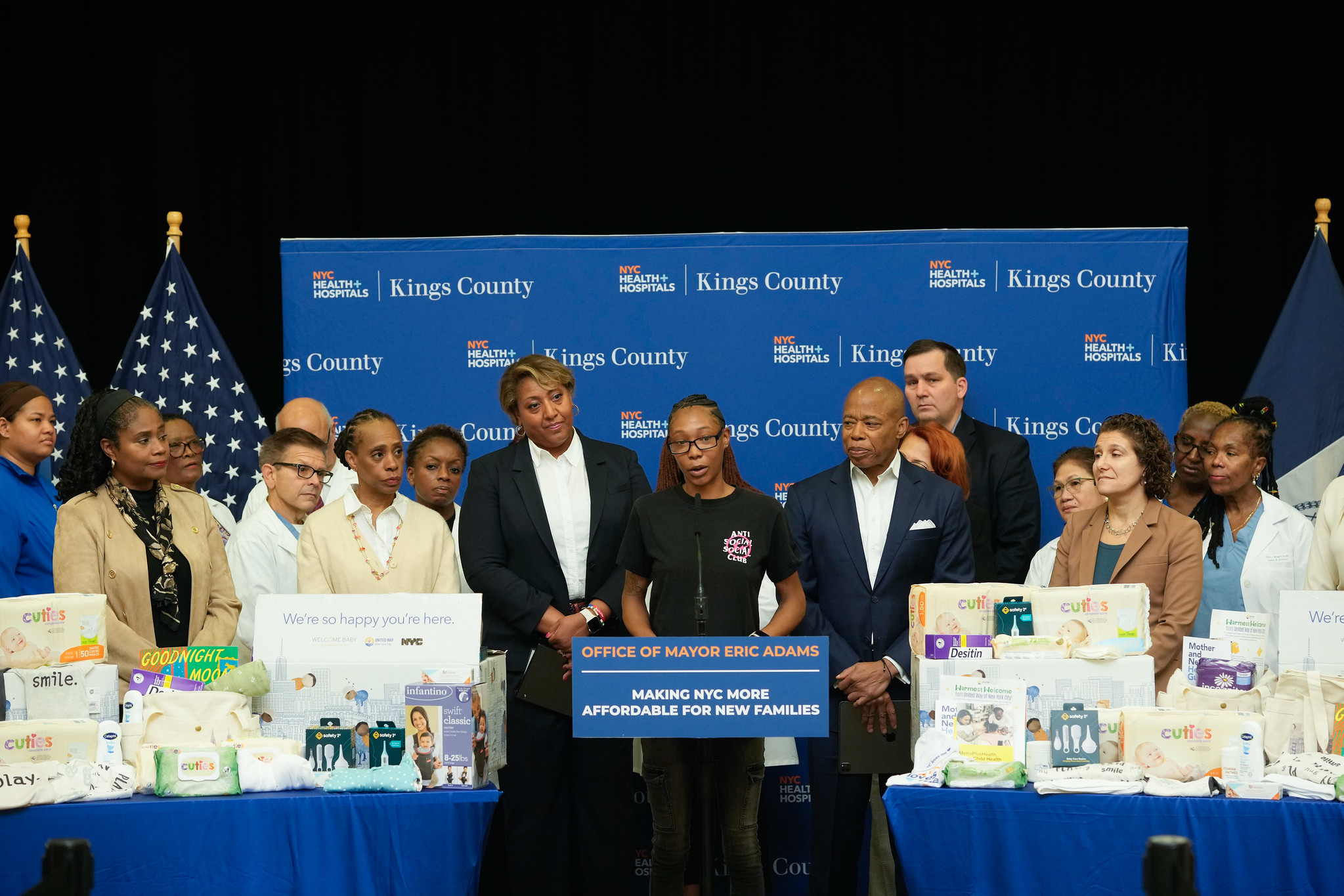
New York City Mayor Eric Adams and New York City Department of Social Services (DSS) Commissioner Molly Wasow Park today announce details of a new initiative that aims to break the cycle of infant homelessness in New York City by delivering support to pregnant New Yorkers. Officially launched on September 15, 2025, the pilot program, “Creating Real Impact at Birth” (CRIB), is an innovative DSS program that will connect and prioritize pregnant New Yorkers applying for shelter with housing vouchers to put them on a path toward permanent housing and stability on Tuesday, October, 14, 2025. Michael Appleton/Mayoral Photography Office
MAYOR ADAMS ANNOUNCES RELEASE OF $93 BILLION FISCAL YEAR 2026 SEPTEMBER CAPITAL COMMITMENT PLAN FOCUSED ON CRITICAL INVESTMENTS THAT LIFT WORKING-CLASS NEW YORKERS, PROMOTE HEALTH AND SAFETY, AND BOOST AFFORDABLE HOUSING PRODUCTION
Largest September Capital Commitment Plan in City History
City’s 10-Year Capital Plan Now at Record $182.8 Billion
$2.6 Billion Invested in Infrastructure, Parks, Cultural Centers, and Internet-Enabled Devices for Public School Students Since Fiscal Year 2026 Adopted Budget, Which Was Already Considered “Best Budget Ever”
Accelerates $1.5 Billion in HPD and $300 Million in NYCHA Funding in FY 2026 to Expedite Construction and Rehabilitation of Nearly 6,500 Homes
Highlights Administration’s Ongoing Commitment to Making New York City Safer, More Affordable, and Best Place to Raise a Family
NEW YORK – New York City Mayor Eric Adams today announced the release of the $93 billion Fiscal Year (FY) 2026 September Capital Commitment Plan — the largest September Capital Commitment Plan in city history — which includes new investments the Adams administration made over this budget cycle in affordable housing, public safety, education, cultural institutions, and more. The September Capital Commitment Plan also includes new capital investments, accelerates nearly $2 billion in funding to address the affordable housing crisis, and uses pre-existing resources to meet urgent infrastructure needs that support the health and safety of New Yorkers across the city, as well as boost economic development. Critically, not a single capital project was cut or had funding reduced under this plan. Investments made in and along with the September Capital Commitment Plan bring the city’s 10-Year Capital Plan to a record level of $182.8 billion.
“Building off our ‘Best Budget Ever,’ we are proud to unveil the largest September Capital Commitment Plan in New York City history that invests in a safer, more affordable city for the working-class people of this city,” said Mayor Adams. “This $93 billion plan makes the smart and forward-looking investments in the capital and infrastructure projects that will build our future. And, because we are the most pro-housing administration in city history and we are endlessly coming up with creative ways to address our generational housing crises, our September Capital Plan accelerates $1.8 billion in funding for affordable housing for both working-class New Yorkers and our city’s public housing residents. That means major affordable housing construction and rehabilitation efforts will happen now — when they are most needed — because we do not have time to wait to deliver the real relief New York City needs to become the best place to raise a family.”
The September Capital Plan is the largest in city history and reflects $2.6 billion in new capital investments on top of the $2.2 billion made in the FY 2026 Adopted Budget, which included; $1 billion to support the Metropolitan Transportation Authority’s (MTA) capital plan, $254.6 million to support New York City’s world-class cultural institutions, $239.5 million in additional investments for educational purposes, $207.6 million in improvements to city parks, $85.4 million for affordable housing needs, $52.4 million in upgrades for the city’s different library systems, $40.3 million in new investments at NYC Health + Hospital facilities, $39.5 million in improvements for The City University of New York facilities, and more.
New additions of $2.6 billion to the capital plan since the Fiscal Year 2026 budget adoption in June 2025 include:
- Advancing the Adams administration’s bold new vision for Coney Island by preserving the iconic Coney Island boardwalk and adding resiliency features ($1.04 billion).
- Supporting the MTA’s capital plan ($800 million).
- Funding $182.4 million in infrastructure and parks improvements related to the Atlantic Avenue Rezoning Plan as part of capital investments made to support the Adams administration’s New York City Strategy for Equity and Economic Development Fund, which will create jobs, housing, and economic opportunities, particularly in areas that have experienced disinvestment, including the following:
- Comprehensive redesign of Atlantic Avenue in Brooklyn between Flatbush Avenue and Bedford Avenue ($120 million).
- Park renovations in Crown Heights and Prospect Heights, Brooklyn:
- John Hancock Playground ($25 million)
- Potomac Playground ($14.1 million)
- Dean Playground ($12.3 million)
- James Forten Playground ($10.6 million)
- Lefferts Place Community Garden ($500,000)
- Continuing the Adams administration’s efforts to bridge the digital divide and invest in a more affordable city for working-class New Yorkers by distributing 350,000 new internet-enabled devices for free to K-12 New York City Public Schools students ($129.3 million).
- Addressing East Side Coastal Resiliency project needs, including soil remediation, increased materials costs, and improved flood protection design and delivery ($91.6 million).
- Replacing at least 145 Fire Department of the City of New York (FDNY) ambulances that are reaching the end of their useful life ($91 million).
- Reconstructing the existing 34th Street Ferry landing to add additional slips for vessel docking in an effort to reduce crowding, improve service, and reduce delays at the current landing ($75 million).
- Funding for infrastructure, parks, and school improvements with $71.8 million in investments connected to the Midtown South Rezoning Plan launched by the Adams administration to transform outdated industrial areas in Midtown South into a dynamic live-work neighborhood, including:
- Broadway Vision Plan Expansion between West 33rd Street and West 38th Street and Herald Square and Greeley Square ($50 million).
- Redesigning and upgrading McCaffrey Playground ($13.5 million).
- Improvements to P.S. 11, P.S. 33, P.S. 340, the High School of Fashion Industries, and the Jacqueline Kennedy Onassis High School ($6.1 million).
- New sports field lighting at St. Vartan Park ($2.2 million).
- Funding to reconstruct the basketball court, pickleball court, playground, lawn, adult fitness equipment, and dog run at Printer’s Park in the Bronx ($16.7 million).
- Funding renovations within the Jewish Children’s Museum ($16.3 million).
- Funding to install radio communication systems to ensure systemwide communications for staff working at the Brooklyn Borough Based Jail facility ($14.3 million).
- Adding funding to help complete Phase 1 of the QueensWay project that will transform an abandoned railroad line into five acres of new park space. ($14 million).
- Renovating Ittner Place Park in the Bronx by turning a vacant lot into a basketball court and skate park ($8.7 million).
- Adding funding to accelerate completion of the Bronx Animal Care Center, which will be substantially completed by January 2026 ($6 million).
- Developing an application to streamline the Mayor’s Office of Criminal Justice’s ability to consolidate and review data from partner city agencies and service providers to enable more effective individualized decisions around social services or alternatives to incarceration that are available to justice-involved individuals ($4.1 million).
- Funding a commemorative landscape to be added alongside a Holocaust Memorial at Queens Borough Hall ($2 million).
Along with newly added resources, agencies will be allocating more than $2 billion in pre-existing capital funding, including:
- Accelerating $1.8 billion in funding from capital plan outyears to speed up creation and renovation of thousands of new affordable homes to address a generational affordable housing crisis.
- Allowing the New York City Department of Housing Preservation and Development to close on additional housing developments in the near term and build approximately 4,000 new affordable housing units more quickly than originally planned. ($1.5 billion).
- Expediting the rehabilitation of nearly 2,500 more homes through the New York City Housing Agency (NYCHA) Section 8 Conversions (NYCHA Permanent Affordability Commitment Together and the Public Housing Trust) in the current fiscal year ($300 million).
- Expanding the automated traffic camera program by installing 300 additional bus lane cameras and increasing the number of red-light cameras to 600 intersections ($315 million).
- Completing wetlands restoration at Idlewild Park, including marsh elevation, construction of living shorelines, and planting of native trees shrubs and grasses ($38 million).
- Installing a Sprung Structure over one of the two basketball courts at the Crossroads Juvenile Detention Facility to create an additional 28 beds and two classrooms needed to address capacity issues ($24 million).
- Upgrading the Staten Island Composting Facility to more effectively contain litter and food waste ($19 million).
- Increasing space at the new Brownsville Recreation Center to meet current community programming needs ($13.3 million).
- Building an enclosed climate-controlled physical training space at the FDNY’s Fire Academy Training Fieldhouse for probationary firefighters who engage in physical training outdoors in order to reduce the risk of rhabdomyolysis, a serious muscle-damage related injury that can impact firefighters due to the inherent injury risks in their training and jobs ($6 million).
- Adding funding for the renovation of the Brooklyn Animal Care Center, which will be substantially completed by the fall of 2026 ($2.6 million).
The September Capital Plan follows the release of and further builds on an on-time, balanced, and fiscally responsible $115.9 billion Adopted Budget for FY 2026, which built on the FY 2026 Executive Budget, often called the “Best Budget Ever.” The Executive Budget doubled down on Mayor Adams’ commitment to make New York City the best place to raise a family by, among other things, investing in “After-School for All,” a $755-million plan to deliver universal after-school programming to families of children in kindergarten through eighth grade; baselining funding for 3-K citywide expansion and special education pre-K to build on the administration’s work to dramatically expand access to early childhood education; investing over $400 million to fully fund the transformation of Fifth Avenue in Manhattan into a world-class, pedestrian-centered boulevard; and revitalizing “The Arches,” the public space on the Manhattan side of the Brooklyn Bridge. The FY 2026 Adopted Budget was also the first to implement Mayor Adams’ landmark “Axe the Tax for the Working Class” plan, which abolishes and cuts New York City’s personal income tax for filers with dependents living at or below 150 percent of the federal poverty line. Because of this plan, which the Adams administration successfully fought to pass in Albany this budget cycle, $63 million will go back into the pockets of over 582,000 low-income New York filers, including their dependents, helping make New York City more affordable for working-class families.
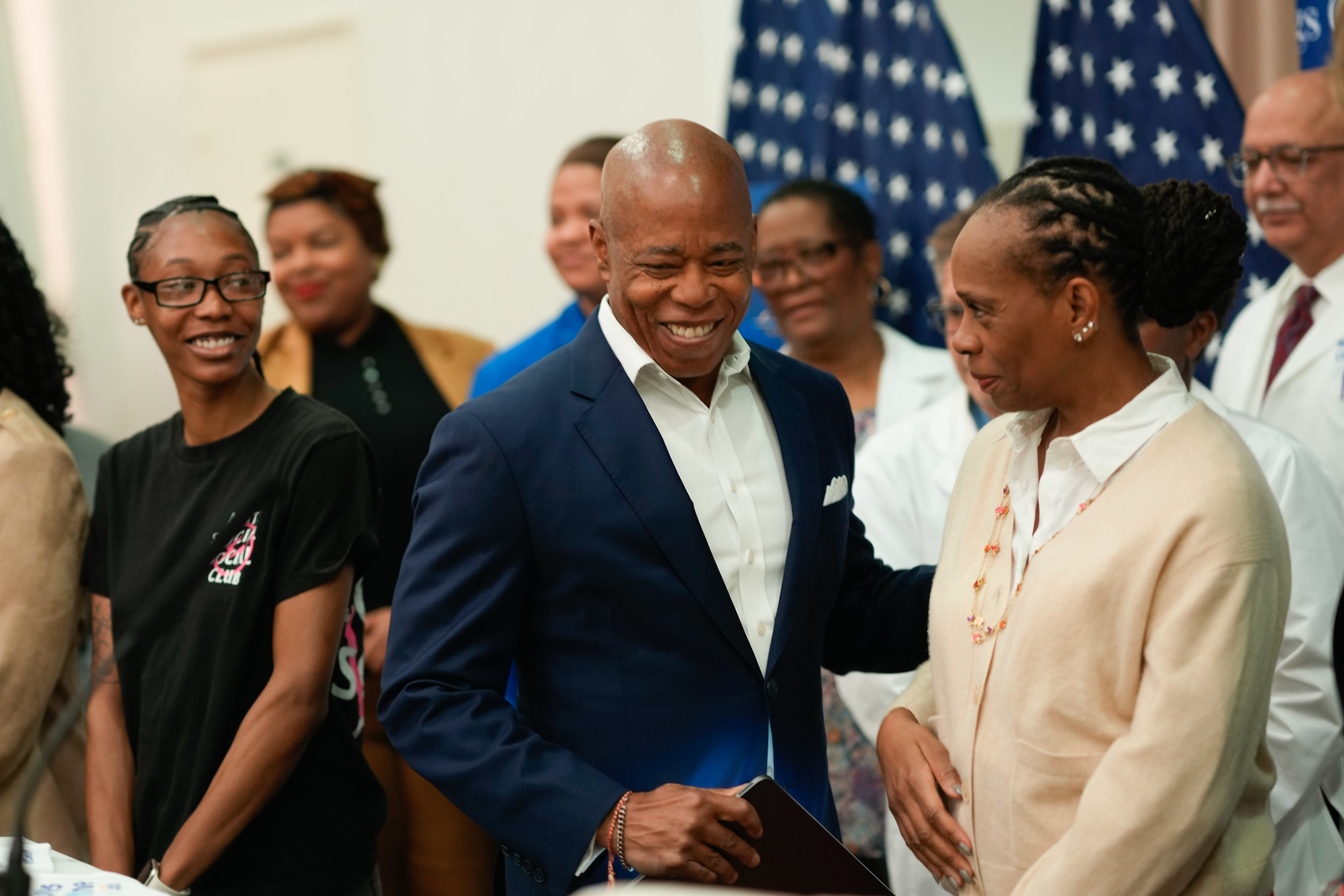
New York City Mayor Eric Adams and New York City Department of Social Services (DSS) Commissioner Molly Wasow Park today announce details of a new initiative that aims to break the cycle of infant homelessness in New York City by delivering support to pregnant New Yorkers. Officially launched on September 15, 2025, the pilot program, “Creating Real Impact at Birth” (CRIB), is an innovative DSS program that will connect and prioritize pregnant New Yorkers applying for shelter with housing vouchers to put them on a path toward permanent housing and stability on Tuesday, October, 14, 2025. Michael Appleton/Mayoral Photography Office
MAYOR ADAMS ANNOUNCES NEW YORK CITY’S FOURTH SALE OF SOCIAL BONDS TO SUPPORT MORE AFFORDABLE HOUSING AS LEADING INDEPENDENT AND INTERNATIONALLY-RECOGNIZED RATING AGENCIES AGAIN AFFIRM CITY’S STRONG FINANCIAL STANDING AND STABILITY
Proceeds of Social Bonds Will Help Finance Nearly 2,200 Affordable Housing Units, Part of Adams Administration’s Efforts That Have Already Created, Preserved, or Planned Approximately 426,800 Homes
Social Bonds Exclusively Supporting Affordable Housing Have Only Been Issued During Adams Administration
Moody’s, S&P, Fitch, and Kroll Show Strong Confidence in City’s Stability, Resilience, and Fiscal Outlook
NEW YORK – New York City Mayor Eric Adams today announced that New York City will sell $460 million of taxable, fixed-rate General Obligation Social Bonds in October 2025, helping to support the creation of thousands of units of affordable housing. Additionally, Mayor Adams announced that — for the 18th consecutive time in this administration — the independent, internationally-recognized credit rating agencies Moody’s Ratings, S&P Global Ratings, Fitch Ratings, and Kroll Bond Rating Agency have all affirmed the city’s strong bond ratings and stable outlook. Selling bonds to investors generates resources that the city uses to build and maintain its world-class infrastructure, and, in this case, will be used to support the construction and development of nearly 2,200 units of affordable housing in New York City. Social Bonds exclusively supporting affordable housing in New York City have only been issued during the Adams administration, and this is the city’s fourth issuance of Social Bonds since 2022.
“When it’s come to tackling our generational housing crisis, our administration has gotten creative as we’ve used every tool possible to tackle our generational housing crisis,” said Mayor Adams. “From our historic ‘City of Yes’ plan to our neighborhood rezonings, we have never been afraid to take the bold and necessary steps to build more housing for working-class New Yorkers. Issuing Social Bonds exclusively for housing is yet another example of how we are thinking outside the box to finance and spur more affordable housing. With this latest sale of $460 million of General Obligation Social Bonds, we will support the construction of nearly 2,200 additional units of affordable housing. And because of our work and more, the leading credit rating agencies have, once again, affirmed our administration’s strong fiscal management. Our administration has consistently stepped up to the plate, skillfully managing crises after crises while making our economy stronger and boosting investor confidence. And while we have made great strides, we will never stop fighting to make our city more affordable, more livable, and the best place to raise a family.”
Financing Affordable Housing Through Sale of Social Bonds
Social Bonds allow the city to take advantage of demand for investment opportunities while addressing core policy objectives, including investing in programs and initiatives that can make the city more affordable for working-class New Yorkers. The city’s first three sales of Social Bonds — all of which took place under the Adams administration — totaled $1.92 billion and helped finance over 12,100 units of affordable housing across the city. Following the upcoming transaction, the city will have sold $2.38 billion of Social Bonds since 2022 to help finance over 14,300 units of affordable housing.
The upcoming issuance of Social Bonds to support the building of more affordable housing follows yet another record-breaking year by the Adams administration for producing and connecting New Yorkers to affordable homes. Through its efforts to date, the administration has created, preserved, or planned for over 426,800 homes for New Yorkers — including at least 250,000 affordable homes — over the next 15 years. To support the creation of even more affordable housing, the Adams administration continues to use every tool available to produce the homes New Yorkers need and make generational progress against the city’s housing crisis, having committed $25.8 billion towards affordable housing through the city’s 10-Year Capital Plan.
Net proceeds from the upcoming sale of Social Bonds will be used to reimburse prior spending by the city under the New York City Department of Housing Preservation and Development’s Extremely Low- and Low-Income Affordability (ELLA) Program, Senior Affordable Rental Apartments (SARA) program, and Supportive Housing Loan Program (SHLP). The projects being financed are expected to provide an estimated 1,152 units under the ELLA program, 190 units under the SARA program, and 856 units under the SHLP program. Over 80 percent of the units will be for households earning 60 percent of area median income (equal to $97,200 for a family of four) or below. Additionally, 790 of the total units — more than one-third — will provide housing for individuals and families formerly experiencing homelessness.
Leading Credit Rating Agencies Again Show Confidence
Earlier this month, based on the strength of the city’s fiscal management, revenue performance, budget reserves, and post-pandemic recovery, Moody’s, S&P, Fitch, and Kroll all assigned double-A category ratings and stable outlooks to the city’s upcoming sales of approximately $1.5 billion tax-exempt and $1.75 billion taxable General Obligation Bonds, which includes the $460 million of Social Bonds. The four credit rating agencies have repeatedly upgraded or affirmed the city’s strong General Obligation Bond ratings and outlooks over the course of the Adams administration. Notably, in February 2023, Fitch Ratings upgraded the city’s credit rating from AA- to AA. On each occasion, the four agencies cited the city’s ongoing strong fiscal management in support of their decisions.
Maintaining a strong bond rating is an indication of the city’s financial strength and encourages continued investment in the city’s bonds, which help support funding to build and maintain housing, schools, streets, parks, and other critical infrastructure that spans the five boroughs.
In maintaining its Aa2 rating, Moody’s Ratings cited “New York City’s post-pandemic economic recovery, including a record-high employment-to-population ratio, positive trends in assessed property values despite commercial real estate challenges, and steady but slow tax revenue growth. The expanding economy is driven by the city’s competitive advantages: a young, highly skilled labor pool that over time has helped make New York City households wealthier; strong higher education and medical centers that also contribute higher paying jobs; and strong domestic and international transportation links that support New York City’s position as a global economic, financial and cultural hub.”
S&P Global Ratings stated that the AA rating “reflects our view of New York City’s governance strengths and the dynamism and resilience of its economy, which we believe support stable credit quality over the outlook horizon. At the onset of fiscal 2026, we believe that the fiscal trajectory remains stable, and budgetary reserves — while not projected to increase over the near-term — provide the city with financial flexibility to navigate near-term risks…The stable outlook further reflects our view of the city’s continuing ability to navigate potentially disruptive economic uncertainties and sustain financial stability in the near term, particularly amid a shifting federal and state funding landscape.”
Fitch Ratings noted that “New York City’s ‘AA’ Long-Term Issuer Default Rating and GO bond rating reflect the city’s exceptionally strong budget monitoring and controls, supporting Fitch’s ‘aa’ financial resilience assessment…The city experienced record revenue performance and strong economic recovery coming out of the pandemic, as well as improvement in reserve levels, which will help management navigate slowing revenue growth and future economic downturns.”
In its assignment of the city’s AA+ rating, KBRA wrote that “the city’s role as an international business and cultural center, and its position as the hub of the country’s largest metropolitan economy, highlight the diversity of the resource base supporting the G.O. Bonds. Institutionalized, long-range financial management and capital planning practices support financial stability.”
The credit rating and stable outlook affirmations follow the passage of the city’s $115.9 billion Fiscal Year (FY) 2026 Adopted Budget, which builds on Mayor Adams’ FY 2026 Executive Budget — often called the “Best Budget Ever.” The “Best Budget Ever” prioritizes investments that will make New York City a safer, more affordable city that is the best place to raise a family. Additionally, this fiscal year, for the first-time ever, New York City abolished or cut personal income taxes for eligible low-income New Yorkers. Recently, in his FY 2026 September Capital Commitment Plan, Mayor Adams announced the largest capital commitment plan in city history, which includes the acceleration of $1.5 billion in the New York City Housing Preservation and Development capital budget and $300 million in the New York City Housing Authority capital budget for FY 2026 to expedite construction and rehabilitation of nearly 6,500 homes, yet another example of how the administration is delivering affordable housing faster and more creatively.
Thanks to careful fiscal management and policies that have fostered robust economic growth, the Adams administration overcame unprecedented challenges in this budget cycle to manage the budget responsibly, support essential services, and make upstream investments that will benefit New Yorkers for generations to come.

New York City Mayor Eric Adams addresses NYPD Cadets at the Police Academy in Queens on Friday, October, 10, 2025. Michael Appleton/Mayoral Photography Office
CITY OF NEW YORK TAKES NEW ACTION OPPOSING FEDERAL GOVERNMENT’S MILITARY DEPLOYMENT IN AMERICAN CITIES
New York City and Coalition Support Oregon’s Case Against Federal Administration
Brief Highlights Harms to Local Public Safety and Economies
NEW YORK – The City of New York — as part of a coalition of 74 localities from around the nation — has filed a new amicus brief supporting Oregon’s ongoing case against the federal government’s unlawful deployment of the National Guard in Portland. In the brief, the coalition urges the U.S. Court of Appeals for the Ninth Circuit to affirm a district court ruling in Oregon v. Trump, which enjoined the federal government from deploying federal troops in Portland. The coalition warns against the Trump administration’s plans to deploy the National Guard at “anytime, anywhere, for any reason — based on nothing more than sporadic incidents of conflict or being a disfavored jurisdiction.” The coalition highlights the harms to local sovereignty, to local peace and tranquility, and to local economies from the federal government’s deployment of the National Guard to American cities on pretextual and political grounds.
“New York City is proud to — once again — partner with a multitude of localities to assert local control over our own domain: public safety,” said New York City Mayor Eric Adams. “Our administration has been unrelenting in driving down crime, rooting out violent criminals, and protecting New Yorkers, and we have had record drops in crime thanks to our commitment to public safety and the precision policing of the NYPD. Collaboration with state and federal law enforcement has always been a key part of our public safety strategy, but we do not need a deployment of the National Guard to our city. Instead, we plan to continue to work with the federal government on areas where collaboration is warranted, such as stopping the flow of illegal guns to our city from the Iron Belt. We remain committed to keeping New Yorkers safe while upholding our constitutional rights.”
“As highlighted in this brief, the president is continuing to treat American cities as military ‘training grounds’ based on pretext and misinformation that is contrary to the facts on the ground,” said New York City Corporation Counsel Muriel Goode-Trufant. “Federalizing and domestically deploying the National Guard can sow chaos in local communities and should be a last resort, not a primary tactic, reserved for exceedingly rare circumstances. The district court ruling enjoining the federal government should be upheld.”
In September 2025, the Trump administration deployed members of the National Guard to Portland, citing protests of immigration enforcement operations. On October 4, 2025, the U.S. District Court for the District of Oregon ruled that the deployment likely violated federal law because plaintiffs submitted evidence that the cited protests were not significantly violent or disruptive in the days or weeks leading up to the president’s directive. The federal government filed an application in the U.S. Court of Appeals for the Ninth Circuit seeking an immediate stay of the district court’s temporary restraining order.
In the amicus brief, the coalition argues that the federal government has overreached its authority and that the lower court’s injunction should remain in place, based on longstanding federal laws prohibiting the National Guard from engaging in domestic law enforcement. The brief asserts that the federal government has provided no factual basis or legal justification for deploying 200 federal troops in Portland over the objection of local officials. The coalition states that there was no invasion or rebellion directed toward the federal government that would have allowed it to lawfully deploy the National Guard under 10 U.S.C. 12406, and that this pretext dramatically increases the risk of irreparable injury by inflaming community tensions and interfering with local law enforcement personnel which is better trained to manage situations such as protests and crowd control.
Further, the brief cites the chilling effect that National Guard deployments have on the local economy and taxpayers — as more customers stay inside and local businesses lose customers. Also, taxpayers are stuck paying the bill for these deployments: $134 million for Los Angeles alone and, potentially, at least $10 million for Oregon.
Joining the City of New York and Portland, Oregon are the cities of Tucson, Arizona; Alameda, Anaheim, Berkeley, Culver, Long Beach, Los Angeles, Oakland, Sacramento, San Diego, San José, San Leandro, Santa Ana, Santa Monica, San Francisco, and West Hollywood, California; Denver and Ridgway, Colorado; New Haven, Connecticut; Tallahassee, Florida; Bloomington, Chicago, and Evanston, Illinois; Indianapolis, Indiana; Baltimore, Maryland; Boston, Cambridge, and Lawrence, Massachusetts; Ann Arbor, Bellevue, and Exeter, Michigan; Hopkins, Minneapolis, and St. Paul, Minnesota; Hoboken and Newark, New Jersey, Albuquerque, New Mexico; Hudson, Rochester, and Brighton, New York; Cleveland, Ohio; Pittsburgh and Norristown, Pennsylvania; Providence, Rhode Island; Knoxville and Nashville, Tennessee; Austin, El Paso, Iowa Colony, and San Marcos, Texas; Burlington, Vermont; Alexandria and Norfolk, Virginia; Tacoma, Washington; Madison and Exeter, Wisconsin; as well as the counties of Pima, Arizona; Alameda, Los Angeles, Monterey, San Mateo, Santa Clara, and Sonoma, California; Denver and Ouray, Colorado; Montgomery, Maryland; Ingham and Bellevue, Michigan; Columbia, Cortland, and Monroe, New York; Multnomah, Oregon; Allegheny, Bucks, Clarion, Dauphin, and Montgomery, Pennsylvania; Davidson and Shelby, Tennessee; Harris and Travis, Texas; Kings and Pierce, Washington; Dan and Exeter, Wisconsin.
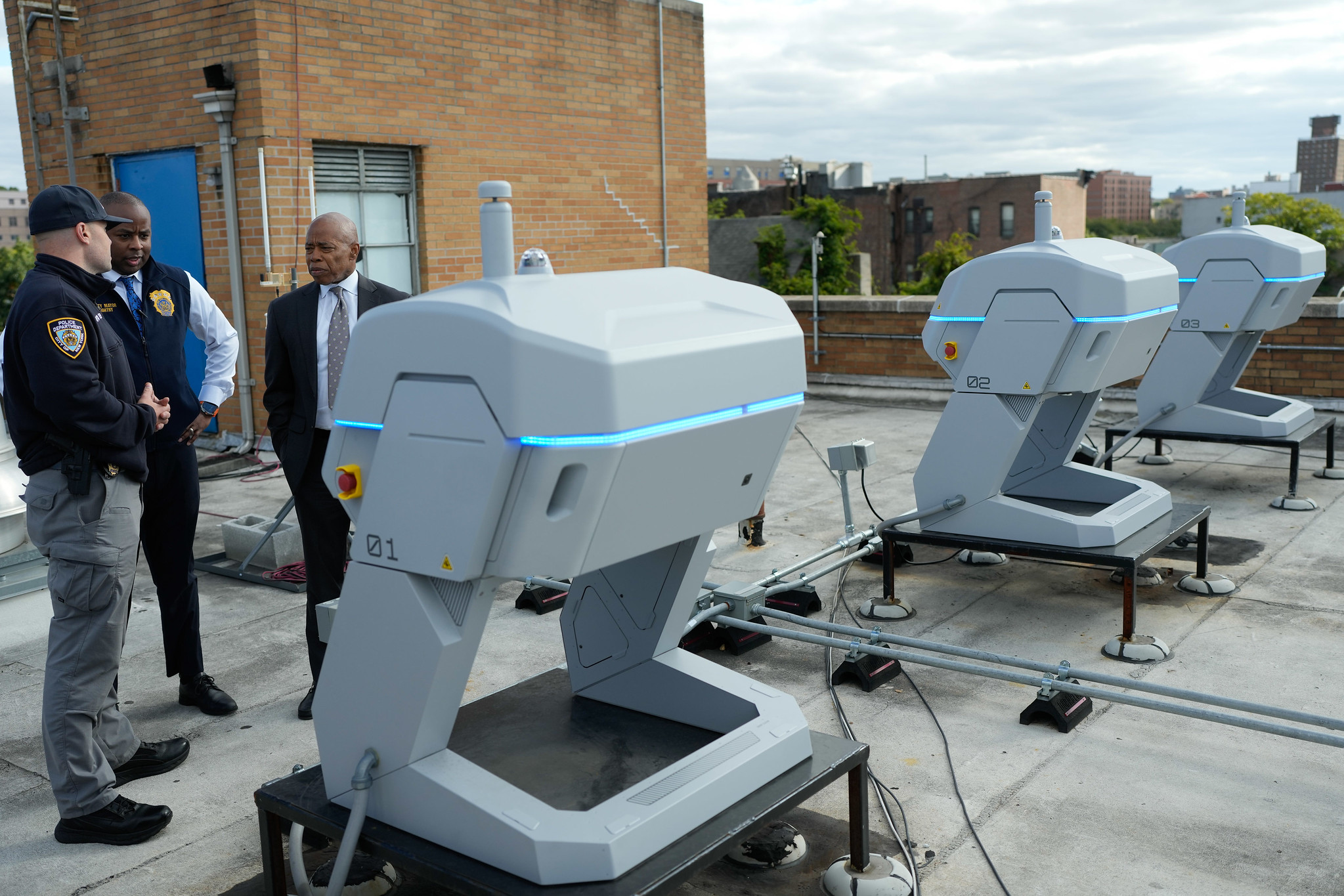
New York City Mayor Eric Adams visits the 48th Precinct where he inspected a new drone instillation on Friday, October, 10, 2025. Michael Appleton/Mayoral Photography Office
MAYOR ADAMS ANNOUNCES LEGAL ACTION AGAINST TRUMP ADMINISTRATION TO PROTECT $12 MILLION IN FEDERAL COUNTERTERRORISM FUNDING FOR NEW YORK CITY SUBWAY SYSTEM
Subways Transport Average of 5.5 Million People Daily
Transit Security Grant Program Helps Protect Public-Transit System Against Terrorist Attacks
Cuts Threaten Anti-Terror, Explosives, Suspicious Activity, and Operational Response Work Conducted by NYPD in Subways
NEW YORK – New York City Mayor Eric Adams today announced the City of New York has filed an amicus brief supporting the State of New York’s ongoing case to prevent the Trump administration from revoking $12 million in grant funding that would be passed from the Metropolitan Transit Authority (MTA) to the New York City Police Department (NYPD) for counterterrorism policing in the subway system. In the brief, the city supports the state’s motion for a preliminary injunction in New York v. Noem, which the federal government opposes.
“The subway system is the lifeblood of our city, making it one of the biggest terrorist targets in the nation, so we cannot afford to lose a single dollar — let alone $12 million — when it comes to protecting 5.5 million daily riders,” said Mayor Adams. “Extremist behavior is taking place across the globe, and these funds are crucial in both being proactive and reactive to the threats to the safety of everyone in our city. We filed this amicus brief to support our state partners in the fight to stop the federal government’s dangerous funding cuts.”
“Cutting federal funds that support vital NYPD counterterrorism efforts endangers all New Yorkers,” said New York City Corporation Counsel Muriel Goode-Trufant. “The Trump administration is risking mass casualties, severe property damage, and public terror to coerce the City of New York into falling in line with its policy priorities. The DHS secretary’s unlawful and dangerous action should be enjoined.”
On September 30, 2025, New York state learned that U.S. Department of Homeland Security (DHS) Secretary Kristi Noem announced that the federal government was revoking funding under the Transit Security Grant Program (TGSP) that was originally allocated to the MTA for the coming fiscal year. The NYPD is primarily responsible for public safety in the city’s subway system, a component part of the MTA’s transit network, and the MTA planned to pass on $12 million of the grant award to the NYPD for counterterrorism policing in the subways. The NYPD uses the funds to train and support units that detect explosives and chemical and radiological weapons, identify and preempt incipient attacks, train transit officers to respond to active shooter attacks in the subway, and respond effectively to terrorist incidents.
The NYPD plans to use its portion of the grant funds for Fiscal Year 2025 to continue to safeguard the subway-riding public. The grant funding withheld by DHS would support a variety of NYPD deployments that work to keep the subway safe, including:
- Officers on the Radiological Anti-Terror Patrol Train Operational Sweep Team, which inspect critical infrastructure throughout the subway system — including stations, tunnels, equipment rooms, tracks, and train cars — for radiological weapons.
- The Explosive Detection Canine Unit, which patrols the subway system with dogs trained to find chemical, radiological, and nuclear explosives.
- The Mobile Explosive Screening Team, which uses explosive detection equipment to screen passengers’ bags at entrance points.
- The Suspicious Activity Behavior Recognition Team, which sends undercover officers on the subway system to prevent terrorism.
- The Transit Operational Response Canines and Heavy Weapons Team, which patrols entrances during rush hour to deter attacks.
- Funding active-shooter training.
According to the brief, the harm from the loss of those funds will not only endanger the average 5.5 million daily commuters and tourists who ride the subways every day, but all of the city’s 8.5 million residents. The city argues that the DHS secretary’s choice to deny MTA funding — for the first time since the grant program’s creation — was motivated by a policy disagreement with city and state officials rather than any assessment of the risk of a terrorist incident in New York City’s subway system. Cutting funding based on a policy disagreement violates the statute authorizing the counterterrorism grant. The statute expressly provides that funds “shall” be distributed to public transit systems based solely on the risk of terrorism. The city’s subway system faces a higher risk of a terrorist attack than any other transit system in the country, and the DHS secretary is required to allocate part of the grant to the MTA.
The action comes on the heels of the federal government’s decision to reverse its $187 million reduction in public safety grants. As the brief notes, “the DHS secretary’s decision is even more unsupportable given that the secretary has reversed course on announced massive cuts to the state from a similar but separate grant —the Homeland Security Grant Program — which is also required to be distributed based on risk.”
Since the inception of the TGSP program, the NYPD has received close to $250 million in funding, which it has used to support vital counterterrorism initiatives in the subway system.
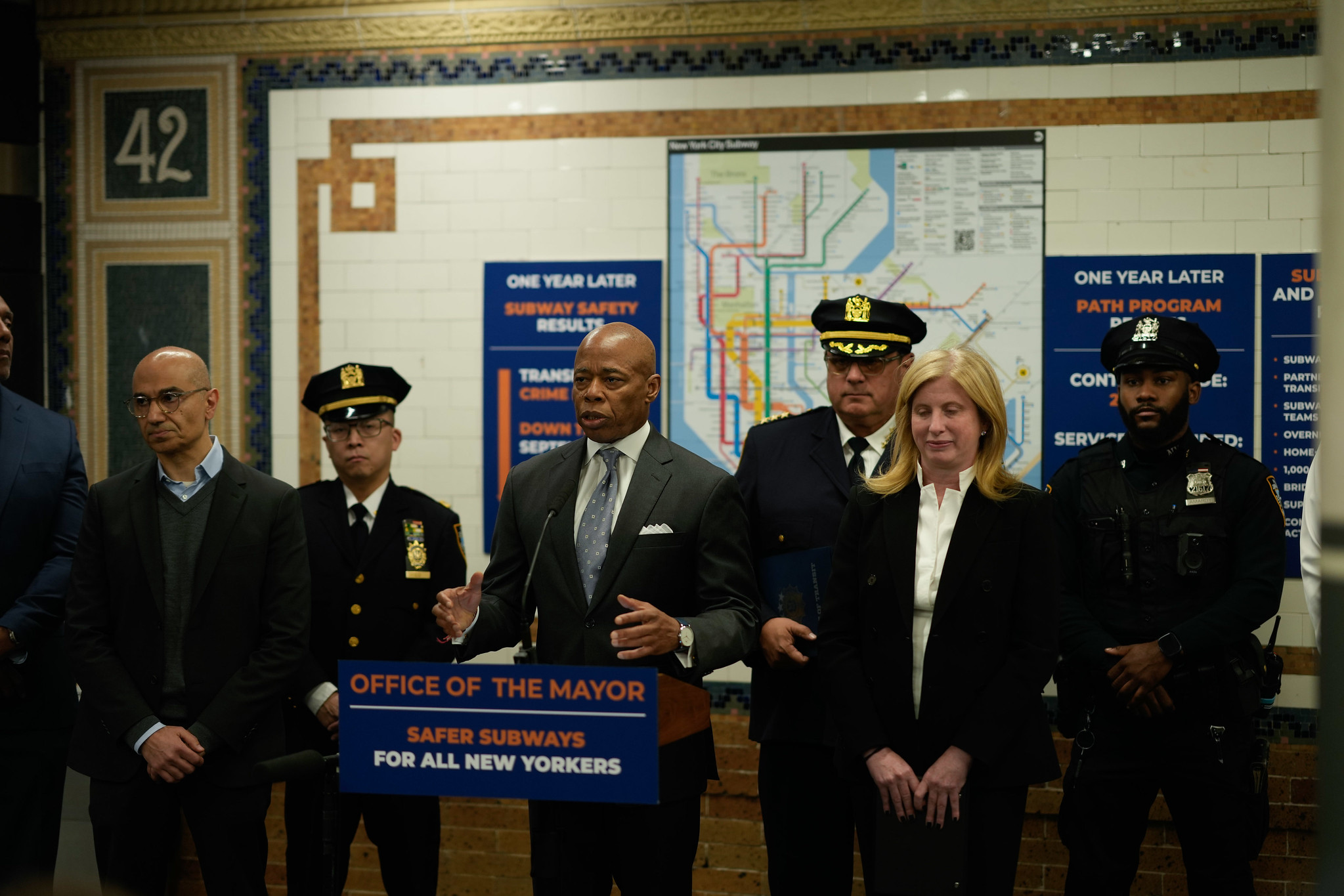
New York City Mayor Eric Adams New York City Mayor Eric Adams, New York City Police Department (NYPD) Commissioner Jessica S. Tisch, and New York City Department of Social Services (DSS) Commissioner Molly Wasow Park today celebrated the one-year anniversary of the Partnership Assistance for Transit Homelessness (PATH) program — a public safety and social services co-response outreach initiative, launched in August 2024, to help keep New Yorkers safe and healthy on the subway system on Friday, October, 10, 2025. Michael Appleton/Mayoral Photography Office
Banner Image: New York City Mayor Eric Adams and New York City Department of Social Services (DSS) Commissioner Molly Wasow Park today announce details of a new initiative that aims to break the cycle of infant homelessness in New York City by delivering support to pregnant New Yorkers. Officially launched on September 15, 2025, the pilot program, “Creating Real Impact at Birth” (CRIB), is an innovative DSS program that will connect and prioritize pregnant New Yorkers applying for shelter with housing vouchers to put them on a path toward permanent housing and stability on Tuesday, October, 14, 2025. Image Credit – Michael Appleton/Mayoral Photography Office