


By Anonymous Staten Island Resident
Lately, I have heard from “the media” that Curtis Sliwa is “unelectable” due to lack of support, and that voters who might have voted for the street-smart founder of the vaunted Guardian Angels, should instead vote for Mario Cuomo to “prevent Mandami from getting in.” Cuomo? Are you kidding? Let’s just ignore history, shall we?
Ah, the media. The Fourth Estate—perhaps more so than ever, the Fifth Horseman of the Apocalypse, galloping ever closer to defining the very contours of our democratic faith, riding on the airwaves, not a horse.
Will it take the Fifth Estate to stop this unaccounted-for Fifth Horseman of Doom? Independent media retains this responsibility, solely. This, also, is Constitutionally mandated. Why haven’t other islanders written in to this paper or others on this exact issue? You should be ashamed.
As voters, we expect the media to serve as a trustworthy guide through the murky waters of political choice. But somewhere along the way, something went terribly wrong. Media outlets, with all their polls, predictions, and chatter, have started behaving like psychic octopuses, confidently stating which candidates are “unelectable”—with the solemn certainty that only an internet meme or a late-night pundit could summon.
Here’s the problem: the idea that a candidate, in this case, Mr. Curtis Sliwa, “can’t win” is an insult to both the democratic process and to voters’ capacity for surprise. And it’s worse when this mantra is based on one thing and one thing only: polling data. But let’s take a moment to consider that in the great theatre of democracy, polling might not be the definitive script it’s made out to be. And media declaring who “can’t win”? Well, that’s simply bad journalism. It’s an electoral misstep of the highest order.
The Polling Paradox: Data, Not Destiny
Polling is a curious creature. On one hand, it’s an invaluable tool for gauging public opinion—a thermometer for the health of the electorate. On the other, it’s about as predictable as a weatherman forecasting a tornado in November. We should remember what Alexis de Tocqueville warned us about democracy in America. He feared, not just the tyranny of the majority, but the way in which public opinion could easily be manipulated, swayed, or warped by the media’s interpretation of it.
When media outlets claim that a candidate “can’t win” because of polling, they reduce the complex, unpredictable art of democracy to a simple, mechanistic number. Yet history is full of upsets. Do we remember that early on, polling told us that Donald Trump had no chance of winning the presidency in 2016? I mean, every major outlet had essentially written him off—only to see him shatter predictions and storm through the electoral process with an outcome no one foresaw.
Polling is often touted as an oracle, but oracles can be wrong. And worse, when media outlets pass off these numbers as the final word on a race, they are subtly (or not-so-subtly) telling voters, “Don’t bother supporting that candidate—they’re not worth your time.” They’re reducing the democratic process to the business of counting heads before those heads have even cast their votes.
When media outlets trumpet a candidate’s “electability” based on polling data, they are not just delivering news—they are shaping the news. That’s a problem. Clearly.
The fact that a candidate might be “losing” in the polls becomes, in itself, a story. But let’s not forget, polling data can be as misleading as a five-dollar bill folded in half and placed beneath a stack of campaign flyers. It’s not necessarily indicative of a candidate’s ultimate chances.
The Self-Fulfilling Prophecy: How Polls Affect Voter Behavior
The danger here is a self-fulfilling prophecy. When media outlets insist that a candidate “can’t win,” it creates a feedback loop that discourages voter participation. Why vote for a candidate if everyone says they’re destined to lose? This is a powerful psychological effect that has been explored in various academic fields. But more importantly, it undermines the integrity of democracy itself. Media isn’t just reporting reality—it is creating it.
James Madison, in the Federalist Papers, wrote about the importance of a free press in maintaining the integrity of democratic systems. A free press, he argued, should not merely follow the whims of public opinion; it should serve as a counterbalance, helping to inform and engage citizens in the political process. However, in this age of 24-hour news cycles and clickbait headlines, the media often forgets this noble calling and instead caters to the easiest narrative: the horse race.
It’s as though every election is reduced to a football game, where we know, by halftime, who’s going to win based on the score. How realistic is that?
And when we’re talking about life, is this really democracy in action? Is the role of media to act as a scoreboard, or to enliven and engage and enlighten the public? We must ask whether this approach does justice to the very principles upon which our country was built.
To quote Tocqueville again, “The great advantage of democracy is that it ensures the prosperity of all, provided that it maintains a balanced and informed populace.” And to be balanced, a media landscape should provide voters not just with numbers, but with context. It should teach citizens that every vote counts, and every race has twists and turns that may defy conventional wisdom.
Polling Data: A Snapshot in Time, Not a Script
Here’s the crux of the matter: polling data is merely a snapshot, not a full narrative. It can reflect a moment in time but cannot predict the future with absolute certainty. Much like a weather forecast, it provides a range of possibilities, not a guarantee. And anyone who tells you otherwise is either ignorant of the limitations of data or seeking to manipulate you for their own gain.
Take the example of the 2020 Democratic primaries. Early on, polling data had a frontrunner, Joe Biden, as the “underdog”—he was struggling in national polling, and pundits were ready to crown other candidates like Elizabeth Warren or Bernie Sanders as the heirs apparent. But when the votes were actually cast, Biden dominated. Polling data, which had painted him as a man of the past, didn’t account for voter sentiment on the ground, and certainly didn’t account for the intricacies of the electorate’s preferences.
This highlights the fluidity of political races.
As Tocqueville noted, “Democracy is the slow work of gradual change.”
Just as in life, the political terrain is shaped by more than just numbers—it is shaped by human behavior, unforeseen events, and the changing dynamics of social movements.
The media, when it presents polling data as destiny, doesn’t just ignore this uncertainty—it actively diminishes it. It locks the electoral process into a neat, predictable box, which ultimately diminishes voters’ agency. After all, if we already know who’s “winning” based on a poll, why bother engaging in the process at all?
The Influence of Polling on Electoral Outcomes: Swaying Things Much?
Now, one might ask, “But surely polling has some value, right?” Indeed, polling is invaluable. When done properly, it can illuminate trends, highlight public opinion, and shed light on shifts within the electorate. But it’s critical to note the difference between trend analysis and deterministic forecasting. A poll showing that 50% of voters support one candidate over another is not a guarantee that this will translate into a victory come Election Day. C’mon. If that were life, I’d come home from AC a winner every time. Just stop.
Polling data is subject to numerous external variables: voter turnout, last-minute endorsements, unexpected scandals, and the inexorable tide of current events. So how could they even know? It’s pure BS.
Even the way polling is conducted—what questions are asked, how respondents are selected—can skew results. We must remember the words of Madison, who argued for a robust public discourse: “A free press is a servant of the people, not its master.” When the media begins to dictate who can win based on polling data alone, they are not serving the people—they are shaping their perceptions, often to the detriment of a more nuanced, open-minded democratic process.
Conclusion: Democracy, Not Data
The role of the media in a democracy is not just to predict the future, but to engage voters in an informed, thoughtful way. It should foster civic engagement, not cultivate a sense of futility. The idea that a candidate “can’t win” based on polling data alone is not just misleading; it’s anti-democratic. It discourages voter participation, fosters apathy, and undermines the very essence of electoral freedom.
As Madison and de Tocqueville both warned, democracy is a fragile experiment that relies on an informed, engaged populace. When the media asserts that a candidate is “unelectable,” it does not just predict the future—it may influence the future. And that, my dear reader, is a chilling thought.
So the next time you see a headline declaring that a candidate “can’t win,” remember this: Democracy is not about data—it’s about choice. And the only way to shape the future is by engaging with it, vote by vote, poll by poll, until the very end. Don’t let the media, with their snapshots of public opinion, decide what’s possible.
After all, history has taught us one thing: No candidate is ever truly unelectable until the final ballots are counted.
So, if you were going to vote for Curtis, then vote for Curtis! Don’t believe the hype and don’t let some media pundit tell you what to do. It’s not really the American Way.
Really, these are attempts to disenfranchise Curtis Sliwa and the voters. Resist.
Whomever you’re going to vote for, got out there and vote! Be involved.
Just don’t let some lame news station tell you to give up hope.
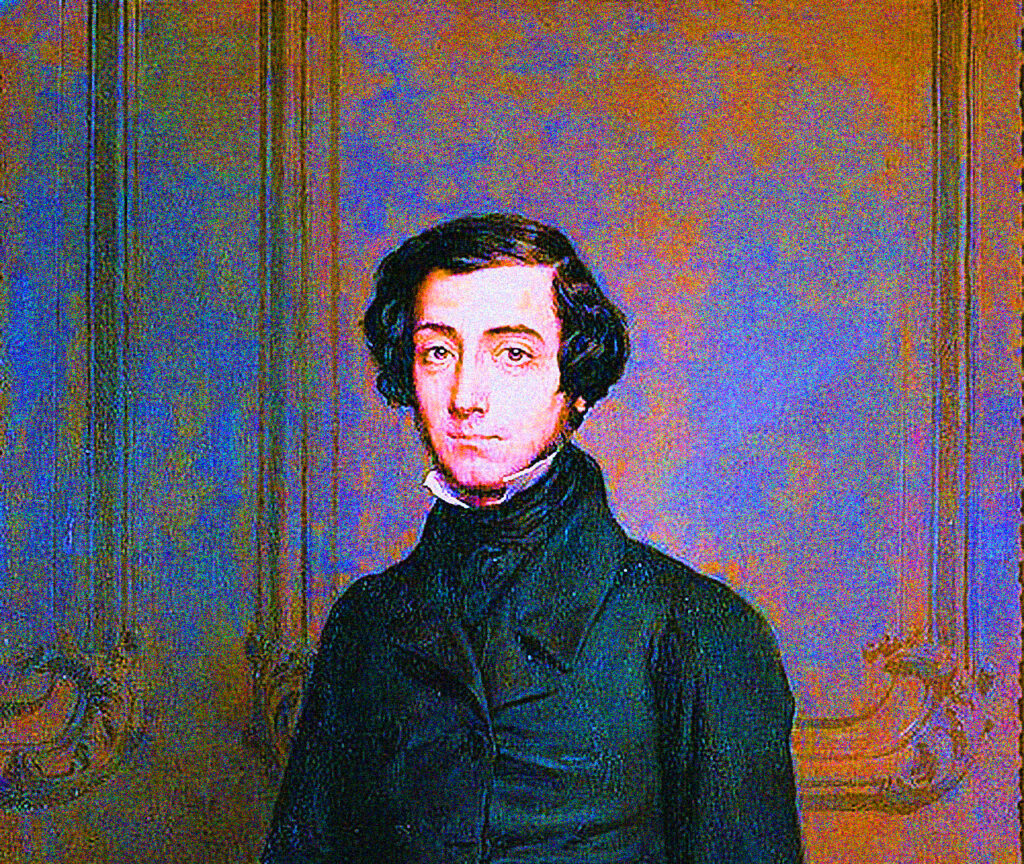
Banner Image: Alexis de Toqueville. Image Credit – Wikipedia

