Preventing Israel Boycott In Contracts, Funding For Staten Island Parks, Housing Progress, Commucating With Non-English Speakers, New Older Adult Center: Mayor Adams
MAYOR ADAMS SIGNS EXECUTIVE ORDERS PROHIBITING MAYORAL APPOINTEES AND AGENCY STAFF FROM BOYCOTTING AND DISINVESTING FROM ISRAEL, PROTECTING NEW YORKERS’ RIGHTS TO FREE EXERCISE OF RELIGION WITHOUT HARASSMENT AT HOUSES OF WORSHIP
City’s Five Independent Pension Systems Support Over 750,000 City Employees, Retirees, Beneficiaries, Invest Almost $300 Billion in Global Marketplace Securities, Including Over $300 Million Invested in Israel Bonds and Israeli Assets
New Executive Order Prevents Agency Heads, Agency Chief Contracting Officers, Other Mayoral Appointees with Discretion Over City Contracts From Carrying Out Policy Decisions That Discriminate Against State of Israel or Israeli Citizens Based on Their National Origin
EO 60 Reaffirms Investment Decisions Must Be Made Solely to Further Financial Interests of Pension System and Beneficiaries
EO 61 Directs NYPD Commissioner to Evaluate Changes to Patrol Guide for Protests Around Houses of Worship While Protecting Freedom of Speech and Right to Peaceful Assembly
NEW YORK – New York City Mayor Eric Adams today signed two executive orders that will ensure city agencies continue to make sound financial decisions that protect taxpayer dollars and that protect New Yorkers’ right to practice their religion at houses of worship without harassment, while protecting freedom of speech and peaceful assembly. Executive Order No. 60 prohibits mayoral agency heads, agency chief contracting officers, and any other mayoral appointees with discretion over contracting from engaging in procurement practices that discriminate against the State of Israel, Israeli citizens, or those associated with Israel. The executive order also prohibits the chief pension administrator and mayoral trustees to the city pension system from opposing divestment from bonds and other assets that would discriminate against the State of Israel, Israeli citizens, or those associated with Israel.
Executive Order No. 61 directs the commissioner of the New York City Police Department (NYPD) to evaluate potential changes to the NYPD patrol guide to evaluate proposals for regulating protest activity occurring close to houses of worship. Those proposals include the establishment of zones where protest activity would be prohibited or regulated within an area a certain distance from the entrance to a house of worship and the establishment of additional restrictions on protest activities that would be applicable during publicly scheduled religious services.
“New York City has always been this nation’s melting pot, but, too often, over the last few years, we’ve seen those of Jewish ancestry be singled out and targeted. Today, we are ensuring our city government doesn’t participate in that type of behavior and are putting in safeguards that protect New Yorkers’ tax dollars and protect their right to practice their religion without harassment,” said Mayor Adams. “New York City not only has a strong bond with the State of Israel because of our commitment to protecting a Jewish homeland, but also because it has always been a sound financial investment, and our financial decisions should continue to reflect that truth. Today, we are proud to sign this executive order and affirm that our investments and contracts should be made on the basis of what is best for New York City and our economic future, and not in pursuit of discriminatory policies on the basis of politics and national origin. This executive order builds on our long track record of fighting back against antisemitism wherever it rears its ugly head and making the investments that help boost our city. Additionally, we are proud to sign an executive order to evaluate additional ways to ensure New Yorkers’ right to peacefully and safely practice their religion at houses of worship, while protecting the First Amendment rights to protest, to which all Americans are entitled. Together, these executive orders put us on a path to addressing these complex issues without discrimination.”
Executive Order No. 60
New York City and state law prohibit discriminating against bidders and proposers for city contracts on the basis of their actual or perceived national origin. Despite this, in recent years, there have been calls to exercise social policy through the city’s procurement and pension systems with the goal of harming the economies of targeted nations, including calls to boycott, divest from, and sanction (BDS) the State of Israel, which has strong economic and social ties with the City of New York. Such calls are based on unreasonable social policies and not a function of sound procurement policy, the fiduciary responsibility of pension appointees, or in the best interests of the respective pension system.
New York City is home to the largest Jewish community outside of the State of Israel, and maintaining deep ties with Israel is rooted in decades of economic and social cooperation. Mayor Adams has made rooting out antisemitism a core focus of his administration. This past May, Mayor Adams established the Mayor’s Office to Combat Antisemitism, the first office of its kind established in a major city across the nation. Flanked by dozens of leading Jewish advocates, Mayor Adams announced this new effort to establish an inter-agency taskforce dedicated to fighting antisemitism in all its forms, liaise with the New York City Law Department on appropriate cases to bring or join, advise on executive orders to issue and legislation to propose to address antisemitism, and work across agencies to ensure New Yorkers feel protected against antisemitism and address incidents of antisemitism, among taking other actions. The office has, and continues to, also work to combat antisemitism at city-funded entities and city agencies.
Later that month, Mayor Adams launched the New York City–Israel Economic Council, a first-of-its-kind initiative bringing together city leaders, business executives, and innovators to deepen economic cooperation between New York City and Israel. The council advances shared priorities in technology, public safety, climate resilience, infrastructure, and life sciences — ensuring that New York continues to benefit from Israel’s world-leading innovation ecosystem.
In June 2025, Mayor Adams signed a historic executive order to recognize the International Holocaust Remembrance Alliance’s (IHRA) working definition of antisemitism. The IHRA working definition identifies demonizing Israel and holding it to double standards as forms of contemporary antisemitism; these are exactly the core tactics of the BDS movement.
Executive Order No. 61
The City of New York is home to thousands of houses of worship that represent myriad religions and faiths, and which coexist peaceably and add to the diverse fabric of the city. Yet, at times, houses of worship are targets of protests and other actions that can disrupt congregants’ ability to freely exercise their chosen religion and threaten the public safety of worshipers and surrounding neighbors. Federal, state, and local laws have been enacted to ensure access to houses of worship, safeguard protected speech and religious exercise, while maintaining the right to assemble and protest peaceably.
Executive Order No. 61 directs the commissioner of the NYPD, in coordination with the New York City Law Department to review the NYPD patrol guide to evaluate new proposals for regulating protest activity occurring close to houses of worship, while considering existing federal, state, and local laws regulating protests and other existing legal constraints on policing demonstrations and large gatherings.
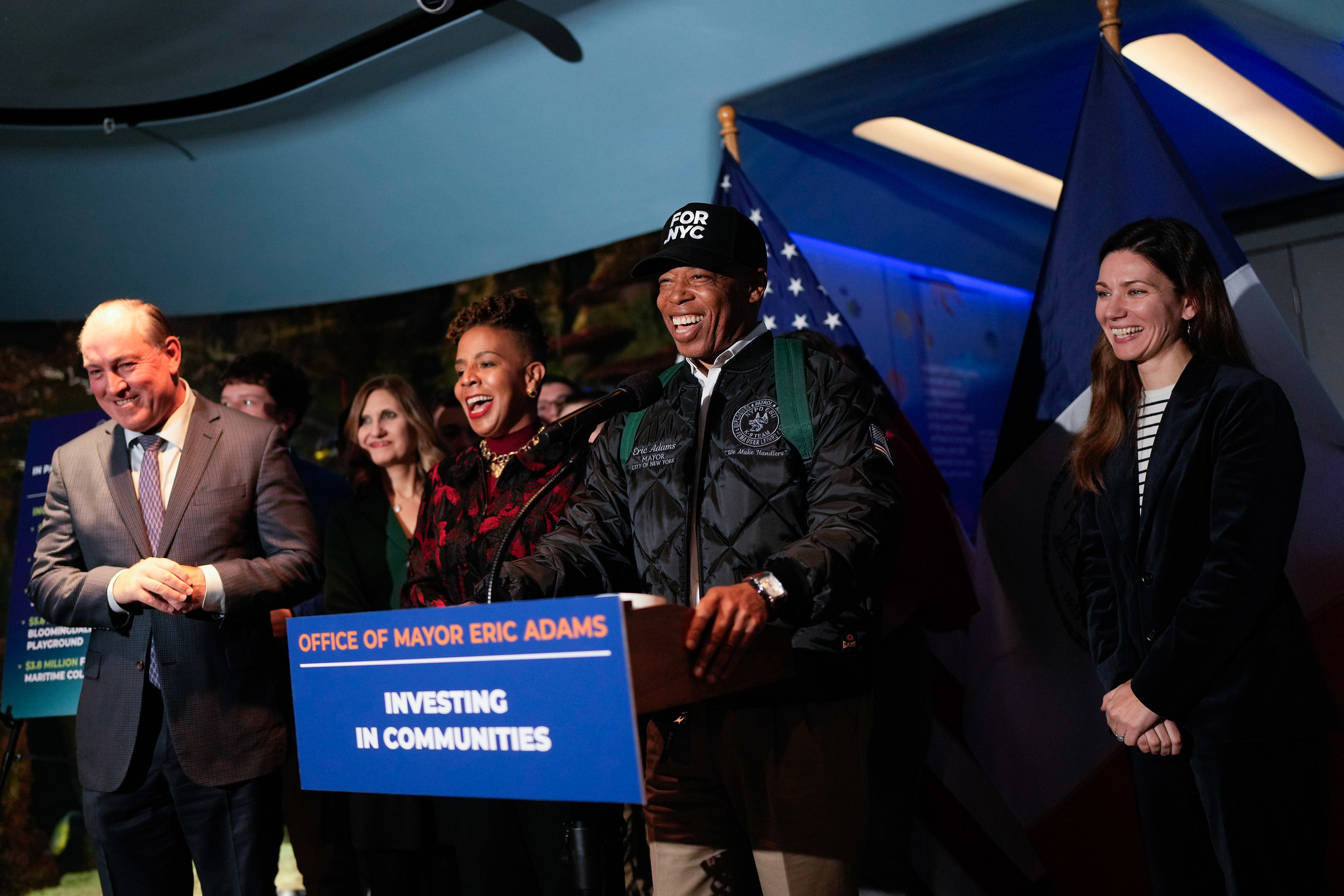
New York City Mayor Eric Adams and Staten Island Borough President Vito Fossella today announced that they have partnered to invest nearly $30 million of capital funding in three parks and public recreation projects on Staten Island. Investments will improve quality-of-life for Staten Islanders by making upgrades at Bloomingdale Park playground, Snug Harbor Cultural Center and Botanical Garden, and the Staten Island Zoo on Thursday, December 5, 2025. Michael Appleton/Mayoral Photography Office
MAYOR ADAMS, STATEN ISLAND BOROUGH PRESIDENT FOSSELLA CELEBRATE $30 MILLION IN FUNDING FOR PARKS,
OPEN SPACE ON STATEN ISLAND
Funding Will Help Upgrade Cultural and Public Spaces to Increase Access, Utilization, Safety, and Quality–of–Life
Announcement Continues to Highlight Investments Made in Mayor Adams’ “Best Budget Ever”
NEW YORK – New York City Mayor Eric Adams and Staten Island Borough President Vito Fossella today announced that they have partnered to invest nearly $30 million of capital funding in three parks and public recreation projects on Staten Island. Investments will improve quality-of-life for Staten Islanders by making upgrades at Bloomingdale Park playground, Snug Harbor Cultural Center and Botanical Garden, and the Staten Island Zoo. The investments were made in the Fiscal Year (FY) 2026 Adopted Budget, which builds on Mayor Adams’ FY 2026 Executive Budget, often called the “Best Budget Ever.”
“Public space in our city is precious, and we cherish every inch of it — no matter where it is, no matter what borough it is in,” said Mayor Adams. “Under our administration, we have always made it a priority to take care of Staten Island and today’s announcement is just the latest example of how we are living up to that promise. In partnership with Staten Island Borough President Fossella, we are proud to celebrate nearly $30 million in investments in several parks and recreation projects throughout the borough invested through our ‘Best Budget Ever.’ This funding will upgrade Bloomingdale Park playground, the Snug Harbor Cultural Center and Botanic Garden, and the Staten Island Zoo — expanding access to these public spaces and improving quality of life for all Staten Islanders. We thank Borough President Fossella for his partnership and helping bring us closer to becoming a city that is the best place to raise a family.”
“We have some of the most scenic spaces and vibrant cultural institutions right here in Staten Island,” said Borough President Fossella. “We will continue to improve our parks and open spaces, and to support cultural institutions so they can continue to flourish and provide the best for our residents. We appreciate that we have a partner in Mayor Adams, who is committed to helping us to achieve our goals. We thank Mayor Adams for being a strong partner to make our parks and public spaces even better.”
“Bloomingdale Park is a thriving oasis of greenspace and recreation on Staten Island,” said New York City Department of Parks & Recreation Commissioner Iris Rodriguez-Rosa. “These new capital investments in Bloomingdale Playground will offer the community a revitalized place to gather and play, with all-new play equipment, an enhanced spray shower, improved lighting, and more plantings. We’re excited to watch this project come to fruition and are grateful to Mayor Adams and Borough President Fossella for funding improvements that will benefit Staten Islanders for years to come.”
“As my fellow Staten Islanders and I know, our cultural institutions contribute so much to making this borough an extraordinary place to visit, live, and raise a family,” said New York City Department of Cultural Affairs Commissioner Laurie Cumbo. “We’re proud of the city’s investments in the borough’s cultural infrastructure, which will enhance the incredible museums, cultural centers, and zoos that serve residents and attract visitors for years to come.”
As a result of a $5.6 million investment made by Mayor Adams and Borough President Fossella, Bloomingdale Park playground will see significant improvements resulting in a vibrant reconstructed play space for the community. The reconstruction project — led by the New York City Department of Parks and Recreation — will include new play equipment, a spray play area, fencing, security lights, and an upgrade of electrical and water utilities. This project will also be supplemented with new landscape improvements. The renovations are the next major investment in this heavily utilized park, building on recent improvements, including installation of adult fitness equipment, as well as a shade structure at the bocce court. In 2021, the Bloomingdale Park athletic field project was completed, resulting in new multi-use and soccer synthetic turf fields to accommodate activities, including toss sports, free play, picnics, and more. The project is expected to begin design in the spring of 2026 following a community input meeting where members of the public will have the opportunity to share their vision for this space.
The Snug Harbor Cultural Center and Botanical Garden received $6.5 million in funding from the Adams administration and Borough President Fossella to advance key infrastructure projects for the 83-acre campus and its cultural tenants. The site-wide improvements will upgrade the building management system and other infrastructure to improve the security, energy efficiency, and visitor experience across the campus. The project will modernize one of Snug Harbor’s key facilities, which provides the cultural center with programming space and revenue-generating rentals.
Several organizations located on the Snug Harbor campus also received new funding from Mayor Adams and Borough President Fossella in the FY 2026 Adopted Budget. The Staten Island Museum received $6 million for the next phase of the museum’s expansion project, which will transform the currently vacant Building B into a state-of-the-art STEAM education center, with additional public space for natural history collections and exhibitions, a lab classroom for hands-on STEAM learning, and a café. The project will also include exterior restoration of the historic, Greek revival building. The Noble Maritime Collection, located in Building D on the Snug Harbor campus received $3.8 million to replace the museum’s existing chiller and air conditioning system. The group has struggled to maintain its existing aging system to ensure the comfort for guests in hotter weather and to maintain the protection of their extensive collections of maritime history from Staten Island and beyond. The Noble Maritime Collection’s 20,600 square foot space is one of the anchor institutions for the Snug Harbor Cultural Center and contains the entirety of the museum’s administrative and programmatic space.
At the Staten Island Zoo, a combined $8 million in funding from Mayor Adams and Borough President Fossella will support the creation of a new interactive education center, which will provide a fun and enriching experience for children and visitors themed around sensory abilities in people and animals. The project will create a public purpose for special opportunities to have guests with sensory or developmental disabilities enjoy defined experiences for them, as well as a 1960’s-era children’s center with a modern, diverse and inclusive “Learn & Play Zone.”
“At the Noble Maritime Collection, our staff and Board of Trustees are deeply committed to ensuring that our landmarked building remains a welcoming, inclusive, and accessible space for all,” said Megan Beck, executive director, Noble Maritime Collection. “We are grateful to Mayor Adams, Commissioner Cumbo, and the Department of Cultural Affairs for their generous capital investment in a new chiller and air conditioning system — an essential upgrade that will help preserve our collections and historic building. We also appreciate their continued support for major capital improvements at the Snug Harbor Cultural Center and at the Botanical Garden, the beautiful and storied campus we are proud to call home.”
“The Staten Island Zoo staff and visitors are excited to launch our vision for an entirely new re-imagined experience in our popular Children’s Center at the Zoo,” said Ken Mitchell, executive director, Staten Island Zoo. “Thanks to the generosity and support of Mayor Adams and Borough President Fossella, as well as our Staten Island City Council delegation, the zoo can start to bring this vision into the planning stage and ultimately reality. With our expertise in animal care, education, and exhibit design, the zoo can provide a unique experience and special place for children of all backgrounds to connect with nature and animals.”
“The Staten Island Museum’s board and staff are grateful to Mayor Adams, Cultural Affairs Commissioner Cumbo, and Borough President Fossella for their deep support of and investment in the STEAM Education Center expansion that will activate the adjoining historic building at Snug Harbor into a distinctive environment for exploring natural history while meeting professional standards for collections preservation,” said Janice Monger, president and CEO, Staten Island Museum.
“Snug Harbor Cultural Center and Botanical Garden is profoundly grateful to Mayor Adams, Commissioner Cumbo, our New York City councilmembers, and Borough President Fossella for their visionary investment in Staten Island culture,” said Jessica Vodoor, president and CEO, Snug Harbor Cultural Center and Botanical Garden. “This funding will support critical ongoing HVAC infrastructure projects in buildings that support a myriad of public activities at Snug Harbor.”

New York City Mayor Eric Adams and Staten Island Borough President Vito Fossella today announced that they have partnered to invest nearly $30 million of capital funding in three parks and public recreation projects on Staten Island. Investments will improve quality-of-life for Staten Islanders by making upgrades at Bloomingdale Park playground, Snug Harbor Cultural Center and Botanical Garden, and the Staten Island Zoo on Thursday, December 5, 2025. Michael Appleton/Mayoral Photography Office
MOST PRO-HOUSING ADMINISTRATION IN CITY HISTORY: MAYOR ADAMS, CITY PLANNING CELEBRATE PROGRESS ONE YEAR AFTER HISTORIC PASSAGE OF “CITY OF YES FOR HOUSING OPPORTUNITY”
City of Yes Already Delivering More Housing for New Yorkers
Nearly 23 Percent Increase in New Homes Permitted Over Year Before Approval, Nearly 10,000 New Homes Enabled by New, High-Density Zoning Districts
Approximately 900 Additional Homes Set to Be Created Through New “Universal Affordability Preference” Through First Year Alone
Along With Five Neighborhood Plans, Record Affordable Housing Production, Charter Revision Commission, and More, City of Yes Cements Adams Administration’s Historic Housing Legacy
NEW YORK – New York City Mayor Eric Adams and New York City Department of City Planning (DCP) Director Dan Garodnick today celebrated one year since the passage of “City of Yes for Housing Opportunity,” the most pro-housing legislation in the city’s history. In the first year since its passage, tools from City of Yes are already creating new housing across the five boroughs while housing permits have seen a significant year-to-year increase. In addition to proposing and passing City of Yes, the Adams administration has also passed five ambitious neighborhood plans; produced historic amounts of affordable housing; secured a landmark deal in Albany to give the city new tools to build housing; convened a historic Charter Revision Commission focused on land-use and housing; and much more to build more affordable housing across the five boroughs.
“One year ago today, our city said ‘yes’ to more housing and a more affordable future for working-class New Yorkers. We turned the page on decades of half-measures and proved that government can still meet the challenges of our time with energy, ambition, and resolve,” said Mayor Adams. “One year later, we are already seeing the results, with thousands of new affordable homes in the pipeline across our city. Whether it’s passing the first citywide rezoning in six decades, investing historic amounts of money into new homes, or creating record amounts of affordable housing, we are proud to be the most pro-housing administration in city history.
“With the adoption of City of Yes for Housing Opportunity, we have begun to turn the tide on the housing crisis in New York City. The full impact of these changes will take time to be felt, but twelve months in, we’re already seeing success delivering a little more housing in every neighborhood,” said DCP Director Garodnick. “New York City’s housing crisis has been growing for so long that it is easy to take it for granted. But with City of Yes and other policy changes, we are changing course and creating a more affordable city for generations to come.”
The initiative — which was approved by the New York City Council on December 5, 2024 — aims to deliver “a little more housing in every neighborhood” through carefully-crafted zoning changes, including creating a new affordable housing bonus; legalizing accessory dwelling units (ADU) for homeowners; re-legalizing three-, four-, or five-story apartment buildings near transit and along commercial corridors; reducing costly parking mandates for new construction; and allowing underused office buildings to become housing; among other reforms.
Already, many of these new tools are being used to create new housing across the city:
Universal Affordability Preference: Over 100 housing developments across the five boroughs have already applied to use the Universal Affordability Preference, which allows buildings in medium- and high-density parts of the city to add at least 20 percent more housing if the additional homes are permanently affordable. These projects are expected to deliver 5,400 new homes, of which approximately 900 would be affordable to households at an average 60 percent Area Median Income.
High-density zoning districts: New, higher-density R11 and R12 zoning districts created through City of Yes have been mapped in Mayor Adams’ Midtown South Mixed-Use Plan that the City Council approved in August, where they will deliver 9,500 new homes, including 2,800 permanently income-restricted affordable homes. These new zoning districts are also being proposed at the site of the future 125th Street Second Avenue Subway station and at 395 Flatbush Avenue Extension in Downtown Brooklyn, which are currently in public review, where they could deliver another 1,800 new homes.
Reduced parking mandates: Rolled-back requirements for off-street parking are also helping to deliver more housing near transit. For example:
- At 2060 Walton Avenue in the Bronx, an underused lot close to the 4, B, and D trains is being transformed into 94 new homes — without the 25 parking spots that had previously been required, a change that meaningfully lowers building costs.
- At 21 Freeman Street in Brooklyn, a vacant lot close to the G train is set to become over 500 new homes without the 140 parking spaces that would have been required prior to City of Yes.
- Meanwhile, as envisioned, new housing in less transit-accessible areas continues to include parking.
Office-to-residential conversions: Together with the 467-M tax incentive — which the Adams administration successfully advocated for in Albany — City of Yes has supported a boom of office-to-residential conversion projects. There are more than 12,000 homes in the pipeline from office conversions, including more than 3,000 permanently affordable units.
Landmark Transferable Development Rights: In the last year, five landmarked buildings have begun seeking approval to transfer their development rights to nearby housing projects through a process that was streamlined and expanded by City of Yes. These transfers will enable over 400,000 square feet of new development, while bringing in additional revenue to support maintenance of landmarked buildings. Those five applications in less than one year compare to a total of 15 applications over more than 50 years before City of Yes.
Accessory Dwelling Units: So far this year, the New York City Department of Buildings has received 98 filings from homeowners in Brooklyn, the Bronx, Queens and Staten Island, seeking to construct ADUs on their properties. Half of these filings have come in just the past two months, since the city finalized rules for safe, code-compliant ADUs and launched the “ADU for You” homeowner assistance program. ADUs like backyard cottages, garage conversions, and basement apartments are a proven tool to support homeowners and expand housing choice in lower-density areas without a changing neighborhood’s look-and-feel.
As these City of Yes tools are deployed, new data shows that New York City permitted 22.8 percent more new homes in 2025 than the same time period in 2024 (through October 23), when the Adams administration was already shattering several housing records for the second year in a row. This permitting increase includes a boom in homes from alterations — more than double the number of permitted units from 2024, many of which are from office conversions — and an increase in units from new construction over the previous year.
The Adams administration has continued working to deliver the full benefits of City of Yes, including successfully defending the policy in court, where a judge recently dismissed a challenge. HPD also recently released the Shared Housing Roadmap, which — building on the City of Yes zoning reforms and in concert with new legislation — clears the way for reintroducing shared homes as a safe, affordable housing option for single New Yorkers.
The success of City of Yes for Housing Opportunity is a part of the Adams administration’s work as the most pro-housing administration in city history. In addition to City of Yes, the administration also put forward five neighborhood plans — all of which have been approved by the City Council — that will deliver nearly 50,000 new homes to New Yorkers: the Bronx-Metro North Station Area Plan, the Atlantic Avenue Mixed-Use Plan in Brooklyn, the Midtown South Mixed-Use Plan in Manhattan, and the Jamaica Neighborhood Plan and the OneLIC Neighborhood Plan in Queens.
Since entering office, Mayor Adams has made historic investments to create more affordable housing and ensure more New Yorkers have a place to call home. In Fiscal Year (FY) 2025, the Adams administration created the most affordable rental units in city history and celebrated back-to-back-to-back record-breaking years for producing permanently-affordable homes for formerly-homeless New Yorkers, placing homeless New Yorkers into housing, and connecting New Yorkers to housing through the city’s housing lottery. HPD has now produced nearly 86,000 affordable homes since the start of the Adams administration, with the last three fiscal years representing the most new affordable homes ever created in a three fiscal-year stretch (FY 2023 to FY 2025).
Building on the success of City of Yes for Housing Opportunity, Mayor Adams unveiled his “City of Yes for Families” strategy in his State of the City address earlier this year to build more homes and create more family-friendly neighborhoods across New York City. Under City of Yes for Families, the Adams administration is advancing more housing on city-owned sites, creating new tools to support homeownership, and building more housing alongside schools, playgrounds, grocery stores, accessible transit stations, and libraries.
Further, the Adams administration is actively working to strengthen tenant protections and support homeowners. The “Partners in Preservation” program was expanded citywide in 2024 through a $24-million investment in local organizations to support tenant organizing and combat harassment in rent-regulated housing. The Homeowner Help Desk, a trusted one-stop shop for low-income homeowners to receive financial and legal counseling from local organizations, was also expanded citywide in 2024 with a $13 million funding commitment.
“A mayoral administration rarely advances a policy that can fundamentally change the future health of a city for generations to come. The City of Yes for Housing Opportunity, coupled with the City Council led “City For All” initiative, is such a policy,” said Marc Greenberg, executive director, Interfaith Assembly on Homelessness and Housing. “With City of Yes, the Adams administration has changed the momentum of a city that has been losing ground on affordable housing for decades and has begun again to lift Lady Liberty’s Lamp beside New York City’s golden door.”
“One year after the passage of City of Yes for Housing Opportunity, the results speak for themselves. Across all five boroughs, thousands of new homes are being constructed thanks to modernized zoning that promotes transit-oriented development, the elimination of outdated parking mandates, new tools like the Universal Affordability Preference, expanded opportunities for office-to-residential conversions, and more,” said Carlo A. Scissura, Esq., president and CEO, New York Building Congress. “Among the most significant wins are more than 12,000 homes, including 3,000 permanently affordable units, already in the pipeline from office-to-residential conversions, breathing new life into underused buildings and neighborhoods. This is the smart, forward-thinking development New York has needed for decades, and it’s exactly why the Building Congress worked so closely with the Adams administration to get it across the finish line.”
“City of Yes is already proving to be a major step toward achievement of our housing goals,” said Kathryn Wylde, president and CEO, Partnership for New York City. “This carefully crafted initiative is encouraging development that is consistent with neighborhood standards by lowering costs and accelerating or eliminating the need for multiple public approvals.”
“As we mark one year since the launch of the City of Yes for Housing Opportunity, we’re already seeing real progress on housing growth in New York City,” said Rachel Fee, executive director, New York Housing Conference. “Housing continues to be one of New Yorkers’ most urgent needs, and City of Yes shows what a common-sense approach can deliver. By modernizing outdated rules and unlocking new housing in every community, City of Yes is giving New Yorkers the tools to spur affordable housing production. This initiative is clearing the path for meaningful housing victories, including the passage of ballot Proposals 2 – 5, and laying the groundwork for even more progress in the year ahead. We commend the administration for advancing these critical reforms to reduce delays and promote a fairer, more equitable distribution of housing across the city.”
“One year after the passage of City of Yes for Housing Opportunity, we’re seeing what happens when New York City chooses vision over fear,” said Emma Pfohman, CEO, Association for a Better New York (ABNY). “ABNY applauds the herculean work of the Adams administration, in partnership with Governor Hochul and the City Council, to pass the City of Yes for Housing Opportunity and approve the creation of thousands of units through the successful rezonings championed by the Department of City Planning over the last year. Together, these efforts ensure New York remains a city where every resident has the chance to live, thrive, and build their future.”
“In just its first year, City of Yes has opened the door to more homes in every borough,” said Andrew Fine, chief of staff and policy director, Open New York. “In the Bronx, longtime proposals are finally moving forward with deeper levels of affordability. Homeowners from Staten Island to Queens are excited to add ADUs, and in Brooklyn, new apartment buildings near the subway are being built without costly parking requirements. In Manhattan, the Midtown South rezoning was the first to use new higher-density districts, creating room for more homes through office conversions and new construction. All of this shows what is possible when City leaders work together to break down barriers to housing. And since then, the need for homes and the public’s support for building them have only grown. With November’s historic pro-housing ballot proposals behind us, we are ready to keep working toward a more affordable future for New York.”
“A year on from the most expansive citywide zoning changes for housing that New York City has seen, it’s a great moment to reflect on this achievement, and redouble our commitment to its implementation,” said Howard Slatkin, executive director, Citizens Housing and Planning Council. “City of Yes has opened the door for a generation of new housing achievements, which with sustained effort can stand as a legacy to what we can do when we agree that no challenge is too large for New Yorkers to tackle.”
“One year ago marked a turning point in the fight against New York City’s housing crisis with the enactment of the City of Yes zoning text amendments,” said Baaba Halm, senior vice president for programs, Enterprise Community Partners. “By allowing more housing types, increased density, and more flexible zoning options in a wider swath of New York, we collectively took a major step toward significantly increasing needed housing supply and reducing development barriers which add costs. Importantly, the amendments also specifically increased affordable housing, and came alongside robust new capital and programmatic resources. The results are already evident through more projects in the pipeline, and we look forward to seeing them come to fruition.”
“Habitat for Humanity NYC and Westchester is driven by a simple goal, to create permanent, affordable homeownership opportunities for New Yorkers who need them most,” said Sabrina Lippman, CEO, Habitat for Humanity NYC and Westchester. “One year after the approval of City of Yes for Housing Opportunity, we’re already expanding our pipeline by nearly 50 percent as a direct result of zoning reforms that remove barriers and make it easier to build. City of Yes is perfectly aligned with Habitat’s work to build stable, inclusive communities and ensure more families can call New York City home.”
“One year in and we are already seeing the tremendous impact of City of Yes for Housing Opportunity. This landmark rezoning has already begun to unlock meaningful opportunities to deliver high quality, affordable homes in neighborhoods across the city. By removing outdated barriers and enabling smarter, more flexible design, we are creating the conditions for a more equitable and resilient city,” said Jesse Lazar, executive director, American Institute of Architects New York Chapter. “Building on the momentum generated by City of Yes, we must continue to explore how we capture the future value of our city today, creating thriving communities and building housing that serves all New Yorkers.”
“The rising cost of housing is chipping away at hard-earned wages and pushing too many New Yorkers out of the city. Last year’s passage of the landmark City of Yes legislation represented a monumental step forward toward addressing the urgent housing affordability crisis,” said Manny Pastreich, President of 32BJ SEIU. “We’re seeing progress and look forward to continuing this momentum alongside stakeholders, to deliver the housing essential workers and their communities need, while creating thousands of good jobs.”
“City of Yes is a landmark achievement and a testament to the hard work of everyone who helped make these vital zoning reforms a reality,” said Basha Gerhards, executive vice president of public policy, Real Estate Board of New York. “With growing momentum behind adaptive reuse, New York City has the best conversion rules in the country, positioning us to unlock much needed homes across all five boroughs.”
“After one year, City of Yes is delivering on the promise of more affordable housing and giving hope to the over 2 million New Yorkers struggling to keep a roof over their head,” said Rich Buery, CEO, Robin Hood. “By taking an all-of-the-above approach, the city is unleashing the pent-up potential we knew existed. When paired with the recent pro-housing City Charter amendments, overwhelmingly approved by voters, our city is making progress toward being a place where people of all incomes can live, raise children, and flourish.”
“City of Yes set a new bar for what pro-housing policy can look like in New York, and the first year has already shown that the old excuses for doing nothing don’t hold up,” said Aaron Carr, founder and executive director, Housing Rights Initiative. “It’s given us a real foundation to build upon and proven that smarter zoning and bolder reforms can actually make a dent in our housing crisis. This is just the beginning.”
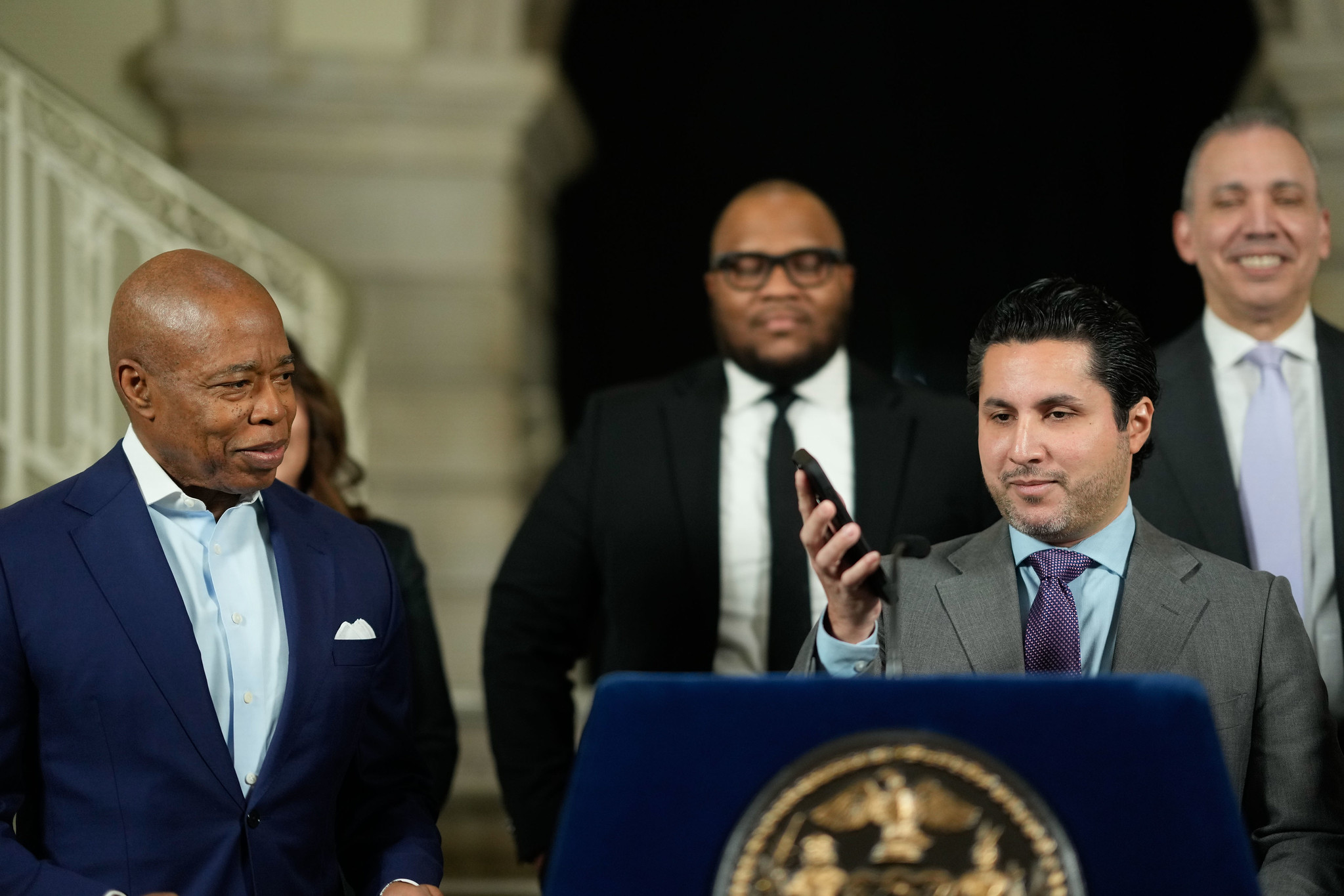
New York City Mayor Eric Adams today issued a directive to city agencies to evaluate how they can further incorporate language technologies into their day-to-day interactions with the public to improve communications with all New Yorkers, including non-English speaking communities. To start, the city is planning to install language apps on all city-owned smart devices — more than 100,000 in total — to make city services more accessible to New Yorkers as part of the City of New York’s push to become the most language-friendly city on the globe on Monday, December 8, 2025. Michael Appleton/Mayoral Photography Office
MAYOR ADAMS ISSUES DIRECTIVE TO CITY AGENCIES TO IDENTIFY WAYS TO IMPROVE COMMUNICATIONS WITH NON-ENGLISH SPEAKING NEW YORKERS BY USING LANGUAGE TECHNOLOGIES
Adams Administration Leads on Embracing Technology to Deliver Services, Make New York City More Inclusive and Accessible to All
All City-Owned Smart Phones Will Receive Language App to Empower City Employees to Better Communicate with New Yorkers
Goal is to Make All New York City Agencies More Language Friendly
Updated NYPD Patrol Guide Policy Will Allow Officers to Use Language Applications to Communicate with People with Limited English Proficiency While on Patrol
New York City Public Schools to Develop New, Custom App to Bridge Language Gaps in School Communities
NEW YORK – New York City Mayor Eric Adams today issued a directive to city agencies to evaluate how they can further incorporate language technologies into their day-to-day interactions with the public to improve communications with all New Yorkers, including non-English speaking communities. To start, the city is planning to install language apps on all city-owned smart devices — more than 100,000 in total — to make city services more accessible to New Yorkers as part of the City of New York’s push to become the most language-friendly city on the globe. The New York City Office of Technology and Innovation (OTI) will provide support to city agencies to facilitate downloads and usage of tools like Google Translate and Apple’s built-in Translate app, while continuing to evaluate advances in technology to ensure effective, safe, and quality communications. Additionally, the New York City Police Department (NYPD) will immediately begin using language technology to communicate with New Yorkers they interact with on a day-to-day basis, while New York City Public Schools has begun development on Hello, a new app to help bridge language gaps that will be rolled out in the spring of 2026.
In order to reach New Yorkers in the languages they speak, NYC311 already provides interpretation services in over 175 languages. Residents can text 311 at 311-692 to receive help through translation services. In 2024, these language resources were used in more than 320,000 customer interactions across 104 languages. Additionally, MyCity, which connects New Yorkers to city services and benefits, is available in the city’s 10 most common languages.
“From the very start, our administration has continually expanded our use of technology to keep New Yorkers safer, stronger, and more informed, but to be a more inclusive and accessible city, we must also be the most language-friendly city on the globe,” said Mayor Adams. “Today, we are taking another step forward by expanding the use of language technology to improve communications with all New Yorkers, no matter what language they speak. This is a global city, where you can hear over 175 languages spoken on every street, every store, and every stoop. That is why we are issuing a directive to our city agencies that will make it possible to expand the use of language apps in their work. The city will kickstart this process by ensuring every city-owned smart device has language apps, like Google Translate, available at their fingertips. Additionally, the NYPD is updating its Patrol Guide Policy to allow officers to use translation apps while interacting with the public, and, in our school system, we will begin developing a new custom app to bridge language gaps in school communities. Today’s announcement further builds on the work we have done to improve service delivery and make New York City government more inclusive and accessible because when we embrace technology, we are able to deliver every part of our vision more effectively — making our city safer, more affordable, and the best place to raise a family.”
“Our administration has made it clear that we need to use every tool we have to meet New Yorkers wherever they are; for me, that mission has always been personal. Growing up in a community full of immigrants, like my own, I learned first-hand how important it is for government to speak to every person, with every tool, in every language. But, too often, language and cultural barriers have made it hard for our city’s residents to understand what’s happening in their neighborhood, to learn what resources are available, and to know where to turn for help in a crisis,” said Deputy Mayor for Communications Fabien Levy. “The Adams administration is changing that by being laser-focused on speaking to all New Yorkers. With this new directive, we will double down on that mission by giving our agencies new tools to meet New Yorkers where they are, deliver the information they need, and help our city government connect with every New Yorker, regardless of their background or the language they speak as we make it easier to live, work, and raise a family in the greatest city in the world.”
“The Adams administration has ushered New York City into the 21st century with bold technology strategies that make city services and benefits more accessible to all New Yorkers,” said New York City Chief Technology Officer (CTO) Matthew C. Fraser. “Today’s announcement builds upon the mayor’s forward-thinking efforts to deploy technology in fresh ways to remove barriers to government resources for those who need them most. By putting language technologies at the fingertips of more than 100,000 public sector workers, the city is significantly expanding its ability to deliver the services and support that non-English speaking New Yorkers deserve. That is a success in any language.”
“Language should never be a barrier to safety or access to city services,” said New York City Department of Citywide Administrative Services (DCAS) Commissioner Louis A. Molina. “By equipping city-owned smart devices with language technology, we can help ensure that the public servants who keep New York City running can communicate more clearly with the New Yorkers they serve. At DCAS, we value equity and inclusion for all, and we’re proud to support our agency partners in making the city more accessible to every community.”
“Clear communication is essential to public safety,” said NYPD Commissioner Jessica Tisch. “Our officers interact with New Yorkers who speak dozens of different languages, often in situations where time and understanding matter. Expanding access to real-time translation tools helps officers communicate more clearly, respond more effectively, and better serve the people who need help. I thank Mayor Adams for supporting this update and ensuring that our officers have practical tools that make interactions safer for everyone involved.”
“Every day our schools work hand-in-hand with families to provide a world-class education and critical supports for our students,” said New York City Public Schools Chancellor Melissa Aviles-Ramos. “Parents and families are our first partners in the success of our youngest New Yorkers, so it is essential that we have effective, efficient, and robust communication pathways between families and our schools. When our educators and school leaders work in close partnership with our families, our students thrive.”
“As the office responsible for overseeing language access citywide, we are committed to finding new and better ways to communicate effectively and responsibly with immigrant communities, including the 2 million New Yorkers with limited English proficiency,” said New York City Mayor’s Office of Immigrant Affairs Commissioner Manuel Castro. “We are proud of the progress we’ve made over the last four years, including significantly growing our internal capabilities and our partnership with over 40 city agencies and more than 30 mayoral offices to advance language access implementation across New York City.”
In addition to OTI downloading language technology on all city-owned smart devices, the NYPD’s patrol guidelines for interaction with “Limited English Proficient Persons” has been updated to include technology, instead of just human translations. Since 1992, NYPD officers have had access to the NYPD’s Language Line service, which provides language services by phone in more than 180 languages. In an effort to improve ease of communication with the communities they serve and utilize the latest technologies that facilitate real-time translations, NYPD officers on patrol will now also be able to use additional translation applications on their NYPD-issued smartphones. Such applications have access to dozens of additional languages.
This winter, New York City Public Schools will begin to develop Hello, a new custom-developed app to help bridge language gaps in New York City school communities. Using speech-to-text and text-to-speech interactions, Hello will be able to give real-time translation and interpretation in the top 12 languages spoken by New York City Public Schools’ families. This app is specifically being designed securely and with privacy in mind to support families during impromptu meetings and interactions with school staff, and comes on the heels of an amendment to Chancellor Regulation A-663 earlier this summer to bring the number of covered languages from nine to 12.
In collaboration, MOIA and OTI are testing Google/Apple/Microsoft speech-to-speech translation apps to test efficacy and inform citywide policy. This continues MOIA’s partnership in supporting OTI’s efforts to make nyc.gov more accessible in multiple languages through 1) providing MOIA language access specialists to review machine translated content for city websites and 2) support OTI with reviewing needs and potential vendors for citywide implementation.
Today’s announcement further builds on the work the Adams administration has done to encourage city agencies to adapt to improve service delivery and make New York City government more inclusive.
Increasing Communications: Establishing Direct Access to 911 for Emergency Response
Mayor Adams has invested in technology that enables direct integration to the NYPD for swift emergency responses for schools, bodegas, and businesses.
Recently, Mayor Adams and CTO Fraser announced the nation’s first pilot directly integrating public schools with 911 services for life-saving rapid response in case of an active shooter situation. The pilot will be rolled out to 25 school buildings, representing 51 public schools across the five boroughs, during the 2025-2026 school year to provide an immediate, secure, and automated pathway for public schools to directly alert 911 of a critical emergency.
Additionally, in May 2025, Mayor Adams announced an investment of $1.6 million in funding to equip an estimated 500 bodegas across the five boroughs with “SilentShields” buttons that bodega staff can press to immediately call the NYPD in cases of emergency. SilentShields builds off another program Mayor Adams launched in 2024 to combat retail theft by helping local businesses voluntarily share information in real-time with the NYPD through existing closed-circuit television cameras as they seek to solve crimes.
Further, this past summer, in July 2025, the city launched a new city-run account, “NYC Public Safety” on Citizen, a free app that provides users with real-time notifications about nearby emergencies and ongoing incidents. The account compiles public safety alerts and notifications from across public safety agencies to share public safety updates and incident information directly with Citizen users — including more than 3 million subscribers across the five boroughs — ensuring that critical information reaches New Yorkers when and where it matters most.
Deploying New Tools: Using Technology to Make Public Spaces Safer
Mayor Adams has launched pilot programs and evaluated new technology to make public spaces — including streets, subways, parks and beaches — safer.
In April 2023, Mayor Adams announced three new policing technologies — including Spot the Digidog robot, the StarChase GPS attachment system, and the Knightscope K5 autonomous security robot — to be deployed in public spaces to help keep New Yorkers safe.
In July 2025, Mayor Adams announced a new Drone Operations Committee to coordinate drone operations across key agencies. This effort has expanded on the city’s existing drone programs, including the NYPD’s pioneering ‘Drone as First Responder’ initiative, which allows drones to autonomously deploy from police precincts and arrive at scenes within minutes, providing live intelligence to police officers before they arrive to help save lives. Under the Adams administration, New York City has also deployed drones to monitor beaches for distressed swimmers and sharks during the summer, prevent injuries and fatalities from subway surfing, monitor large-scale events, track criminal suspects attempting to flee crime scenes, assess damage after incidents, and protect critical infrastructure.
Investing in Technology for Delivering Services to New Yorkers
Since its outset, the Adams administration has prioritized technology initiatives focused on bridging the digital divide. In the Adams administration’s first year in office, Mayor Adams and CTO Fraser launched “Big Apple Connect” to deliver free internet and basic cable to New Yorkers at New York City Housing Authority (NYCHA) facilities. The program has been expanded multiple times and, today, more than 330,000 New Yorkers across 220 sites in NYCHA have access to free internet and cable.
In September 2025, Mayor Adams, CTO Fraser, New York City Public Schools Chancellor Aviles-Ramos announced that 350,000 public schools students would receive brand-new, free Chromebooks equipped with high-speed internet access during this school year. This internet service provided on these Chromebooks is being subsidized as part of the city’s agreement with T-Mobile earlier this year to become a major wireless carrier to support city operations.
Additionally, this past summer, Mayor Adams, along with the New York City Department of Housing Preservation and Development and the New York Public Library, launched “Liberty Link,” a groundbreaking program that will deliver high-quality internet to low-income New Yorkers in 100-percent affordable housing buildings at little or no cost to tenants.
Further, in March 2025, the Adams administration invested $2.4 million and released a roadmap to advance digital equity in disadvantaged communities. The city also offers free internet, device, and digital skills training access at more than 450 public computer centers across the five boroughs.
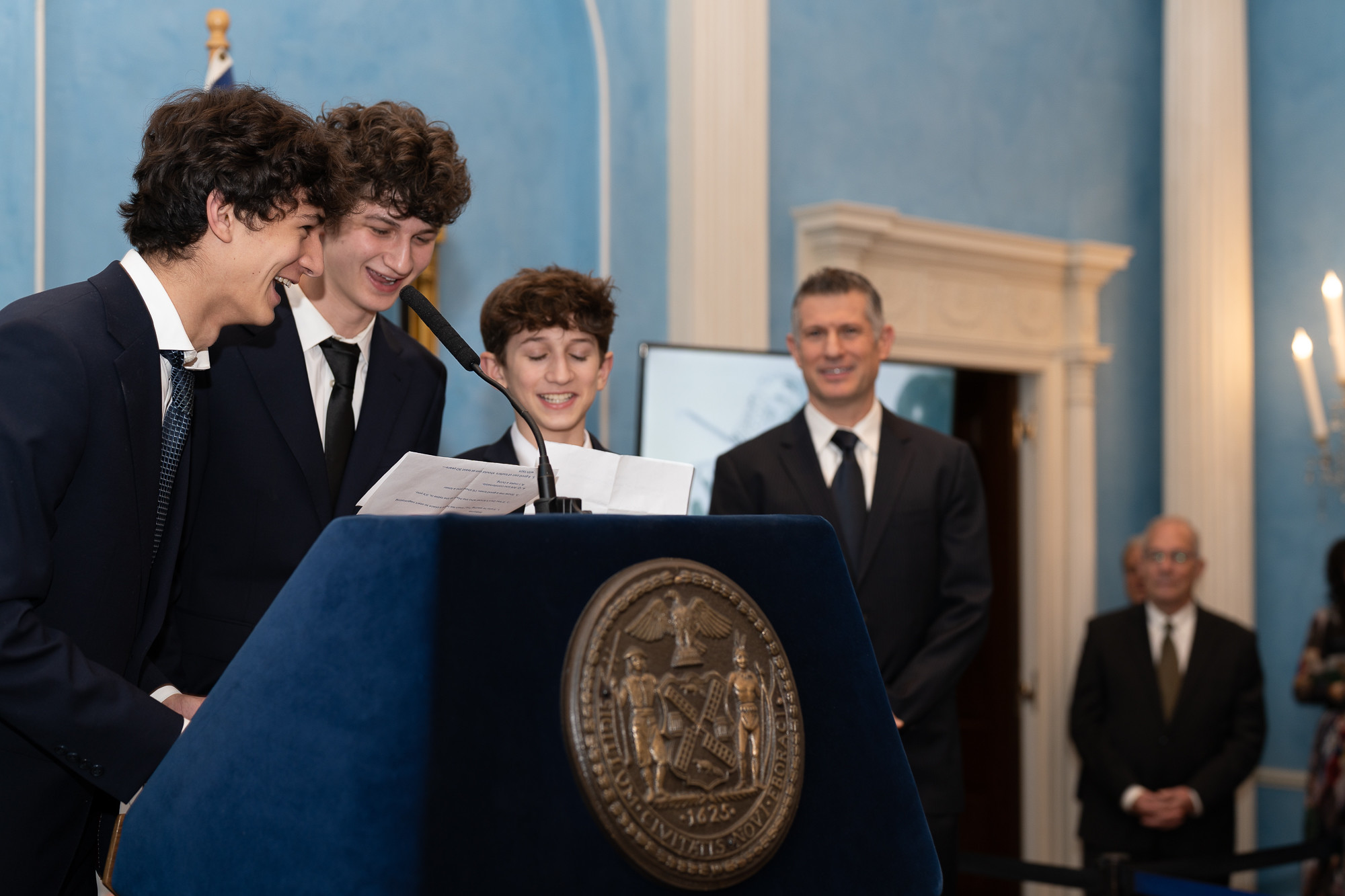
New York City Mayor Eric Adams delivers remarks at a celebration of life for Sid Davidoff, former senior advisor to former New York City Mayor John Lindsay, at Gracie Mansion, on Wednesday, December 10, 2025. Photo Credit: Benny Polatseck/Mayoral Photo Office
MOST PRO-HOUSING ADMINISTRATION IN CITY HISTORY: MAYOR ADAMS ANNOUNCES NEXT STEPS FOR THOUSANDS OF
NEW HOMES, OLDER ADULT CENTER AT 100 GOLD STREET
GFP Real Estate Selected to Build Approximately 3,700 Units of Mixed-Income Housing Units, At Least 25 Percent of Units Designated as Permanently Affordable
Project Will Include New Public Open Space and Revitalized Older Adult Center for Local Residents
Project Will Relocate City Agencies to Improved Office Space and Increase Quality of Service to New Yorkers Without Disruptions
Part of Mayor Adams Historic Executive Order to Build New Homes on City-Owned Sites
NEW YORK – New York City Mayor Eric Adams today announced the next steps in the transformation of a city-owned site at 100 Gold Street in Lower Manhattan into a new, mixed-income residential building. The city has selected GFP Real Estate to build approximately 3,700 units of high-quality, mixed-income housing, with a minimum of 25 percent of the homes required to be permanently affordable as more than 900 units of affordable housing are created without any subsidy from the New York City Department of Housing Preservation and Development (HPD). Additionally, proceeds from the disposition of the city-owned site will be used to acquire new office space for HPD and other agencies that currently occupy 100 Gold. GFP Real Estate will also build and maintain approximately 40,000 square feet of new public open space as well as a new state-of-the-art, publicly-accessible fitness center inside the building. Finally, the development will include an upgraded older adult center for the community. After Mayor Adams issued a historic executive order last year requiring city agencies to review their portfolios and identify potential sites for new housing, the New York City Economic Development Corporation (NYCEDC) led a competitive request for proposals (RFP) process to identify a developer for 100 Gold. Along with proposals to build thousands of new homes on city-owned sites like Flushing Airfield, Gansevoort Square, 390 Kent Avenue, and more, today’s announcement will help the Adams administration create, preserve, or plan over 433,000 homes for New Yorkers.
“From an abandoned airfield in Queens to an old office building in Manhattan, our administration is using every piece of land we have to build the housing we need,” said Mayor Adams. “With today’s announcement, we’ll give thousands of families an affordable place to live, thousands of city employees new high-quality office space, and all New Yorkers new public space and amenities to enjoy. Whether it’s passing the most pro-housing legislation in city history, creating record amounts of affordable housing, or issuing a historic executive order to turn city land into new homes, we are proud to be the most pro-housing administration in city history, and our record reflects exactly that.”
“100 Gold is exactly the kind of bold step New York needs to meet the moment on housing,” said Deputy Mayor for Housing, Economic Development, and Workforce Adolfo Carrión, Jr. “With GFP Real Estate on board, we are creating thousands of homes, expanding affordability, and delivering new community amenities. And as this work advances, the city will secure a modern home for HPD, the dedicated-team driving our affordable housing mission”
“For decades, 100 Gold Street has been the physical nerve center of our work to expand affordable housing across the city. Transforming our headquarters into new homes at the scale made possible under this proposal is a bold expression of that mission. A building that has supported the people fighting for affordability will soon provide real homes for the New Yorkers we serve,” said HPD Acting Commissioner Ahmed Tigani. “With a dynamic and highly skilled team leading this commercial-to-residential conversion, we are leveraging our newly established land use tools and proven expertise to reimagine office space as a vibrant, mixed-use community. This project unlocks the full potential of the site, maximizes its transit-oriented development advantages, and welcomes new individuals and families into a neighborhood rich with amenities. By rethinking how we plan for city offices and applying every tool for thoughtful development, HPD is strengthening its ability to serve New Yorkers, deliver the housing this city urgently needs, and pursue our mission with renewed focus.”
“Transforming outdated city-owned sites into mixed-income housing is at the core of NYCEDC’s mission, and bold projects like 100 Gold are critical to tackling New York City’s ongoing affordability crisis,” said New York City Economic Development Corporation (NYCEDC) President and CEO Andrew Kimball. “The historic redevelopment will deliver thousands of high-quality, mixed-income housing units and public amenities for New Yorkers, and NYCEDC is proud to partner with GFP Real Estate to bring this extraordinary vision to life in Lower Manhattan.”
GFP Real Estate is a proven family-owned real estate firm with over 70 years of experience in New York City. Their development experience positions them as a key driver of the Financial District’s shift from a traditional office hub to a vibrant mixed-use neighborhood, including 25 Water Street, the largest office-to-residential conversion in the country. GFP is also a leading developer of housing in the Financial District, with nearly 2,500 units completed or under development, including more than 620 designated as permanently affordable.
The current building — which was constructed in the 1960s and requires significant investments — currently houses the Hamilton-Madison House older adult center. The proposed development will include a new, purpose-built facility for the older adult center on site, reflecting feedback from months-long community outreach and engagement, that will deliver a substantial improvement in space, accessibility, and overall experience. During construction, a temporary facility will be provided nearby to ensure no disruption in service.
Originally announced in Mayor Adams’ 2025 State of the City address, the 100 Gold project will also take advantage of new high-density zoning districts created through the Adams administration’s historic “City of Yes for Housing Opportunity” proposal.
The release of this RFP follows public engagement with elected officials, Manhattan Community Board 1, and other key stakeholders. To date, NYCEDC has hosted two public engagement meetings and released a public survey. Following today’s announcement, the development team will conduct site due diligence and environmental review. The project anticipates certifying into the Uniform Land Use Review Procedure (ULURP) in 2027, where robust community engagement will continue.
“On behalf of GFP Real Estate, we are honored to have been selected by NYCEDC and HPD to advance the redevelopment of 100 Gold Street. We look forward to a collaborative process with the community, local leaders, and our partners in government,” said Brian Steinwurtzel, co-CEO and principal, GFP Real Estate.
“When public land is leased to private developers, the affordability of the upcoming project is always our top priority,” said New York City Councilmember Christopher Marte. “We look forward to working with the city and the development team to achieve this project to meet the affordability crisis that our city is facing.”
“This project is a smart, innovative means of addressing the city’s ongoing housing crisis while opening more accessible pathways for hardworking people to pursue the middle class,” said Gary LaBarbera, president, Building and Construction Trades Council of Greater New York. “Thanks to the wage and workforce development standards outlined in 485-x, the redevelopment of 100 Gold Street will not only help generate much-needed affordable homes but also help create family-sustaining union careers for our city’s tradesmen and tradeswomen. We look forward to continuing to collaborate with city leadership and GFP Real Estate to help this come to fruition in a manner that will improve the lives of countless New Yorkers.”
“By taking advantage of City of Yes zoning changes, this project will bring an incredible 3,700 new homes to Lower Manhattan,” said Andrew Fine, chief of staff and policy director, Open New York. “As we face rising rents and a critically low 1.4 percent vacancy rate, we must maximize opportunities on city-owned land to build more housing in every neighborhood. The scale of this project should be a model for the future.”
“The Manhattan Chamber of Commerce congratulates GFP Real Estate on being selected to lead the 100 Gold Project, which represents a pivotal moment in the continued evolution of Lower Manhattan into a vibrant, 24/7 mixed-use community,” said Jessica Walker, president and CEO, Manhattan Chamber of Commerce. “This development hits all the right notes: creating massive housing stock, upgrading community facilities, and expanding public space. We are proud to support this initiative, which will drive foot traffic to local businesses and ensure the Financial District remains a dynamic place to live, work, and visit.”
“The New York Building Congress applauds NYCEDC and GFP Real Estate for advancing this transformative vision for 100 Gold Street. This project delivers exactly what New York needs right now: thousands of new, premium mixed-income homes, including more than 900 permanently affordable units, 40,000 square-feet of new public open space, and a modern older adult center that strengthens services for our neighbors,” said Carlo A. Scissura, Esq., president and CEO, New York Building Congress. “Our city is in a real housing crisis, and 100 Gold is proof that we can rise to the moment with bold action, smart planning, and a commitment to building for every New Yorker. We are excited to support this effort and keep pushing for more projects that move our city forward.”
Since entering office, Mayor Adams has made historic investments to create more affordable housing and ensure more New Yorkers have a place to call home. Earlier this year, Mayor Adams announced that his administration has created, preserved, or planned approximately 426,800 homes for New Yorkers through its work through the end of the last fiscal year — a number which has already grown to over 433,250 homes to date. Mayor Adams also announced that, in Fiscal Year 2025, the Adams administration created the most affordable rental units in city history and celebrated back-to-back-to-back record-breaking years for producing permanently-affordable homes for formerly-homeless New Yorkers, placing homeless New Yorkers into housing, and connecting New Yorkers to housing through the city’s housing lottery.
In addition to creating and preserving record amounts of affordable and market-rate housing for New Yorkers, the Adams administration has also passed ambitious plans that will create tens of thousands of new homes as well. Last December, Mayor Adams celebrated the passage of City of Yes for Housing Opportunity, the most pro-housing proposal in city history that will build 80,000 new homes over 15 years and invest $5 billion in critical infrastructure updates and housing.
Building on the success of City of Yes for Housing Opportunity, Mayor Adams unveiled his “City of Yes for Families” strategy in his State of the City address earlier this year to build more homes and create more family-friendly neighborhoods across New York City. Under City of Yes for Families, the Adams administration is advancing more housing on city-owned sites, creating new tools to support homeownership, and building more housing alongside schools, playgrounds, grocery stores, accessible transit stations, and libraries.
Further, the Adams administration is actively working to strengthen tenant protections and support homeowners. The “Partners in Preservation” program was expanded citywide in 2024 through a $24 million investment in local organizations to support tenant organizing and combat harassment in rent-regulated housing. The Homeowner Help Desk, a trusted one-stop shop for low-income homeowners to receive financial and legal counseling from local organizations, was also expanded citywide in 2024 with a $13 million funding commitment.
Finally, Mayor Adams and members of his administration successfully advocated for new tools in the 2024 New York state budget that are already helping spur the creation of urgently needed housing. These tools include a new tax incentive for multifamily rental construction, a tax incentive program to encourage office conversions to create more affordable units, lifting the arbitrary “floor-to-area ratio” cap that held back affordable housing production in certain high-demand areas of the city, and the ability to create a pilot program to legalize and make safe basement apartments.
Banner Image: New York City Mayor Eric Adams and Staten Island Borough President Vito Fossella today announced that they have partnered to invest nearly $30 million of capital funding in three parks and public recreation projects on Staten Island. Investments will improve quality-of-life for Staten Islanders by making upgrades at Bloomingdale Park playground, Snug Harbor Cultural Center and Botanical Garden, and the Staten Island Zoo on Thursday, December 5, 2025. Image Credit – Michael Appleton/Mayoral Photography Office