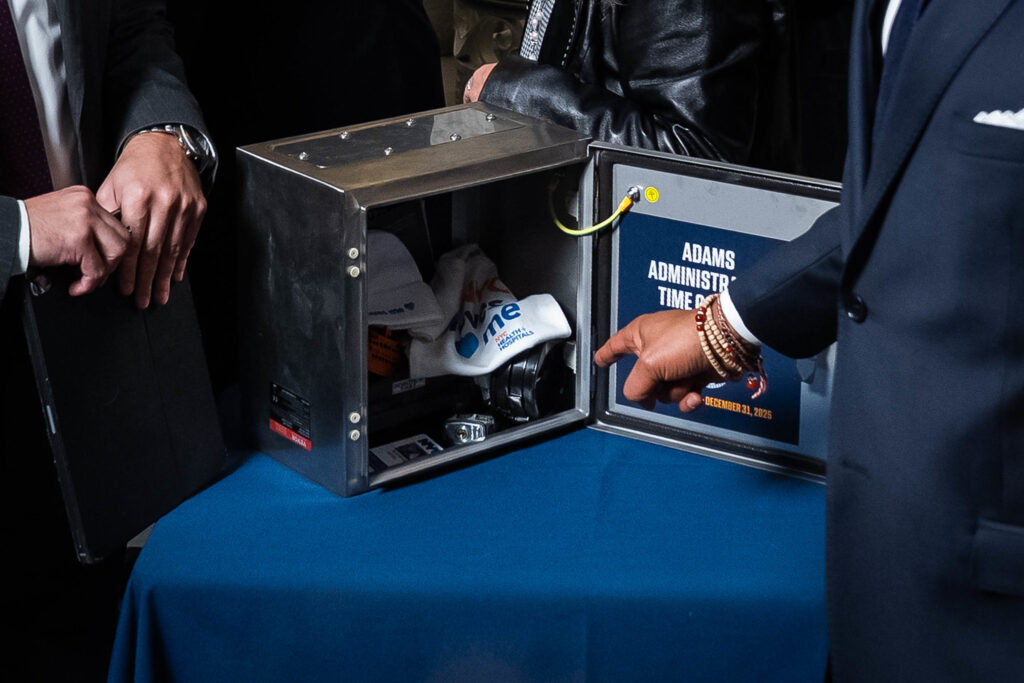
Office Of Rodent Mitigation, Birth-2-Childcare Initiative, Appts To Brooklyn Dev Corp, Rent Guidelines Board, Celebrating Minority Women-Owned Businesses, Manhattan Plan For Housing: Mayor Adams
Editor’s note: Recently, the executive director of PETA has requested that she be given the Rat Czar position that is now available under this executive order. As a representative of an organization in favor of compassion towards and kind treatment of all animals, including rats, she would be an ideal candidate for this position.

Mayor Eric Adams announces the appointment of, and swearing in, of Mark Guerra as the 36th commissioner of the Fire Department of the City of New York (FDNY). Tuesday Dec 23 2025. Credit: Justin Persaud/Mayoral Photography Office.
MAYOR ADAMS SIGNS EXECUTIVE ORDER ESTABLISHING OFFICE OF RODENT MITIGATION
New Mayoral Office to Streamline Coordination Across City Agencies, Community Organizations, and Private Sector in Service of Reducing New York City’s Rodent Population
Adams Administration’s Efforts Have Resulted in 12-Months of Rat Sighting Declines
NEW YORK – New York City Mayor Eric Adams today signed Executive Order No. 63 to establish the first-ever Mayor’s Office of Rodent Mitigation, which will streamline coordination across city government agencies, community organizations, and the private sector to continue Mayor Adams’ “War on Rats.” This new mayoral office builds on the Adams administration’s commitment to improving the quality of life for New Yorkers and the unprecedented focus on rodent mitigation over the last four years, including by appointing the first citywide director of rodent mitigation — informally known as the “rat czar” — and by launching numerous programs at the New York City Department of Sanitation (DSNY) as part of the “Trash Revolution.”
“New Yorkers know there is nothing I dislike more than rats, and that’s why we have made it our mission to significantly address this intractable problem that has plagued New Yorkers for decades,” said Mayor Adams. “With this new executive order establishing the Office of Rodent Mitigation, we are ensuring our ‘War on Rats,’ and the smart policies we put in place to coordinate across city agencies, has a permanent home. Thanks to our efforts, we have revolutionized how we approach trash in our city by containerizing 70 percent of the city’s garbage, recruited the public in our ‘War on Rats,’ and decreased rat sightings for 12 months in a row. I am proud of our legacy on a major quality-of-life, public-safety, and public-health issue, and am excited to see this work continue to make our city more livable for all.”
Under the leadership of a mayor-appointed “rat czar,” the office will provide expert recommendations, coordinate interagency initiatives, and work closely with residents, community organizations, academic partners, and pest management professionals to continue to bring the rodent population down across the five boroughs. City agencies will support the office’s mission by executing integrated pest management on city properties, closing operational gaps that contribute to infestations, and strengthening pest control contracts and oversight. This coordinated structure ensures greater accountability and sustained progress toward a cleaner, more welcoming New York City.
That Adams administration’s commitment to rodent mitigation work has produced positive results through decreased rat sightings consistently over the past 12 months, cleaner public spaces, enhanced enforcement, greater community education, and integrated pest management strategies — such as mandatory trash containerization with the new Empire Bins. The Office of Rodent Mitigation will coordinate citywide strategies, align policies across agencies, and lead public outreach and education efforts to support long-term rodent reduction. According to the 2025 Mayor’s Management Report, in Fiscal Year 2025, initial inspections with active rat signs are at a five-year low, at 19.7 percent, reflecting efforts are working, such as citywide waste containerization and public education efforts. Response to rat and other pest complaints have improved at New York City Housing Authority properties as well, as the percent of rat complaints responded to within two days and within five days have increased by 17 and 13 points, respectively. Other pest complaints responded to within seven days and within 10 days have increased by 44 and 40 points, respectively.
Today’s announcement reinforces Mayor Adams’ commitment to a cleaner, more affordable city through unprecedented investments in quality of life, including rodent mitigation and trash containerization:
- In October 2022, the Adams administration kicked off the Trash Revolution by changing set-out times for both residential and commercial waste from 4:00 PM — one of the earliest set-out times in the country — to 8:00 PM beginning in April 2023, while also allowing earlier set-out if the material is in a container. This incentivization of containerization was paired with major changes to DSNY operations, picking up well over a quarter of all trash at 12:00 AM rather than at 6:00 AM, particularly in high density parts of the city, and ending a practice by which up to one-fifth of trash had been purposefully left out for a full day.
- In April 2023, Mayor Adams appointed the first-ever citywide director of rodent mitigation, also known as the “rat czar,” to lead citywide rat mitigation efforts by working with DSNY, the New York City Department of Health and Mental Hygiene, and the New York City Department of Parks and Recreation, and other city agencies, contributing to a 12-month reduction in active rat sightings in mitigation zones.
In July 2023, containerization requirements went into effect for all food-related businesses in New York City. These businesses — restaurants, delis, bodegas, bars, grocery stores, caterers, and more — produce an outsized amount of the type of trash that attracts rats. - In March 2024, container requirements went into effect for all businesses — of every type — in New York City to get their trash off the streets and into a secure bin.
- In July 2024 Mayor Adams and the former director of rodent mitigation announced the “NYC Rat Pack,” a volunteer initiative to help everyday New Yorkers to learn about, engage on, and take action against New York’s rodent issue through rat walks and community cleanups.
- In November 2024, container requirements went into effect for low-density residential buildings — those with one to nine units — containerizing approximately 70 percent of all trash in the city.
- In June 2025 Mayor Adams announced the launch of a new team to tackle rat populations in 600,000 street tree beds citywide

Mayor Eric Adams and leaders across city government celebrate four years of historic accomplishments under the Adams administration. City Hall. Tuesday, December 16, 2025. Credit: Ed Reed/Mayoral Photography Office.
MAYOR ADAMS, CHANCELLOR AVILES-RAMOS ANNOUNCE OPEN ENROLLMENT FOR BIRTH-TO-2 CHILD CARE INITIATIVE
$10 Million Investment Expands Access to Early Childhood Education Programs for New York City’s Most Vulnerable Communities
Adams Administration Investment Will Prioritize Services for Children Who Need Them Most, Expand Services for Younger Children and Add Over 200 Seats Across 16 Sites
NEW YORK – New York City Mayor Eric Adams and New York City Public Schools Chancellor Melissa Aviles-Ramos today opened enrollment for the “Birth-to-2 Child Care Initiative,” a groundbreaking, city-funded, early childhood education initiative that will provide more than 200 infant and toddler seats across 16 community-based provider sites at zero cost to families. Mayor Adams announced this initiative in April 2025, and further supports the Adams administration’s broader $167-million investment to support early education for young children and their families. This initiative also builds on New York City Public Schools’ existing infant and toddler programs — strengthening the city’s early childhood system and reflecting a long-term commitment to supporting families with young children. The Birth-to-2 Child Care Initiative expands access to high-quality care and early learning for infants and toddlers aged six weeks to two years in neighborhoods with the greatest need. Programs are in communities identified through a data-driven analysis of family economic need and child care access, with locations in the Bronx, Central Brooklyn, Upper Manhattan, and Southeast Queens.
“With the launch of the ‘Birth-to-2 Child Care Initiative,’ we are making a powerful statement about what matters in New York City: our children, our families, and their future,” said Mayor Adams. “Today’s investment ensures that infants and toddlers in the communities with the greatest need have access to high-quality early learning from the very start — at no cost to families. By expanding access to care for children as young as six weeks old, we’re giving our youngest New Yorkers the strong foundation they deserve, and making life more affordable and easier for parents to provide for their families without having to choose between a paycheck and child care. This is what it looks like when a city invests boldly and unapologetically in its people and prioritizes making our home the best place to live and raise a family.”
“This initiative marks a new chapter for early childhood education in New York City,” said New York City Public Schools Chancellor Aviles-Ramos. “Quality early childhood education gives our youngest learners the strongest possible start, and I am proud to be able to bring these programs to more families across our city. I am grateful to our Division of Early Childhood Education, which worked tirelessly to bring this initiative from concept to reality – analyzing data, partnering with providers, and ensuring we’re reaching the families who will benefit most.”
There are no income eligibility requirements for the Birth-to-2 Child Care Initiative, and the initiative prioritizes families in communities that have historically faced barriers to affordable child care. Families with children ages six weeks to two years who live in or near the identified providers’ communities can enroll now by contacting service providers. Services will begin on January 5, 2026.
The following are the providers for the Birth-to-2 Child Care Initiative:
| Name of Provider | Borough | Zip Code |
| NYCELC – White Plains 1 | Bronx | 10467 |
| BBRU 6th | Brooklyn | 11220 |
| Aleph Preschool | Brooklyn | 11230 |
| Colony-South Brooklyn Houses, Incorporated | Brooklyn | 11208 |
| DMI Prep | Brooklyn | 11223 |
| Friends of Crown Heights | Brooklyn | 11213 |
| SCO Family of Services | Brooklyn | 11212 |
| United Community Centers Inc. | Brooklyn | 11207 |
| Wiser Choice Learning Inc. | Brooklyn | 11221 |
| Wiser Choice Learning Inc | Brooklyn | 11233 |
| The Hudson Guild | Manhattan | 10001 |
| Rena Day Care Centers, Inc. | Manhattan | 10032 |
| Round The Clock Nursery | Manhattan | 10027 |
| Urbanconcepts of NY Round the Clock Nursery, Inc | Manhattan | 10039 |
| Victoria Children’s Center, Inc. | Manhattan | 10002 |
| Sholom Daycare #4 | Queens | 11435 |
A thriving early childhood education system is crucial to making New York City more affordable, particularly for women and families. The Adams administration’s child care blueprint found that nearly 375,000 parents left or downshifted their jobs due to COVID-19 and a lack of access to quality child care. For mothers, the decision to leave the workforce to care for a child can cost up to $145,000 in foregone earnings over their lifetime. That is why the Adams administration is prioritizing early childhood programs that works for the long term and has seen results in terms of access and affordability.
Mayor Adams’ commitment to investing in education for New York City children is also reflected in the $115.9 billion Adopted Budget earlier this year, which built on the Fiscal Year 2026 Executive Budget, often called the “Best Budget Ever.” This year’s budget included support for programming and additional staffing related to Mayor Adams’ “After-School for All” expansion in New York City; funding distribution, maintenance, and wireless service costs through the end of 2025 for the purchase of 350,000 Chromebooks for New York City public school students; funding for Summer Rising academic and enrichment programming; and expanding the Pathways program to provide career readiness opportunities for students at New York City Public Schools.
Over the last four years, the Adams administration has been focused on making New York City more affordable for families through popular and essential programs like early childhood education. Earlier this year, Mayor Adams announced a new pilot program, “Creating Real Impact at Birth” (CRIB), to connect and prioritize pregnant New Yorkers applying for shelter with housing vouchers to put them on a path toward permanent housing and stability, so that no child is born into the shelter system, as well as a $7 million expansion of the “Fatherhood Initiative,” which helps fathers reconnect with their children, provide financial support, and develop parenting skills. Additionally, the Adams administration enrolled a record 150,000 children across the early childhood education system. These initiatives all build on Mayor Adams’ efforts that have reduced out-of-pocket costs for child care from $55 per week in 2022 to less than $5 per week with subsidies today for a family of four. Further, the administration met its commitment to offer a seat to every child who applied for 3-K on time last school year — the first time this has ever been done in the city’s history. Finally, the Adams administration invested an additional $20 million to ensure that every student on a 3-K waitlist was offered a seat this year, as well as $55 million to provide more than 700 new seats for three- and four-year-olds with special needs.
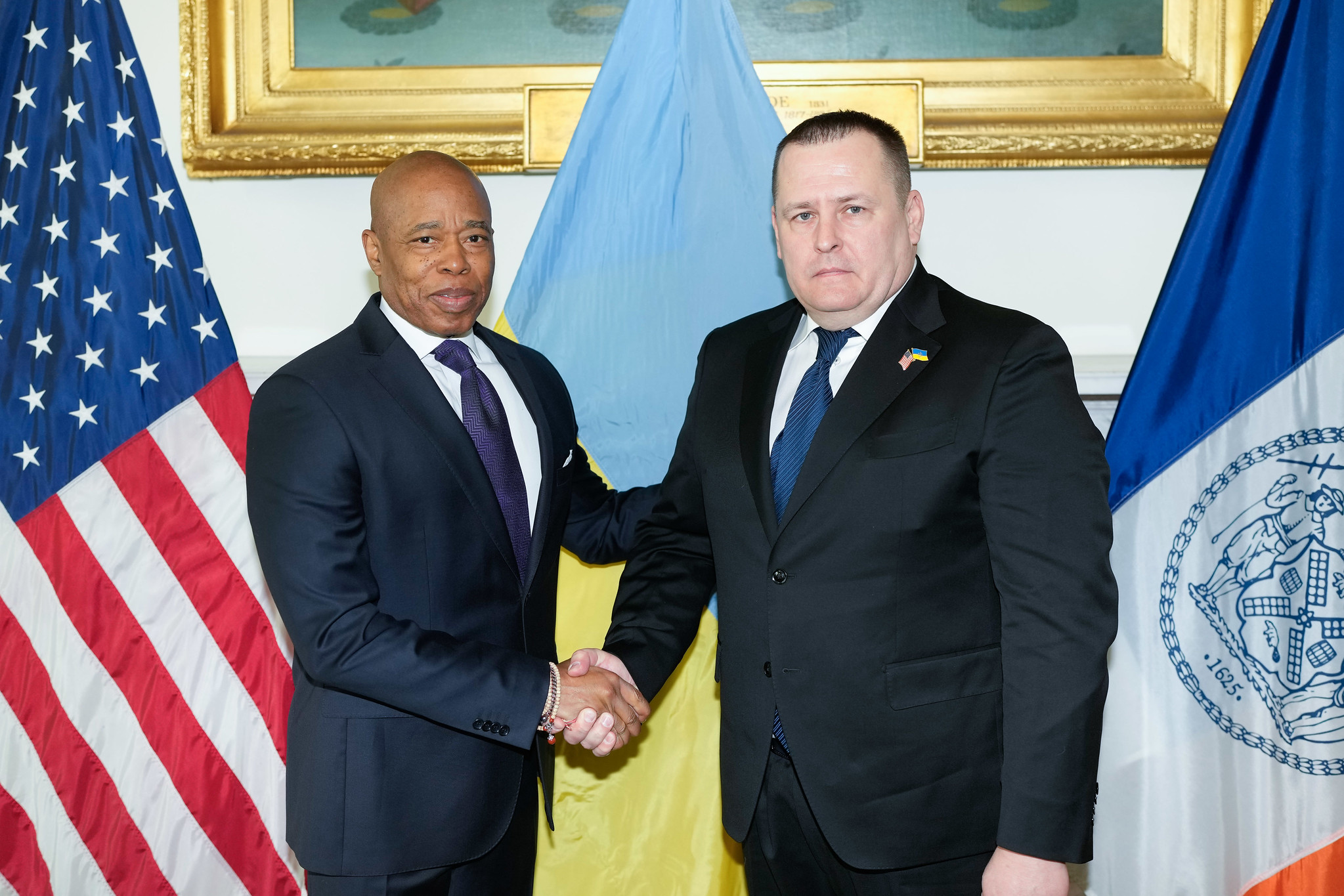
New York City Mayor Eric Adams meets with Borys Filatov, Mayor of Dnipro, Ukraine. at City hall on Tuesday, December 16, 2025. Michael Appleton/Mayoral Photography Office
MAYOR ADAMS ANNOUNCES SEVEN APPOINTMENTS TO BROOKLYN MARINE TERMINAL DEVELOPMENT CORPORATION
Brooklyn Marine Terminal Development Corporation Will Help Bring $3.5 Billion Brooklyn Marine Terminal Vision Plan to Life
Board Will Ensure Transparency, Accountability, and Continued Engagement With Stakeholders
NEW YORK – New York City Mayor Eric Adams today announced seven mayoral appointees to the Brooklyn Marine Terminal Development Corporation (BMTDC) Board. The BMTDC will help create a modern maritime port and vibrant, mixed-use community at the Brooklyn Marine Terminal (BMT) and implement the BMT Vision Plan for the site, which the Brooklyn Marine Terminal Task Force voted to advance by a two-thirds majority in September. The 23-person BMTDC Board — which was a key part of the Vision Plan — will consist of appointments from the New York City Mayor’s Office, New York State Governor’s Office, local elected officials, Brooklyn Community Board 6, and New York City agency commissioners serving in an ex-officio role. The seven mayoral appointees announced today are Karen Blondel, Michelle de la Uz, Thomas McMahon, Regina Myer, John Nardi, Tokumbo Shobowale, and Jesse Solomon. With today’s announcement, Mayor Adams fulfills a key commitment outlined in the Vision Plan to stand up the BMTDC and appoint initial board members before the end of the year.
“Our administration not only helped craft an ambitious plan for the future of the Brooklyn waterfront but promised to set it in motion by the end of this year. With these appointments, we are keeping our word and taking the next step toward bringing thousands of homes, tens of thousands of jobs, and a new maritime port to the Red Hook community,” said Mayor Adams. “These appointments will serve as responsible stewards of the Brooklyn Marine Terminal and work alongside the community and elected officials to bring our bold vision for the area to life.”
“The Brooklyn Marine Terminal Development Corporation will ensure strong governance of the Brooklyn Marine Terminal project and I want to personally thank all of the board members for their time and dedication to this project,” said Deputy Mayor for Housing, Economic Development, and Workforce Adolfo Carrion Jr. “I look forward to the delivery of an all-electric port, that represents a modernized vision for the city’s working waterfront, alongside thousands of units of affordable housing and acres of public open space.”
“I’m excited for the formation of the BMTDC and to see many amazing leaders announced today,” said Brooklyn Borough President Antonio Reynoso. “I look forward to advancing a working waterfront and championing a port-first plan for the BMT.”
The BMT Vision Plan — which is backed by $418 million in city, state, and federal investments — will transform the dilapidated marine terminal into a 60-acre, all-electric maritime port that can serve as a key economic driver for the area. Additionally, the approved plan will create 6,000 new homes — including over 2,400 permanently-affordable units — as well as at least 28 acres of public space, 275,000 square feet of commercial space, 250,000 square feet of community facility space, and 275,000 square feet of light-industrial and industrial space at discounted rents. The plan, which covers a total of 122 acres, will also deliver vital resiliency and infrastructure upgrades for the area while generating an estimated $18 billion in economic impact, 37,000 temporary construction jobs, and 2,000 permanent jobs.
The BMTDC Board will oversee the implementation of the Vision Plan. Additionally, BMTDC will help enforce transparency, accountability, and the delivery of community commitments throughout the BMT redevelopment — including the creation of mixed-use spaces that enhance neighboring communities, respond to the housing crisis, improve mobility and transit accessibility, and develop new open spaces and opportunities for community gatherings. Appointed board members will serve at the will of their appointing party.
Recently, BMTDC held an organizational meeting — led by an interim board of directors, soon to be replaced by a full slate of appointed members — to take initial organizational and procedural actions to stand up the new entity. Prior to approval of the state-run General Project Plan (GPP), BMTDC’s initial activities will also include the establishment of by-laws and governance procedures; the naming of interim leadership, including an executive director (ex-officio officer of NYCEDC); and development of a process for implementing the Points of Agreement after GPP approval. Additionally, all BMTDC meetings shall be subject to Open Meetings Law, and BMTDC will comply with all applicable reporting requirements, including those pursuant to the Public Authorities Accountability Act of 2005.
The appointees of the mayor are:
- Karen Blondel, president, Red Hook Houses West Tenants Association
- Michelle de la Uz, executive director, Fifth Avenue Committee
- Thomas McMahon
- Regina Myer, president, Downtown Brooklyn Partnership
- John Nardi, president, Shipping Association of New York and New Jersey
- Tokumbo Shobowale, senior vice president, Chief Financial Officer & Treasurer, Fordham University
- Jesse Solomon, executive director, Southwest Brooklyn Industrial Development Corporation
The New York City government ex-officio appointees are:
- New York City First Deputy Mayor Randy Mastro (chair)
- New York City Department of Transportation Commissioner Ydanis Rodriguez
- New York City Department of Housing and Preservation Acting Commissioner Ahmed Tigani
- New York City Mayor’s Office of Management and Budget Director Jacques Jiha
- New York City Economic and Development Corporation President & CEO Andrew Kimball
The Vision Plan will inform the final project plan for the site through the state-run GPP. Currently, the project is undergoing the environmental review process, and, recently, the public comment period was extended to March 2026.
Today’s announcement of the BMTDC Board is also a major step forward in the effort to build the “Harbor of the Future” — a reimagined network of innovation and growth across New York City’s waterways. In addition to a modern maritime port and vibrant mixed-use community hub at BMT, the Harbor of the Future includes emerging innovation centers such as the Hunts Point Produce Market in the Bronx; the climate innovation hub “BATWorks” at the Brooklyn Army Terminal in Sunset Park; the country’s largest offshore wind port at the South Brooklyn Marine Terminal; the Science Park and Research Campus in Kips Bay in Manhattan; new sustainable housing and public space on the North Shore of Staten Island; and an anchor research and educational partnership with the New York Climate Exchange on Governors Island.

Mayor Eric Adams, New York Governor Kathy Hochul, New York City Economic Development Corporation (NYCEDC) President and CEO Andrew Kimball, and The City University of New York (CUNY) Chancellor Félix V. Matos Rodríguez celebrate progress on the Science Park and Research Campus (SPARC) Kips Bay project, a first-of-its-kind life sciences innovation, career, and education hub they have been working in partnership to make a reality since year one of the Adams administration. CUNY Hunter College Brookdale Campus Cafeteria, Manhattan. Tuesday, December 23, 2025. Credit: Ed Reed/Mayoral Photography Office.
MAYOR ADAMS ANNOUNCES REAPPOINTMENTS AND APPOINTMENTS TO RENT GUIDELINES BOARD
Respected New York City Leaders Will Bring Decades of Experience AcrossAcademia, Law, Finance, and Advocacy to Rent Guidelines Board
NEW YORK – New York City Mayor Eric Adams today announced four appointments and reappointments to the Rent Guidelines Board. Arpit Gupta has been reappointed as a public representative while Christina Smyth has been reappointed as an owner representative. Additionally, Lliam Finn has been appointed as a public representative and Sagar Sharma has been appointed as a tenant representative. The members bring decades of experience across a diverse range of fields from housing policy to public advocacy and reflect the Adams administration’s ongoing commitment to affordable housing and evidence-based policymaking.
“From passing historic zoning reforms to creating record amounts of affordable housing, we are proud to be the most pro-housing administration in city history. We’re using every tool in our toolbox to tackle our city’s housing crisis, and that includes appointing smart, seasoned experts to the city’s Rent Guidelines Board,” said Mayor Adams. “These respected appointees bring decades of experience in the housing sector and I am confident they will serve as responsible stewards of our city’s housing stock, using facts and data to reach the right decision for both tenants and property owners.”
About the Reappointments and Appointments
Arpit Gupta is associate professor of finance at New York University Stern School of Business, where his research focuses on using large datasets to understand default dynamics in household finance, real estate, and corporate finance. His interests in policy research include real estate, housing, and land-use regulation, as well as transit, infrastructure, public finance, pedestrianization, and the management of urban street space. Gupta was the recipient of the 2016 Top Finance Graduate Award at Copenhagen Business School. He holds a B.S. in mathematics from the University of Chicago and a Ph.D. in finance and economics from Columbia Business School.
He was previously appointed to the Rent Guidelines Board in 2022 and is being reappointed as a public representative.
Christina Smyth, Esq. is the founder and owner of Smyth Law PC, a real estate law practice that represents multifamily residential building owners, operators, and management companies throughout Manhattan, Queens, Brooklyn, and the Bronx. She is also an adjunct instructor at the New York University Real Estate Institute. Smyth has been a member of the Real Estate Services Alliance since 2011 and is a committee member of the New York State Bar Association’s Lawyers Assistance Program. She holds a B.A. in political science from Fordham University and a J.D. from St. John’s University School of Law.
Smyth was previously appointed to the Rent Guidelines Board in 2022 and is being re-appointed as an owner representative.
Sagar Sharma is the deputy director at Legal Services NYC, where he has worked in the Housing Unit since 2018 helping to fight poverty and seek justice for low-income New Yorkers. Sharma earned a B.A. in political science from The City College of the City University of New York (CUNY) and a J.D. from CUNY Law School.
Sharma has been appointed as a tenant representative.
Lliam Finn is a senior financial advisor with Merrill Lynch, where he focuses on large market retirement plans. In addition to his work in the financial sector, Finn served as a naval officer for six years. Finn received his M.B.A. from Fordham University as well as a B.S. in economics from the United States Naval Academy.
Finn has been appointed as a public representative.
Since entering office, Mayor Adams has made historic investments to create more affordable housing and ensure more New Yorkers have a place to call home. Earlier this year, Mayor Adams announced that his administration has created, preserved, or planned approximately 426,800 homes for New Yorkers through the end of the last fiscal year — a number which has already grown to over 433,250 homes to date. Mayor Adams also announced that, in Fiscal Year 2025, the Adams administration created the most affordable rental units in city history and celebrated back-to-back-to-back record-breaking years for producing permanently-affordable homes for formerly-homeless New Yorkers, placing homeless New Yorkers into housing, and connecting New Yorkers to housing through the city’s housing lottery.
In addition to creating and preserving record amounts of affordable and market-rate housing for New Yorkers, the Adams administration has also passed ambitious plans that will create tens of thousands of new homes as well. Last December, Mayor Adams celebrated the passage of “City of Yes for Housing Opportunity,” the most pro-housing proposal in city history that will build 80,000 new homes over 15 years and invest $5 billion in critical infrastructure updates and housing.
Building on the success of City of Yes for Housing Opportunity, Mayor Adams unveiled his “City of Yes for Families” strategy in his State of the City address earlier this year to build more homes and create more family-friendly neighborhoods across New York City. Under City of Yes for Families, the Adams administration is advancing more housing on city-owned sites, creating new tools to support homeownership, and building more housing alongside schools, playgrounds, grocery stores, accessible transit stations, and libraries.
Further, the Adams administration is actively working to strengthen tenant protections and support homeowners. The “Partners in Preservation” program was expanded citywide in 2024 through a $24 million investment in local organizations to support tenant organizing and combat harassment in rent-regulated housing. The Homeowner Help Desk, a trusted one-stop shop for low-income homeowners to receive financial and legal counseling from local organizations, was also expanded citywide in 2024 with a $13 million funding commitment.
Finally, Mayor Adams and members of his administration successfully advocated for new tools in the 2024 New York state budget that are already helping spur the creation of urgently needed housing. These tools include a new tax incentive for multifamily rental construction, a tax incentive program to encourage office conversions to create more affordable units, lifting the arbitrary “floor-to-area ratio” cap that held back affordable housing production in certain high-demand areas of the city, and the ability to create a pilot program to legalize and make safe basement apartments.

New York City Mayor Eric Adams meets with Borys Filatov, Mayor of Dnipro, Ukraine. at City hall on Tuesday, December 16, 2025. Michael Appleton/Mayoral Photography Office
MAYOR ADAMS CELEBRATES ANOTHER RECORD-BREAKING YEAR OF SUPPORTING MINORITY- AND WOMEN-OWNED BUSINESSES
City Awarded $6.9 Billion in Total M/WBE Contracts During Fiscal Year 2025
City Agencies Utilized M/WBEs at Highest Rate Ever in Fiscal Year 2025, Breaking Record Set in Fiscal Year 2024
Highest Total Contract Amount Awarded to M/WBEs in Program’s History
NEW YORK – New York City Mayor Eric Adams, New York City Chief Business Diversity Officer Michael J. Garner, Mayor’s Office of Contract Services (MOCS) Director Kim Yu, and New York City Department of Small Business Services (SBS) Commissioner Dynishal Gross today celebrated a citywide effort to deliver yet another record-breaking year for contracting with, and supporting, minority- and women-owned business enterprises (M/WBE). The Fiscal Year (FY) 2025 outcomes follow back-to-back record-breaking years of success for the city’s M/WBE program.
In FY 2025, the city awarded $6.9 billion in M/WBE contracts to New Yorkers, which puts it on pace to surpass Mayor Adams’s OneNYC proposal of $25 billion in M/WBE city contracts by FY 2026 — a full six months ahead of schedule. Under Local Law 1 (LL1), which governs the city’s M/WBE program, the utilization rate was 36.4 percent — the highest ever in the program’s history and eclipsing the record set in FY 2024 by more than 5 percent. The city also set a record-high in total contract value awarded to M/WBEs under LL1 at $2.2 billion — the first time the city has surpassed $2 billion in LL1 M/WBE contract awards. Additionally, more contracting dollars than ever were awarded to M/WBEs under the city’s M/WBE Small Purchase method in FY 2025 — a contracting method that streamlines processes to more efficiently contract with M/WBEs — representing a total of nearly $350 million which effectively doubled the amount awarded with this method in FY 2023.
“When we came into office, we were clear that much more needed to be done to lift up our minority and women-owned businesses, which, for too long, were left behind in city contracting,” said Mayor Adams. “Today, we are proud to announce, yet another historic milestone with a record $6.9 billion in contracts awarded to M/WBEs last fiscal year and a record 36.4 percent utilization rate for M/WBEs — the highest-ever in the history of the program. This, once again, demonstrates how our administration is investing money where it sees value by making smart, targeted investments that help make our city government more accessible and equitable to all. I thank Chief Garner, Commissioner Gross, and Director Yu for the work they are doing to impact lives every day and improve city services in the process.”
“The City of New York has demonstrated with effective leadership that it’s possible to award government contracts in a more inclusive manner,” said Chief Business Diversity Officer Garner. “With more than $24 billion awarded to certified minority-and women-owned businesses during the Adams administration, we continue to drive equity within communities of color who have historically been excluded. Awarded government contracts equals job creation, homeownership for those respective business owners, and better educational and health care opportunities for their families.”
“SBS is proud to contribute to yet another record-breaking year for M/WBEs in New York City,” said SBS Commissioner Gross. “From helping to certify M/WBEs to programs like the Contract Financing Loan Fund and business education, together with our partner agencies, we are working to unlock the economic potential of small businesses that power our city across the five boroughs.”
“We take pride in the strong agency partnerships we’ve established in our commitment to revolutionizing the contracting process in New York City,” said New York City Chief Procurement Officer and Director of the New York City Mayor’s Office of Contract Services (MOCS) Kim Yu. “MOCS aims to ensure that every dollar spent on contracts contributes to inclusive economic growth. By moving away from outdated perspectives and practices, we focus on developing systems, policies, and collaborations that eliminate barriers and provide tangible, sustainable access for our M/WBEs. We will continue our efforts for more transparency, efficiency, and accessibility of our city’s contracting processes, making it possible for more M/WBEs to succeed.”
The Adams administration has a proven track record of investing in the success and growth of M/WBEs. Mayor Adams appointed Michael Garner as the city’s first-ever chief business diversity officer to address historic disparities in city contracting and provide minority- and women-entrepreneurs increased opportunities to do business with New York City. Additionally, Mayor Adams signed Executive Order 34, ensuring that each city agency has a senior staff member empowered to prioritize M/WBE programming; standardize data collection from city-affiliated entities that will help facilitate the city’s full, real-time M/WBE performance outcome tracking; create more contracting opportunities for M/WBEs wherever practicable.
Finally, the city continues to leverage the Mayor Adams’ M/WBE Advisory Council’s network of M/WBE advocates and sector leaders.
MOST PRO-HOUSING ADMINISTRATION IN CITY HISTORY: MAYOR ADAMS, CITY PLANNING RELEASE “MANHATTAN PLAN,” AMBITIOUS PROPOSAL TO BUILD 100,000 NEW HOMES IN THE BOROUGH OVER NEXT DECADE
Originally Announced in Mayor Adams’ 2025 State of the City Address, Manhattan Plan Will Help Deliver a More Affordable Borough in Decade Ahead
Strategies Include Building More Homes Near Transit, Expanding on Transformation of City-Owned Sites, Boosting Office-to-Residential Conversions, and More
NEW YORK – New York City Mayor Eric Adams and New York City Department of City Planning (DCP) Director Dan Garodnick today released the “Manhattan Plan,” a bold blueprint to tackle Manhattan’s deep housing shortage by adding 100,000 new homes to the borough over the next decade. After an extensive public engagement process that collected more than 2,500 ideas for where and how to create new housing in Manhattan, the plan lays out key strategies for creating new housing in Manhattan, including adding more homes close to transit and in areas that restrict new housing, redeveloping city-owned sites, facilitating office-to-residential conversions, implementing regulatory improvements, and more. Since unveiling the Manhattan Plan in his State of the City address earlier this year, the Adams administration has already advanced several initiatives to create more housing in the borough, including passing the Midtown South Mixed-Use Plan to build nearly 10,000 more homes in the heart of Manhattan, the redevelopment of city-owned sites like 100 Gold Street in Lower Manhattan, and individual applications for zoning changes like the creation of nearly 700 homes above a future Second Avenue Subway station in East Harlem.
“For too long, the cost of living in Manhattan has gone up, working-class families have gone away, and our city’s housing crisis has grown more severe. Our administration promised to change that, advancing bold plans to bring thousands of new homes to the borough and make sure that Manhattan is still a place you can live and raise a family,” said Mayor Adams. “We passed the first citywide rezoning in six decades, landed the plane on our Midtown South Mixed-Use Plan, and with today’s announcement, are putting forward our ambitious ‘Manhattan Plan’ to bring 100,000 new homes to the borough. With the innovative ideas laid out here, we will help create the homes that Manhattan needs, deliver the more affordable future that all New Yorkers deserve, and reinforce, once again, our position as the most pro-housing administration in city history.”
“For generations, Manhattan was the place where people of all backgrounds could start their life’s journey and find new opportunities. This important plan lays out how it can fulfill that role once again,” said DCP Director Garodnick. “By embracing the ambitious, transformative ideas outlined in this framework, we can ensure that many more New Yorkers can live, work, and follow their dreams in a more affordable, welcoming, and vibrant Manhattan.”
Manhattan’s unparalleled job market, transit access, and walkability helped make the borough a site of enormous opportunity through the 20th century and drove a housing boom that unlocked all the island had to offer for millions of New Yorkers. But Manhattan’s housing production has dropped sharply when compared to the previous century. Today, Manhattan produces less housing than every other borough except for Staten Island; income-restricted affordable housing is also in extremely short supply.
Due to the lack of housing options, today, almost half of Manhattanites are rent-burdened, meaning they spend more than 30 percent of their income on rent, and about a quarter are severely rent-burdened, meaning they spend more than half of their income on rent. The Manhattan Plan looks to address this severe housing shortage through a set of strategies to help create 100,000 new homes over the next decade. Delivering these additional homes will allow more New Yorkers of all income levels to live near transit, jobs, schools, parks, and cultural resources — reaffirming Manhattan’s historic role as a place of opportunity. Ultimately, new housing will deliver a win-win-win: giving New Yorkers more affordable places to live, workers more opportunities to connect with nearby jobs, and small businesses more foot traffic.
The Manhattan Plan was developed through extensive public input gathered through pop-up events in every community district in the borough, online engagement, briefings, interviews, and focus groups held in English, Spanish, and Chinese. More than 2,500 ideas on where and how to bring new housing to Manhattan were generated from this public input process, including over 900 responses to the website survey and over 1,000 contributions to an interactive map.
The Manhattan Plan is built around six key themes that reflect the many ideas received for where and how the city can increase the borough’s housing supply:
- Housing near transportation and job centers: To take advantage of the borough’s role as the nation’s largest job center and one of its most significant transit hubs, the plan suggests bolstering housing opportunities near both resources, such as the recently-approved 125th Street and Lexington Avenue Project by the Metropolitan Transportation Authority, which will use “City of Yes’” new, high-density R11 zoning district to generate nearly 700 new homes, including around 170 permanently-affordable, income-restricted homes.
- Housing in areas with greater housing potential or low housing production: While much of Manhattan permits new housing, many mid-density areas have the capacity for additional housing and affordable housing through land use changes. There are also opportunities to map the city’s high-density R11 and R12 zoning districts, a key component of City of Yes that could create permanently affordable homes in some of the densest parts of the borough.
- Housing on city- or government-owned sites: The Manhattan Plan describes ideas for the increased use of government-owned sites for new housing, either as standalone developments or mixed-use projects with resources like schools or libraries on the ground floor. This work is already underway through projects like 100 Gold Street, an office building with several city agencies that will be transformed into a mixed-use tower with 3,700 apartments, at least a quarter of them permanently affordable.
- Housing on private sites: Although much of Manhattan is developed, there are opportunities for new housing on remaining vacant or underutilized private sites, such as those that are currently home to automotive uses, self-storage, parking lots, and more. The city will explore how to best incentivize the redevelopment of these sites for new housing, including through office-to-residential conversions.
- Improving the development process and regulatory environment: The Manhattan Plan explores ways to lessen regulatory barriers, cut red tape, get shovels in the ground, and help New Yorkers move into new homes faster. This work could include streamlined city agency processes, expedited financing, expanded funding streams, and other reforms.
- Expanding development models and building methods: From Housing Development Fund Corporation cooperatives to Mitchell-Lamas to Community Land Trusts, New York City has a long history of creative housing ownership and management models. This plan suggests ideas for expanding alternative ownership and development models for new housing.
When Mayor Adams came into office, he promised to turn the page on decades of dysfunction, make real progress against New York City’s long-standing housing crisis, and create 500,000 units of housing by 2032; four years later, he delivered, and the Adams administration is well on the way to that goal by creating, preserving, or planning over 433,000 homes through its efforts to date.
Thanks to decisive strategies to build more housing — including cutting red tape to speed up construction of new developments and investing a historic $26 billion towards affordable housing through the city’s 10-Year Capital Plan in Fiscal Year 2025 — the Adams administration has produced nearly 86,000 affordable homes, with the last three fiscal years representing the most new affordable homes ever created in a three fiscal-year stretch (Fiscal Year 2023 – Fiscal Year 2025).
The Adams administration also passed landmark changes to overhaul the city’s outdated zoning code and spark the creation of new housing. In December 2024, Mayor Adams passed “City of Yes for Housing Opportunity” — the most pro-housing legislation in city history — to create over 80,000 new homes and invest $5 billion in housing and infrastructure. Additionally, Mayor Adams passed five neighborhood plans to create nearly 50,000 homes over the next 15 years in the Bronx Metro North neighborhood, Central Brooklyn, Midtown South in Manhattan, and Long Island City and Jamaica in Queens. The Adams administration’s rezoning efforts in less than four years alone are expected to create more new housing than the previous two mayoral administrations’ rezoning efforts in 20 years combined.
To build new housing everywhere, Mayor Adams advanced over 10,000 new homes on city-owned land through his historic Executive Order 43; secured a landmark housing deal in Albany to give the city new housing tools; and convened the first-ever Charter Revision Commission to focus specifically on housing and land use measures.
Additionally, the Adams administration put public housing first, helping to unlock nearly $5.5 billion in capital repairs for over 24,000 residents through the Permanent Affordability Commitment Together program and helping establish the Preservation Trust to repair, rehabilitate, and modernize 25,000 apartments under control of the New York City Housing Authority.
Moreover, the Adams administration has worked to connect New Yorkers to homes and keep New Yorkers in their homes, connecting a record number 30,000 New Yorkers with affordable homes through the city’s Housing Lottery.
Banner Image: Mayor Eric Adams and leaders across city government celebrate four years of historic accomplishments under the Adams administration. City Hall. Tuesday, December 16, 2025. Image Credit: Ed Reed/Mayoral Photography Office.