

Cracking Down On Drunk, Speeding Drivers For Holidays, Washington Heights Plaza Named For Dominican Cultural Inst., Harlem River Greenway, Curb Enthusiasm Reflection, 5th Ave Signs, Water-Highway, Historic Progress: NYC DOT
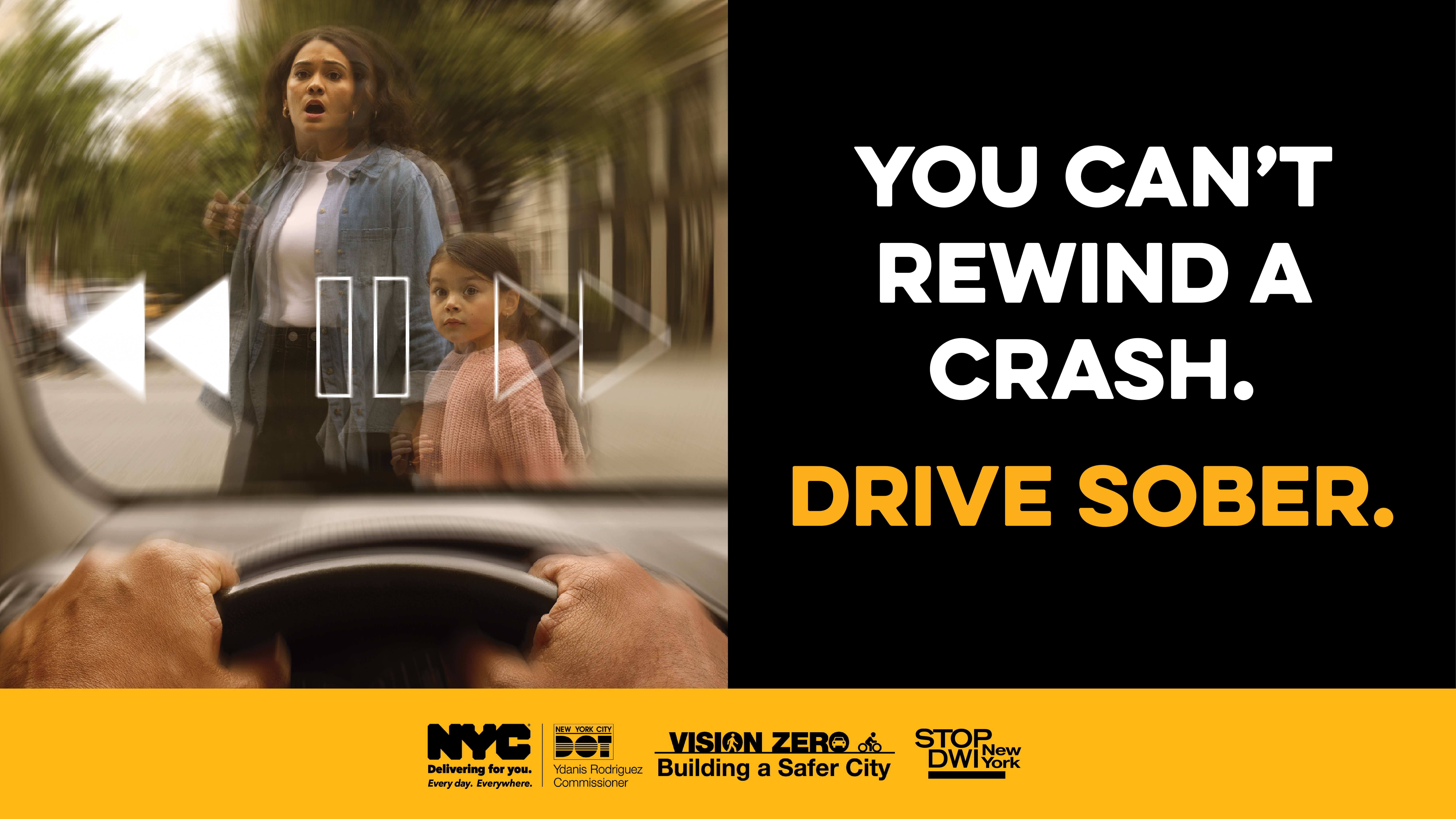
VISION ZERO: NEW YORK CITY WILL AGGRESSIVELY ENFORCE DWI DURING THE WINTER HOLIDAYS
NYPD Will Focus Holiday Enforcement and Education Efforts on Speeding and Driving While Intoxicated
NEW YORK – The New York City Police Department (NYPD), the New York City Department of Transportation (NYC DOT), NYC Taxi and Limousine Commission (TLC), the Department of Health and Mental Hygiene (DOHMH), and other Vision Zero agencies came together today to announce major initiatives to crack down on speeding and drunk driving going into the winter holidays, a period which has traditionally seen an increase in dangerous driving.
“The NYPD wants every New Yorker to fully enjoy their holiday season — but to do so responsibly,” said NYPD Chief of Transportation Olufunmilola Obe. “As they do year-round, our officers will be highly visible on New York City roadways during this busy period to monitor reckless driving and increase enforcement against intoxicated motorists. We encourage New Yorkers to plan ahead and use public transportation or a ride-hailing service, or ask a friend or family member for a ride. Protect yourselves, protect each other, and be safe.”
“Over the last four years, we have continued to make progress on Vision Zero goals through our partnership with sister agencies helping us help keep our streets safe,” said NYC DOT Commissioner Ydanis Rodriguez. “With expanded enforcement, drivers need to know not only that they will get stopped if they have been drinking, but also that getting behind the wheel drunk or impaired now comes with far greater consequences. Driving is a privilege, and we want everyone to be able to return home to their families for the holidays and new year.”
“This holiday season, think before you drink. The risks of unsafe driving can affect all New Yorkers, so the decisions you make can save lives – including your own,” said TLC Commissioner and Chair David Do. “Being impaired by alcohol or drugs behind the wheel puts you and those around you in danger. TLC regulates 180,000 taxi and for-hire drivers who are drug tested, Vision Zero trained and available to you. Let them do the driving while you have fun.”
“As New Yorkers head to gatherings and celebrations across our city, if you choose to drink, it’s important to plan ahead for how you will get around safely. Whether you’re taking the subway, sharing a ride, or designating a driver, preparation can make all the difference,” said Acting Health Commissioner Dr. Michelle Morse. “This holiday season let’s look out for one another and make decisions that keep our families, and our city, safe. And for anyone who feels that drinking alcohol is negatively affecting their life, it’s never too late to talk to a friend, family member, mental health professional, or your medical provider. For additional support, you can call or text 988.”
NYPD Holiday Enforcement: NYPD will be actively enforcing laws against speeding and DWI throughout the holiday season and into the new year. Enforcement will be conducted by NYPD Highway Patrol and local precinct officers using sight and remote sensing devices on major highways, roads, and secondary streets where excessive speeds have previously been observed, including by DOT speed cameras.
Historic declines in traffic deaths: Traffic deaths, which once exceeded 1,000 annually in the early 20th century, have declined to historic lows over the past four years, to well under 250 annually. One death is one too many, and that is why Vision Zero agencies have – and will continue – to work with urgency to reduce crashes. By 2023, New York City recorded the lowest number of pedestrian deaths in history, and overall traffic fatalities have remained near record lows through 2025.
NYC DOT RELEASES HARLEM RIVER GREENWAY IMPLEMENTATION PLAN, COMPLETES PORTION OF THE GREENWAY PROJECT WITH REDESIGN OF BAILEY AVENUE IN THE BRONX
NYC DOT Harlem River Greenway Implementation Plan Outlines Long-Term Construction Strategy for Seven-Mile Greenway Between Van Cortlandt Park and Randall’s Island Park
The Bailey Avenue Project Improves Traffic Safety on a Street That Has Experienced Two Traffic Deaths and 18 Serious Injuries Since 2020
NEW YORK – New York City Department of Transportation (NYC DOT) Commissioner Ydanis Rodriguez today announced the release of the Harlem River Greenway Implementation Plan for the Bronx, and the completion of a street safety project on Bailey Avenue, an important segment of the larger greenway project. The Harlem River Greenway will run between Van Cortlandt Park and Randall’s Island Park, and the implementation plan outlines the long-term construction strategy for the seven-mile project. The completed redesign of Bailey Avenue, from Van Cortlandt Park South to West 225 Street, delivers 1.8 lane miles of two-way, parking protected bike lane, new pedestrian islands, bus boarding islands, and other intersection upgrades to improve safety on a street that has experienced two traffic deaths and 18 serious injuries since 2020. The project is one of several greenway segments recently completed or under construction.
“The Harlem River Greenway is a game-changer that will provide access to the Harlem River from Van Courtlandt Park to Randall’s Island. As we outline plans for the future of the project, the completion of our redesign of Bailey Avenue provides a safe connection to Van Cortlandt Park and enhances safety on one of the more dangerous streets in the Bronx,” said NYC DOT Commissioner Ydanis Rodriguez. “Bronx residents deserve safer access to their waterfronts and green spaces, and we look forward to continuing to build on our work for years to come with our new Harlem River Greenway Implementation Plan.”
“The Harlem River Greenway will not just be a vital transportation link— it will serve as a vibrant resource to help New Yorkers explore their neighborhoods, get fresh air and exercise, access their local parks, and connect with their waterfronts,” said NYC Parks Commissioner Iris Rodriguez-Rosa. “For the last two years, we have worked on a vision for this 7-mile greenway, stretching from Van Cortlandt Park to Randall’s Island Park, that strengthens cycling and walking connections and helps Bronxites connect to their waterfront. We are looking forward to working with our interagency partners and the Bronx community to build on this momentum and close gaps as laid out in this plan.”
“The Harlem River Greenway Implementation Plan is going to deliver in a big way for the Bronx, bringing a travel corridor for pedestrians and cyclists, increased access to the Harlem River waterfront, and help spur additional economic development throughout the area,” said NYCEDC President & CEO Andrew Kimball. “We are thrilled to be working alongside our greenways partners NYCDOT and NYC Parks in delivering this and countless other greenway projects throughout New York City – providing New Yorkers with safe and accessible public spaces to enjoy.”
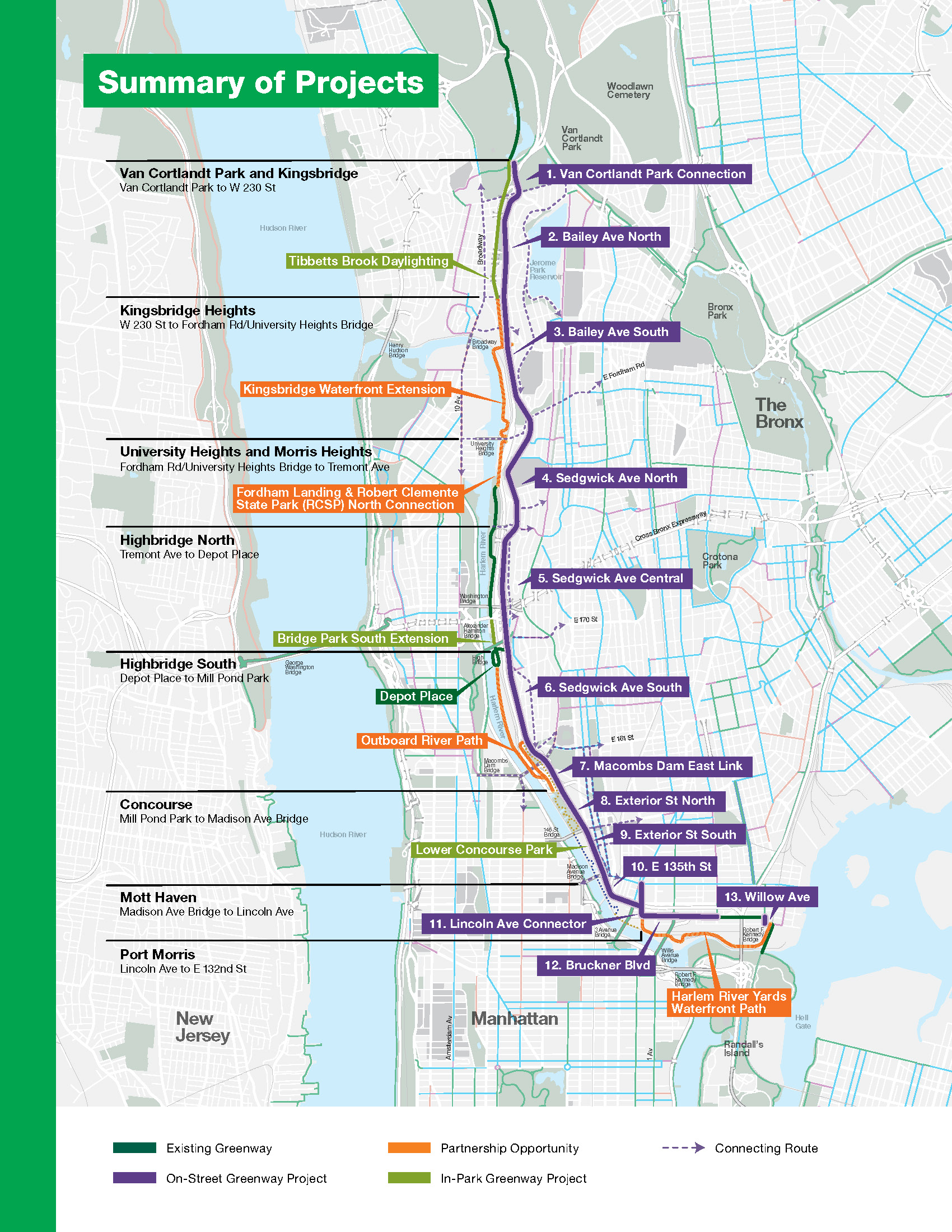
A summary of NYC DOT projects, either planned or recently completed, that together will make up the Bronx Harlem River Greenway. Credit: NYC DOT
The Bailey Avenue project is a ‘road diet,’ a type of redesign that right-sizes streets to provide room for things like safer pedestrian spaces and crosswalks, bike lanes, bus lanes, and parking. These projects help reduce speeding, cut down on crashes, and make streets work better for everyone. These projects have shown to reduce total traffic deaths and serious injuries by 30 percent, and pedestrian deaths and serious injuries by 32.7 percent. The Bailey Avenue North project responds to community requests to address dangerous speeding and cyclist safety on the corridor, enhancing safety on a truck route with 18 serious injuries and two fatalities between 2020 and 2024. The agency plans to return to the neighborhood next year to complete a southern phase of the project, which will extend the redesign from West 225 Street down to West Fordham Road.
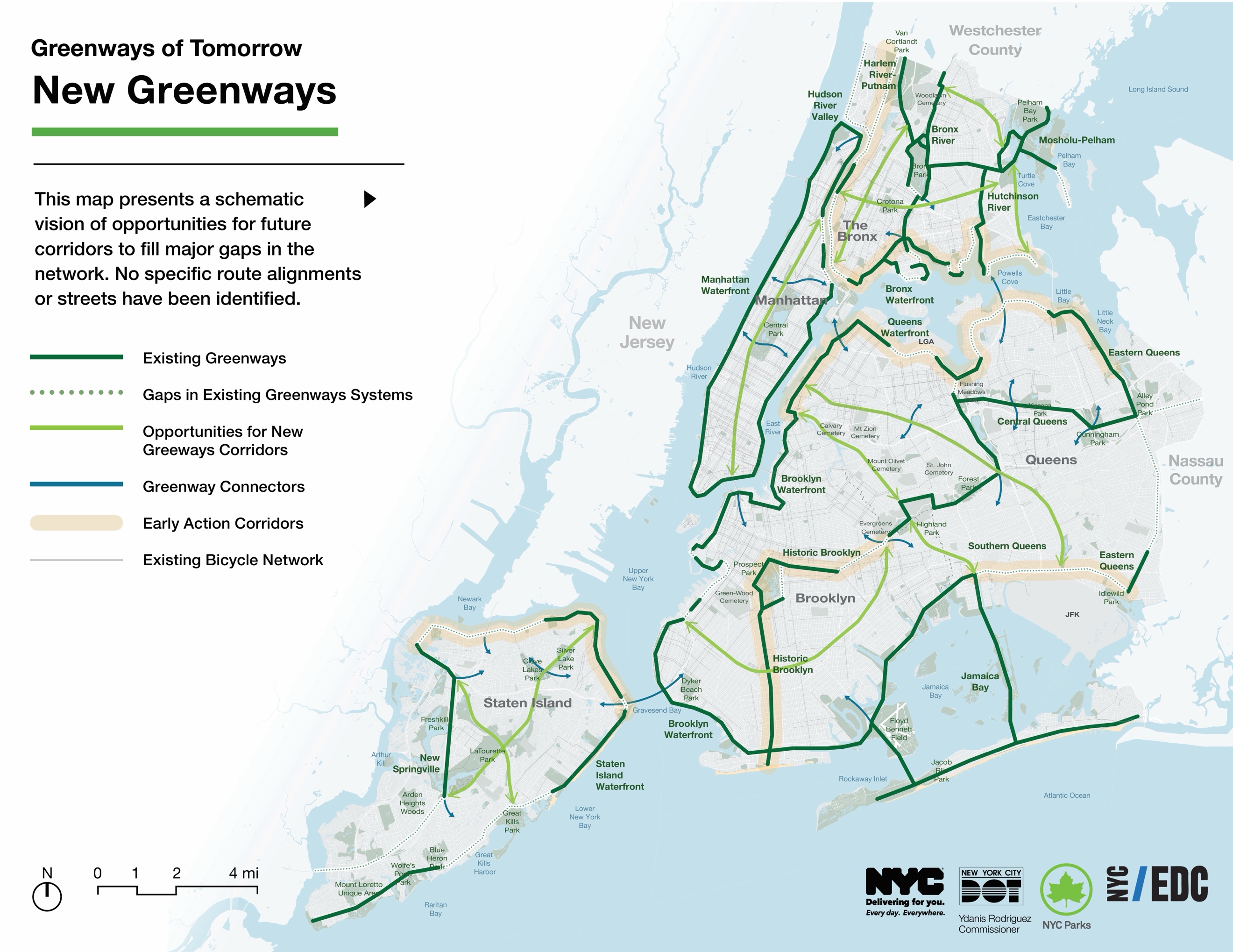
A map of existing and proposed greenway routes under development as part of the city’s historic greenway expansion across the five boroughs. Credit: NYC DOT
The project is one of many that will ultimately form the Harlem River Greenway in the Bronx, and was informed by hundreds of community members who attended three rounds of community workshops or responded at NYC DOT tabling at over 30 community events. The implementation plan released Friday summarizes the outreach conducted to date and lays out a roadmap for how to turn the community-based vision from concepts to projects, with phases for short-term and long-term greenway construction.
NYC DOT last year also began a similar planning process in Queens to develop a Queens Waterfront Greenway, with intention to being building out that corridor using in-house resources in 2026.
“For generations, Bronx residents have lacked access to the Harlem River waterfront. This plan for the long-awaited Harlem River Greenway represents an important step toward correcting that injustice. We are grateful for the tenacity of advocates like the Harlem River Coalition and to NYC DOT and other partners in government for at last responding to the community and creating this plan,” said Hunter Armstrong, co-chair, NYC Greenways Coalition. “Today, the NYC Greenways Coalitions celebrates the release of the Harlem River Greenway plan and the greenway improvements to Bailey Avenue, and we look forward to many future ribbon cuttings here.”
“On behalf of the Harlem River Coalition, we are writing to express our support for the 2025 NYC Department of Transportation’s Harlem River Greenway plan. The release of this plan marks a historic milestone for the Bronx, offering a concrete roadmap to realize a dream that our community has nurtured for generations: reconnecting our neighborhoods to the Harlem River Waterfront and creating a continuous greenway path from Randall’s Island to Van Cortlandt Park. The development of this greenway will not only serve the Bronx, but also strengthen New York City’s Greenway Network as well as serve as an essential link for regional networks including the New York State Empire Trail and the East Coast Greenway,” said Chauncy Young, of the Harlem River Working Group and the NYC Greenway Coalition. “The plan honors the community’s long-time vision, prioritizing safe, continuous access to the water and acknowledging the river as a vital natural resource for recreation, education, and ecological health. We look forward to continuing our partnership to bring these renderings to life—starting on our public streets and extending to the Harlem River waterfront—to revitalize the Bronx for the benefit of Bronxites and all New Yorkers.”
“The Harlem River Greenway will provide Bronx residents with safer pedestrian and bicycling routes to the Harlem River, expanding their access to the wonderful nature, recreation, and health benefits the river offers,” said Robert Pirani, director of New York – New Jersey Harbor & Estuary Program at the Hudson River Foundation. “This effort reflects a shared commitment to improving access to the river through thoughtful, community-driven planning. We are grateful to the NYC Department of Transportation for their leadership in advancing these improvements and value the opportunity to work alongside DOT, the Harlem River Coalition, community organizations, and local artists through our Bronx and Harlem Urban Waters Federal Partnership to celebrate the river and support neighborhood involvement in shaping the Greenway.”
NYC DOT COMMISSIONER YDANIS RODRIGUEZ REFLECTS ON PAST FOUR YEARS, FUTURE OF AGENCY IN NEW EPISODE OF CURB ENTHUSIASM PODCAST
Commissioner Rodriguez, NYC DOT’s Leader Since January 2022, Highlights Four Years of Record Accomplishments and Reflects on His Career-Long Commitment to Public Service
He Shares Lessons Learned and Advice for Mamdani Administration
NEW YORK – The New York City Department of Transportation (NYC DOT) today announced the release of the 15th episode of the agency’s Curb Enthusiasm podcast featuring Commissioner Ydanis Rodriguez. The commissioner discusses the agency’s accomplishments over the past four years and the future of NYC DOT. He also reflects on his own personal story of immigrating to New York City at 18 years old, working as a taxi driver during college, and how one of his first jobs was as a cafeteria worker in the same office building that is now headquarters for NYC DOT.
“It has been the honor of a lifetime to serve the people of New York City as DOT commissioner, a city council member, and as a teacher,” said NYC DOT Commissioner Ydanis Rodriguez. “As I reflect on the past four years and the challenges that lie ahead, I am immensely proud of the 6,000 employees at this agency who deliver for their fellow New Yorkers every single day.”
In a conversation about celebrating accomplishments, Commissioner Rodriguez stresses the importance of taking time to celebrate moments of success because there will always be moments of defeat, both as an institution and as an individual. The discussion also touches upon the high retention rate of employees at NYC DOT, the agency’s leadership being over 50% people of color for the first time ever, and the growth of M/WBE contracting from 11% to 37% since Commissioner Rodriguez took charge.
Commissioner Rodriguez was asked to list his proudest accomplishments as commissioner, and he highlighted reductions in traffic fatalities, record protected bike lane miles, bike lane widenings, more bus lanes, legislative approval for the expansion of the use of Weigh-In-Motion technology to combat overweight trucks on bridges, major bus lane projects on Hillside Avenue and Flatbush Avenue, and the Broadway Vision project to make Broadway more welcoming for pedestrians and cyclists from Columbus Circle to Union Square.
The Curb Enthusiasm podcast focuses on issues at the local, national, and international level and features guests who discuss the most consequential transportation work happening all over the globe.
This episode is co-hosted by Emily Weidenhof, assistant commissioner of public realm at NYC DOT, and Ryan Lynch, the agency’s chief of staff.
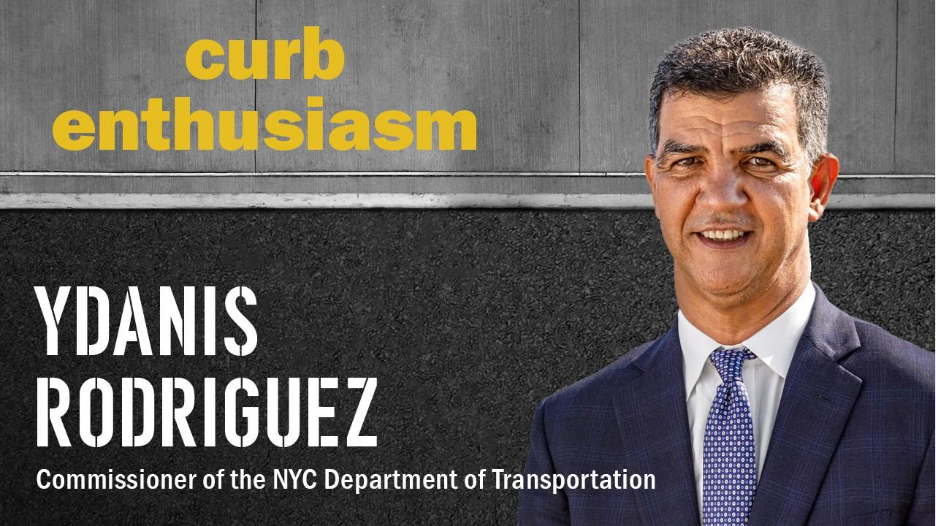
Curb Enthusiasm is available on Spotify, Apple Podcasts, YouTube, Amazon Music, BuzzSprout and other major streaming platforms. More information is available at nyc.gov/CurbEnthusiasm.
About Ydanis Rodriguez
Ydanis Rodriguez was appointed Commissioner of the New York City Department of Transportation in December 2021 by Mayor Eric Adams – and began serving in the position on January 1, 2022. As NYC DOT Commissioner, Rodriguez oversees nearly 6,000 employees, an annual operating budget of $1.4 billion, and a 10-year capital budget of $33 billion. Rodriguez is the first Latino and only the second person of color to serve in the position.
In his tenure as commissioner, Rodriguez has led several major initiatives, including the Adams Administration’s plan to increase investment in the Streets Master Plan by nearly $1 billion as well as NYC DOT’s pledge to redesign 1,000 intersections citywide. In 2022, he also led the successful administration effort to strengthen state law to allow NYC DOT’s speed-cameras to operate 24/7.
Previously, Commissioner Rodriguez served in the New York City Council, representing the 10th District that includes the neighborhoods of Washington Heights, Inwood and Marble Hill. First elected in 2009, he became a member of the Council’s Transportation Committee, which he then chaired from 2014 through 2021. As chair, Rodriguez led oversight of transportation agencies, spearheading the fight for improvements in mass transit and sustainable transportation – including expanded bus and bicycle lanes and the growth of bike share.
Prior to elected office, Commissioner Rodriguez taught in New York City public schools for more than fifteen years. As a teacher, he co-founded two schools: Gregorio Luperon High School, which supports newly arrived immigrants from Latin America transitioning to the American educational system, as well as the Community Health Academy of the Heights, a school that serves 6th through 12th grades.
Born in the Dominican Republic, Rodriguez arrived in New York City in 1983 at the age of 18. Like most immigrants who come to America to pursue their dreams, he worked tirelessly — including as a livery cab driver — to put himself through City College of the City University of New York, where he earned both bachelor’s and master’s degrees.
About Emily Weidenhof, Episode Co-Host
Emily Weidenhof is assistant commissioner of public realm at NYC DOT. Emily works closely with community organizations throughout the five boroughs to transform their streets as public space. For over a decade, she has focused on strengthening communities through the creation of plazas and shared streets and retooling the curb lane for innovative programming. She’s also played an integral role in NYC DOT’s Broadway Vision Plan, which employs a range of tools to reimagine the famed Manhattan corridor from Union Square to Columbus Circle, which now prioritizes pedestrians and cyclists. Emily has worked as an architect and urban designer in Pennsylvania, New Jersey, and New York, including at the NYC Department of City Planning.
Emily received her bachelor’s degree in architecture from Pennsylvania State University and her master’s degree in architecture and urban design from Columbia University.
About Ryan Lynch, Episode Co-Host
Ryan Lynch serves as the Chief of Staff to Commissioner Ydanis Rodriguez, overseeing executive operations. Before joining NYC DOT, he served as the deputy chief of staff for operations for Mayor Eric Adams, and chief of staff to then Borough President Adams.
Before joining government, Mr. Lynch served as the Associate Director for the Tri-State Transportation Campaign. He began his career as a Peace Corps volunteer in Burkina Faso, and also served as an Alternative Livelihoods Officer for Women’s Education for Advancement and Empowerment (WEAVE), a small, community-based organization working to support economic empowerment for Burmese refugees along the Thai-Burma border.
Mr. Lynch earned a bachelor’s degree in psychology from Mary Washington College, and a master’s degree in Urban and Regional Planning from the University of Wisconsin-Madison.
NYC DOT RELEASES LIMITED BATCH OF FIFTH AVENUE SIGNS HONORING THE ICONIC CORRIDOR KNOWN TO BE AT ITS MOST SPECTACULAR DURING HOLIDAY SEASON
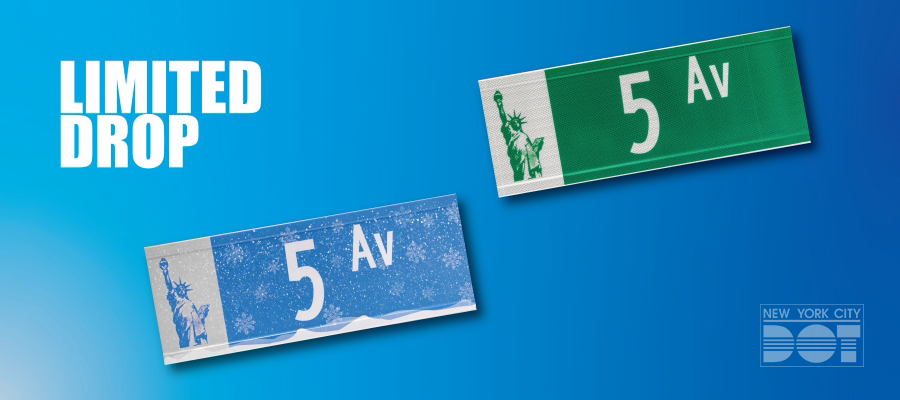
NEW YORK – New York City Department of Transportation (NYC DOT) Commissioner Ydanis Rodriguez today announced a limited number of authentic street signs honoring Manhattan’s iconic 6.2 mile-long Fifth Avenue, the home to many of New York City’s greatest museums, boutiques, landmarks, and buildings. Today’s release is part of the agency’s monthly ‘sign drops’, pulled from the wide range of hand-made signs from the NYC DOT Sign Shop, which produces over 70,000 signs each year.
“Fifth Avenue, from West 143rd Street in Harlem down to the heart of Greenwich Village at Washington Square Park, offers a stage to some of the greatest institutions, shopping districts, architecture, and neighborhoods in New York City,” said NYC DOT Commissioner Ydanis Rodriguez. “A corridor that was once a country road, featured bronze traffic towers in the 1920s, and has since seen multiple traffic configurations since, is now even partially fully pedestrianized during the holiday season.”
“Fifth Avenue truly captures the spirit of New York, especially during the holiday season when the lights, storefronts, and sidewalks feel like a celebration all of their own,” said DCAS Commissioner Louis A. Molina. “This sign drop captures that magic, turning one of the city’s most iconic corridors into a collectible. Through the CityStore, DCAS is excited to help New Yorkers take home a piece of the streets that define our city.”
Fifth Avenue was originally a country road in northern Manhattan in the 1820s, to later become residential, and eventually the stretch adjacent to Central Park would be known as Millionaire’s Row. It would eventually extend to 14th Street with the opening of NYU in 1837, and later to where it now terminates at Washington Square Park. Beginning in the late 1870s and thriving to this day, Fifth Avenue is widely regarded as one of the most notable shopping districts in the world, alongside Bond Street in London, Via Monteleone in Milan, and Avenue Montaigne in Paris. Aside from Rockefeller Center and the Annual Christmas Tree Lighting, Fifth Avenue is home to Museum Mile and its many institutions, St. Andrew’s Church in Harlem, St. Patrick’s Cathedral, Grand Army Plaza, the Plaza Hotel, the New York Public Library Main Branch, the Empire State Building, the Flatiron Building, and many other notable destinations. Fifth Avenue also runs within six historic districts.
The architecture and historic importance of so many structures along the corridor have resulted in various landmark status designations, including the National Register of Historic Places, The National Historic Landmarks program, The New York City Landmarks Preservation Commission, and World Heritage Sites. Fifth Avenue has been home for decades to many famous annual parades, and beginning in 2022 the Adams Administration launched Holiday Open Streets along the avenue from 57th to 48th streets, closing this section to vehicular traffic for selected dates and times each December. The Adams Administration and the Future of Fifth Avenue Partnership also announced last year plans to redesign Fifth Avenue between Central Park and Bryant Park into a world-class boulevard.
The corridor has of course been features in pop culture and several movies, including Annie, Elf, Home Alone 2: Lost in New York, The Devil Wears Prada, and The Wolf of Wall Street. The Plaza Hotel also famously hosted The Beatles during their 1964 world tour, and Truman Capote’s 1966 Black and White Ball. It also helpfully serves as the dividing line between “East” and “West” street addresses in Manhattan along its entire 6.2 mile stretch.
A limited release of 50 signs will be sold online for $100 each and are available one per customer. All signs will be sold via the CityStore, the Official Store of the City of New York, and proceeds will benefit the city’s general fund. This signage offers a bit of nostalgia and a literal piece of the city’s infrastructure.
Monthly sign drops from NYC DOT feature signs for iconic New York City streets, commemorations of famous New Yorkers, celebrations of special occasions, and other custom releases. NYC DOT began its monthly drops in June 2024, with the release of Christopher Street/Stonewall Place street signs to commemorate Pride Month.
Other recent sign drops include:
- Bleecker Street
- Mulberry Street
- Hip Hop Boulevard to celebrate the genre’s musical and cultural legacy
- Welcome to Queens: The World’s Borough
- Gay Street in recognition of Pride Month
- Wall Street
- Leaving Brooklyn: Fuhgeddaboudit
- East 161st Street and Shea Road in honor of baseball’s opening day
- Love Lane to recognize Valentine’s Day
- Broadway in celebration of Broadway Week
- Cornelia Street to honor the street’s prominence among pop music fans
About the NYC DOT Sign Shop
The New York City DOT Sign Shop is in Maspeth, Queens and manufactures over 70,000 signs each year. A team of 32 Sign Shop employees hand-make street signs, highway signs, directional signs, parking signs, and more. There are about one million NYC DOT signs in use across the 6,000 miles of streets in New York City.
The monthly sign drops are the latest iteration of sales that have historically been available from the Sign Shop
About the CityStore
CityStore is the Official store of the City of New York. CityStore is operated by the New York City Department of Citywide Administrative Services. 100% of sales benefit the City of New York.
CityStore is similar to a museum store, which complements the museum by highlighting the treasures within while serving as a stand-alone retail entity for wonderful gifts, collectables and research materials. A museum store is a revenue source for the museum and reinforces and protects the integrity of the museum brand. CityStore is the ‘museum store’ for the entire City of New York.
NYC DOT CELEBRATES FOUR YEARS OF HISTORIC PROGRESS REIMAGINING NEW YORK CITY STREETS FOR A SAFER, MORE SUSTAINABLE CITY
Traffic Deaths Reach Historic Lows as NYC DOT Installed Record Protected Bike Lanes, Pedestrian Space, and Intersection Improvements
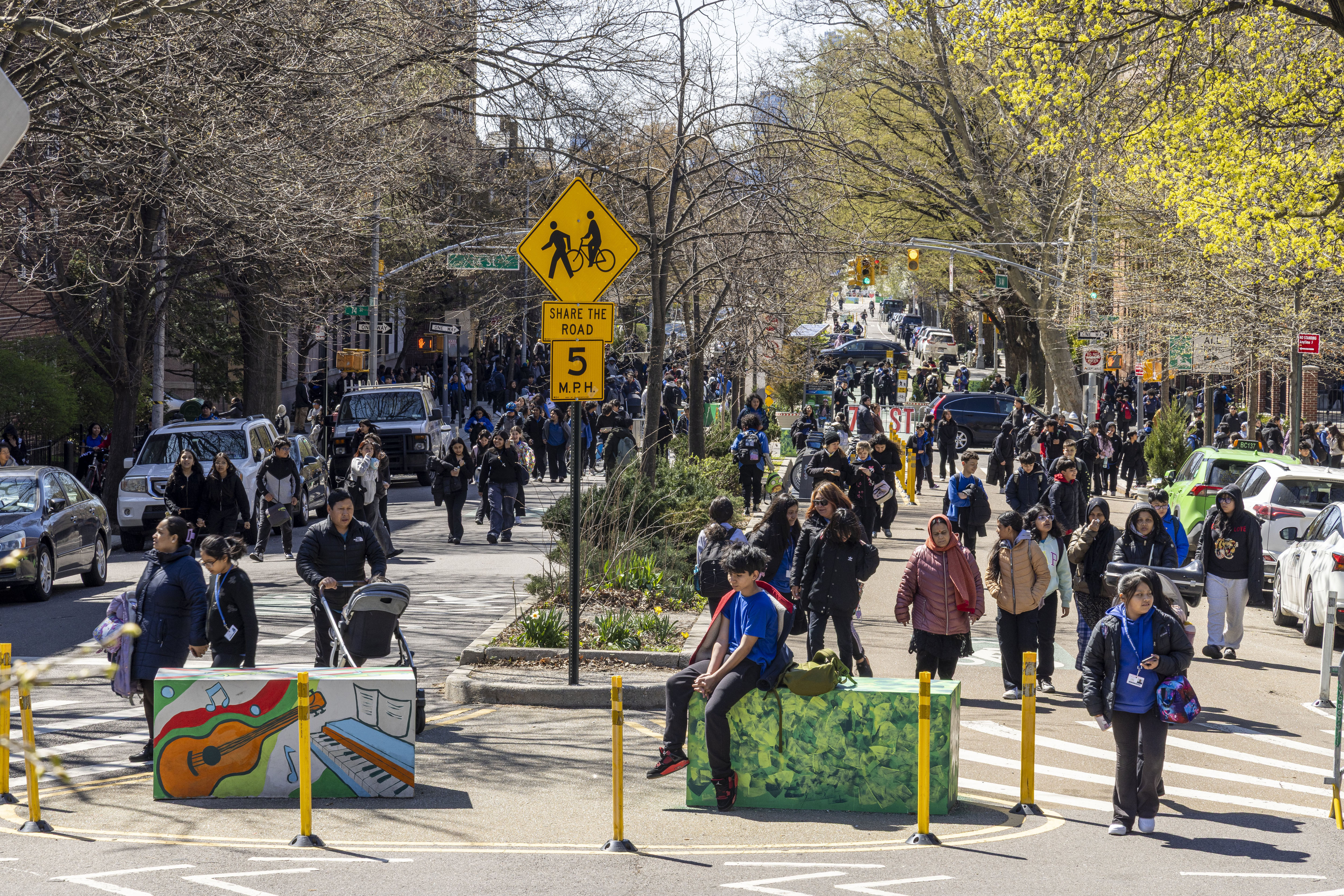
School dismissal on the 34th Avenue Open Street in Jackson Heights, Queens. Credit: NYC DOT
NEW YORK – New York City Department of Transportation (NYC DOT) Commissioner Ydanis Rodriguez today celebrated four years of record accomplishments to reimagine New York City streets and create a safer, more sustainable city. NYC DOT properties, including streets, account for roughly 27 percent of all land in New York City and the agency has prioritized its use for greater safety, growing the city’s economy as it emerged from the pandemic, and better accommodating all road users.
“We took office with a simple promise: to ‘Get Stuff Done,’ and, four years later, our administration can say that we delivered on that promise every day for working-class New Yorkers,” said New York City Mayor Eric Adams. “We drove shootings to record lows and pushed jobs and small businesses to record highs. We rewrote the playbook on homelessness and mental health to finally get New Yorkers living on our streets the help they need, and, after decades of half-measures, passed historic housing legislation to turn New York into a ‘City of Yes.’ We overhauled the way our students learn to read and do math, cut the cost of child care, and forgave medical debt. We eliminated taxes for low-income families, launched free universal after-school programming, and consistently decreased traffic deaths to historic lows, with this year having overall traffic fatalities at near record lows. We got scaffolding off our buildings, trash bags off our streets, and opened up new public spaces for New Yorkers to enjoy. The haters may have doubted us, but the results are clear. On issue after issue, we brought common-sense leadership to create a safer, more affordable city, and our work has changed our city for the better; it will stand the test of time because we made New York City the best place to live and raise a family.”
“Over the last four years, NYC DOT has advanced a comprehensive, equity-focused strategy built on data to improve safety, expand mobility, and to prioritize streets that serve a range of public needs that go beyond the movement and storage of private vehicles,” said NYC DOT Commissioner Ydanis Rodriguez. “We have made historic progress designing streets for the New York City of 2050, not 1950, with a record number of protected bike lanes, a record amount of new pedestrian space, and a record number of intersection safety improvements.”
EXPANDING MOBILITY AND INCREASING SAFETY
Over the last four years, NYC DOT has advanced a comprehensive, data-driven, and equity-focused strategy to expand mobility, improve safety, and deliver on its Vision Zero commitments.
- Historic declines in traffic deaths: Traffic deaths, which once exceeded 1,000 annually in the early 20th century, have declined to historic lows over the past four years. One death is one too many, and that is why the agency has – and will continue – to work with urgency to make our streets safer. By 2023, New York City recorded the lowest number of pedestrian deaths in history, and overall traffic fatalities have remained near record lows through 2025.
- All-time high bike lanes: Over the past four years, the agency installed a record number of protected bike lanes, enhanced a record number of bike lanes that lacked protection, widened and upgraded bike lanes along major Manhattan streets, and introduced new bike lanes in underserved areas such as Soundview, East New York, and long-requested routes like Sixth and Third avenues in Manhattan.
- Supporting congestion pricing: NYC DOT provided critical modeling, design, and policy analysis while securing $125 million in environmental justice investments. Transit improvements continued citywide, with new dedicated bus lanes on 96th Street, Livingston Street, Hillside Avenue, Northern Boulevard, and a major new Flatbush Avenue corridor.
- Expanded automated enforcement: NYC DOT secured an unprecedented expansion of automated enforcement through 24/7 speed cameras and the quadrupling of red-light cameras, contributing to major reductions in dangerous driving.
- Sammy’s Law: The agency also succeeded in passing Sammy’s Law to allow New York City to better control speed limits on its own streets after nearly 10-years of advocacy from New York City and advocates.
- Historic Greenway Expansion: NYC DOT secured a $7.25 million U.S. Department of Transportation (USDOT) Rebuilding American Infrastructure with Sustainability and Equity (RAISE) grant which has begun to lay the foundation for an historic greenway expansion across the five boroughs through the launch of the Greater Greenways plan, with implementation already underway in the Bronx’s Harlem river greenway.
REIMAGINING STREETS AND THE PUBLIC REALM
Over the past four years, NYC DOT reshaped the public realm at an unprecedented
scale, opening streets to people, culture, and community life.
- Summer Streets: For the first time since its inception in 2008, NYC DOT delivered a massive expansion from a Manhattan-only route to a 22-mile, five-borough program, drawing record participation.
- Signature event creation: For the first time ever, NYC DOT expanded Car-Free Earth Day citywide, established Trick or Streets, Día de Muertos programming, and the Fifth Avenue Holiday Open Street—growing into beloved traditions drawing millions while also inspiring other cities across the United States to enact similar programs.
- Permanent Outdoor Dining: NYC DOT institutionalized the pandemic-era success of outdoor dining by launching Dining Out NYC, now the nation’s largest outdoor dining program with nearly 3,000 outdoor dining setups across the city, nearly three times the size of the pre-pandemic outdoor dining program.
- Accessibility: Launched a 10-year plan to install seating at every bus stop in the city, invested $600 million in ADA-accessible curb ramps, installed 3,000 accessible pedestrian signals, and expanded the number of raised crosswalks that improve safety and make it easier to navigate New York City.
- Public Art: NYC DOT oversaw more than 150 new temporary installations—a 15 percent increase—plus nearly 275,000 square feet of asphalt art and a major restoration of a permanent artwork.
- Bridges for People: NYC DOT completed the long-awaited pedestrianization of the Queensboro Bridge South Outer Roadway, creating dedicated pedestrian and cycling paths to meet surging demand; added bike and bus lanes to the Washington Bridge connecting the Bronx to Manhattan; and improved biking conditions on the Roosevelt Bridge by covering the steel roadbed with rubber matting.
- Deliveries: A suite of pioneering freight-movement reforms—Smart Curbs, microhubs, LockerNYC, Blue Highways, e-cargo bike legalization, and an overnight truck-parking pilot—further advanced a safer, more sustainable streetscape and worked to address last-mile challenges that increased as a result of the COVID-19 pandemic.
INFRASTRUCTURE AND ASSET MANAGEMENT
NYC DOT delivered major capital, operational, and technological advancements.
- Bridge rehabilitation: NYC DOT completed an historic $300 million restoration of the Brooklyn Bridge and opened newly revitalized public space at the Manhattan gateway of the Brooklyn Bridge. The agency also reconstructed key bridges citywide, including by redecking the Queensboro Bridge’s upper roadway, building a new Unionport Bridge in the Bronx, and through the use of in-house crews, redecking the wooden Ocean Avenue pedestrian bridge over Sheepshead Bay.
- Weigh-in-Motion: The agency pioneered weigh-in-motion truck weight limit enforcement, reducing the number of overweight vehicles on the Queensbound Brooklyn Queens Expressway by 60 percent and working with partners in Albany to expand the use of this technology to protect aging infrastructure across the state.
- Roadways: The agency resurfaced more than 1,150 lane miles annually and repaired over 600,000 potholes. Streets are smoother and safer, with pothole repair response times cut nearly in half.
- Sustainability: NYC DOT piloted an asphalt mix with 50 percent recycled content and converted the entire Staten Island Ferry fleet to renewable diesel, five years ahead of schedule.
- Ferries: Three new Ollis-class ferries entered service as part of a massive upgrade to the ferry fleet, while the entire fleet of vessels transitioned to renewable diesel boosting. resilience. A breakthrough labor agreement ended a 13-year impasse and eliminated crew-related service gaps.
ADVANCING EQUITY, WORKFORCE DIVERSITY AND ORGANIZATIONAL EXCELLENCE
Equity has become a defining principle of NYC DOT’s operations, investments, and culture.
- Public Space for All: The Public Space Equity Program expanded plazas and Open Streets in underserved neighborhoods, while the first major restoration of Sixth Avenue’s medallions honored the City’s immigrant communities and the legacy they have left on New York City.
- M/WBE contracting: NYC DOT M/WBE contracting grew from 11 percent to 37 percent of agency contracting dollars, benefiting more than 400 minority and women-owned businesses with over $400 million in awards.
- MEBA Contract: The city reached an agreement with 94 percent support with the Marine Engineers’ Beneficial Association (MEBA), the union representing Staten Island Ferry licensed officers. This was the first one the city had reached with the union since 2010 and led to a 100 percent reduction in missed ferry trips due to crew shortages.
- Safety projects: NYC DOT’s data shows that the lowest income communities now receive the highest rate of safety improvements per mile—and are experiencing the largest decline in pedestrian fatalities.
- Citi Bike and e-scooter share expansion: deeply into historically underserved areas, improving mobility and access. Finally, NYC DOT embedded inclusive planning into major regional initiatives—including transformative work on the Cross Bronx and Brooklyn Queens Expressways—ensuring that future infrastructure reflects the voices and needs of all New Yorkers.
WATERWAYS ARE THE NEW HIGHWAYS: NEW YORK CITY BEGINS MOVING FREIGHT THROUGH WATERWAYS AS PART OF ITS HISTORIC BLUE HIGHWAYS PILOT PROGRAM
City Activates Manhattan’s Pier 79 as First Location to Receive Small Commercial Freight Deliveries by Boat through Pilot Program
Goods, Including Cosmetics, Fashion, and Household Items Will be Transferred from NY Waterway Ferry Vessel to DutchX Electric Cargo Bikes for Local Delivery
Pilot Program will Shift Freight from Roadways to Waterways, Easing Truck Congestion, Pollution
NEW YORK – New York City Department of Transportation (NYC DOT) Commissioner Ydanis Rodriguez, New York City Economic Development Corporation (NYCEDC) President Andrew Kimball, NY Waterway, and DutchX announced the activation of a marine freight pilot between Manhattan’s Pier 79 and the Brooklyn Marine Terminal (BMT) as part of New York City’s Blue Highways program. Blue Highways activates the city’s waterways for local and regional movement of goods—improving quality of life for New Yorkers by reducing congestion on roadways, adding resiliency to the city’s supply chain, and tapping into New York’s roots as a port city. This effort builds on the recent passage of the historic Vision Plan approved by the BMT Task Force in September to transform the site into a modern, 21st century all electric maritime port and vibrant, mixed-use community. NYCDOT is working to develop similar freight models for three other piers in coordination with NYCEDC. With nearly 90 percent of goods moving into and through the city by truck, the City of New York ‘s Blue Highways program is part of NYC DOT ‘s efforts to reimagine freight delivery in New York City, restructure freight distribution, and create a sustainable last-mile delivery system for getting goods where they need to go.
“Waterways are the new highways in New York City! New York’s waterways built this city—now they’re helping us create a cleaner, safer, and smarter way to deliver the goods New Yorkers rely on,” said NYC DOT Commissioner Ydanis Rodriguez. “Blue Highways is how we shift from a 20th century freight system to a 21st century one, and when we move goods by water and deliver them by sustainable modes of transportation like cargo bikes, everyone wins—our streets, our air, and our neighborhoods.”
“New York City was built on its waterways and, through the Blue Highways program, we’re taking advantage of them once again,” said NYCEDC President & CEO Andrew Kimball. “This pilot is perfect example of how New York City can leverage New York Harbor to move freight quickly and efficiently, all while unclogging city streets and reducing pollution caused by truck traffic. We’re excited to work with our public and private partners and communities across the five boroughs as we continue to this strategic, and transformational shift of goods from our roadways to our waterways.”
“Ferries are the most effective and environmentally friendly way to transport commuters into and out of Manhattan. We are excited to partner with DutchX, NYC DOT and NYCEDC on the Blue Highways Program to show why they are ideal for freight transportation, as well,” said NY Waterway President and CEO Armand Pohan. “Our city’s waterways are key to getting trucks off Manhattan streets while getting freight delivered more quickly and efficiently than ever before.”
“I came to New York from Amsterdam twenty years ago, a city shaped by its waterways, so I’ve always believed this city could do more with its own,” says Marcus Hoed, Co-Founder of DutchX. “In collaboration with NYC DOT, NYC EDC, and NY Waterway, DutchX has carefully prepared Blue Highways with a clear vision for a smarter way to move parcels through the city. By using the waterways as the new middle mile and completing the last mile with electric vehicles, we are creating a cleaner and more efficient path to the end-customer. Launching service from Atlantic Basin to Pier 79 shows what becomes possible when the waterways support the final stages of the supply chain. It proves that better options exist, and it is only the beginning of what this system will unlock.”
“Regional Plan Association (RPA) is proud to support the City’s activation of Manhattan’s Pier 79 for the first boat-based freight delivery hub as part of the Blue Highways Program. New York City has 520 miles of waterfront and a deep history of moving people and goods by water,” said Tiffany-Ann Taylor, vice president for transportation, RPA. “With the Vehicle Miles Traveled (VMT) reduction mandate amidst the escalating climate crisis and demands on our roadways, the City should encourage transporting more goods via our waterways. Through this collaboration between NYC DOT and NYCEDC, businesses of all sizes can work towards faster delivery times yet a lighter carbon footprint. Expanding the Blue Highways system is a regional win. We support the City’s efforts to restructure freight distribution and look forward to continued collaboration in this space.”
The route launched today runs from Atlantic Basin in Red Hook to Pier 79. The pilot route was tested extensively by NY Waterway and DutchX. DutchX will begin transporting 300 to 400 parcels per day from a ferry onto five electric pedal-assist cargo bikes — with operations to gradually increase as the program progresses. The goods transported include cosmetics, fashion, lifestyle, and small household products. They will be delivered from Pier 79 to a Manhattan service area spanning from 23rd Street to 70th Street. The city will monitor the success of this pilot route, and gather data on frequency, capacity, and vehicle miles traveled (VMT) reduction. NYC DOT is working to develop similar freight models for three other piers: Pier 11, 34th Street Pier, and the Battery Maritime Building in coordination with NYCEDC.
Beginning in 2021, the city conducted a series of test-runs with landings in Weehawken, Manhattan’s West Side, Red Hook, Manhattan’s East Side, Bayonne, and Hunts Point. Today’s announcement follows the success of a proof-of-concept seasonal pilot between Red Hook and Governor’s Island run by Empire Clean Cities.
About Blue Highways
With freight volumes projected to grow by 46 percent through 2055, congestion and emissions from truck traffic pose increasing challenges to New York City’s quality of life and infrastructure. Each day, more than 44,000 trucks cross critical chokepoints like the George Washington and Verrazano Bridges, leading to congestion and delays costing the city an estimated $20 billion annually in lost productivity, increased maintenance, and environmental impacts.
Blue Highways proposes a strategic shift: moving a significant portion of freight deliveries off crowded streets and onto the city’s navigable waterways, taking advantage of its 520 miles of waterfront with last mile microdelivery by commercial cargo bike. By leveraging publicly controlled waterfront assets, partnering with private industry, and investing in supportive infrastructure for last mile microdeliveries, the initiative aims to reduce congestion, pollution, and roadway wear – while catalyzing economic growth and job creation.
During this administration, progress on the Blue Highways program has accelerated rapidly. In the past two years, more tangible steps to advance maritime freight have been taken than in the previous two decades, including the creation of pilot routes using existing City assets, and NYCEDC’s announcement of a new Hunts Point Marine Terminal, a micro-freight facility at Downtown Skyport, as well as the recently approved and historic Brooklyn Marine Terminal (BMT) redevelopment project, which will transform BMT into a fully electric, modern maritime port and vibrant mixed-use community. Additionally, NYC DOT and NYCEDC’s Blue Highways Action Plan, released in October 2025, is a comprehensive report that lays out a clear agenda to build on these recent successes to revive short sea shipping and maritime freight movement throughout New York City waterways:
- Comprehensive analysis of the three service lines of the Blue Highways program – microfreight, containerized freight, and bulk freight – as well as the vessels and infrastructure required to operationalize them.
- Mapping and assessment of 25+ Blue Highways “opportunity sites” for activation, ranging from old piers to ferry landings to container terminals, matching site characteristics to potential services.
- Tangible maritime infrastructure projects for short-term, medium-term, and long-term activation.
- Engagement with industry partners such as DutchX, U.S. Coastal Service, and Sixth Borough Marine, who are investing in new vessels, logistics hubs, and innovative delivery models.
- Creation of a Blue Highways Advisory Council in early 2026, ensuring continued dialogue and collaboration between public and private stakeholders.
Efforts like the DutchX and NY Waterway pilot also capitalizes on numerous freight reform efforts undertaken by the NYC DOT, including:
- Curb Management Action Plan: Demand for curb space in New York City – from trash collection and bike lanes to truck loading and parking – is increasing and NYC DOT is responding to address these new demands. ‘Smart Curbs,’ ‘Microhubs’ and the broader Curb Management Action Plan, released in September 2023, are efforts to address the dynamic community needs of today while better preparing the city’s streets for the future. These efforts build on the core tenets of the ‘New’ New York panel’s action plan, which identified public space as a key force for the city ‘s economic recovery. As part of the Curb Management Action Plan, NYC DOT launched the ‘Smart Curbs’ program on the Upper West Side in 2024 to implement and evaluates new treatments and regulations to improve safety, reduce congestion, create vibrant and clean public spaces, support orderly local deliveries, and more.
- Cargo Bike Rulemaking: In March 2024, the agency authorized the use of e-cargo bikes on city streets to make deliveries safer and more sustainable. Since the inception of the cargo bike pilot program, the use of commercial cargo bikes for deliveries has grown at least seven-fold with an expectation for continued expansion with the City’s support.
- Off-Hour Delivery Program: In August 2024, NYC DOT launched applications for its Off-Hour Deliveries (OHD) incentive program to encourage goods delivery during the off-peak hours of 7 p.m. and 6 a.m. in efforts to decrease congestion, double parking, and truck emissions. One-time monetary reimbursements will help businesses make the switch to off-peak deliveries. For more information visit nyc.gov/ohd.
- Microhubs: In April of this year, NYC DOT also launched the first pilot locations for the ‘Microhubs’ program that established safe, dedicated spaces for truck operators to transfer deliveries onto safer and more sustainable modes of transportation for the last leg of delivery, including e-cargo bikes, handcarts, and smaller electric sprinter vans.
- LockerNYC: In September 2025, the agency expanded its secure public delivery locker pilot to reduce truck traffic and cut down package theft, adding six new Go Locker locations as part of the LockerNYC program.
“As e-commerce deliveries and freight volumes increase, Blue Highways can help make our city greener. By shifting freight from crowded streets to local piers, the City has the opportunity to minimize dangerous truck traffic, decrease congestion, improve air quality, and make our streets safer for all,” said Manhattan Borough President Mark Levine. “I am excited about this pilot and look forward to the potential to expand it to other waterfront areas of New York City.”
“Freight delivery is a major economic engine, but it’s one that clogs our roads with too many vehicles and warms our planet with greenhouse gas emissions. Shifting freight transportation from roadways to waterways will at once ease congestion while reducing toxic air pollution, especially for environmental justice communities that have been negatively impacted the most by last mile facilities,” said Alia Soomro, deputy director of NYC Policy for the New York League of Conservation Voters. “NYLCV applauds DOT Commissioner Ydanis Rodriguez and EDC President Andrew Kimball on the activation of Pier 79 as the part of New York’s Blue Highway and for their ongoing commitment to creating a healthier, more sustainable New York City.”
Banner Image: Open Streets at 34th Avenue in Queens. Image Credit – NYC DOT
NYC DOT


The New York City Department of Transportation’s (NYC DOT) mission is to provide for the safe, efficient, and environmentally responsible movement of people and goods in the City of New York and to maintain and enhance the transportation infrastructure crucial to the economic vitality and quality of life of our primary customers, City residents.