

For several years, a specific type of signage has become a familiar fixture at retail registers across New York. These placards are primarily designed to protect the public from external scammers—criminals who use social engineering to coerce unsuspecting customers into sending gift cards as payment for fabricated debts or government fines.
These existing interventions have been successful because they meet the individual at the exact moment of risk, providing a necessary pause for reflection before an irreversible financial mistake occurs. While these signs focus on the “outbound” threat of money being sent to a criminal, they have established a powerful precedent: the retail counter is a highly effective place to share vital legal and financial information that the public might not otherwise encounter.
There is a significant opportunity to apply this same logic to the “inbound” side of the gift card economy, specifically regarding how some businesses choose to compensate their staff. In certain illicit sectors, employers have moved away from traditional payroll to distribute wages via retail gift cards.
This practice creates a “shadow payroll” that bypasses the legal requirements of New York State Labor Law § 192, which mandates that wages be paid in negotiable currency like cash or check. By paying in store credit, an employer essentially traps a worker’s liquidity and avoids the contributions required for a stable social safety net, including unemployment and workers’ compensation.
The 2026 Enforcement Climate: A Convergence of Risk
The urgency of this proposal is driven by a fundamental shift in both state and federal enforcement. The landscape in 2026 is no longer one of mere civil fines; it is one of criminal financial scrutiny and significantly higher financial stakes.
- Federal “Funding Source” Crackdown: A major development in the 2026 National Money Laundering Risk Assessment is the Department of the Treasury’s focus on gift cards as a high-risk vector for laundering. Federal prosecutors have moved toward investigating the “funding source.” This means that the act of a business owner purchasing high volumes of gift cards for payroll is now being scrutinized for federal financial crimes under 18 U.S.C. § 1956. By bypassing traditional banking, these businesses trigger anti-money laundering (AML) violations that carry much more severe penalties than standard labor violations.
- The 2026 Wage Thresholds: As of January 1, 2026, the minimum wage in New York City, Long Island, and Westchester has risen to $17.00 per hour. Furthermore, the salary threshold for overtime-exempt employees has increased to $1,275 per week ($66,300 annually). These increases provide a massive financial incentive for illicit businesses to “hide” their payroll in untraceable retail credit, making at-register deterrence a necessary intervention to protect the tax base.
- The “Trapped at Work” Act (Article 37): Enacted in late 2025 and moving into full enforcement, this law targets “employment promissory notes” and predatory conditions that lock workers into their jobs. Paying in gift cards is now viewed as a violation of this act’s spirit, as it prevents workers from accumulating the liquid capital needed for true financial independence. While the Act is enforced by the Labor Commissioner, violations can carry civil penalties of $1,000 to $5,000 per violation.
- The New York Gift Certificate Scam Prevention Act: This 2026 legislation requires retailers to maintain more rigorous record-keeping for gift card sales. This “digital paper trail” means that the regular, bulk purchase of cards by a single business entity is now much easier for state and federal investigators to track and audit.
Why At-Register Signage is the Logical Deterrent
We are proposing a humble, informative addition to the retail landscape that mirrors the existing anti-scam notices. By placing a clear sign at the register—the exact moment the employer is funding their payroll—the retailer removes the “shield of ignorance.” This “nudge” moves the act from a private misunderstanding to a public violation of both state labor law and federal financial standards.
It serves to gently inform the employer and subtly empower the employee who might be standing right there, realizing for the first time that their method of compensation is legally non-compliant. For the retailer, it is an effortless way to support a fair local economy and ensure they are not inadvertently facilitating federal financial crimes.
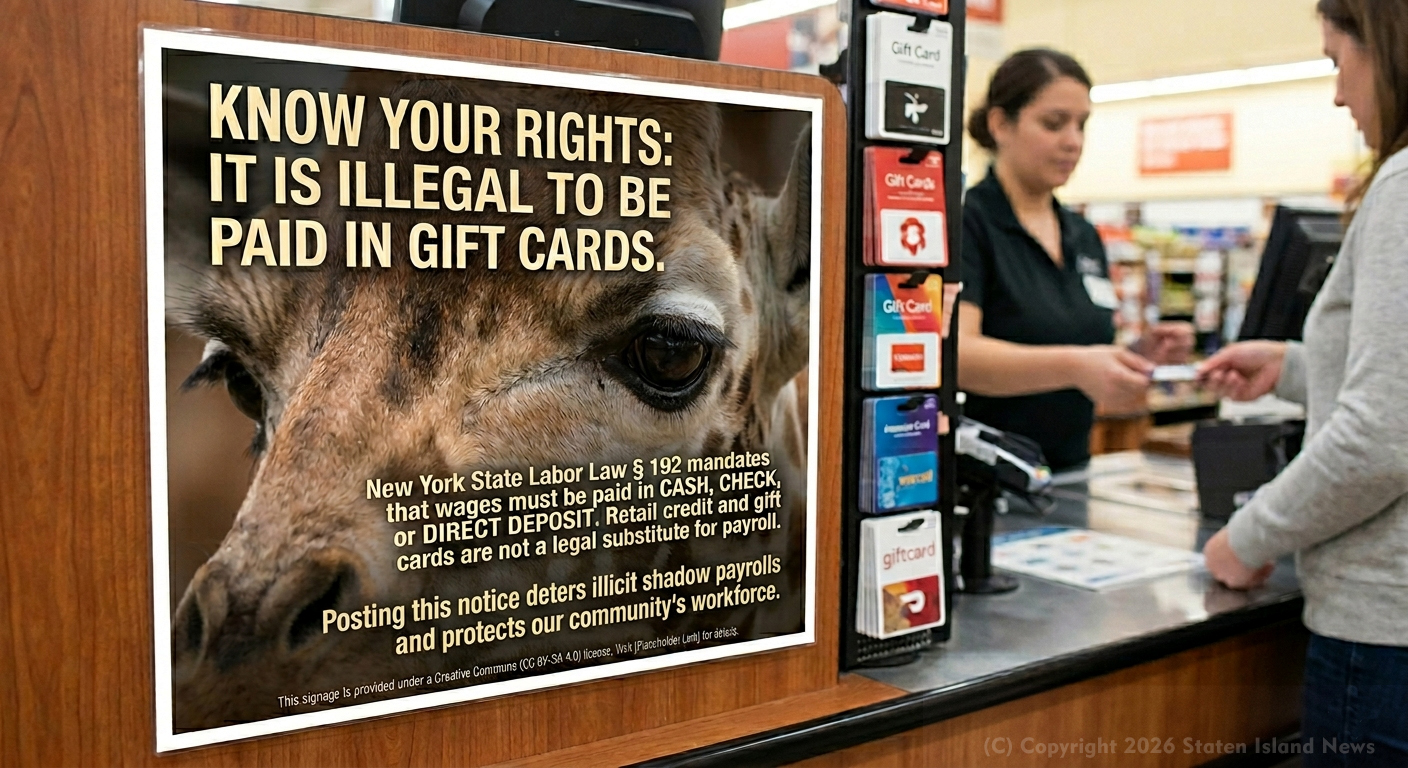
Payment in gift cards is illegal.
Creative Commons Signage Resource
To turn this proposal into reality, we are releasing the following signage design and text under a Creative Commons Attribution-ShareAlike 4.0 International (CC BY-SA 4.0) license. Any business, printer, or advocacy group is free to use, distribute, and display this notice.
[NOTICE FOR DISPLAY] ATTENTION: Under New York State Labor Law § 192, all wages must be paid in cash, check, or direct deposit. It is a violation of law to compensate employees with gift cards. Please be aware that gift cards are not a legal substitute for payroll and may be subject to federal investigation for shadow payroll and money laundering offenses.
Selected References
- New York State Labor Law §§ 191, 192, and Article 37. Provisions regarding wage payment methods and predatory employment notes.
- U.S. Department of the Treasury. (2026). National Money Laundering Risk Assessment.
- BakerHostetler. (2026). Preparing for the New Year: A Guide for New York Employers as We Enter 2026.
- Holland & Knight. (2026). New York Amends Trapped at Work Act.
- Thaler, R. H., & Sunstein, C. R. Nudge: Improving Decisions About Health, Wealth, and Happiness.
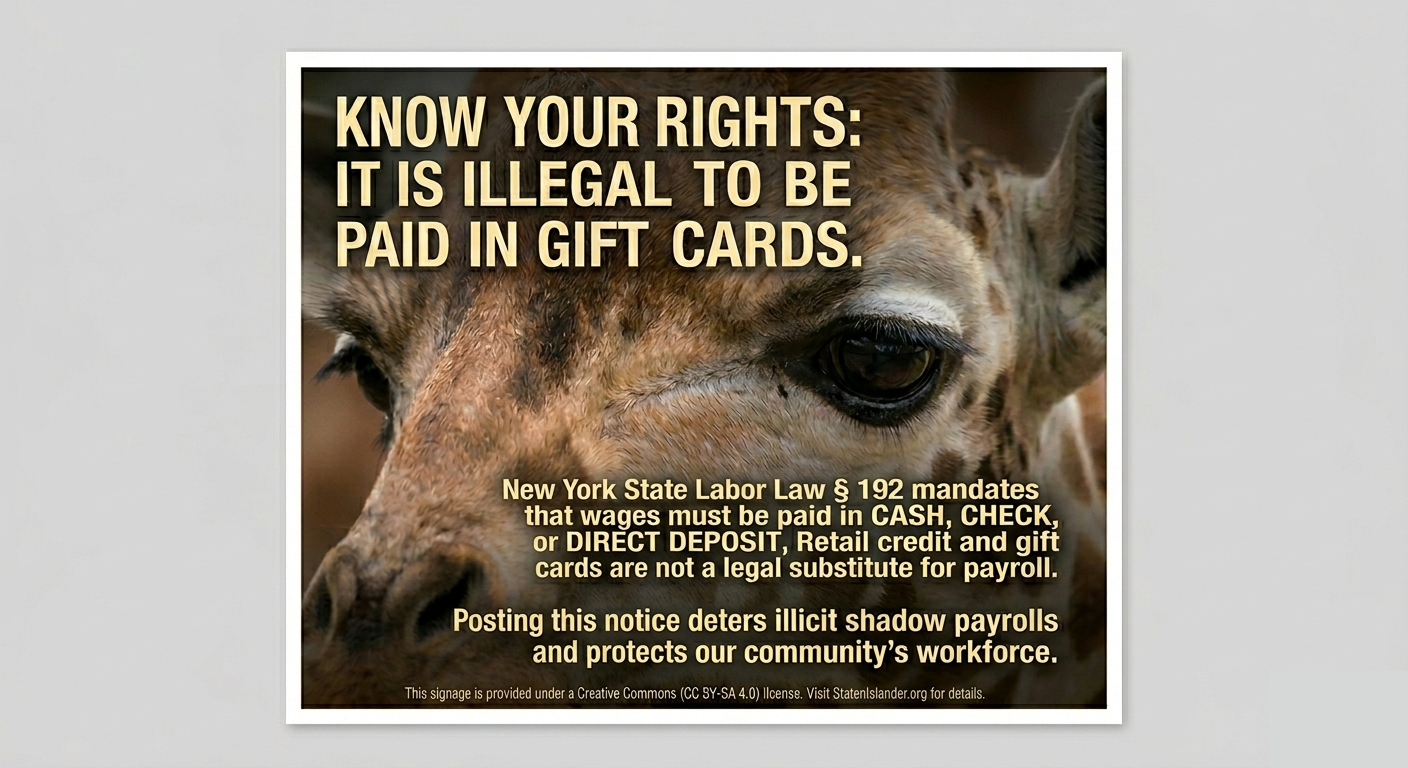
Payment in gift cards is illegal.
Banner Image: Payment in gift cards is illegal. Image Credit – Staten Island News
Staten Islander News Service Staff Writer


This byline indicates that this article was penned by a member/members of the Staten Islander News Organization office team. Our staff writers are the backbone of our newspaper, performing all sorts of important tasks like conducting interviews, investigating leads, besides writing the news stories you see.