Staten Island Ambulance Response Times Will Suffer Even More When Richmond County Medical Center Eliminates Their Hospital Ambulance Units Later This Year
Editor’s note: We previously covered this issue related to pay parity for FDNY EMS workers, who presently make only a small amount more to start than McDonald’s workers, and they often face housing insecurity and rely on SNAP to buy food due to an inability to afford to reside in the city in which they work due to low wages. Outgoing Mayor Adams had a final chance to fix this issue, but did not do so before leaving. Now it is up to the new mayor and City Council to finally resolve this issue that has been festering for decades. Unfortunately, the suffering is not limited to the workers themselves, as there are real consequences when ambuance response times climb to the higher teens and 20 minute-plus marks. More people will die when it could have been prevented. Many EMS workers, along with firefighters and police, live on Staten Island, so this affects many members of this community. Fixing this issue would also fix the response times, since it would allow them to attract and retain more workers, since these employees would then want to stay. As it is now, they will often have to find a second job in order to continue as an EMS workers, due to their inability to pay New York City level bills on such a low salary.
We asked the below questions of EMSPAC about this important issue, and the following are their responses:
EMSPAC is happy to provide clarity on behalf of EMSPAC. We encourage you to also address these questions to 1199SEIU, the union representing RUMC, and the hospital administration. [Staten Islander will reach out to these organizations, and this article will be updated with their responses]
1. What does the loss of units mean for Staten Islanders?
Any reduction in ambulance units, especially in a borough like Staten Island, has immediate, real-world consequences. When response times are already averaging around 18-23 minutes in some areas of the City, losing units means longer delays, more out-of-service gaps, and increased reliance on already overstretched crews. In cardiac arrest or respiratory failure, brain injury can begin within 4 to 6 minutes. This is not abstract. It directly increases the risk of preventable death and disability. The system becomes reactive instead of responsive. We are amid a managed collapse of the EMS system that very much did collapse in the Pandemic of 2020.
The risk is not limited to 2 EMS units cut at RUMC. It is signalling to other hospitals, such as Northwell SIUH, that ambulance units are a disposable resource. Northwell has cut 5 units in 2025 and plans to cut more. Maimonides, which currently provides 19 EMS units, was in such poor financial health that it was acquired by HHC. That deal is almost complete. NYP is planning to cut 6 units. Across the City hospitals are cutting ambulance units, and FDNY EMS lacks the ability to replace them.
That is because there is a total collapse of morale at the FDNY EMS. The latest solution of their powerless DC 37 union asking people to “not join the FDNY EMS” and claim “that 1,500 people are leaving this year.” They haven’t had a contract in 4 years.
2. What was different about private hospital-based EMS (for example, RUMC) versus FDNY EMS?
Hospitals like Richmond University Medical Center (RUMC) historically operated their own EMS units or contracted private providers. These systems often had more flexibility in staffing, offer better pay or different scheduling structures, and can deploy units more directly tied to hospital capacity. Transitioning to an exclusively FDNY-run system centralizes operations, but without adequate staffing and pay, it can reduce overall system flexibility. The issue is not public versus private. It is whether the whole system is adequately resourced. It is not. FDNY at its current staffing can only answer 60% of all 911 calls, and its unions are saying 1,500 people will be resigning or promoted to Fire in 2026. Of serious importance is that of the FDNY’s 2.6 billion budget, only 16% is used on EMS.
3. Staffing shortages and low pay. What can be done?
This is the core issue. FDNY EMS faces a recruitment and retention crisis driven by noncompetitive pay, burnout, and limited upward mobility. To fix this, the City must establish true pay parity with firefighters and other uniformed services, create retention incentives and career ladders, improve working conditions including shift structures and safety protections, and address cost-of-living disparities, especially housing. Without these changes, the workforce will continue to shrink.
4. What is EMSPAC asking the City Council to do?
We are actively advocating for legislation mandating pay parity for FDNY EMS, baseline staffing requirements to prevent unit brownouts, dedicated EMS funding streams to stabilize the system, and oversight hearings on response times and deployment gaps. We are pushing for immediate legislative action and budget commitments. We are also proposing legislation in the private and hospital-based EMS sectors to set wage minimums at $35/hr and mandate employers to provide 3 mental health days. We are asking for injunctions to prevent hospitals from withdrawing EMS units.
5. What can the State do?
The State of New York has a role in EMS funding, reimbursement rates, especially Medicaid, and workforce development. Increasing reimbursement rates for ambulance services would directly improve system sustainability. There has been growing awareness among state legislators, and we propose a microtax on alcohol, which is directly responsible for over 25% all 911 calls in NYC.
6. What is EMSPAC doing now, and how can constituents help?
We are organizing advocacy campaigns and public awareness efforts, meeting with City and State officials, and supporting EMS worker coalitions and unions. Constituents can help by calling and emailing their City Council members, contacting the Mayor’s office, attending hearings, supporting EMS-focused legislation, and amplifying these issues publicly. Public pressure drives political action.
7. Can the Mayor fix this, or does it require legislation?
Both. The Mayor has significant authority through the budget process and executive actions to improve conditions, including funding allocations and contract priorities. Lasting structural change, especially pay parity, likely requires City Council legislation. To date, mayoral action has been limited and insufficient given the scale of the crisis. To date, Mayor Mamdani has shown absolutely no interest in the ambulance crisis the city is facing. That is likely because the FDNY Unions endorsed his opponents and the majority of the EMS Service when it votes, votes Republican. EMS is, in general, a conservative-leaning workforce. 1199SEIU, which represents RUMC, Northwell SIUH, NYU, Assist, Jamaica, Flushing, Mt. Sinai, Wyckoff, and Maimonides, has not been aggressive enough in the defense of ambulance units. Its members enjoy some of the best benefits and wage scales of EMS in NYC.
8. What does it mean if RUMC becomes part of HHC?
If RUMC goes bankrupt and is then bailed out by joining NYC Health and Hospitals, it would become part of the City’s public hospital system. Potential benefits include greater financial stability, integration with the broader public health network, and expanded access to resources. However, there are concerns such as bureaucratic constraints, potential loss of local control, and no guarantee of improved EMS response unless staffing and funding issues are addressed system-wide. A merger alone will not solve EMS shortages. In such an event, all of the RUMC ambulance fleet likely would be laid off. Such is the current threat at Maimonides. There is no such configuration as a city hospital with private EMS staffing. The FDNY may make people offers but they will not be getting the wage scales they enjoy being under the 1199 League Contract.
9. Are EMS workers still facing extreme financial hardship?
Yes, many. While there have been incremental pay adjustments, they have not kept pace with inflation or the cost of living in New York City. Reports of EMS workers struggling to afford housing, including reliance on shelters, have been documented and reflect a deeper systemic failure. This situation has improved only marginally and remains unacceptable. Most EMS in the FDNY and the Private sector make around $20/hr. At locations represented by 1199SEIU, such as RUMC that rate is much higher. Usually $28 to $35/ hr. Paramedics make more in all locations and are in shorter supply.
10. On pay parity and mayoral inaction
You are correct that prior opportunities to address pay parity were not taken. This has compounded the current crisis. EMSPAC continues to push elected officials to act decisively rather than defer responsibility. As of now, there have been no actions or public statements by the Mayor identifying that he has a clear plan around EMS. As far as we understand, he does have a plan to utilize EMS in some version of the BHEARD mental health program, grouping EMTs with social workers, but this remains unclear. It is widely believed that the Mayor will see increased privatization of the EMS system at the expense of both Hospital and FDNY EMS jobs.
Below is the EMSPAC’s initial press release about this issue:
EMSPAC Raises Alarm Over Planned EMS Unit Cuts at Richmond University Medical Center
EMSPAC is expressing serious concern over reports that Richmond University Medical Center (RUMC) will discontinue two FDNY 911-participating EMS units, Advanced Life Support unit 22X and Basic Life Support unit 21B, effective July 26, 2026. If implemented, the reduction is expected to significantly decrease EMS coverage across Staten Island and increase emergency response times in multiple neighborhoods.
The ALS unit 22X currently serves a large portion of the North Shore, including West Brighton, Port Richmond, Westerleigh, Castleton Corners, and Mariners Harbor. Its removal would create a substantial gap in access to advanced, life-saving prehospital care.
The BLS unit 21B, which covers Clifton and the surrounding areas, has already experienced prior service reductions and has not been fully backfilled. Its full elimination is expected to deepen existing coverage gaps and leave residents with fewer emergency response options.
EMSPAC warns that these cuts are part of a broader trend of hospital-based EMS reductions across New York City, including similar reported changes within Northwell-affiliated EMS operations, which cut back 5 units last year: 1 in Staten Island, 1 in Queens, and 3 in Manhattan. The continued contraction of hospital-based 911 participation is expected to place additional strain on FDNY EMS, which is already facing staffing shortages, recruitment and retention challenges, and increasing system demand. Maimonides, which supplies 19 units to the 911 system, is about to become a City Hospital; the status of its EMS fleet is unclear. New York Presbyterian will be cutting 6 units across the city. There is a high probability that RUMC will also be sold to the HHC system, and all EMS units will be shut down this year.
The loss of both ALS and BLS resources will likely lead to longer response times, increased workload for remaining EMS personnel, and reduced system capacity during peak call volumes and large-scale emergencies. EMSPAC further notes growing concerns about the financial stability of some hospital-based EMS providers, raising questions about long-term impacts on public emergency care infrastructure.
EMSPAC is calling on the New York City Council and relevant oversight bodies to immediately review these planned reductions and take action to preserve 911 EMS unit coverage. Ensuring timely emergency response is a critical public safety priority, and any reduction in service capacity poses a direct risk to community health and safety.
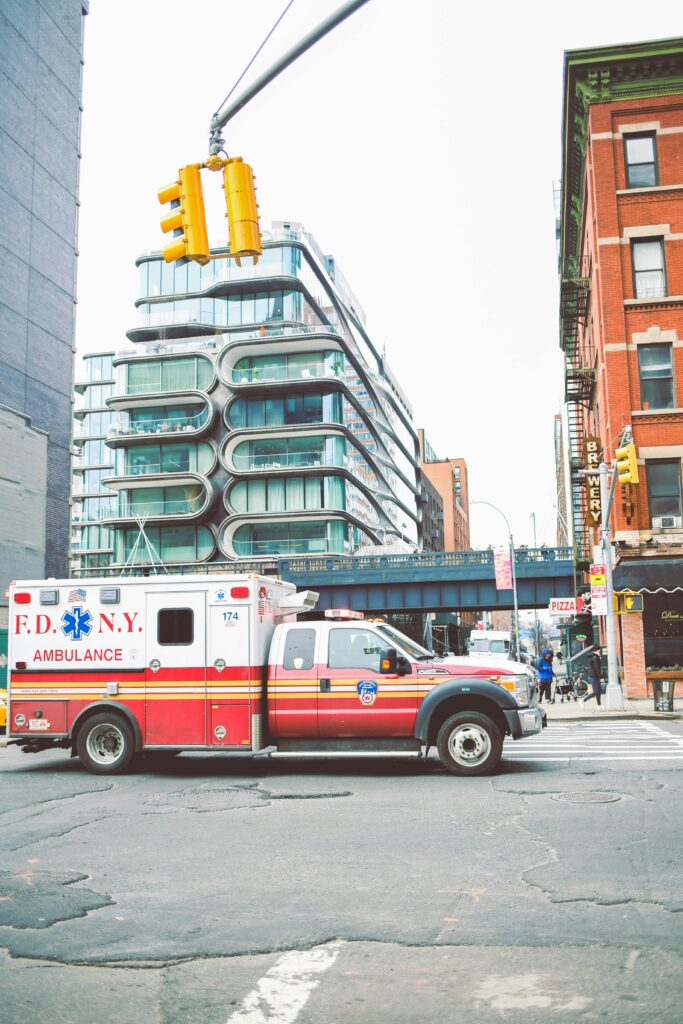
Banner Image: FDNY Ambulance on city street. Image Credit – Morgane Le Breton