

Staten Island’s Wagner College Holocaust Center To Plant Sapling Of Horse Chestnut Outside Anne Frank’s Window During WWII
Editor’s note: We previously covered Bayonne, NJ’s annual Holocaust Memorial program, which occured on April 13th. Following Wagner College’s statement and release below, you can see the information provided by Anne Frank Center USA about the sapling gift and their hope that it can inspire future generations:
And here is some additional information about this particular sapling and its history and future:
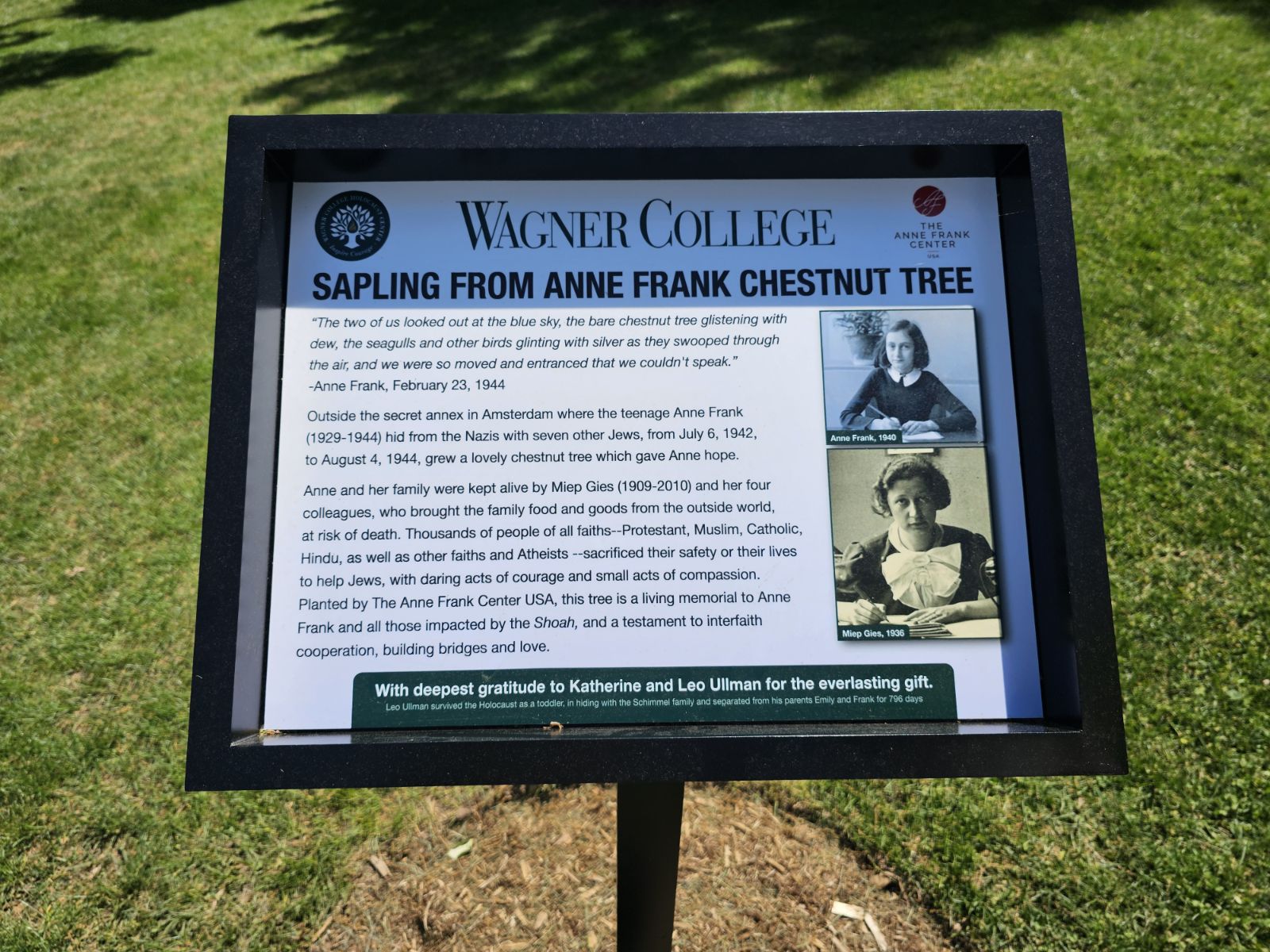
Plaque describing the sapling. Image Credit – Anne Frank Center USA
“SYMBOL OF HOPE”: ANNE FRANK TREE TO BE PLANTED AT WAGNER COLLEGE
On the morning of May 5, a sapling from the white chestnut tree that grew outside the annex where Anne Frank hid from the Nazis for two years will be planted at Wagner College.
The sapling, gifted to the Wagner College Holocaust Center (WCHC), will overlook the iconic Verrazzano Narrows Bridge, and will stand for all New Yorkers as an interfaith symbol of hope and courage in the face of persecution and indifference.
The Anne Frank Center USA has been sharing saplings from the beautiful chestnut tree with carefully selected organizations to form a living memorial to Anne Frank. The tree at Wagner College will be the third in New York City, joining ones at the United Nations Plaza and the 9/11 Liberty Park.
The gift comes thanks to Leo Ullman, a friend of the WCHC. Ullman was hidden as a toddler, apart from his parents, in Amsterdam, the same city as Anne Frank. His book “796 Days” tells the story of interfaith rescue and protection by “ordinary people doing extraordinary things.”
“I hope and believe that saplings of the Anne Frank tree will be as important over time as a photo of Anne Frank herself or a copy of her diary,” said Ullmann. “These are defining links to remembrance of the Holocaust and its millions of victims, but also its heroes like Miep Gies who saved Anne Frank’s diary and, in my case, members of the Dutch Resistance, who saved my life and that of many others”.
Beginning on July 6, 1942, Anne Frank hid along with her sister Margot, her parents, Otto and Edith, and four others in a small secret annex. They were kept alive by Gies and four colleagues who brought them food and necessities from the outside world, at risk to their own lives. On August 4, 1944 they were discovered and arrested by a group of Dutch police and Nazi officers and Anne was eventually deported to Auschwitz, and then to the concentration camp of Bergen-Belsen, where she died at the age of 15 of typhus. After the war, her father retrieved her diary, which has become one of the most famous pieces of writing in the world, translated into over 70 languages.
Anne wrote about the chestnut tree in several of her diary entries: “After our mild winter, we’ve been having a beautiful spring. April is glorious, not too hot and not too cold, with occasional light showers. Our chestnut tree is in leaf, and here and there you can already see a few small blossoms.” (April 18 1944)
The ceremony for the tree planting will include remarks by Barry Nieuwenhuijs, deputy consul general of the Netherlands, and numerous guests and dignitaries from Holocaust, Jewish and interfaith organizations in NYC, including Dr. Lauren Bairnsfather, CEO of the Anne Frank Center USA, Rabbi Rachael Houser of the Central Synagogue in Manhattan and a Wagner College alum, and Ullman.
The day will also feature performances by the P.S. 22 Chorus of Staten Island.
A light reception is planned, donated by Lore Baer, who was also hidden as a child in the Netherlands during World War II.
The event is organized by Drs. Laura Morowitz and Lori Weintrob, who curated the permanent Holocaust Education and Action Gallery on campus.
The WCHC, founded in 2014, has connected more than 35,000 young people in the tri-state area face-toface with Holocaust survivors from New York. The center has a unique interfaith focus, working closely with the District Attorney’s Office, the Albanian Islamic Cultural Center and the NYC Human Rights Commission.

Lauren & Leo with Wagner staff. Image Credit – Anne Frank Center USA
From the release by Anne Frank Center USA:
Anne Frank Center USA Advances Expansion of Sapling Project
On the morning of May 5, a sapling from the white chestnut tree that grew outside the annex where Anne Frank hid from the Nazis for two years will be planted at Wagner College.
The sapling, gifted to the Wagner College Holocaust Center (WCHC), will overlook the iconic Verrazzano Narrows Bridge, and will stand for all New Yorkers as an interfaith symbol of hope and courage in the face of persecution and indifference.
New Sapling Planted at Wagner College Through Ongoing Ambius Partnership
On Tuesday, May 5th, Anne Frank Center USA marked the expansion of its Sapling Project with the unveiling of a new tree at the Wagner College Holocaust Center in Staten Island.
The Sapling Project awards and plants saplings grown from the horse chestnut tree that stood behind the Secret Annex in Amsterdam, as described in Anne Frank’s diary. The initiative is part of a nationwide effort to bring Anne Frank’s message of hope, resilience, and humanity to the next generation.
NEW YORK, May 5, 2026 — Anne Frank Center USA, an organization dedicated to transformative education honoring the legacy of Anne Frank, is pleased to announce the continued expansion of its Sapling Project, which awards and plants saplings grown from the horse chestnut tree that towered behind the Secret Annex in Amsterdam. The initiative is poised for meaningful growth in the years ahead, with plans to bring additional saplings to communities nationwide.
Anne Frank Center USA will plant a sapling at the Wagner College Holocaust Center in Staten Island, New York, this month. The sapling was thoughtfully grown at Vallonia Tree Seedling Nursery in Indiana. Ambius, a leading provider of interior landscaping and plant services, will oversee the specialized transportation and logistics required to ensure the sapling’s successful planting, carefully monitoring and managing temperature conditions throughout its journey.
“The continued growth of our Sapling Project is a powerful reminder that Anne Frank’s legacy is living and evolving,” said Dr. Lauren Bairnsfather, CEO of Anne Frank Center USA. “Each new sapling planted represents a renewed commitment to carry forward Anne’s message of hope, resilience, and humanity in the face of adversity for future generations. We are proud to expand this initiative to new locations, including Wagner College this year, and grateful to Ambius for their ongoing partnership and expertise in helping these trees take root and endure throughout time.”
Anne Frank Center USA has received significant interest in the Sapling Project and is maintaining a waitlist for potential tree recipients. Each tree will become a lasting part of the community where it is planted. The organization continues to raise funds to support the initiative, which is made possible by contributions from donors, including Holocaust survivor and former Anne Frank Center USA Chairman Leo S. Ullman. To learn more and donate, please visit: www.annefrank.com/donate/.
The Tree in Anne’s Diary
From her only window to the outside world, Anne Frank could see the sky, birds, and a majestic chestnut tree. “As long as this exists,” she wrote in her diary, “how can I be sad?”
Anne Frank wrote about her beloved chestnut tree in three separate diary entries in 1944, marking the changing of the seasons as she and others hid from the Nazis.
February 23, 1944
“The two of us looked out at the blue sky, the bare chestnut tree glistening with dew, the seagulls and other birds glinting with silver as they swooped through the air, and we were so moved and entranced that we couldn’t speak.”
April 18, 1944
“April is glorious, not too hot and not too cold, with occasional light showers. Our chestnut tree is in leaf, and here and there you can already see a few small blossoms.”
May 13, 1944
“Our chestnut tree is in full bloom. It’s covered with leaves and is even more beautiful than last year.”
In a 1968 speech, Anne Frank’s father, Otto Frank, reflected the impact of the chestnut tree on his youngest daughter. “How could I have known,” he asked, “how much it meant to Anne to see a patch of blue sky, to observe the seagulls as they flew, and how important the chestnut tree was for her, when I think that she never showed any interest in nature.” “Still,” he acknowledged, “she longed for it when she felt like a bird in a cage.”
Project History
The Sapling Project began in 2009 with the Anne Frank House in Amsterdam’s efforts to preserve the original chestnut tree by gathering and germinating chestnuts and donating the saplings to organizations dedicated to Anne Frank’s memory.
Despite efforts to strengthen the original chestnut tree, the aged, diseased tree toppled in a windstorm in 2010. It was one of the oldest chestnut trees in Amsterdam.
Anne Frank Center USA is the only organization in the world that has continued to propagate and grow descendants of Anne Frank’s beloved horse chestnut tree. Over the last 15 years, Anne Frank Center USA has awarded saplings to sites across the United States, including the U.S. Capitol, the United Nations Headquarters, and others. Taken together, these trees form a living memorial with branches reaching from coast to coast.

Leo and Kay Ullman. Image Credit – Anne Frank Center USA

Leo Ullman. Image Credit – Anne Frank Center USA
About Anne Frank Center USA
The Anne Frank Center USA traces its roots to the efforts of Otto Frank in the 1950s to raise funds to support the restoration of Anne Frank House in Amsterdam. He established the Anne Frank Foundation in New York as a fundraising organization dedicated to this purpose. The Anne Frank Foundation evolved into the Anne Frank Center USA, securing official 501(c)(3) nonprofit status in New York in 1977. AFC USA, which is still based in New York, functions as a decentralized organization. This makes it possible for the organization to remain nimble and responsive in a rapidly changing world. Over the past year, programs of AFC USA have reached hundreds of thousands of students in twenty-two states and the District of Columbia.
About Anne Frank
Born on June 12, 1929, Anne Frank was a Jewish teenager from Frankfurt, Germany who was forced to go into hiding during the Holocaust. She and her family, along with four others, spent over two years during World War II hiding in an annex of rooms on Prinsengracht in Amsterdam, today known as the Anne Frank House. After being betrayed to the Nazis, Anne, her family, and the others living with them were arrested and deported to Nazi concentration camps. In March of 1945, seven months after she was arrested, Anne Frank died of typhus at the Bergen-Belsen concentration camp. She was fifteen years old.
About The Diary of a Young Girl
Since it was first published in 1947, Anne Frank’s diary has become one of the most powerful memoirs of the Holocaust. Its message of courage and hope in the face of adversity has reached millions. The diary has been translated into more than 70 languages with over 30 million copies sold. Anne Frank’s story is especially meaningful to young people today. For many she is their first, if not their only exposure to the history of the Holocaust.

P.S.22 Chorus. Image Credit – Anne Frank Center USA

Rabbi Rachael Houser from Central Synagogue. Image Credit – Anne Frank Center USA

The sapling. Image Credit – Anne Frank Center USA
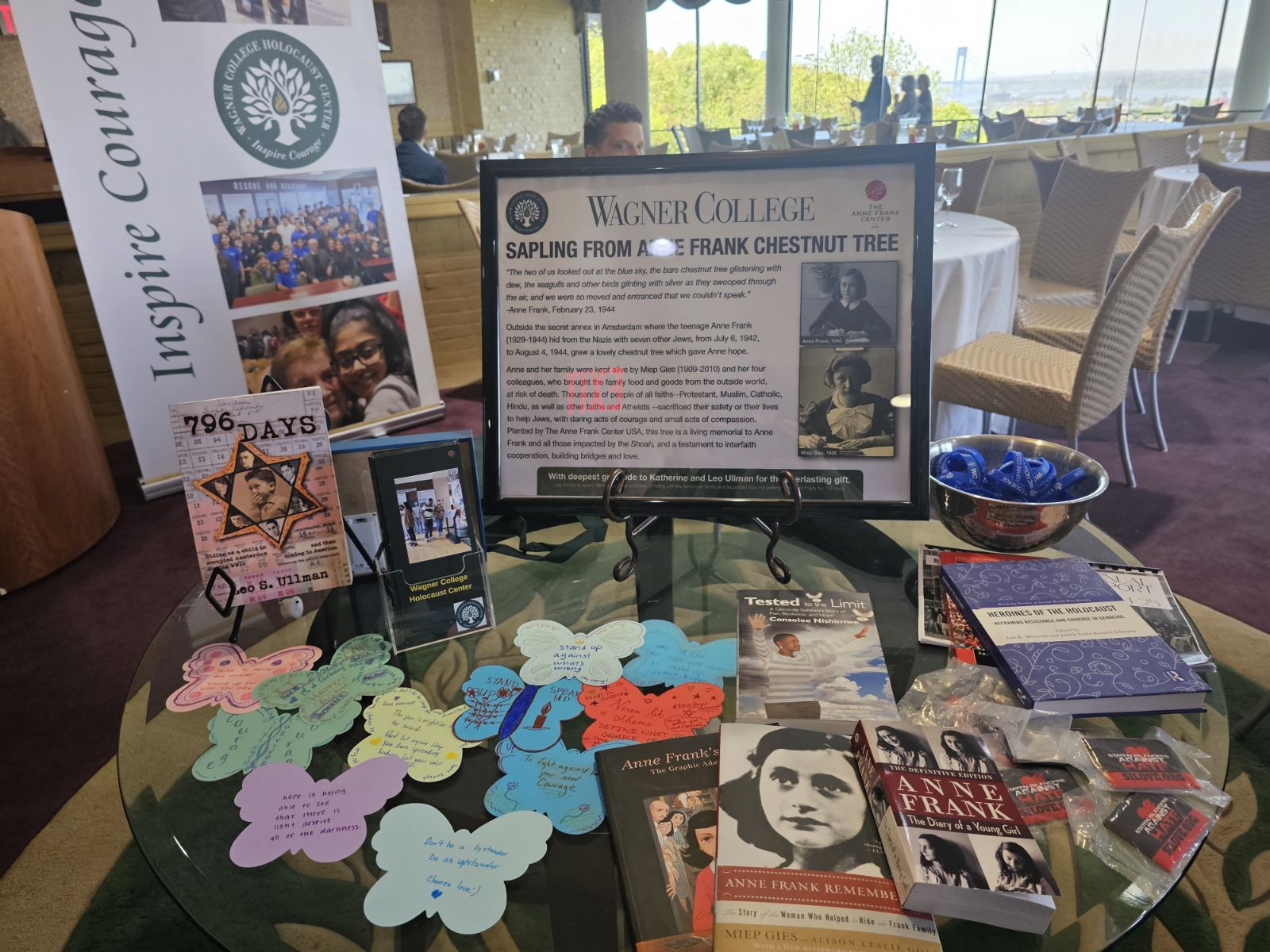
Student display at the Holocaust Center. Image Credit – Anne Frank Center USA

Wagner Students reading diary exerpts in Dutch and English. Image Credit – Anne Frank Center USA
Banner Image: Student display at the Holocaust Center. Image Credit – Anne Frank Center USA
Wagner College


Wagner College prepares students for life, as well as for careers, by emphasizing scholarship, achievement, leadership, and citizenship. Wagner offers a comprehensive educational program that is anchored in the liberal arts, experiential and co-curricular learning, interculturalism, interdisciplinary studies, and service to society, and that is cultivated by a faculty dedicated to promoting individual expression, reflective practice, and integrative learning.