



The CREEP Act: Closing the “Intimacy Gap” in New York’s Protective Statutes
Legislative Evolution: Addressing the “Grey Zone” of Predatory Behavior
The Ceasing Repeated, Extremely Egregious, and Predatory (CREEP) Behavior Act represents a significant legislative pivot in the management of non-domestic stalking and harassment. For law enforcement, the judiciary, and the community at large, this Act—specifically New York Senate Bill S3394A—addresses a critical “grey zone” in the penal code where predatory behavior often evades traditional harassment or stalking statutes until physical harm occurs.

The Man From The Park Behind The Girls In A Deli
This “grey zone” is essentially a jurisdictional no-man’s-land where the law has historically remained frozen. By focusing on the relationship between the parties rather than the severity of the conduct, the previous legal framework effectively signaled to predators that their behavior was permissible so long as they remained “strangers” to their targets. The CREEP Act shatters this outdated paradigm by prioritizing the victim’s right to safety over the arbitrary classification of their connection to the offender. It acknowledges that the psychological and physical toll of being hunted is not mitigated simply because the hunter is an anonymous figure from the internet or a neighbor down the hall. This evolution reflects a modern understanding of digital-age predatory patterns, where proximity is no longer a prerequisite for terror.

The Stalker Following The Women Into A Store
The Mechanism of Intervention
Currently, New York is one of only seven states that does not offer a civil path to an order of protection for victims of “stranger” or “non-intimate” stalking. Senate Bill S3394A creates a “special proceeding” in the Supreme Court, allowing victims to petition for an anti-stalking order based on a “preponderance of evidence” rather than the higher criminal standard of “beyond a reasonable doubt.” Once issued, any further violation of this civil order is treated as Criminal Contempt, providing law enforcement with a clear mandate for immediate arrest before escalation occurs.
The brilliance of this mechanism lies in its procedural agility. By utilizing the civil standard—a “preponderance of evidence”—the law lowers the barrier for entry into the protective system, recognizing that stalking is often a crime of cumulative actions rather than a single, easily provable felony. This shift transforms the protective order from a “post-crime” formality into a “pre-crime” preventative tool. When a victim can present a pattern of egregious behavior to a judge without the immediate need for a grand jury or a criminal trial, the state gains a powerful lever to de-escalate volatile situations. It essentially grants the judiciary the power to draw a “line in the sand” early on, converting what was once a series of frustratingly “non-arrestable” incidents into a singular, high-stakes legal boundary that carries the full weight of the New York penal system behind it.

Stalker Takes A Table Next To The Women In Pizzeria
Real-World Stakes: The Case of Samantha Stites
The necessity of this “intercessory” model is demonstrated by the case of Samantha Stites, whose 13-year ordeal at the hands of a non-intimate stalker became a focal point for legislative reform. Because Stites and her stalker were never in a romantic or domestic relationship, she was historically ineligible for a civil order of protection under the New York Family Court Act. The lack of early-stage legal intervention allowed the harassment to escalate into a 2025 abduction and imprisonment. The CREEP Act is specifically designed to provide a legal “tripwire” for victims in similar positions, allowing for judicial intervention during the stalking phase rather than after a violent breach.
The tragedy of the Stites case serves as a visceral reminder that the “Intimacy Gap” has a body count. For over a decade, the legal system functioned as an inadvertent accomplice by repeatedly telling a victim that her fear was legally “unactionable” because her predator was a stranger. This case illustrates the dangerous shelf-life of unchecked obsession; when the state fails to intervene in the “nuisance” stage, it almost guarantees it will eventually have to intervene in a “tragedy” stage. The CREEP Act functions as a legislative correction to this systemic failure, ensuring that the law finally recognizes that a 13-year campaign of terror is a crime, regardless of whether the perpetrator ever shared a dinner table or a bedroom with the victim. It moves the focus of the court from the history of the parties to the trajectory of the threat.

Stalker Placing Sticker Over Vehicle License Plate
Administrative Efficiency and Fiscal Impact
Beyond public safety, the CREEP Act introduces a necessary layer of administrative efficiency to the New York judicial and law enforcement systems. Currently, the state’s reactive model necessitates a heavy expenditure of resources—requiring police to respond multiple times to the same “non-criminal” incidents until an inevitable escalation occurs. This cycle creates an “administrative drag,” where manpower is spent documenting a crisis rather than preventing it. By providing a civil mechanism for intervention, the Act allows for the resolution of these threats through streamlined judicial orders, preserving crucial but limited judicial resources and reducing the long-term economic impact of complex felony trials on the community.

Stalker Following Girls On Different Day When The Police Are Called
From a purely fiscal standpoint, the current “wait-and-see” approach is a disaster. It forces local precincts to act as expensive social workers for ongoing harassment cases that they have no legal authority to end. Each “wellness check” or “incident report” that lacks the teeth of an order of protection is a sunk cost that does nothing to solve the underlying problem. By contrast, the CREEP Act creates an “off-ramp” for these cycles of escalation. A single civil proceeding in the Supreme Court is exponentially more cost-effective than a multi-year felony prosecution, a period of pretrial detention, and the subsequent costs of long-term incarceration. By investing in early judicial intervention, New York is effectively practicing “preventative maintenance” on its justice system, ensuring that high-level resources are saved for cases where harm has already occurred, rather than being wasted on predictable escalations that could have been stopped with a single court order.
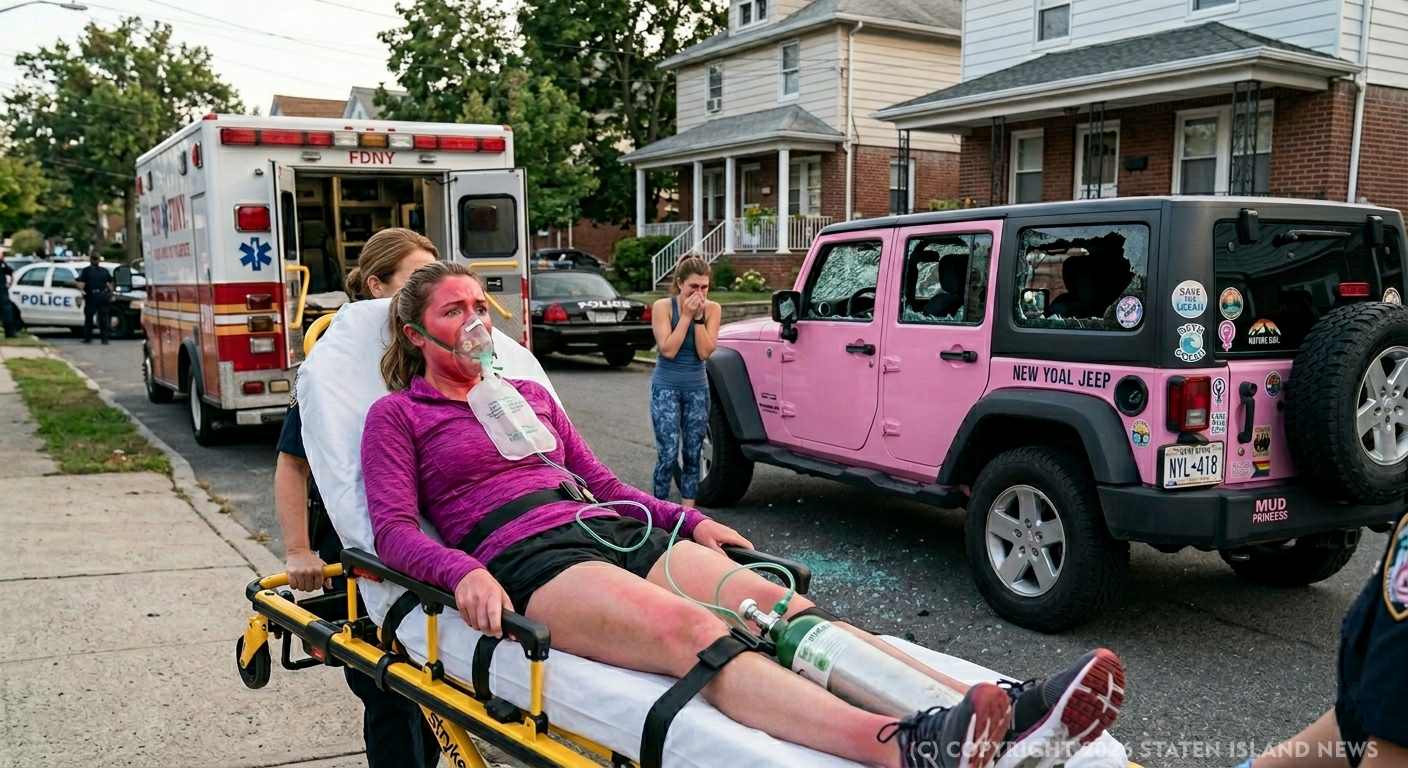
Anxiety Attack After Finding Their Vehicle Vandalized.
Current Legislative Status
As of February 11, 2026, the CREEP Act passed the New York State Senate with a unanimous 59-0 vote. It was subsequently delivered to the Assembly and referred to the Judiciary Committee. The bill represents a rare point of bipartisan consensus, moving New York toward the standards already held by 43 other states that provide civil protections regardless of the relationship between the victim and the predator.
This unanimous vote is a resounding signal that the safety of New Yorkers is no longer up for partisan debate. It acknowledges that the “Intimacy Gap” was a relic of a different era, and that in 2026, the law must be as adaptive and persistent as the predators it seeks to restrain. The move to the Assembly represents the final hurdle in rectifying a decades-long oversight. By adopting these standards, New York is finally acknowledging a simple truth: the law should protect you from being followed, harassed, and terrorized by anyone, whether you know them intimately or not at all.

The Shift To Assault
Citations:
- New York State Senate, Bill S3394A (2025-2026): Official legislative text and sponsor’s memo regarding the Supreme Court “special proceeding” and the unanimous Senate floor vote. See the equivalent Assembly Bill here.
- National Institute of Justice (NIJ): “Civil Protection Orders: Legislation, Current Court Practice, and Enforcement” regarding the administrative efficiency of civil-standard orders.
- C.A. Goldberg, PLLC (2025): Legal analysis of the “Intimacy Gap” and documentation of victim testimony regarding non-domestic stalking in New York.
- The Associated Press / Regional News (2025-2026): “Thirteen Years of Silence: The Samantha Stites Stalking and Abduction Case.” Detailed reporting on the escalation of non-intimate stalking. See also the film by ABC about this story.
Banner Image: Jogging in the park. All Images Credit – Staten Islander News
Staten Islander News Service Staff Writer


This byline indicates that this article was penned by a member/members of the Staten Islander News Organization office team. Our staff writers are the backbone of our newspaper, performing all sorts of important tasks like conducting interviews, investigating leads, besides writing the news stories you see.