

Below, you will find statements from local and city politicians regarding the recently announced executive budget proposal for the state of New York. This budget then allows the city to begin negotiations on its own budget, as now there is greater certainty on revenue and services coming to the city from the state. Readers should consider that a likely reason for some of the issues that the politicians have a problem with are built into the system, in the form of elections every TWO years for both Assembly and Senate, with contenders for the seat in nearly every race. While the politicians currently in office are strong contenders for their own seats, this is not guaranteed. With such a short legislative session (six months out of each year – beginning in January and ending in early June) and with all of the politicians then spending their second year in office primarily campaigning instead of focusing on passing laws – and additionally, when there is an election, there is always more caution to what laws they will attempt to pass. Anything that voters might not like is taken off the table. This makes it quite challenging to pass any real legislation outside of the budget. Also worth noting is that anything that is NOT in the budget that costs money and that is in the legislation, will not receive the funding it needs to function. This makes the budget negotiations also the most critical part of the legislative agenda in any given year. Governor Hochul’s gubernatorial reelection campaign is also occurring this year, but the governor serves a four year terms. In the last 91 elections for New York State governor, the incumbent has lost in only 15 of them. However, as stated before, elections are never actually guaranteed.
10 Budget Extenders Later, Albany’s Dysfunction Continues
A statement by Assemblyman Sam Pirozzolo (R,C-Staten Island)
“Today’s passage of a 10th budget extender is another embarrassing reminder that Albany’s Democrat leadership is failing the people of New York. After weeks of missed deadlines, secretive negotiations and political infighting, taxpayers, schools, local governments and families are still being left completely in the dark while Democrats continue to stall on one of the state’s most basic responsibilities.
This morning, New Yorkers were told there was supposedly a “general agreement” on a bloated $268 billion budget, an increase of roughly $14 billion over last year. Within hours, conflicting statements from legislative leaders made it clear there was no real agreement at all. What we saw today was Albany’s dysfunction on full display: mixed messages, no transparency and no accountability from the one-party control running our state.
Instead of focusing on affordability and fiscal discipline, they continue to push reckless spending while everyday New Yorkers struggle with rising costs, high taxes and economic uncertainty. Families across this state are tightening their budgets while Albany keeps expanding government and dragging its feet.
New Yorkers deserve leadership that can govern responsibly, pass a budget on time and put taxpayers ahead of politics. The longer this chaos continues, the more it proves just how disconnected Albany has become from the people it is supposed to serve.”
Assemblyman Sam Pirozzolo represents the 63rd Assembly District, which encompasses parts of the North Shore, including Emerson Hill, Sunnyside, Bloomfield, Travis and Chelsea.
PHIL WONG ISSUES STATEMENT ON FY27 EXECUTIVE BUDGET
Wong says City must focus on efficiencies, public safety, and easing burdens on middle-class families
Maspeth, NY — Council Member Phil Wong (D-Queens), a member of the New York City Council’s Finance Committee, issued the following statement regarding Mayor Zohran Mamdani’s Fiscal Year 2027 Executive Budget proposal:
“While we are still awaiting the full details of the Executive Budget and final state funding figures, I’m pleased to see that property tax increase proposal is off the table after the Council made clear from day one that New Yorkers cannot continue to shoulder additional tax burdens. At $124 billion, this budget is still larger than the budget of many states, including Florida, and middle-class families, especially in the outer boroughs, believe their tax dollars are too often being wasted without seeing the results in the form of increased public safety, cleaner streets, better quality of life, or more reliable services. The State budget being finalized more than a month late also created additional uncertainty for the City’s budget process. As the Council reviews this proposal in the weeks ahead, my focus will remain on identifying efficiencies and savings, reducing burdens on homeowners and small businesses, hiring and retaining more police officers, and ensuring taxpayer dollars are being spent responsibly and effectively.”
GOV. HOCHUL ANNOUNCES GENERAL BUDGET AGREEMENT TO DELIVER AUTO INSURANCE RELIEF FOR NEW YORKERS
ALBANY—Governor Kathy Hochul today announced an agreement in the FY 2026-27 State Budget to tackle skyrocketing auto insurance premiums and provide direct relief to millions of New York drivers. By modernizing the state’s insurance laws and launching an aggressive crackdown on rampant fraud and abuse, the deal addresses the root causes of an affordability crisis that has left New Yorkers paying nearly double the national average for coverage.
“This agreement is a big win for New Yorkers struggling to get by in the midst of an affordability crisis. For too long, drivers in this state have been paying nearly double the national average for auto insurance, while broken systems and rampant fraud have driven costs through the roof. Governor Hochul and lawmakers have taken decisive action to address the root causes of this crisis. By strengthening enforcement and modernizing outdated rules, they are helping put money back in people’s pockets. These reforms will bring real relief for working families and mark a meaningful step toward making New York more affordable.” — José Bayona, spokesperson for Citizens for Affordable Rates (CAR):
Lowering Auto Insurance Rates for Everyday New Yorkers
New Yorkers pay some of the highest car insurance rates in the nation, totaling just over $4,000 annually on average — nearly $1,500 above the national average. Car insurance rates are driven up by a combination of fraud, litigation, legal loopholes, and enforcement gaps, with staged crashes and associated insurance fraud inflating everyone’s premiums by as much as $300 per year on average, according to some estimates.
The final Budget will put money back in New Yorkers’ pockets through a series of common-sense legislative reforms that will prevent bad actors and fraudsters from exploiting the system and hold insurers accountable to pass their savings on to consumers.
The final State Budget will:
- Cap payouts for drivers engaging in criminal behavior at the time of the incident, including uninsured motorists, drunk drivers, and drivers in the act of committing a felony.
- Better define what actually constitutes a ‘serious injury’ so that damages for pain and suffering or emotional distress are reserved for those able to objectively demonstrate that they have suffered a serious injury.
- Ensure that if a driver is found to be mostly at fault for causing an accident, they cannot claim outsized payments for damages.
- Prevent insurance companies from exorbitantly raising rates by setting a legal threshold that prevents excess profits and returns savings to consumers.
- Create new regulatory safeguards to prevent insurance companies from raising rates without seeking express approval from the Department of Financial Services.
- Protect consumers by prohibiting insurance companies from setting rates based on extraneous, personal factors like homeownership status, occupation, education level or zip code.
These measures complement the Governor’s whole-of-government approach to combating fraud by tasking DFS, DMV, DCJS, and NYSP with a more proactive, coordinated effort.
About Citizens for Affordable Rates (CAR)
Citizens for Affordable Rates (CAR) is a coalition of citizens, advocates, and organizations dedicated to tackling the root causes of high auto insurance costs in New York. Through advocacy, education, and policy reform, CAR is committed to building an affordable and dependable system for all New Yorkers. For more information, visit: www.citizensforaffordablerates.com
As detailed above in Asm. Pirozzolo’s statement, Council Member Wong also talks about secret negotiations and backdoor deals in this latest budget agreement:
Wong Calls Out “Backdoor Legislating” Amid Ongoing State Budget Delays
Must End Practice of Stuffing Major Policy Into Budget Deals
Phil Wong, NYC Council Member and member of the City Council’s Finance Committee, issued the following statement regarding the purported FY27 New York State Budget agreement and ongoing delays in Albany:
“The fact that we’re now more than a month late on a State budget, delaying the City’s ability to finalize its own budget, is bad enough. What’s even more troubling is that much of the holdup appears to center around policy and backdoor legislating through the budget process instead of allowing legislation to stand on its own through the normal legislative process. That’s how New Yorkers ended up with policies like bail reform and congestion pricing jammed into budget negotiations in the first place. Albany needs to reform this broken system, stop stuffing major policy proposals into budget deals, and start treating taxpayer dollars with the respect they deserve instead of continuing to grow government and nickel-and-dime hardworking New Yorkers already struggling to get by.”
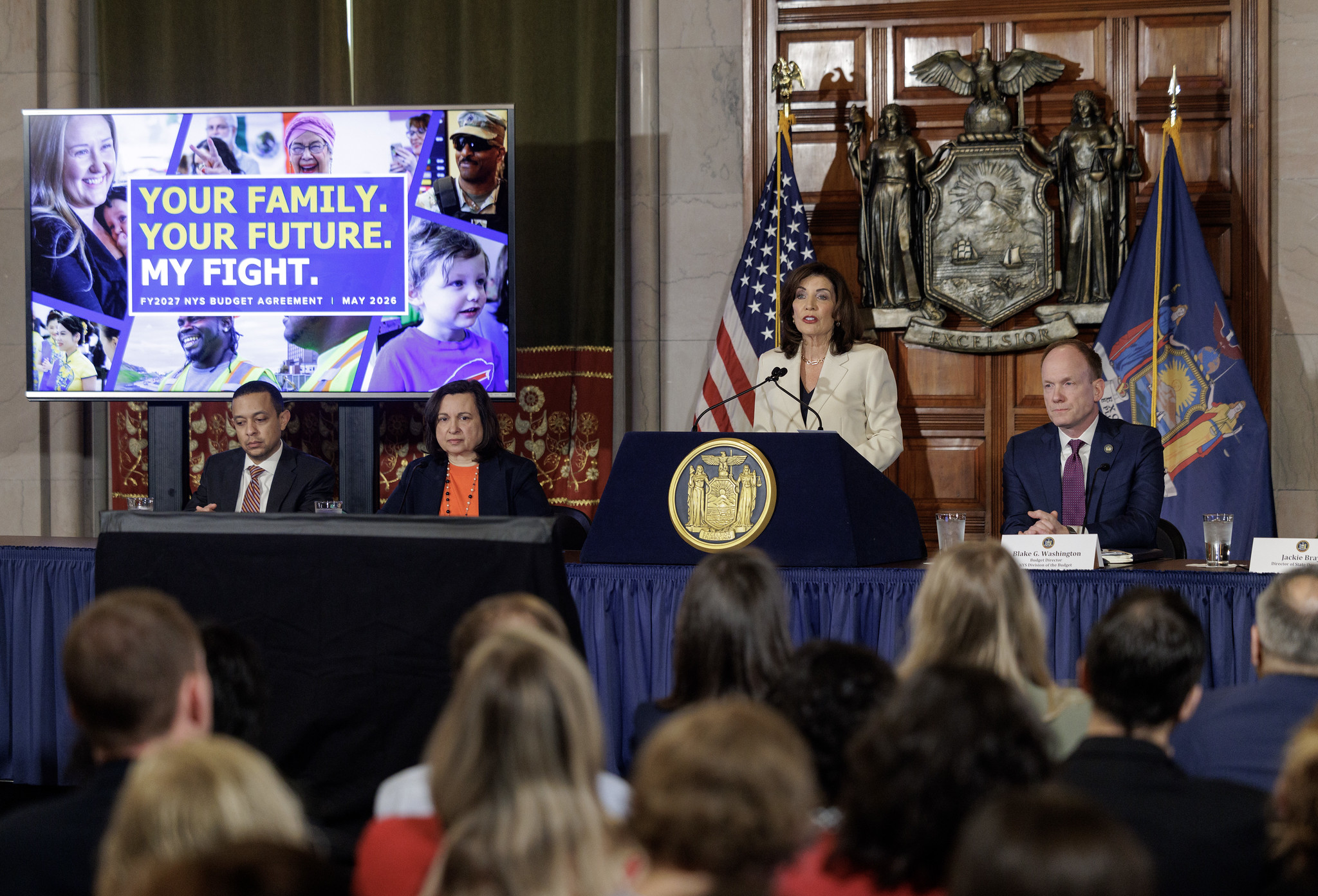
Governor Hochul Announces Agreement on FY 2027 State Budget
Major Investments, Including Comprehensive Path to Universal Child Care, Will Make New York More Affordable for Families
Budget Reforms Will Mean Lower Auto Insurance Premiums for New Yorkers
Tackles Energy Costs With Sweeping Affordability Package, Including $1 Billion Energy Rebate To Provide Utility Relief to New Yorkers and New Ratepayer Protection Program To Guard Against Rate Increases and Spiraling Costs
Budget Includes Comprehensive Protections Against Unprecedented Escalation in Aggressive Federal Immigration Enforcement by ICE
Enacts Nation-Leading Online Protections and Privacy Requirements To Protect Children From Predators and AI Chatbots
Landmark Reforms Cut Red Tape To Build More Housing and Infrastructure Faster and More Affordably
First-In-Nation Law Will Crack Down on 3D Printed Ghost Guns
Governor Kathy Hochul today announced an agreement has been reached with legislative leaders on key priorities in the Fiscal Year 2027 New York State Budget.
“I promised a Budget that works for working people and expands opportunities for all New Yorkers and I was not going to back down from that fight,” Governor Hochul said. “Alongside my partners in the Legislature, today we are delivering on that promise. This Budget includes sweeping changes to lower costs, enhance public safety, protect our communities from federal overreach and invest in the future of New York families.”
Providing Universal Child Care
In this State Budget, Governor Hochul is putting New York State on a concrete path to universal, affordable child care, beginning with committing to investments that will support the delivery of affordable child care to up to 100,000 additional children.
The Governor’s landmark investment will increase funding by $1.7 billion bringing the total FY27 investment to $4.5 billion for child care and pre-kindergarten services statewide.
These investments will:
- Make Pre-K truly universal statewide with funding to make high-quality Pre-K seats available for all four-year-olds in New York by the start of the 2028-29 school year and increasing State grants to existing programs to ensure high-quality care.
- Partner with New York City to launch the new 2-Care program and finally realize the promise of universal 3K access in New York City.
- Enhance the Child and Dependent Care Tax Credit to help defray childcare expenses for 230,000 New York families by providing an average benefit of $576.
- Support the development of New York’s ‘First 3’ program, which will partner with counties to offer high-quality, affordable child care to children 0-3 regardless of income.
- Make historic investments in the Child Care Assistance Program, delivering high-quality, affordable child care to tens of thousands of additional young New Yorkers that is capped at $15 a week for most families.
- Support the child care workforce through early childhood educator preparation.
Alongside these commitments, the Governor will launch an Office of Child Care and Early Education to steer the implementation of high-quality, universal child care for New York families, and will work to enhance awareness of the Empire State Child Credit to ensure as many families as possible benefit from the Governor’s historic expansion of New York’s child tax credit, which increased the credit from $330 per child to $1,000 per child for children under four and $500 per child for children ages four through 16.
Lowering Auto Insurance Rates for Everyday New Yorkers
New Yorkers pay some of the highest car insurance rates in the nation, totaling just over $4,000 annually on average — nearly $1,500 above the national average. Car insurance rates are driven up by a combination of fraud, litigation, legal loopholes, and enforcement gaps, with staged crashes and associated insurance fraud inflating everyone’s premiums by as much as $300 per year on average according to some estimates.
The final Budget will put money back in New Yorkers pockets via a series of common-sense legislative reforms that will ensure bad actors and fraudsters cannot exploit the system and will hold insurers accountable to ensure that their savings are passed on to consumers.
The final State Budget will:
- Cap payouts for drivers engaging in criminal behavior at the time of the incident, including uninsured motorists, drunk drivers, and drivers in the act of committing a felony.
- Better define what actually constitutes a ‘serious injury’ so that damages for pain and suffering or emotional distress are reserved for those able to objectively demonstrate that they have suffered a serious injury.
- Ensure that if a driver is found to be mostly at fault for causing an accident, they cannot claim outsized payments for damages.
- Prevent insurance companies from exorbitantly raising rates by setting a legal threshold that prevents excess profits and returns savings to consumers.
- Create new regulatory safeguards to prevent insurance companies from raising rates without seeking express approval from the Department of Financial Services.
- Protect consumers by prohibiting insurance companies from setting rates based on extraneous, personal factors like homeownership status, occupation, education level or zip code.
- These measures come in addition to the Governor’s whole-of-government approach to combatting fraud by tasking DFS, DMV, DCJS and NYSP with a more proactive and coordinated approach to enforcement.
Tackling Utility Costs
New Yorkers deserve reliable energy at a price they can afford, which is why the final State Budget includes a comprehensive energy affordability package designed to put money back into New Yorkers’ pockets and protect against future drivers of rate increases.
The final State Budget will include a one-time, $1 billion energy rebate to provide relief to New Yorkers dealing with rising energy costs.
The Budget also includes a Ratepayer Protection Plan comprised of a sweeping set of reforms to modernize the Public Service Law, demand strict fiscal discipline from utilities and empower the State to fight more effectively for lower bills. The Budget will:
- Tie executive pay directly to customer affordability.
- Require utilities to present a Budget constrained option that keeps their operating and capital costs below the rate of inflation when requesting a rate increase to ensure efficiency and affordability are prioritized.
- Ensure customers do not foot the bill for hidden costs like lobbying, political contributions and unnecessary executive travel.
The final State Budget also includes measures to:
- Invest millions more into the EmPower+ program, which has helped nearly 42,000 low- and moderate-income households across the state finance energy improvements, saving families about $600 per year on their utility bills.
- Modernize the way utility rate cases are reviewed to help keep prices manageable.
- Incentivize the use of smart technology to help reduce energy usage and bills.
This is in addition to other work the Governor has announced to drive down energy rates for consumers, such as her proposal to ensure large data centers pay their fair share for energy.
In addition, the final State Budget will enact common-sense changes to the Climate Leadership and Community Protection Act that continues the state’s nation-leading commitment to clean energy and climate goals while at the same time prioritizing affordability.
Comprehensive Immigration Protections
Amid an unprecedented escalation in aggressive federal immigration enforcement by ICE, the final State Budget will include a comprehensive plan that will expand protections for New Yorkers, safeguard basic rights, and hold federal immigration officials accountable. The plan will:
- Prohibit local law enforcement from being deputized by ICE for federal civil immigration enforcement by eliminating 287(g) agreements, barring state and local police from acting as civil immigration agents, or using taxpayer-funded resources or personnel to carry out federal civil immigration enforcement and detention.
- Establish a state right to sue federal, state, and local officials, including ICE officers, for constitutional violations.
- Deny ICE permission from entering sensitive locations – including schools, libraries, health care facilities, polling locations, and homes – without a judicial warrant.
- Ban federal, state, and local law enforcement from wearing masks while on duty.
- Strictly prohibit the use of state, local or school civil resources—including employee time—for civil immigration enforcement activities.
- Ensure all students can access education without fear of ICE interference, codifying the right to a free public education regardless of immigration status.
Let Them Build
The final State Budget will include landmark reforms to cut red tape and speed up the building of critically needed housing and infrastructure projects that often face extensive delays and raise costs for New Yorkers. The Budget will include a series of common sense changes to modernize the fifty-year old State Environmental Quality Review Act (SEQRA) to expedite critical projects that have been consistently found not to have any significant environmental impacts. By allowing projects that localities want to move forward that will not harm the environment to do so faster, these actions will make it easier and more affordable to deliver the new housing and infrastructure that New Yorkers need while we continue to preserve our environment and conserve New York’s natural resources.
The Budget will:
- Provide exemptions from duplicative environmental review for new housing that is desperately needed and does not result in significant environmental impacts. These exemptions will cut costs and speed construction. In New York City, qualifying housing in medium and high-density areas up to 500 units will be exempted, with projects up to 250 units exempted in the rest of the city. Outside of New York City, the exemptions would apply to qualifying housing of up to 300 units in urbanized areas, up to 100 units in non-urban areas, and up to 20 units in areas that have no zoning. Housing must be on previously disturbed land and connected to water and sewer systems upon occupancy.
- Add further SEQRA exemptions for categories of beneficial projects including clean water infrastructure, public parks and trails, green infrastructure, and public schools within New York City.
- Establish a clear, two-year timeline to complete an environmental impact statement, creating accountability and ensuring faster decisions for communities.
- Overhaul overcomplicated bureaucratic processes to make it easier for communities to build without impacting or impairing local laws and processes related to local zoning and other environmental permitting.
Safe By Design
Building on New York State’s work to protect our children from digital harms such as addictive algorithmic feeds on social media and the distractions of cell phones within schools, the Budget includes nation-leading legislation designed to protect children from online predators, scammers and harmful AI chatbots integrated on online platforms. These changes were motivated by extensive reports of incidents where children have been left vulnerable to grooming, child abuse, and exposure to violent and inappropriate content, including content that promotes suicide.
The Budget will enact substantial protections for children across a variety of online spaces and gaming platforms, including:
- Mandating platforms automatically apply privacy-protective settings for children by default, meaning non-connections cannot message kids, view their profile, or tag them in content.
- Requiring children’s location settings to be inaccessible by default to people they are not connected with.
- Requiring children under 13 receive parental approval for new connections on online gaming platforms.
- Disabling integrated AI chatbots for children.
- Instituting new financial protections relating to children’s expenditures on gaming websites, including parental limits on a child’s financial transactions.
Additional highlights of the Fiscal Year 2027 Budget include:
Investing in Public Safety
- Enacts a first-in-the-nation legislation requiring the development of regulations to ensure that every 3D printer sold in the State of New York includes technology that blocks it from printing a firearm, and strengthens criminal penalties for manufacturing ghost guns.
- Requires firearm manufacturers to design guns in a way that prevents quick and easy conversion into DIY illegal machine guns.
- Invests $352 million in gun violence prevention programs to continue successful efforts to drive down gun violence to their lowest levels in decades.
- Provides $77 million to assist the New York City Police Department in policing the subway system.
- $25 million to expand the MTA’s SCOUT program responding to severe mental illness in the subway system from 10 to 15 teams.
- Expands subway platform edge barriers to an additional 85 stations, on pace for 200 stations by the end of 2026.
- Requires dangerous drivers in New York City who receive 16 or more speed camera violations in a year to install intelligent speed limiter devices on their vehicles.
- Invests an additional $35 million for Securing Communities Against Hate Crimes grants, bringing the Governor’s total commitment to over $131 million since taking office.
- Establishes buffer zones to protect places of worship so New Yorkers can practice religion, a guaranteed right, free of harassment.
- Prohibits nefarious drones near sensitive locations, including schools, and authorizing law enforcement to mitigate credible aerial threats, while creating additional pathways for the research and development of drone and counter-drone technology.
Reducing Costs and Putting Money in Your Pocket
- Eliminates New York State income tax on tipped wages up to $25,000 per year, ensuring more money stays in people’s pockets.
- Provides $395 million to ensure free breakfast and lunch for every K-12 student in New York, the second consecutive year for the highly successful Universal School Meals program.
- Makes a college degree more affordable and accessible by investing more than $65 million in the Opportunity Promise Scholarship to not only make community college free for adult students pursuing associate degrees in high-demand industries, but expand it to four-year public institutions that offer associates degrees in high-demand fields.
- An additional $250 million in capital funding to accelerate the construction of thousands of new affordable homes.
- Provides $30 million in direct “tariff relief” for New York farmers to offset increased costs for equipment, fertilizer and supplies caused by federal tariffs.
Investing in Infrastructure and Local Communities
- Create the state’s first Pied-a-terre tax program, a targeted surcharge on high value second homes and investor-owned apartments worth $5 million and up in New York City, which will generate at least $500 million in tax revenue annually.
- Provide an additional $1 billion investment in climate priorities through the state’s Sustainable Futures Fund, with an emphasis on Environmental Justice programs.
- A record level five-year, $3.75 billion funding commitment to clean water infrastructure, spurring housing growth and economic development projects across the state.
- Nearly $40 billion in total school aid, a total increase of $10 billion since Governor Hochul took office, to continue to build on New York’s nation leading commitment to educating the next generation.
- Provides $1 billion in new funding for existing Safety Net Hospitals to carry out transformative capital projects that promote financial sustainability.
- Invests $500 million in additional support for distressed hospitals.
- Historic $1 billion in total aid to support municipalities outside of New York City, mitigating the need to increase local taxes.
- Continues the Governor’s “war on potholes” with $1.4 billion for maintaining and repairing New York State’s local roads and bridges.
- $6 million for NY Kicks to capitalize on the momentum from the FIFA World Cup 2026 tournament by building soccer pitches and other lasting infrastructure for youth recreation in disadvantaged communities across the state.
- $10 million for the Saving Performing Arts and Cultural Experiences (NY SPACE) initiative which will provide grants to help nonprofit performing arts organizations acquire their venues.
- $75 million to advance major transit projects reimagining Jamaica Station and expanding the Second Avenue Subway tunnel westward across 125 St.
- $17.5 million to make Teen Mental Health First Aid training available to all 10th graders across New York State, a first-in-the-nation action.
With a conceptual agreement in place, the legislative houses are expected to pass bills that will fully enact these priorities in the coming days. Based on a preliminary assessment of the negotiated changes to the Executive proposal, the total Budget for FY 2027 is currently estimated at $268 billion. The FY 2027 Budget does not raise income or statewide business taxes and maintains the Governor’s powers to make future adjustments if actions by the federal government require.
Banner Image: May 7, 2026 – Albany, NY – Governor Kathy Hochul makes a budget announcement. Image Credit – Mike Groll/Office of Governor Kathy Hochul
Staten Islander News Service Staff Writer


This byline indicates that this article was penned by a member/members of the Staten Islander News Organization office team. Our staff writers are the backbone of our newspaper, performing all sorts of important tasks like conducting interviews, investigating leads, besides writing the news stories you see.