



NYC HEALTH DEPARTMENT TAKES FLIGHT AGAINST MOSQUITOES WITH FIRST AERIAL LARVICIDING OPERATION OF THE SEASON
Aerial Larviciding Treatment to be Conducted by Helicopter in Marshes and Wetlands June 8-10 to Reduce Mosquito Activity and Lower the Risk of West Nile Virus
Treatment Uses EPA-Approved Products Targeting Mosquito Larvae with Minimal Impact on People, Pets, and Wildlife
New Yorkers Encouraged to Eliminate Standing Water, Mosquito-Proof Their Homes, and Take Precautions When Spending Time Outdoors to Reduce Mosquito Exposure
Editor’s note: Homeowners and renters with access to and use of a backyard or front yard space are reminded of their responsibility to eliminate, reduce, or treat with larvacide any standing water on their property. If all residents do their part, the mosquito population is reduced, and aerial spraying with broad-spectrum insecticides, as the DOH normally does in late summer, may not be needed. However, it has yet to happen that a year passes without indiscriminate pesticide spraying, making it very difficult for populations of predator insects to rebuild their populations after being destroyed in the heart of summer. Once sprayed, aerial pesticides are not only indiscriminate in their killing of all insects, but they also have the unintended effect of increasing immunity to the pesticides among target insects (mosquitos). They are using sumithrin when they spray for adult mosquitoes, which is especially susceptible to this issue. It also kills bees and monarch butterflies, not just predators. This is always an issue when using pesticides to control insects, as it is when using antibiotics to control bacteria. At some point, they develop resistance to and eventual immunity against the chemicals used to control them. Using principles of regenerative agriculture, including encouraging the populations of predator insects, birds, and other animals rather than spraying chemical killers indiscriminately would likely result in a greater reduction of their population in the long term. As many residents have noted, their populations go down for a few days after spraying but then rebound to more than previous levels, in part due to the resultant lack of predator insects that normally work to keep their populations in check. Larvacide spraying, as is being done right now, is much more effective than adult control methods, and could be repeated throughout the summer for continued control instead of switching to broad spectrum pesticides. It would be more effective that way and less destructive to the natural environment and developing ecosystems, including those encouraged by bee bunkers placed by the City in public plazas.
NEW YORK, NY — To reduce mosquito activity and the risk of West Nile virus, the NYC Health Department will conduct aerial larviciding treatment for the first time this summer from June 8-10, treating nonresidential marshes and wetland areas of the Bronx, Brooklyn, Queens, and Staten Island between the hours of 6 a.m. and 7 p.m. Due to their size, dense vegetation, and limited accessibility, these areas will be treated using a low-flying helicopter. In the event of inclement weather, treatment will be delayed until June 11-12 and June 15, during the same hours.
“Preventing mosquito-borne disease starts long before mosquitoes become a nuisance,” said NYC Health Commissioner, Dr. Alister Martin. “The NYC Health Department’s mosquito surveillance and control program helps protect New Yorkers by reducing mosquito populations before they have an opportunity to spread disease. As we enter the summer season, we encourage all New Yorkers to eliminate standing water around their homes and take simple precautions to reduce mosquito exposure.”
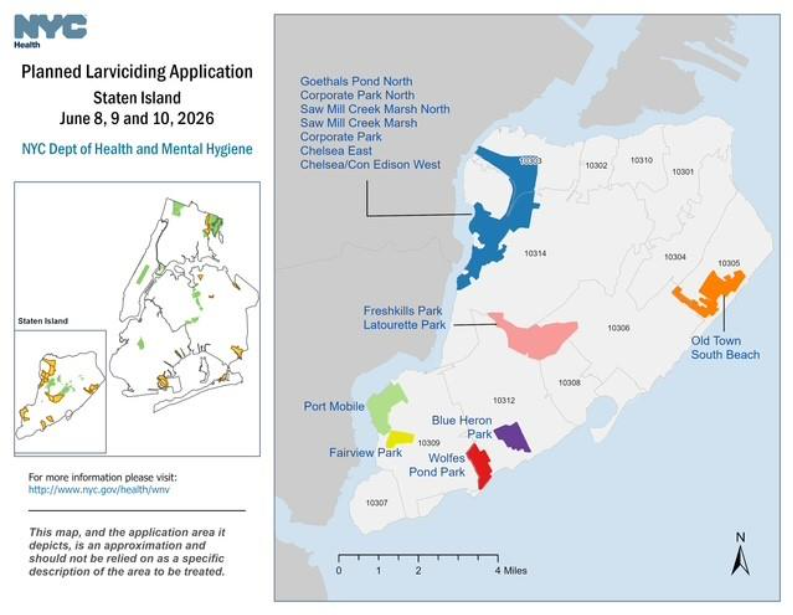
The NYC Health Department conducts ongoing mosquito surveillance throughout the five boroughs and monitors mosquitoes for West Nile virus and other mosquito-borne diseases. Periods of warm weather, rainfall, and high tides can create ideal breeding conditions for mosquitoes in marshes and wetlands, which are active in New York City from approximately April through October each year. To date, no human cases of West Nile virus have been reported in New York City this year. The targeted treatment areas are expected to experience conditions favorable for mosquito breeding, prompting the agency to conduct its first treatment of the year.
The NYC Health Department will apply larvicides that target mosquito larvae before they mature into biting adult mosquitoes. The products used for this treatment, VectoBac® GS and VectoPrime® FG, contain naturally occurring bacteria that specifically target mosquito larvae. Both products are approved by the U.S. Environmental Protection Agency and the New York State Department of Environmental Conservation and are used as part of the NYC Health Department’s integrated mosquito management program. The larvicides used in this treatment target mosquito larvae and have minimal impact on people, pets, fish, birds, and other wildlife when applied according to label directions.
New Yorkers are encouraged to mosquito-proof their homes and take precautions when spending time outdoors. The most effective way to control mosquitoes is to eliminate standing water where they breed. Other recommendations to reduce exposure to mosquitoes include:
-
Use an EPA-registered insect repellent containing DEET, picaridin, IR3535, or oil of lemon eucalyptus (not recommended for children younger than three years old).
-
Make sure windows have properly fitted screens and repair any tears or holes.
-
Eliminate standing water on your property and dispose of containers that collect water.
-
Keep roof gutters clean and draining properly.
-
Clean and chlorinate swimming pools, outdoor saunas, and hot tubs. Keep them covered when not in use.
-
Drain water that collects on pool covers.
-
When possible, wear long sleeves and long pants when outdoors in areas with high mosquito activity.
-
Report standing water by calling 311 or visiting NYC.gov/health.
For more information about West Nile virus and mosquito prevention, visit NYC.gov/health or call 311.
Banner Image: The Vector Control helicopter spraying for mosquitos from behind. Image Credit – Don McCullough licensed by CC
NYC Dept of Health and Mental Hygiene


The New York City Department of Health and Mental Hygiene is the department of the government of New York City responsible for public health along with issuing birth certificates, dog licenses, and conducting restaurant inspection and enforcement. The New York City Board of Health is part of the department. Its regulations are compiled in title 24 of the New York City Rules (the New York City Health Code). Since March 2022, the commissioner has been Ashwin Vasan.