

Let the Investment Grow: Horseshoe Crabs and the Future of Delaware Bay
From American Littorical Society
Editor’s note: An organization that has also been working to save horseshoe crabs from medical usage is the Physician’s Committee For Responsible Medicine. We spoke with them about the new MAHA guidelines, an how those will negatively affect kids in elementary through high school in many communities, limiting their ability to access truly healthy food. Due to their work, now the US Pharmacopeia allows non-animal testing methods to determine the presence of toxicity. This was previously done using horseshoe crabs, and had led to a significant population decline. From the PCRM article: “One of those pressures is the biomedical harvest of horseshoe crabs for their blue blood, which is used to create the Limulus amebocyte lysate test. Medical devices and injectable drugs are all tested for contaminants—or endotoxins—to ensure safety. Currently, most pharmaceutical companies use LAL. This comes at a high cost to horseshoe crabs and coastwide conservation.”
Affordability is on everyone’s mind. We are all asking what we can afford now, what we need to save, and what today’s choices will cost tomorrow. The same is true in nature.
Delaware Bay has its own economy. Every spring, tiny green horseshoe crab eggs become one of the Bay’s most valuable currencies. The influx of calorie-rich eggs fuels red knots, ruddy turnstones, sanderlings, fish, terrapins, and the larger web of life.
When there are enough eggs on the beaches, shorebirds gain the weight they need to reach Arctic breeding grounds. Fish and terrapins fuel up after a long winter. And that abundance helps sustain the next generation of horseshoe crabs and the future productivity of the Bay.
A large spawning horseshoe crab population is a long-term investment in the Delaware Bay ecosystem.
Delaware Bay Was Once a Superabundant Food Engine
In the 1980s and early 1990s, horseshoe crabs were dense enough to “cobble” the beaches, and egg densities in the upper beach sand often exceeded 50,000 eggs per square meter. That abundance supported extraordinary concentrations of migratory shorebirds and fish.
When eggs were abundant, red knots could gain weight at extraordinary rates, and the Bay supported immense concentrations of migratory wildlife.
During the 1990s, Delaware Bay horseshoe crab bait harvest increased approximately tenfold, contributing to a greater than 90 percent decline in egg availability for red knots.
Scientists have suggested that red knot recovery may require average egg densities of at least 50,000 eggs per square meter. In 2024, NJDEP reported average egg densities of 7,618 eggs per square meter on Delaware Bay beaches. Recent average egg densities remain more than ten times below estimates from the 1980s.
The red knot numbers tell a similar story. Delaware Bay peak counts of red knots averaged more than 43,000 birds from 1986 to 2002. From 2012 to 2024, they averaged about 21,000, still far below historic highs. NJDEP reports that recent counts remain roughly 77 percent below the historic maximum count of 94,460 red knots in 1989.
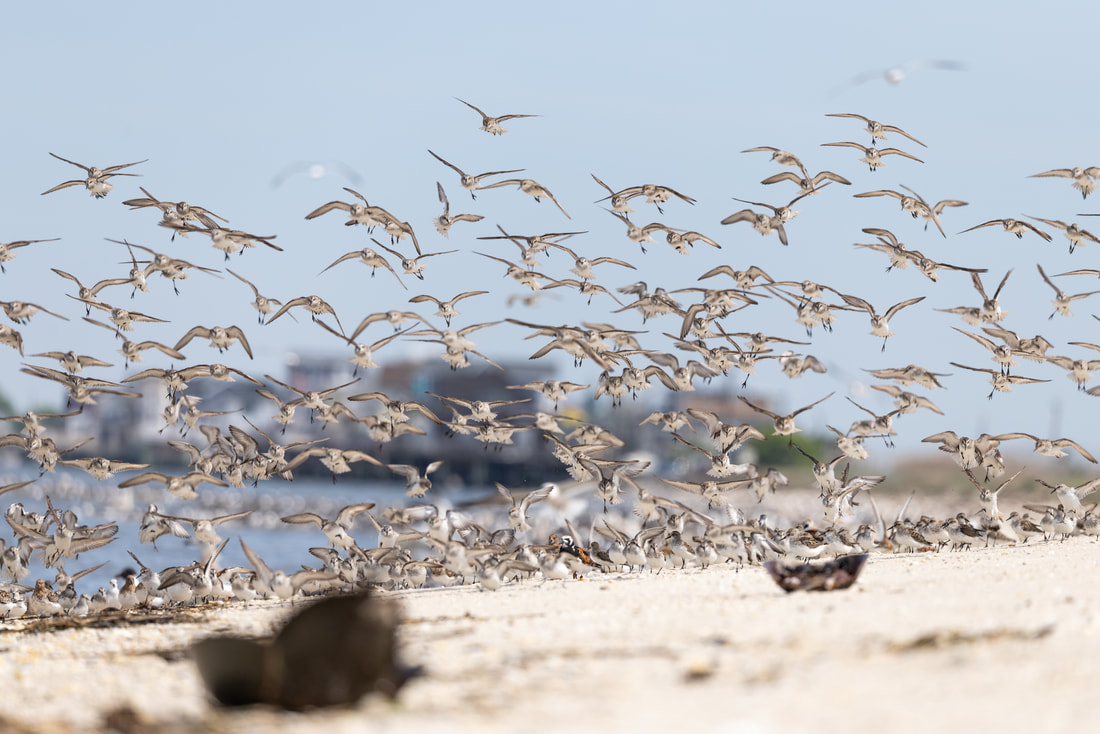
Shorebird foraging along one of the restored beaches built by the Society and their partners in Delaware Bay. Photo Credit: Sue Allen
A Hopeful Year, But Not a Full Recovery
This year’s shorebird observations offer reason for hope after years of conservation work.
Preliminary 2026 project observations reported approximately 33,000 red knots in a May 25 New Jersey-side count. Egg availability improved later in May on some beaches, although overall egg densities appeared broadly similar to those of recent years.
Even more encouraging, the proportion of red knots reaching the 180-gram departure threshold was extremely high. This matters because it is the weight biologists look for as a sign that birds are leaving the bay in good condition for the final flight to the Arctic.
These hopeful (albeit preliminary) numbers suggest that when beaches are restored, crabs are protected, and birds are given space to feed, Delaware Bay can still do what it has always done: fuel life. Conservation investments can pay dividends, but now is the time to let those investments grow, not cash them out too soon.
The Balance Is Still Fragile
Many factors influence whether enough eggs are available to the food web.
Like economics, some forces are beyond our direct control: climate, water temperature, migration timing, sea-level rise, and storms that sweep sand from beaches more frequently.
Plus, timing matters.
Shorebirds need eggs to be abundant and available during a very narrow window. Climate change can shift timing in ways that make it harder for shorebirds and horseshoe crabs to meet each other at the right moment. Water temperature can alter spawning timing. Cold water can delay spawning, while unusually warm conditions may advance it, potentially reducing the overlap between peak egg availability and shorebird migration.
Plus, horseshoe crabs can take roughly a decade to reach maturity. That is why the choices within our control matter so much.
We cannot control timing, or every tide, storm, or climate impact moving through Delaware Bay. But there are clear levers we can pull to support a strong Delaware Bay and a thriving horseshoe crab economy.
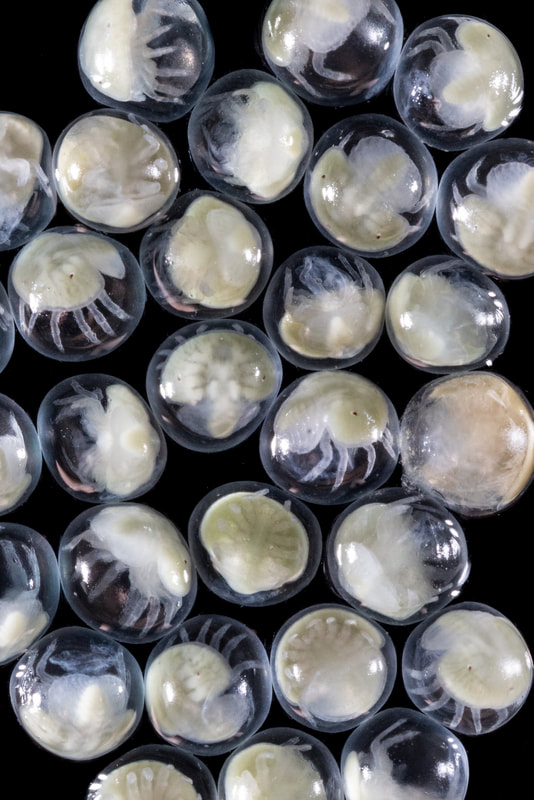
Developing horseshoe crab eggs up close! These calorie-rich orbs fuel the bay! Photo Credit: Sue Allen
First, Protect and Restore Delaware Bay Beaches
On Delaware Bay, sand is the platform for spawning and the delivery system for eggs.
Horseshoe crabs need dynamic sandy beaches with the right slope, grain size, and elevation so eggs are not smothered, washed away, or buried beyond the reach of shorebirds. American Littoral Society’s work at Reeds Beach, Cooks Beach, Kimbles Beach, and other Delaware Bay sites shows what this looks like in practice: removing rubble and debris, adding sand at a suitable grade and depth, restoring beaches for horseshoe crab spawning and shorebird foraging, and using oyster reefs and marsh restoration to strengthen shorelines. If you build the habitat, the wildlife comes. Restoring beaches is an investment in the bay’s productivity.
It’s just a bonus that by improving habitat and increasing shoreline resilience, we strengthen the shoreline for communities too.
Second, Maintain New Jersey’s Horseshoe Crab Harvest Moratorium And Preserve The Delaware Bay Region’s Zero-Female Bait-Harvest Quota
Taking adult crabs for bait removes spawning animals from a system that needs more eggs, not fewer.
Reopening a female harvest would be especially shortsighted. Female horseshoe crabs are the reproductive engine of the population. Removing them limits the food source that supports shorebirds, fish, terrapins, and the broader fisheries food web.
Horseshoe crab eggs help feed the bay. For people who rely on fisheries, this is also a fisheries productivity issue. These eggs support the chain of life that supports fish, baitfish, and the species commercial and recreational fishermen care about.
Reducing that food supply before the horseshoe crab population and egg densities have fully rebounded is not smart management. It is pulling from the principal before the investment has matured. You would not drain your savings just because the market finally started moving in the right direction. You would let the investment grow.
The same is true here. Recent signs of improvement are exactly why we should stay the course. They are not a reason to roll back protections. They are encouraging evidence that sustained conservation can help the system recover when conditions align.
Third, Move Fully Toward Synthetic Biomedical Alternatives
For decades, horseshoe crabs have been captured and bled for biomedical testing. Horseshoe crabs have contributed enormously to human health. But synthetic alternatives now exist.
Validated alternatives to horseshoe crab-derived endotoxin tests now exist and are increasingly recognized by U.S. and international standards. Accelerating their adoption is necessary to reduce biomedical reliance on wild horseshoe crabs. Eliminating the biomedical pressure is another lever we can pull.
Fourth, We Can All Be Good Stewards
Everyone who loves Delaware Bay has a role to play.
People can help by respecting seasonal beach closures, giving feeding shorebirds space, turning over stranded horseshoe crabs, joining American Littoral Society tagging events, supporting beach restoration, supporting smart horseshoe crab policy, and bringing others to the bay to learn why the Bayshore is so important.
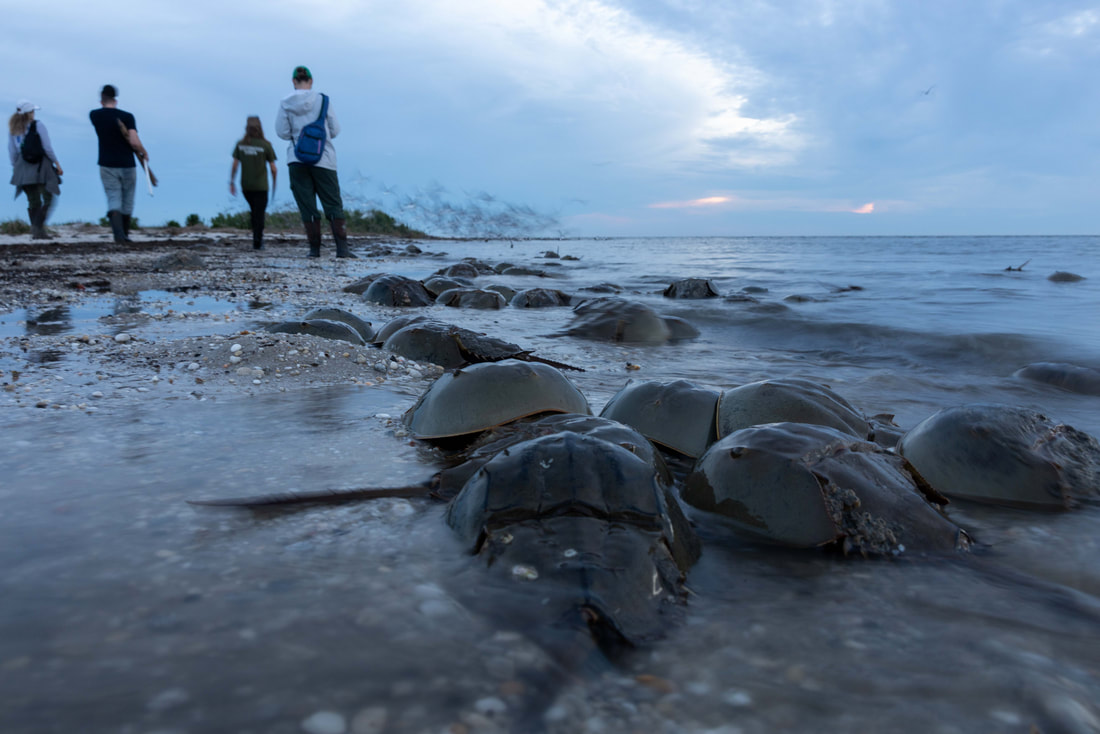
Society surveying Kimbles Beach, before upcoming sand nourishment in the coming year. Monitoring work by Society supports beach restoration efforts that help horseshoe crabs, fish, and residents. Photo Credit: Sue Allen
Let the Investment Grow
Recent assessments indicate that Delaware Bay horseshoe crab abundance has generally improved since approximately 2012, following earlier harvest reductions. Those signs of improvement have prompted decision-makers to look again at the models that inform horseshoe crab bait harvest policy. But abundance today should not make us forget how hard this system was hit, or how long recovery takes, particularly for slow-maturing species.
The real question is whether there are enough eggs, in the right places, at the right time, to support the food web and broader ecology of the system to a level we want.
Now is not the time to roll back protections. Now is the time to let the investment grow.
Policymakers should maintain horseshoe crab harvest moratoriums, keep Delaware Bay female horseshoe crabs off the bait market, expand funding for Delaware Bay beach restoration, and accelerate the transition to synthetic biomedical alternatives.
To support a thriving Bay full of life, we need to act on the levers we still control. Delaware Bay still knows how to sustain life. Our job is to give it enough room, enough time, and enough horseshoe crabs to do so.
American Littoral Society


The American Littoral Society promotes the study and conservation of marine life and habitat, protects the coast from harm, and empowers others to do the same. Since 1961 we have empowered people to care for the coast through advocacy, conservation, and education. We not only provide a voice for the coast, but also give concerned citizens the knowledge and tools they need to raise their voices with us. When we restore habitat, our objective is not only to restore a dune or rebuild an oyster reef, but also to motivate people to invest “sweat equity” into a piece of the coast, take ownership and become committed stewards. When we educate, we don’t merely provide books, CDs, or handouts.