


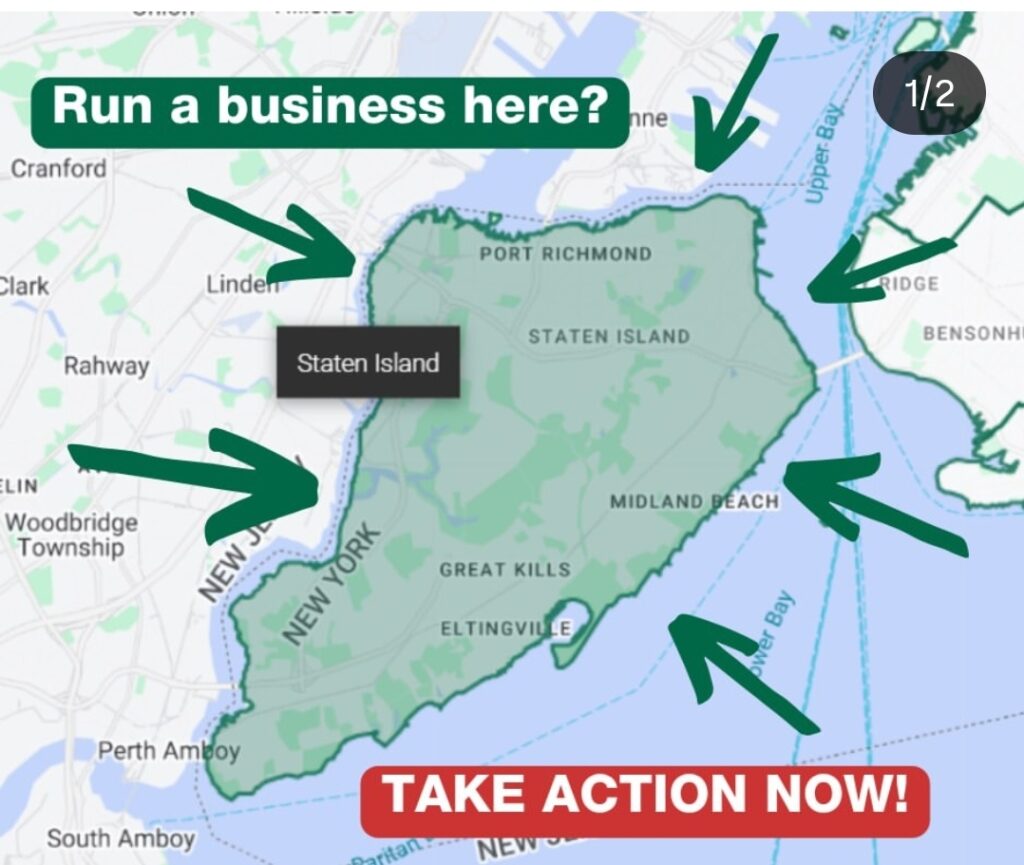
Staten Island is one zone, and its rollout has begun and goes through August.
The following was provided by Department of Sanitation’s press office regarding this program:
You can find information about commercial waste zone implementation here: https://www.nyc.gov/site/dsny/businesses/commercial-waste-zones.page (there is a wealth of information in the sidebar links and the buttons along the top).
Here is a summary of the program discussed with DSNY for companies on Staten Island and citywide:
For businesses: everyone falls into a zone. Staten island is being zoned now. There’s a handful of companies per zone, and everyone is receiving one to one outreach from DSNY.
Businesses are free to shop around the approved providers. If they don’t get a contract, then one will be assigned to them. The DSNY is not putting out a new press release as each one of the zones comes online, since they communicate to the companies with direct outreach.
All businesses are receiving one to one outreach, with mailers going out.
Details about Staten Island’s rollout:
Commercial Waste Zones Plan
While DSNY collects trash, recycling, and composting from residential buildings, more than 90 different private carters crisscross the city each night to service the city’s 100,000 commercial businesses, driving long, overlapping and unsafe routes.
The Commercial Waste Zone (CWZ) program divides the city into 20 zones, each served by up to three carters selected through a competitive process. Five citywide contracts are also awarded for the collection of containerized waste and compactors. The CWZ program will begin reducing truck traffic associated with commercial waste collection, eliminating millions of heavy-duty truck miles from NYC streets every year, while strengthening service standards and allowing for customer choice.
The first Commercial Waste Zone rolled out on January 2, 2025, in Central Queens.
This is the press release announcing the opening of the new location in Queens in 2025, which served as a pilot for the program:
Queens Central (Jackson Heights, Corona, Elmhurst, Parts of Forest Hills and Ridgewood) Now Fully Governed by New Rules Set Forth in Local Law 199 of 2019
The New York City Department of Sanitation (DSNY) announced today that, following an extensive outreach and education period, the first New York City Commercial Waste Zone is now fully operational. While the Department of Sanitation collects trash, recycling, and compostable material from residents, businesses are required to hire private carters to collect their waste. Historically, this has been an inefficient, hazardous system with private carters driving lengthy routes all over the City.
Local Law 199 of 2019 was designed to reform this system, by establishing new safety standards for workers in the commercial carting industry, improving service for businesses, increasing diversion rates, and reducing vehicle miles traveled to reduce harmful emissions from waste hauling vehicles. Under this new system, the City is divided into 20 “Commercial Waste Zones,” and DSNY authorizes three carters to operate in a given zone. In addition to three carters per zone, there are also five carters authorized to pick up large containers from loading docks or large off-street compactors citywide.
In order to implement the first zone, Queens Central (Jackson Heights, Corona, Elmhurst, and parts of Forest Hills and Ridgewood), DSNY engaged in thousands of contacts with local businesses and sent mailers in multiple languages. All businesses have had the opportunity to sign contracts with the new authorized carters, and a majority have done so; the remaining businesses have been assigned a carter by DSNY, but are able to renegotiate price and service level if needed, or may sign on with a different carter in the zone. In order to ensure that no commercial trash is left on the street, DSNY recently amended the CWZ rules to allow greater flexibility in the amount of service carters provide to businesses that did not actively sign a contract.
The implementation of this first zone gives DSNY substantial new regulatory authority over commercial waste, but some new enforcement authority began with the start of the first implementation period in September 2024 – and the Strongest have not waited to act. In the last three months, DSNY has issued approximately 150 notices of violation to commercial waste haulers in Queens Central, with a goal of a cleaner, safer City.
A great deal of additional information about the regulatory and environmental benefits of the CWZ program is available in this prior press release, and more information about the program – including details on how this program can save businesses money – is available at nyc.gov/commercialwaste.
New York City Department of Sanitation Announces Key Details and Contract Awards by Zone for Implementation of Sweeping Commercial Waste Reform, Local Law 199 of 2019
First Commercial Waste Zone to roll out in Queens; will bring increased safety and worker protections to entire commercial waste industry
Program will lead to 12 million fewer truck miles per year driven by private carting vehicles
Following significant planning, analysis, and contract development, the New York City Department of Sanitation (DSNY) today announced the next steps in the monumental overhaul of the City’s commercial waste industry mandated under Local Law 199 of 2019. While the Department of Sanitation collects trash, recycling, and compostable material from residents, businesses are required to hire private carters to collect their waste. Currently, any neighborhood may be serviced by dozens of these carters in an inefficient, hazardous, and unsustainable system.
Local Law 199 of 2019 was designed to reform this system, by establishing new safety standards for workers in the commercial carting industry, improving service for businesses, increasing diversion rates, and reducing vehicle miles traveled as well as harmful emissions from waste hauling vehicles.
DSNY is today announcing that it has established new no-cost contracts with carters directly to reach the goals set out in the law. These selected carters are then authorized to operate in a given “Commercial Waste Zone” within the five boroughs and under the rules and requirements set forth by DSNY. Three carters were selected in each of the 20 zones to provide small businesses with service choices and competitive pricing. In addition to contracts with three authorized carters per zone, DSNY has also established contracts with five carters to operate citywide to pick up containerized waste from compactors and businesses that have loading docks. A map of all 20 zones can be seen here.
Today, for the first time, DSNY is listing the awardees by zone and affirming the timeline to launch the first zone. Queens Central, which includes Jackson Heights, Corona, and Elmhurst, will come online as the pilot district of the Commercial Waste Zone program in the fall of 2024, fulfilling a commitment made by DSNY at the start of the Adams Administration. After extensive, thoughtful review, Queens Central was selected because of its wide variety of business types, and this pilot zone will inform the rollout timeline and methodology of subsequent zones.
One of the driving forces behind Local Law 199 of 2019 was the creation of stronger legal protections for the workers who collect and process commercial waste. To that end, as the program rolls out, DSNY rules will take effect requiring carters to install safety equipment including back-up cameras, auxiliary exterior lighting, and cross-over mirrors, as well as an integrated system for monitoring and recording GPS data.
Each awardee and subcontractor is also required to provide annual certifications of worker safety training to DSNY, including training on collision avoidance, vehicle and equipment inspections, container management, and safe collection stops, as well as staffing plans to demonstrate that they have sufficient staff to perform awarded work.
While some awardees are still working to finalize their list of subcontractors, the current list of awardees and subcontractors contains a mix of small, medium, and large carters, which directly addresses concerns from advocates that this reform would lead to an industry dominated by a few large companies. 70 percent of the awardees or subcontractors currently hold less than 3 percent market share each, and 14 of the 30 hold less than 1 percent market share each.
Under the agreements being announced today, carters must charge their customers less for the collection of recycling and compostable material than they do for the collection of refuse, giving New York City’s 200,000 businesses an opportunity to save money while helping divert material from landfill.
A DSNY analysis found that when fully implemented, this program will achieve the legislative goal of reducing by 50% commercial carter vehicle miles traveled, equivalent to 12 million fewer miles driven per year. In keeping with a key priority of the Adams Administration, each carter also submitted plans to utilize zero emission vehicles in the provision of their services.
In other cities that have attempted to reform their commercial carting systems, businesses suffered under substantial price increases. As a result of complex negotiations and smart, careful contracting by the Adams Administration, in 18 of the 20 zones, at least one of the three carters will operate at a maximum rate that is below the current Business Integrity Commission (BIC) rate cap for commercial carters. There are only two zones in which all awardees will be operating at a maximum price above the current BIC rate cap, and the amount over is in the low single digits – 5 percent in Bronx West and 2 percent in Upper Manhattan. Like the current BIC rate cap, these are maximum allowed prices and businesses may continue the practice of negotiating for lower pricing as carters compete against one another within their awarded zone. This pricing is a ceiling, not a floor.
The Adams Administration has included substantial measures to protect residents and businesses in these contracts. The Department may terminate any contract if: the awardee or any of its officers, directors, partners, five percent or greater shareholders, principals, or other employee or person substantially involved in its activities are indicted or convicted under any state or federal law for certain criminal offenses, including any offense possibly indicating a lack of business integrity. Each of the selected carters is licensed by BIC, and revocation of a carter’s BIC license is grounds for immediate termination of its ability to operate within the Commercial Waste Zones program.
Additionally, DSNY has the authority to require an independent monitor of any of the carters at any time it deems necessary.
Before the law goes into effect in each zone, every business in that zone will receive substantial direct and multilingual outreach from DSNY, providing ample time to transition service if required. Businesses may also find all information about this program at nyc.gov/cwz or nyc.gov/commercialwaste.
Banner Image: Staten Island new business regulations flyer. Image Credit – DSNY
NYC Department of Sanitation


The NYC Department of Sanitation is the world’s largest sanitation department. DSNY collects more than 10,500 tons of residential and institutional garbage and 1,760 tons of the recyclables – each day. While efficiently managing solid waste and clearing litter or snow from 6,300 miles of streets, the Department is also a leader in environmentalism — committing to sending zero waste to landfills.