

Eastern Parkway Library, Queens Flood Infrastructure, David Dinkins Panoramic Access, Probation Graduation, Childcare Payment Delays, Fast Buses, Year-Round Outdoor Dining, Legionnaires Disease, Brooklyn Street Redesign, Generative AI Moratorium In Schools: Mayor Mamdani
Editor’s note: We have reported in the past on the expansion of childcare, including free 2-K for some residents, by the Mayor’s Office. This has been a top priority for this administration. We also reported on Legionnaires’ Disease outbreaks in various locations in the City, primarily in Harlem. We have also covered the new evolutions of AI and how businesses can keep pace with this emerging technology.
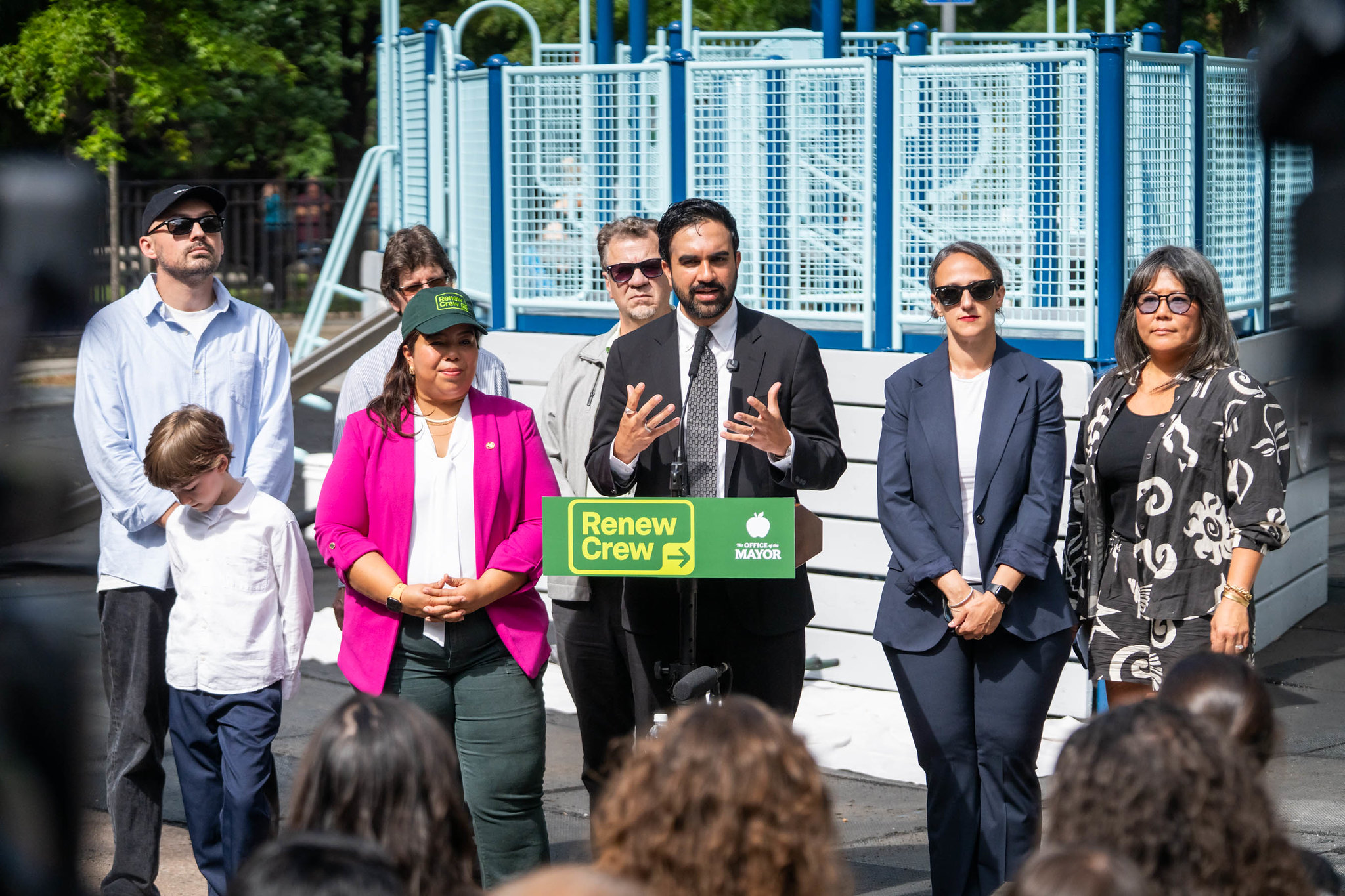
Mayor Mamdani Breaks Ground on $36 Million Transformation of Eastern Parkway Library
Major renovation will expand the branch by more than 50%, make it accessible and preserve its historic architecture
NEW YORK – Mayor Zohran Kwame Mamdani, Department of Design and Construction (DDC) Commissioner Paul A. Ochoa and Brooklyn Public Library President and CEO Linda E. Johnson today announced the start of a $36 million project to renovate and expand the Eastern Parkway Library, increasing the branch’s public space by more than 50% while preserving its historic site architecture. DDC expects construction to be completed in summer 2028.
“Libraries are where New Yorkers go to learn, discover and imagine what is possible, and they deserve spaces that meet the needs of our city today,” said Mayor Mamdani. “This $36 million investment will make Eastern Parkway Library fully accessible, more energy efficient and more welcoming, while honoring the architecture that has made this branch a beloved part of Crown Heights for more than a century. With more natural light, a green courtyard, a reading terrace and spaces for kids, teens and families, we are giving New Yorkers a library worthy of the community it serves.”
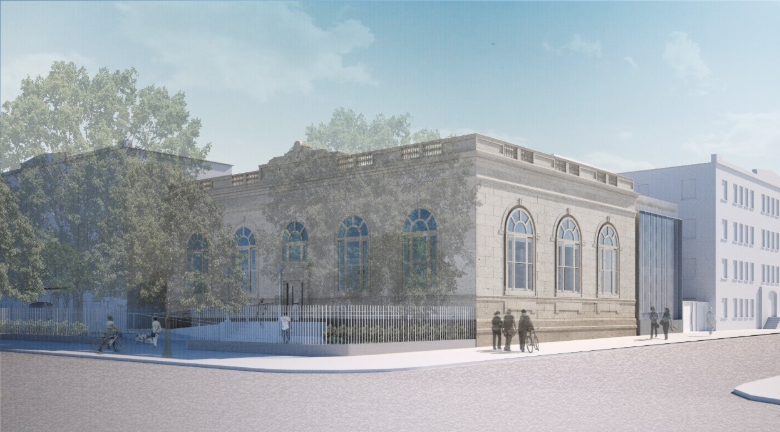
Rendering of the renovated Eastern Parkway Library exterior.
“Renovations like this one recognize that practical doesn’t have to come at the expense of excellent,” said Deputy Mayor for Operations Julia Kerson. “This $34 million renovation will deliver a more accessible and efficient building while celebrating the historic architecture that makes the library so iconic. Thank you to the Department of Design and Construction and Brooklyn Public Library for designing this renovation with care and modeling how we build with purpose and heart.”
“The Eastern Parkway Library has served Brooklyn for over a century. The renovation — which will bring more natural light into the branch, add modern technology and create inspiring spaces — will ensure that Eastern Parkway Library can serve the community for another 100 years,” said Linda E. Johnson, President and CEO of Brooklyn Public Library. “Thanks to Settlement Housing Fund, Amazon and IKEA, we are opening a temporary library in the neighborhood this fall, ensuring vital library services remain accessible throughout the construction process.”
“The Eastern Parkway Library is an architectural gem in the Crown Heights community and one of the busiest libraries in Brooklyn, and we are thrilled to break ground on this amazing project,” said DDC Commissioner Paul A. Ochoa. “This project is not only upgrading the interior of this unique, two-story building, but we are also making it fully ADA-compliant and expanding public space by more than 50%! This is what the community asked for, and what we’ll be delivering.”
The Eastern Parkway Library has served the Crown Heights community since 1914. The Carnegie library is a two-story Classic-Revival building with a limestone façade and distinctive long, arched windows. The library features double-height reading rooms with abundant natural light and mezzanines overlooking the lower floor.
The expansion will add a large glass façade to bring more natural lighting into the library and make the building fully ADA-compliant with a new elevator and entrance ramp. The redesigned branch will include dedicated reading and learning spaces, including a multipurpose room with a projector, a main reading room, a teen zone, two children’s zones, a STEAM room, a community room and a classroom in the restored fireplace room.
The library will also feature a renovated courtyard with outdoor seating and a third-floor reading terrace surrounded by greenery. Through the NYC Department of Cultural Affairs (DCLA) Percent for Art Program, artwork by New York-based artist Oasa DuVerneywill be displayed throughout the library.
The building will receive modern, energy-efficient lighting, as well as upgrades to its plumbing, HVAC and fire alarm systems. Following the renovation, the library is expected to achieve a LEED Silver certification.
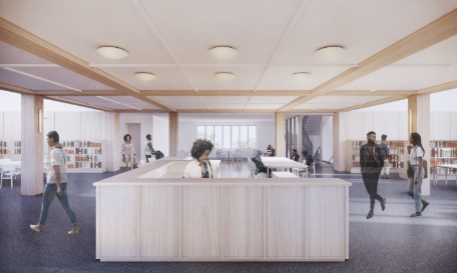
Renderings of the renovated Eastern Parkway Library interior.
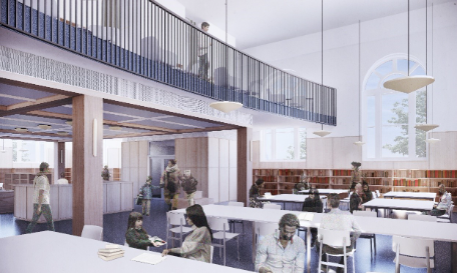
Renderings of the renovated Eastern Parkway Library interior.
During construction, library services will continue at a temporary pop-up location provided by Settlement Housing Fund, with furnishings donated by IKEA and additional support for interim library services provided by Amazon. When the pop-up library opens this fall, patrons will be able to check out books, attend programs and use technology.
Funding for the renovation is provided by the Office of the Mayor, the New York City Council, Brooklyn Borough President Antonio Reynoso and the New York State Assembly.
“The Eastern Parkway Library has been opening doors to opportunity for Brooklynites for more than a century, and I am proud to help fund the transformation of this beloved landmark,” said Brooklyn Borough President Antonio Reynoso. “Libraries are one of the most important public resources we can invest in, and this redesign will create more modern, accessible spaces that our communities deserve. Thanks to the Brooklyn Public Library and the Department of Design and Construction for ensuring that the Eastern Parkway Library continues serving Crown Heights and Brooklynites for generations to come.”
“We are so thrilled to be able to host this temporary library space while renovations are completed at the Eastern Parkway Library,” said Judy Herbstman, President of Settlement Housing Fund. “Settlement Housing Fund has been working in Crown Heights for more than 35 years and we’re proud to partner with Brooklyn Public Library to host this temporary pop-up, ensuring that learning, connection and opportunity remain within reach for our residents and neighbors while the Eastern Parkway Library is renovated.”
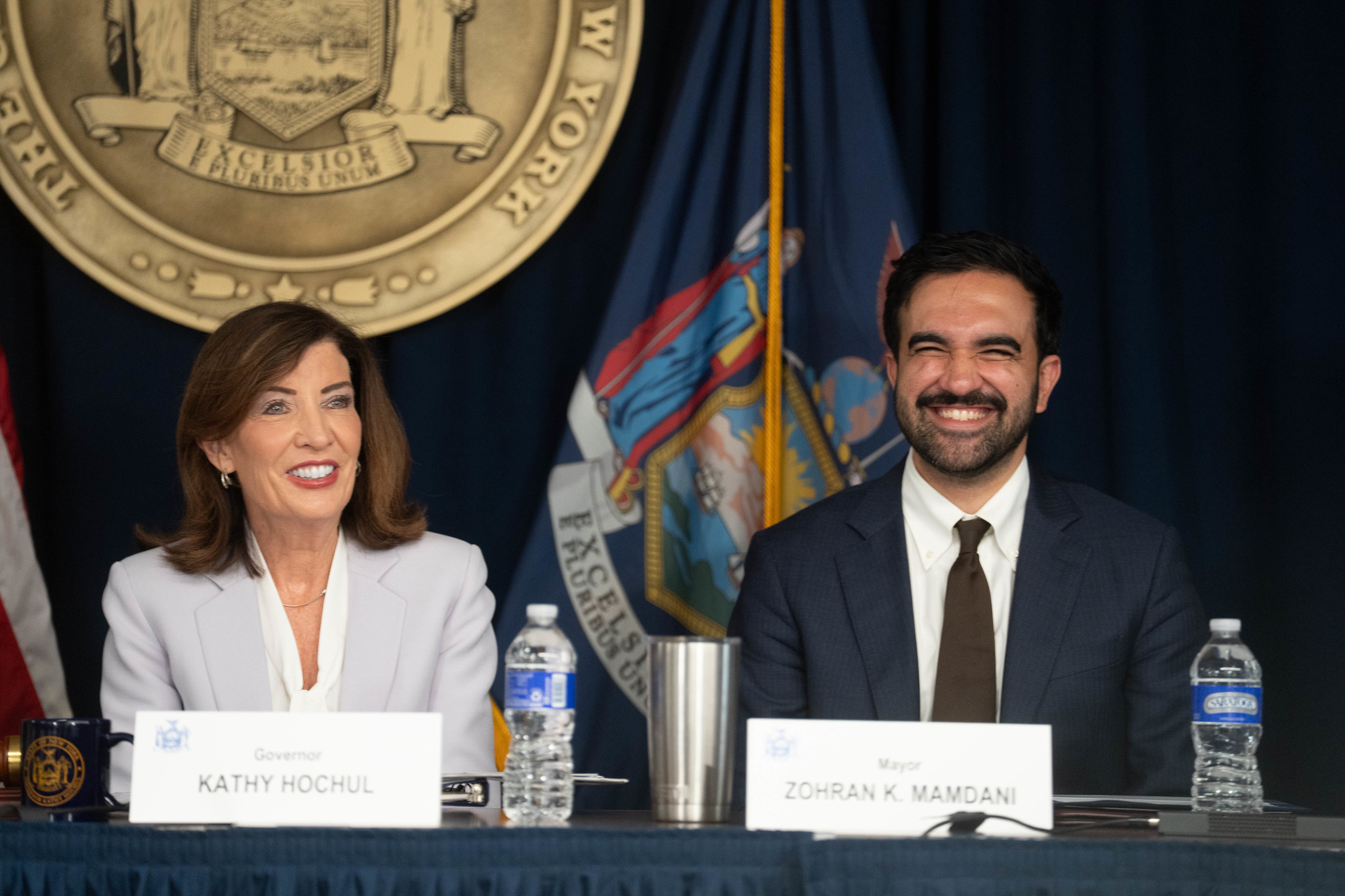
Mayor Zohran Kwame Mamdani attends the annual New York State Financial Control Board meetingwith Governor Kathy Hochul on Wednesday, August 12, 2026. Michael Appleton/Mayoral Photography Office
Mayor Mamdani, Governor Hochul Announce $8.4 Million to Transform Concrete Medians into Flood Prevention Infrastructure in Queens
New green spaces in Whitestone, Forest Hills and Queens Village will capture a combined five million gallons of stormwater each year
Projects will help alleviate strain on sewer system and improve water quality of local waterways
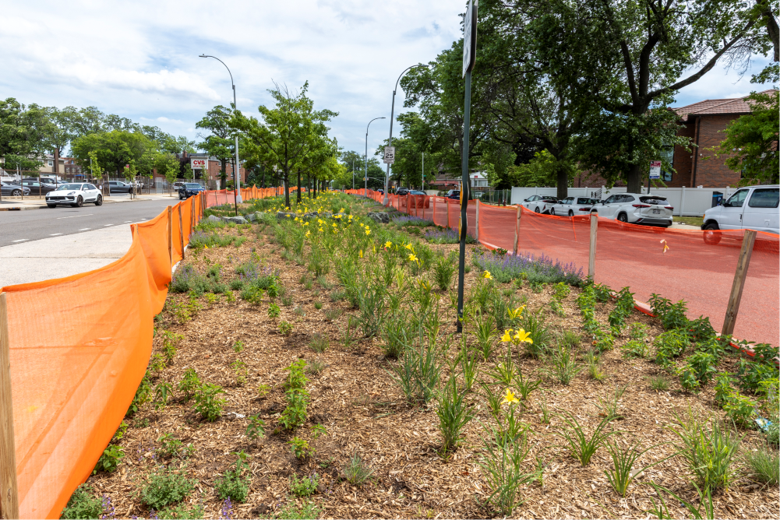
Green median project in Whitestone. Image Credit – NYC Mayor
NEW YORK – Mayor Zohran Kwame Mamdani, Governor Kathy Hochul and New York City Department of Environmental Protection (DEP) Commissioner Lisa F. Garcia today announced an $8.4 million investment in flood resiliency infrastructure, transforming concrete roadway medians in Whitestone, Forest Hills and Queens Village to green infrastructure “sponges” that will absorb stormwater and prevent extreme weather flooding. In total, the newly engineered spaces in Queens are expected to capture an estimated five million gallons of stormwater each year, alleviating strain on the sewer system and improving the water quality of local waterways including the East River, Flushing Bay and Jamaica Bay.
“Climate change is bringing more intense and unpredictable bursts of rain, and without action, those storms will continue to overwhelm New York City’s sewer system,” said Mayor Mamdani. “This $8.4 million green median project meets that challenge with infrastructure that works for our environment and our neighborhoods. By planting native species and wildflowers above an underground stormwater storage network, we will capture five million gallons of stormwater each year, easing pressure on our sewer system and keeping New Yorkers safe. We are grateful to Governor Hochul and our state partners for investing in resilient infrastructure that protects New Yorkers while making our city greener and more beautiful.”
“With flash floods becoming more the norm due to extreme weather tied to our changing climate, it’s imperative we do all we can to protect our communities,” said Governor Hochul. “Here in New York, we are implementing innovative solutions to strengthen our infrastructure and better protect our communities. Working with Mayor Mamdani and the City of New York, these critical green infrastructure projects will help make Whitestone, Forest Hills and Queens Village more resilient and safe.”
The projects are funded in part by New York State grants totaling $5 million from the Green Innovation Grant Program administered by the Environmental Facilities Corp. and the Water Quality Improvement Project overseen by the New York State Department of Environmental Conservation (DEC).
“Climate change is reshaping our world, and we need to reshape the infrastructure of our city in return. By trading hard concrete for living landscapes, we are not just managing stormwater but reimagining what our streets can be,” said DEP Commissioner Lisa F. Garcia. “These expansive medians will become vibrant green corridors that soak up millions of gallons of stormwater each year. This is how we transform everyday spaces into innovative flooding solutions that both protect communities and beautify neighborhoods.”
“DEC is proud to partner with Mayor Mamdani and our city and state partners on strategies to help reduce flooding and enhance communities in Queens,” said DEC Commissioner Amanda Lefton. “Thanks to Governor Kathy Hochul’s record state investments in green infrastructure and other water quality improvements, DEC is able to help support initiatives led by the City and municipalities statewide with resources they need to implement important stormwater management projects like these new green corridors that will greatly benefit Queens Village, Whitestone and Forest Hills.”
“Governor Hochul is investing in solutions that are as practical as they are innovative. The $5 million in grants for these Queens projects will transform concrete medians into green ‘sponges’ capable of soaking up millions of gallons of stormwater, reducing flood risk and protecting New Yorkers,” said New York State Environmental Facilities Corporation President and CEO Maureen A. Coleman. “By supporting projects that work with nature to manage severe weather, the State is helping New York City build resilience while minimizing costs for ratepayers.”
Work will remove the old concrete medians and curbs and clear overgrown or dead trees, weeds and accumulated debris. To ensure water flows into the medians, new inlet openings will be built to divert water off the streets and directly into the planted areas. Construction includes installing specially engineered soils and underground storage systems designed to absorb stormwater.
The landscaping will transform these spaces into green corridors, planted with native species, shrubs, grasses and wildflowers. Together, these improvements will cool and beautify the streetscape while providing stronger flood protection for surrounding neighborhoods. The projects also deliver landscape upgrades that enhance neighborhood aesthetic, while improving pedestrian safety with ADA‑compliant ramps and detectable warning surfaces.
Whitestone: Francis Lewis Boulevard, between 20th Avenue and 21st Road
The medians along Francis Lewis Boulevard, now nearing completion, stretch 1,105 feet and capture runoff from a 1.17‑acre drainage area. They will manage 1.11 million gallons of stormwater each year, reducing combined sewer overflows (CSO) into the East River.
Forest Hills: Union Turnpike, between Metropolitan Avenue and 71st Road
Set to be planted this fall, the Union Turnpike medians extend 3,245 feet and draw from a 2.56‑acre drainage area. They are designed to handle 2.43 million gallons of stormwater annually, easing pressure on the system and preventing CSO into Flushing Bay.
Queens Village: Springfield Boulevard, between Lucas Street and Merrick Boulevard
Construction on Springfield Boulevard’s medians, expected to begin later this year, will add 1,182 feet of green infrastructure tied to a 1.51‑acre drainage area. These improvements will manage 1.44 million gallons of stormwater each year and help limit CSO into Jamaica Bay.
All work has been closely coordinated with the New York City Department of Transportation (NYC DOT) and NYC Parks.
“Concrete medians help improve safety by making it easier for pedestrians to cross the street and by better organizing traffic — but they can also play an important role in protecting our city from the dangers of extreme weather and flooding,” said NYC DOT Commissioner Mike Flynn. “As New York City sees more and more intense rainstorms due to climate change, now more than ever it’s crucial to improve and rethink our infrastructure to protect New Yorkers against growing environmental threats.”
“As we deal with the effects of climate change, New York City must take creative measures to bolster our infrastructure against flooding from severe storms. These medians will prevent millions of gallons of stormwater from entering our sewer system, while also making it safer for New Yorkers to cross streets and beautifying our neighborhoods with native plantings,” said NYC Parks Commissioner Tricia Shimamura. “We were proud to partner on this project that will serve to make our city greener and more resilient.”

Mayor Zohran Kwame Mamdani mkes an announcement on standing up to ICE overreach with Governor Hochul and Attorney General James on Wednesday, August 12, 2026. Michael Appleton/Mayoral Photography Office
Mayor Mamdani Expands Access to Free Panoramic Experience Atop the David N. Dinkins Municipal Building
Large groups and walk-in access will give nearly 2,000 visitors a month the chance to take in views from Centre 360
Since opening in June, reservations have booked out in less than two minutes
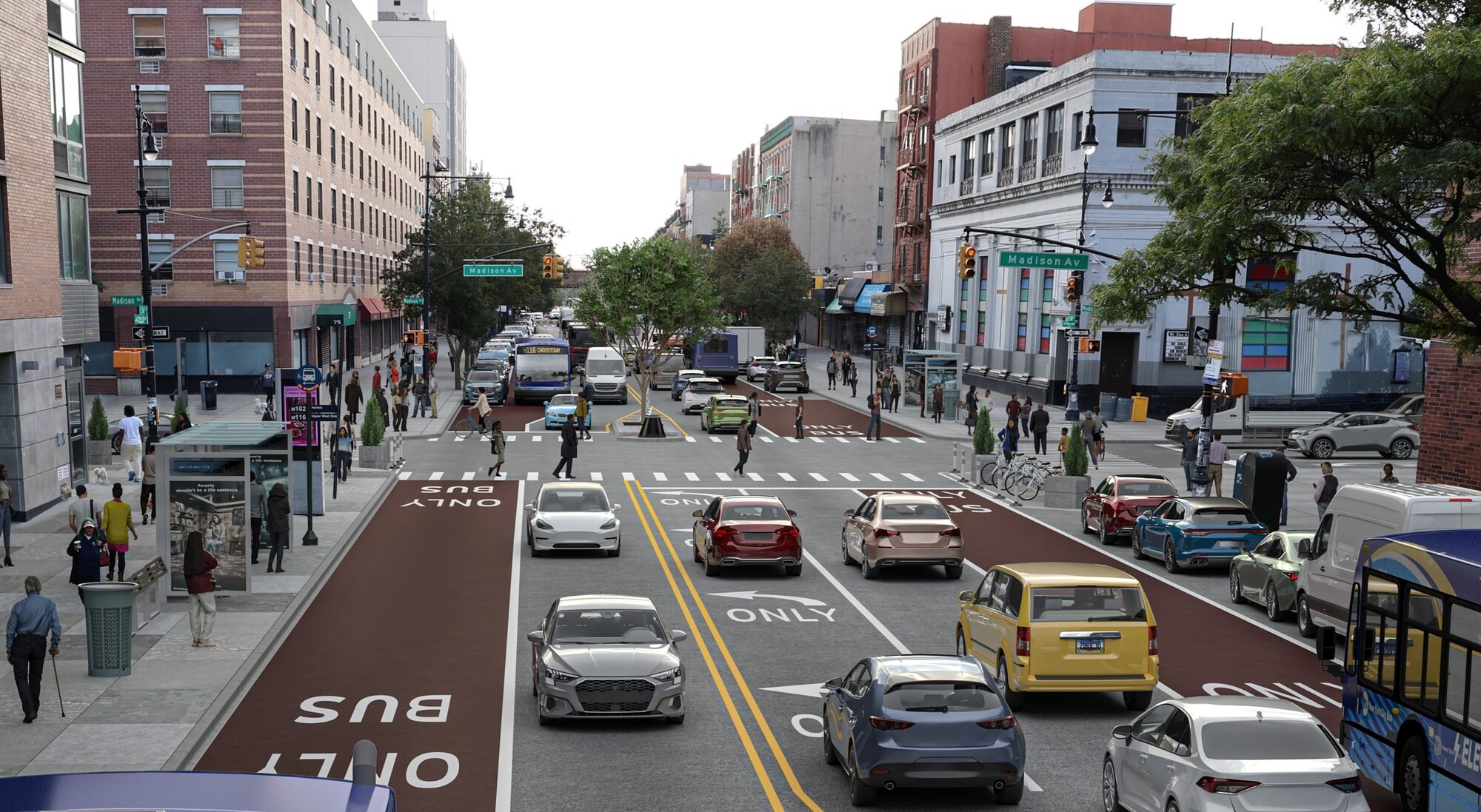
Rendering of the future design of East 116th Street and Madison Avenue. Credit: NYC DOT
NEW YORK – Mayor Zohran Kwame Mamdani and Department of Citywide Administrative Services (DCAS) Commissioner Yume Kitasei today announced expanded access to Centre 360, the City’s free public panoramic experience atop the cupola of the David N. Dinkins Municipal Building. Reservations will now accommodate groups of up to eight visitors, up from five, giving nearly 2,000 people each month the opportunity to travel more than 500 feet above street level and take in unparalleled views of Lower Manhattan and all five boroughs from one of New York City’s most iconic civic landmarks.
Centre 360 launched in June following a $6 million restoration project that repaired the building’s historic cupola, installed glass safety barriers and restored the rotunda landing. Since opening, reservations have booked out within two minutes each month.
“Since we opened the cupola this summer, New Yorkers have shown us just how much they want to experience this iconic landmark,” said Mayor Mamdani. “When demand is this strong, our job is to find a way to open the doors wider. Today we’re doing just that by expanding reservation groups from five to eight and adding walk-in access when space becomes available, so hundreds more people can take in these incredible views each month.”
“Due to the overwhelming popularity of the Centre 360 experience, we are excited to open more slots and begin accepting walk-ins,” said DCAS Commissioner Yume Kitasei. “The views from Centre 360 are breathtaking, and it has been a goal of this administration to ensure as many New Yorkers as possible can have this experience — this is the next step in that mission.”
To further expand access, DCAS will also implement a first-come, first-served walk-in policy when last-minute cancellations or no-shows create availability.
DCAS offers eight viewing sessions each weekday, Monday through Friday, from 9 a.m. to 5 p.m. Each session will have two reservations available for groups of four people, a total of eight people per viewing. Children under 18 must be accompanied by an adult and must be at least 42 inches tall.
Visitors must reserve tickets through the online reservation system and present a valid photo ID upon arrival. Reservations open on the first day of each month. Walk-ins will be accommodated on a first-come, first-served basis when availability allows. For more information or to make a reservation, visit the Centre 360 website.
One of the world’s largest government office buildings, the David N. Dinkins Municipal Building houses more than 2,000 employees across a dozen City agencies. Designed by the architectural firm McKim, Mead & White and constructed between 1909 and 1914, the building was designated a New York City landmark in 1966 and added to the National Register of Historic Places in 1972.
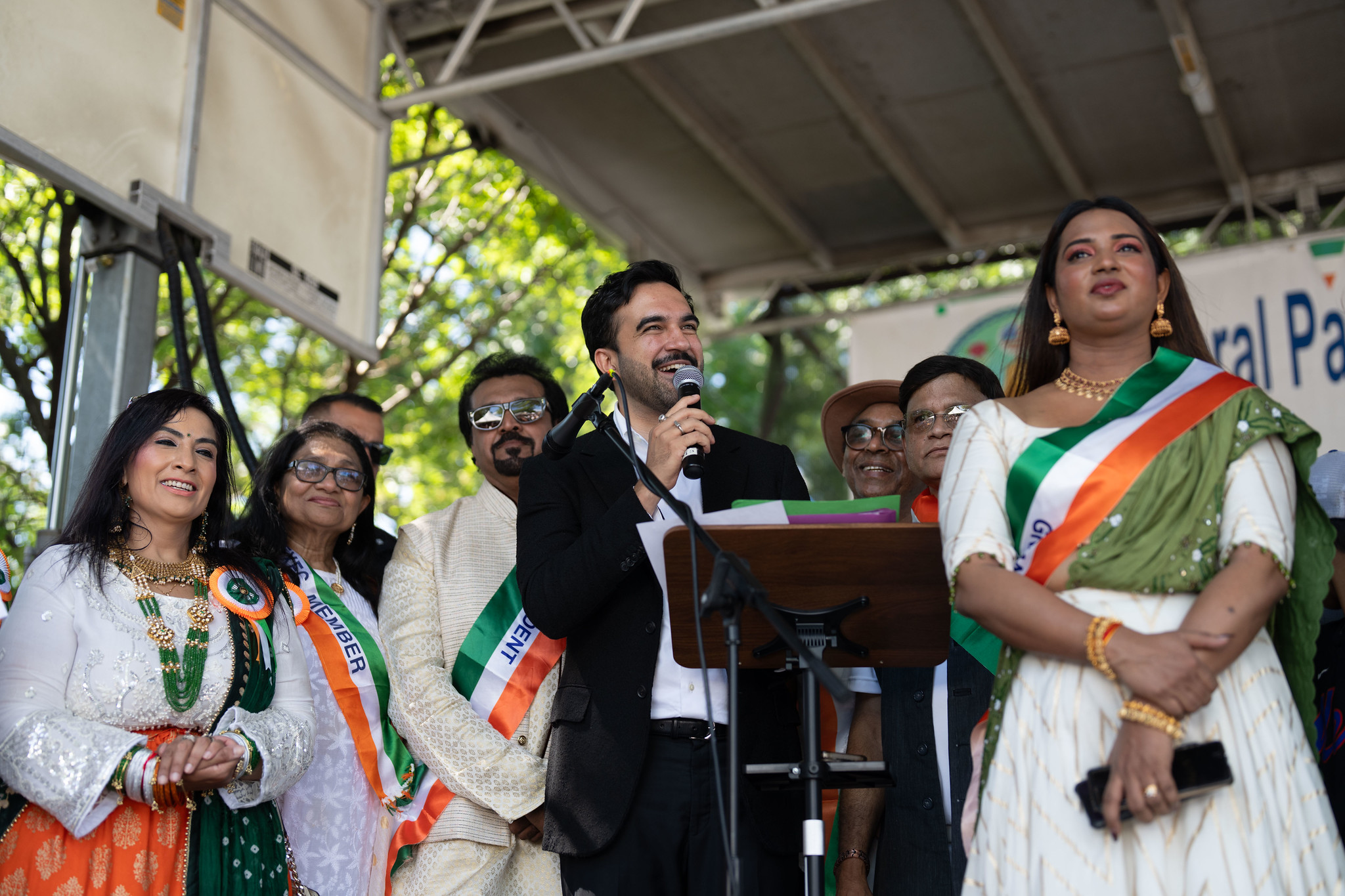
Mayor Zohran Kwame Mamdani delivers remarks at the Floral Park Indian Day Parade on Saturday, August 15, 2026. Michael Appleton/Mayoral Photography Office
REMARKS AS PREPARED: MAYOR MAMDANI DELIVERS REMARKS AT DEPARTMENT OF PROBATION GRADUATION CEREMONY
Mayor Zohran Kwame Mamdani: Good morning, Class 26-01! It is an honor to join you and your families here at Queens Borough Hall as we celebrate your graduation. First and foremost: congratulations. Today, you become New York City Probation Officers. Let’s hear it for the class!
I want to start by thanking Commissioner Sharun Goodwin for her leadership. I would also like to thank Queens Borough President Donovan Richards for hosting us today, as well as Council Member Brooks-Powers and Sheriff Raymond for their service to our city. I am also pleased to be joined today by my First Deputy Mayor, Dean Fuleihan. I would like to recognize the United Probation Officers Association and President Dalvanie Powell.
I also want to take a moment to acknowledge the Department of Probation staff who have spent the last 14 weeks preparing this next class of officers. Your guidance and expertise have delivered our graduates to this day. And most importantly, I want to thank the many family members here this morning — the parents, grandparents, spouses, kids, aunts, uncles, and so many more who supported our graduating officers through their training.
Now, to the graduates standing before us, this morning is a testament to your dedication, commitment to public service, and belief in your fellow New Yorkers. Our city will be stronger and safer for your work. There are 35 of you graduating today, the largest class of our administration yet. You hail from each of the five boroughs and speak the languages of our city. For seven of you, this role is a continuation of a career in service to New York.
Many of you will proudly serve the communities you call home. And each of you is taking the oath of office for different reasons, but guided by the same love of this city. Bryan Rivera of Queens — a veteran and a son of immigrants — is becoming a probation officer because he wants to see more people like him represented in public service. Manny Carvajal of the Bronx wanted to take the skills he had developed as a corrections officer and bring them directly to his community. And Lawrence Burwell of Brooklyn joined up to become a force for good in the lives of others—just like the people who believed in him and gave him a second chance after he was incarcerated on Rikers Island as a young man.
Each of you — wherever you come from, whatever your story may be — have answered the call to serve. You may not have known what to expect on that first day of orientation nearly four months ago. But you came ready to learn and willing to challenge yourself. Now, you have the tools you need to serve your fellow New Yorkers with integrity, accountability and compassion.
Probation officers are often the bridge for New Yorkers between the criminal legal system and a new chapter of opportunity. You help people navigate some of the most critical moments in their lives, guiding them towards a better future. I have no doubt that this group of graduating officers is ready to meet that task.
I understand your class motto is “Firm in Duty, Fair in Judgement, Strong in Service.” But I have also heard that you have an unofficial motto — one that reflects the challenges of the work you are about to undertake: “It’s real out there.”
It certainly is.
There will be hard days, tough cases, moments where you feel disappointed and deflated, and more lessons to be learned on the job. But you did not choose to serve because you thought it would be easy. You chose it because you believe in supporting your fellow New Yorkers when they need it most. You chose it because you believe that every single person in our city deserves the chance to build a life they are proud of.
And as you step into that work, you will not be alone. You have the support and solidarity of your fellow graduates who are walking this path alongside you. You have a leader in Commissioner Goodwin who is charting a bright future for this department. And you have a City Hall that is standing proudly behind you.
Thank you for all that you have done so far and all that you will continue to do. On behalf of all New Yorkers, congratulations.
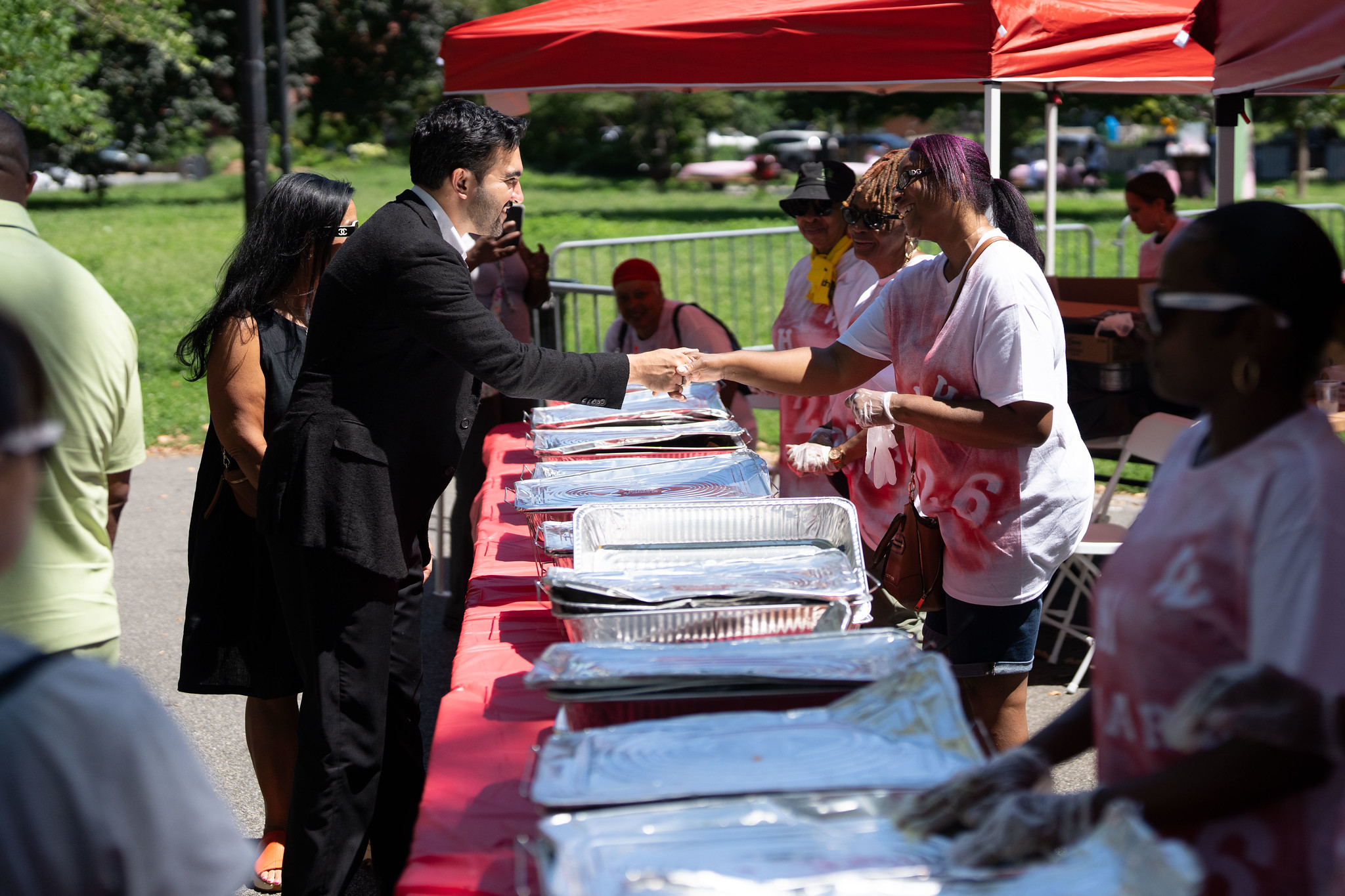
Mayor Zohran Kwame Mamdani attends NYCHA Family Day in Red Hook, Brooklyn on Saturday, August 15, 2026. Michael Appleton/Mayoral Photography Office
Mayor Mamdani and Chancellor Kamar Samuels Launch Sweeping Overhaul to Fix Child Care Payment Delays
Whole-of-government effort underway to expedite payments and ensure providers can open on the first day of school
$43 million investment will transform New York City Public Schools’ Division of Early Childhood Education and prevent future payment delays
NEW YORK – Mayor Zohran Kwame Mamdani and Schools Chancellor Kamar Samuels today announced a comprehensive overhaul of the City’s child care procurement process and New York City Public Schools’ Division of Early Childhood Education to better support child care providers and ensure they can continue serving New York families.
The Mamdani administration is taking a whole-of-government approach to ensure providers can open their doors on the first day of school by expediting interest-free bridge loans, accelerating contract registration and delivering critical supplies directly to providers. The overhaul also includes a $43 million investment to transform NYCPS’ Division of Early Childhood Education, restoring staffing capacity and implementing reforms designed to prevent future contracting and payment delays.
“Child care changes lives. For parents struggling under the weight of the affordability crisis, it can mean the difference between being able to work and being forced to choose between a paycheck and caring for your child. But we cannot deliver that relief without the child care providers who make it possible every day,” said Mayor Mamdani. “We are bringing every resource to bear to get providers paid, get classrooms open and make sure families have the care they were promised. And we are changing this system so that providers are never again asked to carry the cost of the City’s bureaucracy.”
“As a parent of three, I know firsthand the importance of finding a safe and affordable child care program. Our families and our small business owners cannot wait for contracts to clear — they need access to child care now,” said Chancellor Samuels. “Our families shouldn’t have to worry about their child care provider being able to pay the bills, and our providers should be focused on getting their classrooms ready for learning — not wondering when a check will come. Mayor Mamdani and I are absolutely committed to addressing the current issues now, and reforming our processes so this does not happen again.”
“Early childhood education providers have been grappling with cash flow and other contracting challenges for many years. To achieve our shared vision of a universal birth to five system, this administration must address all the issues that have perpetuated this dynamic. These proposed reforms are important and will go a long way to stabilize the system. We appreciate Mayor Mamdani for making this commitment to providers, and we look forward to working with the mayor and his team to build a system that will last,” said Susan Stamler, Executive Director, United Neighborhood Houses.
“As the City moves toward universal child care, the Day Care Council of New York appreciates Mayor Mamdani’s recognition of the tremendous financial strain facing providers, driven by long-persisting contracting and invoicing delays, and his Administration’s decisive steps to strengthen staffing across City agencies and reinforce contracting and payment systems after years of underinvestment,” said Tara Gardner, Executive Director of the Day Care Council of New York. “These immediate actions are critical to helping providers address operating expenses incurred for summer programming, meet payroll, retain staff and continue providing uninterrupted care to children and families. Just as importantly, the City’s upcoming early childhood reprocurement presents an opportunity to build on these reforms with contracts that provide greater stability and prevent these cash-flow crises from continuing to burden an already undervalued and overextended workforce.”
PREPARING FOR FIRST DAY OF SCHOOL:
The Mamdani Administration is taking a whole-of-government approach to ensure approved providers have the resources and support they need to open on the first day of school. These efforts include:
- FAST-TRACKING CONTRACT REGISTRATION: Deploying additional staff from across City government, including every available contracting staffer at New York City Public Schools, to finalize outstanding contracts and quickly deliver them to the City Comptroller for registration and payment. These efforts have effectively tripled the number of staff working on early childhood contracts and increased the pace of contract review by several weeks.
- EXPEDITING INTEREST-FREE LOANS: Accelerating the processing and disbursement of interest-free bridge loans, which will be processed within five business days of submission, provided all required materials from vendors are complete. Once received, bridge loans are ultimately reconciled through the provider’s NYCPS budget. Providers will not be required to take additional action or directly repay the bridge loan after receiving it.
- DELIVERING CRITICAL SUPPLIES: Delivering schools supplies and other essential resources, including toys, diapers, educational materials and more, directly to any provider who needs it, ensuring they have the tools necessary to welcome children on the first day of school at no cost.
- DIRECT PROVIDER OUTREACH: Calling and emailing every affected child care provider directly to ensure they have the support they need to open on the first day of school and to walk providers through the interest-free bridge loan application process.
- ENHANCING COMMUNICATIONS: Increasing the staff assigned to monitoring incoming communications so child care providers receive timely, accurate and informed responses to their questions.
TRANSFORMING DIVISION OF EARLY CHILDHOOD EDUCATION:
The Mamdani Administration is investing $43 million to transform the NYCPS Division of Early Childhood Education. The investment will support the initial reforms outlined below, and the incoming Deputy Chancellor for Early Childhood Education will be charged with building on this work to create a system that prevents future contracting and payment delays.
- RESTORING HEADCOUNT: Rebuilding the division’s staffing after its capacity was reduced during the prior administration, starting with the initial hiring of more than 200 employees dedicated to this work. The investment will expand contracting and enrollment outreach capacity and rebuild provider support ratios that have been severely diminished.
- PROCUREMENT REFORM: Implementing procurement and contracting reforms that establish clear timelines for every stage of the contracting process and centralize key functions to eliminate the administrative bottlenecks that have left providers waiting for the resources they are owed.
- COMMUNICATIONS OVERHAUL: Launching a top-to-bottom overhaul of how NYCPS communicates with child care providers and bringing these small businesses into the center of the system’s work. This will include a new commitment to transparency, clear communication and stronger service for families and providers.
- ENHANCINGFEEDBACKCHANNELS: Creating structured opportunities for child care providers and families to share feedback directly with the City and participate in policymaking discussions in partnership with the Mayor’s Office of Child Care and Early Childhood Education as the administration works toward models of true co-governance.

Mayor Zohran Kwame Mamdani attends NYCHA Family Day in Red Hook, Brooklyn on Saturday, August 15, 2026. Michael Appleton/Mayoral Photography Office
Fast Buses: Mayor Mamdani Breaks Ground on 116th Street Overhaul to get 65,000 Riders Moving
New bus lanes, protected bike lanes and pedestrian safety upgrades will transform a critical Manhattan crosstown corridor
NEW YORK – Mayor Zohran Kwame Mamdani and New York City Department of Transportation (NYC DOT) Commissioner Mike Flynn today announced that construction has begun on a major redesign of 116th Street in Manhattan, including 2.5 miles of new bus lanes and street upgrades that will speed commutes for more than 65,000 daily bus riders across 10 routes while improving safety for everyone traveling along the corridor.
In some sections of 116th Street, buses currently travel at less than 4 mph — slow enough that New Yorkers can walk nearly as fast as they can ride the bus. The redesign will change that. The project will add offset and curbside bus lanes, dedicated traffic signals known as queue jumps that give buses a green light before other vehicles at intersections, protected bike lanes, 35,000 square feet of new pedestrian space and critical street safety infrastructure.
“When your bus is moving slower than you can walk, something isn’t working,” said Mayor Mamdani. “New Yorkers should spend less time in traffic and more time with their families and enjoying the city. This redesign brings together bus lanes, bike lanes, pedestrian space and proven safety improvements because our streets have to work for the millions of New Yorkers who use them every day — however they get around.”
“When buses are fast, it means getting to work on time, making it to an important doctor’s appointment and simply more time with family and friends. Faster bus service matters and we are delivering on Mayor Mamdani’s commitment to fast buses here on 116th Street,” said NYC DOT Commissioner Mike Flynn. “Buses on this corridor are often stuck in traffic with current speeds almost as low as walking. We look forward to speeding up buses and delivering life-saving pedestrian and cycling improvements that will make this critical crosstown connector and surrounding area safer for everyone.”
“With every street redesign, we’re showing New Yorkers that the City and MTA are serious about better bus service,” said MTA Chair and CEO Janno Lieber. “Dedicated bus lanes and transit signal priority are proven solutions that are going to make a huge difference for the 65,000 riders who travel on 116th Street every day.”
The redesign will benefit riders of the M116, one of Manhattan’s slowest bus routes, as well as the M3, M7, M102, BxM1, BxM6, BxM7, BxM8, BxM9 and BxM11.
116th Street is also a critical connection to the 2, 3, 6, B and C subway lines, as well as the future 2nd Avenue Subway Q train.
Protected bike lanes will be installed on Pleasant Avenue between East 120th and East 116th streets, creating new connections to existing bike lanes serving Randall’s Island and the Harlem River waterfront.
NYC DOT will also improve safety along the corridor by installing three new midblock crosswalks, new traffic signals, pedestrian median islands, a speed hump, on-street bike parking, updated parking regulations to support curb access for drivers and deliveries and hardened daylighting.
A NYC DOT Art mural will also be installed at the intersection of East 120th Street and Pleasant Avenue.
Construction is expected to continue through fall 2026. Drivers are encouraged to use alternative routes, take mass transit or allow additional travel time.
116th Street is one of 50 priority corridors identified for faster bus service in Mayor Zohran Mamdani and Governor Hochul’s Next Stop: Fast Buses, Better Service, a comprehensive City and State plan to make buses up to six minutes faster on more than 175 routes across the city.
Since January, the Mamdani administration has advanced major projects to speed up buses across the five boroughs, including on Fordham Road, 161st Street and Tremont Avenue in the Bronx; 34th Street, 116th Street, Madison Avenue and Lexington Avenue in Manhattan; Marcy Avenue, Flatbush Avenue, Utica Avenue, Church Avenue and Linden Boulevard in Brooklyn; Victory Boulevard on Staten Island; and Broadway in Queens.
Read Next Stop: Fast Buses, Better Service for more information on the City and State’s bus action plan.
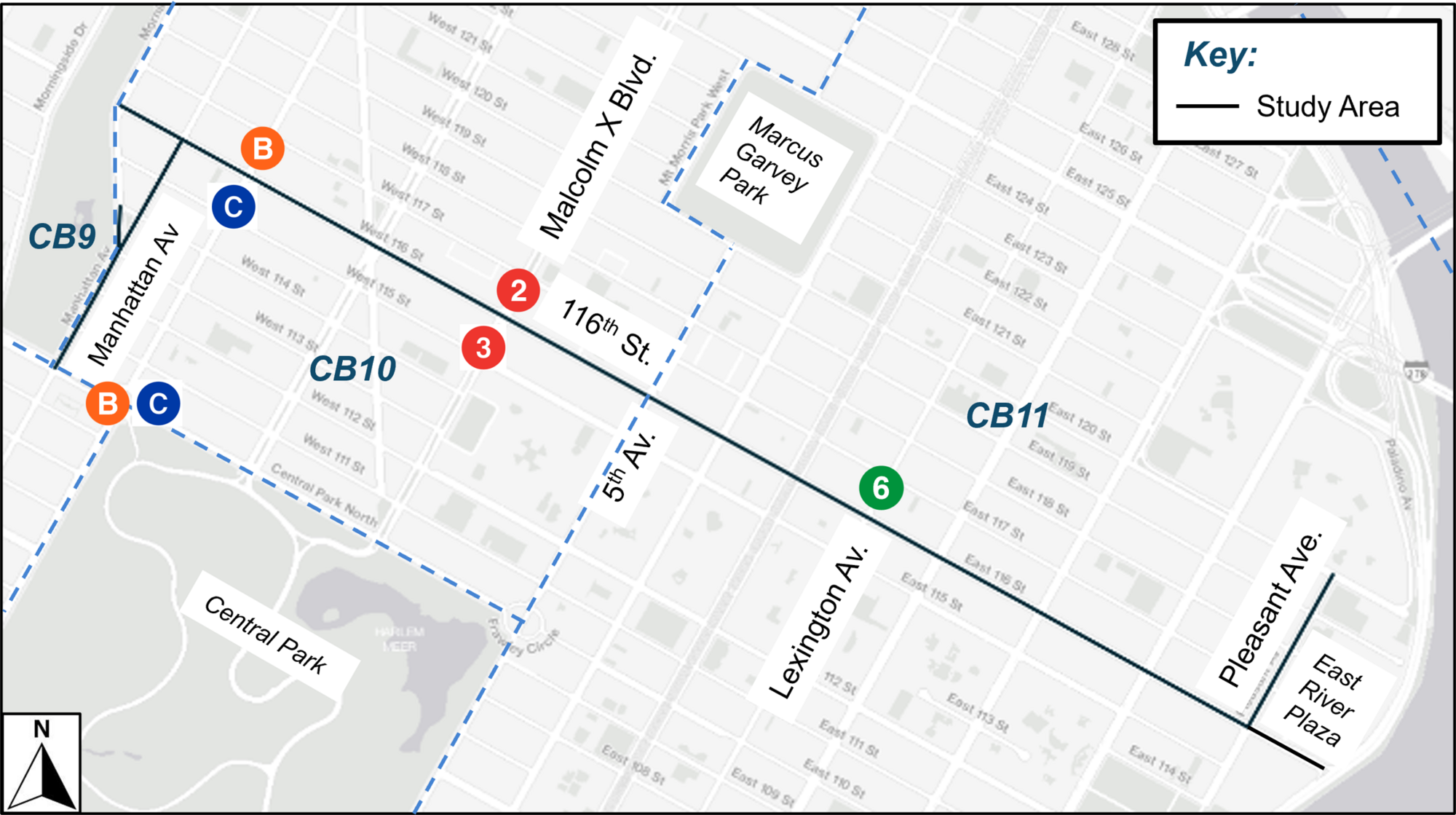
116th Street redesign project area. Credit: NYC DOT

Mayor Zohran Kwame Mamdani attends an FDNY Block Party in the Bronx on Saturday, August 15, 2026. Michael Appleton/Mayoral Photography Office
Mayor Mamdani Signs Bill Making Year-Round Outdoor Dining a Permanent Part of New York City
NEW YORK – Mayor Zohran Kwame Mamdani today signed legislation into law establishing permanent, year-round outdoor dining on New York City roadways.
Int. 0655, sponsored by Council Member Lincoln Restler, amends a previous law that required restaurants participating in the City’s outdoor dining program, Dining Out NYC, to remove roadway dining setups November 30 through March 31, a requirement that did not apply to sidewalk cafes.
The New York City Department of Transportation (NYC DOT) will promulgate rules in the coming months allowing restaurants to temporarily winterize roadway dining setups.
“Outdoor dining transformed our city once before, and now we are making sure it has a permanent place in New York City,” said Mayor Mamdani. “The previous law forced small businessowners to dismantle and rebuild their outdoor dining setups every year, adding unnecessary costs and making it harder for neighborhood restaurants to plan for the future. With the legislation we’re signing today, our favorite restaurants can continue bringing New Yorkers together over good food and great company in every season. I’m grateful to Council Member Restler for championing this legislation and helping ensure that our streets work for the small businesses and communities that make this city what it is.”
“The Adams-era regulations nearly broke outdoor dining, but this law will successfully restore outdoor dining to neighborhoods across the five boroughs,” said Council Member Lincoln Restler. “Too many restaurants and cafes have been locked out of our roadway dining program by unnecessary red tape and seasonal restrictions. We are transforming the public realm by making it easy for thousands of restaurants to offer roadway dining. Outdoor dining is great for local restaurants, great for the hospitality sector workforce and great for all of us to be able to enjoy a meal on the streets of New York City. I’m grateful to Mayor Mamdani, Speaker Menin and my colleagues in the City Council for strongly supporting this bill.”
“Our entrepreneurs deserve a city that creates pathways for them to grow, adapt and succeed. Intro. 0655 gives them greater flexibility to serve their neighbors, grow their businesses and create opportunity year-round,” said Council Member Shanel Thomas-Henry. “As Chair of the Committee on Small Business, I’m proud to support a bill that recognizes that when we reduce red tape for entrepreneurs, we strengthen our neighborhoods and build a stronger local economy for everyone. Thank you to Mayor Mamdani, Speaker Menin and my Council colleagues for their partnership in moving this work forward.”
“New Yorkers love dining outside, and outdoor seating makes our streets more vibrant while helping support the small businesses we cherish. NYC DOT built a successful permanent outdoor dining program that created cleaner, more accessible and more resilient roadway setups — but the previous law restricting roadway seating to a specific period was a costly hurdle that hurt restaurants’ participation,” said NYC DOT Commissioner Mike Flynn. “We look forward to developing new rules to allow for restaurants to winterize their roadway dining setups in a way that creates a comfortable dining experience while still maintaining the light and airy setups we see on our streets today.”
“Small businesses deserve a city government that treats them as partners, not one that leaves them navigating a maze of regulations,” said Department of Small Business Services (SBS) Commissioner Kenny Minaya. “SBS is proud to have championed these reforms as part of Mayor Mamdani’s Open for Small Business initiative, and we are grateful to Small Business Committee Chair Thomas-Henry and Council Member Restler for their leadership in expanding the outdoor dining program. Intro. 0655 activates our public realm, ensures vibrancy on our streets and strengthens small businesses’ ability to serve their neighborhoods and build community.”
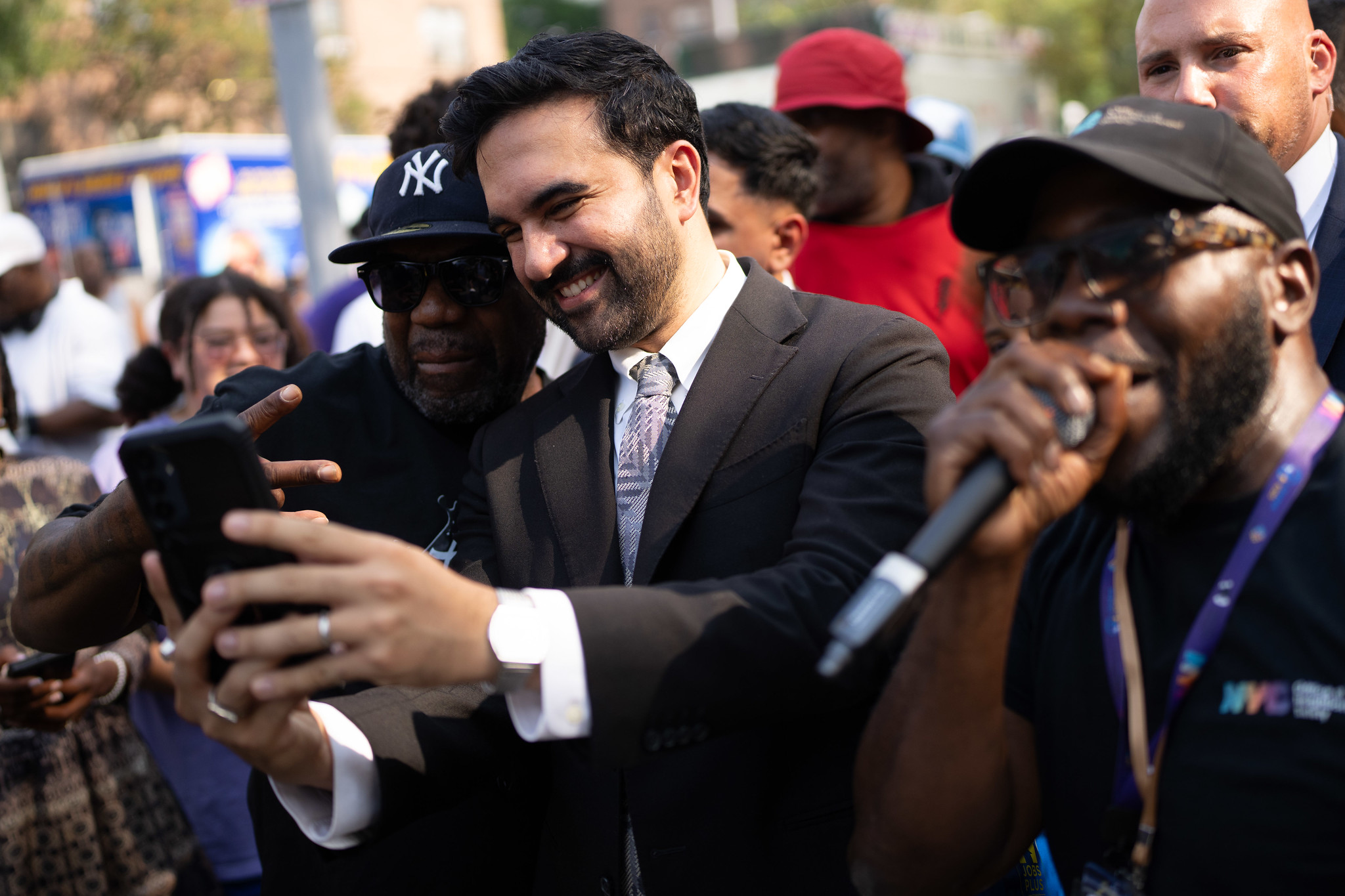
Mayor Zohran Kwame Mamdani attends a community safety event in Brooklyn. on Thursday, August 13, 2026. Michael Appleton/Mayoral Photography Office
Mayor Mamdani Announces Sweeping New Measures to Strengthen New York City’s Response to Legionnaires’ Disease
NEW YORK —Today, Mayor Zohran Kwame Mamdani and the New York City Health Department announced a series of new measures to strengthen the City’s education, enforcement and response to Legionella bacteria in cooling towers following the Upper East Side community cluster earlier this summer.
The initiatives build on the Health Department’s rapid and aggressive response to the Upper East Side cluster, including unprecedented steps to increase transparency and accelerate the remediation of cooling towers in the affected area.
“New York City responded to this summer’s cluster of Legionnaires’ disease with urgency and an unprecedented level of action. When New Yorkers’ health is at stake, government cannot wait for the crisis to pass before asking how it can do better. Our response to the Upper East Side cluster was fast and aggressive, and we are building on what we learned to make our systems stronger, enforcement faster and public health response more transparent,” said Mayor Mamdani. “New Yorkers deserve a government that moves with urgency to keep them safe.”
“Our first responsibility is to protect the health and safety of New Yorkers,” said Deputy Mayor for Health and Human Services Dr. Helen Arteaga. “These measures build on the Mamdani administration’s unprecedented response to this summer’s cluster and strengthen the systems that protect New Yorkers from Legionella bacteria year-round. This is what public health looks like when government is coordinated, measured, and responsive.”
“New York City already has some of the most rigorous cooling tower laws and regulations in the country, but rigorous standards only matter if we are constantly working to make them stronger,” said NYC Health Commissioner Dr. Alister F. Martin. “Today’s announcement reflects our commitment to continuous improvement and investment we need to respond faster and more effectively when New Yorkers’ health is at risk.”
“Education, outreach, and efficient government processes are critical to delivering the services New Yorkers deserve, and we remain committed to providing our sister agencies with the information and support they need,” said Department of Buildings Commissioner Ahmed Tigani. “We are proud to continue working closely with our partners in Health as we look for ways to strengthen our efforts and better serve and protect New Yorkers.”
The new measures include:
- Identifying potentially unregistered cooling towers by developing synergy between the Health Department and the Department of Buildings (DOB) in the City’s registration and tracking systems.
- Enhancing public visibility and transparency regarding cooling tower regulations by adding a mapping feature to the Health Department’s address-based cooling tower lookup tool.
- Exploring faster culture testing methods and novel testing approaches to decrease the amount of time it takes to test and confirm positive results.
- Accelerating enforcement of cooling tower violations by assigning the earliest Office of Administrative Trials and Hearings (OATH) date that rules permit.
- Convening a scientific advisory panel to evaluate emerging cooling tower technology and alternative cooling systems.
Strengthening Education and Awareness
To increase public education and transparency before a Legionnaires’ disease investigation is underway, the Health Department will expand its existing online, address-based cooling tower lookup toolwith a citywide mapping feature that will allow New Yorkers to see registered cooling towers across the five boroughs.
Users will be able to review each registered cooling tower’s inspection history, including compliance with Legionella sampling requirements.
To ensure New Yorkers are aware of the new tool, the Health Department will launch an annual public education and media campaign ahead of cooling tower season each summer. The mapping tool and campaign are expected to launch by spring 2027.
Improving Enforcement and Prevention
Strong enforcement of the City’s cooling tower laws and regulations is critical to protecting public health and promoting compliance with requirements designed to reduce the risk of Legionnaires’ disease.
When a building owner receives a summons for violating cooling tower regulations, the owner may appear before OATH to contest the violation. Unless a fine is paid in advance, collection may not occur until after the hearing. Since May 8, the Health Department has conducted 800field inspections, over 460 of which resulted in at least one violation, and $80,500 in fines have been paid.
Under new procedures, the Health Department will assign the earliest hearing date permitted — 15 days after service of a summons. The City implemented this approach during the summer, helping accelerate the hearing process and strengthen enforcement.
The Health Department will also intensify efforts to identify and prevent the operation of unregistered cooling towers.
No cooling tower should be operating in New York City without being registered. Yet the Health Department identified unregistered cooling towers during both the Upper East Side investigation and last year’s Central Harlem cluster investigation.
Going forward, the Health Department will work with the New York City Department of Buildings to strengthen connections between the Health Department’s Cooling Tower Registration Portal and DOB’s construction permitting system. The agencies will also work together to educate developers about cooling tower requirements before systems begin operating. This change will formalize an existing partnership that has helped identify unregistered cooling tower and will ensure more cooling towers are registered before they are ever turned on. By connecting the two systems, this will help ensure more cooling towers are registered in the first place before they are ever turned on. The new measures are expected to be implemented by the end of the year.
Convening a Scientific Advisory Panel
Rising temperatures, longer heat waves, and high humidity for longer periods of the year are creating conditions that can increase the risk of Legionella bacteria growth in cooling towers.
Cooling towers already provide conditions favorable to Legionella growth. As climate change drives more extreme and prolonged heat, it is increasingly important to invest in proactive measures that reduce the public health risks associated with these systems.
In response, the Health Department will convene a scientific advisory panel to evaluate emerging cooling tower technology and explore alternative cooling technologies that could reduce New York City’s reliance on cooling towers.
The Health Department will appoint the panel’s chair and members in the coming months and aims to issue recommendations within the next year.
Strengthening Investigation and Response Times
One of the defining challenges of the Upper East Side investigation was the density of cooling towers in the affected area — nearly four times as many as were identified during the Central Harlem cluster in 2025. Each tower needed to be sampled and tested for Legionella as quickly as possible.
In the coming years, the Health Department will explore faster culture methods and novel testing approaches, including to reduce the time it takes to test and confirm positive results. This will allow the Public Health Lab to rapidly scale up testing during a Legionnaires’ disease cluster while providing additional capacity for other emerging issues. This requires additional staff and resources, which the Health Department aims to have in place before the summer of 2028.
Upper East Side Community Cluster
The Health Department continues to investigate potential sources of exposure associated with the Upper East Side community cluster. Results from whole-genome sequencing analysis are expected this fall.
That analysis compares the specific strain of Legionella found in patient samples with strains identified in cooling towers in the affected area. If genetic matches are identified, the analysis may provide additional information about the source of this summer’s cluster.
As of August 31, there have been 94 cases of Legionnaires’ disease associated with the cluster. No patients remain hospitalized, and 11 people have died.
As of late August, 81% of cooling towers citywide were in compliance with monthly requirements to sample and test.
Mayor Mamdani Completes Redesign of ‘Crashland’ in Downtown Brooklyn
City transforms Ashland Place into a one-way street with a two-way protected bike lane, creating a 5.5-mile protected biking corridor from Sunset Park to DUMBO

Cyclists travel in both directions in the completed protected bike lane on Ashland Place. Credit: NYC DOT
NEW YORK – Mayor Zohran Kwame Mamdani and New York City Department of Transportation (NYC DOT) Commissioner Mike Flynn today announced the completion of a continuous protected bike lane on Ashland Place in Downtown Brooklyn, filling the final gap in a 5.5-mile protected bike corridor between Sunset Park and DUMBO.
NYC DOT first began the Ashland Place redesign in 2022, but after interference from the previous administration, work stopped before the final block of protected bike lane could be installed. For three years, the project sat unfinished, with bags covering new traffic signals intended to improve safety at the intersection.
Today, as the long-awaited redesign takes effect, the City removed those bags and completed the project.
“For years, ‘Crashland’ has been a symbol of broken promises and safety put on the back burner. Today, we finish the job,” said Mayor Mamdani. “The Ashland Place redesign connects New Yorkers to a protected bike network, shortens crossing distances for pedestrians and calms traffic for everyone moving through the area. Our job as government first and foremost is to build a city that keeps New Yorkers safe and works for the people who live here. This is what that looks like.”
“Completing the Ashland Place redesign is not just the completion of one city block, but a critical link that will safely connect cyclists from across Brooklyn to Manhattan, North Brooklyn and Western Queens,” said NYC DOT Commissioner Mike Flynn. “We’re proud to unbag the traffic signals on Ashland Place and officially make ‘Crashland’ a distant memory as we work alongside community members across the five boroughs to advance the next generation of street safety redesigns.”
“At long last, the day has finally come: Crashland is no more,” said State Senator Andrew Gounardes. “So many neighbors and advocates worked for years to arrive at this moment. The completion of this project finally closes a critical gap in Brooklyn’s bike network and makes the street safer and easier to navigate for everyone. This new design will help save lives, and it’s proof that, with hard work, we can create streets that truly serve all New Yorkers. Thank you to Mayor Mamdani and NYC DOT for their work to finish this much-needed project.”
“Crashland no more! Credit to Mayor Mamdani and the Department of Transportation for completing the long-awaited and much-needed Ashland Place protected bike lane. The new lane is a major safety improvement and helps connect riders to a network of protected lanes from Sunset Park to Greenpoint,” said Council Member Lincoln Restler. “I look forward to DOT’s planned bike lane redesign projects on blocks surrounding Ashland Place, including 4th Ave and Lafayette Ave, that are critical connectors to the network of protected lanes.”
“Livable streets happen when we redesign them to prioritize people,” said Jackson Chabot, Director of Advocacy and Organizing at Open Plans. “The area around Atlantic Terminal and Barclays Center is one of the best-connected places in New York, yet its streets have long devoted too much space to moving and storing cars. The Ashland Place redesign is an important step toward changing that, with safer crossings and protected bike lanes. We also need to bring that same mindset to the curb, rethinking how we use some of our most valuable public space so it serves pedestrians, transit riders, cyclists, deliveries and local businesses — not just private vehicles. We applaud Mayor Mamdani and Commissioner Flynn for completing this critical project and look forward to seeing more low-traffic, slow-speed design approaches brought to more neighborhoods across the city.”
“We applaud the completion of the redesign of Ashland Place to implement the protected two-way bike lane that had been sidelined by the foregoing administration. This previously missing link completes a more than five-mile protected cycling route connecting Sunset Park to the Brooklyn and Manhattan Bridges, making biking appreciably safer for thousands of people every day,” said Eric McClure, Executive Director of StreetsPAC. “We’re grateful to Mayor Mamdani and Commissioner Flynn for their continuing efforts to prioritize street safety.”
“Today’s completion of Ashland Place’s redesign marks an important investment in the safety and accessibility of a key Downtown Brooklyn corridor used by thousands of New Yorkers every day,” said Kate Slevin, Executive Vice President at Regional Plan Association. “By strengthening Brooklyn’s protected bike network and reducing risks for pedestrians and cyclists, this project demonstrates how thoughtful street redesign can create more intuitive transportation connections that better serve everyone who uses our streets. RPA applauds NYC DOT for delivering on improvements that will make this critical connection safer and easier to navigate.”
Mayor Mamdani and Chancellor Samuels Put Students First with Nation’s Broadest Generative AI Moratorium in Schools
Representing the most expansive student-facing AI policy in the country, the Mamdani administration prioritizes student safety and real, human instruction
NEW YORK – Mayor Zohran Kwame Mamdani and Schools Chancellor Kamar H. Samuels today announced a moratorium on student-facing generative Artificial Intelligence (AI) use in schools, alongside a new screen time policy, a decision that will impact nearly 600,000 public school students, or two-thirds of the system’s total enrollment. The policy establishes a one-year moratorium, effective in the 2026-2027 school year, on student-facing generative AI for children in 2-K through 8th grade. It also introduces twice-yearly AI critical thinking modules for high schoolers, limited AI pilots for a small number of high school classrooms and age-appropriate screen time restrictions.
“Children need teachers and human connection in order to learn and grow. They need to develop skills alongside their peers, build relationships with educators and wrestle with tough problems on their own,” said Mayor Mamdani. “The tech industry wants us to believe that A.I.-powered early education is not only inevitable, but necessary. We do not see it that way. That’s why we’re implementing a moratorium on generative AI for students in 2-K through 8th grade and spending the next year studying the impacts of this technology.”
“We have a responsibility to ensure that rapidly-changing technology supports our children and their learning, rather than getting in the way of it,” said Governor Kathy Hochul. “New York State has been leading the way in our efforts to keep kids focused on learning and growing — not clicking and scrolling — and I commend Mayor Mamdani for building on this work and pushing our shared commitment to supporting New York’s kids forward.”
“As Chancellor and as a parent, I believe our job is to protect what makes learning work, while ensuring every child has the critical thinking skills they need before graduating,” said Schools Chancellor Kamar Samuels. “We’re putting guardrails in place to protect the human connection, curiosity and creativity that help children grow. We’re standing firmly in our belief that innovation does not mean more technology, and over the next year, we will lead with evidence to make sure technology serves learning — not the other way around.”
Representing the most expansive student-facing AI moratorium in the nation, the new policy eliminates AI use for students in grades 2-K through 8th grade. This includes all software that uses student-facing generative AI. Companion chatbots will be prohibited across all grades.
Throughout the 2026-27 school year, a new Technology in Schools Coalition, made up of students, educators, parent leaders, elected officials, advocates, union partners and experts in the field will convene to assess the impact of the moratorium and limited pilots. The coalition will publish a report with recommendations for future school years.
For a maximum of 50,000 high school students in general education classes, or approximately 5% of the public-school student body, five limited AI pilots will be introduced. All high school students will also have access to twice-yearly AI literacy classes designed to help them think critically about AI before they begin to rely on it.
The two 45-minute modules will introduce students to what AI is and is not, as well as AI-related bias, risks, ethical considerations and impacts on careers and future skills.
The limited pilots will be offered at a maximum of five classes per high school. All use will take place under the direct supervision of a trained educator and will involve carefully vetted AI tools. The pilots were selected based on rigorous safety and data privacy standards, their focus on teacher-guided instruction and their commitment to keeping students as the primary thinker in the classroom.
Pilot programs include:
- Quill: Accessed by English language arts classrooms, Quill is designed to support close reading, text analysis and the use of evidence to support claims. Students will use Quill for no more than 15 minutes per week.
- Edia: Accessed by math classrooms, Edia is designed to provide step-by-step coaching and prompt students to explain their reasoning. Students will use Edia for no more than 20 minutes per week.
- Brisk Teaching: Accessed through teacher-created activities, Brisk Teaching is designed to provide guided practice using teacher-selected texts or videos, with objectives and guardrails set by the teacher. Students will use Brisk Boost for 10 to 20 minutes once or twice per week.
- Playlab: To be used across multiple subjects, Playlab is designed to help students engage with assignment-specific applications and examine AI outputs for bias and reasoning. No more than two assignments per marking period will use Playlab.
- Intel AI-Ready Schools: To be used across multiple subjects, Intel AI-Ready Schools is designed to help students identify community problems and develop AI solutions through semester-long projects. Students will use the tool for one period per week.
Teachers will continue to be permitted to use AI for instructional planning and operational tasks, provided all tools comply with NYCPS safety standards. Exceptions to the policy will be granted for assistive technology usage by students with disabilities, multilingual learners and students participating in career readiness programs, like computer science.
With this new policy, students in 2nd grade and below will see restricted 1:1 screen time, with recommended caps of 30 minutes a day for students in 3rd grade through 5th grade and 45 minutes for students in 6th grade through 8th grade.
Under the new policy, all technology tools used in NYCPS will undergo an exhaustive review and will be barred if their functionality is ultimately determined not to be mission-critical to learning. The review will include vendor accountability for safety and transparency standards, ethics, evidence of learning design and instructional impact, prior research and the continuous collection of user feedback.
“Mayor Zohran Mamdani and Chancellor Kamar Samuels are taking a thoughtful and responsible approach to AI in our schools. Early-grade education must be rooted in building foundational skills through evidence-based practices, not experimenting on children with rapidly evolving technology. As Chair of the New York State Assembly Committee on Libraries and Education Technology, I introduced similar legislation, and I’m proud to serve on the advisory panel that will help New York City determine where AI can genuinely improve education while protecting students and preserving appropriate exceptions for children with disabilities,” said Assemblymember Robert Carroll, Chair of the Assembly Committee on Libraries and Education Technology.
“The AI policy set forth today protects the city’s youngest learners and prepares high school students to tackle the changing landscape they will graduate into. This policy is appropriately careful and responsive to community voices. I look forward to working closely with the Technology in Schools Coalition to further develop this policy and ensure accountability. As the coming wave of technology emerges, young people will be on the forefront — it will be their creativity, and ingenuity will lead the way. Our responsibility is to establish guardrails, such as these, to help them do it responsibly. This is a good step in that direction,” said Councilwoman Rita Joseph, Higher Education Chair.
“As a former middle school teacher, I’m so pleased to see that our Mayor is taking a nuanced approach to a new and rapidly changing educational tool. We took too long to respond to the effects of social media and smart phones on our youth. This combination of a 1-year ban with select pilot programs allows us to take a serious look at AI usage in schools and find a path that allows our students to adapt to our changing world in a safe manner,” said State Senator Jabari Brisport.
“This one-year ban on student-facing artificial intelligence technology use and restrictions on screen time through eighth grade are the right policies for optimal student learning and development,” said Council Member Lincoln Restler. “Credit to Mayor Mamdani and Chancellor Samuels for listening to students, parents, teachers and administrators and protecting our young people from the potentially harmful effects of untested technology. This pause alongside a commitment to meaningfully engage stakeholders in the months ahead will allow us to craft long term policies amid a rapidly changing technology landscape.”
“We should never confuse a machine’s ability to produce an answer with a child’s ability to arrive at one. There is something sacred in the struggle to understand: the question asked twice, the page wrestled with, the mistake that becomes discovery, the teacher who sees possibility before a student sees it in themselves,” said State Senator Robert Jackson. “That is where intellect is formed and independence begins. In a democracy, we educate children not simply to know things, but to question, discern, imagine, and ultimately think for themselves. I commend Mayor Mamdani and Chancellor Samuels for recognizing that progress must earn its place in the classroom. Technology will continue to change, but our obligation must remain constant: childhood must never be the price we pay for innovation.”
“Tech companies have forced their way into every corner of kids’ lives with big promises of benefits but little evidence to back them up. Enough is enough,” said State Senator Andrew Gounardes. “These new rules are an important step toward ensuring our kids’ needs come before Big Tech’s profits. By putting smart, thoughtful guardrails around the use of tech in schools, we can ensure learning comes first. Thanks to Mayor Mamdani and Chancellor Samuels for working to give our children the education they need and deserve.”
“AI is changing how we learn and work, and our kids need to be prepared to use it safely, think critically, and interrogate the information it produces,” said Council Member Gale A. Brewer. “I am encouraged that NYC Public Schools is taking a comprehensive approach, with age-appropriate AI literacy in K–8 and more focused instruction in high school, and I look forward to the program being shared with parents and staff. Thank you to Chancellor Kamar Samuels and Mayor Mamdani for preparing our students for a rapidly changing world.”
“The recent METR OpenAI report demonstrated how easily AI models can run amok, literally learning how to lie and cheat while covering their tracks to evade being caught deviating from their original code. Our ability to use generative AI with confidence that it won’t turn on our kids and do something else is tenuous at best. The policies announced today are well thought out, age-appropriate, and comprehensive — allowing for carefully chosen pilots for high schoolers and for those AI tools that provide access for students with disabilities and English language learners. Thank you, Mayor Mamdani and Chancellor Samuels, for pumping the brakes and creating this detailed policy,” said Assemblymember Jo Anne Simon.
“As a 14-year public school special education teacher and Chair of the City Council’s Education Committee, I’ve seen how quickly new technology can outpace a school system’s ability to manage it responsibly,” said Council Member Eric Dinowitz. “My committee’s recent oversight hearing made clear the DOE needs a deliberate, evidence-based approach before AI tools reach classrooms unchecked. I applaud Chancellor Samuels’ work on this policy and look forward to continuing our work together to ensure our students are kept safe and that technologies support and enhance learning.”
“AI and technology are central to New York’s economic future, as underscored by last week’s CBRE report showing that New York City now has more tech jobs than the Bay Area. We’re encouraged that high schoolers will have access to AI career readiness tools that can help prepare them for the workforce, and we recommend expanding this access beyond one hour per week in the future. At the same time, strong guardrails should enable age-appropriate learning that puts safety first, even at younger grades. Preparing youth for adult life and workplaces that rely on technology will require students to understand AI, question it, and use it safely, under the guidance of teachers. These are incredibly complex issues, and we give Mayor Mamdani and Chancellor Samuels credit for listening to all sides and creating a task force, which I am proud to serve on, to help shape what comes next,” said Tech:NYC President & CEO Julie Samuels.
Banner Image: Mayor Zohran Kwame Mamdani delivers remarks at the Floral Park Indian Day Parade on Saturday, August 15, 2026. Michael Appleton/Mayoral Photography Office
NYC Mayor Zohran Mamdani


Zohran Mamdani was sworn in as Mayor of the City of New York on January 1st, 2026. Prior to becoming Mayor, he represented the 36th New York State Assembly District and its neighborhoods of Astoria, Ditmars-Steinway, and Astoria Heights.