


Editor’s note: While it is factually true that the founders of NYCLASS are affiliated with the real estate industry, there is more to their story. They have pledged never to attempt to purchase or acquire any of the former carriage horse stable land, and the majority of the push for this bill came from national and international organizations, including the ASPCA and People for the Ethical Treatment of Animals. The founders also mentioned that there was already opportunity to bid on one of the properties, which they did not take advantage of. In addition to ASPCA, People for the Ethical Treatment of Animals (PETA) brought national and international attention to this issue. We covered their perspective during the course of the evolution of this law, including after one horse, Lady, was allegedly beaten and later died. They are both organizations with no ties to the real estate industry, and the NYCLASS organization founders have also been heavily involved in animal rights advocacy for many years prior to the founding. PETA has maintained that horses don’t belong in traffic, and that five weeks of vacation per year while for 11 months they are working is not enough for their physical and mental health and recuperation.

Carriages must cease operating on City streets by June 1, 2028
Administration will support 200 affected workers through medallion buybacks, career services and workforce development
NEW YORK – Mayor Zohran Kwame Mamdani today signed into law legislation ending New York City’s horse-drawn carriage industry after 150 years.
Sponsored by Council Member Chris Marte, Romanch’s Law requires horse-drawn carriages to cease operating on New York City streets by June 1, 2028. The law honors the memory of Romanch Mahajan, an 18-year-old who lost his life following a horse-drawn carriage accident in Central Park on June 17, 2026.
“For 150 years, horse-drawn carriages have been a fixture of Central Park. Today, we are bringing that chapter to a close,” said Mayor Mamdani. “This industry will come to an end, and we have a responsibility to the workers whose livelihoods depend on it. We will work alongside them to ensure they have the financial support and career opportunities they need to build their next chapter.”
“This is a truly historic day for New York City, nearly two decades after the Council first considered ending the horse-drawn carriage industry,” said Speaker Julie Menin. “Today, I’m thinking of Romanch Mahajan, who should still be with us and whose tragic, untimely death reminds us why this legislation was so urgently needed. This law will protect the welfare of horses while ensuring that the hardworking New Yorkers who depend on this industry have the support they need to transition to new employment opportunities. I’m proud to have worked alongside Council Member Marte, my Council colleagues, and advocates to make this moment possible, and I thank Mayor Mamdani for signing this historic legislation into law. With this law, we are ushering in a safer, more humane chapter for our city.”
“For nearly two decades, New Yorkers fought to end the horse-drawn carriage industry. Today, that fight has produced a law that protects horses and passengers and requires the city to help carriage workers move into new livelihoods,” said Council Member Christopher Marte. “I am proud to have sponsored Romanch’s Law and built the Council majority behind it. I thank Mayor Mamdani for signing it and working with us on the transition, and the advocates who refused to give up. We cannot bring Romanch Mahajan back, but we can honor his family’s call to prevent another tragedy. Today, New York has made that commitment law.”
“Romanch’s Law marks a historic step forward for animal rights and public safety in New York City,” said Allie Taylor, Director of the Mayor’s Office of Animal Welfare. “As we work to support carriage drivers through this transition, we have sanctuaries and rescue organizations ready to welcome the horses into retirement.”
The Mamdani administration announced Tuesday that it will support the approximately 200 New Yorkers whose livelihoods are affected by the end of the horse-drawn carriage industry, including medallion owners, carriage drivers and stable hands. The plan includes facilitating medallion buybacks for owners and providing workforce development and career support for drivers and stable hands.
The administration will work to engage TWU and horse carriage workers throughout the process to ensure their feedback is integrated into the full plan, which will be released by April 2027.
In partnership with NYC Talent and the NYC Department of Small Business Services (SBS), City Hall will establish a new Horse Carriage Worker Industry Program to help affected workers transition into new careers and advance professionally. The program will provide career advisement, job training, entrepreneurship support, connections to employers, educational opportunities and tuition assistance for carriage drivers and stable hands.
Mayor Mamdani will also direct the Administration to commission a feasibility study examining electric carriages and electric pedal-assist bicycles as potential alternatives for use within Central Park, as well as electric carriages along the park’s perimeter.
“Today’s bill signing marks an important step toward making New York City safer and more humane,” said Council Member Lynn Schulman, Chair of the Committee on Health. “Horse-drawn carriages have been part of New York City’s history since before cars, but our city has changed drastically. Our streets and parks have become increasingly chaotic and overcrowded, creating a massive safety risk for all. In many ways, today is about the tragic death of 18-year-old Romanch Mahajan. This bill was a partnership with the Council and the Mayor, and I want to thank Speaker Julie Menin and Mayor Zohran Mamdani for their leadership and roles in protecting the horses and prioritizing the safety of all New Yorkers.”
“As Vice Co-Chair of the Animal Welfare Caucus, I am especially grateful that we are signing Romanch’s Law today and finally ending the dangerous and inhumane horse-drawn carriage industry,” said Council Member Shahana Hanif. “After nearly two decades of unanswered advocacy, collaboration between our Mayor and City Council have allowed this legislation to be realized. Today, we honor Ryder and Romanch and move toward a safer, more humane city.”
“We are grateful that the end of the horse carriage industry is in sight, ensuring a safer future for the tens of millions of visitors to Central Park each year,” said Betsy Smith, President & CEO of the Central Park Conservancy. “We thank Mayor Mamdani and Speaker Menin for their historic leadership in passing Romanch’s Law, ending this practice after decades of debate and advocacy. We are committed to working with the Mayor and the Speaker on a just and effective transition.”
Mayor Mamdani Announces Plan to Support Horse-Drawn Carriage Workers Through Industry Transition
Framework includes medallion buybacks, career support and workforce development for 200 workers
Full transition plan to be released by April 2027
NEW YORK – Mayor Zohran Kwame Mamdani today announced a framework to support a workforce transition for horse-drawn carriage drivers and stable hands as New York City prepares to sunset the horse-drawn carriage industry.
The framework outlines financial assistance for medallion owners and new workforce development opportunities for drivers and stable hands, including career training, educational pathways and stipends. A full transition plan will be released by April 2027, in partnership with the City Council and in accordance with the timeline established in the legislation.
“As New York City moves to bring the horse-drawn carriage industry to a close, we have a responsibility to the workers who have built careers in this industry. This administration will not leave them behind,” said Mayor Mamdani. “Our transition plan will provide financial support and pathways to new careers through training, career guidance and education. We will support workers every step of the way.”
“This framework reflects our commitment to supporting every New Yorker affected by this transition,” said Deputy Mayor Julie Su. “We will work closely with workers, medallion owners and our partners to make sure they have the resources and opportunities to move forward, including into good jobs and new careers.”
“LaGuardia will work with each carriage driver and stable hand to ensure they get the workforce training they need to transition to new careers with family sustaining wages,” said Kenneth Adams, President of LaGuardia Community College. “With more than sixty programs to choose from, including skilled trades, IT, healthcare, and even Veterinary Technology, carriage drivers will be able to design personalized education and training programs to meet their needs and interests.”
The Mamdani administration will support New Yorkers affected by the industry’s sunset, including medallion owners, carriage drivers and stable hands. This includes a goal of facilitating medallion buybacks for owners and providing workforce development programming for drivers and stable hands. The administration will work to engage TWU and horse carriage workers at every step of the process to ensure their feedback is integrated into the full plan that will be released by April 2027.
In partnership with NYC Talent and the NYC Department of Small Business Services (SBS), City Hall will establish a new Horse Carriage Worker Industry Program to help approximately 200 affected workers transition into new careers and advance professionally. The program will offer career advisement, job training, entrepreneurship support, connections to employers, educational opportunities and tuition assistance for carriage drivers and stable hands.
Managed by SBS and operated by LaGuardia Community College (CUNY), the program will build on existing workforce infrastructure, employer partnerships and educational pathways to provide workers with practical, timely support. SBS will also work with employer and labor partners to develop and tailor additional opportunities, drawing on the Workforce 1 system and its Industrial and Transportation Career (ITC) Centers.
Mayor Mamdani will also direct the Administration to commission a feasibility study examining electric carriages and electric pedal-assist bicycles as potential alternatives within Central Park, as well as electric carriages along the park’s perimeter.
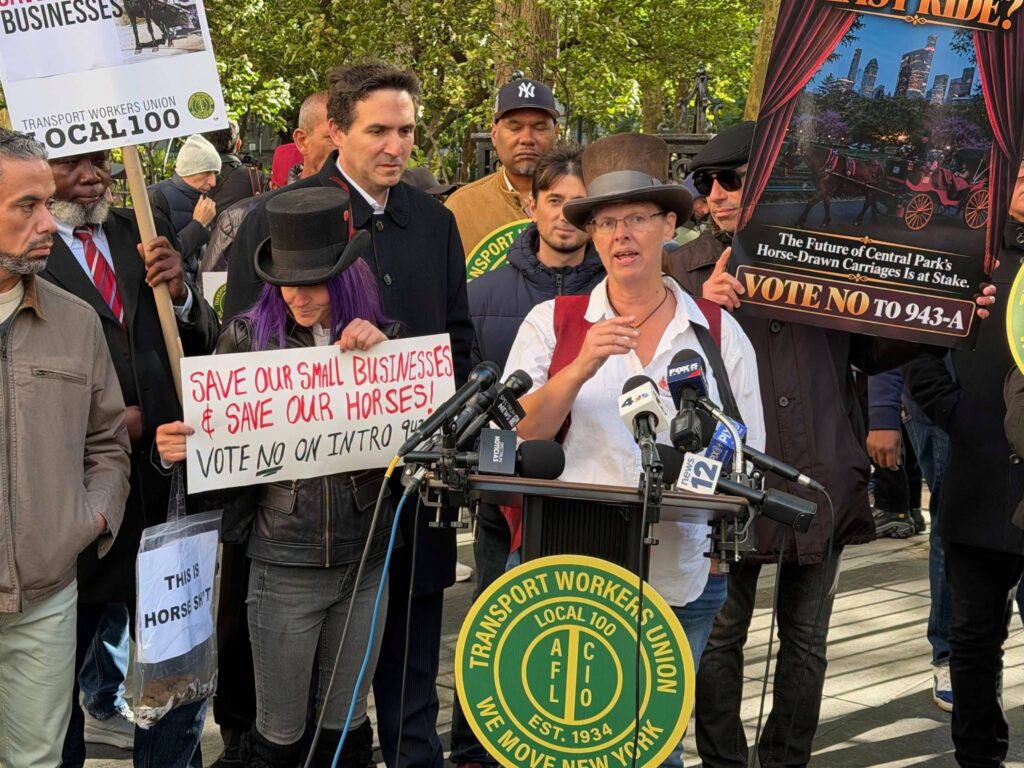
TWU Local 100, Which Represents Carriage Horse Workers, Says The Following On Their Website:
WHAT YOU SHOULD KNOW ABOUT THE CENTRAL PARK CARRIAGE HORSES
Transport Workers Union Local 100 is proud to now represent the approximately 300 horse-carriage drivers and owners providing scenic tours through Central Park for both tourists and New Yorkers alike.
Local 100 has been a champion for blue-collar bus and subway workers for more than eight decades. In recent years, our ranks have expanded to include employees at Big Bus Tours, New York Waterway, and other companies in the tourism economy.
Local 100 believes strongly in workers’ rights and animal welfare. We look forward to discussing how we can possibly work together on such important issues in the future.
Here are some facts about the Central Park carriage horses and drivers
LOVED
The Central Park carriage horses are loved. They receive excellent care and treatment. Many of the carriage drivers and stable hands are immigrants raised on farms in their home countries, or first-generation Americans who learned their trade from their parents. They have a unique bond with these magnificent animals, which were bred for centuries to work with people.
The NYC horse-carriage workers are wholeheartedly committed to animal welfare.
POLITICS AND REAL ESTATE
There are 68 licensed carriages and more than 100 horses in three stables on the West Side of Manhattan. Each carriage owner essentially is a “mom-and pop” business. They support hundreds of blue-collar jobs. The horse-carriage folks have been subject to harmful lies and allegations that they abuse their horses. One group in particular stands out: NYCLASS. NYCLASS was founded by the real-estate industry and is funded by the real-estate industry. Why? There are three stables on the West Side of Manhattan and that land now is very valuable. Developers would love to get their hands on these properties to build skyscrapers with high-priced apartments and commercial space. NYCLASS is a smokescreen for an insidious land grab that would put hundreds of blue-collar workers out of work.
Healthy
Carriage horses live long, healthy lives. Every equine veterinarian who has examined the NYC carriage horses has remarked on their good health and care. The American Veterinary Medical Association, the American Association of Equine Practitioners, and the New York State Veterinary Medical Society have all endorsed horse-carriage rides in New York City.
Carriage horses are not stressed by the city. The overwhelming majority of rides are in bucolic Central Park. A study of cortisol levels in NYC carriage horses by Dr. Joe Bertone of Western University concluded they have exceptionally low levels of this stress hormone while working in the city, and they appear to be more stressed while vacationing on the farm.
Vacations and Regulations
Each horse gets at least 5 weeks of vacation on a farm every year. They are subject to some of the most extensive horse regulations in the country, and are overseen by 5 city agencies, including the Department of Health and the NYPD Mounted Police Unit. Carriage horses can’t work in extreme heat or cold. They can’t work more than nine hours per day. They must have stalls large enough to turn around and lie down comfortably. They are examined by veterinarians at least four times year: two regularly scheduled exams, and exams before and after their vacations.
Safe
Not a single horse has been killed in a traffic accident in the last 15 years – and new regulations enacted in recent years have increased safety further. The city banned cars from Central Park in 2018. More than 2,100 pedestrians, meanwhile, were killed by cars and trucks in the city over the last 15 years.
Union
The horse-carriage drivers are represented by Transport Workers Union Local 100, which has been a champion for blue-collar New Yorkers for more than 80 years. TWU Local 100 is comprised of 46,000 men and women who operate and maintain the MTA’s bus and subway system; the employees of Big Bus Tours, New York Waterway and Liberty Lines Transit; and several school bus companies in the metropolitan area. Local 100 is part of TWU of America, “America’s Fighting Democratic Union,” with more than 150,000 members across the country in the transportation sector.
The New York City Bar Association provided testimony in support of this bill as well.
Claims made in the testimony at the hearing that the cities of London and Paris have banned horse-drawn carriages is inaccurate and misleading. There are several cities that have banned or phased out the industry, as New York City is now doing, but those two cities still use horse-drawn carriages for multiple purposes, though they never had them for tourist use as they were in the cities below (which include Philadelphia, PA, Salt Lake City, UT, and Montreal in Canada:
SUMMARY
On July 15, 2026, the Animal Law Committee of the New York City Bar Association testified before the New York City Council Committee on Health in support of Int. 0943-2026, which would prohibit the operation of horse-drawn cabs in New York City. The testimony was submitted by Animal Law Committee Co-Chairs Mikki Golar and Sherry Ramsey.
The City Bar has urged the Council to ban carriage horse operations for approximately twenty years. Throughout that period, the City Bar has argued that regulatory reform cannot create fully humane conditions for horses working on the City’s congested streets, and that a full ban is the only humane solution. The testimony addresses:
- Regulatory and enforcement failures, including the 2007 New York City Comptroller audit finding inadequate drinking water, overheating risk on hot asphalt, insufficient veterinary care, and horses living in their own waste — and the City’s continued failure to enforce even existing Administrative Code protections.
- Public safety risks from spooked horses bolting on congested streets, with dozens of incidents identified between 2006 and 2023 and additional casualties since, including a human death in summer 2026.
- Gaps in oversight of nine-hour workdays, stabling conditions, turnout, and the absence of any guaranteed retirement — leaving horses at risk of slaughter once they can no longer work.
- Benefits of a ban, including relieving the Department of Health and Mental Hygiene of ineffective monitoring obligations, reducing the City’s financial liability, protecting the public, and — most importantly — protecting the horses.
Horse-drawn carriages have been banned in cities including Philadelphia, Chicago, San Antonio, Salt Lake City, Montreal, Brussels, Prague, and Melbourne, and in the Mexican state of Quintana Roo. Israel is the first country to ban horse-drawn carts.
The City Bar’s related advocacy on this issue includes prior Animal Law Committee testimony and reports on Int. 573-2022, carriage horse heat relief, proposed DOT rules on horse carriage passenger boarding areas, and horse slaughter legislation.
Banner Image: Horse carriage ban protest by TWU 100. Image Credit – TWU Local 100
Staten Islander News Service Staff Writer


This byline indicates that this article was penned by a member/members of the Staten Islander News Organization office team. Our staff writers are the backbone of our newspaper, performing all sorts of important tasks like conducting interviews, investigating leads, besides writing the news stories you see.