

NYC HEALTH + HOSPITALS DETAILS SYSTEMWIDE CLIMATE RESILIENCE AND SUSTAINABILITY ACHIEVEMENTS SINCE EARTH DAY 2024
Since Earth Day 2024, the public hospital system has reduced annual operational carbon emissions by nearly 6,000 metric tons and achieved nearly $2.5 million in annual energy cost savings
NYC Health + Hospitals completed climate resilience projects at NYC Health + Hospitals/Metropolitan and Jacobi and sustainability and efficiency projects at NYC Health + Hospitals/Elmhurst, Queens, and Lincoln
The health system has now achieved a 31% reduction in operational carbon dioxide emissions since 2006 and is continuing its efforts to hit a 50% reduction target by 2030
Editor’s note: Critical Region Consulting talked about the regulations being considered to ban gas stoves, and how this could help move NYC away from fossil fuels toward a more sustainable future. A similar opinion from The Conversation contributed to the discussion on gas stoves and the move away from them. The NYC DOT talked about some of their environmental and driver initiatives that should help with debt relief for drivers and former medallion owners while at the same time making improvements to sustainability overall.


NYC Health + Hospitals/Metropolitan CEO Julian S. John, former Metropolitan Hospital CEO Cristina Contreras, Congressman Adriano Espaillat, NYCEDC Chief Infrastructure Officer Josh Kraus, Deputy Council Speaker Diana Ayala, Assembly member Eddie Gibbs, and Community Board 11 Chair Xavier Santiago moments before cutting the ribbon for the Metropolitan Hospital floodwall. Image Credit – NYC H + H
“At NYC Health + Hospitals, decarbonizing our buildings and operations is key to creating healthier, more resilient care spaces,” said NYC Health + Hospitals Chief Decarbonization Officer Omer Cabuk. “By upgrading HVAC systems, optimizing building controls, improving energy efficiency, and installing renewable energy where feasible, we’re cutting emissions while enhancing indoor air quality and long-term sustainability-ensuring our facilities remain safe, efficient and climate ready for the communities that we serve.”
“These achievements bring us closer to meeting our ambitious climate goals, but we know that our work is far from over,” said Anna Speed, Director of Sustainable Design and Resiliency at NYC Health + Hospitals. “By continuing to implement sustainable design, energy efficiency, and climate resilience measures, we are building a healthier, more sustainable future for all New Yorkers.”
“I am very proud to be part of an organization that has prioritized and integrated decarbonization and climate resiliency measures into its day to day operations and future planning,” said Tennille Santos, Director of Energy Management at NYC Health + Hospitals. “Continuous success in achieving our goals is only made possible by the consistent effort and support of NYC Health + Hospitals’ engineers and staff.”
On Earth Day 2024, NYC Health + Hospitals released its Climate Resilience Plan, a key commitment of the U.S. Department of Health and Human Services’ Health Sector Climate Pledge, which the public health system signed in May 2022. To develop the plan, NYC Health + Hospitals surveyed its facilities — which have a total footprint of approximately 20 million square feet across over 75 buildings — and studied the impact climate hazards such as stormwater flooding, coastal flooding, extreme heat, and wind can have on key facility operations. The plan identified a series of infrastructure projects, such as installation of additional emergency generators linked to critical HVAC equipment, improving the drainage capacity of roofs and windows, building additional flood barriers, and installing green infrastructure.
Since the Climate Resilience Plan was issued, the public health system has completed the following climate resilience projects:
- Completed construction of a new flood protection system at NYC Health + Hospitals/Metropolitan enabling the hospital to withstand a one-in-500-year storm event. The Metropolitan Hospital Floodwall Resiliency Project, a partnership with the NYC Economic Development Corporation and community stakeholders, was initiated in 2016 following Hurricane Sandy to address the hospital’s flooding vulnerabilities given its close proximity to the East River and the growing climate risks of coastal storm surge and extreme rainfall. The project will protect the hospital campus from significant flooding caused by heavy rain and storm surge, which are becoming increasingly common, and ensure patients receive uninterrupted critical care.
- Installed stormwater drainage and storage systems beneath three of the parking lots at NYC Health + Hospitals/Jacobi. The now-completed stormwater drainage and storage systems can capture more than 5 million gallons of water a year. The project, coordinated in partnership with the NYC Department of Environmental Protection, helps protect the hospital’s facilities, staff, and visitors, and creates additional capacity in the larger Pelham Parkway sewer system to reduce flooding throughout the neighborhood. Creating a stormwater flood mitigation system will ensure staff and patients can continue to access the hospital for critically needed services during periods of heavy or extreme rainfall.


NYC Health + Hospitals/Jacobi and Office of Facilities Development leadership with DEP to celebrate the installation of the hospital’s stormwater drainage system. Image Credit – NYC H + H
NYC Health + Hospitals has established a robust decarbonization and sustainability agenda, making energy efficiency, electrification, and renewable energy initiatives for the built environment central to its policy, operations, and capital planning. As a result of its ongoing sustainability efforts, between Earth Day 2024 and 2025, the public hospital system has reduced its annual carbon emissions by nearly 6,000 — the equivalent of removing over 1,400 cars from the roads.
The public health system has recently reached the following sustainability and efficiency achievements:
- Installed the first-ever solar panel installation at NYC Health + Hospitals/Elmhurst in January 2024. The 55KW installation, completed in partnership with the city’s Department of Citywide Administrative Services (DCAS), supplements the hospital’s daily energy use with cleaner, greener, renewable power.

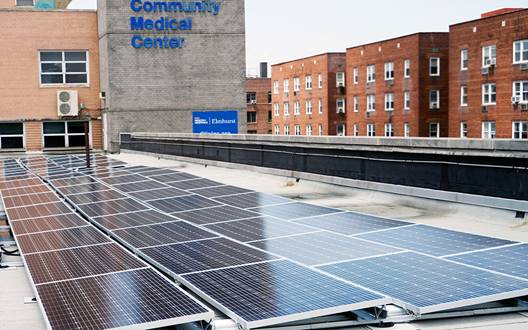
Solar panels on the roof of NYC Health + Hospitals/Elmhurst.
- In May 2024, NYC Health + Hospitals appointed Omer Cabuk, ME as its first ever Chief Decarbonization Officer. Omer serves as an executive-level strategist, partnering with leadership teams, capital project leads, facilities management staff, and other key stakeholders to pursue the organization’s robust decarbonization initiatives, including adhering to the targets set by Local Law 97, which mandates a 40% reduction in operational emissions by 2025 and a 50% reduction by 2030.
- Completed large-scale energy efficiency upgrades at NYC Health + Hospital/Queens to enhance the hospital’s sustainable infrastructure and heating, ventilation, and air conditioning systems. These upgrades, completed in partnership with DCAS, have created a healthier environment for patients and staff while transforming the facility into a greener, more energy-efficient healthcare hub. The $8.2 million energy project is expected to save 1.4 million kWh of electricity and 218,000 therms of natural gas annually, cutting greenhouse gas emissions by approximately 1,500 metric tons of CO2e per year and generating more than $400,000 in annual energy savings.


Key energy efficiency upgrades at Queens Hospital include the installation of an advanced chiller plant optimization system and boiler burner control upgrades.
- Phase I of a comprehensive energy upgrade project at NYC Health + Hospitals/Lincoln was completed in early 2024, with Phase II targeting completion by June of this year. Together, the two phases represent a $41 million investment and include major energy efficiency improvements to the hospital’s air handling units, lighting systems, and fan coil units. Once project is complete, the upgrades are expected to generate $1.7 million in annual energy savings and reduce carbon emissions by approximately 3,200 metric tons per year.
- Achieved a 52% annual reduction in carbon dioxide equivalent (CO₂e) emissions in its anesthesia practices systemwide, an achievement driven by the deactivation of central piped nitrous oxide (N₂O) and optimized use of anesthetic gases. Four of the public health system’s hospital facilities, including NYC Health + Hospitals/Bellevue, Elmhurst, Jacobi, and North Central Bronx, have fully deactivated the use of central N₂O in their anesthesia practices. Across the public health system, the collective reductions in CO₂e emissions as a result of deactivating central N₂O systems and reduced delivery of anesthetic gases amounts to over 5,000 metric tons of carbon dioxide, or the equivalent of taking approximately 1,100 gas-powered cars off the roads.
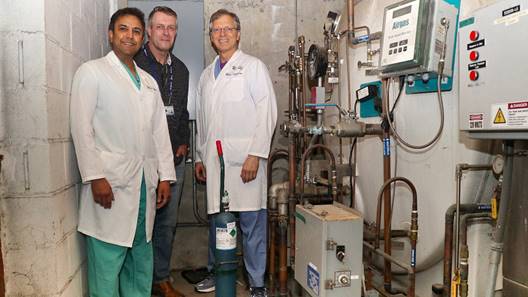
Dr. Sudheer Jain, Chief of Anesthesiology at NYC Health + Hospitals/Bellevue, Andy Nuzer, Bellevue Hospital’s Assistant Director of Engineering and Support Services, and Dr. Kenneth Sutin, Bellevue Hospital Anesthesiologist and Principal Investigator of NYC Health + Hospitals’ Fresh Gas Flow Project, with the now-deactivated central N₂O supply system at Bellevue Hospital and a portable N₂O tank used in the hospital’s operating rooms.
- In addition to ongoing infrastructure upgrades, NYC Health + Hospitals has reduced climate emissions through its commitment to serving plant-based meals to its patients. The health system has served over 2 million plant-based meals since the program launched in March 2022. In addition to the considerable health benefits for patients, the plant-based meals served in 2023 led to a reduction in carbon emissions of 36% and a cost savings of 59 cents per meal.
The health system has now achieved a 31% reduction in operational carbon dioxide emissions since 2006. Decarbonization often involves upgrading building infrastructure with more efficient, modern systems, such as better insulation, high-efficiency HVAC systems, and advanced building materials. Such improvements can make buildings more resilient to external climate conditions and disasters, maintaining internal conditions more effectively and ensuring patient comfort and safety. In addition, these improvements also reduce building energy needs and extend the operational time of emergency backup systems, which contribute toward its resiliency.
Banner Image: NYC Health + Hospitals/Jacobi and Office of Facilities Development leadership with DEP to celebrate the installation of the hospital’s stormwater drainage system. Image Credit – NYC H + H
NYC Dept of Health and Mental Hygiene


The New York City Department of Health and Mental Hygiene is the department of the government of New York City responsible for public health along with issuing birth certificates, dog licenses, and conducting restaurant inspection and enforcement. The New York City Board of Health is part of the department. Its regulations are compiled in title 24 of the New York City Rules (the New York City Health Code). Since March 2022, the commissioner has been Ashwin Vasan.