


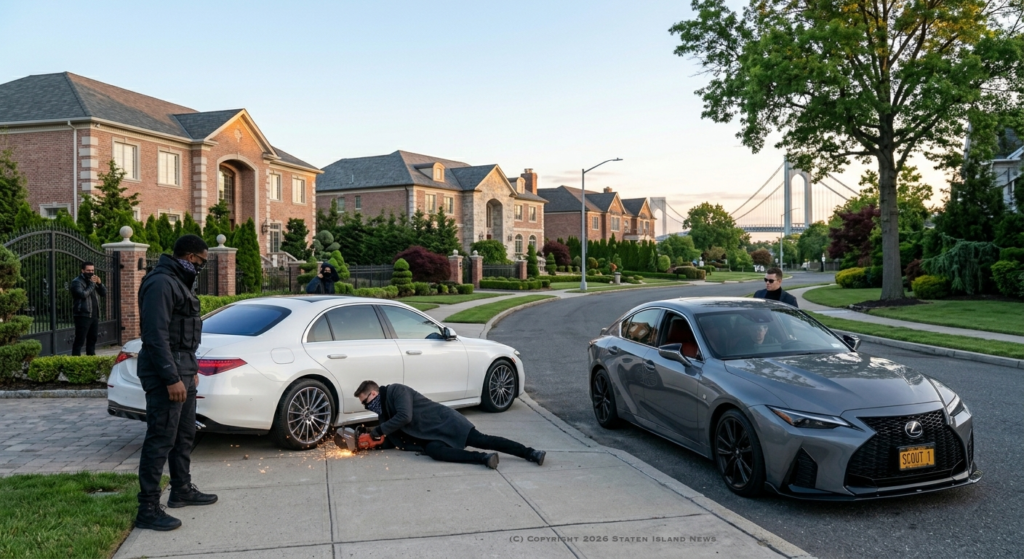
The geographical reality of Staten Island is the first hurdle in the race for law and order. Spanning roughly 60 square miles, the borough offers a suburban landscape that is deceptively difficult to police, even with an increased NYPD presence. The density of residential streets, coupled with immediate access to four major bridges—the Verrazzano-Narrows, Goethals, Outerbridge Crossing, and Bayonne—creates a “high-speed escape” environment. Unlike the gridlock of Manhattan or the deep interior of the Bronx, a thief on Staten Island can transition from a residential curb to an interstate highway in under three minutes.
In 2026, the data reflects a disturbing evolution in how these crimes are executed. We are no longer seeing the lone opportunist; instead, the Island has been targeted by organized rings using high-performance, often stolen, “lead cars” from high-end brands. These vehicles are used to scout neighborhoods and provide a rapid extraction point for those stealing catalytic converters or entire vehicles. This tactical speed means that by the time a 911 operator has dispatched a unit, the suspects have often crossed the state line into New Jersey or vanished into the expressway system.
The legal framework governing these incidents creates a “Vehicle Vacuum” that leaves the owner in a state of enforced passivity. There is a profound and frustrating disconnect between how New York State law treats your front door versus your car door. Under the current interpretation of New York Penal Law, your home is a “dwelling,” a sacred space where the “Castle Doctrine” applies. Within those four walls, you have no duty to retreat and may use physical force to terminate a burglary.
However, when a vehicle is parked on a public street, it is relegated to the status of “personal property.” This classification strips the owner of the right to intervene. If you look out your window and see a criminal using a reciprocating saw to remove a catalytic converter, the law effectively mandates that you remain a spectator. Attempting to physically detain that individual—a “Citizen’s Arrest”—is a legal minefield. In the eyes of the city’s current prosecutorial climate, if a vehicle owner uses force to stop a property crime, that owner risks being charged with Unlawful Imprisonment or Assault. The criminal’s right to flee, oddly enough, is often more protected than the owner’s right to protect their equity.
A critical nuance exists when the vehicle is parked within the “curtilage” of the home, such as a private driveway. While the car itself remains personal property, the driveway is part of your private premises. In this scenario, the act of entering the driveway constitutes Trespass or even Burglary if the intent is to commit a crime within a structure on the land. However, the threshold for using force remains dangerously high. The law expects a homeowner to distinguish, in the dark of night and in a state of high adrenaline, between a threat to property and a threat to life. Because a car is not a “dwelling” where one sleeps, the state generally maintains that no amount of property damage justifies a physical confrontation initiated by the owner.
To restore a sense of justice, the conversation must move toward “untying” the hands of the police and escalating the consequences for the criminal. We must advocate for a higher definition of criminality regarding vehicle-related offenses. Stealing a catalytic converter is serious; it is an act of environmental and financial sabotage that renders a necessary tool for survival—the car—inoperable.
Furthermore, we must address the legislative hurdles that allow repeat offenders to return to the streets within hours. The “cost” of the crime must be elevated to exceed the black-market value of the precious metals being harvested. But unauthorized car entry or vehicular vandalism should also cost the perpetrator, acting as a disincentive to both. Only by reclassifying these brazen acts of vandalism and theft as significant violations of personal security can we begin to close the door on the lawlessness regarding motor vehicles currently felt across the borough.
The legal paralysis deepens when we consider the direct invasion of the vehicle’s interior. We are not merely discussing the theft of an external component; we are addressing the harrowing moment a resident looks out their window to see a stranger physically inside their car, rifling through the glove box or center console for cash and personal documents. In any rational society, the interior of one’s vehicle is an extension of their private domain, yet New York law treats this intrusion with a startling lack of urgency. If you discover an intruder sitting in your driver’s seat, the current legal framework effectively limits your response to a verbal request for them to leave. You are legally expected to play the role of the polite host to a predator. And, don’t be too harsh. They may be armed, and the law is certainly not a limiting factor in their behavior!
This reality is a slap in the face to every hardworking Staten Islander. Because the vehicle is not legally classified as a “dwelling,” you cannot physically remove the intruder or bar their exit to wait for the police. If you were to grab a thief by the collar to pull them out of your seat, you—the victim—could well be the one facing an assault charge. If you were to block the door to prevent them from fleeing with your property, you could be cited for unlawful imprisonment. This creates a perverse incentive for the criminal; they know that as long as they do not physically attack you, they are shielded by a legal “hands-off” policy that renders the owner a captive witness to their own victimization. Staten Islanders, remember the law! Don’t get yourself in a jam doing what you thought was the “Right Thing,” because by law, it is not.
Even the act of “simple” vandalism is treated by the system as a victimless administrative nuisance, but for the resident, it is a profound violation of safety. When a window is shattered or a dashboard is ripped apart for electronics, the damage is not just financial; it is a signal that the sanctuary of one’s own property has been nullified. The law’s tendency to downplay these acts as mere property crimes ignores the psychological toll of knowing that a stranger can enter your space, destroy your property, and walk away with total impunity because the “threshold for intervention” has been set impossibly high for the citizen.
The call for reform must therefore be absolute. We do not just need more police; we need to untie the hands of the officers we have and restore the rights of the property owner. Legislative action must be taken to elevate “unlawful entry of a motor vehicle” to a felony-level offense that recognizes the vehicle as a protected space. We must broaden the definitions of “justifiable force” to include the protection of one’s vehicle when it is being invaded or destroyed. The criminal must be made to understand that entering a car on a Staten Island street carries a cost so high it is no longer a viable “profession.” Until the law stops prioritizing the mobility of the thief over the security of the taxpayer, the sense of law and order in NYC will remain a ghost of the past.
Ultimately, any strategic or legislative shift must be paired with a fundamental correction in resource allocation. Staten Island is the third largest borough by land area—nearly 60 square miles of residential corridors, industrial zones, and sprawling developments—yet it continues to be policed as an afterthought. Our geography demands a unique staffing model; we are not a vertical, dense grid like Manhattan that can be flooded with foot patrols. We are a borough of distances, and those distances are currently being exploited by the aforementioned high-speed theft rings.
As of 2026, Staten Island operates with significantly fewer officers per square mile than our neighbors across the bridges, a disparity that District Attorney Michael McMahon recently noted has reached critical levels, with staffing lower than it was decades ago when the population was half its current size. To secure our streets, we must hire more police specifically for the Staten Island command, ensuring that our response times match the velocity of the criminals targeting us. A borough this size cannot be protected by a “lean” force; it requires a presence that acknowledges our 60-square-mile reality.
Staten Islander Staff Writers’ Sources for This Article
Section 1: The Tactical Geography and Case Facts
- NYPD CompStat 2.0: Statistical breakdowns for Staten Island Patrol Borough (PBSI) showing the 22% increase in Grand Larceny Auto and the 164% spike in specific incidents over a recent 28-day period as of May 2026.
- Staten Island Advance / Police1 Reporting: Coverage from May 2026 detailing the “triple-digit” percentage surges in vehicle theft and calls from local officials for harsher penalties.
- New York Attorney General’s Office: March 2026 investigation details regarding “Operation Fast Break” and other organized theft rings utilizing high-performance vehicles for rapid extraction across the NYC/NJ border.
Section 2 & 3: Legal Distinctions and Premise Rights
- New York Penal Law Section 35.20: The statutory definition of “Justification” for the use of physical force, highlighting the specific “duty to retreat” when dealing with non-dwelling property like vehicles.
- New York Penal Law Sections 140.05 – 140.10: Statutes governing Trespass and Criminal Trespass, clarifying the current light sentencing and classification of unauthorized vehicle entry.
- National Insurance Crime Bureau (NICB) 2026 Market Analysis: Data regarding the resurgence in catalytic converter thefts driven by 2026 precious metal market peaks for Rhodium and Palladium.
Section 4 & 5: Resource Allocation and Policy Reform
- Staten Island District Attorney Public Statement: March/April 2026 testimony regarding the 12% decrease in borough officer headcount and the disparity between land area and patrol strength.
- NYC Financial Plan Detail (FY 2026-2030): Documentation regarding the reversal of planned NYPD expansions and the impact on outer-borough staffing targets.
- NYC Council Fiscal 2026 Preliminary Plan: Budgetary reports on Patrol Borough Staten Island headcount versus geographically smaller, higher-density districts.
Staten Islander News Service Staff Writer


This byline indicates that this article was penned by a member/members of the Staten Islander News Organization office team. Our staff writers are the backbone of our newspaper, performing all sorts of important tasks like conducting interviews, investigating leads, besides writing the news stories you see.