


Attorney General James Issues Voter Guidance to Inform New Yorkers of Their Rights Ahead of November Election
Editor’s note: We previously covered some of the rights that New Yorkers have when it comes to having an interpreter for those who are legally allowed to vote but for whom English is a second language and they might face challenges because of this. We will shortly be covering the way in which Texas is dealing with this extremely significant election. They already did the most heavy gerrymandering they could do (which is essentially political cheating where district lines are redrawn by the majority party in order to help them get more seats by changing the demographics in the districts. In Texas and elsewhere, many of these lines are drawn in order to take power away from minority voter groups. Another issue that Attorney General James has been dealing with has been issues with migrants and their treatment under the current administration. We have also reported on the separation of children from their parents by taking the parent only (such as happened in New Jersey), as well as holding children in detention, often with their parents, such as the couple from Russia whose 18 month old son was held in detention with them in a warehouse-type center not designed for human beings. The US Representative for the Manhattan and Brooklyn areas of New York City, who lost the primary to Comptroller Brad Lander, has been pressing, legally, the Department of Homeland Security and Immigration and Customs Enforcement for transparency regarding their detention center that is in his district. He has been given permission by a judge to conduct announced and unannounced visits, and is required to be allowed access to the detainees inside, over 60% of whom have absolutely no criminal record whatsoever, and that is according to DHS themselves.
NEW YORK – New York Attorney General Letitia James issued guidance to inform New York voters of their rights and help them vote safely in the November 3 general election. With early voting set to begin statewide on Saturday, October 24, Attorney General James reminded voters that state and federal laws protect their right to cast a ballot free from intimidation, harassment, or interference from anyone, including government officials and armed federal agents. Attorney General James also released new guidance on voters’ rights to language assistance and sent a letter to local Boards of Elections (BOEs) and law enforcement agencies, reminding them of their responsibility to stop voter intimidation and protect every voter at the polls
“Every New Yorker has the right to vote freely and safely, without fear of being threatened or harassed in the voting booth,” said Attorney General James. “I will not let anyone or anything stand between New Yorkers and the ballot box. I encourage all New Yorkers who encounter voter intimidation or suppression efforts to report the incident to my office immediately.”
The Office of the Attorney General (OAG)’s Election Protection Hotline will be available to help voters resolve problems from Saturday, October 24 through Wednesday, November 4. New Yorkers can call 866-390-2992 or submit a complaint online. Anyone who witnesses potentially dangerous or violent conduct should call 911 immediately.
Key Dates and Deadlines
New York voters should keep the following dates and deadlines in mind as they make a plan to vote:
- Saturday, October 24: Last day to register to vote, and last day to request a mail ballot online or by mail.
- Saturday, October 24 – Sunday, November 1: In-person early voting.
- New York City voters are assigned an early voting site by the New York City BOE, which may be different from their Election Day poll site. New York City voters can find both sites on the NYCBOE website.
- Voters outside New York City may vote at any early voting site in their county and can find locations through their county board of elections or the New York State BOE Poll Site Search.
- Monday, November 2: Last day to request a mail ballot in person at the local BOE.
- Tuesday, November 3: Election Day. Polls are open statewide from 6 a.m. to 9 p.m.
- Mail ballots must be postmarked by Election Day and received by the county BOE by Tuesday, November 10. Because of recent changes in how the U.S. Postal Service applies postmarks, a ballot dropped in a mailbox may not be postmarked for a day or more.
- Voters are encouraged to mail in their mail ballots as early as possible or drop their ballot off in person at their county BOE, any early voting site in their county, or any open poll site in their county by 9 p.m. on Election Day.
Know Your Rights
Every New York voter has the right to vote freely and without fear of intimidation, coercion, or threats to their safety. Every voter has the right to:
- Vote without showing photo ID. New York never requires photo identification to vote. If a voter is voting for the first time in their district and did not provide identification when they registered, they may be asked to confirm their name and address. They can choose to show a photo ID or a copy of a current utility bill, bank statement, government check, paycheck, or other government document with their name and address. If they have none of these, they can still cast an affidavit ballot.
- Refuse demands for ID or proof of citizenship from poll watchers or observers. Only election officials can ask for identification, and only in the limited case above. A poll watcher, observer, or any other person demanding to see a voter’s ID or proof of citizenship may be engaging in illegal voter intimidation.
- Vote in private. No one may stand anywhere that lets them see how a person votes, and no one may be within three feet of the ballot scanner, ballot marking device, or privacy booth while someone is using it. It is a crime for anyone to ask to see a person’s completed ballot. However, voters may bring a trusted individual to the polling site to help fill out their ballot.
- Cast an affidavit ballot. If a person’s name is not on the voter list but they believe they are eligible and at the right polling site, they can request an affidavit ballot. Election officials will count it once they confirm eligibility and the voter’s address.
- Stay in line. If someone is in line when polls close, they still have the right to vote.
- Vote free from campaigning. Electioneering is banned inside polling places and within 100 feet of the entrance. Within that zone, no political banners, buttons, posters, or placards are allowed, and no one may urge anyone to vote a certain way.
- Vote with a criminal record. If someone is in jail awaiting trial, incarcerated on a misdemeanor, or on parole or probation, they are eligible to vote. If a person has been released from prison after a felony conviction, they are eligible to vote but may need to re-register. However, people currently incarcerated for a felony conviction cannot vote.
Language Access
New Yorkers who have difficulty reading or writing in English have the right to bring someone to the polls to help them vote. The person helping does not have to be a U.S. citizen or a registered voter and can be a minor, family member, or friend – it just cannot be the voter’s employer, an agent of the employer, or an officer or agent of the voter’s union.
The helper can assist throughout the entire voting process, including inside the voting booth, but may be asked to swear an oath that they will not improperly influence anyone’s vote. If a voter does not have anyone to help them, two poll workers from different political parties or a designated interpreter can assist.
Under the New York Voting Rights Act and federal law, certain BOEs, counties, cities, towns, villages, and school districts must provide assistance to voters who do not speak or read English well. Where these requirements apply, local governments must:
- Make all voting materials and election information that are available in English also available in the required languages;
- Provide translated ballots, voter registration forms, and other written materials, including information about absentee and mail voting; and
- Provide oral language assistance, such as interpreters or bilingual poll workers.
Voters can contact their county board of elections to learn whether it provides language assistance. Questions about language access can be sent to OAG at votinglanguage@ag.ny.gov.
Accessibility and Accommodations
Under New York law, voters with disabilities must receive reasonable accommodations to ensure meaningful access to voting.
- If voting in person:
- A trusted individual may help in the voting booth. The person helping does not have to be a U.S. citizen or a registered voter and can be a minor, family member, or friend – it just cannot be the voter’s employer, an agent of the employer, or an officer or agent of the voter’s union.
- Election inspectors can assist and provide assistive devices.
- Poll workers can offer a chair, let someone hold a place in line, or move a person to the front if they cannot stand for long periods.
- If voting by mail:
- Voters can request an accessible ballot, which comes with a postage-paid return envelope.
- Voters can sign the security envelope on the raised marker, or anywhere else on the envelope if signing on the marker is difficult.
- Voters can mark their ballot electronically using their own assistive technology.
Recognizing Voter Intimidation
Under state and federal law, it is illegal for anyone to intimidate, threaten, or coerce voters to interfere with their right to vote. It is also illegal to obstruct or impede someone trying to vote or participate in the voting process. Examples of potentially illegal voter intimidation include:
- Individuals or groups patrolling outside polling places and trying to scare people out of line;
- Poll watchers aggressively challenging large numbers of voters, or targeting voters of a particular background, to create long lines and false fears of illegal voting;
- Poll watchers standing near privacy booths or in unauthorized areas, recording or photographing voters, or following or harassing voters;
- Civilians dressing as law enforcement officers and harassing voters;
- People carrying weapons or wearing foreign military uniforms or military gear at polling locations; and
- People spreading rumors that voting will have negative consequences.
Courts have also found that threatening to evict someone for voting, threatening to share voter information with debt collectors, threatening to use voter information to track down old warrants, publishing voters’ names and addresses online (“doxing”), and following voters to the polls while talking loudly about prosecuting them for illegal voting all constitute illegal voter intimidation. The First Amendment does not protect true threats or false statements meant to keep people from voting.
It is a felony to bring a firearm, rifle, or shotgun to a polling place in New York, or to threaten or harass someone with other dangerous objects, such as a baseball bat, tire iron, knife, or hammer.
Poll Watchers and Federal Election Monitors
Poll watchers can observe and report problems, but they cannot interfere with voters. Under New York law, poll watchers must be appointed in writing by a political party, independent body, candidate, or ballot proposal committee, and their certificate must be delivered to the election inspector. Each organization may have no more than three poll watchers per election district at a time, and only one may be inside the guard rail where election inspectors work.
Poll watchers may challenge a voter’s eligibility in appropriate circumstances, but they may not:
- Solicit votes or wear, carry, or hand out campaign literature, buttons, posters, or banners;
- Tamper with election materials, including posted signs or results tapes;
- Protest an election inspector’s ruling on a voter challenge; or
- Follow a voter to the privacy booth, ballot scanner, or ballot marking device.
A poll watcher who blocks voters from reaching the voting booths can be ordered to remain seated and removed if they refuse.
The U.S. Department of Justice (DOJ) has announced plans to send monitors to polling places during the November election and may send monitors to New York. These monitors may not demand identification, challenge voters, direct or interfere with poll workers, or campaign or engage in political activity. DOJ monitors typically coordinate with local election officials in advance. Poll workers who encounter someone identifying as a DOJ monitor without prior notice should contact their county election officials.
Law Enforcement at Poll Sites
It is a federal crime to order or keep troops, military personnel, or armed federal officers, including U.S. Immigration and Customs Enforcement (ICE), U.S. Customs and Border Protection (CBP), or Federal Bureau of Investigation (FBI) agents, at a poll site. In addition, members of the military may not use force, threats, or intimidation to stop anyone from voting, and government officials may not use their authority to interfere in a federal election.
New York law also prohibits local governments and their employees from granting immigration enforcement officers access to a polling location in violation of these protections, unless they present a valid judicial warrant or court order.
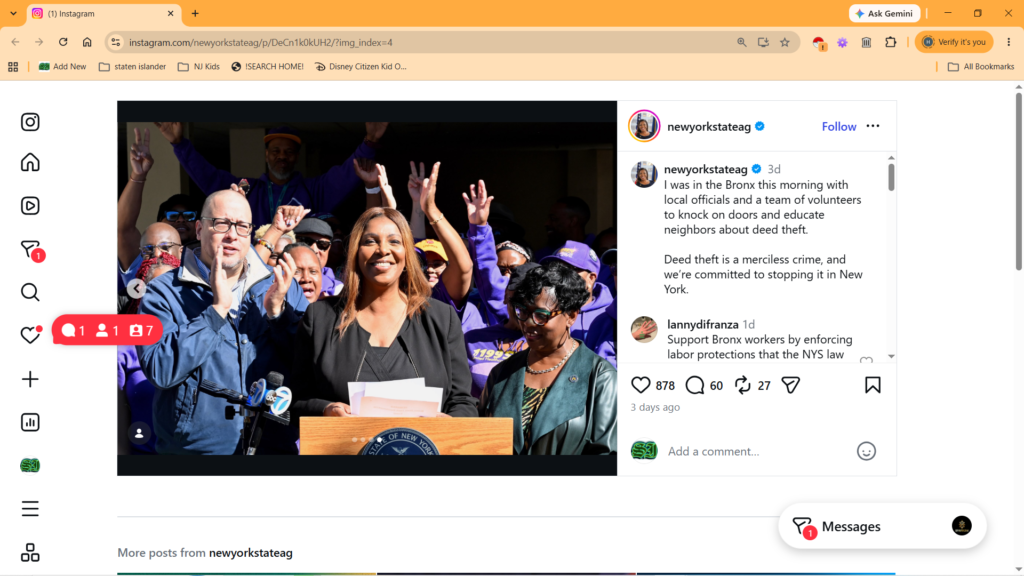
Banner Image: AG James stands with constituents. Image Credit – AG James
Leticia James NY State Attorney General


Letitia “Tish” James is the 67th Attorney General for the state of New York. With decades of experience and a long record of achievements, she is a powerful, effective attorney and lifelong public servant. When she was elected in 2018, she became the first woman of color to hold statewide office in New York and the first woman to be elected Attorney General.