
New York Attorney General: Protecting Haitian/Syrian Immigrants, NY Presbyterian Hospital, Mail-In Voting, Illicit Xylazine, Predatory Lender, Vehicle Theft Ring,
NY AG: Challenging SCOTUS To Uphold Haitian/Syrian Immigration Status, Mental Health Settlement At NY Presbyterian, Protecting Mail-In Voting, Protecting Communities From Illicit Xylazine, Resolving Healthcare Disputes, Predatory Lender Suit, Vehicle Theft Ring Takedown
Editor’s note: Regarding the immigrants discussed by AG James, several Staten Island hospitals and healthcare organizations, along with Representative Malliotakis, talked about the disruptions to medical care that these specific changes would cause, if all of these immigrants were suddenly uprooted and deported. You can see our previous rundown for the New York Attorney General here, where she covered many items, including the now in-effect SNAP work requirements for everyone who is not disabled and is under 64 years of age (previously 55 before the OBBBA). This means that more people will be removed from SNAP in the coming months if they cannot meet these requirements. They can apply, with their doctor’s assistance, to be considered disabled, if they’re unable to work. New York has also been forced to cut eligibility for New Yorkers enrolled in the Essential Health Care Plan, which had previously included people making 250% of the Federal Poverty Level (which is around $39,000 per year for a single adult). Such a salary would make one presumably an ALICE individual (Asset Limited, Income Constrained, Employed). The FPL is about $23,000. The new Essential Plan requires applicants to be at our below 200% of the FPL.

Image Credit – AG James
Attorney General James Urges Supreme Court to Uphold Legal Status of Haitian and Syrian Immigrants
AG James Co-Leads Coalition of 18 Other Attorneys General Defending Temporary Protected Status for Hundreds of Thousands of People
NEW YORK – New York Attorney General Letitia James today co-led a coalition of 18 other attorneys general in filing an amicus brief with the U.S. Supreme Court urging the Court to uphold the legal status of hundreds of thousands of immigrants from Haiti and Syria who have been living in the United States for years. Attorney General James and the coalition argue that the administration’s unlawful attempt to cancel Temporary Protected Status (TPS) for Haitian and Syrian immigrants threatens the lives and livelihoods of hundreds of thousands of families throughout the country, disrupting states’ economies and jeopardizing the futures of immigrants’ U.S. citizen children. The coalition is urging the Court to uphold lower court decisions to postpone the termination of TPS for Haiti and Syria.
“For generations, we have welcomed those fleeing danger in their home countries to build a safe and prosperous life in the United States,” said Attorney General James. “Immigrants with TPS hold valuable roles in our communities as business owners, workers, teachers, and parents. We will continue to stand against the Trump administration’s illegal attempts to cancel their legal status and tear families apart.”
The United States has a long history of providing a safe haven to those who have escaped armed conflict, natural disasters, and repressive conditions. TPS allows immigrants fleeing dangerous conditions in their home countries to live and work in the U.S. and has been extended to immigrants from Haiti since 2010 and to immigrants from Syria since 2012. New York is home to tens of thousands of TPS holders, including at least 5,400 Haitian TPS holders in New York City. Nationwide, there are approximately 350,000 Haitians and more than 6,000 Syrians with TPS. In 2025, the Trump administration illegally moved to terminate TPS for Haiti, Syria, and several other countries.
As Attorney General James and the coalition argue in their brief, Haitian and Syrian TPS holders contribute substantially to their communities and their states’ economies. Tens of thousands of Haitian TPS holders work in health care and other critical services, particularly in New York, where TPS holders fill valuable roles as home health aides. Syrian immigrants own businesses at more than triple the rate of U.S.-born citizens, and Syrian TPS holders contribute $165 million annually to the U.S. economy. Haitian TPS holders contribute $3.4 billion annually to the U.S. economy.
Terminating TPS for Haitian and Syrian immigrants would put hundreds of thousands of families at risk by forcing vulnerable immigrants to either remain in the U.S. without a secure legal status or return to dangerous conditions in their home countries. As Attorney General James and the coalition explain, the federal government has designated conditions in Haiti and Syria as extremely dangerous. The State Department warns Americans not to travel to either country due to the risk of violence, terrorism, civil unrest, and limited health care – the very conditions that prompted TPS protections for residents of these countries in the first place. Terminating TPS would force TPS holder parents to choose between abandoning their children born in America and returning to their home country alone, taking their families with them to a dangerous and unfamiliar country, or remaining in the U.S. without legal status and with the constant fear that they could be forcibly separated and deported at any time.

Attorney General James and the coalition also argue that terminating TPS would increase public health and safety risks in their states. Ending the legal status for hundreds of thousands of workers would cause many to lose their health insurance, putting themselves and their families at greater risk and increasing health care costs for states. Without legal status, many TPS holders would be unwilling to visit a hospital or doctor’s office for fear of encountering immigration enforcement officers. TPS holders would also be less willing to report crimes to law enforcement or serve as witnesses at trial, increasing public safety risks in their communities.
Attorney General James and the coalition are urging the Supreme Court to uphold lower court orders postponing the federal government’s termination of TPS for Haiti and Syria.
Joining Attorney General James in filing this brief are the attorneys general of California, Connecticut, Delaware, Hawaii, Illinois, Maine, Massachusetts, Maryland, Michigan, Minnesota, Nevada, New Jersey, Oregon, Rhode Island, Virginia, Vermont, and Washington, and the District of Columbia.
Attorney General James has consistently taken action to defend TPS from the Trump administration’s unlawful attacks. In March, Attorney General James co-led a coalition of 18 other attorneys general in urging the Supreme Court to uphold TPS for Haitians. In February, Attorney General James co-led a coalition of 17 other attorneys general in filing an amicus brief with the U.S. Court of Appeals for the District of Columbia in support of TPS for Haitians. In November 2025, Attorney General James led 15 other attorneys general in filing an amicus brief to defend TPS for Haitian and Venezuelan immigrants. In July 2025, Attorney General James co-led a coalition of 14 other attorneys general in filing an amicus brief defending TPS for immigrants from Honduras, Nicaragua, and Nepal.
Image Credit – AG James
Attorney General James Mandates Major Mental Health Reforms at NewYork-Presbyterian Hospital
OAG Investigation Revealed Systemic Failures in Emergency Care, Patient Safety, and Psychiatric Bed Capacity
NEW YORK – New York Attorney General Letitia James today announced a landmark settlement with NewYork-Presbyterian Hospital (NYP) following a years-long investigation into the hospital system’s treatment of patients experiencing mental health emergencies. The Office of the Attorney General (OAG) found that NYP engaged in a repeated pattern of failures that put vulnerable patients at risk, including failing to properly evaluate and stabilize patients in emergency departments, leaving critical psychiatric beds offline during a worsening mental health crisis, and frequently diverting ambulances from bringing mental health patients to the emergency department without any defined policy in place. As a result of the investigation, NYP must implement extensive reforms to better serve emergency department patients experiencing mental health and substance use challenges and improve its screening, stabilization, and documentation procedures.
“Too many New Yorkers experiencing mental health crises have been met with inadequate care when they need help most,” said Attorney General James. “Mental health care is necessary medical care, and hospitals have a legal and moral obligation to treat these crises with urgency and compassion. These sweeping reforms will protect patients, strengthen oversight, and help ensure that no one is left without care in their most vulnerable moments.”
The OAG launched an investigation into NYP after mounting concerns regarding access to mental health care and the treatment of patients in crisis, including testimony from providers, advocates, and impacted families about dangerous gaps in emergency and inpatient psychiatric services. The OAG reviewed data regarding thousands of emergency department visits involving behavioral health conditions, as well as patient records, hospital policies, incident reporting systems, and psychiatric bed capacity data to assess compliance with federal and state law.
The investigation uncovered repeated breakdowns in emergency department care, including consistent failures to properly screen and stabilize patients with behavioral health conditions, as well as a lack of effective screening and safety measures to prevent impaired patients from leaving the hospital prior to discharge (known as elopement). The OAG also found that NYP failed to adequately monitor patients placed under observation, including those requiring one-on-one supervision, and did not consistently gather critical information from outside sources, such as family members or community providers. Patients were routinely discharged without the care, stability, or follow-up support they needed, and NYP’s records did not always include complete or accurate documentation.
In multiple cases, patients experiencing serious psychiatric symptoms — including suicidal ideation, psychosis, and violent behavior — left the hospital before being properly discharged or transferred due to inadequate supervision and safety protocols, putting both patients and the public at potential risk. For example:
- A patient with a history of suicide attempts and homicidal ideation arrived at the hospital reporting hallucinations. After telling staff he “couldn’t control when he wanted to hurt people,” he was determined to need inpatient psychiatric admission and remained in the emergency department for more than two days awaiting a bed. Despite being ordered to receive close supervision, he eloped from the hospital before he could be transferred.
- A teenage patient initially cleared for discharge pending a psychiatric evaluation was later found to need inpatient admission after providers reached his mother and determined he was at high risk for suicide or violence. Because staff had failed to implement safety precautions, the patient eloped from the hospital within minutes without receiving further care.
- A young man was brought to the hospital by EMS and police after attacking a bystander. Staff failed to review the EMS report documenting the incident and did not fully assess the risk he posed. The patient ran from the emergency department, chased by staff and security, but the hospital did not notify law enforcement until the following day.
The OAG also determined that NYP failed to bring all of its licensed inpatient psychiatric beds back online after the COVID-19 pandemic, despite clear legal requirements and growing demand for care. As of May 2023, more than 100 psychiatric beds remained out of operation across the NYP system. State regulators had directed hospitals to restore this capacity as the pandemic subsided, but NYP did not fully comply, contributing to a shortage of inpatient care during a period of heightened mental health need.
As a result of OAG’s investigation, Attorney General James is requiring sweeping reforms across the NYP hospital system, including:
- Major Emergency Department Reforms: NYP must strengthen its screening policies to identify risks such as suicide, violence, and substance use, with required follow-up assessments and ongoing reassessment for higher-risk patients. NYP must also strengthen patient safety and monitoring, including establishing mandatory observation protocols, maintaining monitoring logs, and documenting clinical decisions.
- Elopement Prevention Measures: NYP must strengthen its elopement screening policies and precautions to prevent vulnerable patients from leaving care unsupervised. If a high-need patient goes missing, staff must immediately escalate the situation, notify leadership, and fully document and review each incident.
- Health Record Upgrades: NYP must improve its electronic health record (EHR) system to ensure providers have real-time access to complete patient information and can follow care protocols.
- Care Coordination Improvements: NYP staff must review prior records, consult relevant databases, and make efforts to contact a patient’s family members, providers, or other sources when available, documenting all outreach. When appropriate, NYP must coordinate with outpatient providers and care teams before making treatment or discharge decisions.
- Stronger Discharge and Admission Planning: NYP must ensure patients with complex needs leave the hospital with appropriate follow-up care, including scheduled appointments and connections to ongoing services. NYP must also document all efforts to locate available beds for patients awaiting admission.
- Ongoing Oversight and Accountability: NYP will be subject to continued monitoring, reporting, and quality assurance reviews, including tracking and reviewing every incident of patient elopement to ensure compliance with OAG’s reforms.
Attorney General James has secured $500,000 from NYP for its misconduct and will impose a $10,000 penalty per violation for any future violations of the settlement terms. NYP must also comply with all laws governing psychiatric bed capacity and ensure appropriate planning and transparency regarding inpatient services going forward.
“Today’s settlement announced by New York Attorney General James is an important reminder of the ongoing need for strong oversight and enforcement to ensure compliance and accountability with New York’s laws and regulations. This is essential to guarantee that New Yorkers with mental health conditions can access care—especially in emergencies, when proper screening, evaluation, and treatment are crucial,” said Glenn Liebman, CEO of Mental Health Association in New York State (MHANYS). “As we continue to address a mental health crisis, it is vital for New York state to require community hospitals to restore all inpatient capacity to pre-COVID levels and to implement policies and procedures that assure not only adequate care and safety in emergency rooms and inpatient units, but also in discharge planning. Let this agreement strengthen the collective commitment and resolve of regulators, providers, and stakeholders to meet the needs of New Yorkers with the most complex mental health conditions and their families.”
This matter was handled by Assistant Attorney General Michael Reisman and Assistant Attorney General and Special Assistant to the First Deputy Gina Bull, under the supervision of Health Care Bureau Chief Darsana Srinivasan. The Health Care Bureau is part of the Division for Social Justice, which is led by Chief Deputy Attorney General Meghan Faux and overseen by First Deputy Attorney General Jennifer Levy.

Image Credit – AG James
Attorney General James Challenges Unconstitutional Executive Order Threatening Mail-In Voting
AG James and Multistate Coalition Sue to Block Federal Power Grab That Threatens Voter Access and States’ Authority Over Elections
NEW YORK – New York Attorney General Letitia James and a coalition of 22 other attorneys general, as well as the governor of Pennsylvania, today are filing a lawsuit to block the president’s latest illegal executive order that would upend state election systems, baselessly restrict mail-in voting, and threaten election officials with prosecution for carrying out their duties. Attorney General James and the coalition argue that the order, signed just days ago, violates the United States Constitution and federal law by attempting to seize control of elections from the states and Congress. The coalition is asking the court to strike down the order and prohibit federal agencies from carrying out its unlawful directives.
“Free and fair elections are the cornerstone of our democracy, and no president has the power to rewrite the rules on his own,” said Attorney General James. “This executive order is yet another attempt to disenfranchise voters and sow distrust in our electoral system as we head into the next election cycle. Our elections are and always have been free, fair, and secure, and we will not allow this administration to attack the very foundation of our nation.”
Earlier this week, President Trump issued an executive order, “Ensuring Citizenship Verification and Integrity in Federal Elections,” attempting to impose sweeping and unlawful federal control over state election systems. The order directs federal agencies to create and maintain master federal voter rolls by state and pressures states to rely on those voter rolls under threat of investigation, prosecution, or withholding of federal funds. It also requires the United States Postal Service (USPS) to refuse to deliver mail ballots from voters who are not included on a federal voter roll, directly interfering with states’ mail voting systems. Additionally, the order seeks to force states to preserve election records for longer periods than required under existing law at states’ expense, again backed by threats of enforcement action, criminal prosecution, or the withholding of federal funds.
Attorney General James and the coalition argue that the president is violating the Constitution by attempting to override states’ authority to administer elections. They contend that the order unlawfully interferes with mail-in voting by directing USPS to block ballot delivery based on federal criteria outside states’ control, despite the fact that mail-in voting is a secure, reliable method used by voters of all parties and in all states – including the president himself. The coalition emphasizes that election administration is a complex, state-run process that requires extensive planning and preparation, and that the demands outlined in the executive order would significantly disrupt such plans, with potentially disastrous consequences.
The coalition warns that, if allowed to stand, the order will create widespread confusion and chaos by forcing last-minute changes to election systems ahead of upcoming federal elections. It would require states to overhaul their election operations on dangerously short notice and divert critical resources away from existing responsibilities, potentially within weeks of primary elections and mere months before the beginning of mail-in voting for the 2026 general election. By imposing conflicting federal voter lists and restricting mail ballot delivery, the coalition contends that the order risks disenfranchising eligible voters and disrupting elections that are already underway. It also threatens state and local election officials with investigation or prosecution for following state law, creating a chilling effect that could undermine the administration of free and fair elections.
Attorney General James and the coalition emphasize that this is not the administration’s first attempt to unilaterally change election laws. After failing to secure these changes through Congress, the administration has turned yet again to executive action to impose sweeping new election rules nationwide after Attorney General James and 18 other attorneys general already secured a court order blocking a prior unlawful executive order on elections last year, and courts have repeatedly affirmed that the president cannot bypass Congress or the Constitution to rewrite the rules governing federal elections.
Attorney General James and the coalition are asking the court to declare the executive order unconstitutional and prevent federal agencies from enforcing its provisions.
Joining Attorney General James in filing this lawsuit are the attorneys general of California, Arizona, Colorado, Connecticut, Delaware, Illinois, Maine, Maryland, Massachusetts, Michigan, Minnesota, Nevada, New Jersey, New Mexico, North Carolina, Oregon, Rhode Island, Vermont, Virginia, Washington, Wisconsin, and the District of Columbia, as well as the governor of Pennsylvania.

Image Credit – AG James
Attorney General James Co-Leads Bipartisan Coalition Urging Congress to Pass Legislation to Protect Communities from Illicit Xylazine
NEW YORK – New York Attorney General Letitia James today co-led a bipartisan coalition of 40 other attorneys general in calling on Congress to pass the Combating Illicit Xylazine Act. The bipartisan legislation would classify the dangerous animal tranquilizer xylazine – which is often mixed with fentanyl and other opioids – as a federal controlled substance to better protect communities and reduce opioid overdose deaths. In a letter to House and Senate leadership, Attorney General James and the coalition explain the dangers of illicit xylazine, which is causing an increasing number of opioid overdose deaths, and argue that federally classifying xylazine as a controlled substance is essential to helping law enforcement stop the spread of the drug.
“Xylazine makes deadly opioids like fentanyl even deadlier, and it is rapidly spreading to every state in the country,” said Attorney General James. “We need every tool at our disposal so we can investigate and stop the spread of this dangerous drug to protect our communities. This bipartisan legislation is a commonsense and necessary step to help law enforcement get xylazine off our streets.”
Xylazine, widely known by its street name “tranq,” is a non-opioid veterinary tranquilizer used for large animals, including horses and deer, and is not approved for any human use. Xylazine is not an opioid and therefore does not respond to the overdose reversal drug naloxone, greatly increasing its lethality when mixed with opioids. In recent years, xylazine has been mixed with illicit opioids, most commonly fentanyl.
Attorney General James and the coalition argue that the lack of information on xylazine’s development, distribution, and related deaths makes it difficult to track and stop the spread of the drug. The Combating Illicit Xylazine Act would classify xylazine as a controlled substance, would allow the Drug Enforcement Administration (DEA) to track the manufacturing of the drug, prevent diversion, and mandate public reporting. With more information on the development, distribution, and use of xylazine, law enforcement professionals would be better equipped to fight against this rising threat. Last week, the Senate Judiciary Committee advanced the legislation with strong bipartisan support. In their letter, the attorneys general urge Congress to immediately pass this legislation to help address the opioid epidemic and save lives.
Attorney General James is a national leader in combating the opioid crisis. To date, Attorney General James has secured more than $3 billion to support New York opioid abatement, treatment, and prevention efforts from companies that fueled the opioid epidemic, including Purdue, Mylan, Amneal Pharmaceuticals, Hikma Pharmaceuticals, Teva Pharmaceuticals, and Johnson & Johnson, among others. Attorney General James has also led multistate coalitions in reaching settlements for billions of dollars with CVS, Walgreens, and Walmart for their roles in failing to properly regulate opioid prescriptions, and secured settlements with consulting firm McKinsey & Company and the marketing firm Publicis Health for their role in fueling the opioid crisis. Attorney General James has also led numerous investigations to stop major drug trafficking networks across the state, including in Central New York, Western New York, the Hudson Valley, Brooklyn, and the Capital Region.
The letter is led by Attorney General James and the attorneys general of Arkansas, Connecticut, and Tennessee. Joining the letter are the attorneys general of Arizona, California, Colorado, Delaware, Georgia, Hawaii, Illinois, Indiana, Kansas, Kentucky, Louisiana, Maine, Michigan, Minnesota, Mississippi, Nevada, New Hampshire, New Jersey, New Mexico, North Carolina, North Dakota, Ohio, Oklahoma, Oregon, Pennsylvania, Rhode Island, South Carolina, South Dakota, Utah, Vermont, Virginia, Washington, West Virginia, Wyoming, American Samoa, the District of Columbia, and the U.S. Virgin Islands.
Image Credit – AG James
Attorney General James’ Health Care Helpline Recovers Over $1.5 Million for New Yorkers in 2025
OAG Helped Thousands of New Yorkers Resolve Medical Billing Errors, Insurance Denials, and Coverage Problems
NEW YORK – New York Attorney General Letitia James today released the Office of the Attorney General’s (OAG) 2025 Health Care Bureau Annual Report, detailing how the office helped thousands of New Yorkers resolve health care disputes, correct medical billing errors, and obtain necessary medical treatment. In 2025, OAG’s Health Care Helpline handled 4,890 complaints from New Yorkers and secured $1.53 million in restitution and savings by correcting billing mistakes, reversing wrongful insurance denials, and addressing unlawful business practices.
“Health care is complicated enough without families being forced to fight insurers for the care and coverage they are entitled to,” said Attorney General James. “My office’s Health Care Helpline helps New Yorkers cut through red tape, correct billing mistakes, and access the care they need. Whether someone is facing a surprise bill, a wrongful denial of coverage, or confusion about their benefits, my office is here to help.”
The Health Care Helpline serves as a direct resource for New Yorkers seeking help with medical bills, insurance claims, and access to care. In 2025, helpline advocates directly intervened in 3,279 complaints and helped thousands more by providing information or referrals to other agencies. In addition to resolving individual complaints, the report, “Real Solutions for New Yorkers,” highlights how consumer complaints help OAG identify broader systemic issues in the health care system and launch investigations when necessary.
In 2025, the most common categories of complaints to the Health Care Helpline were provider billing (42 percent), wrongful practices such as improper collections or refund issues (24 percent), claim-processing errors (13 percent), and health plan denials of coverage (10 percent). Other complaints involved obtaining or maintaining insurance coverage and access to prescription drugs.
Many of the complaints handled by the Health Care Helpline involve significant financial or medical consequences for patients. Highlights from the report include:
- The OAG helped secure approval for a life-saving double-lung transplant for a patient with Stage 4 lung cancer whose insurance company initially denied coverage because he had not been cancer-free for five years. As the patient only had one to three years left to live, meeting that requirement was impossible, and his doctors had approved an earlier transplant as part of a clinical trial. After an OAG advocate challenged the denial and highlighted flaws in the insurer’s reasoning, the company reversed its decision and approved the procedure.
- The OAG successfully convinced a health plan to reduce outstanding debt for a disabled Social Security recipient from $262,466 to $1,297 after her health plan wrongfully refused to cancel claims following retroactive Medicare coverage. The health plan had sent her bills to debt collectors, but after significant pressure from OAG, the plan agreed to reprocess the claims in accordance with Social Security Administration guidance.
- A New Yorker was left with a five-figure ambulance bill after her son had to be transferred to another hospital due to emergency surgery complications. An OAG advocate intervened and negotiated with the insurer to reduce the bill to just $100 for the consumer.
- A cancer patient needed an MRI after being diagnosed with lymphoma, but the test was rejected by her insurer. The consumer later learned that her online insurance account had been wrongfully closed, and her attempts to reopen it failed. The OAG contacted the insurance plan and successfully restored the consumer’s account, allowing the MRI to be scheduled.
- An OAG advocate recovered $4,287 in premiums that a consumer paid for a fake health plan that did not provide adequate coverage. After the consumer discovered the plan was fraudulent and was unable to cancel it herself, OAG intervened to secure a full refund.
- A consumer was saddled with a $79,721 surprise bill after her insurance company suddenly stopped paying for her son’s mental health treatment and sought reimbursement for prior payments. The OAG intervened to remind the insurer of its legal obligations and existing settlements with OAG, ultimately forcing the plan to repay the denied claims, plus interest.
New Yorkers can contact the Health Care Helpline through the online complaint form to report and resolve health care complaints ranging from simple billing errors to complex deceptive business practices. Consumers can also call 1-800-428-9071 to file a complaint. Any consumer who believes that they may have been treated unfairly by a health care provider, Health Maintenance Organization (HMO), insurance plan, or other health-related business should contact the helpline for assistance. Helpline advocates also work to ensure that any negative impacts from improper medical billing or insurance claims are removed from credit reports.
The helpline is overseen by Assistant Attorney General/Helpline Manager Nannette Kelleher and operated by Advocates Erin Signer, Matt Corvin, Colette Marcil, Luke Meunier, Yuri Crolla, Jessica Jankowski, Naomi Butner, Christine Myers, Daniel Davis, James O’Hara, Curtrina Davis, and Linda Moran. The Health Care Bureau is led by Bureau Chief Darsana Srinivasan and is a part of the Division for Social Justice, which is led by Chief Deputy Attorney General Meghan Faux and overseen by First Deputy Attorney General Jennifer Levy.
Image Credit – AG James
Attorney General James Leads Bipartisan Coalition Suing Predatory Lender OneMain for Scheme to Trap Consumers in Debt
AG James Leads 12 Other Attorneys General in Suing OneMain for Tricking Borrowers into Adding Expensive and Useless Add-Ons to Loans
Tens of Thousands of New Yorkers Impacted by OneMain’s Abusive Tactics
NEW YORK – New York Attorney General Letitia James today led a bipartisan coalition of 12 other attorneys general in suing OneMain Financial (OneMain) for illegally misleading its customers and trapping tens of thousands of borrowers in expensive loans with hidden costs. OneMain advertises itself as a lender that provides loans to consumers in need, including those with poor credit. Attorney General James and the coalition allege that OneMain exploits its vulnerable customers by loading their already high-cost loans with expensive and often useless additional products like insurance policies. OneMain adds these products to consumers’ loans without their knowledge or by misleading them about the products’ terms and costs. As a result, customers are charged hundreds or thousands of dollars more for their loans than they expect. In a vicious cycle, consumers are often forced to refinance into more expensive loan packages in order to keep up with payments to OneMain, at which point OneMain misleads them again and packs more products into their loans. Attorney General James and the coalition are seeking court orders to stop OneMain’s misleading and abusive practices and to collect restitution for consumers who were cheated.
“OneMain targets people who are already struggling financially, saddling them with hidden fees and misleading loans to trap them in even more debt,” said Attorney General James. “These predatory tactics are driving up costs for working families across New York and the country. Today I am taking action to stop OneMain’s illegal and abusive business model and get New Yorkers their money back.”
OneMain is one of the largest non-bank installment lenders in the United States, with more than 1,300 branches across 44 states. OneMain markets itself as a lender but ambushes its customers with expensive add-on products for its loans. These include credit insurance products that claim to pay the loan off if consumers die, lose their jobs, or are injured, as well as non-credit products like home and auto membership clubs.
In many cases, OneMain adds these additional policies to the loan without consumers’ consent. OneMain buries the terms and conditions of these products in a stack of paperwork and rushes consumers through the loan closing to ensure that they do not understand what is in their loans. If borrowers refuse these add-ons or express concerns, OneMain employees pressure them to accept the terms. In some cases, OneMain charges the consumer for add-ons even if they decline them. As a result, customers are left with loan terms they do not understand and end up paying for products they do not want, have any use for, or even know they have.
When customers do learn about the add-on products, OneMain misleads them about the cost. OneMain never tells the customer how much the add-on products will cost once interest is applied until after the loan has been closed. The products are expensive, often costing customers hundreds or thousands of dollars more than they expect to pay. Sometimes customers are even charged more for these add-on products than they are for the money they borrow.
OneMain’s exploitative practices trap borrowers in cycles of debt, requiring them to take out additional loans to keep up with payments. Customers who try to refinance or extend the terms of their loans are misled again and are often saddled with new add-on products, driving up their costs.
Attorney General James and the coalition allege that OneMain’s practices violate state and federal consumer protection laws, including New York’s laws against illegal, fraudulent, deceptive, unfair, and abusive conduct and false advertising. With this lawsuit, Attorney General James and the coalition are seeking restitution for consumers who were unlawfully charged for these products, penalties, and disgorgement of all unlawful profits. The lawsuit also seeks a court order preventing OneMain from continuing its illegal practices and ordering OneMain to withdraw any negative information reported to credit agencies that may affect its customers’ credit scores and to abandon any legal proceedings against customers related to their add-on products.
Joining Attorney General James in filing this lawsuit are the attorneys general of Colorado, Maryland, Nevada, New Hampshire, New Jersey, North Dakota, Oklahoma, Pennsylvania, South Dakota, Virginia, Washington, and Wisconsin.
For New York, this matter is being handled by Assistant Attorney Generals Patrick Gibson and Benjamin Fishman of the Consumer Frauds and Protection Bureau. The Consumer Frauds and Protection Bureau is led by Bureau Chief Jane M. Azia and Deputy Bureau Chief Laura J. Levine, and is a part of the Division of Economic Justice, which is overseen by Chief Deputy Attorney General Chris D’Angelo and First Deputy Attorney General Jennifer Levy.
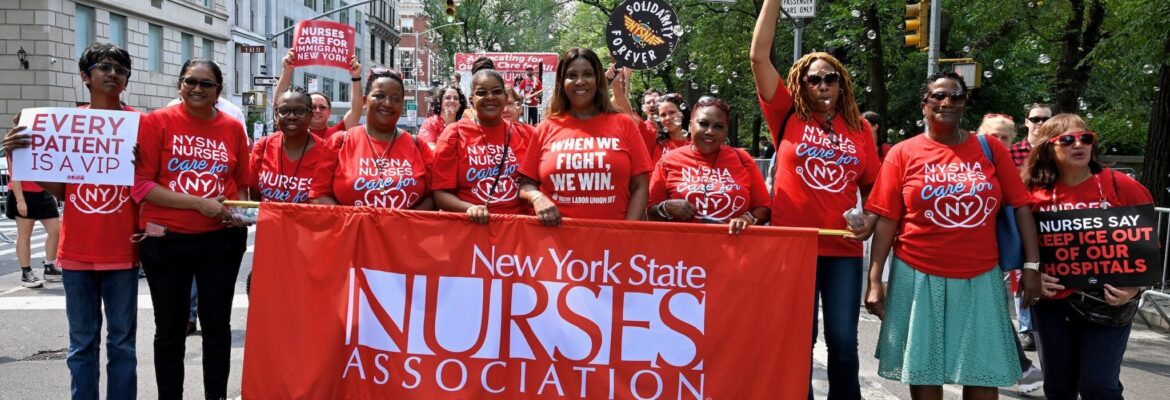
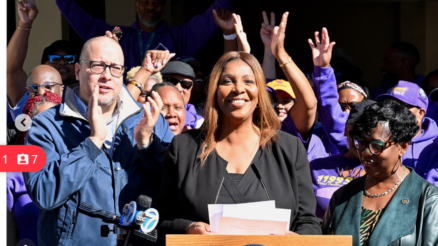
Banner Image: New York Attorney General supporting nurses. Image Credit – AG James


Leticia James NY State Attorney General
Letitia “Tish” James is the 67th Attorney General for the state of New York. With decades of experience and a long record of achievements, she is a powerful, effective attorney and lifelong public servant. When she was elected in 2018, she became the first woman of color to hold statewide office in New York and the first woman to be elected Attorney General.
[…] previously covered the Attorney General’s opinion on this matter as it worked its way very quickly through the courts to come before the Supreme Court. This […]
[…] note: We’ve previously covered the Attorney Generals efforts to protect Haitian and Syrian immigrants, whose rig… under congressional law, was just revoked by SCOTUS. NYC Health + Hospitals system recently held a […]