
Childless Cat Ladies Unite! College of Staten Island Professor’s “Pronatalism: Discourses and Counter Discourses” Must-Read Book Review
Childless Cat Ladies Unite! “Pronatalism: Discourses and Counter Discourses” Must-Read Book Review by CSI professor
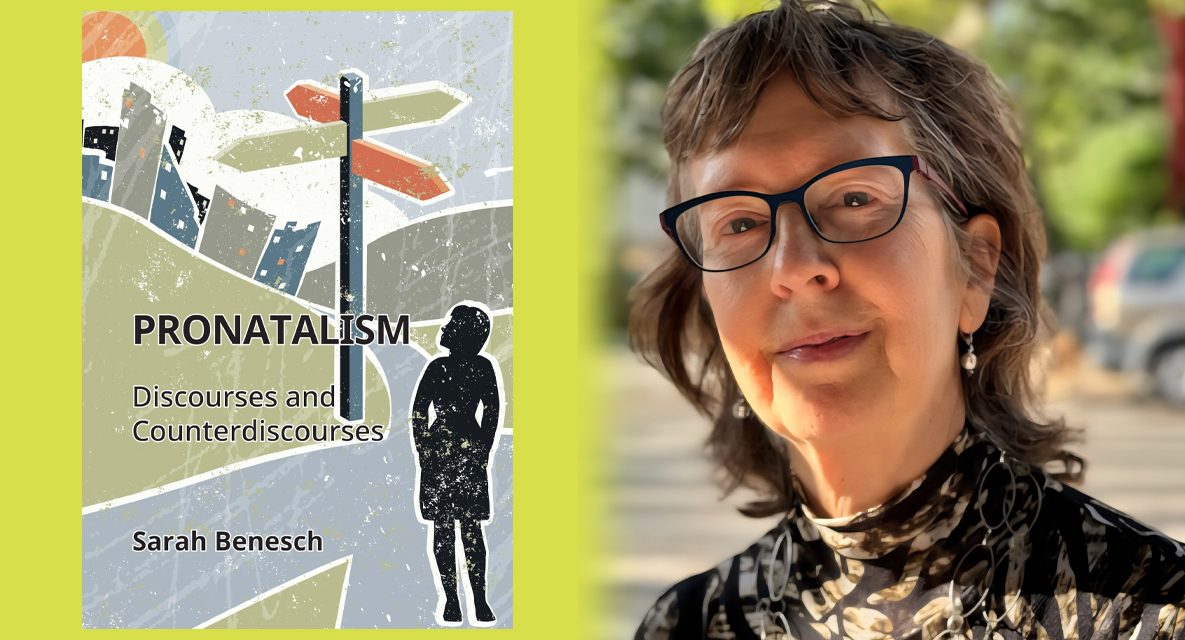
Pronatalism book and Sarah Benesch. Image Credit – CSI
This incredibly engaging and interesting book went into great depth and detail about what pronatalism is, including how it relates to eugenics. For those unfamiliar, eugenics is a philosophy that believes that there are superior characteristics and that, instead of being environmentally determined, these traits are considered to be genetic.
Eugenics is often called a science, but it is far from that. Eugenicism was quite popular in the 1930s through 1950s and 60s, but it is a persistent philosophy that many have cloaked in new clothing and so-called proofs. Eugenicists often use scripture to prove their beliefs, and there are usually many stumbling blocks in their own point of view. Specifically, when a child is born with developmental delays or disabilities to a supposedly genetically superior family, this would disprove the theory. But the way they dealt with that eventuality was to hide their ‘defective’ kid in an institution. This was socially acceptable at the time, and many of these children were abused and neglected.
One of the most familiar examples of a eugenicist is Margaret Sanger, famous promoter of abortion, especially for Black mothers. Why Black mothers? Because she believed them to be inferior. One thing that individuals that have been paying attention to movements forming in our larger culture will notice is that these quotes are nearly identical to those being promoted by so-called Christians involved in the ‘toxic empathy’ movement. There are quite a few of them, including Toxic Empathy by Allie Beth Stucky and The Sin of Empathy by Joe Rigney.
In these books, you’ll be told that helping people to survive or thrive while they are sinning is actually sinful on your part. That helping people to feed and clothe themselves is keeping them from becoming self-sufficient. Or that accepting or being friends with a gay couple without reminding them of their error every chance you get rather than just accepting it as a fact is enabling and promoting that behavior. And that it’s wrong to accept others as they are if they don’t behave just like you or your group, or if they are different physically or are differently abled.
And on top of that, when people get involved in these kinds of philosophies, they believe that those who aren’t like them should be uncared for, even if the likely result is that they will suffer or die. Just like Margaret Sanger believed about lower income people of color in her own time. She believed that she was ‘putting them out of their misery,’ ‘reducing the drain on the system,’ and other un-Christian arguments. She was an atheist herself, by the way, as most of the earlier eugenicists were.
As I was reading through her statements, I was reminded very heavily of the toxic empathy movement. If you simply changed their phrases to 1950s-style writing, it could literally be identical. So there are some Christians who, instead of being like Jesus, are instead his exact opposite – while loudly saying that THEY are the true Christians and everyone else should be like them. What an awful world they’d make where no one cares about anyone but themselves and lets everyone else suffer and rot.
Eugenics and the perspective of child bearing
So how is this topic related to pronatalism (which is the belief that everyone should procreate a a moral imperative or civic duty – except those deemed inferior)? Very simply because pronatalism is inextricably intertwined with eugenics. You can see it in an example the author provides of eugenics in action:

A man and woman have a child, a baby boy. The boy is blind from birth, and they are a White well to do family. Instead of accepting their gift, their miracle of a child that is healthy in all other ways, the father packs the son into his car. He drives to the state mental hospital. Without a word to his son, he takes him out of the car, puts his suitcase next to him, gets back in the car, and drives away, never looking back. The boy, for his part, is saying “Dad? Dad? Where are you? Where did you go?”
And he never sees him or hears from him again. He is institutionalized. Why? Because he was considered ‘defective’ instead of disabled, worthy of being left behind and forgotten. Eugenics is the concept that only the strong survive, and only those who are upper class and White should reproduce. Everyone else should not. It’s something of an extension of Darwinism and survival of the fittest, and – despite all evidence to the contrary – the belief persists to show that scarcity doctrines guarantee unequal societies, while cooperative cultures have stronger cohesiveness and structural supports for their people.
Pronatalism, similarly, is the belief that affluent White women should all reproduce, and that when they don’t they’re failing the society and abdicating their only worthwhile role in it – having children. Careers aren’t important for a woman, only bringing a child into the world to continue their family line or legacy is critical. Everything else is secondary. This applies only to women, of course.
This is the same philosophy that guided the many many forced hysterectomies given to Native American women when they would go to the White Man’s hospital to deliver their baby. That would be their last child ever. Black women in decades past were also given forced hysterectomies for the same reason. And forced sterilization programs for certain races were commonplace for a long while. All of this always begs the question: who is to say what and who is superior? How is that determined?
There is NO external characteristic, whether genetic, racial, ethnic, religious, or otherwise that is always indicative of certain superiorities. None of these external indicators guarantee certain behaviors, including adherence to certain philosophies of kindness and compassion – or even ambition, drive, and success seeking. A disabled child can be born just as easily to a White family as to any other race. And when eugenics is worked into the law, as has been the case for a long time in the wording of certain laws on the books in various places, then it becomes dangerous. These laws that are based on that philosophy are then used to justify actions that result in negative consequences.
This is particularly true for forced sterilization programs as applied to certain races under the color of law and left in place for quite a long time as perfectly in line with the Constitution – clearly demonstrating the pervasiveness of this festering philosophy in our larger society.
The author goes into great depth about this portion of the topic, and it’s really interesting to see how our culture has, in truth and in many ways, evolved quite dramatically. Gone are the days when it is socially acceptable to throw your child away – and significantly shrunken are those who could do this to their own child. This discussion was quite thorough, and will give anyone a primer on the topic as it relates to multiple areas including abortion as a voluntary act (as separate from that as a medical necessity – those numbers aren’t available anywhere as medical, or really any, pregnancy terminations aren’t required by law to be recorded except now in those states where such activity must be heavily justified with the concurring opinions of multiple physicians, because it carries a penalty of imprisonment – see The Devil Is Busy).
Moving On to the ‘having it all’ narrative and the financial realities for most women
A large part of this book is also devoted to the financial aspects of childbirth and rearing of children. As anyone who lives in America understands, it is not cheap to raise a child. Especially in New York City, where the author lives and works (Staten Island specifically). She is a professor at the island’s own CUNY school, the College of Staten Island. As such, she has been pursuing certain aspects of the professorial profession, which requires a lot of work and a great deal of persistence. If she had decided to have children, it would have pretty much forced her to put her career on hold and try to take on the monumental task of juggling everything together all by herself. Because she is a woman, and a woman can have it all and do it all.
The popular myth of “Having It All,” as initially proposed in a magazine article of that title in a women;s magazine, can give you an idea of the problem. If you are a little older, you might remember having seen this theme proposed in other magazines later, along with online even still to this day.
The woman stands facing the camera, a baby on one hip, a briefcase in her other hand, pursuing the American Dream of feminist success where you can have kids and a career, all at the same time, all so easy. The reality is, this is not easy. In many cases, it isn’t even possible. The woman is able to easily be the CEO of a company while raising multiple kids at home. As many women and new parents are well aware, this is a fantasy. Especially if you feel, once you’ve had a child, that you want to stay home with them for longer than the usual six or twelve weeks.
In New York, if you want to do that, it will be at your own expense, and you had better have a lot of savings before starting out. She goes over the financial realities and caregiving and housekeeping realities as well. There are still many men who believe that women should do all of the housework and the child care, regardless of how much free time they actually have.
The author discussed other societies around the globe where this is not the case. There are several Scandinavian countries where the new mother is allowed to take off from work for a full year, returning when the child is one year old and ready to go into some kind of preschool or other childcare. This almost guarantees success in a breastfeeding dyad perspective (which the author does not discuss). But on top of that, they are not rushed back to work before they are ready simply because the financial realities in this state and many others require it. Most people don’t have enough savings to take off more than the provided federal twelve weeks at a certain percentage of their pay – usually just enough to make ends meet for that brief time.
This has not even touched on another crux of the author’s points: the time realities of many careers. High pressure careers or high time requiring careers, such as this author’s chosen path of dissertations and professorship and tenure, make it a really tough choice whether to have kids – but that is also part of the point. Why is it considered by most people as an absolute necessity for a woman to have children?
This even includes contemporary politicians, specifically Vice President Vance, whose comments about “childless cat ladies” had many people quite upset – as if a woman’s only value to this society is whether she has had children or not. Our Tucker Carlson, who famously said that if you haven’t had as many kids as George Floyd, you’re not doing your duty to bring kids into the world. If a woman has not done this, her value as a contributor to this culture is insignificant.
For a person such as the author, she found her own truth elsewhere, and she made her own path based on her priorities and what she wanted from life. And while she felt the push to have children from our larger culture, it wasn’t really for her, and she was not interested in it at all. She wanted to pursue her career, and besides, a suitable man did not materialize during the time she would have wanted to have them.
Part of this book also contains the story of her own life, which was a winding and interesting journey to say the least. But it does give a good understanding of where she is coming from in this perspective. How she came to these decisions, and seeing others around her in her life making the opposite choices is quite enlightening. If the reader happens to also be a childless person, then you can relate to many of the things she is talking about. If you have children, you can also relate, as she describes the experiences of those who have had children as well as those who have not.
In the introduction, she brings to the reader’s attention something that you may have never thought of: there is no real universally or largely accepted word for the state of being where one has not had children and does not intend to. Childless is probably the most neutral term one can use. Child free is a bit too excited about being without kids. The author suggests a new term for this state – notherhood. Of all the options it seems as good as any other. But it’s interesting to note that our culture has no suitable term for this situation or state of being.
But that does bring us to the next segment: the biological clock meme in our culture.
If you are part of the society targeted by this meme, which, as stated previously, is based on eugenics and generally includes affluent White women as the primary target, you may recognize the biological clock image from your experience of popular culture. From her surveys and interviews, it seems that for women in other cultures, particularly in minority groups, this meme doesn’t exist. While women in these minorities often do have children, and sometimes quite a few, it isn;t really pushed on them by the society at large. While it may even be accepted in their family that they will be pushed to have kids, they are not the ones in the ads and the memes and pictures for the biological clock meme.
But the concept of the biological clock is simple: at a certain age, women stop ovulating and menopause sets in. After this she cannot get pregnant. However, if she finds a significant other before this clock stops ticking, she can beat this clock and have children anyway. But she shouldn’t wait too long or focus too much on her career, since then the time will run out.
While, in a sense, this is based in reality, there are a lot of other factors at play. First, not all women are as fertile as all others. Some women do not ovulate every month (even if they menstruate). Some couples find it very difficult to conceive for various reasons, leading to the need for medical interventions. And over the age of 35, most women are told there will be issues if they do choose to get pregnant that late.
While that age may vary for many women, along with the age of menopause onset, this meme is more based in reality than the others we discussed, such as the having it all meme. There will come a time when a woman can no longer become pregnant. As most people know, this largely does not apply to men, though at a certain age, most men do produce fewer reproductive cells, making it more challenging for them to have children later as well. This is more based on overall health, fitness, and wellness rather than being a time-limited reality as it is for females.
This book is a very interesting and in-depth discussion of an extremely timely topic: that of the choice of many career-minded women to forgo having children, whether early or at all. The author, being in this category, is perfectly placed to have this discussion. The book was quite revelatory for me, along with being very well written and engaging. I would highly recommend it, and would give it five stars.
The hardcover is expensive but the ebook is affordable for this book, available at the above link. Check back in the coming months, as we will be setting up an interview and discussion with the professor.
Banner Image: Pronatalism book and Sarah Benesch. Image Credit – CSI



[…] previously reviewed this book, Pronatalism, by Professor Sarah Benesch of the College of Staten Island […]