
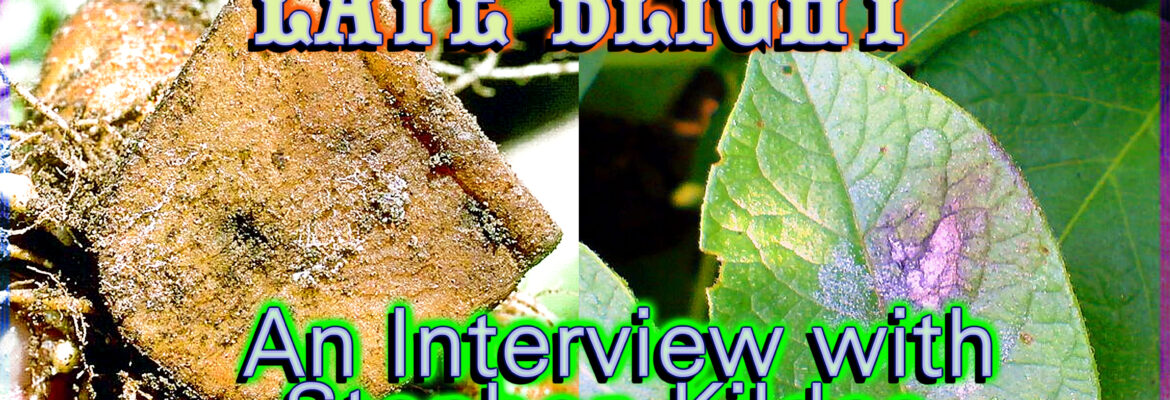
Pathogen Responsible For Great Irish Famine Still Virulent, Responsible For Loss Of Potatoes Sufficient To Feed 80 To Many Hundreds Of Millions Of People – Also Affects Tomatoes, Eggplants
Phytopthora Infestans: for those who are familiar with this pathogen, the name itself might inspire trepidation. Potato Late Blight was single-handedly responsible for the devastation of the potato crop that lead to widespread famine in Ireland in the late 1840s.
This blight, called potato or tomato late-blight, is an oomycete. So while it may look like and, in some ways, behave like a fungus, it is actually an algae-like pathogen. This means that it needs water, and a lot of it, in order to begin infecting a host plant, such as potato. One of the easiest ways for the blight to take hold in a host plant is after heavy rains, or rains that come and go in large volumes.
Staten Islander News sat down with Stephen Kildea, of TEAGASC, Ireland’s Food and Agricultural Authority, to discuss the disease, as well as what farmers and gardeners in Ireland do to combat it. Starting with the life-cycle of this pathogen, we discussed how it grows and spreads. Unlike the Chestnut blight, which is a fungus, the late-blight requires water, and it has some ideal growing conditions. Humidity close to 90%, which is quite muggy and wet, and temperatures between about 55 and 77 degrees Fahrenheit are ideal. While the blight can grow in temperatures slightly below this, these are its preferred environmental conditions.
Stephen spoke about the fields that the lab uses to study the blight, and the smell that it has. It is a smell that is unlike fungi or molds, as it is influenced by the smell of the host plant. He talks about the way in which this pathogen infests and destroys. A spore will land on the leaf, and it will then make a small spot or lesion on the leaf. When a farmer sees a lesion, they should know they will see more. And when he sees these in the field, he knows he will see a second one, then a third, and within just a few days, this pathogen can completely destroy an entire crop if nothing is done.
So, what can a farmer or gardener do when they have potatoes or tomatoes that get infected with this disease? The first method has to do with management. Management of small potatoes that perhaps were too small to harvest this time around, management of the waste products (or potatoes and leaves that are infected), and choice of the best seeds. Most importantly, seeds must not be from infected potatoes. If a farmer has a crop of potatoes that have been infected with p. infestans, they should not save the seed from that crop under any circumstances.
If a farmer has a crop which has been infected, they should be careful with the waste potatoes that have the disease on them. They call this managing the dumps. The dumps should not just be left to rot and possibly grow, as when potatoes sprout from the dump areas, they will be infected with blight already. When a farmer or gardener has smaller potatoes that they might not harvest due to a lack of quality or due to disease, those potatoes must also be managed. Most importantly is to compost the diseased crops. Such diseased potatoes and leaves should be fully composted, rather than just left in a dump or left in the ground.
**Important Note: Potatoes that are known to be diseased should be cut into small pieces, crushed, or buried two feet under the top layer of the composting bin. Otherwise, as a root vegetable, if planted whole, it will sprout, and this will allow it to continue to spread disease. When cut up, crushed, mashed, or buried deeper than two feet, it will not germinate and reinfect your garden.
For our readers who learned about the Chestnut blight, there is a very significant difference between that pathogen and p. infestans. Phytophthora infestans is always carried on the host plant or in the soil that the host plant was harvested from. While it is a spore reproducing pathogen, it is not always in the air. In the case of Chestnut blight, the management is very different because it has nothing directly to do with surviving on a host plant. The spores are just carried by the wind.
This algae-type organism is carried only by the potato, tomato, eggplant, or other nightshade plants. It survives on infected leaves and especially on infected tubers. So the focus of natural management techniques are managing the dumps, keeping an eye on the “volunteers” (or small potatoes that are left behind during harvest), and on choosing non-infected seeds. And the best way for gardeners to avoid the organism is to choose varieties that are resistant to it. There are many resistant varieties, and gardeners and farmers can often choose these to minimize the presence of the disease. However, of course, those farmers that seek to sell their potatoes in the market must grow what the market wants. Sometimes, that is a non-resistant variety, and this is where control of the disease becomes important.
One thing that is interesting about this pathogen is that it loves water. Consequently, gardeners and farmers are encouraged to not water the leaves when they water their plants. However, when it rains, this cannot be avoided. When it rains often, which is how it usually is during the summer in Ireland (and often New York as well), the pathogen becomes much more virulent. This is what the pathogen loves, and when a farmer or gardener has to deal with heavy and frequent rains, this is when the disease will more easily take hold in their garden. If you are on guard for this, you can destroy the pathogen nevertheless, in the section below.

Once The Pathogen Has Taken Hold
In a farm situation, unless it is an organic gardening situation, a cocktail of chemicals is usually used. When a farmer first sees a lesion on any one leaf, the most important thing is to spray fungicides on their field. In Europe, they don’t spray their fields from planes, they have to use tractors with sprayers on the back. The reason for the cocktail is because of the propensity that this pathogen has for developing resistance. When a cocktail of chemicals is used, it is more likely that resistance to all of the chemicals will not develop. Since a farmer will often need to use these chemicals about fifteen times a season, they need to be using something that is effective.
When it comes to the use of copper, this would normally be used in an organic farming situation, and is also effective for home gardeners. At this time, p. infestans has not developed resistance to copper, but if it were to be used in a widespread manner, it is possible that it might develop resistance. This is because this oomycete is very good at creating resistance to chemicals used to control it. However, it is often the case that pathogens have more difficulty when trying to develop resistance to metals and elements such as copper, sulfur, and silver. (https://www.ncbi.nlm.nih.gov/pmc/articles/PMC9907218/) However, resistance to copper from certain bacteria, such as staph, has been observed with long-term use of copper as a bactericide.
While Stephen is not familiar with the specific concentrations of copper to use, there are several products that we found online that state they are effective against late-blight. Most of the products have a concentration of copper between 10 and 27%, and one is a concentrate that advises to dilute the product to several teaspoons or an ounce per gallon. If you decide to use these products in your garden, be sure to follow the directions carefully. Bonide or Captain Jack’s Copper Fungicide (sold as a concentrate or pre-diluted spray) is one option, along with Southern Ag’s Liquid Copper Fungicide. If you prefer to purchase pure copper sulfate, be sure to dilute it to a concentration of 10-27%, then dilute several teaspoons per gallon of water. The safest option is to purchase a pre-mixed copper solution specifically labeled as a fungicide for blight.
One of the reasons why only organic farmers use copper, and only when necessary, is that there is a risk of damage to the microbiome of the soil into which it will run. However, when used in small quantities that are sufficient to destroy the fungus, this should be a minor issue. The evidence for this is also not very clear. There are some studies that show that it improves gut health, which would indicate that it would also be good for the microbiome of soil. There are other studies that show that copper damages the beneficial microbes in the gut. So the evidence is far from clear, and if small amounts are used, it is good for the soil, just as it is for humans. Both humans and plants need small amounts of copper in order to be at their most healthy. Too much of a good thing, however, is often bad, so using a large amount of copper to control this fungus would be unnecessary and possibly damaging to the soil.
Conditions Mimicking Those Of The Great Irish Famine: Recipe For A Perfect Storm
Stephen also mentioned that in 2012, there were environmental conditions that were very similar to those in 1845-46, where there was constant rain, with inches of rainfall every day, high humidity, and a large amount of blight. While they were presumably able to control it, there was likely a larger loss of crops that year than in most years. And, as he mentions, it still makes the hairs on the back of his neck stand up when he thinks about and sees, right in front of his eyes, its incredible destructive power.
It can decimate an entire crop in two weeks without any intervention, which is why the failure of the potato in the 1840s was so devastating. They literally didn’t know what hit them. Germ theory didn’t exist at the time, so it was a total mystery as to why the potato crops were failing. In the decades to follow, the pathogen was discovered, along with many chemical methods to combat it.
While copper was one of the first, and was very effective according to other researchers, it has fallen out of favor in recent decades, giving way to chemical concoctions and expensive fungicide applications. Since copper is cheap and unpatentable, one wonders if this is the real reason why it has been given such a bad name. It cannot be both good and bad for gut and soil health, so further (impartial) research should be conducted to see if that reputation was earned or invented. Until then, copper remains the only EPA-approved organic method of p. infestans control, and is a way for small home gardeners to non-toxically prevent and treat this disease on their potato and tomato plants. Unlike other chemical fungicides, copper is generally non-toxic to humans, pets, and wildlife when used in the quantities mentioned above. The same cannot be said for the chemical fungicide concoctions.
Banner Image: Video title. Image Credit – Staten Islander News


Staten Islander News Service Staff Writer
This byline indicates that this article was penned by a member/members of the Staten Islander News Organization office team. Our staff writers are the backbone of our newspaper, performing all sorts of important tasks like conducting interviews, investigating leads, besides writing the news stories you see.
There are no comments yet
Why not be the first