
Putting ‘Park’ Back In Park Avenue, Nation’s Largest Curbside Charging Program, Making High-Quality Childcare More Affordable For New Yorkers, 24 New Schools: NYC Mayor
MAYOR ADAMS LAUNCHES MAJOR STEP TO PUT THE “PARK” BACK IN PARK AVENUE
City Releases RFP to Redesign Park Avenue Between East 46th Street and East 57th Street, as Greener, Safer, More Welcoming Corridor
City Continues to Advance Efforts to Add Public Space in Business Districts
Editor’s note: The NYC DOT has redesigned a number of streets in NYC, mainly for pedestrian benefits. In one area of the city, bee bunkers and bee hotels were installed during a street redesign to attract bees and other pollinating insects. The Amsterdam Avenue entrance to the Lincoln Center in New York City is also applying sustainability and pollinator-attracting principles in its new design.
NEW YORK – New York City Mayor Eric Adams and New York City Department of Transportation (DOT) Commissioner Ydanis Rodriguez announced a major step to put the park back in Park Avenue between East 46th Street and East 57th Street by adding greenery, public seating, concessions, and safer crossings for pedestrians. The city released an RFP to help develop a cohesive design vision for that portion of Park Avenue, which sits atop the Grand Central Terminal Train Shed — currently undergoing a major capital rehabilitation by the Metropolitan Transportation Authority (MTA)’s Metro-North Railroad. This effort comes as the city continues to advance its vision to permanently reimagine Fifth Avenue as a safer, less congested, pedestrian-centered boulevard, as well as other public realm projects in commercial corridors across the city.
“High-quality public spaces aren’t just a luxury — they’re a necessity, and they’re a vital component of our vision to revitalize commercial corridors like Midtown and build a safer, more affordable, better city for all New Yorkers,” said Mayor Adams. “Our ambitious project will ensure that as the MTA completes its underground structural work, the Park Avenue that goes back on top will be better than ever, with more space for people to enjoy the greatest city in the world.”
“We are seizing the opportunity to make transformative changes to ensure New York City is the place where people want to be,” said First Deputy Mayor Sheena Wright. “The Park Avenue redesign exemplifies investments we are making not only to enhance our public realm but to help reshape business districts into even more livable neighborhoods that attract businesses and workers and generate economic growth that benefits all New Yorkers.”
“As the MTA works underground to shore up our train infrastructure, we are taking this unique moment to make the vital artery, Park Avenue, a destination,” said Deputy Mayor for Operations Meera Joshi. “Lighting, furniture, and concessions will create more of the vibrant space New Yorkers love and deserve.”
“As our administration made clear in the ‘Making New York Work for Everyone’ action plan, a dynamic public realm ensures our commercial corridors remain vibrant hubs for daily life,” said Deputy Mayor for Housing, Economic Development, and Workforce Maria Torres-Springer. “This important project along Park Avenue — one of the world’s great thoroughfares — exemplifies the bright future for Midtown Manhattan by bringing beautiful open space, housing, and culture next to modern offices.”
“We’re putting the ‘park’ back in Park Avenue! This project will transform this iconic stretch of Manhattan’s Park Avenue by adding greenery and making important safety improvements. The Adams administration continues to reimagine public space in record ways,” said DOT Commissioner Rodriguez. “This street redesign is a key piece of a new vision for East Midtown, and we look forward to identifying a partner to make this vision a reality.”
“The East Midtown Rezoning continues to deliver for the public, as funds generated from private development will help us deliver a greener and safer Park Avenue,” said New York City Department of City Planning Director and New York City Planning Commission Chair Dan Garodnick. “This is just another example of how we’re planning ahead to improve livability and public safety in New York.”
“This administration is transforming urban space and finding opportunities to create safer, calmer, and quieter places within our streetscape,” said New York City Department of Design and Construction Commissioner Thomas Foley. “Old Park Avenue placed much more emphasis on the ‘park,’ and we can get back to that while preserving mobility with dedication to a new set of design principles that values people’s health above all. We look forward to continuing to partner with DOT and the East Midtown Governing Group to implement positive upgrades to this community.”
“Collaborating with sister agencies to enhance our green spaces is a cornerstone of our commitment to New Yorkers. This synergy allows us to create vibrant, accessible environments that enrich the lives of all residents, promote community well-being, and sustain the natural beauty of our city,” said New York City Department of Parks and Recreation Commissioner Sue Donoghue. “Reimagining Park Avenue builds on this administration’s efforts to enhance public safety, promote sustainable transportation, and develop exceptional public spaces in Midtown.”
“As a city, we understand the importance of creating more green and vibrant corridors across the whole city,” said Chief Public Realm Officer Ya-Ting Liu. “Investing in the redesigns of Park Avenue and Fifth Avenue continue to show progress in our commitment to improve the connectivity and feel of neighborhoods where we live, work, and play.”
“Reimagining Park Avenue further advances implementation of the ‘New’ New York Panel’s recommendations to reshape our business districts with great public space,” said “New” New York Executive Director B.J. Jones. “This effort joins Broadway Vision, the redesign of Fifth Avenue, and more to make Midtown an inviting, pedestrian-friendly global center of commerce.”
“This is a great example of collaboration across levels of government leading to a more efficient process and a better result for the public,” said MTA Construction & Development President Jamie Torres-Springer. “As we work to rebuild the Grand Central Terminal Train Shed running under Park Avenue, we’re thrilled to work with our partners at City Hall and DOT to coordinate the city’s investments to improve the streetscape with the essential state of good repair work happening below.”
Currently, the City of New York and the MTA are rehabilitating and repairing the Grand Central Terminal Train Shed, which spans from East 46th Street to East 57th Street. This ambitious construction project will address critical infrastructure needs by replacing the train shed roof structure and waterproofing membrane while enhancing Park Avenue, which sits atop the train shed and will be removed and reconstructed in stages as subsurface work proceeds. As the MTA completes its train shed work, Park Avenue will be restored with an expanded median for pedestrians featuring verdant landscaping and seating. The transformational redesign of Park Avenue that emerges from this project will enhance public space, promote sustainable transit options, and foster community among residents and visitors. The MTA began its construction on the block of Park Avenue between East 47th and East 48th Street. That block will be the first along the avenue to feature a wider median when the street is restored as early as 2025.
Through the RFP process, DOT is seeking design services from a contractor with a background in landscape architecture or urban design to help fill in that wider median, encompassing pedestrian enhancements, cycling infrastructure, landscaping, and innovative streetscape amenities. The selected design team will work with relevant agencies and engage with local stakeholders to produce design concepts that are infrastructurally sound and meet community needs.


Concept for a reimagined Park Avenue, with wider median. Credit: DOT
The RFP builds on DOT’s public engagement along Park Avenue that began in 2020 through an online visioning survey that received over 1,700 responses. The overwhelming majority of respondents supported a redesign of Park Avenue with expanded medians allowing for enhanced pedestrian space and potential to create additional capacity for seating, art, concessions, landscaping, or possible bike connections. Park Avenue’s median will be redesigned in coordination with the MTA and community stakeholders, including local businesses. Funding for the RFP has been provided through the East Midtown Governing Group, which was created as a part of the 2017 Greater East Midtown Rezoning. The rezoning created a mechanism through which new office development and the sale of development rights require contribution to public realm improvements, like this redesign of Park Avenue.
The Park Avenue redesign will be an important next step in the effort to create a world-class network of public space in Midtown, as recommended by the “New” New York Panel to rebuild New York City’s economy as outlined in the “Making New York Work for Everyone” action plan. It builds on other initiatives, including expansion of the Broadway Vision Plan, launch of the Fifth Avenue redesign, opening of Plaza33 at Penn Station, a new agreement to support the replacement and expansion of the Port Authority Bus Terminal, and more.
“I applaud today’s announcement of a transformational redesign of Park Avenue that will add new public spaces in one of Manhattan’s most congested corridors,” said U.S. Representative Jerrold Nadler. “I look forward to seeing this project come to life to make Park Avenue a safer, more enjoyable place to live and visit.”
“I am pleased to hear that the city government is moving forward with this plan to make Fifth Avenue a safer, more pedestrian-friendly part of Manhattan,” said New York State Senator Liz Krueger. “I am excited to seeing how this project improves foot traffic, introduces new and much needed green space to our district, and opens up new public space on over ten city blocks.”
“The launch of the Grand Central Train Shed capital development RFP gives us an opportunity to reimagine the central corridor to make it pedestrian-friendly and overall more enjoyable with the potential for more green space and seating,” said New York State Assemblymember Alex Bores. “I encourage all firms interested in this project to submit proposals and help us put the ‘park’ back in ‘Park Avenue.’”
“Widening and adding functional infrastructure to the Park Avenue medians will make for a safer, more sustainable, more enjoyable boulevard for pedestrians and cyclists,” said Manhattan Borough President Mark Levine. “Manhattanites, visitors, and I look forward to seeing how these iconic medians will be reimagined as shared space.”
“Today, we take a significant step forward in reimagining midtown Manhattan,” said New York City Councilmember Keith Powers. “As Chair of the East Midtown Governing Group, we have worked diligently in setting up this RFP process, which will help select the best candidate who provides the necessary experience required to design a concept that will put New Yorkers first. I am excited to participate in this process over the next several months and work closely with the MTA, DOT, and other relevant sister agencies.”
“Midtown Manhattan is in desperate need of green space, and we’re thrilled that the City of New York is taking steps to address that by issuing this RFP,” said Rob Brynes, president, East Midtown Partnership. “By enhancing the public realm just steps from Grand Central Terminal, Mayor Adams, Commissioner Rodriguez, and DOT staff will immeasurably enhance the Midtown Experience, and we thank them.”
“While dramatic changes continue to reshape the skyline of Park Avenue with the rise of JPMorgan Chase’s 270 Park Avenue and other new state of the art office towers on the drawing board; and below the surface improvements with the replacement of the MTA Metro-North train shed and the opening of Grand Central Madison, the ground level experience is now also being reimagined enhancing accessible open public space for Midtown East helping to put the PARK back in Park Avenue,” said Fred Cerullo, president and CEO, Grand Central Partnership President.
“Manhattan Community Board 6 (CB6) is eager to see the Park Avenue Landscape Design project move forward,” said Jason Froimowitz, director to the East Midtown Public Realm Improvement Fund, Manhattan CB6. “This initiative is an important step in enhancing the public realm for all who live, work, and visit this segment of Park Avenue. CB6 looks forward to working with DOT and our fellow stakeholders to ensure the project reflects the community’s needs.”
“The East Midtown Governing Group, developed by Manhattan Community Board 5 (CB5) in partnership with DCP and community stakeholders following the 2017 Greater East Midtown Rezoning, funded this public realm improvement project,” said Bradley Sherburne, chair, Manhattan CB5 and Nancy Goshow, land use, housing, and zoning chair, Manhattan CB5. “Manhattan CB5 applauds this integrated approach for the city’s transit, pedestrian improvements, and public space. We believe collaboration leads to success, and we look forward to working with the team that is selected in this RFP process to ensure the best possible outcome for our community and the city.”
ADAMS ADMINISTRATION WINS $15 MILLION FEDERAL GRANT TO BUILD NATION’S LARGEST MUNICIPAL CURBSIDE EV CHARGING PROGRAM
At Least 50 Percent of New Charging Locations Will Serve Disadvantaged and Low-Income Neighborhoods
Builds on City’s Effort to Reduce Transportation Emissions, Create Inclusive Green Economy
City’s Federal Infrastructure Funding Task Force Has Won Total of $850 Million in Competitive Grants
NEW YORK – New York City Mayor Eric Adams today announced that New York City has won a $15 million federal grant from the U.S. Department of Transportation’s Charging and Fueling Infrastructure Grant Program to build the nation’s largest curbside electric vehicle (EV) charging program. The funding will allow for an additional 600 Level 2 chargers to be installed along streets across the five boroughs, with more than half of those chargers designated for disadvantaged and low-income neighborhoods. Additionally, the funding will allow the city to build 32 solar-powered charging ports at eight different New York City Department of Parks and Recreation (NYC Parks) locations throughout the city. This builds on the city’s existing 100-charger pilot program, launched in conjunction with Con Edison, and supports the city’s goals to transition 100 percent of for-hire vehicle rides to electric or wheelchair-accessible vehicles by 2030.
“We’re building a cleaner, greener, and more affordable city for all New Yorkers, and through initiatives like this, we’re making sure that no New Yorkers are left behind,” said Mayor Adams. “This $15 million grant will let us build the nation’s largest EV charging program, focused on low-income and disadvantaged areas so people living in all five boroughs can afford to drive and charge electric vehicles — especially as we continue to transition all of our for-hire vehicles to EVs through our ‘Green Rides’ initiative. My thanks to the Biden-Harris administration for issuing this grant and to our congressional delegation for helping bring this vital funding back home.”
“Supporting the transition to electric vehicles means ensuring that everyone has quick and easy access to chargers — especially taxi and for-hire-vehicle drivers, who will lead the way towards a modal shift,” said Deputy Mayor for Operations Meera Joshi. “Deep thanks to the Biden-Harris administration and the U.S. Department of Transportation for their continued investment in New York City’s evolving and climate-ready streetscape.”
“Combined with efforts to promote mass transit and cycling, this grant will help us take a big step toward decarbonizing the transportation sector in New York City. The electrification of transportation across five boroughs, including for-hire vehicles, is a vital step in combating the climate crisis for future generations,” said New York City Department of Transportation (DOT) Commissioner Ydanis Rodriguez. “But we must ensure no New Yorker is left behind in the transition to a sustainable tomorrow. As a former cab driver, I understand how important equity of access will be to our efforts to transition for-hire vehicles away from fossil fuels. We thank the Biden-Harris administration, the New York congressional delegation, Mayor Eric Adams, and our sister agencies for their support.”
“This is a win for both working-class New Yorkers and for making our city cleaner and more livable,” said New York City Taxi and Limousine Commissioner David Do. “With the use of EVs surging thanks to the ‘Green Rides’ initiative, we know that the chargers coming out of this grant are not only needed but will go right where they’re needed most — in neighborhoods where TLC drivers live.”

Curbside EV Charger at Norman Avenue in Brooklyn. Credit: DOT
This expansion builds on DOT’s successful curbside EV charging pilot, a partnership with Con Edison. The current system of 100 chargers has the highest utilization of any such system, with an average utilization of 70 percent across all 35 sites throughout the five boroughs. Utilization is measured as the proportion of time an EV is plugged into the charger over a 24-hour period each day. These new chargers will play a critical role in the city’s ambitious “Green Rides” initiative, which requires Uber and Lyft to transition to 100 percent electric or wheelchair-accessible for-hire vehicles by 2030. The chargers will support hard-working, mostly immigrant for-hire vehicles drivers with affordable charging options where they live and work. It will also allow DOT to advance the development of charging infrastructure for micromobility options like e-bikes in the future. As part of New York City’s comprehensive electrification and zero emissions strategy, this project will significantly reduce greenhouse gas emissions and improve air quality, including averting an estimated 8,000 tons of carbon dioxide emissions annually. This emissions reduction is equivalent to what’s generated by 20.4 million miles driven by an average gasoline-powered passenger vehicle.
Recent federal legislation, including the Biden-Harris administration’s Bipartisan Infrastructure Law and the Inflation Reduction Act, have made unprecedented amounts of federal funding available for key projects across the country. Recognizing this once-in-a-lifetime opportunity, Mayor Adams formed the Federal Infrastructure Funding Task Force. Under Deputy Mayor Joshi’s guidance, that task force evaluates the competitive grant opportunities available, with a focus on new opportunities made possible through both the Bipartisan Infrastructure Law and the Inflation Reduction Act, and works to break down silos and foster creativity across city agencies. The city has aligned its priorities for high-quality, sustainable, and equitable infrastructure with aggressive and creative grant applications from a wide range of infrastructure agencies. To date, the city has received over $850 million in competitive federal infrastructure grant awards from these sources.
Today’s announcement builds on the Adams administration’s efforts to make getting around New York City both more accessible and more affordable, particularly for young people and low-income New Yorkers. In the Fiscal Year 2025 Adopted Budget, the administration partnered with the City Council to invest an additional $20.7 million in “Fair Fares NYC,” expanding eligibility for half-price fares to people making 145 percent of the Federal Poverty Level. The budget also included $11 million to provide free MetroCards to Summer Youth Employment Program participants, who — thanks to the Adams administration’s efforts — are also eligible for free two-month Citi Bike memberships. In 2023, Mayor Adams launched a historic greenway expansion to build 40 new miles of protected bike infrastructure in the outer boroughs, bringing safer, greener transportation options to the Bronx, Brooklyn, Queens, and Staten Island. In 2022, Mayor Adams unveiled “NYC Ferry Forward,” which created a discount program, similar to Fair Fares, in which seniors, people with disabilities, and low-income riders pay reduced fares for ferry rides.
“I am proud of my work to accelerate our transition to electric vehicles, a critical step for our sustainable future,” said New York State Assemblymember Jenifer Rajkumar. “In Albany, I helped pass legislation requiring all new vehicles sold in the state to be zero emission by 2035. Mayor Adams is now ensuring this policy’s success by deploying the nation’s largest curbside charging program. Placing 600 chargers across all five boroughs will put us on the fast track to our goal of all New Yorkers being within 2.5 miles of a charging hub. Significantly, more than half of chargers will be in underserved neighborhoods, allowing the communities most impacted by emissions to have an easy transition to emission free vehicles. Together, we will drive down transportation emissions and charge full speed ahead to a sustainable city.”
“As we confront the urgent threat of climate change, investments like the $15 million grant to expand New York City’s curbside electric vehicle charging infrastructure are vital to building a sustainable and inclusive future,” said New York State Assemblymember Brian Cunningham. “By prioritizing neighborhoods impacted most by climate change, this program not only reduces transportation emissions but also ensures that all New Yorkers, regardless of zip code, have access to the benefits of clean energy. I applaud Mayor Adams and the city for their leadership in making our green economy more equitable and inclusive for everyone.”
“This transformative $15 million investment from the federal government will significantly enhance our electric vehicle infrastructure, particularly in neighborhoods that have historically been underserved,” said Bronx Borough President Vanessa Gibson. “By expanding access to safe and reliable EV charging, we are not only supporting the transition to cleaner transportation alternatives but also addressing long-standing disparities in our EV infrastructure. This initiative is a significant step forward in ensuring that all Bronx residents, regardless of their neighborhood, have equitable access to charging facilities, fostering a more sustainable and inclusive future for our borough. I want to thank Mayor Eric Adams for his continued investment in reducing transportation emissions and making electric vehicle ownership a practical and widespread reality.”
“Queens and New York City have been battered by climate change in recent years, but we are continuing to turn that pain into purpose as we become global leaders in clean energy and green technology. This federal grant is a critical step forward in that goal, as we build out the necessary infrastructure to foster society’s transition to electric vehicles,” said Queens Borough President Donovan Richards Jr. “There is no mission more critical than ensuring our children and grandchildren have not just a habitable environment, but a thriving one, and I look forward to the work ahead alongside this administration in building toward that future.”
MAYOR ADAMS, CITY COUNCIL ANNOUNCE HISTORIC 10-POINT PLAN TO MAKE HIGH-QUALITY CHILD CARE MORE AFFORDABLE, ACCESSIBLE FOR ALL NEW YORKERS
Plan Would Reimagine City’s Early Childhood Education System With More Than $3 Billion Invested, Bolstered by $100 Million New Funding in FY25 Adopted Budget Joint Adams Administration-Council Effort Will Better Allocate Resources to Meet Needs, Connect Families with Unfilled Seats, Support Providers
New Investments Will Support Over 1,500 3-K Seats for Upcoming School Year in High-Need Communities, Expand Special Education and Extended Day Seats, Fund to Support Undocumented Children, Target Outreach Efforts to Boost Enrollment
Adams Administration Has Extended Offers to 100 Percent of Families Who Applied for 3-K On Time, History
Administration Has Made Child Care More Affordable by Dramatically Reducing Out-of-Pocket Cost of Subsidized Child Care by More Than 10-Fold
Editor’s note: We’ve previously covered the Gifted and Talented programs at NYC schools, including their re-expansion, which followed their near-removal from the educational landscape.
NEW YORK – New York City Mayor Eric Adams and leadership of the New York City Council today announced a historic joint effort to strengthen early childhood education across the five boroughs and address longstanding systemic issues, while boosting enrollment and connecting families with more Pre-K and 3-K seats. The strategic plan — developed by an unprecedented joint Adams administration-Council working group, chaired by Deputy Mayor for Strategic Initiatives Ana J. Almanzar and Speaker Adams — will be anchored by $100 million in new city investment allocated in the Fiscal Year (FY) 2025 Adopted Budget to implement an action-oriented roadmap for outreach and seat allocation across the city. With the new $100 million investment, the total investment in the FY25 city budget for early childhood education is $3 billion, comprised of $2 billion for early childhood education programming for children aged zero to five and approximately $1 billion for preschool special education.
In the two months since the budget was announced and voted on, New York City Public Schools added more than 1,500 additional 3-K seats in high-demand areas of the city to support families for the 2024-2025 school year. Since May 2024, New York City Public Schools has continued to drive down waitlists — reaching 100 percent of families who applied before the application deadline with first-round offers by mid-August. The Adams administration’s joint effort with the City Council will strengthen the city’s early childhood education system to better allocate resources and connect families with seats.
“All families deserve to live in a city with a safe, nurturing, and affordable place to leave their children, while being given the opportunity to pursue their dreams,” said Mayor Adams. “Access to affordable child care is one of the largest drivers of economic mobility, especially for women. That’s why our administration has delivered an expanded and more equitable early childhood education program, and, with this plan, we are presenting our vision for how to strengthen it even further into the future. Despite early childhood applications more than tripling from five years ago, there has been a 350 percent increase in families receiving offers. This year alone, 100 percent of families that applied on time have received an early childhood offer. But we know there is work to be done. That’s why we have invested $100 million in this historic plan with the City Council to fix lingering systemic problems and usher in a new and improved program. Our plan focuses on better allocating resources to meet needs, conducting robust family outreach, supporting providers, and expanding access for students with disabilities, as well as undocumented families. Every day, we will continue to build a city focused on supporting working-class people, that is safer, more prosperous, more affordable, and, most importantly, that invests in our children. I thank Speaker Adams and our partners on the Council for helping to deliver a better product for New York families.”
“Improving and investing in our city’s early childhood education system has always been this Council’s priority,” said New York City Council Speaker Adrienne Adams. “Today’s announcement is the fruit of more than a year and half of labor to expand extended day options and special education seats, support this essential workforce, and make child care more accessible. I’m pleased that the Department of Education has cleared the 3-K waiting list with offers made to all families that applied. I look forward to working with the Adams administration to ensure more families access seats moving forward. While we celebrate this progress, we will continue the collaborative work to fix the inefficiencies in our early childhood education system to better serve families, particularly those in low-income areas that are currently under-enrolled.”
“As chair of the Committee on Education, I have passionately fought alongside New York City Council Speaker Adrienne Adams to ensure our budget reflects a deep commitment to investing in and protecting education across our city,” said New York City Councilmember Rita Joseph. “Thanks to the relentless efforts of the Council, we’re making real strides in strengthening our early childhood education system and delivering for every New York City student and family. I am thrilled to see New York City Public Schools and the Adams administration take steps to eliminate waiting lists, guarantee timely payments for our providers, and advance culturally responsive recruitment and outreach. Early intervention and learning are not just important—they are essential to the future success and well-being of our youngest New Yorkers. While this is a step in the right direction, I am determined to continue working hand in hand with the Adams administration to ensure that every child in our city has access to equitable, high-quality early childhood education and preschool special education services. This is a fight we cannot afford to lose, and I am committed to making sure we win it for every family in our city.”
“It’s a fact that greater public investments in early childhood education have immediate economic benefits,” said New York City Councilmember Justin Brannan, Chair, Finance Committee. “That means we can make our city’s economy even stronger by getting this right today. For over a year, the Council has advocated for extending full day seats, providing seats for pre-school special education, and supporting the early childhood education workforce, and more. We reached a comprehensive agreement with the Adams administration to immediately fund seats for families still awaiting 3-K placements or on waiting lists for preschool special education, and to implement other reforms that address problems in the system so families can access seats. We vow to keep working together in partnership to fix our city’s world-class early childhood education system so working and middle-class families can remain here in New York City and benefit from all the amazing things our city has to offer.”
Despite inheriting major structural challenges, particularly associated with a mismatch in available seats to demand, the Adams administration has been committed to improving the city’s early childhood education system. Under the leadership of Mayor Adams, early childhood enrollment is at the highest level ever, with over 150,000 children across New York City’s early childhood system. This includes children in New York City Public Schools, as well as programs run by the New York City Administration for Children’s Services and the New York City Human Resources Administration, speaking to how the city is serving families in early childhood education across a range of agencies, programs, and services. For the first-time ever, 3-K has been made available in every school district with more families applying and getting seats than ever-before. is at the highest it has ever been, with over 53,000 available seats across the New York City Public Schools system— an increase of approximately 17 percent in 3-K capacity since the onset of the Adams administration.
Recently, the Adams administration announced the appointment of Simone C. Hawkins as New York City Public Schools’ new deputy chancellor of Early Childhood Education. To continue building on this success and accomplish a comprehensive re-imagining of the early childhood education system in New York City, the Adams administration and the City Council have created a 10-point plan that will be executed by New York City Public Schools, the Mayor’s Office of Child Care and Early Childhood Education and multiple city agencies, in partnership with the Council to:
- Increasing 3-K Access for Families This School Year
The Adams administration committed to ensuring all children who applied for 3-K for the 2024-2025 school year will have access to a high-quality early childhood education seat and has delivered on that commitment. To accomplish this goal, the city added $20 million in the FY25 Adopted Budget to immediately meet the needs of families. Within weeks, New York City Public Schools expanded 3-K capacity to more than 1,500 additional seats in the specific zip codes across several districts in which families did not receive an initial offer. With the passage of the adopted budget, 100 percent of families that initially didn’t receive a 3-K offer now have received one.
- Expanding Family Outreach Strategy
Lacking access to resources about the availability of early childhood education and how to apply is a major barrier to entry for many families. To directly address this access-gap, the Adams administration and the City Council have invested a total of $5 million for an outreach effort to maximize the number of children enrolled in 3-K and Pre-K. The effort conducts targeted outreach to communities with under-enrollment and bring resources directly to communities. Launched in July 2024, this comprehensive outreach plan will leverage partnerships with community partners and community-based organizations to facilitate direct engagement with families and provide hands-on enrollment support.
- Increasing Preschool Special Education Classrooms
The Adams administration will continue to increase preschool special education classrooms to ensure early childhood education across New York City is inclusive of all children. In 2022, the Adams administration announced a historic contract enhancement and committed to creating 800 preschool special education seats, which grew to over 900. New York City Public Schools increased teacher pay for this critical sector at a time when it was suffering due to underinvestment and difficulty hiring staff, which resulted in stabilizing over 6,500 seats.
This investment will be sustained and further expanded with a historic commitment of $122 million. This includes baselining $67 million for preschool contract enhancements for community-based organizations and the addition of $55 million in new city funds for New York City Public Schools to expand hundreds of preschool special education seats across district schools for the 2024-2025 school year. This fall, 450 additional special education seats will be available with the goal of reaching 700 throughout the school year.
- Providing Free Extended Hours of Early Childhood Education for Children and Their Families
Extended day offerings eliminate multiple barriers for parents to maintain employment or further their education while their child is in a safe, high-quality environment later into the evening. That is why the FY24 Adopted Budget baselined $15 million for New York City Public Schools to launch the first-ever pilot, providing funding to give over 1,700 families the opportunity to access free extended hours of 3-K and Pre-K in their own communities. The pilot includes communities with the highest economic need index and where there is limited or no extended day programming. Now, this effort will be propelled by $25 million more , bringing the total investment to $40 million and the opportunity to provide access to thousands of families.
- Expanding Support for Undocumented Children Through Promise NYC
The Adams administration and the City Council will continue to support undocumented children and their families who are not eligible for state- and federally-subsidized child care due to their immigration status by expanding Promise NYC, from $16 million in FY24 to $25 million in FY25. Launched in January 2023, the program contracts with four community-based organizations to help families across all five boroughs access and afford child care. Within three months of its launch, Promise NYC had surpassed its initial goal of enrolling 600 children. The additional funds will allow approximately 1,000 children to enroll in child care through Promise NYC.
- Funding the Mayor’s Office of Child Care and Early Childhood Education
The Adams administration will provide sustainable funding of approximately $485,000 for three additional staff members in the Mayor’s Office of Child Care and Early Childhood Education, which is charged with coordinating early childhood education efforts across the city and executing on this 10-point plan. Funding for this office was previously provided by philanthropic dollars.
- Providing Deeper Support for Child Care and Early Childhood Education Providers and Programs
The Mayor’s Office of Child Care and Early Childhood Education will ensure a holistic approach to child care and early childhood education policy in New York City through collaborative strategy and planning with city agencies. The Mayor’s Office of Child Care and Early Childhood Education will create formal mechanisms for cross-agency collaboration and accountability, and convene agencies to tackle emerging cross-agency issues and plan long-term strategies for the child care sector. Using feedback and input from child care and early childhood providers, the Mayor’s Office of Child Care and Early Childhood Education will work with city agencies to review, assess, and streamline city polices and processes to make it easier for child care providers to sustain their operations and thrive.
- Establishing the “Child Care Advisory Group”
Delivering on a key priority outlined in Mayor Adams’ “Accessible, Equitable, High-Quality, Affordable: A Blueprint for Child Care and Early Childhood Education in New York City,” the Mayor’s Office of Child Care and Early Childhood Education will establish the “Child Care Advisory Group,” comprised of providers, parents, key early childhood stakeholders, and city agencies that work in partnership with the administration to ultimately deliver accessible, high-quality child care across the city. The advisory group — which was established in July 2024 —works with the Adams administration to ensure alignment with provider and family priorities and needs, provide input on the design of new strategies, and support planning and implementation of key policies.
- Convening Bi-Weekly Meetings Between the Adams Administration and the City Council
To execute this plan and address long-standing challenges across the complex and dynamic early childhood education system, the Adams administration and City Council will hold bi-weekly meetings, chaired by Deputy Mayor Almanzar and Speaker Adams, that includes members of the City Council, participants from the Office of Management and Budget, New York City Public Schools, and the Office of the Chief of Staff to Mayor Adams. The outside of these meetings to coordinate efforts and information-sharing across city agencies.
- Ensuring City Agencies Have the Staff and Resources to Support the Infrastructure of the City’s Early Childhood Education System
The Adams administration and city agencies will work together to ensure adequate and sufficient staffing structures that are integral to the sustainability and growth of the city’s early childhood system. This includes staff and resources working on subsidy applications determinations, enrollment into vacant child care seats, background checks, health and safety, and training and technical assistance supports for early childhood programs.
“This joint effort with the City Council to prioritize working families with children reflects our ongoing prioritization of early childhood education,” said First Deputy Mayor Sheena Wright. “Since taking office, the Adams administration has prioritized making accessible and affordable child care available to any parent who needs it, boosting the number of children enrolled in child care to 150,000, and reducing the per child co-pay from an average of $55 per week to less than $5 per week. Today’s investment of over $100 million will enable the city to provide more accessible, affordable, and equitable early childhood education and focuses in particular on communities who were too often left underserved, including seats for special education and extended day services. We will continue every effort to make childcare accessible and affordable to every New Yorker.”
“Our administration is laser-focused on building a more livable city, where New Yorkers from all walks of life can afford to live and raise a family,” said Chief of Staff Camille Joseph Varlack. “That’s why we’re investing an additional $100 million in reimagining early childhood education. We’re making sure every family that wants a seat has access to one, ensuring our system works for New Yorkers with special needs and undocumented New Yorkers, expanding hours so parents who work late hours have a safe place for their kids to stay, and so much more.”
“Today’s announcement is a testament to the Adams’ administration’s commitment to ensuring New York City’s children and their families have equitable access to high-quality, affordable child care and early childhood education,” said Deputy Mayor for Strategic Initiatives Ana Almanzar. “With over $3 billion invested in the early childhood education system and $100 million in new funding, the Adams administration is building an early childhood education system centered on parent- and caregiver-choice, supports for providers, and delivering high-quality options for families. The 10-point plan expands the number of seats for preschool special education, adds more extended day services for working families, and enables undocumented children to get the care they need. I thank the City Council for their partnership and look forward to working together with our city agency partners to accomplish this vision.”
“We’re increasing support for families in need of child care and strengthening programs for children with special needs,” said Deputy Mayor for Health and Human Services Anne Williams-Isom. “Furthermore, today’s announcement shows our commitment to parents, families, children, and young people with investments to help give children and young people a strong start, provide relief to parents, and help us achieve a brighter tomorrow. These are advancements that will help children and families today long into the future as we continue to deliver the foundational supports New Yorkers need to thrive.”
“By giving our children bright starts and a strong educational foundation, we ensure they are on track for bold futures,” said New York City Public Schools Chancellor David C. Banks. “I am thrilled to stand alongside Mayor Adams, Deputy Mayor Almanzar, and the City Council in enacting a new plan for early childhood education. Our children and families deserve this renewed commitment.”
“Affordable child care is a necessity, and the mayor’s 10-point plan is helping to meet that need for tens of thousands of New York City families, including those who were previously ineligible due to their immigration status,” said New York City Administration for Children’s Services Commissioner Jess Dannhauser. “I want to thank Mayor Adams and City Council Speaker Adams for prioritizing this $3 billion investment, which I am confident will better support our youngest New Yorkers, working families, and the city’s child care providers. I want to also recognize the mayor’s commitment to providing the Administration for Children’s Services and other city agencies the staff and resources we need to ensure New Yorkers can easily access child care and be served with dignity, expediency, and respect.”
Thanks to the Adams administration’s ongoing strong fiscal management — which was bolstered by better-than-expected revenue growth — the administration overcame unprecedented challenges in this budget cycle to stabilize the city’s financial outlook and close a $7.1 billion budget gap in January. Now, because of steady, decisive decision making, this adopted budget allows the Adams administration and the City Council to reinvest in initiatives and programs that make New York City more affordable and that address the three things that cost New Yorkers the most — housing, child care, and health care — and that invest billions of dollars of city resources in critical areas, including early childhood education, cultural organizations, parks, public safety, housing, health care, transit, and more. The city will also hold school budgets harmless and safeguard more than $600 million in educational programs previously funded with short-term stimulus.
A thriving early childhood education system is crucial to making New York City more affordable, particularly for women and families. The Adams administration’s child care blueprint found that almost 375,000 parents left or downshifted their jobs because of COVID-19 and lack of access to quality child care. For mothers, the decision to leave the workforce to care for a child can cost up to $145,000 in foregone earnings across their lifetime. That is why the Adams administration has prioritized developing an early childhood program that works for the long-term and has seen results in terms of access and affordability.
Under Mayor Adams’ leadership, the city has made significant investments and enacted policies to support working-class families and put money back into the pockets of working-class New Yorkers by reducing the per child co-payment or out-of-pocket cost of subsidized child care for a family earning $55,000 a year from $55 a week in 2022 to just $4.80 a week today — more than 10 times less. The city has also reduced the co-payments all families pay for subsidized care, bringing the average co-payment per child to less than $220 per year, down from $1,500 annually in 2022.
Despite handling record-high applications, the Adams administration is placing more children in child care than ever before. pandemic, the number of families applying for 3-K has more than tripled, going from approximately 14,000 applicants in 2019 to over 43,000 initial applicants in 2024 — more than three times as many — while, simultaneously, the number of families receiving offers has increased by 350 percent, going from 9,500 offers in 2019 to over 43,000 offers in 2024. Upon the first-round of offers this year, 94 percent of families first received an offer, compared to 82 percent in 2020, meaning there were initially 2,589 families that did not receive a 3-K offer this year, compared to nearly families who did not get a 3-K offer in 2019. Throughout the summer, New York City Public Schools worked with families so that more than 2,500 families received offers by mid-August. This marks the first-time 100 percent of applicants who applied on-time, received a 3-K offer in New York City history — and, the vast majority of families are getting the program of their preference. This admissions cycle, 71 percent of families received their top choice and 85 percent of families received one of their top three choices.
With more than 1,500 seats added since passage of the FY25 Adopted Budget, the city’s 3-K capacity is now over 53,000. Combined with dedicated outreach, these efforts are expected to boost enrollment and ensure efficiency, both operationally and fiscally.
Additionally, last year, Mayor Adams released MyCity, a one-stop-shop portal where parents can easily apply for and track their applications for subsidized child care. In the first year since launching, 65 percent of all applications for child care subsidies were received online through MyCity.
Finally, the administration has dramatically increased early childhood enrollment with over 150,000 children enrolled last year, stabilized the system by reducing the payment timeline to vendors from what was approximately 60 to 90 days to an average of 12 days, and strengthened child care quality with over 90 percent of programs and schools implementing a singular curriculum.
Today’s announcement further builds on the Adams administration’s two years of core educational accomplishments for New York City public school students, including implementing a major literacy initiative through “NYC Reads;” instituting nation-leading dyslexia supports; expanding Gifted and Talented Programs; increasing math test scores by 12 percent and English language arts test scores by 3 percent in 2023; building nine new schools for the 2024-2025 school year alone; helping students prepare for college and careers; cementing new labor contracts for teachers, principals, and staff; and, most recently, unveiling a signature math initiative, “NYC Solves,” as well as creating the Division of Inclusive and Accessible Learning to prioritize the city’s most vulnerable students and families, including multi-language learners and students with disabilities.
“Our Adopted Budget’s responsible $3 billion investment in early childhood education is an investment in the future of our city,” said New York State Assemblymember Jenifer Rajkumar. “High quality early childhood education is critical for our children’s cognitive and social-emotional development. It helps close the gap for low income students, children of color, students with disabilities, and English language learners. Pre-K and 3-K also allow both parents to work, potentially doubling the income of working families. We have now added 1,500 3-K seats, many going toward children with the highest needs, and have provided placement for every family that applied. That is hundreds more children on a path to success and families with more money in their pockets. Today we build on our accomplishments with a historic 10-point plan to meet demand through improved outreach and better allocation of seats, ensuring all children have the foundational skills for success.”
“New York City’s recently passed FY25 budget was an opportunity to demonstrate with public dollars that high-quality child care is crucial; to children’s ability to thrive, to families’ ability work and live in the city, and to our economic vitality,” said Richard Buery Jr., CEO, Robin Hood. “The Adams administration and City Council made good on that commitment by prioritizing early learning and bringing us closer to ensuring that all families can afford child care when they need it. Congratulations to Mayor Adams and Speaker Adams on their important collaboration to deliver on economic relief and expanded education opportunities, and to the new deputy chancellor of Early Childhood Education, Simone Hawkins, as she leads the effort to expand access and improve quality of care. New York City can and should continue to lead the nation in providing opportunities for young children and their families.”
“For more than 25 years, the New York City Child Care Consortium has been dedicated to assisting NYC families in securing high-quality child care,” said Tara Gardner, executive director, Day Care Council. “Over the past five years, we have helped place twenty thousand children in child care settings. We are honored to collaborate with the Mayor’s Office of Child Care and Early Education to ensure that families have equitable access to the essential resources and support necessary to meet their child care needs.”
“As one of the four organizations that have partnered with Promise NYC to ensure that undocumented children are receiving the care and support they need, we are thrilled that the city has expanded funding to $25 million for Promise NYC in the FY25 budget, which will help continue this vital service in supporting new arrivals and immigrant communities,” said Wayne Ho, president and CEO, the Chinese American Planning Council. “Our families have consistently told us that they need access to employment to sustain themselves and their families. Because of Promise NYC, parents can work while their children access affordable care. We want to thank Mayor Adams and the City Council for their leadership, and we look forward to working with them in ensuring the swift implementation of this funding.”
“As a Staten Island provider of Promise NYC, we have seen first-hand the vital role this service plays in our community, empowering families to work and thrive,” said Judith Prado, service referral manager, La Colmena. “Parents in the program say their children feel safe, are learning English, and have a sense of community. Parents are relieved to hear that this program will continue and that their children are going to be safe and protected while they are at work. Every child, regardless of their immigration status, deserves a right to childcare.”
“In Fiscal Year 2024, the Northern Manhattan Improvement Coalition’s Promise NYC team helped hundreds of immigrant families enroll their children in subsidized child care throughout Manhattan and the Bronx,” said Maria Lizardo, executive director, Northern Manhattan Improvement Coalition (NMIC). “Through this crucial initiative, NMIC provided the stability necessary for immigrant parents and caregivers to pursue opportunities to uplift themselves and their families through education and employment. NMIC has seen first-hand that funding like Promise NYC is critical to paving the way for a brighter future for our newest New Yorkers and we applaud the city’s expansion of such important funding. This increased funding will add slots for child care providers, expand access to quality education for immigrant children, and improve our immigrant community members’ ability to participate in our economy.”
“As a community-based provider for Promise NYC in Brooklyn, Center for Family Life in Sunset Park is thrilled that Mayor Adams has fulfilled his promise to New York City’s children and families by allocating $25 million to Promise NYC for child care that keeps children, safe, nourished, and academically enriched, allows their parents to work, and sustains New York City’s small businesses,” Julia Jean-Francois, co-executive director, Center for Family Life in Sunset Park. “With hundreds of families on our waiting list for Promise NYC, increased funding will allow more families to obtain permanent housing and move away from the cliff of economic precarity. We thank Commissioner Dannhauser and the Administration for Children’s Services for supporting vital childcare services for all New York families.”
“Campaign for Children is proud to stand with Mayor Adams, Speaker Adams, leaders of the City Council and the Robin Hood Foundation to announce the important investments and commitments made in the ‘10-Point Plan to Make High-Quality Child Care More Affordable and Accessible,’” said the Campaign for Children. “To that end, we applaud budget commitments that address the 3-K waitlist, support community-rooted outreach and enrollment, expand access to extended day seats, care for immigrant children, and address the needs of children requiring preschool special education. Strong and stable support for early care and education providers is also needed. We look forward to building on progress announced today to ensure the child care workforce is paid fair wages on par with their New York City Public Schools counterparts and that continued progress is achieved with timely payment of providers. Together, we can ensure the highest quality services meet the needs of children and families and that they, the workforce and providers thrive. The 10-point plan announced today is a promising step forward.”
“For more than 25 years, the New York City Child Care Resource Center Consortium has been dedicated to assisting New York City families in securing high-quality child care. Over the past five years, we have helped place twenty thousand children in child care settings. We are honored to collaborate with the Mayor’s Office of Child Care and Early Education to ensure that families have equitable access to the essential resources and support necessary to meet their child care needs,” said the executive directors of the Day Care Council, Chinese Planning Council, Committee for Hispanic Children and Families, and the Child Development Support Corporation.
“Affordable, accessible early child care and education is critical to a thriving New York City,” said Grace Rauh, executive director, The 5BORO Institute. “The 5BORO Institute issued our child care roadmap for the city earlier this year, proposing policy changes to connect families with the care they need and make child care more affordable. We were thrilled to see city leaders invest earlier this summer in outreach efforts to bring more families into 3-K, and we commend the mayor and city council for making critical investments that will ease the child care burden that far too many families face today.”
MAYOR ADAMS OPENS 24 NEW SCHOOL BUILDINGS AHEAD OF 2024-2025 SCHOOL YEAR
Buildings Include More Than 11,000 New Seats, Modern Classrooms, Innovative Learning and Community Spaces, Advanced Technology
Administration Opens Most New K-12 Seats in Two Decades
Details on Each New Building Available Online
NEW YORK – New York City Mayor Eric Adams, New York City Public Schools Chancellor David Banks, and New York City School Construction Authority (SCA) President and CEO Nina Kubota today announced the completion and opening of 24 new school buildings, including 11,010 new seats, across the city, each set to welcome students for the first day of the 2024-2025 school year. This marks the most new K-12 seats opened by the SCA since 2003 and comes in addition to over 20,000 student seats previously added over the course of the Adams administration. Additionally, the newly adopted 2025-2029 Capital Plan provides funding for another 33,417 seats. This significant expansion will provide students with state-of-the-art facilities and resources essential for their continued academic success and overall development.
“Our administration is committed to giving our children a first-class education, and a crucial part of a great education is having access to great facilities,” said Mayor Adams. “The 24 new buildings we’re opening ahead of this school year — with the most K-12 seats the city has opened in two decades — will provide 11,000 additional students with seats and set our children and our communities up for success. With modern and flexible spaces, state-of-the-art technology, science labs, music rooms, sensory gyms, and more, these new schools are going to be incredible spaces for students and staff alike, will play a crucial role in fostering a sense of well-being for our children, and will help us build a safer, more affordable, and more livable city.”
“School buildings are the physical representation of the investment we make in our children and our city as we cultivate the next generation of leaders,” said Public Schools Chancellor Banks. “These new buildings will provide 11,000 new classroom seats, creating more space for bright starts and bold futures. We are truly grateful to our partners at SCA and City Hall for standing alongside us in this vital effort to expand opportunities for our students.”
“The SCA’s mission has always been to create and maintain safe, nurturing, and inspiring learning environments. These new schools are more than just buildings; they are vibrant, dynamic spaces where young minds can explore, create, and grow,” said SCA President and CEO Kubota. “They also underscore the SCA’s dedication to providing equitable access to quality education for all New York City children, highlighting the importance of investing in educational infrastructure as a foundation for student success.”
“Our young people deserve the world — they deserve great teachers, school staff, and mentors, and they deserve state-of-the-art buildings that help them reach their limitless potential,” said Chief of Staff Camille Joseph Varlack. “The 24 new school buildings — and 11,000 new seats, the most we’ve opened in a single year since 2003 — will give our students the infrastructure they need to be their best. My thanks to the team at SCA for building such incredible new facilities and to the students, parents, teachers, staff, and community members who make our schools the neighborhood gems that they are.”
“Of all the capital development we do in New York City, building schools provides probably the most obvious and immediate improvement for New Yorkers’ lives. We are incredibly grateful to be able to deliver 24 schools in 2024, a banner year for school development,” said Deputy Mayor for Operations Meera Joshi. “Schools today have to compete with video games and social media — luckily, these are no ordinary schools. With environments and furniture specially designed for kids, welcoming back-of-house spaces for teachers and staff, and even a farm, these buildings support not only kids’ social and emotional growth, but whole ecosystems.”
“Kudos to New York City Public Schools and the SCA for ensuring New York City’s students — including our three- and four-year olds — teachers, and school leaders start the school year off right,” said Deputy Mayor of Strategic Initiatives Ana J. Almanzar. “Hundreds of brand-new early childhood education seats across our neighborhoods further solidify the administration’s commitment to ensuring that our youngest New Yorkers get the start that they need. I look forward to seeing all the accomplishments from our students this year.”
New school buildings have been completed in four boroughs, with nine in Brooklyn, eight in the Bronx, one in Manhattan, and six in Queens. With a commitment to fostering an enriching educational environment, the new school buildings feature modern classrooms, advanced technology, and versatile learning spaces to ensure that they meet the diverse needs of New York City’s student population. They are also constructed with green spaces and environmentally-friendly materials, promoting sustainability and environmental stewardship. Key features of the new school buildings include:
Innovative Learning Spaces — Classrooms equipped with the latest educational technology, flexible space and furniture, and collaborative workspaces, including:
- Reading and speech resource rooms
- Art and music classrooms
- Science lab and prep rooms
- Special education classrooms
- Libraries
- Gymnasiums and auditoriums
- Medical, guidance counselor, and administrative suites
- Parent and community rooms
- Indoor and outdoor play spaces
- Staff lunch and conference rooms
SCA will continue to invest in creating new seats, not only in areas of current overcrowding and projected growth, but also to help schools comply with state legislation requiring smaller class sizes. SCA will also continue its work promoting healthier school environments, advocating for better health and nutrition, and broadening opportunities for physical education, as well as investing in existing infrastructure to provide better facilities for New York City’s students, teachers, and staff.
As part of SCA’s Public Art for Public Schools Program, 21 new, site-specific pieces of artwork were installed in the new buildings this year by artists Afruz Amighi, Julia Whitney Barnes, Joell Baxter, Joe Bochynski, Chris Bogia, Deborah Czeresko, Dennis Redmoon Darkeem, Delano Dunn, Ghost of a Dream, Taraneh Hemami, Johannah Herr, Wendy Letven, Diana Sofia Lozano, Katherine Tzu-Lan Mann, Tijay Mohammed, John O’ Connor, Jason Rohlf, Sarah Sharp, Pranav Sood, Kirsten Kay Thoen, and Marela Zacarias. The pieces were created using a wide range of materials, including hand-blown glass, porcelain enamel, ceramic tile, metal, lenticular and vitreous glass, cast resin, acrylic, powder-coated aluminum and steel, painted and printed glass, c-prints, stone, and found objects. Images are available online.
“As a father of three, I understand our responsibility to provide our youth with the resources they need for a bright future,” said New York State Senator Jamaal T. Bailey. “The opening of 24 new school buildings across New York City, adding over 11,000 new seats, is a significant step toward achieving this. I thank Mayor Adams, Chancellor Banks, and SCA President Kubota for their commitment to our city’s future by creating innovative learning environments. These new facilities will foster academic excellence, strengthen community ties, and ensure every child has the opportunity to succeed for years to come.”
“This is fantastic news for many schools in Southern Brooklyn that have been struggling with severe overcrowding for years,” said New York State Senator Iwen Chu. “The addition of new school buildings, upgrades such as improved cafeterias, modernized facilities, new physical education spaces, and upgraded surveillance systems will enhance the quality of education for our students. I am excited to welcome students and greet families in Southern Brooklyn on September 5th!”
“The opening of these new school buildings is great news for families in our district,” said New York State Senator Nathalia Fernandez. “With more middle schools now available, our kids will have the chance to learn in modern, well-equipped classrooms right in their own community. This investment shows a real commitment to our children’s future, and I’m excited to see the positive impact it will have on their education and development.”
“Education opened every door for me, and now I am a proud champion of the largest school system in the nation,” said New York State Assemblymember Jenifer Rajkumar. “Working with Mayor Adams, we have made unprecedented investments in education, and I passed the historic Diwali School Holiday bill so that our children could celebrate the day without missing school. Today we embark upon a new school year with 24 new school buildings to accommodate over 11,000 young scholars—in addition to the 20,000 seats we have already built in this administration. I am proud to partner with the mayor, Chancellor Banks, and SCA President and CEO Kubota, providing them the resources from the state to continue building more schools and meet the educational needs of all our children.”
“As a representative of one of the poorest communities in New York City, I know that education is the greatest equalizing force for our working-class families,” said New York State Assemblymember Yudelka Tapia. “The opening of 24 new school buildings, with over 11,000 new seats, will help ensure that every child has access to the educational resources they deserve. These new facilities will play a critical role in addressing learning disparities and providing our future generations with the tools they need to succeed.”
“This expansion of school facilities across New York City is a testament to our commitment to providing every student with the space, tools, and environment they need to thrive,” said New York State Assemblymember Alec Brook-Krasny. “With these new schools and additional seats, we are not just building classrooms — we are building futures.”
“It is a profound honor to have a new school in Assembly District 77 named after the late former Assemblymember Aurelia Greene,” said New York State Assemblymember Landon C. Dais. “During her 27 years of dedicated service to our district, she made a significant and lasting impact on our district. Greene extended her influence across the Bronx as our former Deputy Borough President for an additional nine years. Investment in District 9 Schools’ is an investment for everyone we serve in our community. We need to continue to invest in our children to ensure they have every opportunity to succeed. This school stands as a testament to her legacy, ensuring that her greatness continues to inspire and uplift the students of our community for generations to come.”
“I am very proud to be here today alongside Mayor Adams for the unveiling of P.S. 487 — one of the much-needed schools the city has built for our growing population of students,” said New York City Councilmember Rafael Salamanca, Jr. “Here in the South Bronx, we are witnessing unprecedented levels of overcrowding in our school system, with class sizes affecting the great work undertaken by or educators. With a record number of affordable housing units coming into our borough, the necessity for new educational centers to accommodate our community’s needs has grown exponentially. Now, not only will this new elementary school serve as a beacon for countless generations of Bronxites, but the expanded educational amenities will guarantee that Bronx youth will no longer be left behind.”
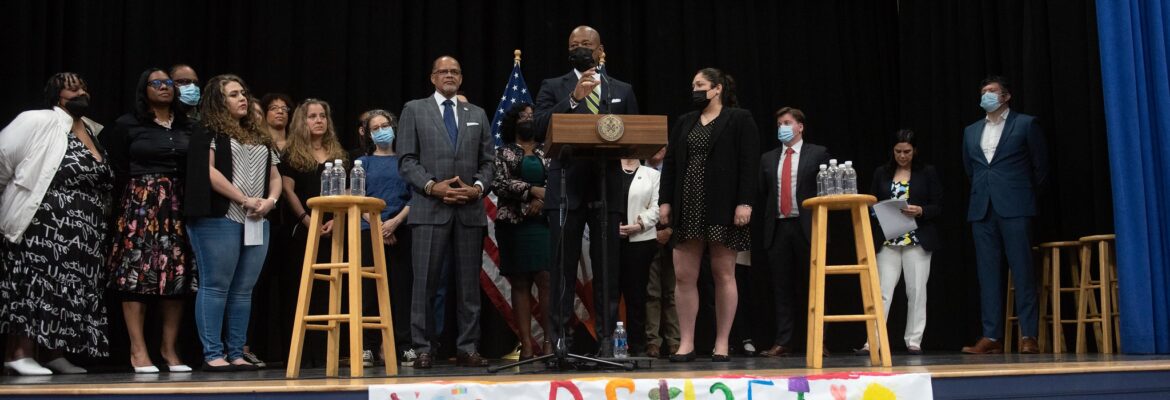
Banner Image: Mayor Adams, Chancellor Banks Announce Comprehensive Approach to Supporting Students with Dyslexia. Image Credit – NYC Mayor’s Office


There are no comments yet
Why not be the first