
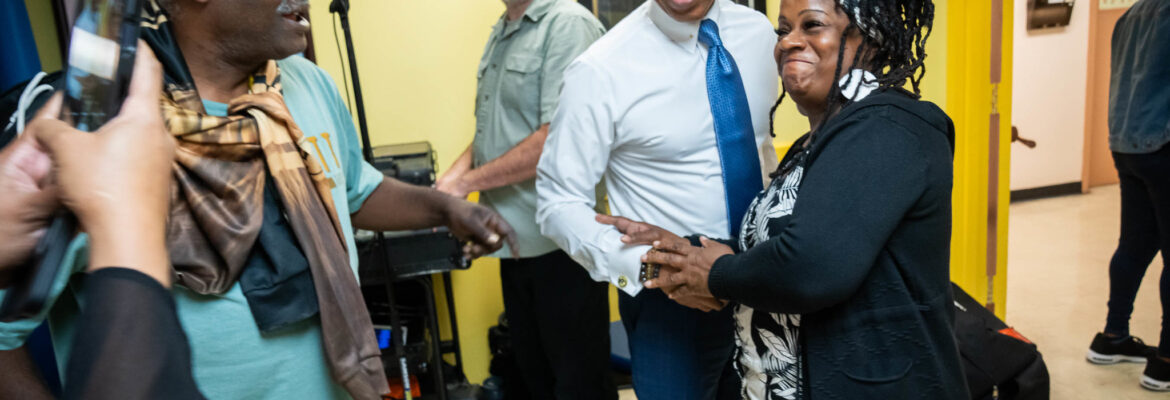
Allison Stoddart Appointed As City Hall Chief Counsel, Nomination Of New City Corporate Counsel, Flag Raising Ceremony For Guinea, Older Adult Town Hall, Security Briefing Before High Holy Days
MAYOR ADAMS APPOINTS ALLISON STODDART AS CITY HALL CHIEF COUNSEL
Editor’s note: This is rundown of many of the mayor’s activities for this past week. These included a briefing before the high holy days of Judaism, an older adult town hall, a flag raising for Guinea, and several counsel appointments.
NEW YORK – New York City Mayor Eric Adams announced the appointment of Allison Stoddart as City Hall chief counsel, effective immediately. Stoddart has served as chief of staff in the Office of the Chief Counsel since the start of the Adams administration. During her tenure, Stoddart spearheaded the New York City Legal Fellows Program, a citywide initiative designed to enable junior attorneys at law firms across New York City to serve their fellow New Yorkers through a one-year appointment in the legal department of a city agency. Stoddart has worked alongside City Hall policymakers on a wide range of issues, including the expansion of paid parental leave and family leave and the removal of sidewalk construction sheds and scaffolding.
“It is my honor to announce Allison Stoddart as City Hall’s next chief counsel, where she will serve New Yorkers every day,” said Mayor Adams. “Allison has been part of our administration since day one, and during this time, has become an integral part of the legal team at City Hall. In her tenure, she’s helped bring private sector expertise to the public sector though the Legal Fellows Program, advocated for better benefits towards city employees by expanding paid parental and family leave, and helped the city get sheds down. I have no doubt that she is the right person to lead this office at this time, and that her intelligence and drive to serve everyday New Yorkers will benefit our entire city.”
“I’ve always believed that the law and public service go hand-in-hand, and serving in the Office of the Chief Counsel to the mayor and City Hall has been a defining privilege of my career,” said City Hall Chief Counsel Allison Stoddart. “I’ve been proud to serve as a chief of staff, and now, as chief counsel, to serve New York City. In this role, I will continue to collaborate with the many committed public servants who work so hard every day to shape the future of our city. I look forward to continuing to work closely with newly-nominated Corporation Counsel Muriel Goode-Trufant and the other members of the Law Department.”
“During her tenure as chief of staff, Allison Stoddart has consistently used the power of the law to advance the needs of everyday New Yorkers,” said First Deputy Mayor Sheena Wright. “With her proven experience and expertise, Allison is ready to serve New Yorkers as chief counsel. I look forward to her continued success in our administration and her using the full force of the legal system to move our city forward.”
“In her time at City Hall, Allison has continuously demonstrated to be a person of the utmost integrity and an exceptional attorney,” said City Hall Chief of Staff Camille Joseph Varlack. “Bringing an impressive understanding of city government, Allison’s appointment will ensure the seamless continuity and transition of the chief counsel team and I am grateful that she will continue to serve our city at the highest level.”
“Allison Stoddart has been an integral part our team for the past two years,” said Chief Advisor Ingrid P. Lewis-Martin. “City Hall has a deep roster of talent, and I am thrilled to elevate one of our best and brightest to lead the chief counsel’s team and continue to deliver for New Yorkers.”
“I’ve been able to see firsthand the strong work ethic, respect for the law, and integrity that Allison Stoddart brings to her work in city government,” said Deputy Mayor for Strategic Initiatives Ana J. Almanzar. “A proven leader, Allison has stepped up time and time again to deliver for New Yorkers, utilizing the full power of the law to ‘Get Stuff Done.’ She is more than ready and qualified to continue her tenure in public service as the city’s new chief counsel.”
“Allison is a talented attorney who has served this administration well,” said Deputy Mayor for Public Safety Phil Banks. “I am proud to see her elevated to this role and look forward to see how she continues in her impressive career of public service.”
“Through her time at City Hall, I have known Allison to be an impressive, thoughtful, and ethical colleague, who has continuously made the chief counsel team and City Hall better,” said Deputy Mayor for Operations Meera Joshi. “I am glad to see her receive this well-deserved promotion and continue to serve our city.”
“Since day one of this administration, Allison has served our city tirelessly and devoted herself to implementing the law in a way that supports 8.3 million New Yorkers,” said Deputy Mayor for Communications Fabien Levy. “Whether working to make our city safer and more livable, fighting on behalf of city employees, or helping train the next class of lawyers for our city, Allison has always put New York City first. She’s smart, dedicated, and has impeccable judgment — and there is no one we’d rather see serve as City Hall’s top lawyer. We are extremely lucky to have such an immensely talented person serve as our next chief counsel.”
“From day one, Allison Stoddart has shown a prowess for using the law for good and lifting up New Yorkers most in need,” said Deputy Mayor for Housing, Economic Development, and Workforce Maria Torres-Springer. “In this new role, Allison will only deepen her hard-earned reputation as a public servant, continuing her proven track record as a lawyer who leads with integrity. I’m thrilled for her to enter into the role and deliver for our city.”
“We are lucky to have Allison Stoddart appointed to chief counsel today. Since the beginning of the administration, Allison has been a trusted leader within the chief counsel’s team, and helped us navigate through complex, yet critical health and human services issues,” said Deputy Mayor for Health and Human Services Anne Williams-Isom. “New Yorkers are better for her promotion today.”
In addition to serving as both Mayor Adams’ and City Hall’s counsel, Stoddart will oversee 10 agencies: the Mayor’s Office of Contract Services, the Mayor’s Advisory Committee on the Judiciary, the Office of Labor Relations, the Mayor’s Office for People with Disabilities, the Mayor’s Office of Risk Management and Compliance, the New York City Business Integrity Commission, the New York City Commission on Human Rights, the New York City Department of Records and Information Services, the Office of the Administrative Justice Coordinator, and the Office of Administrative Trials and Hearings.
About Allison Stoddart
Allison Stoddart most recently served as chief of staff to City Hall’s chief counsel. Stoddart was appointed in January 2022, at the beginning of the Adams administration. Prior to that, she was counsel at WilmerHale, where her practice focused on representing individuals, corporations, and financial institutions in complex commercial litigation, white-collar criminal defense, regulatory enforcement proceedings, and internal investigations.
Stoddart previously served as a law clerk for the U.S. District Court for the District of New Hampshire.

She is a graduate of Johns Hopkins University and Boston College Law School.
Stoddart will report directly to Mayor Adams.

MAYOR ADAMS ANNOUNCES THE INTENTION TO NOMINATE MURIEL GOODE-TRUFANT TO SERVE AS NEW YORK CITY’S CORPORATION COUNSEL
NEW YORK – New York City Mayor Eric Adams today announced his intention to nominate Muriel Goode-Trufant as the city’s next corporation counsel. Goode-Trufant is a longtime public servant, having spent more than 30 years in the New York City Department of Law, where she has served as acting corporation counsel since this summer. As corporation counsel, Goode-Trufant will lead the New York City Department of Law, which is primarily responsible for providing legal representation to the City of New York — for the Mayor’s Office, the Public Advocate’s Office, the Comptroller’s Office, city agencies, and the City Council — in all affirmative and defensive civil litigation.
“I am excited to announce my intention to nominate of Muriel Goode-Trufant as New York City’s next corporation counsel,” said Mayor Adams. “Muriel’s record speaks for itself — a dedicated public servant with more than 30 years of experience at the Law Department, a recipient of the agency’s highest honor, and a lawyer who has fought for equity and justice. As our next corporation counsel, Muriel is prepared to serve our entire municipal government and use the full power of our legal system to lead our city forward.”
“I am humbled and honored by the intention to be nominated by Mayor Adams to serve as the city’s next corporation counsel,” said New York City Corporation Counsel Nominee Muriel Goode-Trufant. “Through my more than three decades as an attorney at the New York City Law Department, I am keenly aware of the vital role the corporation counsel plays in New York City government.”
Muriel Goode-Trufant will replace Judge Sylvia Hinds-Radix, who stepped down from her post at the end of May. Judge Hinds-Radix led the Department of Law since January 2022.
About Muriel Goode-Trufant
Muriel Goode-Trufant began her career at the New York City Department of Law in 1991 as an attorney in the General Litigation Division where she held numerous roles, including assistant chief of the division. She later became the agency’s Equal Employment Opportunity officer and rose to the position of chief in the Special Federal Litigation Division.
Goode-Trufant became the Law Department’s managing attorney in 2015 and first assistant corporation counsel in 2023.
Before working for the city, she was an associate at the Philadelphia law firm Cohen, Shapiro, Polisher, Shiekman and Cohen.
Goode-Trufant has won numerous legal awards, including the Law Department’s highest honor, the Corporation Counsel’s Award for Distinguished Legal Service, in 2011.
Goode-Trufant is a graduate of Temple University School of Law and the University of Pennsylvania.
Under the City Charter, the nominee for corporation counsel must be confirmed by the City Council.

Flag raising ceremony for Guinea.
New York City Mayor Eric Adams delivers remarks at a flag raising ceremony for Guinea. at Bowling Green on Wednesday, October 2, 2024. Michael Appleton/Mayoral Photography Office
TRANSCRIPT: MAYOR ADAMS DELIVERS REMARKS AT FLAG RAISING CEREMONY FOR GUINEA
Deputy Commissioner Aissata Camara, Mayor’s Office of International Affairs: I am so honored to be here as the deputy commissioner and a Guinean in the administration. It is an honor to be celebrating Guinea’s 66th anniversary of their independence. We wish them continued prosperity, continued goodness.
To be Guinean is to be a dignified person. To be a Guinean woman, it means to be a strong woman. And I am proud to be a Guinean woman. So thank you for coming together. Thank you for joining us in raising for the second time, the flag of Guinea. And now it’s my immense honor to introduce the permanent representative and ambassador of the Republic of Guinea, Paul Zoumanigui.
Paul Goa Zoumanigui, Ambassador and Permanent Representative of the Guinea to the United Nations: [Speaks in French.] I will now switch in English to thank everyone here today who have come to celebrate with us the commemoration of the independence of the Republic of Guinea on the 2nd of October.
Mr. Mayor, ladies and gentlemen, collaborators of the mayor, dear president of the Guinean community, ladies and gentlemen from the administration of Guinea, dear friends of Guinea, it is an immense pleasure and satisfaction for me to be here today, October 2nd, 2024, to raise the Guinean flag at the New York Bowling Green for the second consecutive years.
In this regard, I would like to thank warmly Mr. Mayor and your colleagues for the opportunity you are giving us today, again, and to convey to your collaborators and thanks of our president, general of Army Corps, Mamady Doumbouya, head of state and president of the Republic of Guinea.
We appreciate the message of the Secretary of State that was delivered some times ago and we praise that Guinea and the United States will continue working together hand to hand to strengthen the cooperation between the two countries. As you know, the date of October 2nd remains emblematic for our country, the Republic of Guinea, the first French-speaking country, African country, to gain independence on this date in 1958. Thus, opening a way for other countries that followed the path traced by Guinea. Since then, a lot of water has flowed under the bridge, leading the people of Guinea to support other countries, particularly African countries, in the conquest of their independence to promote Pan-Africanism, positive naturalism in its international relations and to develop fruitful relations of friendship and cooperation with all actors of international community.
Our presence on the American soil stems from these convictions. We welcome the conditions and facilities granted to us, I mean the Guinean community, in the exercise of our function in order to strengthen friendly relations with the United States of America. Within the framework of the permanent mission of the Republic of Guinea in New York, we welcome the excellent relation of cooperation with the respective American authorities, particularly with the New York City Hall.
I would like in this occasion to recognize our compatriots, [Mori Kuyate,] Aissata Camara, and the New York African Council, for their valuable contribution to the strengthening of those relations. I also recognize and thank the African law enforcement officers here with us today. I have not forgotten about the Assemblyman Charles Fall. We highly appreciate the excellent relation between the Mayor’s Office and the Guinean National through their respective officials. We encourage the continuation of this relation and assure that we will continue being available to contribute to strengthen those relations. Finally, I would like to reassure you once again to continue working with your office, Mr. Mayor, for the benefit of our respective institutions and citizens. I thank you all for your attention.
Deputy Commissioner Camara: Let’s thank the ambassador again. Vive la Guinée. Vive la Guinée. I am so honored to introduce Mayor Eric Adams, the 110th mayor of New York. But we’re going to introduce him the Guinean way today. My sister, introduce the mayor of New York City to this group. Yeah.
[Music Break.]
Mayor Eric Adams: That should be a standard introduction. You know, the uniqueness of the sound that comes from Guinea, as well as the continent, is not only a call for the acknowledgement of who I am as an individual, but is a call to wake up our spirits of our ancestors. Because we are here because of our ancestors. And I am so proud of my sister, Commissioner Aissata, from Guinea, who really ties the connection with the African diaspora, as well as the other international leaders across the entire globe. This is the second year that we have raised the flag. We did it during your 65th anniversary, and now we’re here during the 66th anniversary.
And although we acknowledge your independence, we want to be clear that we are dependent on each other. We need each other, and that is why we lift up the flag of the various immigrant communities in this city. Because your contribution to this city is what makes us great. And one of the aspects of it that makes me proud, as we do these flag raises in general, but specifically the African diaspora, that you’re seeing a larger and larger group of men and women in the law enforcement community that are representing the African diaspora.
Their presence sends a real signal that they understand how safe we must be, and how the community’s Police Department should reflect the diversity of the city. So I’m here today, not only as a proud American, but as a proud African. And I say, let’s raise the flag, and let’s raise the consciousness of the contributions that this community has provided for not only New York, but this entire country. Happy Independence, Long Live Guinea.

TRANSCRIPT: MAYOR ADAMS HOSTS OLDER ADULT TOWN HALL
Mayor Eric Adams: Fort Greene, how are you, you know? This is, this is, this is like homecoming. 88 Precinct, as a lieutenant, state senator, Brooklyn Borough President, and all of those things. And so we really want to hear from you. This is number how many, Lorraine? Number 17. 31, 31 town halls. 17 older adults. A number of youth town halls. This is so important to me because I get to talk to you directly. And it’s not filtered. And you can hear from me. And any questions you want to ask, we answer them. We answer them. I am so much on the ground. And I enjoy this part of the job more than anything, because I get to hear from you and stay connected.
Go back January 1st, 2022. What did I inherit in this city? 40 percent increase in crime. Black and brown unemployment was high. Black unemployment was four times the rates of white unemployment. Our children were not learning at the capacity that they deserve to in schools. We were not investing in foster care children. No one wanted to be on our subway system. We had that five-letter road that many people have forgotten. COVID was everywhere. And then on top of that, we inherited 217,000 migrants and asylum seekers.
I had no authorization to stop the buses from coming in. People just stepped to me all the time and said, Eric, what are you doing to us? I couldn’t stop the buses. It was against federal law. I could not allow people to work. It was against federal law. People who were repeated offenders, those small numbers who were committing crimes repeatedly, I could not turn them over to ICE. That was against local law. I couldn’t even allow people to volunteer and give them a stipend. That was against federal law. And so in spite of that, we had to manage.
We used to get 4,000 migrants and asylum seekers a week, 8,000 every two weeks, 16,000 a month that we had to house, feed, educate over 40,000 children. And we did it. We did it. But we also had a housing crisis that we had to address. All of those things we inherited. Two years later, two years later in this city, we have more jobs in the City of New York than in the city’s history. More small businesses have opened under this administration than were opened in the history of this city. Robberies in our subway system, despite what you read, robberies in our subway system is the lowest in recorded history.
In August, when they said there’s a large number of shooters that always happens in the month during the summer months, we had the lowest number of shooters in recorded history in the month of August. Independent financial experts have raised our bond ratings that allow us to borrow better and show our strength under this administration. We financed more affordable housing in one and two years in the history of the city in one and two years. Moved more people out of homeless shelters into permanent housing in one and two years in the history of the city. More people participated in the FHEPS voucher program to move into affordable housing in the history of the city in one and two years.
People are back on our subway system, tourism back, fourth largest in the city’s history in tourism. And we had foster care children aging out at 18. We invest in foster care children, giving them life coaches until they’re 21, paying their college tuition and giving them a stipend so they don’t deal with the issues that happen to them when they age out and they were fed into the criminal justice system or mental health issues. More people have benefit from this administration, from our MWBEs, bringing in billions of dollars for Black, brown, women business to be able to support in this city. And specifically for our older adults, what we have done with our Older Adult Cabinet and our analysis of how to make our streets safer and more friendlier for you. We’re doing it. We’re doing it.
And in spite of last year in October, everybody stated when all of a sudden we learned about an investigation and they took my phones from me, everybody said the city was going to fall apart. That’s the noise. Look at the numbers. The city has continued to excel because I know hard times, folks. I know what it is, to watch mommy get up every day and provide for six kids walking to Amstead Daycare Center on her arthritic knees and being able to have to do three jobs every day to provide for us. She always said to me, son, don’t you ever give up. Don’t you ever surrender. Don’t you ever let anyone to write your own narrative and story. I know my life. I did nothing wrong, and it will be proven that I did nothing wrong. I’m strong on that ground.
But while the attorneys handle the case, I’m going to fight for this city. We’ve come too far to go back. And I’m not going to allow this city and the progress that we are making. We’re making unprecedented progress. You have an outer borough mayor. You have a mayor that has gone through a lot, folks. And I’m helping people who are going through a lot right now. That’s why I became the mayor. That’s why I wore that bulletproof vest as a police officer. That is why I fought hard for this city. And I’m going to continue to do so. I’m going to continue to do so.
I got a job to do and I’m going to finish that job. And I’m going to move this city forward in the process of doing so. So we know hard times, folks. Mommy could have easily said, I got these six kids and I don’t see any way forward. I’m walking out of here. She could have easily have done that. And everybody in this room, all of you know some hard times. All of us know some hard times. But I don’t care what anyone say. You just got to pray.
Prayer works. Prayer worked for me when I had a learning disability undiagnosed. Prayer worked. Prayer worked for me when we used to, people used to say on the block, they say, you’re the luckiest people on the block. You barbecue every time, every night. The cooking gas was turned off. We knew what it was. And wintertime, folks, we used to pray for snow so we could melt it because back then they would turn off your water if you didn’t pay the bill. Mommy used to say the only bill we would keep on is the telephone bill because everybody don’t need to know you’re poor.
So I know what it is, and I know what we’re going through in this city. You have a working class, blue-collar mayor. Don’t fit what other people feel a mayor should be, but I fit what you believe a mayor should be. And that matters to me. And so I want to thank you for allowing us to come into Fort Greene Senior Citizens Center. I’ve been in here for the Jazz Nights. I’ve been in here for the Valentine’s Day nights. Some of you met your boos in here.
So I know this place, and I’m happy to be here with this amazing team that’s going to answer your questions. Whatever you have on your mind, we want to answer. And I cannot say enough for the amazing Commissioner Cortés-Vázquez. She has redefined our older adults initiative, and we want to continue to evolve in the right way. And many of you know my longtime friend Karen Cherry, who’s here, who’s really on the ground doing the things in the right way. So let’s open the floor to some questions, and let’s move on.

Question: Good afternoon, Mayor Adams. My name is [Ms. Annette Hughley.] This table’s questions would be issues with transportation. When it comes to parking, less spots available. The CitiBikes takes up spots. Delivery trucks, people have to circle the blocks many times and find parking near their residence, where family members must sleep in their cars due to not finding adequate parking spaces, which could be dangerous.
And those of us that take public transportation, specifically the B25 bus, the B26, the B45, and the B48 bus, find that a lot of these specific buses are not in service. Next bus, please. And these buses are taking a long time to come. We understand that this is a state issue, but what can be done at the city level? Thank you.
Mayor Adams: Let’s peel back. Thanks for that comprehensive list of questions. And we got Captain 88. This is Captain 88, lieutenant over here. 88 is a promotion house. So let’s peel back. Let’s start with your concerns around parking. You know, and I tell folks all the time that as we come in and reshape our streets, we cannot ignore the desires of long-term residents who have been there a long time. So we need to balance it off in the correct way and engage communities in conversations on what we want our streets to look like. So who’s here from DOT?
Okay, commissioner, why don’t you give an overview, respond to the street piece, and even we need to look at those bus routes that you’re talking about, where they’re taking a long time. And it is the MTA. A lot of people believe the MTA is controlled by the mayor’s office. Let me tell you something. Everything people think, go get that mayor, you know, go get that mayor. But it’s imperative to bring in your state lawmakers also so that they can talk about these issues. There are clear things that are within my span of control and within the span of control of the state. But we’re not saying it’s not in our span of control, so we’re not going to deal with it. If you have an issue, we’re going to fight for your issue. But we want to be clear that the MTA is controlled by the state, but we want to look at these buses that you’re talking about that are slow. But we can’t talk about the streets.
Keith Bray, Brooklyn Borough Commissioner, Department of Transportation: So with the streets, I heard city bike stations are taking up parking, and people are saying they’re parking overnight because they can’t find a space or sleep in a car overnight, which is very unfortunate. So whatever locations where this is occurring, you can let me know. We can look and see if there’s park regulation changes or something that can change that. I don’t know if Citi bike stations need to move themselves, but we can talk about that once they have the exact locations, and then we can review that and anything else there. And as far as bus operations, I will say that we do talk to MTA bus operations quite a bit, so those Fulton Street buses you’re talking about, so we can talk to them about the issues with operations there also.
Mayor Adams: So we need to look at exactly those bus routes, so let’s get to exact bus routes that she’s talking about and see what is their service reliability, how well are they running. Let’s look into, if you give us those specific routes, we can sit down with bus operations and find out what is their record, you know? What is their record? Are they operated in a reliable fashion like they’re supposed to be? That’s what lets us find out, and we’re going to get back to you personally in doing so. But we need to look at what areas. I know what areas we’re looking at that you have the— No, I got the bus. I’m talking about the bikes. What are you saying, the bike lanes that’s holding up Parker, taking away Parker?
Bray: CitiBike stations, you were saying?
Mayor Adams: I’m sorry? No, go ahead, ma’am. Go ahead.
Question: [Inaudible.] They have to sit in their car, and if somebody want to come and visit them, we have to go downstairs to meet them, you know? And we have to stand outside and talk to them because there’s nowhere to park. The bikes taking up all the lanes, you know, the bikes should be moved. Our sidewalks are wide enough to put the bikes on the sidewalk. And the fire stations where they got the Johnny pumps and stuff like that, half of them not even working.
So, you know, what is going on with that? Because if there’s a major fire, I don’t think anybody is checking these things to see if they’re working. I’ve been living down here over 40-something years, and I have not seen the Fire Department turn on it to see if water coming out. We had an issue that there was a fire, and there was no stands to pump the water up in the building to put out the fire.
Mayor Adams: So, first of all, because you hit me with a couple of things. I opened the door, and then you… So, let us… I am not sure of how FDNY analyzed the fire hydrants. I’m sure they checked them, but let us find out. Exactly what the process is. As a matter of fact, DJ, while we’re here, can we call either the commission or someone and just find out what is the routine for checking the fire hydrants? How is it done? I’m sure there’s a mechanism, because they can’t wait until there’s a fire, and then all of a sudden say, oops, no water’s out. So, let us find out. Let’s find out how much they check on a regular basis, and then we can look at the locations you’re talking about to see if they have checked them, because they have to list when they make those inspections. But let’s find out.
Listen, the whole bike lane conversation is probably one of the most volatile conversations you can be a part of, and it goes into someone like yourself. You say you live in this area for 40-something years. That’s why your voice is important at the community boards and when they hold these hearings for these bike lanes, because oftentimes it’s a one-sided conversation. And I get a lot of heat when I say, listen, we’ve got to listen to the local residents also. We can’t just say we’re going to come and just do whatever we want in the community without sitting down with those who have been there and saying, is this something that you want? How do we list when we roll out these different locations for bike lanes, for CitiBike, and everything else? How do we notify people when we do these hearings?
Bray: Thank you, Mr. Mayor. We go to community boards and list the stations. We also list them on our website for people to review, let them know about it. And before the stations themselves are installed, we usually put postcards and notices to let people know that they’re coming.
Mayor Adams: You put postcards and notices?
Bray: Yeah, CitiBike, actually CitiBikes themselves.
Mayor Adams: They do what? Where they post it? Yeah, before they put it in the station, they’ll post it. Commissioner, why don’t we do this? Because everyone in this room may not be on Twitter, may not be on Instagram, may not be on TikTok.
So we need to have a communication mechanism that identify our older adult centers, because I bet if you do analysis in this room, 85 percent of these people, if not 90 percent of them, are voters. So we have to communicate with them in a mechanism that they receive. Right, and not in the mechanism that we receive. So we should build out a communication plan and Commissioner Stewart, and we will also tap into our community affairs officers so they can go to these locations where our older adults are.
We have to communicate with people where they are, because if we do it based on where those who are social media types, then they’re going to show up at the meetings, and it’s going to seem like they automatically, their opinion matters. Your opinion matters. You know, you’ve invested in this community for 40-something years. You should have a voice on where you’re going to put a city bike location. So we will put together a mechanism where we can communicate on the ground, you know, working class folks in locations like this.
We should get our pastors and our bishops and our imams. They should be part of how we let you know when these hearings are, because it’s important for you to be there, so it’s not a one-sided voice. So we’re going to do a better job of communicating on the ground. Thank you. I’m confident that Ydanis and I can work this out.
Question: [Inaudible.]
Mayor Adams: Yes, Ydanis Rodriguez is the Commissioner of DOT. So let us rectify that, okay? Thank you. But we’re good on the bus? We’re going to look at those bus routes? Okay. How are you, ma’am? You got the mic?
Question: Good afternoon.
Mayor Adams: How are you?
Question: Welcome to, we call it 966.
Mayor Adams: 966. I’m going to play that number.
Question: We have many questions at this table, but this is the consensus question. Yes. Many new building projects are considered affordable housing. However, that doesn’t always seem to be so. Define how the affordable housing label is determined. Where do we go to find resources?
This is specifically for older adults, this question is. Also, some existing developments for older adults are too small. The rooms are small and the bathrooms are small. That is our question.
Mayor Adams: Yeah, okay. But before you do that, let me share this. We don’t have enough housing. We have a housing crisis. We have a 1.4 percent vacancy rate. We need more housing. And we have something right now that’s going through the City Council that’s called the City of Yes. We have not changed our zoning rules for the most part in over 60 years. And our zoning rules are racist. They promote building in some communities, and they don’t allow in others.
We have 59 community boards, 59. Ten community boards have built more affordable housing than 49 combined. And every time we go to those communities where they don’t, are not building housing, they are at the rallies saying housing is a right, but then when you say we want to build it on your block, wait a minute, it’s not a right here.
So we need you to speak with, I think this is Crystal Hudson, is your council person? We need her to be voting yes on the City of Yes. We’re saying build a little more housing in every community. Everyone needs to share the responsibility of affordable housing. And so particularly around senior housing, that is one of the major issues that we have. I told the administration to do an analysis of every city-owned property where we can build housing on top of. But I need help from the City Council to pass the City of Yes.
The state gave us power to change office spaces into housing, to raise our heights that we are building, to do a lot of incentives. They did their job. Now we need the city to do its job through the City Council. And as I stated, we finance more affordable housing in year one and year two in the history of the city in one year. But we got to deal with the inventory issue. We have an inventory issue. Folks want to move out. My son came up from college. I wanted him to move into a place. Listen, it is just too expensive. And we don’t have enough inventory. And when you don’t have enough inventory of something, it drives up the price. That is our huge fight. And City of Yes is important. But can we talk about senior housing? Okay.
Anthony Drummond, Senior Planner, HPD: Thank you very much, Mr. Mayor. Anthony Drummond from HPD. To your question about the various types of programs that are for seniors, one in specific is the SARA program, which is the senior rental assistance affordability program. And that targets for seniors for their income less than 60 percent of the AMI, which is the area median income, but also includes like project-based section eight.
So seniors we know are on fixed income. So a lot of the housing units that are being developed for targeting for seniors, they also include that make sure that the fixed income that a lot of seniors have are included as part of that program when you apply for those units. So that’s part of the HPD term sheets. And that’s specifically for seniors in the program.
Mayor Adams: And we…
Drummond: Yes, yes, yes, definitely. After this, I can give you the one I have here to show you.
Mayor Adams: And while we do this also, why don’t we, why don’t we come here specifically and hold a, a housing senior day specifically, you know that. And, and we should, we should put together, we should put together a, a whole, some of the stuff you’re doing commissioner, we should put together a whole sort of older adult presentation.
Commissioner Lorraine Cortés-Vázquez, Department for the Aging: So look how smart you are because yesterday, Commissioner Garodnick and I were having a conversation just about that and making sure that older adults see all of the benefits of the City of Yes, because now it gives us opportunity to get more developers in so that we can have some focus on older adult housing. So we’re on it, but now we will add to it exactly what you’re saying. Let’s have some specific hearings. I mean, meetings. And then let’s also make sure that they’re aware of the benefits of City of Yes. Right.
Mayor Adams: Not only City of Yes. Do you know how much money we send back to Washington and Albany because we don’t take advantage of it because it’s too bureaucratic to go through it. Like how many of you are signing up for a DRIE or SCRIE? Right, right, right.
There are proposals that allow you to freeze your rent and no increase in your rent. And if you’re with disabilities, you have DRIE. There’s proposals for that also. So that’s why we have to come in and let folks know what, what good is it to have all of these programs that no one knows how to navigate them and get them. So where’s PEU? PEU in the house. One of my favorite units, PEU, our public engagement unit goes out and assist you and signing up for those programs, because there are a lot of programs that are available that are reduced fare MetroCards of SCRIE, DRIE, Snap. There’s so many programs that we’re sending that money back to Washington or we’re not spending it at all. So we got to come in and not only tell people about the program, but have the team online to know how to get access to those programs. Cause every dollar amount count.
How many of you live in a NYCHA? Anyone live in NYCHA here? You know, broadband is free now for NYCHA residents. You know, we have free broadband for NYCHA residents. You know, when I was, when I was president, many of my NYCHA residents did not have access to high speed broadband. We now have it free. So when you start taking that dollar amount for broadband, start taking those dollar amounts for raising your rent, those dollar amounts for disability, those dollar amounts for a reduced fare MetroCard, we put $30 billion back in the pockets of New Yorkers.
If you, if you have a child or grandchild that’s for childcare, we dropped the cost of childcare from $55 a week to less than $5 a week. You start adding all of that up. Those are real dollars we’re talking about. And so we want to make sure you know about these programs so you can get the benefits for them. So we need a whole roadshow of going into all of our older adult centers and say, here are the programs that are available. And then we have PEU there that will show them how to sign up for them. Okay.
Okay. Let me just give this quick announcement. DJ got it for me. Fire hydrants are inspected every six months, April and October. April and October. So if you, so this is October now. So, so, so ma’am, ma’am, they should be inspected in October. You should, you should put a little piece of tape on the hydrant to see if this moved or not. And if it’s not moved, they didn’t do it. You know that? Yeah. Put a little chalk mark. Yes. Yes. So this was respected in October, you know? Yes, ma’am. Karen would, Karen would take you. She’ll take, she’ll take you.
Question: Good afternoon, Mr. Mayor. I’m [Veronica Lawrence.] Thank you. What can be done about the garbage? All the garbage laws. And it’s concerning this, how it affects the seniors because the time to put out the garbage is 8 p.m. and that is too late for some of the seniors. One senior put out the garbage at 5 p.m. and the land owner got a ticket.
Mayor Adams: Okay. So here’s this, here’s this, here’s the science around the 8 p.m. The 8 p.m. we, and you may not know it. You may not have heard it, but I hate rats. You know, and what Commissioner Tisch came into office as the commissioner of Department of Sanitation. And one of the top missions we had to do deal with something with these rats. And I live on, I live on Lafayette Avenue between Lewis and Stuyvesant. And there was a day when I first moved over there, you would stomp your foot and the rat would run. Now he just looks at you like what?
You know what? Right? So we did an analysis of how do we make our city clean? One of the problems we were having when the garbage was being put out early, the rats had the whole day to do their all you can eat. And they would sit there from early in the day to the whole, and then overnight. And it was just a real problem. So we did a couple of things. We changed the hours. Second, we did an analysis of these plastic bags. You know, I don’t know who had this idea that rats are afraid of mint smelling plastic bags because they aren’t.
So now we’re containerizing our garbage. We’re going to have almost 70 percent of our garbage containerized. We’re going to move to one in nine units to put our garbage in containers because we found that those were the two big benefits for rats. Garbage on the street for a long time and plastic bags, not having garbage in containers.
And so that is why the hour is eight o’clock. It’s eight o’clock because we want to have as little amount of time as possible for those bags to be on the street. Hold on, you got to get Karen to video you so you can tell the grandchildren you were hanging out with the mayor.
Question: The garbage containers you want now is the 55 gallon drums. Now, if I put four of them outside and I go out or go for the weekend and I come back, no garbage cans will be there because I live on the main street. They’ll steal it.
Mayor Adams: Someone snatched mine back when I first bought one years ago when I was president. And I put a little lock on it, on the gate, and no one has removed it ever since. So there’s a couple of ways you can do it. And we should come up with some creative ways of how to secure it. Because I hear that a lot. Come up with some creative ways of how to secure it. We understand that.
Question: You secure it on the gates, but you have to wheel it out to the sidewalk. Truck can’t pick it up.
Mayor Adams: And we know that’s a problem. I wrote my address on mine, 936. No, I’m just saying. I wrote my address on mine at 936 and I saw it down at 135. You know what I’m saying? So we know it’s a situation. But if everybody on the block has it, it’s less likely for people to try to swipe it. Okay? All right. Where are we going? How are you, ma’am? Grab your microphone.
Question: Hello, Mr. Mayor, and thank you for being here.
Mayor Adams: Thank you.
Question: I have a comment. We need more cops in the neighborhood due to the constant fighting, drug use, and active gangs in the area.
Mayor Adams: First of all, I love, love, love when I hear that question. You know, because people often try to give the impression that working class families don’t want police officers in their community. And that is just not true. I have yet to go to one meeting where someone stated, give me less cops. You know, so all those folks who are running around here yelling, you know, disband, defund, take down the numbers of police officers. I don’t know where they live. You know, I don’t know where they live. So, captain, talk to me.
Captain Michael E. Goodchild, 88 Precinct: Good afternoon, everyone. I’m Captain Mike Goodchild. I’m the commanding officer of the 88. And, ma’am, thank you very much for that question. I agree with you. We absolutely need to use additional resources here to assist with that problem. What we have done is, through our Build-A-Block meetings with our neighborhood coordinating offices, through our community council meetings that we have monthly, is we’ve been able to identify locations where these issues of narcotic use or crew and gang involvement activities. And we’ve deployed additional resources there.
So we would like more involvement from you in terms of letting us know where it’s being affected. And we will definitely shift our resources so that we can combat some of these issues. Just to talk about what we’ve done, for example, Clinton and Washington. I don’t know how many of you are familiar with that location. We’ve got several complaints about narco use and sales and quality of life issues at that location. We’ve been out there constantly. I’ve been out there myself. And we’ve been able to address a lot of the issues that were popping up at that location. Obviously, there is still some more work to be done. And we are here ready and willing to tackle those tasks with your input.
Mayor Adams: What’s the situation in Clinton and Washington? Is it gang or is it just drug? Narco? Okay. Have we done initiatives there?
Captain Goodchild: We’ve done initiatives just last month. Three weeks ago, we did a sweep where we’ve made a couple of arrests. But one of the things we try to say is it’s a little bit more than just arresting the individuals because they’ll come back because there’s a source of the product that they’re getting. So it’s a matter of us going after the dealers, getting them to, and then getting the courts to actually incarcerate them. We’ve been successful with a couple of the arrests that we’ve made. But there is still more work to be done.
Mayor Adams: Where are we seeing the gang behavior?
Captain Goodchild: So our crew involvement is primarily in my sector, Charlie, which is Ingersoll-Whitman over there on the western part of the precinct. So it’s between across from Fort Greene Park, bordering Park from Carlton Avenue down to Navy Street.
So that’s where we have most of our crew violence. That we’ve been fortunate with the deployment we’ve had over the summer. Correct.
[Crosstalk.]
Absolutely. Correct. And you’ve noticed over the summer we’ve had a steady post over there. We’ve had cameras put up over there as well. That’s correct. We will, 100 percent, we agree with you.
We’re working to getting it full time. But with the various issues that pop up from time to time, we do shift them around. But we haven’t forgotten that location. And it’s a constant reminder that we have to do more. The last incident we took was, I believe, right before Fort Greene, I’m sorry, right before Family Day. Right? Right. But we had a full time post there for the last four weeks following that incident.
[Crosstalk.]
Right. Yes. Yes, I do. Yes, I do. On Washington. All right. I’m 100 percent going to have my midnights, especially on Saturday nights, stop by to make sure that we’re not having any of that. But it’s something that we’ll definitely look into. And I’ll continue having my resources deployed in that location.
Mayor Adams: How are we doing crime wise?
Captain Goodchild: So crime wise this year, in terms of violence, we’re down significantly in terms of our shootings, in terms of our shots fired. What we are seeing, we are having some struggling with, primarily it’s property theft, whether it’s in burglaries. Right? That’s my biggest driver. I have a 60 percent increase in burglaries. We have some felony assaults that are popping up from time to time. And then our grand larceny of autos. Those are some of the issues that we’re struggling with. The recent robberies, we’re down in robberies for the year. We’re down about five robbery crimes. Not going to get into numbers. We’re down in robberies. We’re down in our shootings, our shots fired significantly.
But in terms of the areas that we’ve seen shrugs, we’re down in grand larcenies, which are the senior scams and a lot of those type of activities. But in terms of vehicles being stolen, whether you have your Honda owner or a Toyota RAV4 owner, we’ve seen an uptick in those. We’ve had our crime prevention officers here that have done initiatives, whether they’re giving out steering wheel clubs, whether they’re giving out when we are able to get those, the Air Tags or the Samsung Tiles. We were able to distribute those to those vehicle owners that we’re seeing their cars being targeted. And we’ve had a couple of those initiatives throughout this year, and so far it’s been well received. And I have, there you go. I have Captain Spiro here with me who can speak a little bit more of the initiatives that we’ve done.
Captain Spiro Papavlasopoulo, Crime Prevention Division, Police Department: Hi, my name is Captain Spiro Papavlasopoulo, common spelling, how’s everything today? So we look at, we address some of the issues that are here in the precinct that we’ve seen. There’s an uptick in some of our grand larcenies, specifically targeting our Hondas and certain other vehicles in the neighborhood.
Today, I would like to announce on behalf of the mayor and our deputy commissioner, we will be giving free steering wheel locks to everyone here today. So when you’re exiting the office, you can kindly pick one up. This was an initiative that we saw there was a problem. I brought it up to my boss here, and my commissioner brought it up to the Mayor’s Office. And with the love of the Mayor’s Office and ensuring that our safety and your products are being secured, we were able to secure these steering wheel locks. Thank you.
Mayor Adams: Thank you. Now you put them on the steering wheel, you don’t hit the person that’s still in the car. Now, when you look at those crimes, GLA, grand larceny, auto larceny, these property crimes, many of the laws that were passed are allowing people to do these over and over and over again.
We have sometimes you catch someone that’s arrested 40 times, 30 times for these crimes over and over and over again. And many of them are drug related. So we’re really trying to not only address the immediate action, we want to be preventive and give people the support they need that they’re not out here doing these repeated property crimes. Thanks a lot, captain.
Yes, ma’am. How are you doing?
Question: Hi, Mr. Mayor. How are you?
Mayor Adams: Good.
Question: Scaffolding on the building, outside of the building, and it’s not being maintained. Yes. Yes. And the rats also.
Mayor Adams: See, the woman was talking about the garbage. We have rarely get shed, S-H-E-D, down. You know, we’ve been big on that, Deputy Mayor Meera Joshi. Some of these sheds have been up, people have grew up thinking that they’re part of the building. And, you know, because the laws really didn’t incentivize bringing them down. And we are now moving to incentivize the cost of keeping them up needs to be more expensive than doing a repair and bringing them down.
So, yeah, and that’s the problem. And so there was a first round that Deputy Mayor Meera Joshi carried out that really focused on, we thought that we, by increasing the fines, giving the notices, now she’s going back into another level. We can’t leave these sheds up as long as they have. So we’re, she’s definitely on top of them. This has been a big initiative for us to get down these sheds throughout the entire city.
But do you have a specific location?
[Crosstalk.]
Okay, so DOB can get over there. Where am I going? How are you, sir?
Question: I’m fine, Mayor Adams. This is for this center here, personally. Yes. We have a lot of seniors here that are in walkers, automatic wheelchairs and whatnot. Why can’t we have a swoop sidewalk for their, when they go to their Ubers and accessorize and whatnot.
They have to go to the curb and someone has to help them off the curb so that they can get into their transportation. This needs to be done ASAP. Not next year. Not the end of the middle of the year. It needs to be done now. I would appreciate whoever on your panel handles these type of things, get right on it. Thank you.
Mayor Adams: Thank you very much. Thank you. I will elect you as my block association president any day. Go ahead, commissioner. Tell me about that. But that’s a great idea. Because when I was the borough president, we did a lot around the older adult centers because, you know, we want to make sure they get in and out. So what can we do about that?
Bray: Yeah, I forgot to introduce myself earlier. Keith Bray at DOT. We can work with Department of Buildings on ramps to have access for accessorizing other vehicles. And that’s what we’re going to do. So I’m going to follow up on that today, actually. And then we’re going to see what the deal will be. I didn’t say an answer today. I didn’t say an answer today. I said I was going to follow up today. And I’ll get back to you.
Mayor Adams: And you know what else we’re doing? Commissioner, you may want to talk about who we’re doing it through. Is it DOT? We are having walks through the community with our older adults to analyze, you know, moving about, you know, crack sidewalks, you know, where the signs are. Because we want to see moving around the city and our communities through your eyes. Can you talk about that initiative that we’re doing?
Commissioner Cortés-Vázquez: Right. So one of the commitments of the Department of Transportation was that they did a pedestrian study for the entire city. And then they saw that older adults were the individuals mostly affected by pedestrian safety. And so they did a special study just for older adults. And as a result of that, an offshoot of that, and because of the cabinet that the mayor spoke about earlier, these agencies getting together, now we have audit teams of older adults from older adult centers to go around that community to start saying, these are the things we need. The traffic light needs to be slower. There needs to be a curb cut here. This street is too high. And looking at all of those issues, city bikes is one of the other issues that they talk about.
So they look at that, and then they work with the engineers. So rather than the engineers design what should happen in that community, the older adults are part of that. The other thing that I want to say is part of the partnership with DOT and Commissioner Ydanis, who has been an excellent partner for older adults, is that we’ve also come up with a plan. And right now, I think we started out at 100. Edgar, somebody correct me. And we have a rolling plan to make sure that we have no standing zones so that older adults can have their buses stop in front of the older adult center, and also so that nobody can park there, so that we can have access and egress as fast as we can. So that’s another partnership that we have.
Mayor Adams: So that’s really taking a total overview of the city, and there’s no reason we shouldn’t have a ramp in front of an older adult center. There’s no reason we shouldn’t have the no standing where the buses can operate there. So you’ve got to take a holistic approach. And that’s what we are attempting to do in the process. So, you know, we’re moving, we’re thinking, and we’re responding. Yes, yes, ma’am.
Question: Oh, good afternoon, Mayor Adams.
Mayor Adams: You got your matching violet going on?
Question: I remember you from church, from St. Paul’s, when you were… Yes. I know. I’ve even been there with the exercising at the Borough Hall. Yes, I want to know about crossing Linden Boulevard, because the lights change so fast, and we have seniors coming across. A lot of times I have to go and stand in the middle of traffic, because I’m younger, and get all of the little chickies across. Come on, let’s get across. Yes. So can we please have a little bit longer on that light? Because I was crossing Kings Highway, and Kings Highway much more time than Linden Boulevard.
Mayor Adams: What did you see? Commissioner?
Bray: Yes, we can…
Mayor Adams: This is Bray Day.
Bray: Yes, we can certainly look at that, as the commissioner of Aging was saying earlier, these are the kind of locations that we’re looking at, to see if more time is needed. Not for you, but for seniors that need to cross an intersection. So we can certainly check the timing and increase it if need be. So is Linden Boulevard and Kings Highway, you said?
Question: No, now Linden Boulevard is in East New York, Lincoln Avenue.
Bray: I’m sorry, what Avenue? Lincoln Avenue.
Question: Lincoln Avenue and Linden Boulevard, and there is a, you know, and a senior, I mean, a center across the street. Teresa Moore, my mother, Teresa Moore, said, old adult, the center is across the street, and I don’t want no one to get hit with these people crossing the street, and these big trucks and everything else that’s not even going to stop, because they want to make it through the light. And I just want to keep us safe.
Bray: Gotcha. Is that part of Linden Boulevard with the service road or not? Yes. Oh, so it has a service road too. Yes, that’s a particularly difficult, right, it’s a big main line, and there’s a large service road on both sides. So, okay, I will check with that, our unit, and we will get back to you very shortly on that as well.
Mayor Adams: Thank you, thank you for that. How are you?
Question: Oh, well. Good afternoon. Good afternoon. I’m so glad you came here. Welcome to 966. I’m a member of this center and this community for, I don’t know, maybe 12 years, and I love this neighborhood, I love the community, I love Brooklyn.
And I want to say there’s a lot of issues. Housing is one issue, and you’ve already covered that. Sanitation is another issue, you’ve covered that. Right now, we’re talking about the streets and the egress from our building for the seniors, you’ve covered that. My personal thing is when I cross the street and I’m stepping over bump and jump, the car is bumping and bumping, and I don’t want to fall because I don’t want to go into the hospital with a broken leg. That’s one thing that I want to say to my community. We are a strong community.
We’re 966 where the jazz was every Friday night. And we want to stay strong. We want to stay healthy. We want to stay well-fed. And everything that this young lady here has advocated for the bikes and the egress in the streets, we want to maintain that. And basically, keep us where we want to be. Let us find a place where we can call some of these people and really get some results for our specific problems. That’s what I’m interested in. I’m interested in child care. I want the child care agencies to work with the parents so that these young children coming up today have something to look forward to.
We want housing. We want affordable housing for our children. At my table, somebody brought up the fact that their daughter, granddaughter, needs a house, apartment, someplace to live. That’s affordable. You did not define affordable, really, because it’s been said that it’s not affordable. We don’t have $70,000 a year.
Some of our children are just starting out with $50,000, maybe $40,000. Combined, the two of them might have $80,000, but they have responsibilities. This young man here, he just got a baby, and he says he cannot afford. He’s in NYPD. He can’t afford the affordable housing. Going down the line, Mayor Adams, we love you. Thank you for taking us bowling. Thank you for giving us a pool. Thank you for all the things. But I really want some real solutions.
Mayor Adams: Right, right. I got you, and I got you. One of the most challenging things- Thank you so much. One of the most challenging things for people to fully comprehend, when you look at the list of things that you stated, I’ve only been mayor for two years and nine months. You know? Two years and nine months. That’s how long I’ve been mayor. And the list of items you just stated, they were here for decades. Decades. And, you know, so I know there’s a desire to say, listen, I want it yesterday. But when you look at the analysis of the things that I ran on to make us safer, to build more housing, to make this city more affordable, you can check the list. We have been doing that. We have been doing that.
And the awesome amount of issues to run a city of 8.3 million people, where there’s just so much need, and so many communities have been denied and betrayed for generations. I am in the outer boroughs to deal with these outer borough issues. And when you use the term affordable, because I think you asked at the same time, every level. I need this police officer, and if he’s married, he and his wife, to be able to have a baby. So if I do too low, I’m pushing him out. We’re losing thousands of people that are moving to New Jersey, Pennsylvania, Westchester, because New York City is no longer a place for working class people.
That husband and wife that works at McDonald’s full time, now the levels are so low that they can’t even be qualified for some of the housing. And if we don’t build more housing, we have some places where you have 1,000 units, and you have 60,000 people applying for them. So there’s a combination of having several different income bands, so that teacher and accountant can stay here in the city, or your granddaughter that’s coming back, that she can stay here in the city. And you want the low income, and then you want the income of those who are living on fixed retired income. So it’s several income bands, and we use the term affordability as relative to who you’re talking about. And we got to build on each one of those income bands so we can have the right mixture of people that can call the city the home.
So from everything from the rats, to building more housing, to dealing with the ACS and keeping children inside a household, we know all of these issues happen. It’s not a magic wand. All I could do is bring my commitment, my dedication to saying we’re looking at each one of those issues. I have an amazing team of deputy mayors who, in their portfolios, they have really moved the needle on these important issues, and we’re going to continue to do a lot of work to do. But I inherit a city with a lot of work needed to be done. And we are doing that work every day. Thank you for your question. Yes, yes, yes. How are you, ma’am? Hi, welcome.
Question: Thank you. My name is [Priscilla Lamont,] and my concern is the older adult clubs and the fact that we’ve lost funding. We need you and your administration and the cabinet to put more money back into our centers so we can have more activities. Things going on, I want to know if you have any plans. Commissioner, you want to talk about that?
Commissioner Cortés-Vázquez: Yeah, sure. First of all, thank you. Our services and the demands, and I say that at every budget hearing, outpace the resources. But that’s also across the city, right? But I can tell you that there has been not one budget cut for older adult clubs in this last budget. Not one.
Not one closure, not one loss of programs, not one loss of initiative. There have been no budget cuts. In fact, we’ve given additional money for home-delivered meals, right? And so that the budget has increased for home-delivered meals. But I can assure you that there have been no budget cuts. That said, and I have the greatest respect for Ms. Macy, who is my partner and has been my partner for years.
She also has to make decisions with her resources. And I will never question the decisions that she makes with her resources, because I know that she has the best interest in mind for this center, all right? So that being said, sometimes we’ve got to make tough decisions. I’ve heard the mayor talk about his budget, and I liken his budget to the city budget. You get a finite amount of money, and then that gas bill comes in, or that light bill comes in, and you’ve got to make some adjustments. But I can give you our word that this administration, this mayor, has not cut $1 out of any aging services.
Mayor Adams: And when you, a lot of people don’t realize we have a fixed budget that I must balance by law every June. I must balance by law. Those of you who are homeowners, who’s a homeowner in here that owns a home? You’re a homeowner. Every year you pay your insurance. That insurance is supposed to be there if your roof caves in. And you have a fixed amount that you spend every year. If you use that analogy, and I use it often, we have a fixed budget.
About $70 billion of that we can’t touch. It pays salaries. It makes sure that the water’s on and all that other stuff. We have $30 billion that we can move around about. Out of that $30 billion, we had to spend $5.6 billion on a migrant and asylum seekers. The insurance was supposed to be the federal government. When we called them to say, listen, this is a federal problem. This is not a New York City problem, they gave us only $138 million.
So that money had to come from somewhere, and we had to prioritize where it came from. As the commissioner just stated, we said we want to minimize the pain to places in greater need, such as our older adult centers. But if we didn’t start cutting back from the day I became elected, we’d be in real trouble. We were able to find $7.1 billion in savings. If we didn’t have that $7.1 billion in savings, we would be in some real, real trouble. We put money back into our schools because they were sunsetting dollars. The previous administration had a lot of money that was COVID dollars that sunsetted, that was no longer going to be there.
We had to keep those programs open for these children. We put back into our libraries. We put back into our cultural institutions. We made sure we stabilized our older adult centers. But we were stuck with a $5.6 billion price tag that we had to find that dollar somehow, and that’s what we had to do. We don’t want to cut any of these programs. We managed the budget so well that we had a substantial, about almost $8 billion in our savings. But when we were hit with this unprecedented amount of money coming out of our budget, we had to find ways and some painful choices that we had to make, and it’s not our desire at all. We should not have had to pick up this price tag for the migrants and asylum seekers. Yes, ma’am.
Question: Good afternoon, Mr. Mayor.
Mayor Adams: Good afternoon, how are you?
Question: I am good, and how about you?
Mayor Adams: Quite well. Quite well. Good to see you.
Question: Thank you. Okay. This table concern, the way we’re sitting here, one of the concerns is the safety at the bus stop, because one of my neighbors, her daughter was attacked at the bus stop, so her concern is about the safety. And also, I know we spoke about the B-25, so could, when they talk about this around the round table, could they move the bus B-25 a little faster? You know, because they’re really, really, really, I mean, slow. 45 and the 69. 38, 38. Well, 38 has a lot of buses on the route.
All right. Okay. My concern is, as a homeowner, I live on Atlantic Avenue. The hydrants are always covered because there are no parking. So the hydrants are always covered. Those cars, they never get tickets.
Another concern is that there’s a lot of garbage that is thrown in the sidewalk, and I think you have about maybe something like 11 inches or something from the street to clean up. Okay. So if I don’t clean up because the cars are parked and then the sweepers come, the sweepers cannot clean because the cars are parked there, when the cars move and the police comes, who gets the ticket? Me. So this is my concern.
What can we do, especially the covering of the hydrants on Atlantic Avenue? And Atlantic Avenue is a very busy, busy street, you know, and a lot of traffic. So that is one of my concerns. And like I said, my friend here is concerned about the safety at the bus stop. Thank you for listening.
Mayor Adams: Captain, how are we doing with all to the side of the street, hydrants, and bus stops?
Captain Goodchild: Thank you again for your question. So just this summer past, we did have an initiative along Atlantic Avenue corridor that went from the old Domino sugar plant all the way down into Queens, 106th precinct. And one of the reasons why we focused on that was because of the volume of traffic on that route and the safety concerns that we had, especially during the summer months. The parking conditions that you are bringing up is something that we’ve taken a look at, and I’m trying to pull it up here from my recap, but we’ve shown to date an increase of a total of 45 percent increase in parking and summonses.
With regards to specifically how many of those are on hydrants and from Atlantic Avenue, I’ll take a look to see how much were in that location, but obviously if you mention it at this location, it’s something that we’re probably not addressing enough or paying enough attention to, so we definitely go back and ensure if it’s within the confines of the 88 or the neighboring commands, we all reach out to that commander and ensure that my offices and the adjoining commands are definitely paying significant attention to that location for you.
Mayor Adams:Okay, because the alternate side of the street enforcement is important, because if you don’t, people are not going to clean the streets, and as you state, the property owners are going to be held responsible for it, and we want the stre et cleaning rules to operate, and if people believe there’s a culture where it’s not going to be enforced, they’re not going to move their cars. All right, Captain? Thank you. Okay, we say 45 percent increase in summonses?
Captain Goodchild: That’s correct.
Mayor Adams: Forty-five. That’s a large number. That’s a large number. Ma’am, your hand goes up so much. We’re going to finish off with you. Let me get to these other tables.
Question: Good afternoon, ma’am. How are you? It’s a pleasure to see you here today. Thank you. I am [Janae Bogans,] and I’m a proud member of Grace Agard Adult Center, and I’m also a recently retired New York City probation officer.
Mayor Adams: Love it, love it.
Question: You’ve already prioritized a lot of questions that you’ve already answered. We’re so glad that you did it, but my question to you at this moment is, what is happening with the New York City retirement health insurance changes to Advantage Care? Will it be better for us, and will our retirees have the opportunity to still have the same doctors and the same services? Thank you for answering our question.
Mayor Adams: I’m a retiree, so your health care is my health care. We both have the same health care, and they’ve been going back and forth, back and forth on court on this issue, trying to find the right solutions. At the high end, the most important thing for me is not being hit with having to pay co-pays and others. Our retirement plan is in trouble. This is some serious trouble. I inherited this.
I’ve been on the phone with Renee Campion, my commissioner, and trying to sit down with the MLC, trying to come up with a solution that we don’t bankrupt our health care system, and at the same time don’t put retirees into a vulnerable position of making sure you need stability upon retirement. So I hear you, and I can’t even tell you I know the answer to the question right now. We’ve got another meeting lined up with the MLC and the legal team and labor to sit down how we resolve this issue. It is a mess. Yes, ma’am. Yes, ma’am. You want to ask something about it?
Question: Why are you on the subject here on this table? This is for the rats. I don’t know if you know about this. I bought this in the hardware.
Mayor Adams: Okay, okay.
[Crosstalk.]
Mayor Adams: Yeah, yeah. I’m glad you told me. I thought those were peppermints or something. You know that? You know? I’m sure it was peppermint. You better make sure you mark that somehow.
Question: Yeah, don’t poison the mayor, please. We need him. My name is Sarah Chambers. I’m a community associate at Special Projects, PEU, public engagement unit. Street team. Okay. They had two questions, but the first one was the bus. Apparently that bus is really bad, the 25. So we’re going to go.
Mayor Adams: All right, commission that bus.
Question: 25, yeah. The B25. But the question at this table is, how do we know which smoke shops are legal or not? In my neighborhood, they don’t care where they smoke outside. Why are they open near churches and schools?
Mayor Adams: When this law was first passed, we had very little or any power at all to close them down. And we were able to get folks like Senator Jenifer Rajkumar and others to go to Albany and say, listen, you have to give local control. And the governor has been a real partner with us. She was able to give us the authority to have a task force that comprised of the sheriffs, the New York City Police Department, Deputy Commissioner of Workers Protection, and they’ve been on the ground. We’ve closed down over 1,100 illegal smoke shops thus far, almost $68 million in illegal products. And you’ll be surprised how many locations have been operating illegally.
Matter of fact, if you see one in your area, it’s more likely it’s illegal than legal. But we’ve inspected, I think, all of the illegal ones. We’ve taken action. We’ve partnered with the police departments. And after we close them down, the sectors go and let them know if they pop back up and open again, because many of them were closing down and then coming back and opening. We’ve been on top of that. There is a seal that says if it’s a legal smoke shop. Because you need a legal smoke shop because you don’t know what you’re smoking if it’s illegal. It’s laced with all sorts of things, and we want to make sure we clamp down on that.
If you have a smoke shop in your area, you can let us know, let the precinct know, and the sheriff will come out and do an inspection to determine if it’s a legal place or not. And if it’s an illegal place, we’ll take actions to close it down. They’ve done an amazing job, the sheriff and their team and the whole task force, on closing down the numbers that they have and the value of illegal products that we were able to remove off the streets. If you have a location, let us know, and we’ll determine if it’s legal or not. And if it’s illegal, we’ll shut it down. Yes, ma’am.
Question: Good afternoon, Mr. Mayor.
Mayor Adams: How are you?
Question: Good. My question is, is there any way there can be a reduction in ConEd electric bills for senior citizens?
Mayor Adams: Yes, if ConEd, if they do it, you know, this falls into the category of, you know, the mayor’s in charge. No, ConEd makes a determination of the rates, and I think that we should be more creative, particularly those who are on fixed and retired incomes, because every dollar matters and every dollar counts. And I’m sure ConEd can be creative to do some type of discount. But I’m not, you know, that is outside my span of control, you know. Yes.
Question: How are you doing, mayor?
Mayor Adams: All right. How are you?
Question: My name is [Dennis Harmon,] and I’m a retired transit worker. I’ve been in the community for a long time, and I see that a lot of homeless people come into the community and a lot of mental illness people come into the community. And I think that they must be getting a ticket from the hospitals to come directly here, because I see so many of them in this community ever before. So can you address that, mayor?
Mayor Adams: Thank you. What happened was many people are not aware of how we got here with the street homeless, particularly with those with severe mental health illness. Many years ago there was a lawsuit by the advocates that stated the psych wards were inhumane, and many of them were. And so what we did was determine, you know, the courts determined based on the agreement, they determined to allow people no longer to be required to be in psychiatric wards. They let them go, but the problem was they didn’t let them go to anywhere where they could get the services that they need. And there are people who live on our street who don’t know they need help. I saw that in my first two months when I became mayor when I visited some of the encampments and some of the tents.
And so now we’re stuck with a large population of people with severe mental health illness who are not on medication, don’t know they need help, and we need to give them the help they need. So we started out in year one of the administration of doing what’s called involuntary removal, when you involuntarily take people inside and give them the care and the stability that they need. We got a lot of pushback. Everybody said it was inhumane, people should have a right to live on the street while you’re bothering these people. I disagree. I think it’s inhumane to allow people to live on the street or live in conditions that they can’t take care of themselves. We’re pushing Albany to give us more authority and codify this for us so that we can give people the care. And Department of Health and Mental Hygiene under Dr. Vasan has really leaned into the issues around severe mental health illness.
But when you look at the problems we’re seeing in random acts of violence, that is coming from those who are in some severe mental health issues that we need to face and we need to address. We need more hospital beds for those with severe mental health issues. We closed down a lot during COVID. We need to get them back up online. And we need the real strength to take people indoors to give them the help that they need. So you’re right. We hear that just about at every town hall. I think every town hall we go to, we hear about the same issue about those with severe mental health issues.
So I want to leave with, you know, this was an idea I got from mom when she was with us. It’s an emergency contact card. You know, emergency contact card where, you know, when you respond to an emergency someone has at home, from time to time you don’t know where all your information is. This is a card you can put right on your refrigerator or anywhere. It’s magnetic back. And it’s just your name, the emergency contact name or number, the primary care doctor, the chronic condition, any allergies you may have, and any medication. You can just leave it there so if EMS, Police Department, someone responds, they see this, they have all your basic information, and they’re able to respond. Because when you’re in a medical emergency, the faster you’re able to respond, the better it is for you. There was one question in the back that someone had that I wanted to get. If you do it quick, I’ll do two, you know. You’re giving me for the rats.
Question: Crush it up.
Mayor Adams: Crush it up. Okay. All right. Yes. Yes. Go ahead. Right here. King, get right here. Right here. And then it’s just in the back, then I gotta bounce. What time is it, as a matter of fact? Yeah. Yes. Go ahead, brother. You got to do it quick because I got to bounce.
Question: Hi. My question is about so many homeless people coming on Fulton Street and there’s no porta-potties. What happens when they have to go to the bathroom?
Mayor Adams: Interesting. Interesting. That’s a very good analysis. We need to look at something. That may be something we need to think about. We don’t want to line our blocks with porta-potties, you know. People, when you got to go, you got to go. So we need to figure that out. Yes, ma’am. Last question. For your seventh question.
Question: My name is [Regina Robinson.] I’m letting you know. I have a problem. From what I understand, in the school zone, they don’t supposed to have sex stores around children in the community area.
We have a sex store that’s right here on Fulton and Washington Avenue, I think, by the school zone, right on the corner by the school. We also had an incident in our building that one of our neighbors had a Verizon. The person had a Verizon clothes on and he was stalking our neighborhood. He followed her. She took a picture of him. She posted it in the building. She called the police. The police came and they searched the man. They asked him for ID. Is he working for Verizon? Okay.
He did not have any proof on him. He was stalking in our hallways, jumping out of exits, and she has him on tape. Okay. My question is, the cops came and took the man and let him off our property. My question is, why didn’t they take the uniform from him so he cannot come and stalk us and we think he’s a Verizon person? He’s ringing people doorbells. He’s going around saying he’s from Verizon. Okay. Not only that, I feel that.
Mayor Adams: Sister that’s a long question. No, no.
Question: I got you. I got you. What can you do about the community with the sex store bringing in predators that we don’t know about?
Mayor Adams: I got you, sister. First of all, we can’t take the uniform from him. We’re not allowed to do that. But can we look into have DCWP look at this location? Can you share it with, you know, the team? We’re going to look at that location and see if it’s not supposed to be there. If it’s not supposed to be there, we’re going to get it shut down. Okay. I got to bounce. I got to bounce.
TRANSCRIPT: MAYOR ERIC ADAMS DELIVERS REMARKS AT NYPD SECURITY BRIEFING IN ANTICIPATION OF HIGH HOLIDAYS
Deputy Commissioner Tarik Sheppard, Public Information, Police Department: In a moment, you’re going to hear from the mayor, the police commissioner, our deputy commissioner for Intelligence and Counterterrorism, and Eric Goldstein of UJA. We’re also happy to be joined by Rabbi Freilich, Rabbi Indig, and Rabbi Potasnik. So without further ado, I’ll bring up the mayor, and you’ll hear from him. After that, we will do some on-topic questions on him.
Mayor Eric Adams: Thanks so much, commissioner. And as you look around and you see the cameras that are here, it just really goes to show you how this city has evolved over the years from several different administrations ensuring that this city is under watch.
This city will utilize not only the cameras that are assigned to the New York City Police Department, but our partners through the surveillance throughout the entire city. It has become a real, true partnership of keeping the city safe, and that is why we will continue to be the safest big city in America. And as the Jewish community prepares and celebrates the high holiday season, it also marks one year since the terrible terrorist attack that took place on October 7th, one of the most devastating attacks since the Holocaust that took place in Israel.
We prayed for peace in the entire region. We’re seeing so much violence unfolding in the region, and as a city, we are going to continue to call and pray for peace, and we will always stand in solidarity with all faith communities of New York City. That is more important than ever as we approach this one-year anniversary of this October 7th attack, the one-year mark. One of the worst terror attacks on the Jewish people since the Holocaust, and the one-year anniversary of a tragedy that is still causing such pain to so many here in our city.
We know that there are significant protest plans for October 7th, and while we acknowledge that the city will respect and protect people’s right to peacefully protest, there will be a zero tolerance for those who violate the law, impede traffic, and damage property while doing so. We will not accept for people to be threatened at their places of work, their places of worship, or any place here in New York City. As the mayor with the largest community of various faiths in the United States, it is my sacred duty to protect all New Yorkers, and that is what we are going to do.
As a person of faith, I will always stand with those who seek to live in worship in freedom and security, and I want every New Yorker to know your city will protect you. No matter what is going on on the globe, here in New York City, you will be safe. And so as families come together and neighbors prepare for Rosh Hashanah and Yom Kippur, our city is going to make sure they can do so safely. And I urge New Yorkers to celebrate and congregate throughout the weekend free of fear.
The NYPD is working with our law enforcement partners at the city, state, and federal levels to ensure that every New Yorker, every neighborhood, every community, and house of faith is safe. There will be many protections that you will see, and there will be many that you will not see. New Yorkers can expect an increased police presence at key locations and houses of worship, and you will notice more of them in uniform. We will have an omni-presence and a real visible presence of uniformed personnel. We’re deploying additional cameras to sensitive locations that will complement the 80,000 cameras in the NYPD domain awareness system, and we will ensure a swift response to any act of violence and any call for service.
We will continue to protect New Yorkers, and I really want to thank the entire Police Department and all of our partners that are here from various organizations and entities that are standing in solidarity with us as we keep this city safe during this holiday season. Shana Tova to everyone, and now we’ll turn it over to Interim Police Commissioner Tom Donlon and the members of the NYPD.
Interim Police Commissioner Thomas Donlon: Thank you very much, mayor. And first of all, I want to thank the mayor for his time and his dedicated efforts in keeping all of us safe, and it truly does not go unnoticed.
Good afternoon, everyone, and welcome to One Police Plaza. We are here today to send a clear message. New Yorkers should be certain that, as I am, helping the community with this high holiday season, we intend to make certain that everyone is safe and secure, because the men and the women of the New York City Police Department will be out there 24-7 doing what they do best.
Throughout the year, we have been working on a security plan with direct input from our Jewish community. That’s so important. This doesn’t start weeks before. There’s a plan that’s been in the making for over a year. We’ve been communicating with the public every step of the way, and that dialogue will continue over the next few weeks.
That’s how we plan to succeed, because it was formally in collaboration with all different partners, and that’s the key, working with one another, which is so, so important. It is a true partnership between the police and the public with one shared goal, keeping people safe and confident in the NYPD. So as we celebrate the high holy days in neighborhoods across the city, and we approach the one-year anniversary of the October 7th terrorist attack in Israel, we understand how meaningful the next few weeks, and important, will be to the safety and security of our Jewish community.
This time of year is about unity, working with each other, sharing information, and every individual has the right to freely express their religious beliefs without fear. It is the NYPD’s responsibility to protect that right, and that’s exactly what we will do. This includes the right to peacefully protest, but remember, the NYPD will not tolerate violence, property damage, or anything that impedes emergency services to help people in need. Hate in any form has no place in our city, and our officers will respond accordingly, and they have the full confidence and the backing of myself and the mayor.
Finally, to anyone who is worried about the next few weeks, remember, nobody is better prepared for these situations than the NYPD. We have the historical knowledge, the expertise, and the best leadership team in law enforcement. Many of those executives are here today, including the deputy commissioner of our Intelligent Counterterrorism Branch, Rebecca Weiner, with whom you will hear from a bit later. She’s been working around the clock with New Yorkers, and we are very fortunate to have her on our team. I’ve worked very closely with Rebecca since I arrived here in the Counterterrorism and Counterintel program. I can tell you, she’s extremely knowledgeable, and you are in safe hands with her ability to reactive and proactively approach counterterrorism and counterintelligence matters.
So I want to thank them, and all the men and women of the NYPD who meet every challenge on a daily basis and will always be there in a professional manner. It’s the most important job there is, and nobody does it better than the NYPD. And as we continue today’s program, I wish you all a safe, healthy, and happy new year. And now I will turn it over to our deputy commissioner of Intelligence and Counterterrorism, Rebecca Weiner. Thank you.
Deputy Commissioner Rebecca Weiner, Intelligence and Counterterrorism, Police Department: Thank you, Mr. Mayor. Thank you, commissioner. So, good afternoon. I want to start off by acknowledging that it’s been an incredibly challenging year around the world since last year’s High Holy Days, and particularly since Hamas’s attack on October 7th and the ensuing conflict which is engulfing the Middle East at the moment.
Tensions, as we know, have been high and rising, and polarization has run quite deep. October 7th and its aftermath have had a profound effect on the terrorism ecosystem, perhaps a generational one, galvanizing foreign terrorist organizations and their supporters across the ideological spectrum and around the world. Al-Qaeda, ISIS, Hamas, Hezbollah, IRGC, the far right, the far left, you name it.
And just three weeks ago, a Canadian ISIS supporter was arrested twice. A Canadian ISIS supporter was arrested 12 miles north of the U.S.-Canada border. And as alleged in the indictment against him, he was planning to conduct what would have been a horrific attack against a synagogue in Brooklyn to kill as many Jews as possible, coinciding with October 7th. But, thanks to the excellent work by officers assigned to the Joint Terrorism Task Force, the FBI, working with Canadian partners, his plans were thwarted from inception. And this is exactly what all these counterterrorism resources are meant to do, identify, mitigate a threat before it materializes on our streets.
And over the last two weeks, as leaders of Hezbollah and the IRGC have been maimed and killed overseas, as Iran and its proxies, not just Hamas and Hezbollah, but the Houthis in Yemen, have retaliated with missile strikes and drones, as blood has been shed all over the region, the already heightened threat environment that we’ve been talking about for the last year has ratcheted up even further. And we here at the NYPD continue, in coordination with all of our partners, to track this very closely, focusing in particular on all of the implications of that here in the city.
And so, while the prospect for a peaceful new year is unfortunately elusive in many parts of the world, we are deeply grateful that that’s not at all true of New York City. In a time of violence and turmoil around the world, we are here to assure you that New York City remains a very safe place for all. Our department has done tremendous work, again, in coordination with federal, state, local, international, private sector, partners, and the public, to keep the city safe during a very complicated and tumultuous time. And we’re going to continue to do so, not just through the next coming days, but until the rest of the world can calm itself down.
And I’m going to talk a little bit about some of the enhanced patrols that you’re going to be seeing over the next few days around the city. The security overlay for this year’s High Holy Days has been developed in close coordination with leadership from each patrol borough and every precinct, keeping resources responsive and tailored to each community’s needs and concerns. And as usual, and the mayor mentioned this, there will be security measures you see and others you won’t.
There will be enhanced patrols in the vicinity of houses of worship of all denominations, including synagogues, as well as other locations, based on intelligence. You’ll see deployments of our highly trained heavy weapons teams, like our critical response command, in all five boroughs, again, deployed based on intel, where they need to go. Throughout the city, canine teams will be sweeping sensitive locations each day. And our aviation units will be increasing aerial patrols. We just graduated last week 21 new canines, rookie officers who are going to be helping out just as they did during the UN General Assembly.
And behind the scenes, members of the NYPD’s Intelligence Division and officers assigned to the JTTF will be monitoring leads, both on and offline, to identify threats that may emerge. Our Joint Operations Center, where we are standing right now, has been activated, and it’s going to remain open through Yom Kippur, ensuring that we can share information in real time and move resources exactly where they need to go. As always, we’ll work in close coordination with partners to investigate every tip, every threat, every lead.
So for any of you who may feel uneasy based on what you’re seeing around the world, let me just remind you that, A, we do this every day. We’ve been doing this for the past two decades and with real sustained intensity over the past year. And just days ago, we completed a highly successful deployment during the UN General Assembly. Over 200 countries represented, over 150 world leaders, some of whom hail from warring countries here in the close proximity of New York City, all went off without a hitch. This is particularly complicated at this moment in time, in 2024, with widely dispersed pockets of instability around the globe.
So we remain on high alert. We remain responsive to the threat environment. But we do this work very well, and we do it all the time. And this should not be a time of fear, but it is, as always, we say this, a time for vigilance. We’re going to be vigilant, and we ask that you do the same.
If you see something, say something. You know your neighborhoods. You know the places where you work, where you worship. And if you see something concerning, please report it so that we can investigate. You can tell a police officer. You can call 911 or our counterterrorism hotline, 1-888-NYC-SAFE. Most importantly, we want to wish everyone a healthy, happy, and safe holiday season. Shabbat shalom.
Deputy Commissioner Sheppard: I will turn it over to Mr. Eric Goldstein of UJA.
Eric Goldstein, CEO, UJA-Federation of New York: Thank you. I first want to express our enormous gratitude to Mayor Adams for his strong and longstanding support of the New York Jewish community, the largest Jewish community in the world outside of Israel.
Thanks to the mayor’s efforts, the efforts of his team, the efforts of Commissioner Donlon and NYPD, each day the Jewish community of New York does all the things it does in Jewish spaces feeling comfortable and confident that they can do so. Particularly now, as the high holidays begin, and particularly given the events in Israel, it’s critically important for our community to feel safe and secure. And therefore, we’re incredibly thankful to the mayor, to the commissioner, and NYPD for all of the efforts to deploy additional resources that will provide that level of comfort now.
And as you’ve heard, this coming Monday, October 7, marks exactly one year since the brutal massacre of over 1,200 Israelis, the largest number of killings of Jews in a single day since the Holocaust. And it’s critically important that on that day, too, when we do expect protests, that the Jewish community feels safe to go outside to publicly express our outrage about what happened, to come together to remember solemnly and to reflect on the time ahead. And hopefully it’s a moment for the entire city to come together, recognizing the importance of striking out antisemitism and hate in all its forms and coming together as an extraordinary New York community.
So again, thank you to Mayor Adams, to NYPD, to Commissioner Donlon. We’re incredibly grateful for all of your efforts. And Shana Tova, it should be a happy, healthy, better year ahead for our entire community.
Deputy Commissioner Sheppard: All right, next we want to introduce Devorah Halberstam, the director and founder of the Jewish Children’s Museum and a member of our Hate Crimes Review Panel.
Devorah Halberstam: Good afternoon. Thank you all for being here. While my chicken soup is boiling and my roast is in the oven, I had to run here because how significant this day means to the Jewish community and the Jewish people and myself in particular.
I’m here to stand together with my brothers and sisters. And I want to echo what Eric Goldstein had just said. But in addition to that, I want to say very clearly now that the line is blurred between the Jews in New York City and the Jews in Israel. And sadly, the antisemitism that is going on has gone on the last year is unprecedented. And the message to Iran and its proxies are as follows.
You’ve tried to disrupt our holidays over many, many decades and over history. We will not capitulate. We will survive, as we always have. And we will celebrate our holiday while all this is going on. But at the same time, this holiday is also called Yom HaZikaron, which indicates a day of remembrance. So while we’re in the synagogue praying all day, and it is a somber holiday because we plead before the Almighty that we have a good year ahead of us, we also need to remember that there are hostages that are suffering in tunnels underground, not eating roasts and not having food to eat, and probably are emaciated and being tortured. I am a mother who buried my son. I know what that feels like.
At the same time, we are in New York City. And I need to say that all week long and in the last two weeks, I’ve been working hand in hand with the amazing NYPD. Amazing. There is nobody like this law enforcement body in the world. Their commitment to civilians, their commitment to the people, their commitment to keeping this city safe. Commissioner Donlon, Chief Maddrey, and everybody else behind me, I want to thank you. I cannot thank you enough because, yes, we need you. You’re our right hand. You’re our left hand. You have your eyes and your ears on us, and everybody is praying for the safety of everybody in the city.
Having said that, I will say we could not have done this without our mayor, who has been the strongest supporter of the Jewish community following October 7th. He didn’t wait or pause for one second when he jumped forward, and he stood by the Jewish community with such outrage as every human being in this world needs to stand up and say, this should not be happening in the world we live in today.
Anyway, with that, I will end and say I wish you all, Jews and non-Jews alike, since this week is the anniversary of God’s creation of the world. So it talks about all humanity, all people, that we have a happy and a healthy and a sweet and a good new year for all people. And peace will reign, ultimately. Thank you.
Deputy Commissioner Sheppard: All right, so we’re going to take some on-topic questions. Commissioner Nieves, going to go right down the line, call us to start right from left, and let’s just go right down the line.
Question: [Inaudible.]
John Chell, Chief of Patrol, Police Department: We have identified key locations in the city, about 50, 50-plus that we’re going to put cameras on, just for an extra layer of security during this 10-day holiday season.
Question: Mr. Mayor, and for the Police Commissioner Donlon, please address for our viewers, for who needs this plan you’re presenting here to go off really well. Is there a lot of tension? Please tell them why, that you are getting everything you need from your federal partners in terms of personnel, in terms of information and resources, in spite of the indictment and federal charges, the investigations into the NYPD, some NYPD officials. Convince our viewers that you’re getting what you need from them.
Mayor Adams: Yeah, and the commissioner don’t need to answer, I will answer. This organization is a professional organization. No matter what happens in the city, in any particular time to any individuals, the operation continues. I served in this department. I know how professional they are. And we are going to keep New Yorkers safe.
And New Yorkers know that. We watch how we continue to decrease crime during normal settings, how we handle thousands of protesters since October 7th, how we continue to handle the UNGA that just was in our city, the UN General Assembly, one of the most important operation where world leaders were here. So all I can say to you and every New Yorker, we got this.
Question: Has the department maybe changed or taken a look at what went on with protests in the last year, changed the strategy or learned anything from it?
Jeffrey Maddrey, Chief of Department, Police Department: Good afternoon. Every day we learn. We’ve addressed over 4,000 protests since October 7th, 2023. And every time we’ve dealt with a protest, we always do our little after action reviews and we understand what we did and what we can do better.
One thing we do, we want everyone to know is that we support their right to express their first amendment and lift their voices. But again, we will not tolerate any criminal activity, no destruction of property, no harm to innocent people, things of that nature will not be tolerated. So yes, we’ve learned a lot. Every day we’re making adjustments to do better and we will be ready this holiday season.
Question: For Commissioner Weiner, given the events in the last two weeks and days for [inaudible] and various leaders fighting, have you picked up any indication of intelligence chatter that indicates that there’s an aspiration of targeting perhaps a New York City election?
Deputy Commissioner Weiner: So we always look very carefully at history to give us a sense of what we might expect going forward. So clearly tracking any leads investigations that we do in conjunction with federal partners. And we do maintain that there are not any specific or credible threats to this specific event right now. But in the threat environment that we’re confronted with, we have obviously a lot going on.
We have a history in this city of incidents involving Hezbollah’s external security organization. Three individuals were indicted between 2017 and 2019 that we can look to to say how would Hezbollah potentially have a nexus to New York City. And then there’s always the lone actor threat, which has been the predominant threat facing this city since 9/11 of over 60 plots and attacks disrupted and successful against the city. Two thirds of them have come from lone actors. And this is, again, across the ideological spectrum. So individuals motivated by affinity toward IRGC or Hezbollah, just as much as we have with ISIS. There was an incident two years ago targeting Salman Rushdie, the author Salman Rushdie, by an individual from New Jersey in Chautauqua.
So we look at all of these instances past, especially those in New York City, and we think about what do we need to do to protect against these scenarios. That’s what we do all the time. And right now, as you mentioned, there’s a lot going on internationally.
Question: [Inaudible.]
Deputy Commissioner Sheppard: Yeah, we say this every year. After the operation, we take a look at what the overtime is that we use, how many resources that we use. But we always do that post the operation. But we always get reimbursed by our federal partners. And, you know, our budget people will take care of that.
Question: [Inaudible.]
Mayor Adams: We have consistently carried out that action. And I think that Commissioner Sheppard made it clear. We’ve had close to 4,000 protests. Some of them were disruptive. Some of them were to take real police action. All of this is in the midst of having major events that occur in the city, like UNGA. I don’t know if people realize the security nightmare that UNGA presents when you have so many world leaders who are here. This is what this department does. You know, I think Devorah Halberstam stated, no one does it like us.
Now, Commissioner Weiner really pointed out one of the biggest fears you could have is a lone wolf. You know, there’s no getting around that. We have to do a combination of intelligence, a combination of just see something, say something, and most importantly, do something, notify someone. And we are going to do our job with the partnership of state and federal partners and the public. And so we do it well here in the city. And we’re going to do it well now to make sure that New Yorkers are safe during this season, all New Yorkers.
Because when you have a terrorist action, when you have someone that does something that’s extremely dangerous, it impacts all of us. And we’re going to be identifying the houses of worship. We’re going to be identifying some of the historical targets that we look at. This is what we do. This is a combination of the patrol force that the commissioner and the chief of department is going to do and a combination of intelligence that Commissioner Weiner is going to do and make sure that we get it right. We’re going to do our job.
Question: For Commissioner Chell or Chief Kenny, beyond what Commissioner Weiner talked about, there has been an increase in anti semitic hate crimes? [Inaudible.] Can you talk about a message of assurance given to that dynamic, along with the affordability of people getting worse and inspired?
Chief Joseph Kenny, Detectives, Police Department: I’ll give you a quick snapshot of hate crimes overall in New York City. So far this year, we’ve had 493 incidents that were deemed to be a hate crime in 2024. This compares to 381 incidents that took place last year. That’s a total increase of 112 crimes. That’s an increase of 29 percent. Only 70 of those crimes have deemed to be seven majors, meaning that they were felonies that gets tracked through our CompStat process. That only accounts for 14 percent of all hate crimes being a seven major crime.
Hate crimes against the Jewish community makes up 56 percent of all hate crimes reported so far this year. That’s 275 incidents versus 157 last year. That’s an increase of 118 crimes. Of those 118 crimes, 118 of them happen to be swastika motivated compared to 86 last year. Similar to what we’re seeing overall in our reporting, that hate crimes involving aggravated harassment encompass 157 crimes. What do I mean by aggravated harassment? Meaning somebody was pushed on the street, somebody was spit on, somebody received a hateful email or a hateful letter in the mail.
There have only been 22 major crimes against the Jewish community this year. In response to this, we’ve increased our staffing in the NYPD Hate Crimes Task Force, and that team has investigated and made arrests on over 300 incidents so far this year. We’re going to continue to work with our federal partners and with our district attorney’s office, and obviously our goal is to bring justice to all these victims.
Mayor Adams: I also want to point out that what we are witnessing is an increase in hate. Our Muslim brothers and sisters are also seeing an increase in Islamophobia. We’re seeing an increase in these other areas. And so while we’re going to ensure the safety of our Jewish constituents here in the city, we have an obligation to ensure the safety of all New Yorkers.
And there’s no room for hate, as Devorah Halberstam stated. There’s no room for hate in this city. And many people told us during the Passover and during the Israeli Day Parade, they asked us not to hold a parade. They said that it was unsafe and that we shouldn’t hold it. And we made it clear. This city is not going to surrender to fear. It’s not going to surrender to hate. And it’s not going to surrender to violence.
We held that parade, and we had a safe Passover. And during the parade, where families were able to celebrate their heritage, you saw how the New York City Police Department had the capability of doing the job, and we’re saying that now. We will never surrender to fear and hate in this city. That is not going to happen, and you’re going to be able to celebrate your heritage, no matter what it is, in the City of New York, one of the most diverse cities on the globe. Thank you.
Banner Image: Mayor Eric Adams hosts an older adult town hall. Image Credit – NYC Mayor


There are no comments yet
Why not be the first