
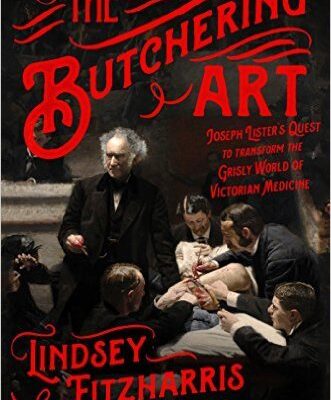
Book Review: The Butchering Art: Excellent Exposition of A Relatively Unknown Time In American History
The Butchering Art: Excellent Exposition of A Relatively Unknown Time In American History
Listerine. We have all heard of it, or at the very least seen it in the supermarket. But did you ever wonder where the name came from, and what they had possibly done to earn the honor of the naming?
To be honest, I had never wondered about this myself. I had heard that it was named after a person, but i had never looked into it or wondered about it really. I didn’t use the product for a number of reasons myself, not the least of which being the fact that it was one of the products made by the company who conducts more animal testing than most other companies. When I was growing up, this product had been purchased and never used/ It was much too caustic and strong to be enjoyable. We always used Scope, which is also a product by an animal testing giant, though I had no idea about any of that at the time.
But Joseph Lister was a real person. He was a Quaker, but he lived in England for his entire life. He and his family were members of the Society of Friends, which is the Quaker association. As a practitioner of this religion, he was also required to wear certain clothing, and he had other religious practices that he observed. Charity was one of them, and several members of his family managed charitable organizations. Herbert Hoover and Richard Nixon were both Quakers who were e
However, his chosen profession was a doctor. He wanted to study to become a surgeon, in fact, though this was a very different profession at that time. Studying was costly, and a good living was far from guaranteed. This was also the time when hospitals were starting to become mainstream. But at the time, this was not actually a good thing. Hospitals were called the “House of Death,” simply because you were more likely to die than you were to survive most health conditions.
Why was this? In fact, germ theory was completely unknown, and was in fact denied. There was no such thing as germs, they did not exist. Only those things that could be seen with the naked eye were considered real. At the same time, however, there were a number of other things that were also quite real. Gangrene was a real thing, and it could kill a whole ward of people. It was thought to be some sort of ‘miasm,’ or vaporous substance that could not be seen, understood, or prevented.
Another thing that was very real was puerperal fever. At the time, women were beginning to deliver in the hospital, and the C-section was beginning to be performed in emergency situations. In puerperal fever, women were dying during childbirth from something which we now understand was an infection. However, since germs were not understood, several things were happening at once.
First, there was no hand washing. None. Not at all. Not even just for the sake of cleanliness. While there was running water, it was not thought to be important. It might have also been from an idea of conservation.
Second, the instruments were not washed. As previously stated, there was no understanding of, and in fact quite the backlash toward, the idea that there were bacteria and viruses which were causing these infections.
When Joseph Lister was in school, as described in this book, there would be the most grotesque occurrences imaginable. The next couple of paragraphs might be sickening for some, so just be forewarned.

Young men in the universities would have ‘sword fights’ with the body parts in the morgue. After these playacting occasions, they would journey upstairs to the maternity ward, where they would deliver one or more babies. Without washing their hands first or between. Then, the mothers who had just delivered would develop a highly deadly fever, and they would often die. For the doctor to be blamed was just unthinkable. Thus, there could be nothing wrong with a physician delivering babies just after he was in the morgue with dead bodies and all kinds of strange bacteria.
The origins of modern medicine were not very pretty.
So, Joseph Lister enters the scene, and an idea begins to form as he observes the hospitals and the conditions therein. He is, of course, being educated in this very system at this very time. And he starts to notice little things. Like if someone’s dressing is changed frequently, they may not get gangrene. And he begins to come to an understanding. I don’t remember exactly what it was that lead him to the etymology of this idea, but he decided to give it a try.
Back in the time that Joseph Lister was alive, in the 19th Century, things were incredibly different. One of the more bizarre customs they had was that if a doctor was at home, a patient could come to them for care in an emergency. So, it would have been normal for someone who was sick or injured at night to go to the doctor’s house and ring their doorbell. In Joseph Lister’s case, his assistant was already at his house with him on the night that something very unique happened. Something which changed history.
Back in this day, there was a great deal more lawlessness. There weren’t cameras everywhere (or at all), there weren’t vitamins and supermarkets with everything that you could think of. And there was really not much in the way of crime detective work. There was a married couple in the vicinity of Dr. Lister’s home. This couple had been fighting about something, and for some reason, the man decided to try to kill his wife. Had he succeeded, there would have been very little in the way of consequences for him. So, as she was walking back to their house with a woman friend of hers, he jumped out of the shadows and stabbed her with a knife, then ran off.
The woman’s friend was able to find help on the street, and they both carried the woman to Dr. Lister’s house. His friend was also able to be summoned quickly in this emergency situation, to act as his assistant. On this occasion, the doctor decided to do something novel. Something which had not been done before. He and his assistant carefully cleaned their hands, every instrument, and the wounds on the woman with carbolic acid. Making absolutely certain to do everything they could to both successfully prevent her becoming infected and dying, and to prove that germs are real, and most importantly that the physician can prevent causing his patients’ unnecessary deaths.
In the case of this woman, she went on to survive, and Dr. Lister was able to testify against her husband for his attempted murder, and he was put in jail for it. Dr. Lister was able to demonstrate, beyond any reasonable doubt, that the theories of too-small-to-see bacteria and viruses had validity. Others went on to duplicate his efforts, and, in no small part because of him, we live in a time where the hospital is not a place where death is a high possibility. The possibility does still exist, and Covid revealed many deficiencies. But, in general, a hospital is no longer known as the House of Death.
At around the same time, there was another doctor, Ignaz Semmelweis, who believed in the germ theory, and he also tried to convince his colleagues of it. However, he was ridiculed, and instead of being calm and amassing proof, he became exceedingly upset and boisterous about the issue, persisting in his behavior for a long while. As a result, he was sent to a mental institution, as this was something that could happen to people at the time if they didn’t behave in a normal manner. So it was not that Joseph Lister was the first one to ever come up with the theory. He was the first to set about proving it in a calm and methodical manner.
Many years later, in the 1800s, when the company who created Listerine was creating their product, they chose to name it in his honor. Without his efforts and tenacity, it might have been many more years before someone came along to prove the theory of germs, after which people started to live longer. This had a cascading effect, as well, bringing about the idea of quarantine as a way to prevent the spread of illness, because there was now an understanding that germs can be spread through the air. When the flu epidemic arrived, it was known that there was virus causing it. It was still a devastating illness, but they were under no illusions of miasms, phantoms, and the like being responsible.
Sanitation, including requirements for limitations and capacity requirements for toilets and baths, made a huge difference in the spread of diseases. The 1800s was a time of great disease because it was a time of great overcrowding. Toilets were shared by many families, there was no refrigeration, so food spoiled more quickly, and many people died of cholera and dysentery, which are diseases caused and spread by low quality food coupled with poor sanitation.
Food sanitation requirements were also heavily responsible for stopping the spread of disease. When butchers could no longer sell rotten meat due to regulations that were actually enforced, fewer people were then exposed to these meats. Much more about this time period can be found in several books, including Dissolving Illusions by Suzanne Humphries and 722 Miles: The Building of the Subways, along with other books and websites that detail this information online. The Timeline of Herbology is a good website to check out if you want to learn the history of herbal medicine. What we think of as tenement homes were built in some cases right next to slaughterhouses (because that is where the land was cheapest), and they were normally rented by those living in poverty.
This book is highly recommended. It is kind of gross in parts, but it was, to be fair, a rather gross time, especially for someone who wanted to become a surgeon. There was nothing more gross that you could become at that time. Medicine had not advanced all that much from previous centuries up until then, likely because those who went to these types of doctors were less likely to survive.
This was the time that conventional medicine really started to replace traditional medicine provided by naturopaths, and later state legislation started to be passed to regulate these types of doctors. This was something else that the book touches on briefly. That is who his competition was: chiropractors and naturopaths. They were the competitors of those who practiced the nascent “scientific” medicine which was just starting to become popular at the time. It was also more expensive, whereas the other types of physicians at the time were cheaper. For the pregnant women, they also competed with midwives, who only became outlawed after this time period, sometime in the 1900s.
According to an article on StatNews: “Joseph DeLee, an influential early 20th century obstetrician, called midwives a “relic of barbarism.” Sexist and racist attacks painted midwives as dirty, uneducated, and dangerous. By the 1940’s midwifery was virtually eradicated in the United States.”
If you’re interested in learning about midwifery’s evolution, particularly with regard to legal standing and acceptance, and you have already had children or don’t want to have kids, Pushed, by Jennifer Block, is an excellent place to start learning about the history of natural medicine in this country. It is a complicated history, but it is important to learn how we got here. Herbalists were also outlawed in the United States for a number of decades. This was not because they killed people or caused any harm. At some point, conventional medicine became dominant, and the politicians began passing laws to limit the competitors of conventional medicine such as midwives, naturopaths, herbalists, etc. The American Medical Association was found to have engaged in manipulative tactics on an organization-wide basis to make chiropractors (who were conventional medicine’s legitimate competitors for patients’ healthcare) lose patients and fail to compete. Many chiropractors were put out of business because general practitioners and others would tell people that chiropractic is dangerous when they knew that it is not.
One important way to know what type of healthcare is safe is to look at their malpractice insurance premiums. IN most states, some of the above mentioned healthcare providers must carry malpractice or liability insurance. A surgeon’s policy cost can be $50,000 per year. This is based on the known risk that the insurance company is taking in providing insurance to that healthcare professional. Most ‘alternative medicine’ providers have an annual cost for liability insurance in the low ($1-400) hundreds of dollars,. This includes midwives, chiropractors, acupuncturists, massage therapists, herbalists (who don’t all need it), and naturopaths.
The Butchering Art touches briefly on this topic, but it is interesting to learn about. This book was a NYPL book that received an award around the time it was published, which was a number of years ago. The following awards were given to this book, according to NYPL:
Winner, 2018 PEN/E.O. Wilson Prize for Literary Science Writing
Short-listed for the 2018 Wellcome Book Prize
A Top 10 Science Book of Fall 2017, Publishers Weekly
A Best History Book of 2017, The Guardian
It is definitely well worth the read, and I would give it Five Stars.

Banner Image: Butchering Art cover. Image credit – Goodreads/NYPL



There are no comments yet
Why not be the first