
Meeting With President Trump, $80M Medical Debt Relief, Response To Gov Hochul’s State Budget: Mayor Adams
Meeting With President Trump, $80M Medical Debt Relief, Response To Gov Hochul’s State Budget: Mayor Adams
Editor’s note: Last week’s rundown of stories from the Mayor’s Office featured his State Of The City address and the affordable housing wins for the past year. His op-ed for the week talked about making NYC the best place to raise a family.
MAYOR ADAMS’ STATEMENT AFTER MEETING WITH PRESIDENT-ELECT DONALD TRUMP
NEW YORK – New York City Mayor Eric Adams released the following statement after meeting this afternoon with U.S. President-elect Donald Trump:
“President Trump and I had a productive conversation about New York’s needs and what’s best for our city, and how the federal government can play a more helpful role in improving the lives of New Yorkers. While we briefly touched on a number of issues, we specifically focused on the ceasefire agreement between Israel and Hamas and how it will have a positive impact on public safety in our country; how we can bring manufacturing jobs back to New York, particularly in the Bronx; and how we can continue to make federal investments in New York City, especially when it comes to infrastructure.
“To be clear, we did not discuss my legal case, and those who suggest the mayor of the largest city in the nation shouldn’t meet with the incoming president to discuss our city’s priorities because of inaccurate speculation or because we’re from different parties clearly care more about politics than people. Like I’ve always done, I will take every opportunity possible to advocate for New Yorkers and our city, and after our discussion, I strongly believe there is much our city and the federal government can partner on to make New York City safer, stronger, and more affordable. I thank President Trump for his time and attention and look forward to working with him to benefit all New Yorkers.”
MAYOR ADAMS RELIEVES $80 MILLION IN MEDICAL DEBT FOR WORKING-CLASS NEW YORKERS
Pioneering Program Launched by Mayor Adams Relieves Medical Debt for 35,000 New Yorkers in Partnership with Undue Medical Debt
New York City’s Investment Will Provide $2 Billion in Relief for up to 500,000 New Yorkers, Becoming Largest Municipal Medical Debt Relief Program in Nation
NEW YORK – New York City Mayor Eric Adams and New York City Department of Health and Mental Hygiene (DOHMH) Acting Commissioner Dr. Michelle Morse today announced that, beginning this week, 35,000 New Yorkers will start receiving letters notifying them that their medical debt has been eliminated by a pioneering program launched by Mayor Adams last year — clearing $80 million in debt. Medical debt — the number one cause of bankruptcy in the United States — disproportionately affects uninsured, under-insured, and low-income households, and the city’s investment of $18 million over three years will relieve a total of over $2 billion in medical debt for 500,000 working-class New Yorkers on a one-time basis.
The city has partnered with Undue Medical Debt, a national New York City-based nonprofit specializing in buying and ultimately wiping out medical debt to acquire debt portfolios and retiree debt from health care providers and hospitals across New York City. There is no application process for New York City’s one-time debt relief program, which is the largest municipal initiative of its kind in the country.
“Working-class families should not have to choose between paying medical bills and keeping a roof over their heads, and thanks to our administration, they won’t have to,” said Mayor Adams. “With this debt relief program, our administration is following through on its promise to relieve $2 billion in medical debt, starting with putting $80 million back in the pockets of working-class New Yorkers this week alone. Our administration is committed to making New York City more affordable and the best place to raise a family.”

“In thousands of mailboxes this week, New Yorkers will find a letter from Mayor Adams and our partner, Undue Medical Debt, stating that their outstanding medical debt has been abolished,” said Deputy Mayor for Health and Human Services Anne Williams-Isom. “A total of 35,000 constituents will receive letters relieving $80 million in total debt. It is the first round of relief for a program set to touch roughly half a million New York City residents in the coming months and years. As we work toward structural change in our health care system to help people avoid debt in the first place, we are doing our part right now to help individuals and families thrive free from medical debt.”
“Receiving life-saving medical care should not lead to financial stress, yet, countless New Yorkers have faced that reality for years,” said DOHMH Acting Commissioner Dr. Morse. “We are eager to get much needed debt relief to as many New Yorkers as possible, as soon as possible. We look forward to reaching our goal of 500,000 New Yorkers over the next three years so that those hardest hit by medical debt can instead focus on what matters most: their health and wellness.”
“As a national nonprofit based in the borough of Queens, I’m proud to be partnering with the City of New York to bring medical debt relief to our neighbors and community members who are burdened by the financial and emotional toll of medical debt,” said Allison Sesso, CEO and president, Undue Medical Debt. “We look forward to more rounds of medical debt relief by collaborating with local providers and hospitals to build on their financial assistance and community benefit programs through the removal of these debts. While we know medical debt relief isn’t a silver bullet, it provides patients a clear runway for re-engaging in the health care system by quickly and efficiently removing an unnecessary barrier to care. We are excited to bring this unique model to our city.”
Undue Medical Debt will purchase bundled medical debt portfolios from providers, like hospitals and commercial debt buyers, to then abolish that debt at pennies on the dollar. Debt relief recipients will then be notified that their debt has been bought by a third party and erased, with no strings attached. Recipients owe nothing on the debt and face no tax penalty. New Yorkers who fit one of the two eligibility criteria will qualify for the debt relief announced today if their debt has been acquired: 1) having annual household income at or below 400 percent of the Federal Poverty Line or 2) having medical debt equal to 5 percent or more of their annual household income.
To supplement the city’s investment, Undue Medical Debt and the Mayor’s Fund to Advance New York City will also partner to raise additional funding over three years in order to relieve more medical debt. New Yorkers interested in helping relieve medical debt can donate online.
More than 100 million Americans hold some medical debt, with the total amount nationwide exceeding $195 billion. Carrying medical debt can undermine financial stability and mobility, as it can affect credit scores and put individuals and families in difficult positions to choose between care and other necessary expenses. Black and Latino communities are 50 percent and 35 percent, respectively, more likely to hold medical debt than their White counterparts, and while medical debt may be held by those without insurance, even those with insurance are at risk of carrying medical debt.
“By eliminating $80 million in medical debt for 35,000 New Yorkers, this initiative is directly addressing one of the most significant financial burdens people face,” said New York State Assemblymember Nily Rozic. “For many families, medical debt can feel like an insurmountable obstacle, impacting their ability to save, invest in their future, or simply get by. This relief will help ease that pressure and provide much-needed breathing room for those who need it most.”
“I commend Mayor Adams and Acting Commissioner Morse for delivering vital financial relief to half a million of our fellow New Yorker,” said New York State Assemblymember Jenifer Rajkumar. “Medical debt is the number one cause of bankruptcy, falling particularly hard on the uninsured, low-income households, and people of color. By spending $18 million to acquire debt portfolios and retiree debt from providers, this administration is wiping away over $2 billion in medical debt—an 11,000 percent return on investment. Today marks the historic first phase, clearing $80 million in debt for 35,000 New Yorkers. At a time when affordability is on the top of everyone’s minds, this program will put money back in New Yorkers’ pockets so they can stand on their own two feet. It will also relieve them of harassment from debt collectors, ruined credit records, and devastating lawsuits. This groundbreaking program will lift the weight of medical debt off the shoulders of hundreds of thousands of working-class New Yorkers, opening the door to financial freedom and economic empowerment in our city.”
“No individual should ever be saddled with crippling debt that threatens to leave them in financial ruins, simply because they fell victim to injury or illness,” said Queens Borough President Donovan Richards Jr. “Crushing medical debt has destroyed countless families across this nation and held back entire generations of Americans, a scourge that can no longer be allowed to continue in the richest nation on earth. I commend the administration for taking this critical action in relieving medical debt for tens of thousands of working-class New Yorkers who otherwise were potentially facing fiscal calamity. This program will help lift New Yorkers out of poverty and put them on paths to prosperity that should never be derailed because they got sick.”
“When working as a registered nurse, I often witnessed the stress and fear that medical bills caused patients and their families, frequently preventing the sick from seeking the care they so desperately needed,” said New York City Councilmember Mercedes Narcisse. “I am proud to support this program that puts people’s health and well-being above financial strain. Every New Yorker deserves the chance to prioritize their well-being without the shadow of debt looming over them.”
“Many New Yorkers struggle with medical debt and stop accessing medical care for fear of falling into a deeper financial hole,” said New York City Councilmember Lynn Schulman, chair, Health Committee. “That is why the city’s partnership with Undue Medical Debt, to acquire debt portfolios and retiree debt from healthcare providers and hospitals throughout New York City, is so crucial in keeping working families financially stable and healthy. An initial debt relief of $80 million is historic for a city like New York and I thank Mayor Adams for his commitment to making healthcare affordable to those who are most in need.”
“Undue Medical Debt is making a profound impact by relieving the crushing burden of medical debt for countless New Yorkers, and helping them regain control of their financial lives,” said Justine Zinkin, CEO, Neighborhood Trust Financial Partners. “At Neighborhood Trust Financial Partners, we see every day how medical debt traps individuals in cycles of insecurity, forcing them to delay essential health care and other basic needs. That’s why we’re proud to support Undue Medical Debt’s vital partnership with New York City; by abolishing medical debt, this program will empower people to move forward financially and restore their access to the care and resources they deserve.”
MAYOR ADAMS KICKS OFF PUBLIC REVIEW ON MIDTOWN SOUTH MIXED-USE PLAN TO CREATE NEARLY 10,000 NEW HOMES
Announced in Mayor Adams’ Fourth State of the City Address, Midtown South Mixed-Use is Part of Ambitious “Manhattan Plan” to Add 100,000 New Homes in Borough Over Next Decade
First-Ever Use of Zoning Tools Won in Albany and Created Through “City of Yes for Housing Opportunity” to Deliver Permanently Affordable Housing
Building on Over Year of Extensive Public Engagement, Proposal Heads to Community Boards for Input
NEW YORK – New York City Mayor Eric Adams and New York City Department of City Planning (DCP) Director and City Planning Commission (CPC) Chair Dan Garodnick today announced the start of the public review process for the Midtown South Mixed-Use (MSMX) plan, a visionary proposal to foster vibrant, 24/7 mixed-use neighborhoods across 42 blocks of Midtown South. The proposal would deliver an estimated 9,700 new homes — including up to 2,900 permanently income-restricted affordable homes — by updating zoning to allow a mix of commercial, manufacturing, and residential uses in areas where housing is largely not allowed today. Thanks, the passage of his historic “City of Yes for Housing Opportunity” and Mayor Adams’ successful advocacy in Albany to lift the “floor-to-area-ratio” (FAR) cap, the plan marks the first time that new high-density residential zoning districts will be used in New York City. New housing will be paired with public realm improvements and additional investments to create a thriving neighborhood with affordable housing, good jobs, and open space.
MSMX is a component of the “Manhattan Plan,” first announced in Mayor Adams’ fourth State of the City address. The “Manhattan Plan” will include the Adams administration’s Midtown South Mixed-Use Plan, public sites, and more to unlock opportunities to create 100,000 new homes in the borough, bringing the total number of homes in Manhattan to 1 million over the next decade.
“In New York City, the old saying is still true: if you build it, they will come. In Midtown South, we are building the neighborhoods of tomorrow with vibrant 24/7 space, affordable housing, and inclusive, dynamic public realm opportunities,” said Mayor Adams. “But, we are not stopping there. Our ambitious ‘Manhattan Plan’ is an opportunity to go even bigger and bolder across the entire borough. From securing historic housing wins in Albany to passing the landmark of ‘City of Yes for Housing Opportunity,’ our administration has the tools needed to build our city forward. Together, we can transform neighborhoods for the better, make our entire city more affordable, and create the best place to raise a family on the globe.”
“We envision for Midtown South a vibrant and dynamic, 24-7 neighborhood with a strong commercial core right alongside brand-new homes for New Yorkers, and we need to change our outdated zoning rules to make it all happen,” said DCP Director and CPC Chair Garodnick. “We developed this plan in partnership with elected officials and community members, and we hope they will continue to make their voices heard as public review now gets underway.”
“Today marks an important step forward for a plan that could help create badly needed housing and reinvigorate some of Manhattan’s core,” said Manhattan Borough President Mark Levine. “I’m excited to see a proposal that will guarantee new affordable housing production and spur public realm improvements while encouraging a more 24/7, mixed-use neighborhood. The public review process will be important for balancing our desperate housing need with public realm improvements and support for local businesses, and I encourage New Yorkers to share their thoughts and help shape the future of Midtown South.”
“It’s time to envision a new future for Midtown,” said New York City Councilmember Keith Powers. “The Midtown South Mixed-Use Plan is the next step in realizing the dream of a neighborhood designed for everyone. This plan will unlock badly needed housing in an area that historically hasn’t allowed it, transforming Midtown into a vibrant live-work neighborhood humming with activity. I look forward to proceeding through the public review process with this innovative plan for Midtown’s future.”
A New Vision for Midtown South
The MSMX plan covers four distinct areas with outdated industrial zoning that are centered around Herald and Greeley Squares and located roughly between West 23rd and West 40th Streets and 5th and 8th Avenues. The neighborhood is home to over 7,000 businesses and 135,000 jobs and near transit hubs at Penn Station, the Port Authority Bus Terminal, Herald Square, and Bryant Park. For decades, Midtown South has been a strong economic center, but following the COVID-19 crisis it has faced challenges with recovery, including commercial vacancies and restrictive zoning rules that limit opportunities for New Yorkers to live close to their jobs.

A map of the four quadrants of the MSMX plan overlaid on an overhead picture of Midtown. Credit: DCP
Building More Affordable Housing
The MSMX plan could create around 9,700 new homes — including up to 2,900 income-restricted affordable homes. The proposal would permit new housing through mixed-use zoning districts, map Mandatory Inclusionary Housing in Midtown for the first time to create thousands of permanently income-restricted affordable homes and allow for live-work opportunities. The mixed-use districts will allow commercial and industrial businesses in this community to continue to thrive alongside new homes for years to come.
The plan marks the first use of new, high-density R11 and R12 zoning districts, which allow residential FARs of 15 and 18. These districts were created through City of Yes for Housing Opportunity plan, following the city’s successful advocacy in Albany to lift the arbitrary FAR cap, which had previously limited housing density in New York City. These new districts will allow for a wide range of non-residential uses, including light manufacturing, office space, and retail, as well as community facilities like schools and libraries that are not permitted today. The MSMX plan would also remove outdated zoning restrictions on converting large buildings into housing, unlocking another way to create new homes and repurpose vacant and underutilized space.
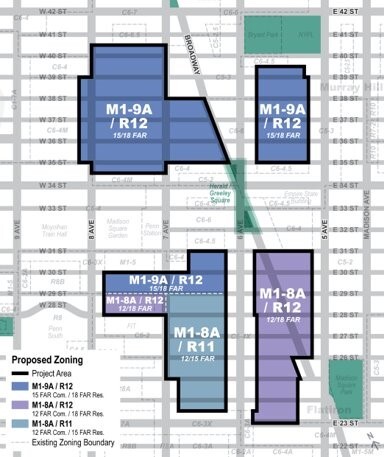
The proposed zoning of the MSMX plan. Credit: DCP
Creating Safer Streets and Investing in the Public Realm
The MSMX plan also establishes a new zoning special district — the Special Midtown South Mixed-Use District — that will ensure new buildings with higher residential densities reflect existing character and maintain active street fronts with uses such as ground-floor retail. This will help to create an open, welcoming streetscape environment for passerbys.
Complementing the ongoing “Broadway Vision” plan to enhance public space along Broadway, the MSMX plan encourages a dynamic public realm by allowing for more floor area in buildings if they provide critically needed local improvements, such as increased accessibility to public transit stations, privately-owned public spaces, and public indoor spaces like atriums. Buildings also receive a floor area exemption for the inclusion of a public school.
Engaging with the Community
The MSMX plan is the result of over a year of community engagement aimed at addressing these challenges. The engagement process included a kickoff meeting, and stakeholder events with residents, business owners, local groups, non-profit organizations and social service providers. DCP also held one-on-one conversations with New Yorkers, organized town halls, and created online tools, including an interactive map and survey. Throughout this process, DCP repeatedly heard strong support for creating housing opportunities in the neighborhood, boosting small businesses and jobs, and enhancing streets to be safer and more active.
Today’s certification begins the roughly seven-month Uniform Land Use Review Procedure for the MSMX plan, which includes recommendations from community boards and Manhattan Borough President Mark Levine, followed by hearings and binding votes at the CPC and then the City Council.
Adams Administration’s Record on Housing
Mayor Adams had made historic investments toward creating affordable housing over the last three years. In June 2024, City Hall and the City Council agreed on an on-time, balanced, and fiscally-responsible $112.4 billion Fiscal Year (FY) 2025 Adopted Budget that invests $2 billion in capital funds across FY25 and FY26 to New York City Department of Housing Preservation and Development and the New York City Housing Authority’s capital budgets. In total, the Adams administration has committed a record $26 billion in housing capital in the current 10-year plan as the city faces a generational housing crisis. In July 2024, Mayor Adams announced back-to-back record breaking years in both creating and connecting New Yorkers to affordable housing. Last spring, the city celebrated the largest 100 percent affordable housing project in 40 years with the Willets Point transformation.
Further, the Adams administration is using every tool available to address the city’s housing crisis. Mayor Adams announced multiple new tools, including a $4 million state grant, to help New York City homeowners create accessory dwelling units that will not only help them to afford to remain in the communities they call home, but also to build generational wealth for families.
Last year, Mayor Adams and members of his administration successfully advocated for new tools in the 2024 New York state budget that will spur the creation of urgently-needed housing. These tools include a new tax incentive for multifamily rental construction, a tax incentive program to encourage office conversions to create more affordable units, lifting the arbitrary floor-to-area ratio cap that held back affordable housing production in certain high-demand areas of the city, and the ability to create a pilot program to legalize and make safe basement apartments.
Additionally, under Mayor Adams’ leadership, the city is fulfilling its 2024 State of the City commitment to build more affordable housing and has created the Tenant Protection Cabinet to coordinate across agencies to better serve tenants. The city has also taken several steps to cut red tape and speed up the delivery of much-needed housing, including through the “Green Fast Track for Housing,” a streamlined environmental review process for qualifying small- and medium-sized housing projects; the “Office Conversion Accelerator,” an interagency effort to guide buildings that wish to convert through city bureaucracy; and other initiatives of the Building and Land Use Approval Streamlining Taskforce.
“We are thrilled to see the MSMX Plan has been certified to begin the ULURP process. New York City is in desperate need of additional housing, and allowing more conversions is an obvious and important step toward addressing this critical issue. At the same time, the MSMX zoning changes are a lifeline for the Garment District. It is imperative that we find new uses to occupy our available space, increase our restaurant and retail customer base, and create a safer, 24-hour mixed-use community. The Garment District’s future depends on it,” said Barbara Blair, president, Garment District Alliance. “We are grateful to DCP for crafting this thoughtful plan that will permit residential conversions and live-work spaces, while preserving the character of this storied neighborhood.”
“The launch of the public review process for the Midtown South Mixed-Use Plan marks a significant milestone in shaping the future of New York City’s built environment. By integrating housing, commerce, and public space in one of Manhattan’s most dynamic neighborhoods, this plan will address the urgent need for new homes while revitalizing the community for generations to come. Mixed-use communities are the cornerstone of vibrant, sustainable cities, creating dynamic neighborhoods where people don’t just live—they thrive,” said James Mettham, president, Flatiron NoMad Partnership. “The Flatiron NoMad Partnership is proud to support this visionary initiative, and looks forward to collaborating with the city and engaging with stakeholders throughout the ULURP process. We are committed to ensuring that this plan fosters growth, opportunity, and a more resilient, inclusive, and thriving Midtown.”
“This rezoning is an exciting opportunity to breathe new life into Midtown while building desperately needed affordable housing,” said Jessica Walker, president and CEO, Manhattan Chamber of Commerce. “It will foster the kind of conversions in midtown that transformed Lower Manhattan into a vibrant mixed-use residential and office district after 9/11.
“The Midtown South area has seen its growth and potential stifled by five-decade old manufacturing zoning, which has prevented it from becoming the housing-rich, vibrant, and transit-oriented 24/7 community it should be. With over 135,000 jobs and 7,000 businesses in the area, the potential of Midtown South cannot continue to be squandered,” said Carlo A. Scissura, Esq, president and CEO, New York Building Congress. “This ambitious plan will harness zoning as a tool to enhance quality of life, bolster the local economy, expand housing opportunity, and foster a thriving, well-connected community. As the plan begins its ULURP, we also applaud DCP’s commitment to community with a plan informed by more than a year of public engagement and research.”
“DCP’s MSMX Plan is an important action to remove unnecessary barriers to efficient redevelopment of an area that offers great opportunities for both new housing development and upgrading of older commercial buildings. The adoption of this plan will result in substantial economic benefits for the city and the target communities,” said Kathryn Wylde, president & CEO, Partnership for New York City.
“Every neighborhood in New York has a role to play in building more housing, and Midtown South is exactly the kind of exceptionally central neighborhood that has room for thousands of additional New Yorkers,” said Annemarie Gray, executive director, Open New York. “Despite being one of the most transit-connected areas in the country, much of Midtown South has been off-limits to new housing for decades. The MSMX rezoning is a vital opportunity to create new homes, bring new neighbors, and reinvigorate Midtown South.”
MAYOR ADAMS ANNOUNCES PROGRESS STRENGTHENING NEW YORK CITY’S POSITION AS NATIONAL LEADER FOR ACCESSIBLE ABORTION CARE ON ANNIVERSARY OF ROE V. WADE
New York City’s Abortion Access Hub Has Served More Than 8,500+ Individuals Since Launching in 2022, 25 Percent of Whom Reside Outside of New York State
Adams Administration to Further Expand Outreach Efforts to Ensure Americans in States Where Abortion is Banned or Severely Restricted Are Aware of NYC’s Critical Reproductive Services
NEW YORK – New York City Mayor Eric Adams and New York City Department of Health and Mental Hygiene (DOHMH) Acting Commissioner Dr. Michelle Morse today announced progress and new efforts to secure New York City’s position as a national leader in accessible abortion care in wake of the 2022 Dobbs decision by the U.S. Supreme Court that effectively overturned Roe v. Wade — on what would have been the legal decision’s 52nd anniversary. Following the high court’s decision, DOHMH launched the “Abortion Access Hub,” a hotline that connects callers to licensed abortion care providers in New York City in an effort to ensure a pathway towards safe, accessible abortion care, amidst national restrictions and misinformation. Since its launch in November 2022, the Hub has served more than 8,500 individuals — 25 percent being from a state where abortion has been banned or restricted. Of those out-of-state callers, 75 percent are from Texas, Florida, or Georgia — all states with outright bans or severe restrictions.
To continue the progress made over the last two years, the Adams administration is launching a targeted search engine marketing effort over the next year to boost awareness and increase visibility to ensure that the public is aware of these services.
“Abortion care is health care, and we are proud that, because of our administration’s efforts, women can be confident that their reproductive rights are protected in the five boroughs,” said Mayor Adams. “Over two years ago, the Supreme Court may have taken action that limited access to abortions across the nation, but, here in New York, on what would have been the 52nd anniversary of Roe v. Wade, we are ensuring that no matter your zip code, race, or economic status, you can safely access reproductive care. Thanks to our Abortion Access Hub, in just over two years, more than 8,500 women have been able to connect to licensed abortion care providers in our city and ensure they retain control of their bodies, their choices, and their freedoms.”
“New York City has and will always stand up for reproductive rights,” said Deputy Mayor for Health and Human Services Anne Williams-Isom. “Since the Dobbs decision, we have taken important steps to affirm rights for people, and one avenue through which all New Yorkers and Americans can seek assistance is via our Abortion Access Hub. To date, it has helped thousands of people connect with the support and information they needed.”
“When the Dobbs decision stripped millions of people of a basic constitutional right to access an abortion, New York City knew it had to act urgently,” said DOHMH Acting Commissioner Dr. Morse. “The New York City Abortion Access Hub provides New Yorkers and people throughout the country who are facing bans or severe restrictions on abortion care a central place to go to navigate this new landscape and get access to care. No matter who you are or where you live, this city is here to help anyone who needs access to an abortion. As we commemorate the 52nd anniversary of Roe v. Wade, New York City’s leadership and commitment to ensuring abortion access is steadfast.”
The Hub is made up of more than 40 clinical sites including NYC Health + Hospitals locations, DOHMH sexual health clinics, private hospitals, independent abortion providers, and telehealth-only sites that provide care. The Hub also helps patients secure financial assistance and find lodging and transportation to New York City. Anyone in the United States can contact the Hub to help them make an abortion appointment with a verified licensed provider that meets their needs and preferences.
Since the start of the administration, Mayor Adams has continued to prioritize reproductive freedom and accessible health care for all New Yorkers. In January 2023, New York City became the first city in the nation to offer medication abortion, free-of-charge, at our public health clinics, ensuring that abortion care was integrated into health care services it provides.
In October 2023, New York City’s public hospital system became the first in the nation to offer telehealth medication abortions to ensure that New Yorkers who cannot physically make it to a clinic or don’t feel safe doing so can still access a medication abortion.
In February 2024, the Adams administration released its Sexual and Reproductive Bill of Rights, to further enshrine reproductive rights.
MAYOR ADAMS’ STATEMENT IN RESPONSE TO GOVERNOR HOCHUL’S FISCAL YEAR 2026 EXECUTIVE BUDGET
NEW YORK – New York City Mayor Eric Adams today released the following statement in response to New York Governor Kathy Hochul’s Fiscal Year 2026 Executive Budget:
“We thank Governor Hochul for delivering an executive budget that will help our administration deliver on our core mission of making New York City the best place to raise a family.
“Governor Hochul and I share the same North Star: to keep our city and state safe. We appreciate the governor’s commitment to fixing the laws that allow our administration to connect New Yorkers with serious mental illness with the treatment they deserve. By combining these fixes with investments in holistic support, we can provide compassion and care to our brothers and sisters in need.
“Keeping our city safe also means going after the small number of repeat offenders who continue to commit crimes across the five boroughs and throughout the state. Justice and public safety can — and must — go hand-in-hand. We look forward to working with Governor Hochul to preserve and protect the best parts of the 2019 discovery reforms, while making targeted changes to stop recidivists from creating chaos on our streets. This and other agenda items will build on our track-record of working together to make New York City safer. Just last week, our administration joined with Governor Hochul to commit to a six-month NYPD surge that will ensure approximately 300 uniformed officers are deployed on nearly all 150 overnight trains. And I applaud Governor Hochul’s focus on gun violence prevention programs to help our city stop violence before it happens on our streets.
“Finally, the governor and I both agree that every dollar counts, and we must make sure that we are putting as much money as possible back in the pockets of working-class New Yorkers. From expanding the child tax credit to making new investments in childcare to supporting our ‘Axe the Tax for the Working Class’ proposal to put an average of $350 back into the pockets of over half a million New Yorkers, this is a budget that meets the moment of our city and state’s affordability crisis.
“Since day one of our administration, Governor Hochul has been a tremendous partner and continuously showed that she understands the needs of our city. From passing the historic Earned Income Tax Credit expansion and helping the city shut down illegal smoke shops to supporting critically needed housing legislation, including investing $1 billion towards our historic ‘City of Yes for Housing Opportunity’ proposal, and extending mayoral accountability, Governor Hochul and I have been lock-step as we’ve served New Yorkers. We look forward to continuing our partnership and engaging with the Governor’s Office to advance the rest of the city’s priorities as we deliver for New Yorkers, every day, everywhere, and make New York City the best place to raise a family.”
Banner Image: New York City Mayor Eric Adams will deliver remarks at the National Action Network’s (NAN) Martin Luther King Jr. Day and Public Policy Forum 2025 in Harlem on Saturday, January 18, 2025. Michael Appleton/Mayoral Photography Office

There are no comments yet
Why not be the first