

Construction Safety Report, Hear From the Mayor, Creating More Homes, $5 Billion to Non-Profit Providers, Universal After-School Programming,
Construction Safety Report, Hear From the Mayor, Creating More Homes, $5 Billion to Non-Profit Providers, Universal After-School Programming, What They’re Saying About After-School Programming, What They’re Saying $5 Billion Non-Profit Payments
Editor’s note: Last week’s rundown by the Mayor included stories on treating people with severe mental illness, the first ever crypto summit, and the recent waterfront access revitalization. Last week’s editorial by the Mayor focused on destroying illegal guns that were seized by the police department recently, permanently removing them from the streets of NYC.
MAYOR ADAMS AND DOB COMMISSIONER ODDO RELEASE ANNUAL CONSTRUCTION SAFETY REPORT, HIGHLIGHT SAFEST BUILDING CONSTRUCTION SITES IN 10 YEARS
Report Details Building Construction Safety Trends in 2024, Highlights 30 Percent Drop in Worker Injuries Compared to 2023
Construction Site Injuries Reached Nine-Year Low, Incidents Reached 10-Year Low, Fatalities Remained at 10-Year Low
DOB Performed Over 416,000 Inspections in 2024, Highest Number on Record, Implemented New Construction Safety Initiatives
NEW YORK – New York City Mayor Eric Adams and New York City Department of Buildings (DOB) Commissioner Jimmy Oddo today released DOB’s annual New York City Construction Safety Report, providing an analysis of building construction trends, safety incidents on construction sites, and enforcement actions by DOB in 2024. The report highlights the Adams administration’s work to keep New Yorkers safe on building construction sites, specifically spotlighting that worker injuries dropped by 30 percent in 2024 compared to 2023, while construction-related incidents fell by 24 percent. With these positive trends towards safer construction sites, worker injuries reached a nine-year low and construction-related incidents reached a 10-year low; additionally, worker fatalities remained at a 10-year low. This historic progress follows multiple initiatives by DOB to protect New Yorkers working on construction sites, including new oversight mandates for construction superintendents, new licensing requirements for operators of smaller crane devices, new technology to help track work site safety compliance, and more. In 2024, DOB also conducted 416,290 total field inspections – the most inspections of building construction sites since the department began tracking the critical datapoint. Finally, the report underscores the ongoing strength of the building construction industry, with initial permits for new building projects increasing by over 24 percent in 2024 compared to 2023. The annual report is designed to provide greater transparency within both city government and the construction industry.
“New Yorkers deserve safe workplaces, and that includes our city’s construction sites. Thanks to the hard work of DOB, we are making significant progress towards that goal, with inspections of construction sites at historic highs and incidents at a 10-year low,” said Mayor Adams. “Nevertheless, we know that even one death at our construction sites is unacceptable, which is why our administration will continue to implement historic safety initiatives and keep up the fight for safer construction sites across the city.”
“The progress we’ve made in reducing injuries and keeping fatalities at their lowest in close to a decade is a testament to the effectiveness of our safety initiatives, the decidedness of our inspection teams, and the buy-in from our industry partners,” said DOB Commissioner Oddo. “We are not alone in believing that every fatality and injury that occurred in 2024 was preventable. We will keep pushing relentlessly for safer work sites because even one life lost is one too many.”
The New York City Construction Safety Report draws upon a wealth of data collected by DOB throughout 2024. Data in the report show that over 98 percent of work sites did not report a single incident or injury in 2024. While incidents are exceedingly rare, the data shows that they can occur on work sites of any size and in every neighborhood across the city.

Construction-related incidents fell from 841 in 2023 to 638 in 2024, a 24 percent decrease year-over-year, while construction-related injuries fell from 692 in 2023 to 482 in 2024, a 30 percent decrease year-over-year. The report also draws specific attention to seven fatal construction worker incidents that occurred on building construction sites in 2024. While deaths on building construction sites have trended down in recent years, DOB remains committed to implementing new safety measures and driving fatality numbers as close to zero as possible.
10 Year Look Back at Construction-Related Incidents, Injuries, and Fatalities
|
Year |
Incidents |
Injuries |
Fatalities |
|
2015 |
1,011 |
472 |
12 |
|
2016 |
1,162 |
603 |
12 |
|
2017 |
1,212 |
671 |
12 |
|
2018 |
1,193 |
759 |
13 |
|
2019 |
960 |
594 |
14 |
|
2020 |
796 |
502 |
8 |
|
2021 |
712 |
505 |
9 |
|
2022 |
752 |
554 |
11 |
|
2023 |
841 |
692 |
7 |
|
2024 |
638 |
482 |
7 |
DOB regularly interacts with construction and development industry professionals through field inspections, enforcement actions, and educational outreach efforts. The report shows that DOB conducted 416,290 total inspections in 2024, the highest number of inspections on record in a calendar year. DOB also spearheaded several new safety initiatives in 2024 to increase compliance with existing regulations and improve safety outcomes. These include new oversight mandates for construction superintendents, new licensing requirements for operators of smaller crane devices and hoisting machines, and technological advances to track work site safety compliance.
To spread the word about these new initiatives, DOB stepped up communications with the construction and development industry, issuing construction advisories directly to work sites to alert them to recent safety failure trends and scheduling regular sit-down meetings between industry groups and construction contractors to address safety concerns.
Finally, the report highlights increased construction activity in New York City throughout 2024, with total initial permits for new building projects increasing by over 24 percent compared to 2023. The 103,592 initial construction permits issued by DOB in 2024 is the highest in five years.
Thanks to recent improvements in DOB’s digital infrastructure, the city can assemble granular data points from construction projects across the city, spot trends, and predict potential problems before they occur. DOB regularly utilizes this data to inform enforcement strategies and efficiently allocate resources across the city’s 1.1 million buildings.
In 2025, DOB will establish a new enforcement unit to utilize this data and proactively inspect potentially dangerous buildings. The new unit, which was created with legislation from the New York City Council and $5 million from the Adams administration, will use predictive analytics to identify derelict buildings and unsafe contractors, prioritizing them for inspection to keep New Yorkers safe.
“The NYC Special Riggers Association (NYCSRA) applauds Mayor Adams and DOB Commissioner Oddo for taking the steps necessary to protect our workers and the public on and around the thousands of construction sites in New York City,” said Veronika Sikorski, president, NYC Special Riggers Association. “The NYCSRA is proud to have worked on the passage of Local Law 196 of 2017, which set safety training standards for all construction workers and supervisors. Strict implementation of this and other safety laws continues to keep people safe, with construction-related incidents falling by 24 percent compared to 2023.”
“Safety is the bedrock of everything we do in the construction industry. The 2024 DOB Construction Safety Report highlights the progress we continue to make in reducing construction-related injuries, continuing the downward trend we’ve seen over the last half-decade,” said ABC Empire State Chapter President Brian Sampson. “However, the work is far from over. We must remain focused on addressing workplace injuries and ensuring that every worker gets home safe. For our members and the DOB staff, safety isn’t just about meeting regulations; it’s about fostering a culture where every individual’s well-being is prioritized. With every project, we are reminded that safety is not just a standard – it’s a shared responsibility. We look forward to partnering with the DOB to continually push for better safety-related practices.”
“The National Elevator Industry, Inc. (NEII) commends the New York City Department of Buildings for its continued leadership in promoting construction safety across the five boroughs. The significant reductions in injuries and incidents are a testament to the collective efforts of industry professionals, advocacy organizations, and regulators who prioritize safety every day,” said NEII Executive Director Amy J. Blankenbiller. “We are proud to be part of a sector that is embracing a culture of safety, accountability, and continuous improvement. While any fatality is one too many, the progress reflected in this report inspires our continued commitment to making every jobsite safer for every worker.”
“Building in a dense urban environment is always a significant challenge, but New York City’s construction industry has proven that their laser focus on increasing site safety is leading to real results,” said John T. Evers, president and CEO, the American Council of Engineering Companies of New York. “Engineering plays a critical role in the construction process, and our member firms work closely with the New York City Department of Buildings and other government partners to update important codes and regulations that ensure construction operations are conducted in a safe manner. Construction fuels our region’s economic engines, but safety is always paramount, and we are proud to say that our colleagues are leading by example.”
“Real Estate Board of New York applauds the effort of DOB to produce this detailed report, as well as our partners in the construction industry, for significant declines in work injuries and construction-related incidents in 2024,” said REBNY President James Whelan. “New York City’s economy relies on a vibrant construction pipeline that cannot be achieved without safe job sites.”
“AGC NYS commends the New York City Department of Buildings on the continued and progressive construction safety initiatives that are obviously producing effective results. The increase in safety compliance and decrease in construction-related injuries are key to ensuring that all workers go home safely at the end of each day,” said Mike Elmendorf, president and CEO, Associated General Contractors of New York State. “AGC NYS continues to work with the DOB in its training and enforcement programs, and we are encouraged by the department’s responsiveness and collaboration with the industry. AGC NYS congratulates the New York City construction industry as whole for its continued efforts in keeping our workers safe.”
“This report is a clear sign that New York City’s construction industry is moving in the right direction. Builders, contractors, and skilled workers across the five boroughs are embracing a culture of safety, and it’s literally saving lives,” said New York Building Congress President & CEO Carlo A. Scissura, Esq. “The Building Congress and its members will always be a consistent voice for safer job sites, and we applaud Commissioner Oddo and the Department of Buildings for working alongside the industry to raise standards and protect lives. Together, we’re building a safer New York.”
“New York’s dedicated tradesmen and tradeswomen deserve to have their wellbeing prioritized on the job, and this year’s Construction Safety Report offers some reassurance that that is happening,” said Gary LaBarbera, president, Building and Construction Trades Council of Greater New York. “We must build on this progress in lessening construction site injuries and fatalities and continue to promote safety, proper workforce development, and increased inspections so that this downward trend can be maintained. Hardworking construction workers throughout the city are simply trying to make an honest living, support their families, and pursue the middle class, and we thank Mayor Adams, Commissioner Oddo, and the entire DOB for their ongoing commitment to ensuring each of these workers return home safely after each shift. BCTC also looks forward to continuing its role in promoting construction safety, both in collaboration with elected officials and city and state agencies and through member education and training.”
“Licensed contractors in New York City are among our country’s most skilled and experienced construction professionals, and the recent safety improvements reinforce the industry’s focus on creating healthy work environments that benefit all New Yorkers,” said April McIver, Esq., executive director, Plumbing Foundation City of New York. “Construction operations are critical to New York City’s economic growth, and we applaud our industry members and government partners for working together to ensure that these operations are performed in the safest manner possible.”
“As an organization of almost 150 years, with a focus on public safety and health in the plumbing sector, we applaud the hard work of DOB to maximize safety and safety awareness during all phases of construction and maintenance of NYC buildings,” said Terence O’Brien, EVP, Association of Contracting Plumbers City of New York. “Construction is inherently dangerous, but we need to ensure the construction industry and the safety entities like DOB work together transparently and collaboratively to strive for fewer accidents and fatalities on jobsites.”
“The New York State Society of Professional Engineers supports the efforts of the NYC Department of Buildings in improving construction safety,” said Joseph A. Pasaturo, PE of the NYS Society of Professional Engineers. “The society looks forward to continuing our partnership with DOB to further improve training and safety standards to protect the health, safety, and welfare for all New Yorkers.”
“These latest data from the NYC Department of Buildings clearly demonstrate the impact of investing in site safety training for workers and for reducing the number of building construction-related injuries. Worker’s Justice Project (WJP) is proud to have partnered with NYC over the past five years to improve access to the mandatory 40-hour construction site safety training, which we’ve offered to nearly 4,000 workers, ensuring they are better equipped to protect themselves on the job,” said Ligia Guallpa, executive director, Worker’s Justice Project. “Site safety training empowers workers to know their rights, conduct informal safety audits of common hazards (e.g., fall risks, trenching, dry cutting), and communicate effectively with supervisors and employers about hazardous conditions. WJP looks forward to continuing our partnership to expand access to this much-needed training, while helping create space for workers to organize and build a culture of safety in an industry where fatalities still disproportionately impact non-union, Latino, and non-English-speaking workers entering construction for the first time.”
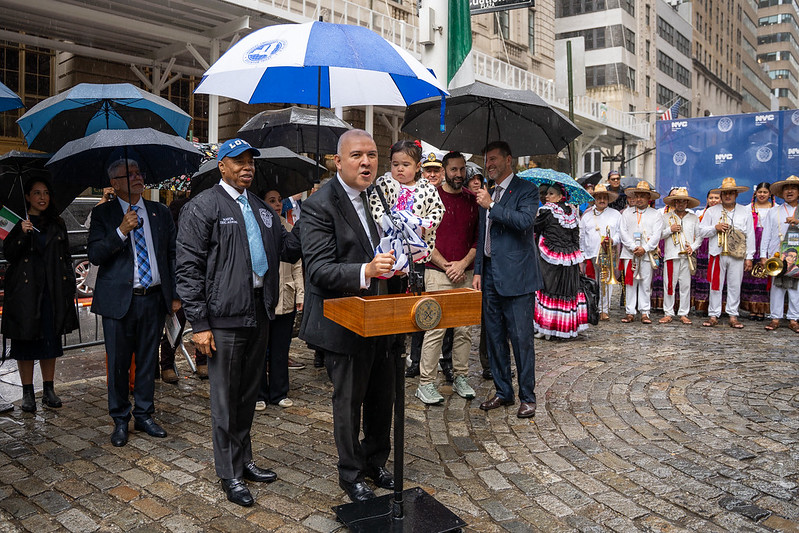
New York City Mayor Eric Adams delivers remarks at a flag-raising ceremony for Mexico in honor of Cinco de Mayo. Bowling Green Park, New York, NY. Monday, May 5, 2025. Image Credit – Benny Polatseck/Mayoral Photography Office
TRANSCRIPT: MAYOR ADAMS HOSTS “HEAR FROM THE MAYOR” RADIO SHOW
Gary Byrd: Well, normally, each and every second Sunday of the month, WBLS presents Hear from the Mayor. With our mayor, of course, the second mayor of color and the first hip-hop mayor in New York City’s history, Brother Eric Adams. This election season, we’ll be moving into an extended schedule with our mayor, who joins us this morning, right here at 107.5 WBLS. Mayor Eric Adams, inside of our broadcast at 107.5 WBLS. My brother, good morning and welcome.
Mayor Eric Adams: Hey, thank you so much, Gary. It’s good to be on with you and the listeners. It’s a real pleasure, and I want everyone to just sit back and enjoy the moment. And just welcome back to Hear from Eric, and I’m your mayor, Eric Adams.
If this is your first time tuning in, the purpose of this show is just really to hear from you and just have an easy conversation so we can learn what is happening in the city. And listeners should give me a call and hear directly from me, or you can sign up to hear more from what we are doing by visiting nyc.gov/hearfromeric. You can sign up on our website to text with Eric and talk with me on WhatsApp. But tonight, or today, or this morning, hit a long ride from D.C. this morning. You can dial in to 212-545-1075. That’s 212-545-1075.
And before we get to our special guest, sister that I really, really appreciate, I want to announce some events we are having in the next couple of weeks. We continue our Faith in Your Borough series in the coming weeks.
Tomorrow, April 28th at 5:30 p.m., we’ll be at Queens Hall at Queens College, gathering with faith leaders from across Queens on May 6th at 5:30 p.m. We’ll be in Harlem with Manhattan faith leaders. And finally, on May 1st at 6:30 p.m., we will be marking the annual New York City Day of Prayer, hosting a service open to the public at Christian Cultural Center with Reverend A.R. Bernard.
But today, we’re going to be discussing something that is really impactful to our communities, and that is gun violence. I always say even when the bullet hits its intended target, it does not stop its destructive pathway through the anatomy of our communities. It brings about pain, and it brings about social and emotional impacts throughout the year. The toll that it takes on our communities and the work we’re doing to prevent violence is something we want to share with you. And last week, I was joined by faith and community leaders and families that we were able to destroy over 3,500 illegal guns in a gun-destroying machine, I like to call it.
None of these guns will ever be used again to threaten, kill, or injure someone. But we don’t do this work alone. We have some young people at the School of Cooperative Technical Education. These students are going to take the medal, and they are going to use their welding vocational program to build a memorial to victims of guns. And so we have a constant reminder all the time.
Even today, we had a police officer who was shot. Thank God he won’t succumb to his injuries. This is that reminder of guns are everywhere in our society, and we must do everything possible to eradicate this threat of violence. And we saw what happened to a grandmother. I spoke to her son a few days ago. She was shot in Harlem in the head, an innocent bystander.
Two individuals shooting at each other, and one of them was just arrested last year for stabbing people during a robbery. These are the revolving door problems we’re talking about. Now, we’re doing our job. We’re doing our job, and we’re doing our job by removing over 21,400 guns off our streets. In this year alone, we removed 1,600 guns, and shootings are down. This quarter, quarters every three months, for five straight quarters, we’ve had decrease in gun violence.
But this quarter, we had the lowest number of shootings in recorded history. Lowest number in recorded history because of the work we are doing. And so we want to continue to do so, but we can’t do it alone. No matter how important our work is, we need partners, and there is no partner that we have that is as good as my special guest that’s joining today, Iesha Sekou, founder and CEO of Street Corner Resources. This is on the ground. You know, you hear so many people, Sister Iesha, so many people talk about this.
They want to write theses and papers, and they want to be sitting inside their comfortable cushion chairs in a sterilized environment of their chambers and say what we should be doing, but should be doing or shouldn’t be doing. But you’re out there. I see you. You’re out there, not only in the village of Harlem and your catchment area, but when we have events all over the city. You know, I walk in the room, and I just see that energy that’s there, and I cannot just say enough for you and your team of brothers and sisters from Street Corner Resources. And so, Iesha, welcome to the show. And, you know, why don’t you start off. How did you get in this work?
Iesha Sekou, CEO, Street Corner Resources: One, I want to thank you, Mayor Eric Adams. One, for the energy that you bring to this issue. I really want to thank you, and I want to do that face-to-face while your ears and your spirit can receive it. So I want to say thank you, and thank you for the gun crush. You know, I wanted to get there, but I had an important meeting at my office in person, so I couldn’t get there and get back.
But I want to say thank you. I was there in spirit. It’s so important that we get guns off the street. So the thing that kind of got me in this work, I’ve always worked with young people. I lived on 136th Street between 7th and 8th Avenue. Young people always hung out at my house, always had backyard parties and cookouts and that kind of thing.
And I, at the time, was running a program under the city, and it was called BEGIN. And BEGIN was Begin Employment, Gain Independence Now, and it was people who were on public assistance, particularly women, the largest population that were being mandated to work at that time. What I found from the students that I had because I was running the educational component of that, most people don’t know, I’m an educator by first profession. I didn’t jump out the backyard. I went to school.
So I was running that program, and while running that program, I met many women, and particularly from Harlem and Brooklyn. And they were beginning to lose their kids, their sons and daughters, particularly sons, and they were getting shot. And what I found was that gun violence was increasing and that young people were not just bloods and crips, that they were setting themselves up as three-letter crews. At that time, it was called three-letter crews, meaning like you had Get Money Boys, it was GMB and like that. And so parents, the mothers, would come to the educational program of which I was the director at the time, and they would be crying. They needed help with funerals and that kind of thing, right?
And so because of that, I saw that more and more of them needed help with the children that were left in the home while there was the child that was caught up in the street. And so I felt like I needed to do something. And then somewhere after that, there was a young man named Scotty Scott. He was shot in his head on 140th Street for what they call [] betting. That’s betting with no money. And so he had won the game but didn’t have money if he had lost the game, and they shot him in the head. So he was 13. There was another young man a little bit later. So this pushed me further and further into this work.
So when I saw the women who were burying their sons, and we had to find help to do that at that time, all of these things were not set up. You know, we didn’t have this. There was no funding for gun violence. And I just knew I needed to get more and more and dig in deeper and put a presence on the street. So we put a presence on the street, and we called in brothers from a lot of places.
It wound up being about four or five of us right now. One young man, he was living in Lincoln Houses at the time, and he was a student, and now he’s Dr. Talib Hudson, Ph.D. I’m glad that I had input on his theses and that kind of thing, but he also has his own organization called The New Hood. It’s called The New Hood. And we had other young people that just kind of helped. Beloved, who’s now with Live and Redemption, was part of that team. And it was really just very ad hoc, but we were very consistent. We would be on the street. We took guns from other young people. We knew where the guns were hid. I don’t want to talk a lot about that on the air, but I will say that we did some nontraditional things to stop violence.
And then, of course, I had to go up in rooms and say things and talk to people who could make a difference. And the person who listened was, at that time, our council member, Inez Dickens. And she told me, you got to calm down and get out of your own way, because I was angry because I saw so many young people dying. So that’s, in short, how I got in this work. And it was just about over years. It didn’t happen overnight. Some folks say, I want the bag. I want to get money to do this work. It’s not like that. This took commitment and passion and consistency and a lot of not necessarily being understood in this work to get to this place.
Mayor Adams: I always say, you’re not new to this. You’re true to this. You’ve been doing it a while, and you were doing it without grants. You were doing the work on your own, like you said, hosting children. What could—think about my sister who just lost her son through illness, Jackie Rowe-Adams, and the work that she’s doing. She lost two sons to gun violence. And so there’s two questions I want to ask you. Have you lost any of your members of Street Corner Resources to gun violence? And what do you tell parents who have other children at home what they can do?
Sekou: Well, I’ll say this. I haven’t lost a child to gun violence, oftentimes people confuse that. One, I want to give my condolences to my sister Jackie Rowe-Adams. She told me that her son was in very, very critical condition and that she may lose him. And I just want to send light and love to her. I didn’t know he had passed, so I’m just hearing that part. So I want to send light and love to her, and I’ll check in with her later on.
So I have not lost a child that I birthed. I have one daughter. People think I have a lot of sons and a lot of young people, a lot of kids. But I don’t. I have one daughter. But in doing this work and always having my door open, you gain children. And so I’ve lost a few. A few. And that kept me in this work. I knew that this was the place. Every time I think this is not where I’m supposed to be, it’s where I’m supposed to be.
My first degree is in education. So I’m a teacher by first profession. And I taught ESL and GED and TOEFL and some other things. But my real passion is for the young people, what people say in the street, but the young people in the community that I see every day. And so I haven’t lost a child, thank God, of my own. But I have a grandson who’s 20. He’s listening now. He’s 28. I think he’s 28. And I would fear for him to come to New York.
Every time he came, after he became like about 11 or 12, he’s unusually tall for his age. He would want to wear his cousin’s jackets and hats and he wanted to fit in and look like everybody else. But he couldn’t understand why I didn’t want him going to the corner store. Why I didn’t want him to wear their jackets. A lot of times kids do that. They get confused in their neighborhood with someone else who may have done some things or may have beef. And so I would almost incarcerate him in a certain kind of way. And he would say, Grandma, you never let me go outside. You don’t let me go to the store. But I understand the pain of mothers who fear for their sons because I had that fear for my grandson.
Mayor Adams: You know what’s interesting is how gun violence can alter your entire childhood. You know, there was a street in my community called New York Boulevard. And a young man named Clifford Glover was shot on 110th, I believe it was, in Guy R Boulevard by an officer, Shea. We were not allowed to go down that block. We were not allowed to cross over that boulevard. Because it has such a long-lasting impact. And so when our children have to be sort of modified their behavior out of our fear of violence, that impacts their childhood. And that’s why we have our summer youth employment.
That’s why we have our Summer Rising employment. Because we want to make our children safe. We’re doing that. But at the same time, we want to give them alternative things that they can do to develop their full personhood. So what do you say to the parents? I’m curious. What do you say to parents to that… When we come back off the break, I want you to talk about what do you say to parents that you have young children at home in general, but specifically young men, which often seem to be the victim of this violence. I want you to share some of the things that you’re saying to parents, okay? When we come back from the break.
Byrd: You’re listening to Hear From The Mayor. And the mayor wants to hear from you. 212-545-1075. 212-545-1075. That’s the number for you to call to speak to our mayor and a special guest. Right here on 107.5 WBLS.
[Commercial Break.]
Byrd: Gary Byrd on your radio, 107.5 WBLS. And with us, as many of you know, normally each and every second Sunday of the month, we welcome the 110th mayor of New York City. Second mayor of color and the first hip-hop mayor in the city’s history, Brother Eric Adams. We’re moving now into an extended schedule with our mayor. He’s here right now. And he wants to hear from you at WBLS. 212-545-1075. Here’s the mayor.
Mayor Adams: Thank you, Brother. And for all of you who are out there listening, please call in if you have any questions. And we want to keep it tight so we can get as many callers as possible. We have a bunch on the line. And so we want to really dig into the questions. So first caller, you are in the air.
Question: Yeah, I have a concern and a question concerning the new enforcement of the recycling program, specifically the composting aspect whereby whole [inaudible] are required to recycle their kitchen garbage. And along with the kitchen garbage, this also includes yard waste, like when you cut your lawn or you prune a tree.
Now, I am concerned that you have to put this yard waste into a bag and put it in the compost bin. I am suggesting, Mr. Mayor, that yard waste, which is not going to attract any rats, the lawn, the grass, and the trees, those things I suggest, Mr. Mayor, could be put into a clear plastic bag. What do you think, Mr. Mayor?
Mayor Adams: I like that idea, Brother. And now you know we announced this week that this is not going to be heavy-handed enforcement. It’s about an educational period going to the end of the year, because this is a new adjustment.
Even when we did the containerizing garbage, which is one of the number one ways to deal with rodents, I get those rodent calls and rodent complaints. And so I want to look at your suggestion, and I’m going to speak with the acting commissioner over at DSNY, because I’m a big believer that it’s not only dollars and cents, it’s common sense. And when good ideas come up, we should look at it, okay? Thanks a lot for calling. Second caller, you’re on the air. Let’s keep it tight so we can make sure we get all the callers that are here. You’re on the air.
Question: Good morning. I am calling from New York, and I’m calling about two things. First and foremost, the issue with the Palestinian woman in Brooklyn who was attacked during a Jewish protest, and one officer luckily was able to help her out. I didn’t hear any comments from you about that situation.
And the second thing is with regards to transit police patrolling the subway. I called previously about this incident. They are still situated in one location stationary, and they don’t move across the platform. And when they are on the train, they don’t move through the trains. The last time I called, that’s something you would look into. So if you can address both issues, the Palestinian woman being attacked, and I didn’t hear any comments from you, and the subway police not moving from location to location.
Mayor Adams: Thank you. Thank you so much, sister. First, let’s deal with the Palestinian woman who was assaulted, and the police officer did his job of getting her out there. I’m being briefed this morning on exactly what happened. I saw her with the video that was sent to me. She was walking down the block. She had a face mask on. I don’t know what led up to that. But no matter what happened, she should not have been assaulted, and arrests would be made.
Those who assaulted her, those who were walking down the block with a video, taking videos of her, that’s not a crime. But the person that I saw, one person strike her over the police officer’s head. That cannot be accepted. Remember, peaceful protests on both sides of the spectrum must be respected. I have a long history of standing up from my Muslim brothers and sisters, Palestinian, Bangladeshi, from the days of when they were removed from community in Brooklyn. I stood up in front of the federal penitentiary calling for their release.
So I have a long history of standing up for those who are the victim of hate crime. Both sides need to tone it down. That’s what we got to be honest about. Both sides need to tone it down. You can protest without being dangerous, destroying property, and hurting people. So I’m saying to both sides, tone it down. Our city is not a city of violence and hate.
With the police officers, we have over 30,000 cops. We’re constantly in a state of reinforcement, of training. Having our inspection units going out there, making sure they’re doing their job. Is everyone going to get the memo and change their behavior overnight? No, they’re not. You have to constantly inspect what you expect or suspect.
I’m out there on the subway constantly reinforcing the rules. My team is out there doing so. But you’re never going to get 100 percent compliance unless you continue doing the re-instruction we’re doing. Crime in the subway is at one of its lowest numbers. Lowest numbers. 4.6 million people ride a day. We have five felonies a day. So the officers are doing their job. Those who are not getting it right, we’re going to stay on them until they get it right. Or this policing is not a place for them. Next caller, you’re in the air.
Question: How you doing, mayor? This is a street council from Newark, New Jersey. I’m just trying to concern about, you know, as I know, I’m a community activist within the tri-state area. When you speak in terms of gun violence, you know, I was on the forefront. I was on the forefront because I wrote the whole model for the Newark Community Street Team. And everything got acknowledged by the city, the mayor, and everybody else. I got a book out that just came out, We Do Time, They Do Business.
What I want to just ask you real quick, man, is you failed to make a statement surrounding the Crown Heights incident that took place against the lady yesterday. She was a neighbor. They thought she was an Arab. And the Crown [inaudible] individuals from that neighborhood, the Jewish individuals, came out and attacked her, threw stuff at her while she was with the police officer. It was a brutal attack. They mistook her thinking that she was a part of anti-Israeli. It’s ironic that no statement or anything was made by your office. Can you find a way to address this? This is a very, very big concern in the community.
Mayor Adams: Thank you, brother. And I just answered that. I don’t think you heard what I was speaking to the previous sister. My team is briefing me on exactly what happened to that, what arrest is going to be made. And we continuously respond to these incidents. And as I shared with the sister, I want to share with you, I’m watching these over 3,000 protests that took place in our city. And I’m saying this is a place of peaceful protest.
But what I saw on that video is not acceptable, particularly to the person who assaulted her. People who were taking photos, walking down the block, hurling comments, it’s inappropriate, but it’s not illegal. That’s not a crime. And if I start arresting everyone who’s taking photos and hurling statements, you’re going to see a whole lot of people [inaudible] out jails. So my message to those who are vociferous and compassionate about this, everyone needs to tone it down. They need to tone it down.
I’m looking at these videos and these protests that are taking place. You can raise your right about something without having to be disrespectful to people who theoretically disagree with you. But we will be looking into the incident. And that person who assaulted her, we’re going to identify them and they will be arrested.
I hear the music coming on. That’s the moment. That’s saying we have to wrap. Thank you so much, folks, for joining us. And let’s continue to air your concerns and your voice as we move forward in this great city, a city called New York. And I want to thank our guest, Iesha Sekou, for coming on and doing the work that you’re doing, sister. Keep the work up.
Sekou: Thank you for having me.
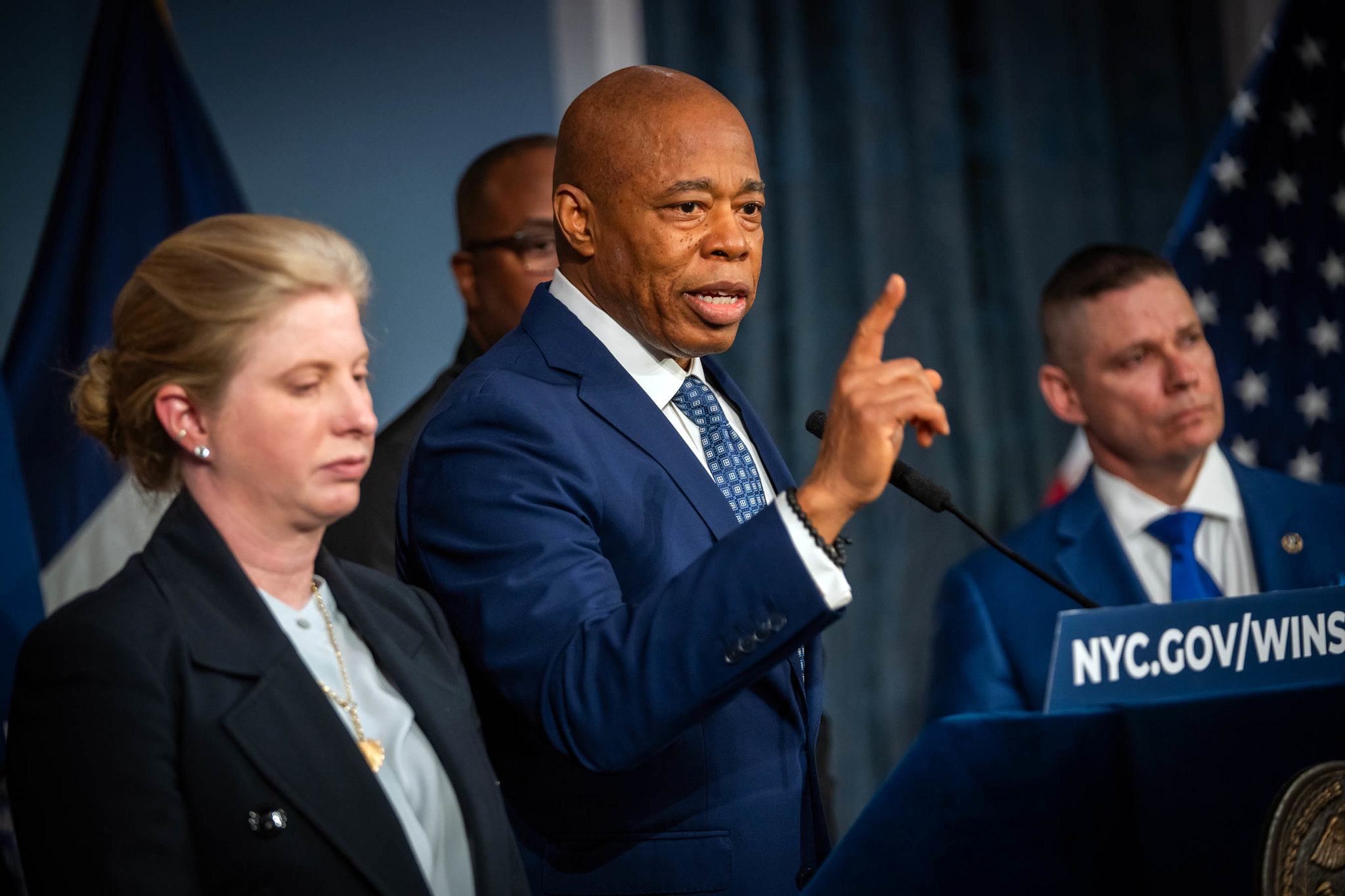
Mayor Eric Adams and New York City Police Department (NYPD) Commissioner Jessica Tisch brief the media on a recent incident involving NYPD officers attacked in Times Square and holds an in-person media availability. City Hall. Tuesday, May 6, 2025. Image Credit – Ed Reed/Mayoral Photography Office.
MAYOR ADAMS UNVEILS NEW INVESTMENTS IN UPCOMING MAYORAL BUDGET TO CREATE MORE HOMES, CONNECT MORE NEW YORKERS TO HOMES, KEEP MORE NEW YORKERS IN HOMES
Following Back-to-Back Record-Breaking Years for Affordable and Supportive Housing, City Will Invest $24.7 Billion in Housing as Part of 10-Year Capital Strategy, Including $1 Billion as Part of City of Yes for Housing Opportunity
Along With Historic $650 Million Investment to Curb Street Homelessness Announced Earlier This Year, City Will Invest $46 Million to Help Create and Preserve 5,850 Units of Supportive Housing, Reimagine 15/15 Housing Initiative and Get New Yorkers Help and Housing They Need
Building on Expansion of Homeowner Help Desk and First-Ever Tenant Protection Cabinet, FY2026 Executive Budget Includes New Investments to Keep New Yorkers in Their Homes, Provide Legal Services for Tenants
Part of Mayor Adams’ “Budget Week,” Unveiling “Best Budget Ever,” Which Invests in Affordability, Public Safety, and Quality-of-Life Issues New Yorkers Care Most About
NEW YORK – New York City Mayor Eric Adams today announced new investments to create more homes, connect more New Yorkers to homes, and keep more New Yorkers in the homes they already have as part of upcoming investments in his Fiscal Year (FY) 2026 Executive Budget. The investments — part of the “Best Budget Ever” — once again, solidify the Adams administration’s position as the most pro-housing administration in New York City history. Following several back-to-back years shattering affordable housing records, today’s investments, first, continue the Adams administration’s historic housing production numbers by allocating $24.7 billion towards affordable housing through the city’s 10-Year Capital Plan, including making a $1 billion commitment for housing as part of Mayor Adams’ historic “City of Yes for Housing Opportunity” initiative. Additionally, Mayor Adams announced today that New York City will invest an additional $350 million in the Permanent Affordability Commitment Together (PACT) and New York City Public Housing Preservation Trust programs to renovate thousands of New York City Housing Authority (NYCHA) units. Second, after breaking supportive housing records two years in a row and unveiling a sweeping $650 million investment to address homelessness earlier this year as part of his State of the City address, Mayor Adams today announced that New York City will invest an additional $46 million — to bring the total to $229 million over several fiscal years — to revitalize the city’s 15/15 Supportive Housing Initiative and create and preserve 5,850 supportive, congregate housing units that provide vulnerable New Yorkers with an affordable home as well as on-site social services. Finally, to keep New Yorkers in their existing homes, Mayor Adams touted new investments in Anti-Harassment Tenant Protection Program legal services that proactively engage tenants experiencing landlord harassment. The investments announced today further solidify the Adams administration’s position as the most pro-housing administration in New York City history, building on Mayor Adams’ five neighborhood plans that will deliver more than 50,000 new housing units and his ongoing commitment to creating new housing on city-owned sites.
“When we came into office, we said the days of letting people languish on our streets and on the subways were over. It was not safe, it was not humane, and it was not going to happen on our watch. That’s why we doubled the number of street outreach teams, pushed for new laws to get people the help they need, and began building thousands of new shelter beds that give people extra support. With our administration’s upcoming budget, we are doubling down on these efforts — building thousands of new supportive housing units that will help get even more people into stable homes as well as investing billions of dollars over the next 10 years in new affordable housing,” said Mayor Adams. “The sweeping investments we are announcing today as part of the ‘Best Budget Ever’ will help so many New Yorkers, from vulnerable people living on our subways to families searching for their first home, and create a safer, more affordable city for the decades to come.”
“In the last year, we have made unprecedented gains in creating and preserving affordable housing for all New Yorkers,” said Deputy Mayor for Housing, Economic Development, and Workforce Adolfo Carrion Jr. “This year’s budget will capitalize on these monumental achievements and continue to invest billions of dollars in our city’s housing agencies so they can create housing stability and opportunity for every New Yorker.”
Creating New Homes for New Yorkers
Since entering office, Mayor Adams has made historic investments toward building the affordable housing that New Yorkers need. The Adams administration has shattered affordable housing records two calendar years in a row — creating and connecting New Yorkers to record amounts of affordable housing — and last December, Mayor Adams celebrated the passage of City of Yes for Housing Opportunity, the most pro-housing proposal in city history that will build 80,000 new homes over 15 years and invest $5 billion towards critical infrastructure updates and housing.
In addition to the sweeping City of Yes for Housing Opportunity initiative, the Adams administration is advancing several robust neighborhood plans that, if adopted, would deliver more than 50,000 units over the next 15 years in Midtown South in Manhattan; in Long Island City and Jamaica in Queens; and around Atlantic Avenue in Brooklyn. Last year, the New York City Council approved the Bronx-Metro North Station Area Plan, which will create approximately 7,000 homes and 10,000 permanent jobs in the East Bronx.
The Adams administration’s 10-Year Capital Plan will build on those projects, investing $24.7 billion in affordable housing — including $1 billion in new funding through Mayor Adams’ City of Yes for Housing Opportunity initiative — to support the New York City Department of Housing Preservation and Development’s (HPD) and NYCHA’s core capital programs that build new homes, preserve existing homes, deliver capital repairs, and more. Moreover, Mayor Adams announced today that the city will invest an additional $350 million in the PACT and Trust programs to renovate thousands of NYCHA units, bringing the total investment in the 10-Year Capital Plan for Section 8 conversions to $1.2 billion.
Connecting More New Yorkers to Homes
Mayor Adams has committed to getting every New Yorker, particularly vulnerable populations who need extra support, the help and housing they deserve. Last year, the Adams administration invested $900 million in supportive housing efforts. Additionally, as part of his State of the City address earlier this year, Mayor Adams announced that New York City will invest $650 million over several fiscal years in hundreds of new Safe Haven beds that offer a more flexible, personalized option for New Yorkers experiencing unsheltered homelessness; an innovative facility specifically to support unsheltered New Yorkers with serious mental illness; and a pilot program to connect soon-to-be parents applying for shelter with services that help them find permanent housing and prevent homelessness before their child is born.
Building on these investments, Mayor Adams announced today that New York City will reimagine the city’s 15/15 Supportive Housing Initiative to better support vulnerable New Yorkers — including individuals with serious mental illness, substance use challenges, or complex traumas — and create more affordable housing for them. First launched in 2015, 15/15 set an ambitious goal of financing 15,000 new units of supportive housing that offer New Yorkers both affordable housing and social services; this target was originally split between congregate units that provide housing and supportive services together at the same location and scattered site units that provide private market housing and supportive services at separate locations. While the city has exceeded its target for awarding new congregate units, it has nonetheless faced long-term challenges meeting its target for scattered site units.
To address these long-term challenges and efficiently connect more New Yorkers with valuable resources, the city will shift the focus of the program to producing more congregate units. Along with funding committed in the 10-Year Capital Plan, Mayor Adams announced today that the city will invest an additional $46 million in expense funding over several fiscal years to finance 5,850 congregate units and help thousands of individuals connect to permanent housing from the streets and from shelters. Eighty percent of those units are projected to be newly-constructed supportive units and 20 percent are expected to be preserved units, bringing them into the 15/15 program for the first time. These numbers are subject to change as the city implements this initiative.
Keeping New Yorkers in the Homes They Already Have
Finally, Mayor Adams has focused on keeping New Yorkers in their existing homes, launching New York City’s first-ever Tenant Protection Cabinet to develop policies and long-term strategies to support tenants; expanding the Partners in Preservation Program to the entire city in 2024 through a nearly $24 million investment in local organizations that support tenant organizing and combat harassment in rent-regulated housing; expanding the Homeowner Help Desk, which provides low-income homeowners with financial and legal counseling, to the entire city; and securing the largest housing discrimination settlement in city history.
Building on these investments, the FY2026 budget will invest $7.6 million in Anti-Harassment Tenant Protection Program legal services that proactively engage tenants experiencing landlord harassment. This critical program proactively engages with, and provides legal services and representation to, tenants experiencing disrepair and harassing treatment.
Today’s announcement comes during Mayor Adams’ “Budget Week,” where the Adams administration is unveiling signature investments in the “Best Budget Ever,” which will make New York City safer, more affordable, and the best place to raise a family, while maintaining record-high reserves and ensuring a strong fiscal future for the City of New York.
“The re-allocation of funding from the 2016 NYC 15/15 supportive housing initiative is a significant victory for tenants and providers alike and will ensure the creation and preservation of desperately needed units at a deeply uncertain time. The Network and the entire supportive housing community applaud the Adams administration for taking this important step,” said Pascale Leone, executive director, Supportive Housing Network of New York. “While the original initiative sought to create 7500 ‘scattered site’ units, the affordable housing crisis has made that goal unworkable. Today’s announcement will enable the city to put those funds to better use, creating thousands of new, high-quality affordable and supportive apartments while ensuring those created decades ago remain livable. Our community has long advocated for this resource re-allocation, responding to tenants who have made clear that congregant living is far preferable and safer. We are deeply grateful to the mayor and the administration, particularly the Department of Housing Preservation and Development, the Department of Social Services and the Department of Health and Mental Hygiene, for making this impactful decision that will create and sustain thousands of homes for New Yorkers in need.”

New York City Mayor Eric Adams delivers remarks at the American Buddhist Confederation’s Prayer Event at Times Square, on Sunday, May 4, 2025. Image Credit – Benny Polatseck/Mayoral Photography Office
MAYOR ADAMS ANNOUNCES UNPRECEDENTED $5+ BILLION IN ADVANCE PAYMENTS TO BE MADE TO CITY-CONTRACTED NONPROFIT PROVIDERS, PROVIDING MORE UPFRONT CASH AND CONTRACTS TO PROVIDERS THAN EVER BEFORE
City Estimates Advancing Nonprofits Over $5 Billion in FY 2026, Up from $2.8 Billion in Initial Advances Issued During FY 2025
Mayor’s Office of Nonprofit Services Launches Updated Version of ContractStat, Realizing Recommendation From Joint Taskforce to Get Nonprofits Paid On Time
Mayor’s Office of Contract Services Completes Spring Contract Backlog Initiative, Unlocking Over $700 Million in Backlogged Contracts
NEW YORK – New York City Mayor Eric Adams today announced that, for the first time in city history, nonprofit providers contracted with the city will receive the highest-ever advance payments, estimated to over $5 billion, during Fiscal Year (FY) 2026, delivering much-needed upfront resources to organizations that provide critical services to the most vulnerable New Yorkers, including children, justice-involved individuals, older adults, people with disabilities, and those experiencing homelessness. Under the leadership of newly appointed Executive Director Michael Sedillo, the Mayor’s Office of Nonprofit Services (MONS) has also launched an updated version of ContractStat, a new performance management system, to bring data-driven accountability to nonprofit contracting across city agencies.
“Every single day, our nonprofit providers show up for New Yorkers — feeding families, providing emergency housing, caring for our kids and our elders, and doing so much more to move our city forward,” said Mayor Adams. “They are the backbone of our city’s social safety net, serving the most vulnerable populations, but too often, they’ve had to do that work while waiting for payments. Since taking office, our administration has worked to pay providers on time, and today, we are giving these organizations the highest advance payments in city history — estimated to over $5 billion in the next fiscal year. This is about trust, respect, and making sure those who care for our city can count on their city to care for them.”
“Whether it be supportive housing and shelter for the homeless, child care centers, afterschool programs, legal services organizations, or other essential services, non-profits are on the frontlines delivering vital city-funded services upon which many of our most vulnerable New Yorkers depend everyday,” said First Deputy Mayor Randy Mastro. “This administration strives to treat our non-profit partners with the respect and consideration they deserve. With the highest advance-payment level ever, this administration is responding to our non-profit partners’ concerns. As always, we aim to ensure that New Yorkers continue to receive the critical services they need and deserve, and with this action today, we are doing just that.”
“The Adams administration is taking bold, strategic action to deepen the city’s partnership with the nonprofit sector,” said Deputy Mayor for Strategic Initiatives Ana J. Almanzar. “Today’s announcement — alongside Mayor Adams’ executive order establishing chief nonprofit officers within every human service agency — underscores our unwavering commitment to frontline organizations. Through unprecedented early investments, including a historic cost-of-living adjustment for nonprofits, we are ensuring these essential partners have the resources and the support needed for their critical work serving all New Yorkers. I look forward to advancing the work with our nonprofit partners as we continue building a better, more affordable, safer city for all.”
“This historic advance funding underscores this administration’s commitment to supporting nonprofit providers that are critical to the well-being of our communities,” said Chief of Staff and Deputy Mayor for Administration Camille Joseph Varlack. “By aligning city resources with the needs of our partners in service delivery, we’re addressing immediate challenges and establishing a sustainable framework to ensure nonprofits can continue their vital work without disruption. This initiative reflects our dedication to building a more efficient, responsive, and equitable city for all New Yorkers.”
“Nonprofits are key partners to the city helping provide critical services to individuals, children, and families in all five boroughs” said Deputy Mayor for Health and Human Services Suzanne Miles-Gustave. “Today’s action infuses important funds into the city’s network of nonprofits, thereby helping create more stability for both the organizations and all those they serve.”
“The Adams administration is clear: Nonprofit providers are not vendors — they are vital partners,” said MONS Executive Director Sedillo. “Whether delivering meals, shelter, mental health care, youth programming, or workforce services, these organizations maintain the safety net that millions of New Yorkers count on. The city will continue to do everything possible to ensure that providers are paid on time, treated with respect, and empowered to serve.”
Each year, nonprofit providers are eligible to receive up to 25 percent of their contract value as an advance. So far, during FY 2025, the city has issued $2.8 billion in initial advances to nonprofit providers. Understanding the immense strain many providers face — from cash flow challenges to adapting to new technology platforms — the Adams administration is taking unprecedented steps to offer relief and stability to providers and will be advancing over $5 billion during FY 2026. By ensuring that more dollars than ever before are going out the door at the start of the fiscal year, the city is ensuring providers can continue offering services without disruption and support their staff with timely payroll.
Concurrently, city agencies are redoubling efforts to close out payments from prior years and clear any remaining backlogs, ensuring that legacy issues do not hinder progress toward paying nonprofits.
Earlier this spring, MONS launched an updated version of ContractStat, following a recommendation by the Joint Taskforce to Get Nonprofits Paid On Time. This system brings data-driven accountability to nonprofit contracting, providing both quantitative metrics — such as contract registration and payment timelines — and qualitative insights.
In parallel, the Mayor’s Office of Contract Services recently concluded its Spring Contract Backlog Initiative, unlocking over $700 million in retroactive, backlogged contracts for nonprofit organizations. This initiative has significantly reduced the city’s overall backlog — speeding up payments to nonprofit providers and restoring financial stability to many organizations.
“With today’s announcement, a big shoutout goes to Mayor Adams and his administration for stepping up in a major way. As someone who’s been on the receiving end of nonprofit services, I know how critical these organizations are — and how hard it is for them to do their jobs when funding is delayed,” said Shams DaBaron, Da Housing Hero. “That’s why I had no hesitation stepping in to help get this issue addressed. The work that City Hall did to make today’s announcement possible was amazing. This $5 billion advance for the new fiscal year is unprecedented, and it’s going to bring real relief. It will ensure that the vulnerable New Yorkers can continue to receive the vital resources from the nonprofit organizations they depend on. I’ve always pushed for collaboration over confrontation — and this is proof that when we work together, we get real results.”
“United Way of New York City has the privilege of working with 600 nonprofits from across the city. We see first had the pressures of serving some of our most vulnerable New Yorkers, that should not include leaders wondering whether they can pay vendors or make payroll because they are waiting to get paid,” said Grace Bonilla, president and CEO, United Way of New York City. “Today’s announcement that the mayor and his administration will increase the advances nonprofits receive at the beginning of the fiscal year does not only guarantee continuity of services, but it is a sign of good faith by the administration. We look forward to continuing to work with the administration as we collectively address some of the root cause of our procurement and invoicing challenges. Today we commend the administration for their commitment to a thriving non-profit sector and thriving communities.”
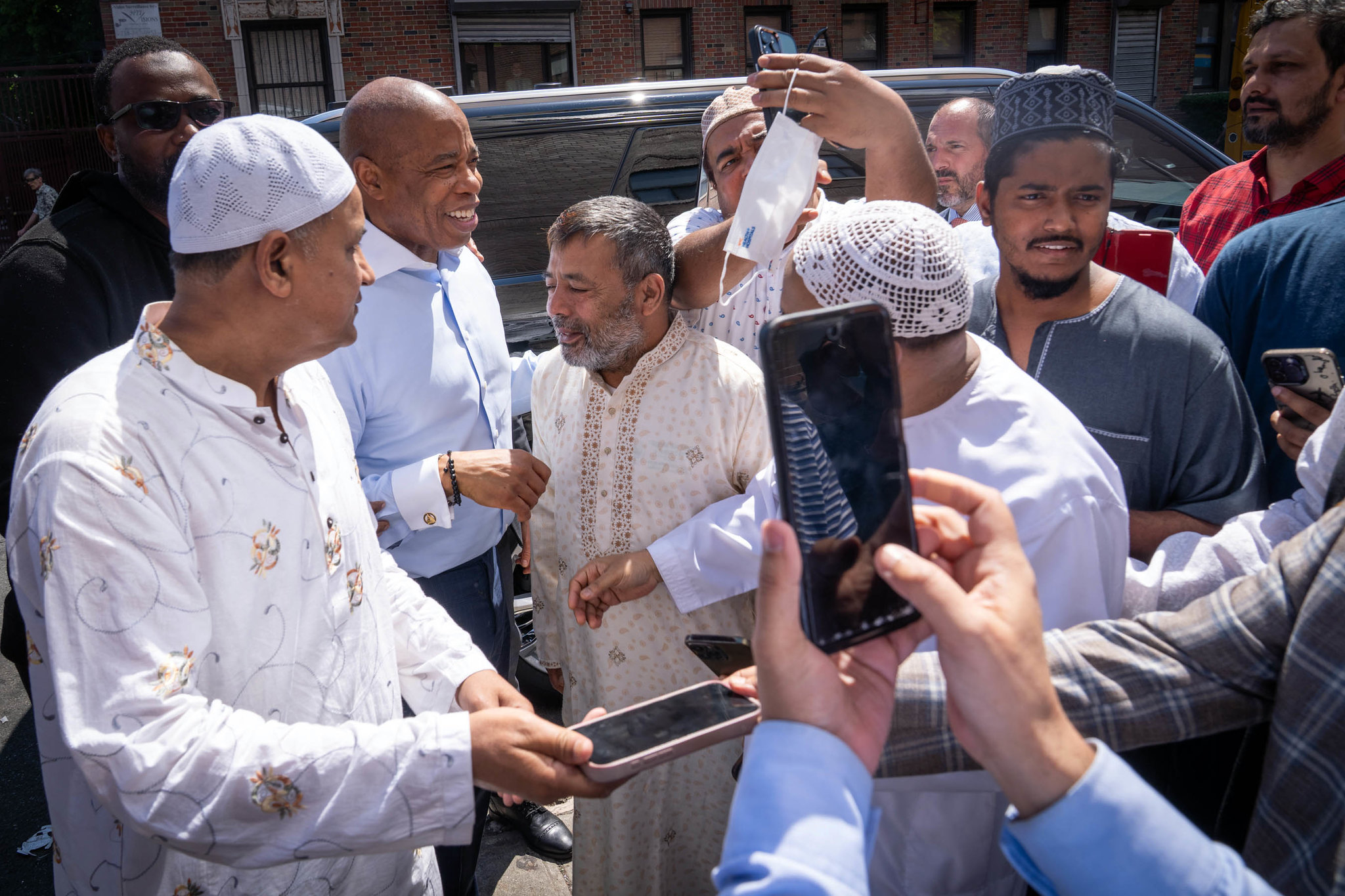
Mayor Eric Adams delivers remarks at the North Bronx Islamic Center’s Jummah prayer on Friday, May 2, 2025. Image Credit – Ed Reed/Mayoral Photography Office.
MAYOR ADAMS UNVEILS AMBITIOUS PLAN TO ACHIEVE UNIVERSAL AFTER-SCHOOL PROGRAMMING IN UPCOMING MAYORAL BUDGET, OPENING HISTORIC OPPORTUNITIES FOR NEW YORK CITY CHILDREN AND FAMILIES THROUGH $755 MILLION “AFTER-SCHOOL FOR ALL” PROGRAMMING
On 20th Anniversary of After-School Systems’ Creation, NYC Makes Unprecedented $331 Million New Investment to Bring After-School to Over 20,000 More K-5 Students by Fall of 2027
Investment Brings Annual Spending on After-School to $755 Million Total 184,000 K-8 Students to Be Served Across All
Department of Youth and Community Development Programs
First Increase to Afterschool Seats in Over 10 Years, Mayor Adams Commits to Developing First-Ever Comprehensive Plan for Universal Afterschool
Builds on Adams Administration’s Commitment to Making New York City Best Place to Raise a Family by Investing in Critical Programs Year-After-Year
Part of Mayor Adams’ “Budget Week,” Unveiling “Best Budget Ever,” Which Invests in Affordability, Public Safety, and Quality-of-Life Issues New Yorkers Care Most About
NEW YORK – New York City Mayor Eric Adams and New York City Department of Youth and Community Development (DYCD) Commissioner Keith Howard today announced a historic and new $331 million commitment — phased in starting in the upcoming Fiscal Year (FY) 2026 Executive Budget and fully baselined by FY 2028 — to support Mayor Adams’ vision of “After-School for All” to all public students from kindergarten through eighth grade. For the first time ever, the city is beginning a comprehensive effort to strengthen and scale after-school programs with the goal of achieving universal access for all students and families across the five boroughs. The new funding will support the addition of 20,000 new seats over the next three school years, bringing the total number of public school students served by universal after-school programming to 184,000 with a total investment of $755 million annually.
“To make New York City the best place to raise a family, we need to make sure our young people and families have opportunities to thrive, and that is why we are launching a big, bold vision to achieve universal after-school for free for all students who want it,” said Mayor Adams. “We’re investing $331 million in additional funds as part of our total $755 million investment in ‘After-School for All.’ This massive infusion of funds will improve our current programs and bring new after-school programs to an additional 20,000 K-5 students, serving a total 184,000 K-8 students. That’s 184,000 students who will be able to participate in sports, robotics, the arts, field trips, and more — discovering their passions and building relationships with their classmates. We are also pursuing a community-driven effort that will stabilize our current after-school system, ensuring these providers are able to get a rate increase for the first time in 10 years so they can hire and train staff, while delivering quality programming to our youth. Our parents shouldn’t have to choose between picking up their child or working a job to put food on the table — and now they won’t have to. This is what it looks like to deliver on our mission of making New York City a safer, more affordable city that is the best place to raise a family.”
“Mayor Adams’ commitment to early childhood development is truly unprecedented,” said First Deputy Mayor Randy Mastro. “Now, he builds on that work with another signature achievement: a commitment to fund universal after-school programs for all public-school families who want it for their children. Just like universal pre-K, this initiative bookends early childhood education in the most positive way. It’s all about investing in our children’s futures — and today’s announcement will serve children for generations to come.”
“Today’s announcement on after-school is nothing short of a game-changer for New York City’s kids and families. Mayor Adams’ commitment to investing $331 million in new funding to expand and improve the Department of Youth and Community Development’s after-school system will transform child care in New York City forever, opening the door for thousands of families to take advantage of this valuable service,” said Deputy Mayor for Strategic Initiatives Ana J. Almanzar. “After-school programs support kids, families, and the larger community — they are a common-sense investment of public resources. The commitment to building a universal system in the years ahead will expand the landscape of youth programs and child care for communities across the city.”
“Growing up in the Bronx, I was greatly influenced by after-school programs,” said DYCD Commissioner Howard. “Juanita Howard, a single mother raising seven young children, worked as a registered nurse at the VA Hospital, and sent me and my siblings to after-school programs. She was so committed to it that I made sure my children attended, as well. I know firsthand the value of creating enriching and meaningful opportunities. Mayor Adams, who is making unprecedented commitments to our elementary school students, shares this sentiment. These investments help make our city more affordable and the best place to raise a family. I want to express my gratitude to our outstanding providers for their patience and partnership in creating the next generation of after-school programming. Together, we are closer than ever to fulfilling Mayor Adams’ vision for universal after-school.”
Mayor Adams’ After-School for All plan begins with an immediate $21 million investment allocated in the upcoming FY 2026 Executive Budget that will bring 5,000 additional K-5 seats online for the upcoming fall semester. That funding will grow to $102 million by the next fiscal year and $136 million, baselined annually, by FY 2028, as DYCD adds 10,000 more seats in the fall of 2026 and 5,000 seats in the fall of 2027, respectively, for a total of 20,000 new seats over the next three school years. The funding for these new seats will be baselined starting in FY 2028 and become a permanent part of the city’s after-school offering, growing the annual budget to a total of $755 million for DYCD after-school programming. Additionally, DYCD will work with the community to assess the ongoing need and add slots if necessary. The plan will also strengthen the current system by issuing the first Request for Proposal to providers in over a decade, in an effort to enhance and improve programs for New York City youth, as well as raise provider rates to stabilize the non-profit organizations leading these programs and better support the workforce who serve New York City’s children. This effort will be supported by a $195 million investment beginning in the FY 2027 Executive Budget, bringing the total new spending to approximately $331 million by FY 2028.
Across all DYCD programs, New York City currently serves approximately 164,000 K-8 students in after-school programs. Today’s investment by Mayor Adams will bring the total number of students served by the program to 184,000 by school year 2027-2028. Currently, only one in five elementary school students can participate in after-school programming, compared to two in five for middle school students; this plan will add $331 million in new funds to the $424 million already allocated to after-school programming in the budget to focus on bringing seats to elementary schools in communities where demand meets need. Additionally, the Adams administration will create a commission for universal after-school by engaging providers and community stakeholders to develop a system that is sustainable in the long term and ensures non-profit organizations are able to continue to hire and train staff and deliver quality programming.
Celebrating 20 years since its inception by former New York City Mayor Michael Bloomberg, after-school programming is a proven and effective way to make New York City a more affordable city for families, invest in the health-and-well being of young people, and build safer communities. In 2022, New York City suffered a loss of $23 billion as working parents left the workforce to take care of their children.
In yet another example of Mayor Adams’ fiscal stewardship and commitment to making upstream investments that have generational effects, after-school is an effective way to yield long-term savings and improve outcomes. For example, one study in Oklahoma estimated that after-school and crime prevention programs yield an $8 – $12 savings for each $1 invested.
The investment adds to the Adams administration’s historic investments in young people, and supports both the Summer Youth Employment and Summer Rising programs to serve record numbers, and increases spending on young adult career success programming by 25 percent, as announced in “Pathways to an Inclusive Economy: An Action Plan for Young Adult Career Success,” a forward-thinking roadmap to build inclusive pathways for the city’s young people to discover their passion, receive hands-on career experience, and, ultimately, enter the workforce.
Over the last three years, the Adams administration has been focused on making New York City more affordable for families through popular and essential programs like early childhood education. Recently, Mayor Adams announced $167 million investment in long-term commitment to funding 3-K and special education pre-K annually. Under the Adams administration, a record 150,000 children are enrolled across the early childhood education system today, the out-of-pocket costs of child care subsidies have been reduced from $55 per week in 2022 to $5 per week today, and the Adams administration met its commitment to offer a seat to every child who applied for 3-K on time — the first time this has ever been done in the city’s history. Over the FY 2025 budget cycle, Mayor Adams protected more than $600 million in key, long-term education programs that had been previously funded with expiring stimulus dollars by making investments in Summer Rising, a citywide 3-K expansion, special education pre-K, community schools, social workers, and arts education. This investment included one-time funding of $92 million to support a citywide 3-K expansion. Additionally, the Adams administration invested $20 million to ensure that every student on a 3-K waitlist was offered a seat, and $55 million to provide more than 700 new seats for three- and four-year-olds with special needs. In his upcoming FY 2026 Executive Budget, Mayor Adams will baseline funding for these crucial programs for the first time ever in city history to support children and families and keep the promise that every child who wants an early childhood seat will have access to one, now and in the future.
Today’s announcement further builds on the Adams administration’s core educational accomplishments for New York City public school students, including implementing a major literacy initiative through “NYC Reads;” instituting nation-leading dyslexia supports; expanding Gifted and Talented Programs; increasing math test scores by 12 percent and English language arts test scores by 3 percent in 2023; building nine new schools for the 2024-2025 school year alone; helping students prepare for college and careers; cementing new labor contracts for teachers, principals, and staff; and, most recently, unveiling a signature math initiative, “NYC Solves,” as well as creating the Division of Inclusive and Accessible Learning to prioritize the city’s most vulnerable students and families, including multi-language learners and students with disabilities.
Today’s announcement comes during Mayor Adams’ “Budget Week,” where the Adams administration is unveiling signature investments in the “Best Budget Ever,” which will make New York City safer, more affordable, and the best place to raise a family, while maintaining record-high reserves and ensuring a strong fiscal future for the City of New York.
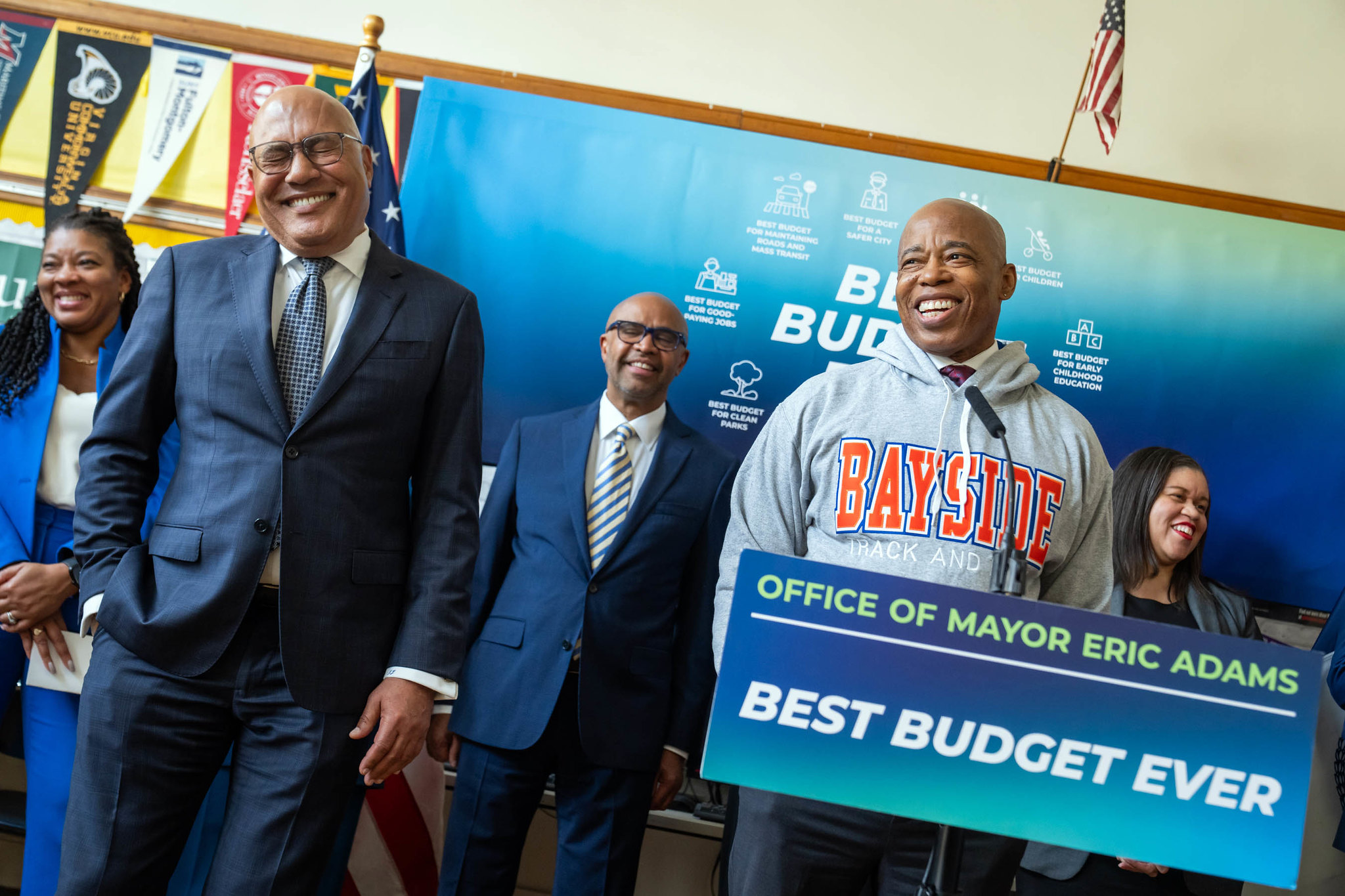
Mayor Eric Adams releases the “Best Budget Ever” — the balanced, $115.1 billion Fiscal Year (FY) 2026 Executive Budget that makes new investments safer, more affordable city that is the best place to raise a family. Bayside High School, Bayside, NY. Thursday, May 1, 2025. Image Credit – Ed Reed/Mayoral Photography Office.
WHAT THEY’RE SAYING: NEW YORKERS PRAISE MAYOR ADAMS’ AMBITIOUS PLAN TO ACHIEVE UNIVERSAL AFTER-SCHOOL
On 20th Anniversary of After-School Systems’ Creation, NYC Makes Unprecedented $331 Million ew Investment to Bring After-School to Over 20,000 More K-5 Students by Fall of 2027
Investment Brings Annual Spending on After-School to $755 Million
Total 184,000 K-8 Students to Be Served Across All Department of Youth and Community Development Programs
First Increase to Afterschool Seats in Over 10 Years, Mayor Adams Commits to Developing First-Ever Comprehensive Plan for Universal Afterschool
Part of Mayor Adams’ “Budget Week,” Unveiling “Best Budget Ever,” Which Invests in Affordability, Public Safety, and Quality-of-Life Issues New Yorkers Care Most About
NEW YORK – New York City Mayor Eric Adams and New York City Department of Youth and Community Development (DYCD) Commissioner Keith Howard today announced a historic and new $331-million commitment — phased in starting in the upcoming Fiscal Year (FY) 2026 Executive Budget and fully baselined by FY 2028 — to support Mayor Adams’ vision of “After-School for All” to all public students from kindergarten through eighth grade. For the first time ever, the city is beginning a comprehensive effort to strengthen and scale after-school programs with the goal of achieving universal access for all students and families across the five boroughs. The new funding will support the addition of 20,000 new seats over the next three school years, bringing the total number of public school students served by universal after-school programming to 184,000 with a total investment of $755 million annually.
Here’s what New Yorkers are saying:
“United Way of New York City’s True Cost of Living Report demonstrates that one of the financial burdens on already struggling families is finding reliable afterschool programs that help their children thrive and allow working family members to show up fully at their place of employment. Part of having reliable after-school programs in the City of New York means right sizing the system to meet the needs of our families and stabilizing the workforce so that a youth development career means living with dignity, while sustaining environments that are loving, creative, and help our youngest New Yorkers succeed academically,” said Grace Bonilla, president and CEO, United Way of New York City. “Today we applaud Mayor Adams and his administration for investing $331 million in new baselined funding for DYCD’s COMPASS/SONYC after-school programs for the next three years. This long-awaited investment will allow providers to increase worker salaries and provide additional seats that gets the afterschool system one step closer to universal afterschool for grades K-5.”
“We applaud the Adams administration for making a critical investment in New York’s afterschool programs and look forward to working together on developing a sustainable plan to expand access,” said Phoebe C. Boyer, president and CEO, Children’s Aid. “For too long, after-school providers have been stretched thin and underfunded. This announcement is an important step toward strengthening these vital programs and recognizing after-school as a lifeline for working families. High-quality after-school programs aren’t a luxury — they’re essential to economic stability, educational opportunity, and healthy communities.”
“As working parents continue to struggle with finding child care, today’s announcement to expand and strengthen New York City’s vibrant after-school system through a $755 million investment serving 184,000 students is a historic step forward,” said Richard R. Buery, Jr., CEO, Robin Hood Foundation. “Building on decades of investment and innovation, this expansion will make high-quality, free after-school programming available to more families across the city, helping to reduce costs for working parents, enrich children’s learning and development, and make New York a better, more affordable place to raise a family.”
“Grand Street Settlement strongly supports the city’s investment in expanding after school programs, and we hope this is just the first step on the path towards universal after-school,” said Robert Cordero, CEO, Grand Street Settlement. “After-school programming is essential for providing students and working families with stability and opportunities. At Grand Street, students in our after-school programs explore their passions and build confidence, whether in their academic work or their social-emotional development. We’re proud to be a part of the movement to ensure every child, regardless of circumstance, has access to safe, enriching, and empowering afterschool opportunities.”
“After-school programs are lifechanging. Successful programs nourish skills and talents, offer positive experiences and give children and young people opportunities to connect with consistent and caring adults,” Laurie R. Dien, vice president and executive director for programs, The Pinkerton Foundation. “They also give an economic boost to the city by providing safe spaces that allow parents and caregivers to be at work without worrying. Baselining funding brings financial stability. Providing additional funds will enhance program quality and give hardworking staff the pay they deserve. ‘It takes a village’ isn’t just a cliche, it is an obligation.”
“Henry Street Settlement appreciates and applauds the transformative investment in the DYCD COMPASS/SONYC system announced today,” said David Garza, president and CEO, Henry Street Settlement. “After-school programs like ours, which serves close to 1,000 children from predominantly low-income families on the Lower East Side, provide an exponential return on investment. They advance the academic, social-emotional, and recreational development of our youth, while keeping them safe and allowing parents to work and provide for their families without fear for their children’s well-being. The crucial resources announced will enable nonprofits like ours to reach more youth, attract top-talent, and enhance programing, providing an even more holistic and high-quality afterschool experience. We know that programs don’t help people; people help people, and this investment puts us in a position not only to build our team but to make them better at what they do and make an even bigger difference in the lives of the children we serve.”
“Mayor Adams’ investment in expanding after-school programs is not just an investment in today’s students — it’s an investment in the future leaders of New York City,” Rachael Gazdick, CEO, New York Edge. “By creating more opportunities for young people to explore their passions and develop their talents, we are tapping into the gifts and potential of our youth. We are building the next generation of scientists, athletes, artists, tech leaders, animators, authors, and so many others. After-school is where kids can explore, be exposed to a wide range of opportunities, and begin a pathway toward college and career success.”
“After-school programs are truly the backbone of our community, providing safety and care for young people and peace of mind for working families,” said Danielle Ellman, CEO, Commonpoint. “We are so grateful for the mayor’s office and our champions at DYCD for expanding programs that are immeasurably important for our community, and for giving children and their families the safety net they both need and deserve.”
“We are heartened by Mayor Adams’ after-school expansion and the administration’s commitment to engage with providers to strengthen and improve the system,” Sharon Greenberger, president and CEO, YMCA of Greater New York. “After-school programs are vital for working families and support our city’s economic health. We look forward to the concept paper, to the new request for proposal and to working with the administration to expand access to thousands more youth and families across New York City.”
“We are thrilled with the increase of 20,000 COMPASS after-school slots over the next three years to help address critical needs,” Wayne Ho, president and CEO, the Chinese-American Planning Council. Thank you to the Adams administration for resourcing these increased slots which will provide much needed support for young people and working families. We look forward to working together with the administration, City Council, providers, and advocates to ensure that every child who needs an afterschool slot has one and that the rates are fully funded to ensure the best possible programming for children and support for staff.”
“We are incredibly grateful to Mayor Adams for this historic investment in our city’s youth,” said Steven Matteo, CEO and executive director, United Activities Unlimited. “As a proud provider for many years, United Activities Unlimited has seen just how life-changing these programs can be for young people. They offer a safe, exciting space where children can discover new passions, build confidence, and strengthen their academic skills. We are thrilled that more students will get to experience all that these vital programs have to offer over the coming years!”
“New York City has often paved the way for the afterschool field, creating the largest municipal afterschool system in the country,” said Alison Overseth, CEO, Partnership for After School Education. “We are excited to see the city once again respond to community needs by providing increased investment in high-quality out-of-school time programs at this critical moment for youth and families, helping to ensure that thousands more students have safe, enriching spaces to spend the afterschool hours. In addition to this significant and promising expansion in seats, we are hopeful to see an increase in the cost-per-student funding allocations in 2026 to more fully reflect the current cost of effective programming for community-based organization providers.”
“CAMBA applauds the city’s decision to make a three-year, $331 million investment in baseline funding of COMPASS and SONYC, beginning with an expansion of K-5 slots in Fiscal Year 2026,” said Valerie Barton-Richardson, president and CEO, CAMBA. “With the $136 million pledged to create 20,000 additional K-5 slots to serve high-need families, the city is showing meaningful beginning steps that reflect years of collective advocacy and attention to what families and communities truly need.”
“Citizens’ Committee for Children of New York appreciates the Adams administration taking important steps towards achieving a universal after-school system,” said Raysa S. Rodriguez, executive director, Citizens’ Committee for Children of New York. “These are critical and long-awaited investments towards quality improvement and critical expanded capacity. We look forward to working with the administration and City Council to ensure necessary investments are made in Fiscal Year 2026 to stabilize the current system and to better meet the needs of children and families.”
“After-school programs and the nonprofits who run them serve as a vital support network for New York City. By investing in this system, the city is investing in our children and families,” said Susan Stamler, executive director, United Neighborhood Houses. “We are pleased to see this long-awaited new investment, and hope it is just the first step towards a stronger and better afterschool system with funding rates that reflect the true costs of high-quality programming.”
“I commend Mayor Adams for taking a meaningful step towards a universal after-school system for New York City elementary school students and working families,” said Udai Tambar, CEO and president, New York Junior Tennis and Learning. “Our North Star is to ensure that students from low-income communities in New York City receive the benefits of after-school programs. A record number of New York City kids will have access to a safe and nurturing environment that supports learning and social-emotional development for a lifetime of success, thanks to this investment in both the quality and quantity of after-school programs.”
“This is an important milestone for children in New York City, responding to the urgent calls we hear from families, youth-serving nonprofits, employers, and others,” said Saskia Traill, president and CEO, ExpandED Schools. “We need more after-school spots for kids to thrive, and we need rates that keep pace with rising costs for quality. Investment in after-school is investment in our city’s future.”
“This $331 million investment isn’t just about expanding afterschool programs for K-5 youth, it’s about strengthening the ecosystem that helps young people thrive,” said Andre White, executive director and CEO, Phipps Neighborhoods. “By investing in both our young people and the educators who support them, this transformative step from Mayor Adams is creating a lasting foundation of opportunity that will continue to benefit New York City for generations. This funding is a commitment to building stronger communities and a brighter future for all.”
“Good Shepherd Services welcomes Mayor Adams’ proposal to move the after-school system towards universality and improved quality and for the commitment to invest new resources to support these goals,” said Michelle Yanche, CEO, Good Shepherd Services. “We look forward to working with the Adams administration over the coming year to address pressing resource and operational challenges to strengthen the current system.”
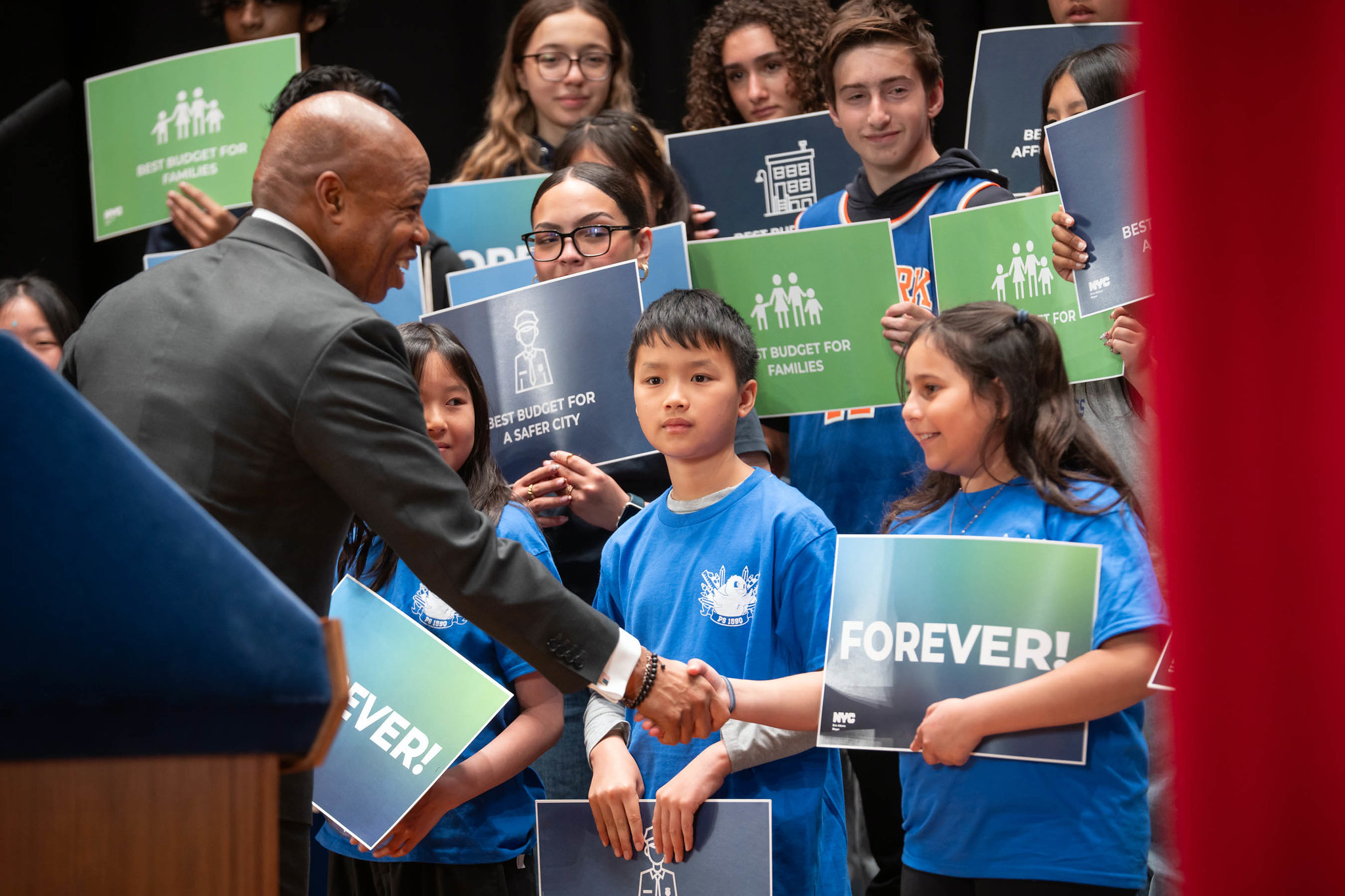
Mayor Eric Adams releases the “Best Budget Ever” — the balanced, $115.1 billion Fiscal Year (FY) 2026 Executive Budget that makes new investments safer, more affordable city that is the best place to raise a family. Bayside High School, Bayside, NY. Thursday, May 1, 2025. Image Credit – Ed Reed/Mayoral Photography Office.
WHAT THEY’RE SAYING: NEW YORKERS PRAISE MAYOR ADAMS’ UNPRECEDENTED $5+ BILLION IN ADVANCE PAYMENTS TO BE MADE TO CITY-CONTRACTED NONPROFIT PROVIDERS, PROVIDING MORE UPFRONT CASH AND CONTRACTS TO PROVIDERS THAN EVER BEFORE
NEW YORK – New York City Mayor Eric Adams yesterday announced that, for the first time in city history, non-profit providers contracted with the city will receive the highest-ever advance payments, estimated at over $5 billion, during Fiscal Year 2026, delivering much-needed upfront resources to organizations that provide critical services to the most vulnerable New Yorkers, including children, justice-involved individuals, older adults, people with disabilities, and those experiencing homelessness.
Here’s what New Yorkers are saying:
“We want to thank the Adams administration for the $5 billion dollar investment that will unlock cash advance payments for the city’s contracted nonprofits,” said Annie E. Minguez, vice president, Good Shepherd Services. “This investment will ensure that contracted providers are able to have cash on hand to perform vital services for New Yorkers. We look forward to our continued work with the administration to identify solutions that address the current fiscal challenges facing nonprofits and to ensure nonprofits are paid on time.”
“Upfront payments are the solution that nonprofits have been asking for. Nonprofits, like any business, cannot survive on the promise of payment,” said Dr. Jocelynne Rainey, president and CEO, Brooklyn Org. “Upfront payments will help stabilize organizations and hopefully start to improve compensation for the nonprofit workers providing services to the residents of our city. We know this approach works because that is how we do it at Brooklyn Org, and we are heartened to see progress being made at the city level to fix this unfair system.”
“Mayor Adams has taken a bold and welcome step in committing $5 billion to remedy the city’s longstanding issues with delayed payments to nonprofit service providers,” said Kristin Miller, executive director, Homeless Services United (HSU). “While much remains to be done to expedite the invoicing and payment processes, we believe this is a big step in the right direction. We applaud the administration’s investment and continuing diligence in moving toward a system where HSU members no longer worry about timely payments as they serve New Yorkers experiencing homelessness.”
“The Chinese-American Planning Council applauds the mayoral administration for its commitment to the nonprofit sector through this historic amount of advances to providers,” said Wayne Ho, president and CEO, Chinese-American Planning Council (CPC). “This new policy goes a long way to reducing stress on human services organizations that are dealing with an increased demand for services and with rising costs of providing these life-saving services. We look forward to working with the city to implement this policy successfully and ensure that it covers all programs in order to provide some much-needed stability for the social safety net.”
“This unprecedented announcement of advance payments for nonprofit providers is a welcome step in the right direction and an example of the administration’s steadfast commitment to supporting New York City nonprofit providers,” said Lisa David, president and CEO, Public Health Solutions. “The $5 billion advance, nearly double the amount of the previous fiscal year will help ensure nonprofits keep their doors open and continue providing the essential services New Yorkers deserve. We thank Mayor Adams for his leadership and partnership as we collectively work to support this dedicated workforce.”
“The Human Services Council, representing over 180 nonprofit human services providers, has fought for years for procurement reform to provide some permanent, forward progress on chronically late payments that make it difficult for nonprofits to navigate serving their communities,” said Michelle Jackson, executive director, Human Services Council. “There is also not one magic fix to solving this decades long problem, and the announcement today that City Hall will provide larger advances on contracts is an important step in creating cash flow relief going forward. Providers still need immediate payment on current contracts, and we look forward to working with the administration and the New York City Council to see more systemic reform and urgent action now so that lifesaving programs can stay open and the nonprofits that millions of New Yorkers rely on can pay their bills.”
“I want to express my profound gratitude to the mayor for his unprecedented and crucial support to the nonprofit sector” said Wesner Pierre, CEO, Partnership With Children. “This move, buttressing the nonprofit sector, which is integral to the infrastructure, safety, and prosperity of New York City, could not come at a more pivotal time. As the CEO of a 117-year-old nonprofit that employs hundreds and serves tens of thousands across all five boroughs of our city, this support directly benefits each of those New Yorkers. For Partnership With Children, this means we will be able to focus on our mission to provide young people growing up in poverty with trauma-informed mental health counseling, community-based programming, and healing-based arts education to break cycles of poverty and become advocates for their communities. And for the rest of the nonprofit sector, this means we can focus on continuing to uplift our city, knowing that a rising tide lifts all boats!”
“This is a powerful and unprecedented investment in the nonprofit sector, and it couldn’t come at a more critical time,” said Tatiana Arguello, executive director, Nonprofit Staten Island. “Advancing over $5 billion at the start of the fiscal year is a clear recognition of the essential role nonprofits play in the health, stability, and future of our city. We applaud the administration for this bold step and look forward to seeing the positive impact it will have on communities across Staten Island and beyond!”
“Today marks a historic moment for our nonprofit sector. For Fiscal Year 2026, the administration will advance over $5 billion to nonprofit providers — a dramatic increase from under $3 billion last year,” said Reverend Dr. Darlene Williams, president and chief consultant, Dr. Darlene Williams Consulting. “This unprecedented investment reflects a bold and necessary commitment to strengthening the vital work of our nonprofit partners. By advancing critical resources at this scale, we are empowering organizations to serve our communities more effectively, sustainably, and with greater impact. We are proud to stand alongside our nonprofit leaders as we build a stronger, more resilient future together.”
Banner Image: New York City Mayor Eric Adams delivers remarks at the American Buddhist Confederation’s Prayer Event at Times Square, on Sunday, May 4, 2025. Image Credit – Benny Polatseck/Mayoral Photography Office

There are no comments yet
Why not be the first