
Staten Island, New York Police Depts Access To Child Care Services, Upstate Estuary Funding Cut Endangers Americans’ Health, PBS Funding Cuts Will Harm Rural Communities Nationwide
Staten Island, New York Police Depts Access To Child Care Services, Upstate Estuary Funding Cut Endangers Americans’ Health, PBS Funding Cuts Will Harm Rural Communities Nationwide
Editor’s note: We recently reported on the success of Senator Gillibrand’s push to keep the Syracuse USDA field office open, which is good news for those who were concerned about bird flu and its affect on egg farms across the state. Without a sufficient number of offices and employees to do inspections, this disease could have devastating consequences as we discussed with John Di Leonardo of Humane Long Island. The Senate has passed the Rescissions Package that removes funding from the Corporation for Public Broadcasting and USAID, thus making permanent and legal the changes made to the grants that were previously contracted to be paid. We have covered the importance of the Corporation for Public Broadcasting, particularly for children in rural and lower income areas around the country, not so much in New York itself.
AS NEW YORK POLICE DEPARTMENTS FACE STAFFING SHORTAGES, GILLIBRAND ANNOUNCES LEGISLATION TO KEEP NEW YORKERS AND LAW ENFORCEMENT FAMILIES SAFE
Bill would establish a pilot program to provide child care services for police officers
WASHINGTON, D.C. – Today, U.S. Senator Kirsten Gillibrand held a virtual press conference to call for the passage of the Providing Child Care for Police Officers Act. This bipartisan bill would provide $24 million in federal funding for each of the next 5 fiscal years to establish a pilot program to provide child care for law enforcement families. Providing child care options for officers could help enhance recruitment, allow families to plan around abnormal work hours, and increase public safety by reducing barriers to a career in law enforcement. Senator Thom Tillis (R-NC) cosponsors this bill in the Senate and Representative Scott Peters (D-CA-50) leads companion legislation in the House of Representatives.
“Police officers play a vital role in keeping communities safe, and officers should not have to choose between taking care of their children and staying in the police force,” said Senator Gillibrand. “This bill would help give aspiring police officers safe, viable child care options while also providing stability to current officers struggling to find care for their kids that works with their nontraditional work schedules. Expanding child care is a win-win for officers and communities, and I’m committed to working across the aisle to get this bill passed.”
The Providing Child Care for Police Officers Act would authorize $24 million in funding for each of the next 5 fiscal years and allows for grants of up to $3 million to individual law enforcement agencies or consortia to establish child care programs for their police personnel. In addition, to ensure parents employed by smaller police departments receive support, 20% of the total grant funding will be set aside for law enforcement agencies employing fewer than 200 officers.
Police officers often work extended hours on a nontraditional schedule. In a recent survey, more than 70% of law enforcement agencies reported that recruitment is more difficult now than five years ago, and at one major metropolitan police department, more than half of officers reported having to leave or miss work due to child care issues. This issue disproportionately impacts women, who make up less than 14% of sworn officers and 4% of police chiefs. Senator Gillibrand’s bill would help increase public safety by reducing barriers to a career in law enforcement and by ensuring the best talent is recruited into our police departments.
This legislation is supported by the following organizations: 30×30, Federal Law Enforcement Officers Association (FLEOA), International Union of Police Associations (IUPA), National Asian Peace Officers Association (NAPOA), National Association of Police Organizations (NAPO), National Fraternal Order of Police (FOP), National Organization of Black Law Enforcement Executives (NOBLE), NYPD Sergeants Benevolent Association (SBA), International Association of Chiefs of Police, Central New York Association of Chiefs of Police, New York State Association of Chief of Police, AFSCME, and Third Way.
The full text of the bill can be found here.
GILLIBRAND SOUNDS THE ALARM ON THE DISASTROUS $8 MILLION CUT TO NATIONAL ESTUARY PROGRAM FUNDING PROPOSED IN FY26 BUDGET THAT WOULD ENDANGER AMERICANS’ HEALTH

Contaminated water can lead to a plethora of health risks; cutting funding to maintain estuary water quality will endanger Americans’ well-being
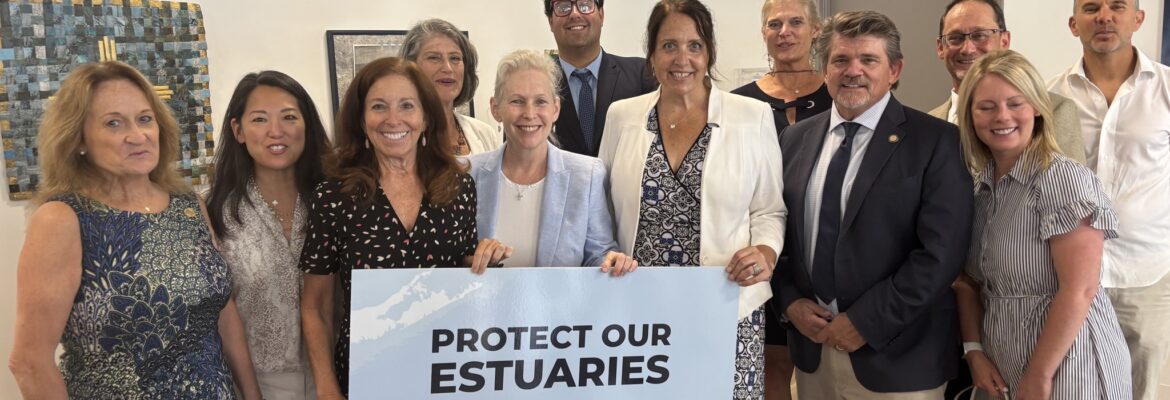
Riverhead, NY – Today, U.S. Senator Kirsten Gillibrand sounded the alarm on the proposed $8 million funding cut from the National Estuary Program (NEP) in the president’s FY26 budget. The NEP works to maintain and restore water quality of 28 estuaries across the United States, including the Peconic Estuary and Long Island Sound. Without sufficient funding, the NEP will not be able to monitor New York’s estuaries and keep them safe from threats such as excess nitrogen pollution, pathogens, and harmful algal blooms, which have been shown to be harmful to public health and the environment. Funding to restore and protect our estuaries also boosts coastal resilience from storms, improves tourism and recreation, and supports local jobs.
“The NEP’s work is not only necessary for the health of the environment, but more importantly, it is necessary for the health of the American people. Cutting the NEP’s funding will lead to disastrous consequences,” said U.S. Senator Gillibrand. “Protecting our estuaries is of the utmost importance, and the president’s proposed funding cut would jeopardize these critical efforts. This is unacceptable.”
Senator Gillibrand has been a longtime environmental advocate and has previously passed legislation to protect the public from environmental risks. In 2018, Senator Gillibrand’s Long Island Sound Restoration and Stewardship Act, which combined and reauthorized two complementary water quality and habitat restoration programs, was enacted as a part of the America’s Water Infrastructure Act of 2018. In February 2025, Senator Gillibrand reintroduced the Long Island Sound Restoration and Stewardship Reauthorization Act to again reauthorize the program. Senator Gillibrand is dedicated to protecting and preserving New York’s natural treasures, and she will continue to fight against any funding cuts to the NEP.
“I lead the bipartisan ESTUARIES Act in the House because I represent two of our nation’s 28 nationally recognized estuaries—and I know they’re vital to our economy, our fisheries, and the coastal way of life we cherish,” said Rep. Nick LaLota. “That’s why I’m proud to join Senator Gillibrand and colleagues on both sides of the aisle to ensure clean water and healthy habitats remain national priorities for generations to come.”
“Reauthorization of EPA’s National Estuary Program is imperative if we want to protect the environment and economy of the East End,” said New York State Assemblyman Tommy John Schiavoni. “The Peconic Estuary Partnership is at the forefront of a collaborative approach to improving water, restoring habitats, and ensuring the resiliency of our communities in the wake of climate change. The continued influx of federal funds is absolutely necessary, and I thank our bipartisan representatives for their unwavering support. “
“As the Suffolk County Legislator for the 1st District, I understand how vital our estuaries are to both the health of our environment and the strength of our local economy,” said Suffolk County Legislator Catherine Stark. “Fully funding the National Estuary Programs is a bipartisan imperative that is essential to safeguarding our coastal communities and preserving these critical natural resources for generations to come.”
“On eastern Long Island, our environment is our economy, and the National Estuary Program stands as a bi-partisan, stakeholder driven success story,” said Bob DeLuca, President of the Group for the East End. “Without question, the program’s generational investment in science-based, clean water and coastal habitat solutions holds the key to solving our most challenging ecological problems. But only through a fully funded National Estuary Program can we and so many other coastal communities hope to continue the critical progress made and meet the many challenges that lie ahead. “
“Operating from the easternmost tip of LI for 55 years, Concerned Citizens of Montauk (CCOM) has been creating awareness and advocacy around the importance of protecting our fragile ecosystems upon which the health of our marine environment depends,” said Kay Tyler, Executive Director of CCOM. “Preserving the National Estuary Program—renowned as one of the most cost-effective environmental initiatives in the nation—is essential for safeguarding the health of our estuaries, which are the seeding grounds to ensuring a harmonious equilibrium among our ecology, environment, and economy.”
“We are grateful for the support of Senator Gillibrand and her recognition of the power of the National Estuary Program to protect both ecosystems and economies. Her commitment to clean water in New York is outstanding,” said Joyce Novak, PhD, Executive Director of the Peconic Estuary Partnership and Chair of the Association of National Estuary Programs. “The National Estuary Program is one of the smartest investments Congress can make in clean water, resilient infrastructure, and local economies. Fully funding the NEP ensures that coastal communities can continue to lead with science, partner across sectors, and deliver real results where they matter most.”
“New York is blessed to have 3 waterways in the National Estuary Program. The Long Island Sound, Peconic Estuary and the NY NJ Harbor have all been designated as Estuaries of National Significance,” said Adrienne Esposito, Executive Director of Citizens Campaign for the Environment. “They are some of our favorite places for boating, kayaking, fishing, crabbing, and swimming. A fully funded NEP program leverages private and state funding for on the ground restoration and protection projects. Thank you to Senator Gillibrand for her commitment to healthy waters in NY.”
“We are grateful to Senator Gillibrand for leading the call to fully fund the National Estuary Program for FY 2026, and to her, and Majority Leader Schumer, Senator Blumenthal, and Senator Murphy for their relentless commitment to ensuring this crucial investment in Long Island Sound and the other 27 estuaries in the program,” said Denise Stranko, Executive Vice President of Programs at Save the Sound. “This is an exciting time, as earlier this summer the Long Island Sound Partnership released its new Comprehensive Conservation and Management Plan, providing a blueprint to forge ahead with efforts to restore Long Island Sound. The investment in a fully funded NEP is indispensable in strengthening our Great Urban Estuary and our coastlines and communities that depend on a healthy, thriving Long Island Sound.”
GILLIBRAND STATEMENT ON SENATE PASSAGE OF THE RESCISSIONS PACKAGE
Washington, D.C. – Today, U.S. Senator Kirsten Gillibrand, a member of the U.S. Senate Appropriations Committee, released the following statement following Senate passage of a rescissions package that claws back funding for public broadcasting that has already been allocated by Congress.
“I’m appalled that Senate Republicans voted to slash funding for the programs that our rural communities rely on. Our public broadcasting system is one of the few remaining institutions committed to providing free, fact-based programming to every American—regardless of zip code. By rescinding funding for the Corporation for Public Broadcasting (CPB), this legislation threatens to gut funding for the local radio and television stations that millions of families rely on for trusted news, high-quality educational content, and lifesaving emergency alerts.
These cuts will have a particularly devastating impact in rural communities, where stations rely heavily on CPB funding to stay afloat and where sources of local news are already limited. Public broadcasters often serve as the only source of information about natural disasters, transportation accidents, national security threats, and public safety matters in areas that face limited connectivity. In emergency situations, the closure of stations and reduction of this programming due to budget cuts could cost lives. On the education front, public television’s early childhood education services help ensure that every family has access to high-quality, non-commercial educational content, regardless of their ability to pay for such services. At a time when misinformation is rampant, taking away this content is dangerous and irresponsible.
Make no mistake; this legislation is not about saving money. Just weeks ago, the same Republicans who now call for cost-cutting at the expense of rural communities voted to give massive tax cuts to the wealthiest Americans and add over $3 trillion to the national debt by supporting President Trump’s so-called ‘Big Beautiful Bill.’ It’s outrageous, and the American people deserve better.
I will keep fighting to protect public broadcasting, support rural communities, and make sure that hardworking families have access to the resources they deserve.”
Banner Image: Protect Estuaries event in Upstate New York. Image Credit – Senator Gillibrand



There are no comments yet
Why not be the first