

Explaining Ripple Effect Of CPB Shutdown On Local, Tribal Stations; PBS, NPR Unbiased, Independent, Free Of Gov’t Propaganda – Provide Key Benefits To US Democracy
Explaining Ripple Effect Of CPB Shutdown On Local, Tribal Stations; PBS, NPR Unbiased, Independent, Free Of Gov’t Propaganda – Provide Key Benefits To US Democracy
Editor’s note: We’ve covered the topic of public broadcasting and its essentiality to childhood education and success. The issues related to an informed electorate are equally or more important. When the population of a democratic republic such as ours is ignorant, this is not helpful for the free flow of ideas and informed choices. Less independent media is a major issue that several organizations are attempting to address. Ethnic and community media, however, especially commercial papers, cannot fill the gap that will be left by public broadcasting’s disappearance. Unfortunately, for many local stations, without federal funding, they’ll be forced to close or reduce hours, coverage, or reporting staff. The states in which local media is most reliant on federal funds are the same states in which many people still don’t have access to or can’t afford broadband internet, there is limited television coverage by major networks in some very rural areas, and thus residents are left in the dark. Many such areas also happen to be swing states.
Clawback of $1.1B for PBS and NPR puts rural stations at risk – and threatens a vital source of journalism
Allison Perlman, University of California, Irvine and Josh Shepperd, University of Colorado Boulder
The U.S. Senate and the House of Representatives approved by narrow margins on July 17 and 18, 2025, a law that claws back federal funding for the Corporation for Public Broadcasting. Once President Donald Trump signs it into law, the US$9 billion rescissions package will withdraw $1.1 billion Congress had previously approved for the Corporation for Public Broadcasting, which distributes money to NPR, PBS, and their affiliate stations, to receive in the 2026 and 2027 fiscal years.
In addition, it makes deep foreign aid cuts. All Democrats present voted against the measure in both chambers. They were joined in the Senate by two Republicans: Sens. Susan Collins of Maine and Lisa Murkowski of Alaska. Two House Republicans also voted no: Michael R. Turner of Ohio and Brian Fitzpatrick of Pennsylvania. The Conversation U.S. asked Allison Perlman and
Josh Shepperd, who are both media scholars, to explain why the measure will have a big impact on public broadcasters.
What will happen to NPR, PBS, and local stations?
NPR and PBS provide programming to local public television and radio stations across the country. The impact on them will be direct and indirect.
Both NPR and PBS receive money from the Corporation for Public Broadcasting, an independent nonprofit corporation Congress created in 1967 to receive and distribute federal money to public broadcasters. More than 70% of the money it distributes flows directly to local stations. Some stations get up to half of their budgets from the CPB.
But NPR and PBS get much of their funding from foundation grants, viewers’ and listeners’ donations, and corporate underwriting. And local public radio and TV stations also get support from an array of sources besides CPB.
Only about 1% of NPR funding, and 15% of PBS funding, comes directly from the government via the CPB. However, once local radio and television stations lose federal funding, they’ll be less able to pay NPR and PBS for the programs they produce.
The nearly 1,500 public media stations in the U.S. rely on a mix of NPR, PBS and third-party producer programming, such as American Public Media and PRX, for the programs they offer. Local stations also produce and air regional news and provide emergency broadcasts for the government.
In rural areas with few broadcast stations and spotty cellphone coverage, public broadcast stations are vital sources of information about important community news and updates during emergencies. Federal support is essential for the programming and day-to-day operations of many local stations and allows for the maintenance of equipment and personnel to operate these vital community resources.
We believe that stations in communities that most need them, especially in rural locations, will be hit especially hard because they rely heavily on CPB funding.
Why are Republicans taking this step?
Public broadcasting has long been a target of conservative Republicans.
They say that with a highly diversified media landscape, the public no longer needs media that is subsidized by federal dollars. They also claim that public broadcasting has a liberal bias and taxpayers should not be required to fund media that slants to the left politically.
Why is public media necessary when there’s news on the internet?
As journalism revenue has plummeted, public broadcasting has remained a vital source for news in communities across the nation. This is especially true in rural communities, where economic and political pressures have threatened the survival of local journalism.
In addition, with much online news coverage placed behind paywalls, public radio and television plays an important role in making quality journalism available to the American public.

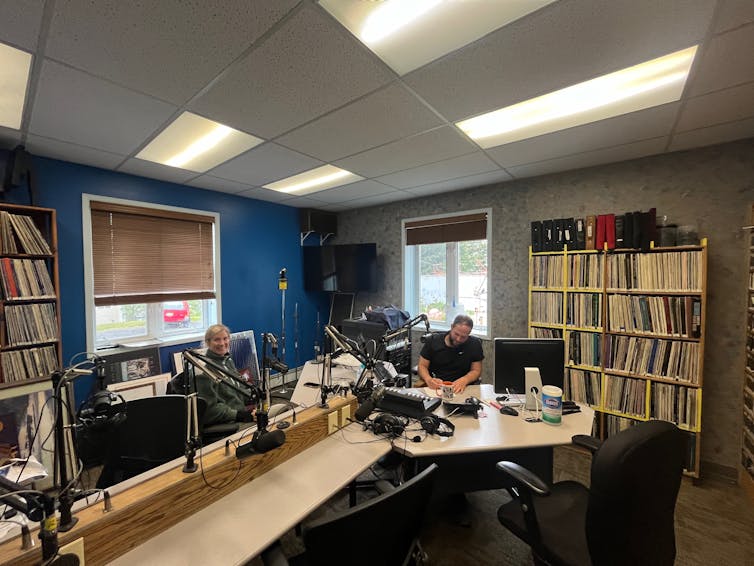
KVMR screenshot
Why did Congress approve these funds 2 years ahead?
Public broadcasting has gotten roughly $550 million per year from the federal government in recent years.
The CPB has always approved and designated those funds two years in advance, due to a provision in the Public Broadcasting Act of 1967, after Congress has voted to provide that money. The CPB then has distributed that funding primarily through grants to PBS and NPR affiliate stations to support their technical infrastructure, program development, and audience research.
What are the consequences for Native communities?
Dozens of Native American stations are at risk of closing once the CPB is defunded. Native Public Media, a network of 57 radio stations and four TV stations, is a key source of news and information for tribal communities across the nation and relies on CPB support.

U.S. Sen. Mike Rounds, a South Dakota Republican, publicly stated that he secured an agreement with the White House to move $9.4 million in Interior Department funding to two dozen Native American stations. But there is no provision related to this promise within the legislation.
This article was updated after the House passed the measure.
Allison Perlman, Associate Professor of Film & Media Studies, University of California, Irvine and Josh Shepperd, Associate Professor of Media Studies, University of Colorado Boulder
This article is republished from The Conversation under a Creative Commons license. Read the original article.
PBS and NPR are generally unbiased, independent of government propaganda and provide key benefits to US democracy
Stephanie A. (Sam) Martin, Boise State University
Champions of the almost entirely party-line vote in the U.S. Senate to erase US$1.1 billion in already approved funds for the Corporation for Public Broadcasting called their action a refusal to subsidize liberal media.
“Public broadcasting has long been overtaken by partisan activists,” said U.S. Sen. Ted Cruz of Texas, insisting there is no need for government to fund what he regards as biased media. “If you want to watch the left-wing propaganda, turn on MSNBC,” Cruz said.
Accusing the media of liberal bias has been a consistent conservative complaint since the civil rights era, when white Southerners insisted news outlets were slanting their stories against segregation. During his presidential campaign in 1964, U.S. Sen. Barry Goldwater of Arizona complained that the media was against him, an accusation that has been repeated by every Republican presidential candidate since.
But those charges of bias rarely survive empirical scrutiny.
As chair of a public policy institute devoted to strengthening deliberative democracy, I have written two books about the media and the presidency, and another about media ethics. My research traces how news institutions shape civic life, and why healthy democracies rely on journalism that is independent of both market pressure and partisan talking points.
That independence in the United States – enshrined in the press freedom clause of the First Amendment – gives journalists the ability to hold government accountable, expose abuses of power, and thereby support democracy.
Trusting independence
Ad Fontes Media, a self-described “public benefit company” whose mission is to rate media for credibility and bias, have placed the reporting of “PBS NewsHour” under 10 points left of the ideological center. They label it as both “reliable” and based in “analysis/fact.” “Fox and Friends,” by contrast, the popular morning show on Fox News, is nearly 20 points to the right. The scale starts at zero and runs 42 points to the left to measure progressive bias and 42 points to the right to measure conservative bias. Ratings are provided by three-person panels comprising left-, right- and center-leaning reviewers.
A 2020 peer-reviewed study in Science Advances that tracked more than 6,000 political reporters likewise found “no evidence of liberal media bias” in the stories they chose to cover, even though most journalists are more left-leaning than the rest of the population.
A similar 2016 study published in Public Opinion Quarterly said that media are more similar than dissimilar and, excepting political scandals, “major
news organizations present topics in a largely nonpartisan manner,
casting neither Democrats nor Republicans in a particularly favorable or unfavorable light.”
Surveys show public media’s audiences do not see it as biased. A national poll of likely voters released July 14, 2025, found that 53% of respondents trust public media to report news “fully, accurately and fairly,” while only 35% extend that trust to “the media in general.” A majority also opposed eliminating federal support.
Contrast these numbers with attitudes about public broadcasters such as MTVA in Hungary or the TVP in Poland, where the state controls most content. Protests in Budapest October 2024 drew thousands demanding an end to “propaganda.” Oxford’s Reuters Institute for the Study of Journalism reports that TVP is the least trusted news outlet in the country.
While critics sometimes conflate American public broadcasting with state-run outlets, the structures are very different.
Safeguards for editorial freedom
In state-run media systems, a government agency hires editors, dictates coverage, and provides full funding from the treasury. Public officials determine – or make up – what is newsworthy. Individual media operations survive only so long as the party in power is happy.
Public broadcasting in the U.S. works in almost exactly the opposite way: The Corporation for Public Broadcasting is a private nonprofit with a statutory “firewall” that forbids political interference.
More than 70% of the Corporation for Public Broadcasting’s federal appropriation for 2025 of US$1.1 billion flows through to roughly 1,500 independently governed local stations, most of which are NPR or PBS affiliates but some of which are unaffiliated community broadcasters. CPB headquarters retains only about 5% of that federal funding.
Stations survive by combining this modest federal grant money with listener donations, underwriting, and foundation support. That creates a diversified revenue mix that further safeguards their editorial freedom.
And while stations share content, each also has latitude when it comes to programming and news coverage, especially at the local level.
As a public-private partnership, individual communities mostly own the public broadcasting system and its affiliate stations. Congress allocates funds, while community nonprofits, university boards, state authorities, or other local license holders actually own and run the stations. Individual monthly donors are often called “members” and sometimes have voting rights in station-governance matters. Membership contributions make up the largest share of revenue for most stations, providing another safeguard for editorial independence.
Nathaniel Herz/Northern Journal
Broadly shared civic commons
And then there are public media’s critical benefits to democracy itself.
A 2021 report from the European Broadcasting Union links public broadcasting with higher voter turnout, better factual knowledge, and lower susceptibility to extremist rhetoric.
Experts warn that even small cuts will exacerbate an already pernicious problem with political disinformation in the U.S., as citizens lose access to free information that fosters media literacy and encourages trust across demographics.
In many ways, public media remains the last broadly shared civic commons. It is both commercial-free and independently edited.
Another study, by the University of Pennsylvania’s Annenberg School in 2022, affirmed that “countries with independent and well-funded public broadcasting systems also consistently have stronger democracies.”
The study highlighted how public media works to bridge divides and foster understanding across polarized groups. Unlike commercial media, where the profit motive often creates incentives to emphasize conflict and sensationalism, public media generally seeks to provide balanced perspectives that encourage dialogue and mutual respect. Reports are often longer and more in-depth than those by other news outlets.
Such attention to nuance provides a critical counterweight to the fragmented, often hyperpartisan news bubbles that pervade cable news and social media. And this skillful, more balanced treatment helps to ameliorate political polarization and misinformation.
In all, public media’s unique structure and mission make democracy healthier in the U.S. and across the world. Public media prioritizes education and civic enlightenment. It gives citizens important tools for navigating complex issues to make informed decisions – whether those decisions are about whom to vote for or about public policy itself. Maintaining and strengthening public broadcasting preserves media diversity and advances important principles of self-government.
Congress’ cuts to public broadcasting will diminish the range and volume of the free press and the independent reporting it provides. Ronald Reagan once described a free press as vital for the United States to succeed in its “noble experiment in self-government.” From that perspective, more independent reporting – not less – will prove the best remedy for any worry about partisan spin.
Stephanie A. (Sam) Martin, Frank and Bethine Church Endowed Chair of Public Affairs, Boise State University
This article is republished from The Conversation under a Creative Commons license. Read the original article.
Banner Image: Broadcast television studio. Image Credit – ThisisEngineering



[…] note: We have covered issues related to the complete cuts to the Corporation for Public Broadcasting, which had been a government-mandated and funded organization for many decades, since Congress […]