
Mennonite Infants Dying At Birth In Upstate NY Communities Due To Lack Of Care: Licensing Certified Professional Midwives Can Help Fill That Need
We met with midwives who are licensed in New York and New Jersey, and are members of or active with the New York chapter of the National Association of Professional Midwives (NARM). NY CPM, LLC, is the New York chapter, and NJ CPM Association is the New Jersey chapter. The two midwives are or have been members of both groups.
These midwives have been fighting for over six years now, possibly closer to eight, for New York to recognize the certification of professional midwives in their licensing requirements. As our closest neighbor, New Jersey has accepted this license since 2001.
New York used to allow it, albeit through an arduous and long process involving challenging the New York Department of Education to make an exception for a CPM. This is how Vicki Hedley was granted her CM license in New York, which she still holds. Dahlyt is a native Staten Islander who was forced to upend her entire life and move to New Jersey, which as many islanders know is not that far away in certain areas.
BUT this means that New York lost an experienced, compassionate, and caring professional midwife to care for our Staten Island homebirth-wanting birthing population. While it is definitely a smaller percentage of families who would want this option, allowing the credential would put more midwives in the home to help people deliver as they want.
However, this is not the crux of the issue that we are discussing. The main issue that is most concerning is that of the minority religious communities of Mennonite and Amish people in Upstate New York. These amount to thousands of people, over 10,000 are estimated.
As mentioned in our article about the movie that Vicki and other New York midwives participated in, Arrest the Midwife!, these women not only have a child practically every year (with an average of more than seven kids per family), they will not go to a hospital (unless a midwife into whose care they have voluntarily submitted themselves tells them it is necessary).
When a midwife is not present (and a doula is not clinical so cannot ‘catch’ a baby legally anywhere, and if informed that there will not be a midwife or other clinical birth professional, they cannot ethically accept the contract), nor any other birth provider, then babies that need resuscitation, as described by the American Heart Association below, will not get that care which they need. In that instance, 1% of those infants would presumably die.
Charts are included in the video and below that show approximate statistics for these communities, of which there are six in the state. Populations for four are estimated, generally by researchers and by exponentially multiplying the original registered population by the anticipated birth rate. This is necessary because Mennonite and Amish do not participate in US Census, health insurance marketplaces, or any other surveying methods normally used to calculate populations among other subgroups. This makes them more difficult to understand than other New York State residents, and also makes their infant mortality, which has certainly increased post-2019 when midwives were arrested that were practicing under the CPM credential, at least 1%, since no one trained in resuscitation is present.
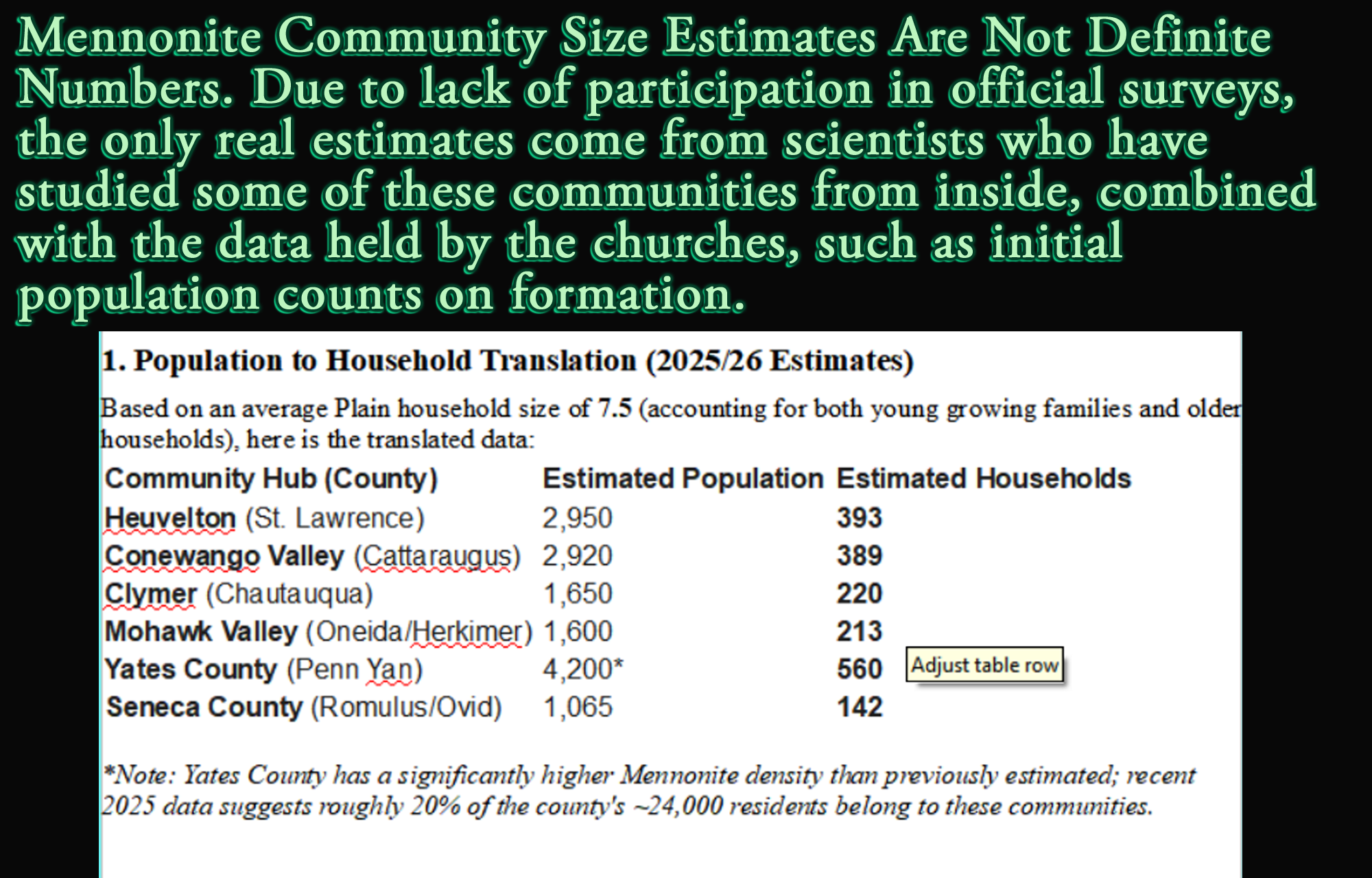
To give you an idea of the real impact of this issue, that means that 1% of all babies born in a given year will not survive the first few minutes after birth. Adding together the estimated number of households (married or church married couple and their kids) for these six communities, dividing the result by 2 (which is 958.5) and then multiplying first by 75% (the average birth rate or number of actively birthing people) then multiplying by 1% gives you an estimate of the number of babies that die each year, which would be 7.19 for all communities. Multiplying this by six, since the midwives were arrested and ultimately removed as providers for their communities, the resultant number of newborns that have likely died since that time is 43 infants. That is a human cost and toll in loss of life that is way too high. And it is totally preventable! If a Certified Professional Midwife, trained in neonatal resuscitation, were allowed to attend a birth by law, the infant would survive because she would provide care. If they could not, they would call for an ambulance before it is too late.
When no one is at a birth to tell the parents that an EMS is needed, they will not call until it is too late. If even Staten Island has over a ten minute response time, then Upstate is certainly worse than that. If they arrive after four minutes, brain damage has already occurred, and the infant will not survive. Since the baby did not survive, and no birth announcements are made in these communities, neither its original potential existence or death is recorded.
The below chart includes neonatal death estimates for only four of the above six communities. The number of actual deaths is even greater than therein estimated, as with the addition of the other communities, the total estimated and likely infant mortality number is 57.5 actual babies that did not survive due to the onerous laws in New York. This is not because of a lack of interest, but is more because of a lack of funds to attain the required degree or to sign up for student loans to pay for it. As mentioned in the article about the movie, if someone does get student loans for a Master’s Degree, they really have to work in a hospital setting. Serving the Upstate Mennonite communities as a birth attendant would require them to charge much lower rates, in order for the members of the communities to afford their services. As mentioned in the video, Melissa Carman and by extension Elizabeth Catlin were charging rates of around $500 per family. This works out to a very low hourly rate, since they have multiple prenatal and postnatal visits for each patient.
The only birth center in the area has a per-patient charge of $5,000, or a tenfold higher rate. The people in those areas often cannot afford this high rate, and they wanted to keep their midwives in their community. But the state has persisted in its belief, which is against most of the evidence, that the only safe birth is a hospital birth. That same philosophy has guided the rulemaking for freestanding birth centers, which in other states are accredited by the Commission for the Accreditation of Birth Centers (CABC), but in New York they must be accredited by the Public Health and Health Planning Council (PHHPC), which also requires a minimum two-year real estate investment before a Certificate of Need is approved, and sometimes it is not approved at the end of the process. In other states, birth centers are understood to work in concert with hospitals, rather than being seen as a replacement that must follow even stricter rules than those required for hospitals. As a result, the entire state has only three.
On a side not, this is even worse than the situation faced by the cannabis dispensaries, which were also required to maintain real estate investment at a loss, before being allowed to open. Due to public pressure and outcry, which is very strong in that community, the state has finally released and approved the licenses for a decent number of dispensaries to open on the island itself after forcing the governor to do something about it. This situation with birth centers can literally be a matter of life and death for New York State residents, since many women cannot make it to their closest hospital in time to deliver there. This applies primarily in the rural areas of Upstate New York, where people live but services are sparse. While often self-sufficient in other ways, birth care is a necessity they are not getting.


The following information is provided by the American Heart Association on infant resuscitation and how this need can be anticipated:
“It is estimated that approximately 10% of newly born infants need help to begin breathing at birth,1–3 and approximately 1% need intensive resuscitative measures to restore cardiorespiratory function.4,5 The neonatal mortality rate in the United States and Canada has fallen from almost 20 per 1000 live births6,7 in the 1960s to the current rate of approximately 4 per 1000 live births. The inability of newly born infants to establish and sustain adequate or spontaneous respiration contributes significantly to these early deaths and to the burden of adverse neurodevelopmental outcome among survivors. Effective and timely resuscitation at birth could therefore improve neonatal outcomes further….
Anticipation of Resuscitation
Every birth should be attended by one person who is assigned, trained, and equipped to initiate resuscitation and deliver positive pressure ventilation. Additional personnel are necessary if risk factors for complicated resuscitation are present. Equipment checklists, role assignments, and team briefings improve resuscitation performance and outcomes.”
Below is our introduction and brief discussion of the issues related to the laws in New York regarding the CPM credential and birthing people in the Mennonite and Amish communities. While these issues also apply to other groups, including minorities and BIPOC women, Orthodox Jewish women, and others, mostly they do go to a hospital, or they are close enough to a birth provider that they can have a home birth. There are a small number of midwives with the CM and CNM credential who provide this service.
Upstate is not quite so easy. By Penn Yan (the town focused on by the movie), there is one birth center and one hospital. As Vicki mentions, the midwives in 2019 were charging a mere $500 for the entire course of care from prenatal to delivery and postpartum. The birth center there now charges $5,000, and elsewhere in New York it is closer to $7-10,000. This also becomes an issue of affordability when it comes to these small farmers:
We’re meeting today with members of the NJ and NY Certified Professional Midwives associations. In New Jersey, CPMs are licensed as birth professionals, and they’ve been improving outcomes and positive birth experiences since 2001. In New York, these exact same professionals are felons if they practice their profession. Unlike NJ, New York State has put in place a requirement that every midwife must have a Master’s degree, at a very high cost, essentially shutting out many of the people who would have wanted to choose this career path. They are relegated to non-birth related careers or to becoming a doula or to leaving the state, as many of the best midwives already have. In 2010, the NY law referenced above was passed. And in 2019, a single infant death led to a witch hunt and the arrest and de- professionalization of every midwife working in Upstate New York at that time. Things have not improved since then, and there are more maternity deserts than there were before.
The reason this is important and why we’re here today is that Upstate New York is home to at least six communities of Amish and Mennonite families. These are the “Invisible Constituents” of the state’s elected officials. They speak English as a second language (their first being Dutch) They don’t use electricity, they don’t use computers or typewriters. They sew their own clothes and farm without heavy machinery. They don’t participate in the us census and don’t buy health insurance. And most importantly, they do not and most of the time will not go to a hospital to give birth. Or a birthing center if one was accessible to them (New York is not making the process of opening centers easy). They deliver babies at home, on average 7-14 per family. And they do so unattended, catching each other’s babies, with no one experienced or trained in delivering babies or in assisting when things go wrong present at their births.
This has importance in part because of the statistics provided by the American Heart Association: “Approximately 10% of infants require help to begin breathing at birth, and 1% need intensive resuscitation.” This means that since 2019, these communities have been forced to reckon with a 1% infant mortality rate that they didn’t have as severely as before 2019 and they may not have had any mortality. These deaths are Invisible as well since the pregnancy isn’t recorded and neither is the death.
Starting in 2010 was an exodus of midwives from New York, leaving a void. Many of these communities are now maternal care deserts, with no hospital, birth center, or any prenatal care within 30 minutes of their home (by car, which some of them also don’t have). We’re here to talk about some of the possible changes in Albany, along with some of the obstacles and possible solutions to bring New York on par with our closest neighbor, New Jersey, which is making progress in this area with more likely to come in the future.
We discussed a number of important topics related to midwifery and New York State, including the possibility for change poltically. Next weekend, look out for Part 2 of this interview.
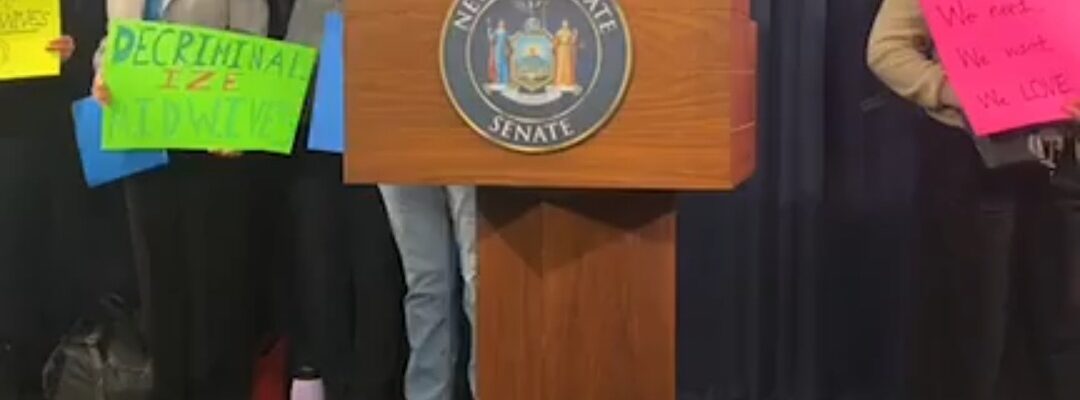
Banner Image: NY CPM protest in Albany. Image Credit – NY CPM LLC



Staten Islander News Service Staff Writer
This byline indicates that this article was penned by a member/members of the Staten Islander News Organization office team. Our staff writers are the backbone of our newspaper, performing all sorts of important tasks like conducting interviews, investigating leads, besides writing the news stories you see.
[…] note: We recently interviewed New Jersey midwives, including a native Staten Islander who decided to move off of State… with many education and experience in delivering healthy babies. We also reviewed the excellent […]
[…] issues related to maternity care deserts in our midwife interviews, with representatives from the New York Certified Professional Midwives and New Jersey Certified Professional Midwives. Due to the prevalence of Mennonite communities in […]
[…] was created to ease the financial burden that careers requiring graduate degrees can bring. We have discussed this very topic more in-depth as it relates to the practice of midwifery in New Yo…. However, due to the requirement, rare among the states, for a Master’s Degree level of […]
[…] New York is one of only 11 remaining states in the country that has this high bar to entry for midwifery, which itself has better outcomes and precents neonatal deaths that result from giving bir…. This one benefit of CPM’s, who are often the only midwives that want to serve rural […]