
Alternate Side Parking Suspended, More Red Light Cameras, Madison Avenue Fast Buses, Court St Redesign Upheld, St. Marks Pl Sign Drop: NYC DOT
Alternate Side Parking Suspended, More Red Light Cameras, Madison Avenue Fast Buses, Court St Redesign Upheld, St. Marks Pl Sign Drop: NYC DOT
Editor’s note: At the end of the last administration, there was a last episode of Curb Enthusiasm with the previous Commissioner of the department, along with new street redesigns and other important accomplishments. Fans of the podcast are awaiting their next episode announcements. Public battery swapping stations have also been implemented to help working class New Yorkers that are freelance gig workers who use e-bikes to make their deliveries in order to help the environment by reducing their own emissions.
SUSPENSION OF ALTERNATE SIDE PARKING REGULATIONS
The Mamdani administration today announced that Alternate Side Parking Regulations will be suspended through Sunday, February 8, 2026, to facilitate ongoing snow operations. New Yorkers are encouraged to shovel out their vehicles Tuesday, with temperatures forecasted to drop through the rest of the week.
Payment at parking meters will remain in effect throughout the city.
NYC DOT BEGINS ACTIVATING ADDITIONAL RED LIGHT CAMERAS TO PROTECT NEW YORKERS AT CITY INTERSECTIONS
City to begin activating red light cameras at 50 new intersections each week for the next five weeks, with goal of reaching 600 intersections by end of 2026
Red light cameras have proven to improve safety, reducing red-light running by 73 percent, T-bone crashes by 65 percent, and rear-end collisions by 49 percent
NEW YORK – New York City Department of Transportation (NYC DOT) Commissioner Mike Flynn today announced that NYC DOT has begun activating additional red light cameras across the city to protect New Yorkers as they travel through intersections. NYC DOT will activate red light cameras at 50 new intersections per week over the next five weeks. Prior to the expansion that is now underway, red light cameras were in place at just 150 intersections—the maximum previously allowed under state law. The state legislature authorized the city to expand red light cameras to a total of 600 intersections. NYC DOT will complete the expansion to all 600 intersections by the end of 2026.

“Red light running is one of the most dangerous behaviors on our city’s streets and puts all New Yorkers at risk. That is why we are taking immediate action to ramp up the city’s red light camera program,” said NYC DOT Commissioner Mike Flynn. “These cameras have reduced red light running 73 percent in the intersections where they are installed, and we will pair this heightened enforcement with ambitious street redesigns to make our streets safer.”
The city’s red light camera program has operated for 30 years and is highly effective. Where cameras have been installed, NYC DOT recorded a 73 percent decline in red-light running, a 65 percent decline in T-bone crashes, and a 49 percent drop in rear-end collisions. These cameras help crack down on the most dangerous drivers on city streets; vehicles that receive five or more red light camera violations in a year are more than 100 times more likely to be involved in a crash that kills or seriously injures someone.
The program has also proven to change driver behavior and prevent repeat offenders. In 2023, 94 percent of vehicles caught running a red light received no more than one or two violations. Fewer than 0.5 percent of vehicles received five or more violations.
Additional cameras will be placed at intersections across the five boroughs based on criteria including crash history.
“New Yorkers should not have to fear for their lives every time they cross the street,” said State Senator Andrew Gounardes. “I passed the law to expand the red light camera program for a simple reason: we know it works. The reality is, most drivers don’t run red lights. But those drivers, along with everyone else, are safer when the ones who do are held accountable. Decades of data makes it clear: these cameras reduce crashes and save lives. Thanks to DOT for implementing this important program so more New Yorkers are safe on our streets, however they get around.”
“This expansion of red light cameras in NYC will ensure the safety of many New Yorkers for years to come. It is proven that these cameras have reduced collisions, decreased the frequency of drivers running red lights, and improved overall driver behavior,” said Assemblymember Jeffrey Dinowitz. “My legislation to increase the amount of red light cameras in our five boroughs has shown to be essential in keeping our streets safe. I applaud the NYC DOT for activating these new red light cameras swiftly and smoothly. By 2026, 600 intersections will be upgraded, improving public safety in countless neighborhoods. If you don’t want a red light camera ticket, stop for a red light. These cameras will save lives.”
“The data on red light cameras couldn’t be more clear – they change driver behavior and save lives,” said Councilmember Lincoln Restler. “The City Council was proud to help lead the way on life-saving legislation to quadruple the number of red light cameras in NYC, and now under the leadership of Mayor Mamdani and Commissioner Flynn, we will finally have cameras installed at 600 dangerous intersections to make our communities safer.”
“Keeping New Yorkers safe at dangerous intersections must always be the priority, and any tool used to do that should be deployed thoughtfully and transparently,” said Councilmember Selvena N. Brooks-Powers. “As the City expands red-light cameras, it’s critical that placements are driven by crash data, paired with strong street design improvements, and regularly evaluated to ensure they are reducing injuries. I look forward to our continued partnership with the Department of Transportation to ensure this rollout delivers real safety benefits and is implemented equitably.”
“Red light cameras save lives — and expanding this critical program will make streets and intersections safer across New York,” said Ben Furnas, Executive Director of Transportation Alternatives. “For years, we’ve had red light cameras at just 150 intersections in New York City, and we’ve fought to reauthorize and expand this program. We’re grateful to our legislators in Albany for passing this legislation, the governor for signing this bill to expand an already successful program, and DOT for upgrading hundreds of intersections with this technology. As we work towards reaching Vision Zero, we need every tool at our disposal, and red light cameras are an essential part of that work.”
“In 2017, I was struck by a turning driver on New Year’s Eve as I was crossing the street in Lower Manhattan. I continue to experience the physical and psychological trauma caused by this crash. We must take action to prevent others from living the confusion and pain of loss and serious injury caused by car crashes,” said Families for Safe Streets Co-chair Kate Brockwehl. “Red light cameras are a quick and commonsense solution to preventing crashes and tragedy on our streets. We wholeheartedly support increasing the size and scope of the City’s red light camera program, and we look forward to working with DOT to expand other street safety initiatives across the five boroughs.”
“Red light cameras save lives. They’re incredibly effective at changing behaviors, and they’re a powerful tool in making our streets more secure,” said Sara Lind, co-executive director at Open Plans. “Expanding the program to the full extent allowed by law will reduce crashes and avoid further tragic deaths. We commend DOT for taking action to keep New Yorkers moving safely around the city.”
“Regional Plan Association (RPA) applauds NYC DOT’s continued efforts to equitably enhance the safety of New York City streets,” said Tiffany-Ann Taylor, VP of Transportation at RPA. “Activating these additional cameras expands the DOT’s ability to reduce crashes and avoidable traffic violence by tracking down dangerous drivers to hold them accountable. RPA continues to support the DOT in changing driver behavior to get the city closer to its Vision Zero goals.”

Red light cameras. Image Credit – NYC DOT
FAST BUSES: MAMDANI ADMINISTRATION MOVES FORWARD WITH STALLED MADISON AVENUE BUS LANE PROJECT
Delayed bus lane redesign will be completed this year, making buses faster and more reliable for 92,000 daily local and express bus riders from all five boroughs
Project will extend existing double bus lanes on Madison Avenue, from 42nd Street south to 23rd Street, where buses crawl at speeds as low as 4.5 miles per hour
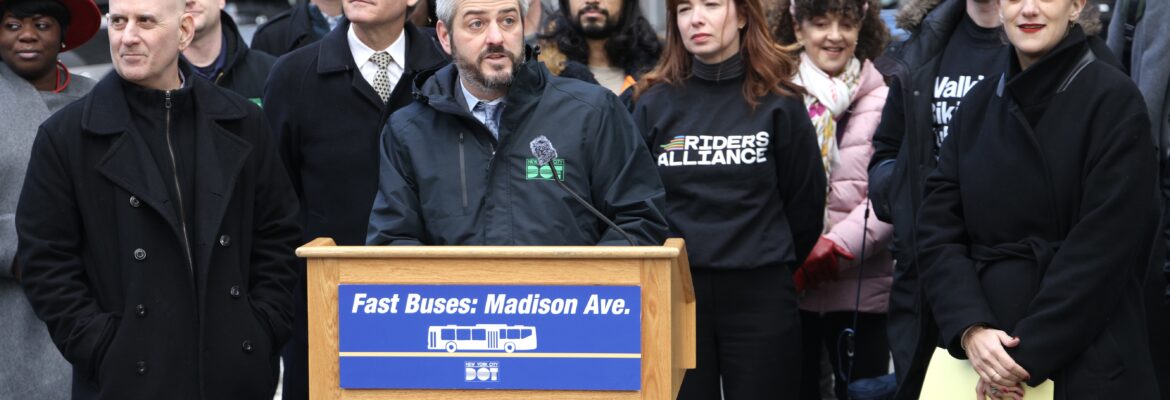
NEW YORK – New York City Deputy Mayor of Operations Julia Kerson and New York City Department of Transportation (NYC DOT) Commissioner Mike Flynn announced the agency will complete a stalled street redesign extending double bus lanes on Manhattan’s Madison Avenue from 42nd Street south to 23rd Street. The project will make buses faster and more reliable for 92,000 daily local and express bus riders from all five boroughs and support the Metropolitan Transportation Authority’s congestion pricing program by making it easier to commute to Manhattan’s core without a car. Commissioner Flynn announced the redesign will be completed this year alongside Deputy Mayor Kerson at Madison Square Park on Sunday.
“The Mamdani Administration is serious about keeping this city moving. Installing new bus lanes on Southern Madison Avenue will speed up commutes for nearly 100,000 riders a day. That saves New Yorkers time, money, and headaches,” said Deputy Mayor for Operations Julia Kerson. “That’s real impact, and I want to thank DOT for delivering it.”
“Madison Avenue is one of the most important bus corridors in the city, yet tens of thousands of riders are crawling along at walking speed,” said NYC DOT Commissioner Mike Flynn. “It’s time to deliver this project and give buses the dedicated space they need so working New Yorkers can get where they’re going faster.”
“Bus lanes are key to getting buses through traffic and keeping riders moving,” said NYC Transit President Demetrius Crichlow. “It’s great news that NYC DOT is moving forward on longstanding bus lane legal commitments to speed up buses on Madison Ave. When paired with bus lane enforcement, nearly 100,000 riders of the M1, M2, M3, M4, Q32, and express buses going to midtown, will save time getting where they need to go.”
Madison Avenue today features two bus lanes, two travel lanes, and one parking lane from 60th Street to 42nd Street, serving 34 local and express bus routes. NYC DOT data shows buses along these routes are often bogged down in traffic below 42nd Street, where riders are stuck traveling as slow as 4.5 miles per hour—nearly half the citywide average bus speed of 8.1 miles per hour. On this stretch of Madison Avenue south of 42nd Street, 55 percent of people on the street are riding the bus—but with no dedicated space prior to this project.
To speed up service, NYC DOT in 2025 proposed extending the double bus lane design south to 23rd Street, with plans to install the project last year before it was paused, delaying critical improvements for transit riders. Along with the two bus lanes, the redesign south of 42nd Street will feature one travel lane, as well as one parking/rush-hour travel lane.
Data shows that double bus lanes can effectively speed up buses. After double bus lanes were installed on the neighboring Fifth Avenue, local bus speeds improved between six and 12 percent, and express bus speeds improved between 11 and 20 percent.
Today’s announcement follows the Mamdani administration’s recent moves to revive critical street redesign projects on McGuinness Boulevard in Brooklyn and 31st Street in Queens.
“One year after the implementation of congestion pricing, it is clear that it is working and making New York better. There’s less traffic, safer streets, and cleaner air. And it allows us to reimagine our streets for improvements such as the extension of the Madison Avenue bus lane south to 23rd Street,” said U.S. Representative Jerrold Nadler. “I’m proud to join the Mamdani Administration today and announce this important investment in public transit.”
“As an early supporter of the 14th Street busway, I knew what we all know today: bus lanes have led to faster and more reliable commutes for riders,” said Councilmember Harvey Epstein. “I applaud DOT’s decision to complete the redesign on Madison Avenue to extend the double bus lane. The sooner this project is implemented, the sooner 90,000 daily riders will start to enjoy the benefits of increased bus speeds along this corridor.”
“The Madison Avenue Bus Improvement Project will make our transit system work better by speeding up buses along one of the East Side’s busiest corridors. It strengthens our economy, protects our environment, and delivers immediate benefits to straphangers,” said Councilmember Virginia Maloney. “Faster buses, safer streets, and less congestion are major wins for East Siders.”
“Bus riders will get a badly needed boost when the Mamdani administration extends double bus lanes a mile south to Madison Square Park,” said Betsy Plum, executive director of the Riders Alliance. “After years of bus priority projects being frozen out, riders who depend on buses every day will enjoy a welcome spring thaw of faster service. And this should just be the beginning. Once summer hits, we look forward to seeing the town painted red, with bold action for bus riders citywide, from Fordham Road to Flatbush Avenue and everywhere in between.”
“Regional Plan Association (RPA) applauds the NYC DOT progress towards the implementation of the double Manhattan Midtown bus lanes on Madison Avenue,” said Tiffany-Ann Taylor, vice president of Transportation at the Regional Plan Association. “Buses are a critical component of the city’s transit network, and their movement deserves to be prioritized to ensure greater mobility systemwide. Giving riders more options on our streets helps to reduce congestion, making travel faster across the Central Business District.”
“We couldn’t be happier to celebrate this expanded bus lane right in the center of the congestion relief zone,” said Ben Furnas, executive director of Transportation Alternatives. “This upgrade will build on congestion pricing’s success to bring faster, more reliable commutes to almost 100,000 New Yorkers. This is a step forward for all bus riders in New York City, and we look forward to new, improved, and expanded bus lanes in every corner of the five boroughs.”

Announcement. Image Credit – NYC DOT
STATEMENT FROM NYC DOT COMMISSIONER MIKE FLYNN ON JUDGE’S RULING UPHOLDING BROOKLYN’S COURT STREET REDESIGN
NEW YORK – New York City Department of Transportation (NYC DOT) Commissioner Mike Flynn issued the following statement in response to a judge’s favorable ruling on the agency’s redesign of Court Street in Brooklyn:
“The redesign of Court Street reflects a proven approach used across the city and around the world—one that has been shown to improve safety for everyone, whether they’re walking, biking, or driving, and to support local businesses. We appreciate the court’s ruling, which affirms the city’s ability to deliver street improvements that protect the people who live, work, shop, and take their children to school on Court Street.”
In 2025, NYC DOT redesigned Court Street, from Schermerhorn Street to Hamilton Avenue, to bring comprehensive safety improvements for everyone—whether they are biking, walking, or traveling by car—on one of the most dangerous streets in Brooklyn. The redesign added a parking-protected bike lane, shorter pedestrian crossings with new pedestrian islands, and aims to cut down on reckless driving. Similar projects around the city have shown to reduce traffic deaths and serious injuries for everyone by 30 percent.
NYC DOT RELEASES LIMITED BATCH OF ST. MARK’S PLACE SIGNS HONORING THE ICONIC AND HIP EAST VILLAGE CORRIDOR
NEW YORK – New York City Department of Transportation (NYC DOT) Commissioner Mike Flynn announced that a limited number of authentic St. Mark’s Place street signs will be on sale. St. Mark’s Place is a three-block segment of East 8th Street between Third Avenue and Avenue A, that is famous for capturing the East Village’s creative spirit. Today’s release is part of the agency’s monthly ‘sign drops,’ where the agency sells limited batches of authentic, hand-made signs produced by the NYC DOT Sign Shop, which fabricates over 70,000 street signs each year.
“St Mark’s Place captures the spirit of East Village, and now you can bring a piece of it home,” said NYC DOT Commissioner Mike Flynn. “So many great artists, writers, musicians and intellectuals spent time along this corridor, and it remains bustling and filled with energy today.”
St. Mark’s Place was originally residential and wealthy in the early 1800s, notable for Federal and Greek Revival townhouses. One famous dwelling amongst many notable addresses was the Hamilton Holly House at 4 St. Mark’s Place, which was the home to Alexander Hamilton’s widow Eliza. As New York changed and immigration brought new waves of New Yorkers to the east side of Manhattan, the townhouses were replaced by tenement living and boarding houses leading into the 20th Century. The new arrivals to the community were primarily German and Polish, with half of New York’s population living in the area by 1855 and the area becoming known as Kleindeutschland, or Little Germany. Another significant arrival to the area in the same era (1834) was the creation of Tompkins Square Park, which begins where St. Mark’s Place terminates at Avenue A.
The 20th Century brought new society, culture, counter-culture, music, and much more to the St. Mark’s Place strip. Famous residents over the century included Emma Goldman, Abbie Hoffman, and Leon Trotsky from the activist world, as well as W.H. Auden, William Burroughs, James Fenimore Cooper, and Allen Ginsberg from the literary world. Musician Debbie Harry of Blondie lived on the corridor, while artists Jean-Michel Basquiat, Keith Haring, and Andy Warhol were affiliated with nightclubs on St. Mark’s Place, including Club 57 and Electric Circus. Musically, both The New York Dolls (self-titled, debut album) and Led Zeppelin (Physical Graffiti) shot album covers on street corner bodegas in the mid-1970s. The Five Spot Jazz Club hosted musicians such as Billie Holiday, Thelonious Monk, Ornette Coleman, Charles Mingus, John Coltrane, and Miles Davis in 1950s and 1960s. More recently, Jeff Buckley performed his EP live at Sin-é in 1993.
Today the St. Mark’s Place corridor holds a substantial footprint in New York City culture with clothing shops, tattoo shops, restaurants, and nightlife.
A limited release of 50 signs will be sold online for $100 each and are available one per customer. All signs will be sold via the CityStore, the Official Store of the City of New York, and proceeds will benefit the city’s general fund. This signage offers a bit of nostalgia and a literal piece of the city’s infrastructure.
Monthly sign drops from NYC DOT feature signs for iconic New York City streets, commemorations of famous New Yorkers, celebrations of special occasions, and other custom releases. NYC DOT began its monthly drops in June 2024, with the release of Christopher Street/Stonewall Place street signs to commemorate Pride Month.
Other recent sign drops include:
- 5th Avenue
- Bleecker Street
- Mulberry Street
- Hip Hop Boulevard to celebrate the genre’s musical and cultural legacy
- Welcome to Queens: The World’s Borough
- Gay Street in recognition of Pride Month
- Wall Street
- Leaving Brooklyn: Fuhgeddaboudit
- East 161st Street and Shea Road in honor of baseball’s opening day
- Love Lane to recognize Valentine’s Day
- Broadway in celebration of Broadway Week
- Cornelia Street to honor the street’s prominence among pop music fans
About the NYC DOT Sign Shop
The New York City DOT Sign Shop is in Maspeth, Queens and manufactures over 70,000 signs each year. A team of 32 Sign Shop employees hand-make street signs, highway signs, directional signs, parking signs, and more. There are about one million NYC DOT signs in use across the 6,000 miles of streets in New York City.
The monthly sign drops are the latest iteration of sales that have historically been available from the Sign Shop.
About the CityStore
CityStore is the Official store of the City of New York. CityStore is operated by the New York City Department of Citywide Administrative Services. 100% of sales benefit the City of New York.
CityStore is similar to a museum store, which complements the museum by highlighting the treasures within while serving as a stand-alone retail entity for wonderful gifts, collectables and research materials. A museum store is a revenue source for the museum and reinforces and protects the integrity of the museum brand. CityStore is the ‘museum store’ for the entire City of New York.

St Mark’s Pl Sign. Image Credit – NYC DOT
Banner Image: Bus Announcement. Image Credit – NYC DOT



NYC DOT
The New York City Department of Transportation’s (NYC DOT) mission is to provide for the safe, efficient, and environmentally responsible movement of people and goods in the City of New York and to maintain and enhance the transportation infrastructure crucial to the economic vitality and quality of life of our primary customers, City residents.
There are no comments yet
Why not be the first