
NYC Mayor’s New Budget Proposal: Residents, Local Politicians Speak Out Unanimously Against It: UPDATED
New York City residents, and Staten Islanders in particular, pay some of the highest property tax rates in the country, closely following California. Mayor Mamdani’s proposed hike of 9.5% would be across the board, applied to all residences equally, across the board, regardless of value. In addition, the City will be raiding the Rainy Day Fund, as well as the trust fund designed to cover the city’s obligations to pay premiums for their retired workforce. This fund was already set to run out of money and be unusable for its intended purpose, and this threatens to accelerate that issue, leaving another deficit.
Unfortunately this fund has already been raided many times and is an issue according to the Comptroller’s latest audit.
Regarding the ‘millionaire tax,’ in the several other states that instituted such a tax, at a much higher rate than that proposed here, there was either a very small initial migration or none at all. In California, the initial migration was followed by steady growth in numbers of millionaires – and thus their tax revenue. In Massachusetts, revenues were higher than anticipated, making it easier for the state to pay for improvements, specifically earmarked for roads and schools. Similar success was seen in Washington DC. This is according to a nonpartisan group of economists.
The wealth tax and corporate tax increase would require approval by Albany and the governor. Whereas a property tax increase would have to be approved by the City Council. New York City’s taxes haven’t increased since Mayor Bloomberg was in office, in 2003.
Already, NYC ranks last by some measures regarding taxation favorability, the rates paid by property owners are more than only five other states including New Jersey. There’s also a rule that anyone employed by a New York business has to pay income tax to this state regardless of other contact within the state. From the Tax Foundation:
New York has a high top individual income tax rate of 10.9 percent and is one of only two states with a “tax benefit recapture” provision, where the benefit of lower rates is phased out and a taxpayer’s top rate is ultimately applied to all income, not just marginal income above a certain level. In addition, some jurisdictions collect local income taxes, including New York City, which imposes a progressive income tax with a top rate of 3.876 percent. New York also has a graduated corporate income tax, with rates ranging from 6.5 percent to 7.25 percent. The state maintains a capital stock base within its corporate income tax, which was scheduled to phase out but has yet to be eliminated. While the state sales tax rate is reasonable at 4 percent, the average combined state and local sales tax rate is much higher, at 8.54 percent, and the base is especially narrow, with both groceries and clothing exempt.
New York is an outlier in imposing a “convenience of the employer” rule on taxpayers, requiring nonresident individuals to pay New York income taxes if they are employed by a business located in the state, even if they have minimal contacts with New York otherwise. This creates double taxation for remote employees of firms headquartered in New York, unless an allowance is provided by the other state. This also adds to compliance costs for tax filers.
New York is not the highest property tax rate (that title belongs to New Jersey), but it’s 46th out of 51 as far as nationwide ranking by cost of effective real estate tax rate:

Below are the statement from Island politicians who have spoken out about this proposal and the Mayor, :
Pirozzolo on Mayor Mamdani Raising Taxes

A statement by Assemblyman Sam Pirozzolo (R, C-Staten Island)
“The mayor campaigned on affordability and equity. Overall, a tax increase does not address either. What we need is equity. When Former Mayor Bill DeBlasio’s multi-million dollar brownstones are taxed less than some Staten Island homes, there is an obvious problem. Let’s fix the problem.”
Assemblyman Sam Pirozzolo represents the 63rd Assembly District, which encompasses parts of the North Shore, including Emerson Hill, Sunnyside, Bloomfield, Travis and Chelsea.
A Statement from Borough President Vito Fossella Opposing Any Proposed Tax Increase in the FY 2027 Preliminary Budget
Staten Island, NY – Borough President Vito Fossella issued the following statement regarding plans to raise taxes to address gaps in the proposed FY 2027 budget:
“We strongly oppose any tax hikes to close the $5.4 billion gap in the FY 2027 budget.
We have said since day one that year after year of irresponsible policy decisions – the sanctuary city policy, and “right to shelter”, for example – would be unsustainable. We were right. $8 billion, and counting, have been spent continuing to provide unlimited emergency housing to migrants. There are countless examples of irresponsible spending that have gotten us to this point.
Now, instead of getting smart with the budget and practicing good governance, the City’s answer is to wave the white flag of surrender.
Raising property taxes, as has been proposed, is bad policy and bad punishment, flying in the face of the hardworking taxpayers who keep this city running – the homeowners, small businessowners and families who have already shouldered record-high assessments and inflation.
This will be yet another example of Economics 101: when commercial and residential property owners receive higher tax bills (commercial owners can see as high as a 30% increase), those higher taxes will be passed onto the renters in the form of higher rents, so they will suffer too.
New Yorkers were told progressive policies would build a fairer city. Instead, they have delivered record shelter costs, strained budgets, and now a threatened tax hike on property owners. We must fight any tax increase at every level, because the people of New York have paid enough for failed experiments.
The solution is not higher taxes. The solution is smarter, tougher, and more responsible governance. We predicted the problem. Now is the time to fix it — not double down and send the bill to working families.”
Malliotakis Slams Mamdani’s Proposed Property Tax Hike
(NEW YORK, NY) — Congresswoman Nicole Malliotakis released the following statement following New York City Mayor Zohran Mamdani’s proposal to increase NYC’s property taxes for the first time in more than two decades.
“As a House Ways and Means Committee Member, I fought to increase the State and Local Tax (SALT) deduction and deliver tax cuts for working Americans, middle-class families, and senior citizens on the federal level so New Yorkers could keep more of their hard-earned money. I worked with President Trump and my colleagues in Congress to quadruple the amount that my constituents could deduct in local, state, and property taxes to provide necessary relief from New York City’s high tax burden, not so this socialist mayor can tax and take more from them. Property owners pay enough taxes in this city.
Year after year, City Hall squeezes the middle-class for more by raising the property tax levy, and now Mamdani wants to raise the rate, making the American dream of homeownership less attainable and the cost of housing even more unaffordable for property owners and renters alike. Instead of further treating New York taxpayers like ATMs and driving out more families from our city, Mayor Mamdani should cut the bloat, slash the waste, and abandon the Marxism and misguided policies he has planned.”
Statement from Christie Peale, CEO & Executive Director, Center for NYC Neighborhoods, on Mayor Mamdani’s Proposed Property Tax Hike
“New York City’s working-class homeowners are the foundation of strong, vibrant neighborhoods across New York. At this moment, Black and brown homeowners are bearing the brunt of increasing scams, rising monthly bills, pressures from extreme weather, the possible re-emergence of the tax liens sale, and more. We must not balance the budget by accelerating the displacement of long-time New Yorkers with increased property taxes. We hope to work with the Administration to strengthen and expand homeownership for working-class New Yorkers.”
NEW YORK STATE ASSEMBLY DEPUTY MAJORITY LEADER CHARLES FALL & NEW YORK STATE SENATOR JESSICA SCARCELLA-SPANTON TO SPEAK OUT AGAINST PROPOSED PROPERTY TAX INCREASES TO STATEN ISLAND HOMEOWNERS
NY State Assembly Deputy Majority Leader Charles Fall and NY State Senator Jessica Scarcella-Spanton held a press conference regarding the recently announced proposal by New York City Mayor Zohran Mamdani that could raise city property taxes for the first time in more than twenty years as part of efforts to close a multibillion-dollar budget gap. Reports indicate the mayor’s preliminary budget includes the prospect of a significant property tax increase of up to 9.5% if other revenue options are not secured.
Deputy Majority Leader Fall and Senator Scarcella-Spanton oppose raising property taxes on homeowners in Staten Island. They will make clear that families and homeowners in their districts should not be asked to pay more to cover the city’s fiscal shortfall. At a time when Staten Island residents are already facing high living costs and everyday expenses, increasing property taxes is the wrong approach and would place an unfair burden on their constituents.
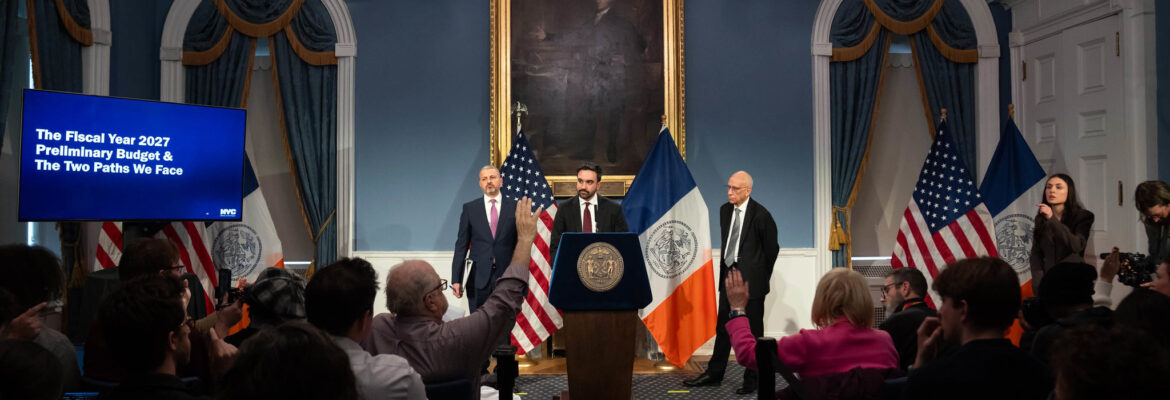
Mayor Mamdani Releases Balanced Fiscal Year 2027 Preliminary Budget
Confronting inherited fiscal mismanagement, Mayor outlines two paths forward: tax the rich & end the drain — or force working New Yorkers to pay the price
NEW YORK – TODAY, Mayor Zohran Kwame Mamdani released the Fiscal Year (FY) 2027 Preliminary Budget, outlining the scope of a fiscal crisis inherited from the prior Administration and presenting two clear paths forward: raise revenue from the wealthiest New Yorkers and most profitable corporations and end the drain of City resources to the State — or balance the budget on the backs of working and middle class New Yorkers.
“There are two paths to bridge the city’s inherited budget gap. The first path is the most sustainable and fairest: raising taxes on the wealthiest and corporations, and ending the drain by fixing the imbalance between what the City provides the State and what we receive in return,” said Mayor Zohran Kwame Mamdani. “If we do not go down the first path, the City will be forced to go down a second, more harmful path of property taxes and raiding our reserves — weakening our long-term fiscal footing and placing the onus for resolving this crisis on the backs of working and middle-class New Yorkers. We do not want to have to turn to such drastic measures to balance our budget. But, faced with no other choice, we will be forced to.”
Upon taking office, the Mamdani Administration identified a pattern of underbudgeted essential services, including rental assistance, shelter operations and special education — that widened projected gaps stated in the November 2025 Financial Plan Update to roughly $12 billion across FY 2026 and FY 2027. To restore transparency and stability, the Mamdani Administration launched aggressive new savings initiatives, maximized the use of in-year reserves and incorporated updated revenues. Through Executive Order 12, Mayor Mamdani is requiring every city agency to designate a Chief Savings Officer (CSO) to identify recurring efficiencies. These savings initiatives are projected to save $1.77 billion across the two fiscal years.
After applying savings, revenue adjustments driven by an upward revision of $7.3 billion in tax revenue, and State support — including $1.5 billion in from Governor Kathy Hochul and an additional $97 million in Foundation Aid — the City faced a remaining two-year gap of $5.4 billion. The Mamdani Administration’s preferred solution is recurring revenue: increasing personal income taxes on New Yorkers earning more than $1 million annually and raising taxes on the most profitable corporations, while recalibrating the City’s long-imbalanced fiscal relationship with the State.
Absent new revenue authority, the City will be forced to use the only tools currently available to increase revenue and fill this gap: property taxes and the use of reserves. The $127 billion FY 2027 Preliminary Budget assumes a 9.5 percent property tax rate increase — generating $3.7 billion in FY 2027. The City also applied $980 million from the city’s Rainy Day Reserve Fund in FY 2026 and $229 million from the Retiree Health Benefit Trust in FY 2027 in order to balance the budget as legally required.
Of $14 billion in city-funded agency expense changes across the two fiscal years, the vast majority fills underbudgeted needs. Roughly 4 percent – $576 million – supports targeted investments, including: $100 million in FY 2026 for snow removal; $5 million in FY 2026 for warming centers and shelter connections for homeless New Yorkers; $11.9 million in FY 2027 for new Street Health Outreach & Wellness (SHOW) mobile units and a new Bridge to Home site for people living with severe mental illness; $5.3 million in FY 2026 and $38 million in FY27 for 200 new attorneys and 100 support staff to reduce tort liability and advance affordability efforts; and more than tripling baseline funding for HRA’s Community Food Connection program with an addition of $54 million in FY 2027. The Preliminary Five-Year Capital Plan totals $113 billion in all-funds and includes $662 million in FY 2027 to modernize and preserve more than 3,200 affordable housing units and $48.2 million starting in FY 2027 to fully fund the renovation and expansion of Bellevue’s Adult Comprehensive Psychiatric Emergency Program.
Banner Image: Mayor Zohran Kwame Mamdani releases the Fiscal Year (FY) 2027 Preliminary Budget. City Hall. Tuesday, February 17, 2026. Image Credit: Ed Reed/Mayoral Photography Office.


Staten Islander News Service Staff Writer
This byline indicates that this article was penned by a member/members of the Staten Islander News Organization office team. Our staff writers are the backbone of our newspaper, performing all sorts of important tasks like conducting interviews, investigating leads, besides writing the news stories you see.
There are no comments yet
Why not be the first