Editor’s note: The Staten Islander News was a participant in the City’s awareness campaign about safer sex a year ago. None of the clinics promoted in the ad campaign mentioned below in 2025 are available on Staten Island, though some of the community health centers on the island offer the same or similar services for free or at a low cost. This includes CHASI and Community Health Centers of Richmond – Canal Street Clinic. Senator Gillibrand introduced a bill to address sexual assault on college campuses. Many Parkinson’s patients want to continue their sexual relationship with their partner which can be difficult after the diagnosis.
NYC HEALTH DEPARTMENT RENEWS FIVE-YEAR PARTNERSHIP WITH ONE CONDOMS TO PROMOTE SAFER SEX IN THE CITY
New Contract Provides Free Condoms and Lubricant to Businesses and Other Organizations Across New York City Through January 2031
Latest NYC Health Department Data Show HIV Rates Increasing and Inequities in STI Rates Continuing in 2024, Underscoring the Ongoing Need for Access to Sexual and Reproductive Health Care in NYC
NEW YORK, NY — Kicking off STI Awareness Week, the NYC Health Department announced today its renewed five-year partnership with ONE Condoms, reinforcing the City’s commitment to promoting access to safer sex products across New York City. The newcontract lasts through January 2031 to supply free external condoms and lubricant, offering a wide selection of condoms, including “ONE Super Sensitive,” “ONE Legend XL,” “ONE Extra Strong,” “ONE FlavorWaves,” and more. The new contract comes as NYC Health Department data on HIV and other sexually transmitted infections (STIs) show high rates and persistent inequities across race and ethnicity, age group, sex, and neighborhood in 2024, underscoring the need to ensure all New Yorkers have access to timely, high-quality sexual and reproductive health care.
“It is essential that New York City continues to invest in the necessary resources that ensure that New Yorkers have access to HIV and STI prevention methods, including safer sex products. That is why we are excited to announce our contract renewal with ONE,” said NYC Health Commissioner Dr. Alister Martin. “And while we are pleased to see a decline in some STI rates in 2024, the inequities across race, ethnicity, and neighborhood among other factors are not acceptable. Every New Yorker, regardless of who they are, where they live, or how much money they make deserves access to safer sex tools they need to stay healthy.”
“Access to safe sex is necessary to protect public health. With the cost of living increasing, many New Yorkers can’t afford contraceptives or treatment,” said State Senator Gustavo Rivera. “We must expand access to safer sex in our city if we want to continue to decrease the rates of sexually transmitted diseases and lessen the taboos that impact New Yorkers’ health, particularly for the marginalized and low-income communities that are most at risk.”
“At a time when we are seeing persistent inequities in HIV and STI rates across our city, partnerships like this are critical to meeting people where they are and providing the tools that they need to protect their health,” said Council Member Lynn Schulman, Chair of the Health Committee. “Access to sexual and reproductive health care is a fundamental part of public health. I’m proud to support the NYC Health Department’s continued work to expand access, reduce stigma, and ensure every New Yorker — regardless of ZIP code, income, or background — can make informed choices about their well-being.”
“Reducing inequities in sexual health across our city is paramount,”said NYC Council Member Pierina Sanchez.“While we are seeing overall declines in STI rates, inequities persist among women, low-income households, and Black and Latino New Yorkers, including in my district. I’m glad to see the NYC Health Department renew its five-year partnership with ONE Condoms to expand access to safe sexual and reproductive health resources. This work must go hand in hand with the full implementation of expanded access to rapid STI testing, per my Local Law 84 of 2024. Together, these efforts are critical to closing gaps in care and improving health outcomes for all New Yorkers.”
“We are proud to be working with the New York City Department of Health and Mental Hygiene again,” said Davin Wedel, president and CEO of Global Protection Corp., parent company of ONE Condoms. “This partnership is about more than just supply; it’s about empowering New Yorkers to take charge of their sexual health with confidence and ease — and to ensure condoms are always within reach.”
Through the NYC Condom Availability Program, the NYC Health Department distributes free safer sex products every year to thousands of businesses, community-based organizations, health care facilities, and other locations. Businesses and other organizations in New York City interested in distributing free safer sex products can place orders for condoms and lubricant through the
NYC Safer Sex Portal. Organizations can receive five boxes (1,000 per box) of any combination of external condoms and lubricant plus one box (1,000 per box) of internal condoms per order. More information is available on the
NYC Health Department website.
The renewed contract comes as the NYC Health Department recently published the
2024 STI Surveillance Annual Report, which finds that after decades of increasing trends, rates of many STIs reported in 2024 decreased or remained relatively stable compared with 2023. These data show:
-
Primary and secondary syphilis rates decreased 16.3%.
-
Early latent syphilis rates decreased 19.6%.
-
Chlamydia rates decreased 6.3% overall, with a 12.7% decrease among men and a 0.4% decrease among women.
-
The number of cases of congenital syphilis, which occurs when a pregnant person passes syphilis to the fetus during pregnancy, increased 5.7%.
While some of these data are encouraging, the report also shows continued inequities across many indicators, including race and ethnicity, age, sex, and neighborhood. These findings include:
-
Chlamydia and gonorrhea rates among people living in very high-poverty neighborhoods were approximately 3 times higher than the rates among those living in low-poverty neighborhoods.
-
The syphilis rate among Black women was 9 times higher than the rate among white women.
-
Young women and teenagers ages 15 to 24 continue to be disproportionately affected by chlamydia, with a case rate 5 times higher than the rate among women overall.
Additionally, mpox cases doubled from 2023 to 2024, though case numbers remained much lower than during the global outbreak in 2022. Most mpox cases were among men, people ages 25 to 34, white people, and Hispanic or Latino people, and people who identified as lesbian, gay, bisexual, or queer or another nonheterosexual orientation.
In 2024, for the fourth consecutive year, the
number of people newly diagnosed with HIV increased or remained stable. A wide range of factors may be contributing to increases in new HIV diagnoses in New York City, including barriers to accessing low-cost, high-quality health care and preventive services.
The NYC Health Department remains committed to improving access to sexual health care through comprehensive tailored programming and services, health care provider education, community outreach, and policy recommendations. As part of the NYC Health Department’s ongoing efforts to improve access to care, New Yorkers can now use the
NYC Health Map to find locations providing doxy PEP, the antibiotic used to prevent syphilis, chlamydia, and gonorrhea after condomless sex. The NYC Health Department’s PlaySure Network 2.0 funds hospitals, clinics, and community-based organizations to provide HIV and STI prevention, testing, and treatment services, as well as supportive services.
The NYC Sexual Health Clinics offer low- to no-cost services for HIV and other STIs, contraceptive care, and medication abortion. Anyone 12 years or older can receive confidential services, regardless of immigration status. For telemedicine services, call the Health Department’s Sexual Health Clinic Hotline at 347-396-7959, Monday to Friday, 9 a.m. to 3:30 p.m. For more information, including clinic locations, hours of operation, and available services, visit
nyc.gov/sexualhealthclinics.To find additional STI and HIV services and free safer sex product distribution sites in New York City, visit the
NYC Health Map.
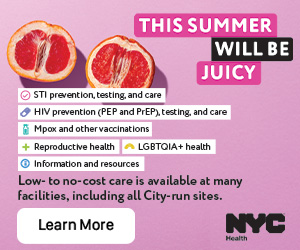
The City had previously promoted its sexual health programs, including STD testing, medication abortion, and other services available to New Yorkers regardless of immigration status and at low or no cost.:
NYC Health Department Launches Public Awareness Campaign to Promote Its Sexual Health Clinic Services
STI Testing and Treatment, HIV Testing and Prevention, Medication Abortion, and More Available to All New Yorkers
Services Are Available at Low or No Cost and Regardless of Immigration Status
June 13, 2025 — The New York City Health Department has launched a citywide public awareness campaign to spread the word that New Yorkers can access low to no cost sexual and reproductive health care at city’s Sexual Health Clinics. With messages in English and Spanish, the campaign highlights the types of services available to all New Yorkers regardless of their ability to pay, immigration status, language spoken, sexual orientation or gender identity. The campaign is intended to empower New Yorker to take care of their sexual and reproductive health.
Ad placements include outdoor (LinkNYC charging portals, subway digital liveboards, posters in bars and other public spaces), radio, social media, and dating apps. The campaign runs through the end of June 2025.
“Good health requires access to high quality health care and information. I am thrilled to announce our citywide public awareness campaign that sends a message that NYC’s sexual health clinics are here for all New Yorkers to use if and when they need it,” said Acting Health Commissioner Michelle Morse. “Our sexual health clinics have a long history of providing dignified, confidential care, without judgment, addressing critical health needs of New Yorkers.”
NYC Health Department Sexual Health Clinics provide low- and no-cost confidential services for people ages 12 and older, regardless of immigration or health insurance status. Most services are provided on a walk-in basis.
Services include:
- STI prevention (including doxy PEP and vaccines)
- STI screening, testing, and treatment
- HIV testing and treatment initiation
- HIV post-exposure prophylaxis (PEP) and pre-exposure prophylaxis (PrEP)
- Emergency contraception
- Birth control, including intrauterine devices (IUDs) and implant services
- Medication abortion
- HPV, hep A, hep B, mpox, and meningitis vaccination
There are six clinics throughout the city that offer services Monday through Friday, 8:30 a.m. – 3:30 p.m., primarily on a walk-in basis.
- Morrisania (Bronx): 1309 Fulton Ave., Second Fl.
- Jamaica (Queens): 90-37 Parsons Blvd., First Fl.
- Fort Greene (Brooklyn): 295 Flatbush Ave. Ext., Second Fl.
- Chelsea (Manhattan): 303 Ninth Ave., First Fl.
- Central Harlem (Manhattan): 2238 Fifth Ave., First Fl.
- Corona (Queens): 34-33 Junction Blvd., First Fl.
The Fort Greene and Chelsea clinics also offer additional hours for rapid STI testing on Tuesdays, 5:00–7:00 p.m.
For more information on clinic services, locations, and hours, visit nyc.gov/sexualhealthclinics, or call 311 and ask for Health Department clinics.
Banner Image: Clinic awareness campaign 2024. Image Credit – NYCDOHMH
About The Author

The New York City Department of Health and Mental Hygiene is the department of the government of New York City responsible for public health along with issuing birth certificates, dog licenses, and conducting restaurant inspection and enforcement. The New York City Board of Health is part of the department. Its regulations are compiled in title 24 of the New York City Rules (the New York City Health Code). Since March 2022, the commissioner has been Ashwin Vasan.



There are no comments yet
Why not be the first