

Staten Island Health Vending Machine, COGE Hearing Next Week, Affordable Senior Homes, Low Cost Healthcare, Other Updates: Mayor Mamdani
Public Health Vending Machines, Tonita Fest, Budget Reached, Innovation Through Data Intelligence ED, Affordable Senior Homes, Low/No-Cost Healthcare Available, Pedestrian Deaths Historic Lows, Heat Response Updates, COGE Report: Mayor Mamdani
See below for a video of a walking tour the Mayor took a few weeks back, during which he visited with employees at several small businesses as well as franchise locations for major chains to talk about their rights under the law as workers, no matter how large or small the company is that they work for. This particularly pertained to food workers, specifically mentioning such rules as that an employee cannot close up the business one evening and then open it up the next morning. Doing so can cause employees to put their bodies under excessive amounts of stress and can cause them to be less focused and more prone to making mistakes due to tiredness. The mayor’s executive order regarding heat-related rights for workers was published in our special story about the historic heat wave we are currently experiencing here in New York City. For Staten Islanders who are noticing that their street trees are losing their bark, that article also talks about things residents can do so that the heat wave doesn’t kill their trees. This is a sign of extreme environmental stress, which they may not weather without help from their neighbors who give them a little water.
Mayor Mamdani Opens City’s First Public Health Vending Machines on Staten Island
Two machines funded with opioid settlement dollars will provide free health and overdose prevention supplies 24 hours a day
Overdose deaths on Staten Island fell 49% between 2023 and 2024
NEW YORK — Today, Mayor Zohran Kwame Mamdani, the New York City Health Department and the Staten Island Partnership for Community Wellness opened the City’s first publicly supported health vending machines on Staten Island. Located in Port Richmond, the two machines will provide free health and harm reduction supplies 24 hours a day, seven days a week outside Community Health Action of Staten Island and A Chance in Life, expanding low-barrier access to lifesaving resources for New Yorkers.
“Too many New Yorkers have lost loved ones to the overdose crisis. We have a responsibility to meet this crisis with urgency and the tools that save lives. These public health vending machines will make naloxone, hygiene supplies and other essential resources available whenever people need them, free of charge and without barriers,” said Mayor Mamdani. “Health care is a human right, and it is our job to make it easier for New Yorkers to get the care they deserve.”
“As we confront the opioid epidemic, we have to make lifesaving resources as easy to access as possible,” said Deputy Mayor for Health and Human Services Dr. Helen Arteaga. “These public health vending machines will connect more Staten Islanders with essential supplies while reducing barriers to care. Every overdose prevented is a life saved, and this investment reflects our commitment to protecting the health of every New Yorker.”
“Public health vending machines offer New Yorkers barrier-free access to resources ranging from naloxone and condoms to socks and hygiene supplies where and when they need them,” said NYC Health Commissioner Dr. Alister F. Martin. “Tools like this allow us to reach more people while opening the door for deeper community engagement and connection to services. This is public health in action.”
Anyone can use the machine by entering a New York City ZIP code before selecting free supplies. The machines are stocked with health and harm reduction tools, including naloxone, hygiene kits, fentanyl test strips and safer sex supplies, including condoms.
The City’s first four Health Department-supported public health vending machines opened in 2023 in Brooklyn and Queens to expand access to lifesaving supplies and connect more New Yorkers to harm reduction services. Since then, the machines have been used more than 73,000 times and have dispensed more than 6,600 naloxone kits. The most frequently selected items include hygiene kits and first aid supplies, sexual health kits, naloxone and other harm reduction resources.

The new Staten Island machines are funded through $12 million in opioid settlement dollars the City allocated in 2023 to expand prevention, harm reduction, treatment and recovery services across the borough. Through those investments, Staten Islanders have been connected to services and support nearly 7,000 times through eight community-based providers.
Those investments are making a difference. Overdose deaths among Staten Island residents fell 49% between 2023 and 2024. After recording the city’s second-highest overdose death rate in 2023, Staten Island has the second-lowest rate in 2024. Provisional data also shows overdose rates remained stable citywide through the first three quarters of 2025 following a significant decline in 2024.
“Public health vending machines are a practical, compassionate way to meet people where they are and provide free access to essential supplies like naloxone, hygiene and wound care kits, menstrual products, and socks,” said New York City Council Majority Whip Kamillah M. Hanks. “We fought for these dollars because Staten Island deserves real investments that protect public health, support harm reduction, and connect our neighbors to resources when they need them most.”
The overdose crisis continues to take far too many lives, and we must continue investing in evidence-based strategies that meet people where they are,” said Chair of the New York City Council’s Committee on Health Lynn Schulman. “Public health vending machines expand access to lifesaving supplies, reduce stigma, and make it easier for New Yorkers to protect their health and the health of those around them. I applaud Mayor Zohran Mamdani, Health Commissioner Dr. Alister Martin, and the New York City Department of Health and Mental Hygiene for continuing to invest opioid settlement funds in innovative, community-based solutions that save lives. Every New Yorker deserves access to the resources they need to stay safe, healthy and connected to care.”
“I’m thrilled to see the installation of vending machines that will promote public health and improve access to lifesaving items like Narcan and safer sex kits. This is a proven method for keeping not just keeping people safer and healthier, but in some instances keeping people alive,” said Chair of the New York City Council’s Committee on Mental Health and Substance Use Tiffany Cabán.
“Today is a huge victory for our borough. Just two years ago, Staten Island had the second highest overdose death rate citywide, a disparity that reflects the persistent health infrastructure gaps residents face here” said Adrienne Abbate, Executive Director, Partnerships for Community Wellness. “As we continue to tackle the overdose crisis, these new vending machines will help us begin to close those gaps, giving every community member free, 24/7 access to lifesaving Narcan and other essential wellness supplies. Partnerships is proud to stand with our community partners in bringing these resources to North Shore and remains committed to fighting for Staten Islanders who have too often been shut out of the public health investments our communities deserve. Many thanks to Mayor Mamdani and the Department of Health for prioritizing the health and safety of every New Yorker.”
“At The Village by A Chance In Life, we see every week that health is shaped long before someone reaches a clinic,” said Gabriele Delmonaco, President and CEO of A Chance in Life. “On Staten Island’s North Shore, more than 29,000 residents live below the poverty line, and many neighbors face long commutes, language barriers, stigma and uneven access to basic care. This public health vending machine is a practical and dignified way to bring life-saving tools closer to people, before a crisis becomes a tragedy. That is exactly the kind of community-centered partnership The Village by A Chance In Life was created to support.”
“The devastating impacts of overdose can be felt in every neighborhood across Staten Island. Along with our partners, Community Health Action has been at the forefront of the response, balancing tried-and-true harm reduction strategies with innovative modes of service delivery. This public health vending machine will improve access for our community when and where we need it most. The project’s design prioritizes equity and evaluation, making it possible for us measure the impact and utility of a new life-saving strategy. Thank you to Partnerships for Community Wellness, Mayor Mamdani’s office, and the Department of Health for this investment in saving lives,” said Ericker Onaga, Executive Director, Community Health Action of Staten Island.

Mayor Zohran Kwame Mamdani hosts a pickup soccer match at Gracie Mansion on Thursday, June 25,, 2026. Michael Appleton/Mayoral Photography Office
TRANSCRIPT: MAYOR MAMDANI ATTENDS TOÑITA FEST 2026
Mayor Zohran Kwame Mamdani: ¡Yo soy Boricua, pa que tu lo sepas! How we doing today? It is an honor to be here today to celebrate the one, the only, the legendary Toñita. For 52 years, Toñita has been an icon for this city. She has helped to show what makes so many of us so proud to be New Yorkers. Every single day she helps to build a sense of community here and a recognition for Nuyorican’s across the five boroughs. And I know that so many of us are here today to celebrate Toñita Fest. I want to take a moment to share a quote from Toñita that I came back to often. She said, “I’m staying here with my people as long as I can. This isn’t for me to make money or a fortune. It’s to maintain a space for all of us to be together.”
And we know that that’s so important for our city, and we also know that’s important for Puerto Rico. Because at a time when Puerto Rico is dealing with a water crisis, at a time when they’re having to deal with the legacies of colonialism, it is so critical that we here in New York City say, “Puerto Rico no se vende” (Translation: Puerto Rico is not for sale). And we know that that solidarity that Toñita has shown this city is not specific to anyone — it’s for all.
And so even now, as we look and see the horrific tragedy that just befell Venezuela, we want to acknowledge that right here with us today is Angelo Colina stepping up to support Venezuela affected by that horrible disaster. [With] that being said, I am also so proud to be here alongside the incredible artist from the Bronx, Edwin Reyes. And to present Toñita with Bandera Viva, a special gift that draws inspiration from the Puerto Rican flag.
Thank you so much, New York City. And I want to acknowledge all of the leaders that have been here. We have the Brooklyn Borough President Antonio Reynoso, who’s here with us. And we also want to celebrate and acknowledge our congresswoman, Nydia Velázquez, as well. Really, it’s an honor to be your mayor; it is an honor to be yet another New Yorker in all of the inspiration that is Toñita. Thank you so much!
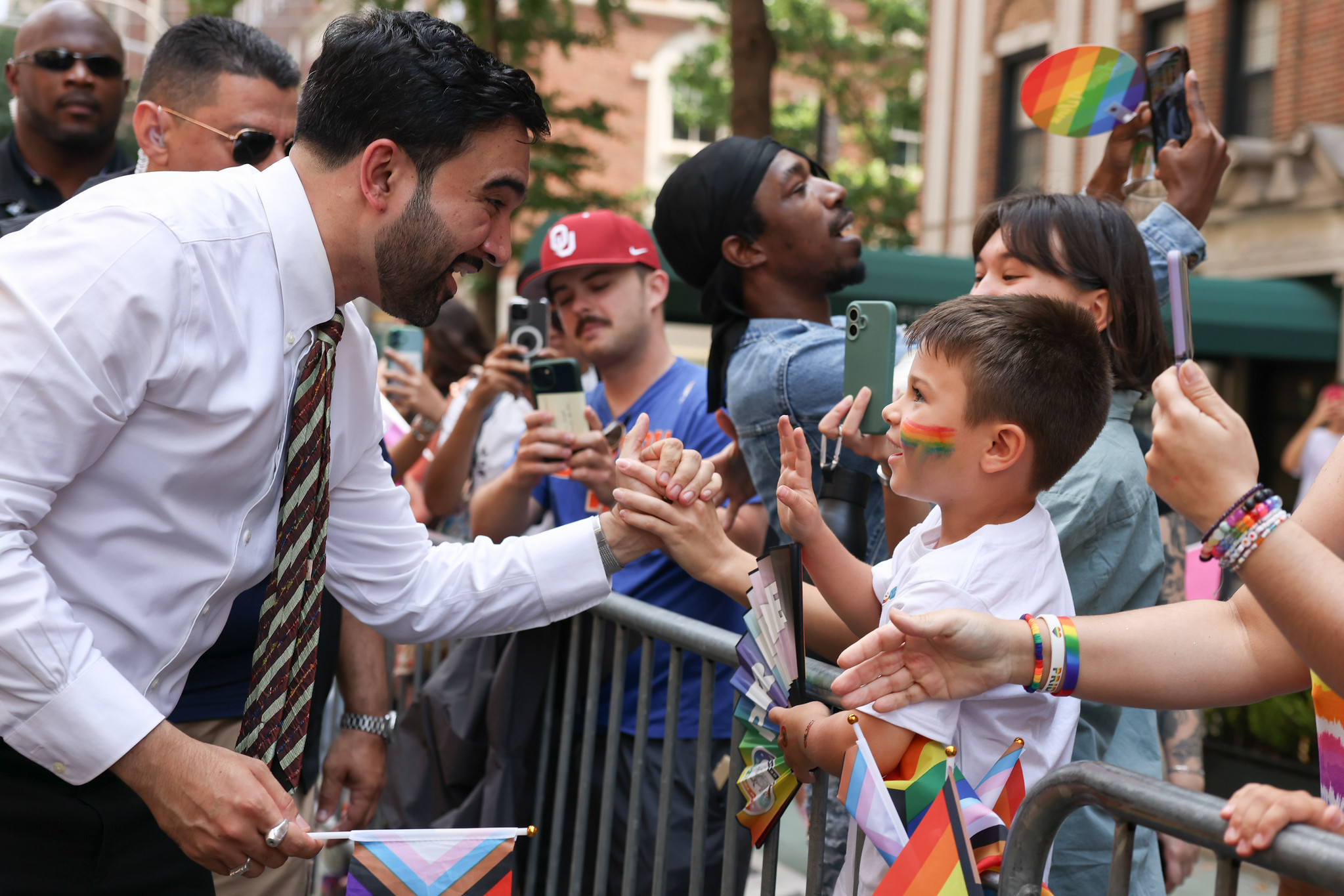
New York City Mayor Zohran Mamdani marches in the NYC Pride March on Sunday, June 27, 2026. Kara McCurdy. Mayoral Photography Office.
Mayor Mamdani, Speaker Menin Reach Handshake Agreement on Balanced Fiscal Year 2027 Budget
Fiscally responsible budget invests in essential services, advances affordability agenda and strengthens City’s long-term fiscal future
City creates public portal with post-9/11 air quality and health records
NEW YORK – Mayor Zohran Kwame Mamdani, City Council Speaker Julie Menin, Council Finance Chair Linda Lee, Director of the Mayor’s Office of Management and Budget Sherif Soliman and members of the City Council today announced a handshake agreement on a balanced $125.8 billion Fiscal Year (FY) 2027 budget.
The agreement pairs fiscal responsibility, including adding $350 million to the City’s General Reserve, with bold investments that make New York more affordable, strengthen essential public services and improve quality of life for working class New Yorkers in every borough.
The budget creates a public, online portal that will house documents from across City government related to post-9/11 air quality and health risks. The first batch of records will be released before the 25th anniversary of Sept. 11, with additional documents added on a rolling basis.
“Our Administration inherited a budget crisis built on years of undercounting the true cost of running our city. We made a different choice. We balanced this budget without resorting to austerity. We protected the services New Yorkers rely on, while restoring honesty to the City’s finances. We accelerated the affordability agenda by investing in housing, mental health services, parks, libraries and students of all ages. This agreement proves that fiscal responsibility and public excellence can go hand in hand,” said Mayor Mamdani. “New Yorkers deserve a government that works as hard as they do – and a government as careful with their money as they are. I want to thank Speaker Julie Menin and the City Council for their partnership in getting this budget across the finish line.”
“With this budget, the Council proved that we could responsibly manage the City’s finances while making transformative investments that lower costs for working families, prevent homelessness, expand opportunity for children, and strengthen the services New Yorkers rely on every day,” said Speaker Julie Menin. “This budget reflects what the Council has believed from the very beginning: New York City does not have to choose between fiscal responsibility and investing in our communities. I want to thank my Council colleagues for their partnership throughout this process and Mayor Mamdani and his administration for working with us to reach an agreement that delivers meaningful results for New Yorkers.”
When Mayor Mamdani took office, he inherited one of the largest structural budget challenges in modern city history. The prior administration had substantially underbudgeted for core City services and long-term obligations, masking the true cost of governance.
Mayor Mamdani committed to restoring fiscal honesty and building a government that delivers public excellence on his first day in office, and in January ordered each City agency to appoint a Chief Savings Officer (CSO). Charged with finding efficiencies and protecting essential services, CSOs generated $1.77 billion in savings across Fiscal Years 2026 and 2027.
Rather than balancing the budget by slashing services, the Mamdani administration worked with the City Council and state partners to close budget gaps through disciplined savings, new tax revenue and a historic partnership with Albany to correct the City’s long-imbalanced fiscal relationship with the State.
On top of strengthening the City’s long-term fiscal outlook, the budget includes investments in the services New Yorkers rely on every day. It expands access to affordable housing, improves public health and safety and protects the beloved public places that make New York the greatest city in the world.
For years, libraries, parks, public transit discounts, cultural organizations and CUNY faced annual uncertainty as workers and advocates were forced to fight each budget cycle to restore funding. The Mayor’s Executive Budget permanently baselined $31.7 million for the City’s library systems, $15 million for the Parks Department, $25 million for Fair Fares, $10 million for cultural organizations and $15 million for the City University of New York (CUNY). New Yorkers should not have to wonder every July whether their neighborhood library will stay open, their parks will be maintained, or affordable transit and higher education will remain within reach.
Investment highlights include:
Tackling Housing & Affordability Crisis:
- Accelerates the preservation of affordable housing by increasing funding for rental assistance and support services, preserving more than 200 units annually ($4.2 million in FY27, growing to $17.5 million in FY30).
- Expands on the baselined $54 million investment made in the Preliminary Budget in the Community Food Connection, which supports more than 700 community kitchens and food pantries serving more than 1 million New Yorkers each year ($5 million, baselined).
- Invests in a new rental assistance program at the Department of Housing Preservation & Development ($175 million in FY27, $125 million baselined as of FY28).
- Build upon the $2.3 million baseline established in the Executive Budget for the Housing Stability Support program that provides low-barrier microgrants to survivors of domestic, sexual, and gender-based violence with the aim of helping impacted individuals maintain safe and stable housing ($1.4 million in FY27).
- Additional funding to support the Homeowner Help Desk which, in partnership with the Center for New York City Neighborhoods, provides support to NYC homeowners at risk of displacement, including technical assistance, financial and legal counseling, and more ($500,000 in FY27).
Improving New Yorkers’ Health, Safety & Well-Being:
- Creates a public online portal for documents related to post-9/11 air quality and health risks ($34.2 million in FY27).
- Expands mobile mental health treatment to reduce waitlists, including a new step-down mobile treatment program for New Yorkers continuing their recovery ($20 million, baselined).
- Adds $137 million in partnership with council for Immigrant Legal Services to the $32 million included in the Preliminary Budget, bringing the City’s total FY27 budget to $210 million in FY27.
- Add nine staff, including civil rights case specialists and a Director of Investigations, and additional resources to strengthen CCHR’s investigation and enforcement capacity ($1.6 million, baselined).
Protecting NYC’s Beloved Public Institutions:
- Establishes a Cultural Stability Fund that will be administered by the Department of Cultural Affairs to assist eligible organizations experiencing unexpected or emergency circumstances ($10 million in FY27, FY28, and FY29).
- Baseline funding for Parks that had previously been added one year at a time including 100 PEP officers, 15 staff and additional funding for GreenThumb Community Gardens, and tree stump removal ($14.4 million, baselined).
- Establishes a Parks “Renew Crew” pilot program to make quick targeted improvements for sites (such as playgrounds, courts, fields, etc.) that do not yet rise to the level of a capital project ($2.3 million in FY27, FY28, and FY29).
- Support for CUNY’s “Accelerate, Complete, and Engage” (ACE) academic support program designed to help students complete their academic journey to a bachelor’s degree on time ($9.1 million in FY27).
- Support for CUNY Accelerated Study in Associate Programs (ASAP) which helps students stay on track and graduate by providing financial, academic, and personal support ($4.5 million in FY27).
- Expand support for CUNY students with disabilities by increasing access to critical services ($800,000 in FY27).

New York City Mayor Zohran Mamdani visits an early childhood program in Brooklyn to encourage New Yorkers to apply for 2-K on Thursday, June 25, 2026. Kara McCurdy. Mayoral Photography Office.
NEW YORK – Today, Mayor Zohran Kwame Mamdani announced the appointment of Bharti Sharma as Executive Director of the Center for Innovation through Data Intelligence (CIDI).
“Bharti Sharma has dedicated her career to using data as a tool to improve people’s lives,” said Mayor Mamdani. “Whether leading our city’s public health response during the global COVID-19 pandemic or building systems to make government more effective, she has shown how responsible, creative use of data can help solve our city’s most pressing issues. Her leadership will help City government deliver better services and real results that New Yorkers deserve.”
“Bharti Sharma brings unmatched experience and expertise that will be invaluable as we coordinate comprehensive, citywide solutions for health and social services,” said Deputy Mayor for Health and Human Services Dr. Helen Arteaga. “I am confident that she will be an exceptional leader as we work to provide solutions for all New Yorkers.”
“It is an honor to serve the people of New York City in this role,” said Bharti Sharma, Executive Director, Center for Innovation through Data Intelligence. “CIDI sits at an extraordinary intersection where government, data, and human impact converge and that is precisely where I want to be. I’ve spent my career inside public health systems, seeing firsthand how the right data or the absence of it shapes outcomes for real people. I come ready to listen, to build, and to ensure that the work we do here delivers for every New Yorker.”
Founded in 2011, CIDI conducts interagency research to identify gaps in City services and improve outcomes for New Yorkers. The center works across Health and Human Service (HHS) agencies and other City partners to use data, research and collaboration to inform policy and strengthen service delivery. Sharma most recently served as Senior Director of Data and AI Strategic Enablement and Operations at NYC Health + Hospitals, the nation’s largest municipal health system, which includes more than 70 care locations and 11 acute care hospitals. During the COVID-19 pandemic, she designed and led the systemwide COVID-19 Intelligence Hub, providing executive leadership with real-time data on ICU capacity, emergency department throughput, bed availability, surge planning, ventilator supply and other critical operational metrics. She also led the development of the City’s testing and vaccination wait-time dashboards.
Following the pandemic, Sharma founded and scaled the Data Champion Program to more than 300 embedded champions across every hospital, central office and ambulatory site in the system. She also led the Data Academy, which has trained more than 500 staff members. Together, those programs generated an estimated $4.75 million to $5.5 million in annual cost avoidance while establishing NYC H+H’s enterprise data governance framework as a nationally recognized for responsible data use.
Sharma holds a Bachelor of Dental Surgery, a Master of Health Administration from Hofstra University and a Master of Science in Information Systems Engineering and Management from Harrisburg University.
“I had the privilege of working side-by-side with Bharti during the COVID-19 pandemic, one of the most challenging periods in modern healthcare history,” said Laura Iavicoli, Chief Medical Officer, NYC Health + Hospitals /Elmhurst. “I witnessed firsthand how her leadership, innovation, and relentless focus on data-driven decision-making helped guide our health system through an extraordinarily difficult time. She has a rare ability to connect data, strategy, and human impact, and I can think of few people better suited to help shape policies and decisions that improve the lives of New Yorkers. City Hall is gaining an exceptional leader and public servant.”
“Bharti represents a new generation of data and AI leaders,” said Divya Pathak, Chief AI Officer at Regeneron. “She has redefined how a large, complex healthcare system builds and scales intelligence — distributing it across the organization while maintaining strong governance and operational discipline. Her work is innovative, impactful, and sets the standard for how public-sector systems can become more intelligent, agile, and future-ready.”

Mayor Zohran Kwame Mamdani delivers remarks at the Police Athletic League Business Luncheon on Thursday, June 25,, 2026. Michael Appleton/Mayoral Photography Office
Mamdani Administration Announces Financial Closing for Sol on Park, Creating 229 Affordable Senior Homes on NYCHA’s Morris Houses Campus
NYCHA, HPD and HDC collaborate on $214 million project, the City’s largest use of the “Transfer of Assistance” program to date
Eighty homes reserved for NYCHA residents and 68 for formerly homeless older New Yorkers

Rendering of Sol on Park. Credit: Magnusson Architecture and Planning, P.C.
NEW YORK – Today, Mayor Zohran Kwame Mamdani announced the financial closing for Sol on Park, a new affordable housing development that will create 229 affordable homes for older New Yorkers on the New York City Housing Authority’s (NYCHA) Morris Houses campus in the Bronx.
Developed through a partnership among NYCHA, the Department of Housing Preservation and Development (HPD) and the Housing Development Corporation (HDC), the $214 million project demonstrates how public land, public investment and innovative financing can work together to deliver desperately needed affordable housing.
The project is the City’s largest use to date of the Transfer of Assistance program, an innovative financing tool that the Mamdani administration plans to expand through its Block by Block housing plan.
Sol on Park will include 80 apartments reserved for current NYCHA residents living at Morris I and II, 68 supportive homes for formerly homeless seniors and 80 homes available through the Housing Connect lottery for low- and middle-income seniors. The project will also feature community facility space, a new pedestrian plaza and will be built to LEED Platinum and Passive House standards. Construction by the NRP Group, Selfhelp Realty Group and Foxy Management will begin following the closing, with residents to move in during early 2029.
“New Yorkers need housing relief, and we’re using every tool at our disposal to deliver it. Sol on Park project will create more than 200 permanently affordable homes for older New Yorkers while strengthening the Morris Houses community. This project shows what is possible when City agencies work together to put public land and public investment to work for the people of this city. We are building affordable homes, creating opportunities for NYCHA residents and proving that government can act with the urgency this housing crisis demands,” said Mayor Mamdani.
“Sol on Park is a win for all New Yorkers, providing brand-new affordable senior housing for both NYCHA residents and new neighbors. Projects like these show how we can use innovative financing models and public land to build the housing that New Yorkers need. This is a success story for the Transfer of Assistance tool and proof of concept for similar projects across the five boroughs,” said Leila Bozorg, Deputy Mayor for Housing and Planning. “Congratulations to the NYCHA, HPD, HDC, and development teams, and the current and future Morris Houses and Sol on Park residents on this milestone!”
“We are thrilled to reach this important milestone and close on the financing for Sol on Park,” said NYCHA Chief Executive Officer Lisa Bova-Hiatt. “With this achievement, we are one step closer to delivering a truly remarkable and dignified living experience to hundreds of low- to moderate-income seniors in the Bronx. Through NYCHA’s largest Transfer of Assistance transaction to date, we will provide new homes for 80 existing residents from Morris I and II while helping to create much-needed affordable housing for seniors, including those who had previously experienced homelessness. We are deeply grateful to our partners at City Hall, HPD, and HDC for their collaboration and unwavering commitment to expanding meaningful affordable housing opportunities in New York City.”
“Sol on Park responds to the growing housing needs of New York City’s aging population while simultaneously strengthening the community of NYCHA’s Morris Houses in the Bronx,” said HDC President Eric Enderlin. “HDC looks forward to working with all of our public and private partners to bring more than 220 deeply affordable senior homes to the Morrisania community.”
“As we strive to ensure safe, affordable housing for all New Yorkers, we must also make sure that our most vulnerable residents are cared for,” said HPD Commissioner Dina Levy. “The Sol on Park project will not only create more than 200 homes for low- to middle-income seniors, it will also provide social services to its residents, as well a health and wellness center and career training opportunities for the local community. Sol on Park represents our commitment to building housing that contributes positively to local neighborhoods, while providing seniors with stable, dignified homes.”
NYCHA began engaging Morris Houses residents on the project in 2019, conducting years of community outreach that helped shape the development’s design. That engagement led to the introduction of the Transfer of Assistance model, allowing current Morris Houses residents the opportunity to move into Sol on Park while creating a brand-new, approximately 1,400 square-foot, fully accessible home for the Morris Houses Resident Association.
When complete, Sol on Park will feature a health-focused design and robust on-site services, including partnerships with the Union Community Health Center and Green Bronx Machine’s National Health & Wellness Center. Residents will also have access to bicycle storage, laundry facilities, exercise rooms and computer labs.
Expanding the use of Transfer of Assistance is one part of the Mamdani administration’s broader commitment to public housing. Through Block by Block, the administration is making the largest capital investment in NYCHA in recent history while restoring NYCHA’s role as a public developer. Those investments include comprehensive building repairs, bringing vacant apartments back online, repairing elevators, remediating mold and expanding opportunities for resident leadership through stronger Resident Associations, “NYCHA in Your Neighborhood” events and deeper tenant participation following Permanent Affordability Commitment Together (PACT) conversions.
Block by Block, the Mamdani administration’s comprehensive housing strategy, outlines a path to build 200,000 affordable homes and preserve another 200,000 over the next decade. The plan also strengthens tenant protections — including an overhaul of how the City responds to building code complaints — expands pathways to homeownership, supports the workers who build housing and streamlines the production of new affordable homes.
“Sol on Park marks an exciting new chapter at NYCHA of leveraging every tool in our toolbox to create new housing opportunities for both our existing residents and low-income New Yorkers citywide,” said NYCHA Interim Chief Real Estate Officer Heather Beck. “With this project, in partnership with our sister agencies and development partners, we are building 100 percent permanently affordable senior housing on NYCHA land, with homes for Morris Houses residents through Transfer of Assistance, and a brand-new space for the Morris Houses Resident Association. I want to thank and congratulate the Morris Houses community for participating in this planning process with us over many years where your ideas and input helped to shape this great project in your community.”
“As President of the Morris Houses Resident Association, I am proud to see this project move forward after a robust planning process that centered the voices of our residents every step of the way,” said Morris Houses Residents Association President Regina Carter. “The voluntary Transfer of Assistance opportunity for 80 Morris Houses households, along with new space for resident leadership and programming, reflects the meaningful outcomes that can be achieved when residents are true partners in the process. We appreciate NYCHA, HPD, and the development team for their commitment to engaging our community and delivering investments that will benefit Morris Houses residents for years to come.”
“Sol on Park demonstrates how thoughtful public-private partnership can transform underutilized land into a vibrant community asset,” said NRP Group Senior Vice President of Development Jonathan Gertman. “Working alongside our co-developers, the talented professionals of the city’s housing agencies, and dedicated elected officials and community leaders, we are bringing new life to a Morris Houses site with 229 affordable homes for seniors. Residents of Sol on Park and the broader community will benefit from 8,100 square feet of community facility space and a robust network of supportive services, providing the resources and stability needed to lead healthy, fulfilling lives. As The NRP Group’s first major project in New York City, we couldn’t be prouder to lead this pioneering, health-centric development.”
“We’re excited to reach this milestone closing for Sol on Park and are grateful to our partners at HPD, HDC, NYCHA, our co-developers, and especially the residents of Morris Houses, whose collaboration has been essential every step of the way,” said Selfhelp Realty Group Executive Director Lisa Trub. “Sol on Park reflects what’s possible when mission-driven partners come together with a shared focus on seniors and community. We’re proud to be part of Sol on Park, which will bring hundreds of permanently affordable homes, paired with social services and meaningful amenities, to the Morris Houses campus. At Selfhelp Realty Group, Sol on Park reflects our commitment to building deeply affordable housing with on-site services so older adults can age with dignity in the community they call home.”
“We are incredibly grateful to our partners and the multitude of city agencies whose collaboration and ingenuity are a testament to the power of public/private partnerships,” said Foxy Development Principal Jeff Fox. “As Foxy’s 6th senior housing project, Sol on Park reflects Foxy’s continued efforts to work with best-in-class partners to provide meaningful, service-enriched housing for our city’s most vulnerable residents.”
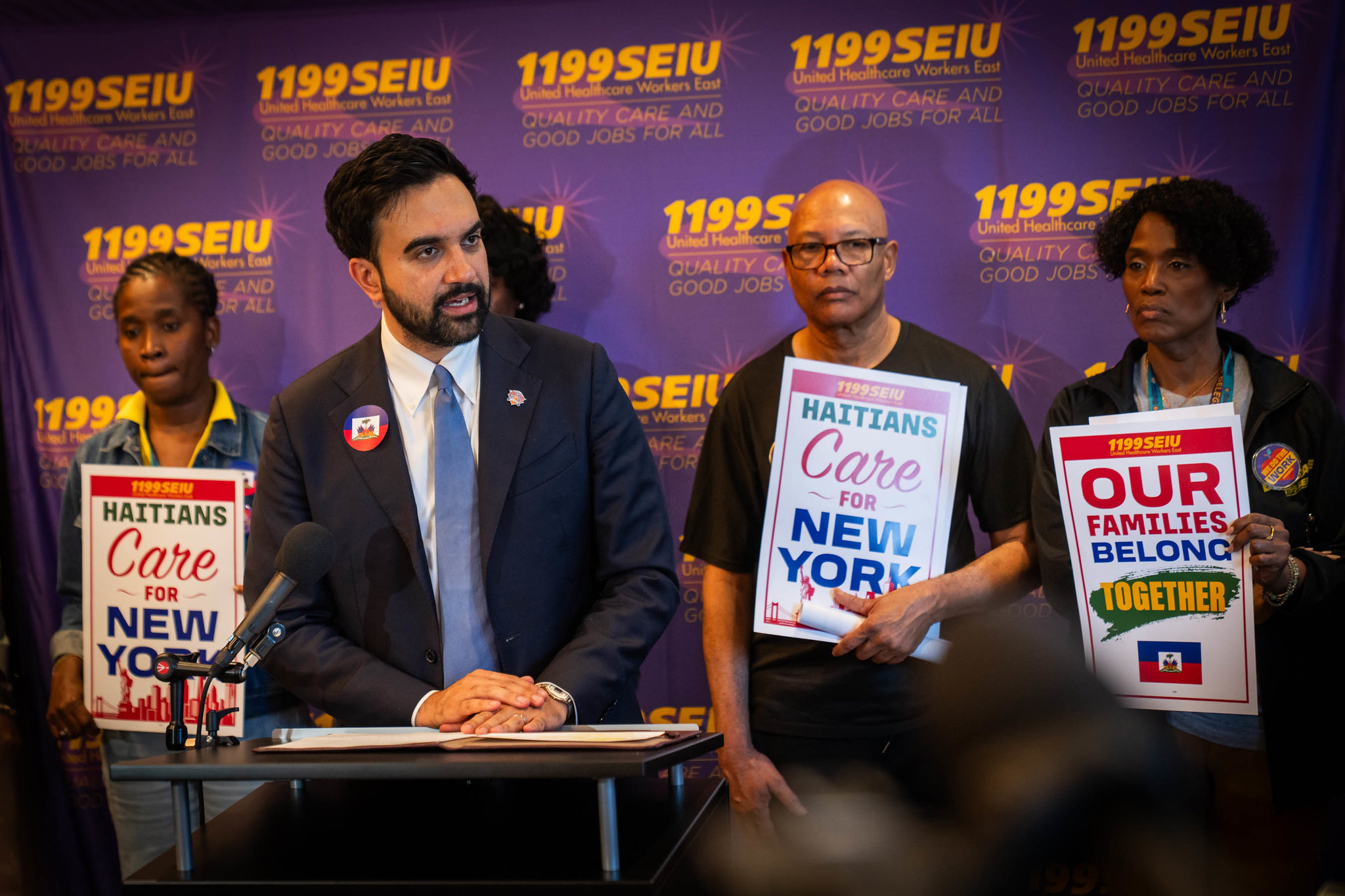
Mayor Mamdani rallies with immigration advocates and 1199SEIU members following the SCOTUS ruling in Manhattan. Thursday, June 25, 2026. Credit: Ed Reed/Mayoral Photography Office.
Mayor Mamdani, NYC Health Agencies Intensify Enrollment in Low- and No-Cost Healthcare as Federal Cuts to Essential Plan Coverage Take Effect
Beginning TODAY, federal cuts threaten to strip healthcare coverage for more than 200,000 New York City residents
Low- and no-cost healthcare services available NOW at more than 50 DOH and H+H clinics, facilities, and community health centers across all five boroughs
NEW YORK – Mayor Zohran Kwame Mamdani, the NYC Health Department and NYC Health + Hospitals announced an expanded outreach effort to protect more than 200,000 New Yorkers from losing healthcare coverage as changes to the Essential Plan caused by federal disinvestment go into effect July 1.
New Yorkers who need assistance are encouraged to call 311 and ask for “help with health coverage” or text “CoveredNYC” to 55676 for multilingual guidance on finding alternative coverage options, including NYC Care. City services include comprehensive primary and preventative care.
“Health care is a human right, not a privilege reserved for those who can afford it. No New Yorker should be skipping doctor’s appointments, ignoring concerning symptoms, or risking bankruptcy because they cannot afford to see a doctor. While the federal government chooses to take health care away from working people, New York is choosing a different path,” said Mayor Zohran Mamdani. “We are making sure every New Yorker knows where they can turn for affordable care, enrollment assistance and the services they need. We want every New Yorker to know that city government has their back.”
“As the federal government attacks those most in need of health care, New York City is standing up to provide health services that are both affordable and accessible,” said Deputy Mayor for Health and Human Services Dr. Helen Arteaga. “The NYC Health Department and NYC Health + Hospitals do critical work by providing low- and no-cost health services, counseling, and other resources across the five boroughs, and with hundreds of thousands of New Yorkers at risk of losing coverage, we must get the word out that these lifelines are available to any person who needs help.”
“As an ER doctor, I’ve seen firsthand what happens when people lose their health coverage. They don’t stop getting sick — they stop getting care until it’s an emergency,” said NYC Health Commissioner Dr. Alister F. Martin. “Access to affordable coverage is a lifeline. The NYC Health Department is ready to meet New Yorkers where they are and make sure no one loses coverage because they didn’t know help was available.”
“At NYC Health + Hospitals we are urging our patients to remain in care, keep taking their medications, and attend their scheduled appointments,” said Mitchell Katz, MD, President and CEO of NYC Health + Hospitals. “Our financial counselors are ready to help existing and new patients identify a new health insurance option or one of four dedicated financial assistance programs such as NYC Care. We take care of all New Yorkers without exception.”
Federal funding cuts have caused loss of coverage for the more than 200,000 New Yorkers enrolled in the Essential Plan with incomes between 200% and 250% of the federal poverty level, which is approximately $31,920 to $39,900 annually for an individual. Although these New Yorkers no longer qualify for Essential Plan coverage, they are eligible for a “special enrollment period” and can immediately enroll in a qualified health plan through the New York State of Health Marketplace without waiting for the open enrollment period beginning this November. The special enrollment period will last for 60 days, until September 1. Enrolling in a plan through the New York State of Health marketplace anytime during this 60-day window will provide retroactive coverage for care received dating back to July 1.
New Yorkers who lose coverage can access:
- Low or no-cost health care services at the NYC Health Department’s sexual health, immunization and tuberculosis clinics, regardless of immigration status or insurance coverage
- Low- or no-cost health care services, including comprehensive primary and preventative care, through NYC Health + Hospitals’ facilities and community health centers, regardless of immigration status
- Free enrollment counselors through the NYC Health Department to help individuals and families compare coverage options and complete enrollment
- NYC Care, a NYC Health + Hospitals healthcare access program that guarantees low- and no-cost care services for New Yorkers who do not qualify or cannot afford insurance
- A financial counselor to learn about transitioning to a new insurance option, available over the phone (1-844-692-4692) or in person at any NYC Health + Hospitals facility
Impacted New Yorkers can learn more by:
- Calling 311 to ask for “help with health coverage” or call direct at 347-665-0214
- Texting “CoveredNYC” to 55676
- Visiting nyc.gov/healthcoverage to submit a Health Insurance Inquiry Form
- Visiting a nearby enrollment center, which can be found using the NYC Health Map
In May, the Mamdani administration launched two citywide public awareness campaigns: a $500,000 campaign encouraging New Yorkers to sign up for free and low-cost health insurance through the NYC Health Department’s free enrollment services, and a NYC Health + Hospitals campaign encouraging enrollment and re-enrollment in NYC Care.

New York City Mayor Zohran Mamdani awards Keys to the City of New York to the New York City Knicks and honored them at both a ticker-tape parade along the “Canyon of Heroes” and a City Hall Ceremony on Thursday, June 18, 2026. Kara McCurdy. Mayoral Photography Office.
VISION ZERO: MAMDANI ADMINISTRATION ANNOUNCES PEDESTRIAN DEATHS AT HISTORIC LOW AND THAT FIRST HALF OF 2026 AMONG SAFEST YEARS ON RECORD
Pedestrian deaths are at the lowest level in recorded history—aside from outlier year of 2020—and down more than 42% since before Vision Zero launched in 2013
Overall, 2026 is the fifth safest year on record to date as NYC DOT and Vision Zero partners double down on safer street designs, targeted traffic enforcement, and expanded public education
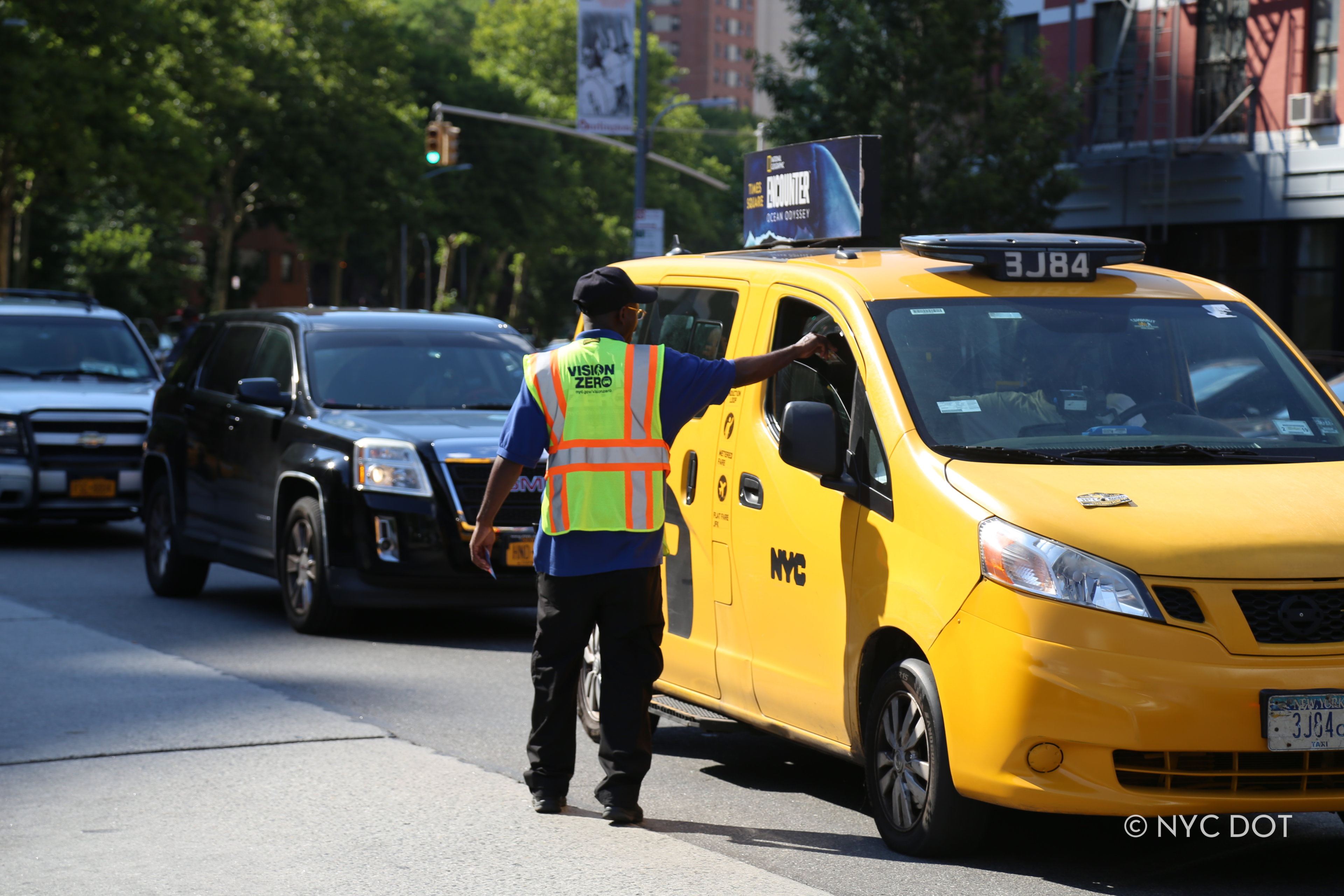
An NYC DOT Vision Zero street team member in the field. Credit: NYC DOT
NEW YORK – New York City Department of Transportation (NYC DOT) Commissioner Mike Flynn today announced that traffic deaths remain near historic lows, including pedestrian fatalities reaching an all-time low—except for the outlier year of 2020 at the height of the Covid-19 pandemic. The city’s streets have experienced 46 pedestrian fatalities, down 13% from last year and down more than 42% since the year before Vision Zero launched in 2013.
To date, this is the fifth safest year on record on our streets, with overall traffic deaths down nearly 25% since Vision Zero’s launch.
“No New Yorker should fear walking to school, biking to work, or driving to visit a loved one. New York City’s streets remain among the safest they have ever been, but Vision Zero means one death is one too many,” said NYC DOT Commissioner Mike Flynn. “Under Mayor Mamdani we are doubling down on innovative approaches to safer street design, targeted traffic enforcement, and expanded public education, because we must use every tool at our disposal to prevent catastrophic crashes and save lives.”
“The progress we’re seeing is the result of agencies working together, using data to identify challenges and act on them,” said Mayor’s Office of Operations Director Annie Levers. “With 2026 on track to be among the safest years on record, that approach is delivering results. But our work isn’t done until fatalities reach zero.”
“Keeping our streets safe and preventing traffic fatalities requires teamwork, and BIC is proud to work alongside NYC DOT and our other Vision Zero partners in this effort,” said NYC Business Integrity Commission Commissioner & Chair Asim Rehman. “Promoting vehicle safety in the trade waste industry is a core element of BIC’s mission, and we will continue to educate carting companies and enforce our safety regulations to protect New Yorkers on the road.”
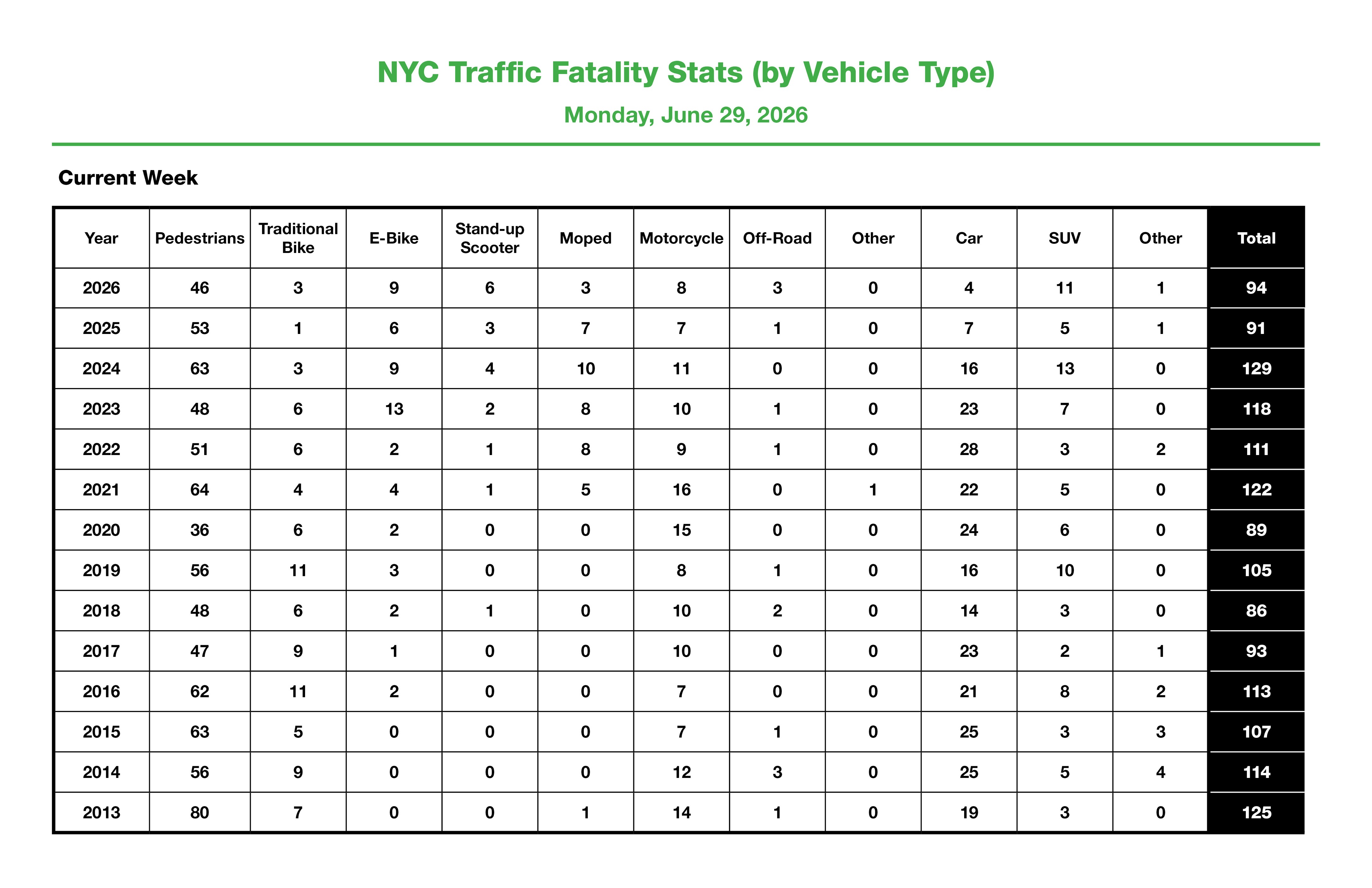
Through June 29, there have been 94 traffic fatalities in New York City, including 46 pedestrian fatalities. Pedestrian fatalities have declined 13%, down from 53 at the same point last year, and are at the lowest level in recorded history—except for the first six months of 2020 at the height of the Covid-19 pandemic. Overall fatalities to date across all categories are similar to last year’s 91 and well below the average from 2021 to 2024, which was 120.
Fatalities among occupants of motor vehicles are at 16, down sharply from 29 at this point in 2024 and 30 in 2023. Fatalities involving riders of e-bikes, stand-up scooters, and mopeds have increased from 16 to 18 compared to last year, though they remain below the 23 recorded at this point in 2024 and 2023. In addition to fatalities, traffic injuries for riders of e-bikes, stand-up scooters, and mopeds are down 7%, from 1,114 to 1,036, as of May 30, 2026—and down 33% from the 1,539 rider injuries recorded through May 30, 2023.
Traditional bicycle fatalities remain low compared to pre-pandemic years, with three deaths recorded so far this year.
The following Vision Zero initiatives have been key to keeping traffic deaths near historic lows while helping NYC respond to safety challenges.
Street Redesigns That Make Streets Safer and Easier to Use
NYC DOT continues to redesign streets in every borough with proven tools that save lives, like protected bike lanes, pedestrian islands, shorter crossings, expanded pedestrian space, safer bus stops, and clear lane organization. The projects make streets less confusing and more predictable. They deliver concrete benefits for New Yorkers like safer trips to school, calmer crossings near homes and workplaces, more comfortable bike routes, and fewer conflicts between people walking, biking, riding, or driving.
Recently completed street redesigns include:
Manhattan’s Third Avenue
- This year, NYC DOT finished adding 10-foot-wide protected bike lanes along Manhattan’s Third Avenue from 23rd Street to East 59th Street. This work is part of the agency’s complete street redesign for the corridor, which included a redesign of every intersection in the project area as well as traffic-calming measures to reduce speeding. The project now better accommodates all road users, including by delivering a safer, more comfortable cycling experience and faster, more reliable bus service for 50,000 daily riders along the corridor.
Brooklyn Bridge Connection South
- This project added a new, dedicated bike connection to the Brooklyn Bridge along Centre Street at its Manhattan entrance, creating fully separate bike and pedestrian access for the first time.
Court Street, Schermerhorn Street to Hamilton Avenue
- This project added 1.3 miles of new, dedicated bike lanes to Court St, a Vision Zero Priority corridor and busy commercial area in Brooklyn. The project also included pedestrian improvements, including painted pedestrian islands, curb extensions, and turn calming. The agency also installed curb regulation updates like commercial loading zones to discourage double parking.
Cross Island Parkway, 147 Street to 154 Street
- This project installed pedestrian improvements at two intersections on Cross Island Parkway, including the Vision Zero Priority Intersection of Cross Island Parkway and 150th Street. Improvements included a concrete pedestrian island, concrete and painted curb extensions, and five new crosswalks. The agency also made markings improvements on the north and south service roads of Cross Island Parkway to clarify vehicle movements and discourage speeding
Making Micromobility Trips Safer
While deaths among riders of e-bikes, stand-up e-scooters and mopeds are up, with 18 deaths so far this year compared to 16 at this time last year, the most dramatic change is among riders of e-scooters, with six deaths so far this year compared to three last year. This increase has been driven in part by a rise in illegal e-scooters and e-bikes that are capable of speeds far beyond legal thresholds, including e-bikes and e-scooters that can reach speeds over 50 mph. NYC DOT is working with sister agencies to address these challenges by designing and constructing safer streets, expanding educational efforts, and supporting the NYPD in its targeted enforcement against illegal devices and dangerous behavior.
Protected bike lanes: NYC DOT has installed 10-foot-wide protected bike lanes along portions of Third Avenue, Sixth Avenue, 10th Avenue, Seventh Avenue, Second Avenue, and the First Avenue tunnel in Manhattan. Wider bike lanes create a safer and more comfortable experience by allowing faster riders, including e-bike users, to pass more safely while also supporting side-by-side riding.
Public education for e-bike and scooter riders: NYC DOT continues to educate riders on safe operation, including how to ride at safe speeds, yield to pedestrians, avoid sidewalks, follow traffic signals, and use equipment that is legal and appropriate for city streets. In addition to the previously announced online ‘Do You Deliver?’ safety course for delivery workers, the Vision Zero Street Team will be deployed over the summer months in areas with high concentrations of e-mobility use to emphasize slow speeds and cautious riding.
Keeping Dangerous Driving in Check
NYC’s automated enforcement network and NYPD’s high-visibility enforcement continue to play a major role in preventing deadly crashes. Speeding, red-light running, and reckless driving remain among the most dangerous behaviors on city streets.
Speed Cameras: New York City’s speed camera program continues to reduce dangerous speeding and protect New Yorkers 24/7. Violations have dropped by 95% at camera locations since the program began.
Red-Light Cameras: New York City’s Red-Light Camera program continues to reduce dangerous red-light running on roads. Violations have dropped 80% at camera locations since the program began.
Vision Zero Street Teams: DOT and NYPD collaboration brings on-street education events to high-crash locations, distributing safety materials to drivers and community members. These week-long outreach efforts are followed by equitable enforcement that focuses on the top Vision Zero violations that are known to cause crashes, like speeding and failure to yield to pedestrians.
High-Visibility Enforcement on High-Crash Corridors: NYPD continues to focus traffic enforcement on the corridors and behaviors most closely linked to severe crashes, including speeding, failure to yield, red-light running, and illegal vehicle operation.
NYC DOT will continue to use data to guide its street safety work, focusing on the locations and behaviors that put New Yorkers at greatest risk. The agency will also continue advancing street redesigns that enhance safety and make it easier for all New Yorkers to travel the city.

Mayor Zohran Kwame Mamdani participates in a fireside chat with Chobani CEO Hamdi Ulukaya at the Choose NYC Summit on Tuesday, June 23,, 2026. Michael Appleton/Mayoral Photography Office
TRANSCRIPT: MAYOR MAMDANI PROVIDES UPDATES ON EXTREME HEAT RESPONSE AND SAFETY LIVE ON WCBS-FM (101.1 FM)
Jesse Addy: Mayor Mamdani, thanks for reaching out.
Mayor Zohran Kwame Mamdani: Oh, absolutely. Thank you for having me.
Addy: Alright, so in the grips of this heat wave, what do you want to get out to New Yorkers right now?
Mayor Mamdani: First and foremost, this goes beyond the typical heat that we would see in a summer. We’re talking about what could be the hottest days the city has seen in more than a decade. What this means for New Yorkers [is] the importance of staying cool, staying hydrated and staying indoors as much as they can. Call 311 if there’s anyone that you’re concerned about. Heat is a serious thing, and we want to make it as easy as possible to be prepared over the next few days.
Addy: You want to break it in — and give us any Taylor news while we’ve got you?
Mayor Mamdani: You know, what I can tell you is that we have approved a permit for a multi-day event at Madison Square Garden, and there will be some partial street closures around there. We’re going to make sure that all the city resources that are necessary are going to be present.
Addy: We’re all going to be keeping track if you’re wearing the same suit to that party as you were to jump in the pool, just so you know.
Mayor Mamdani: Don’t hold your breath. I won’t be at that party.
[Crosstalk.]
Addy: Mr. Mayor, thank you for checking in. Happy Fourth of July.
Mayor Mamdani: Same to you, brother.
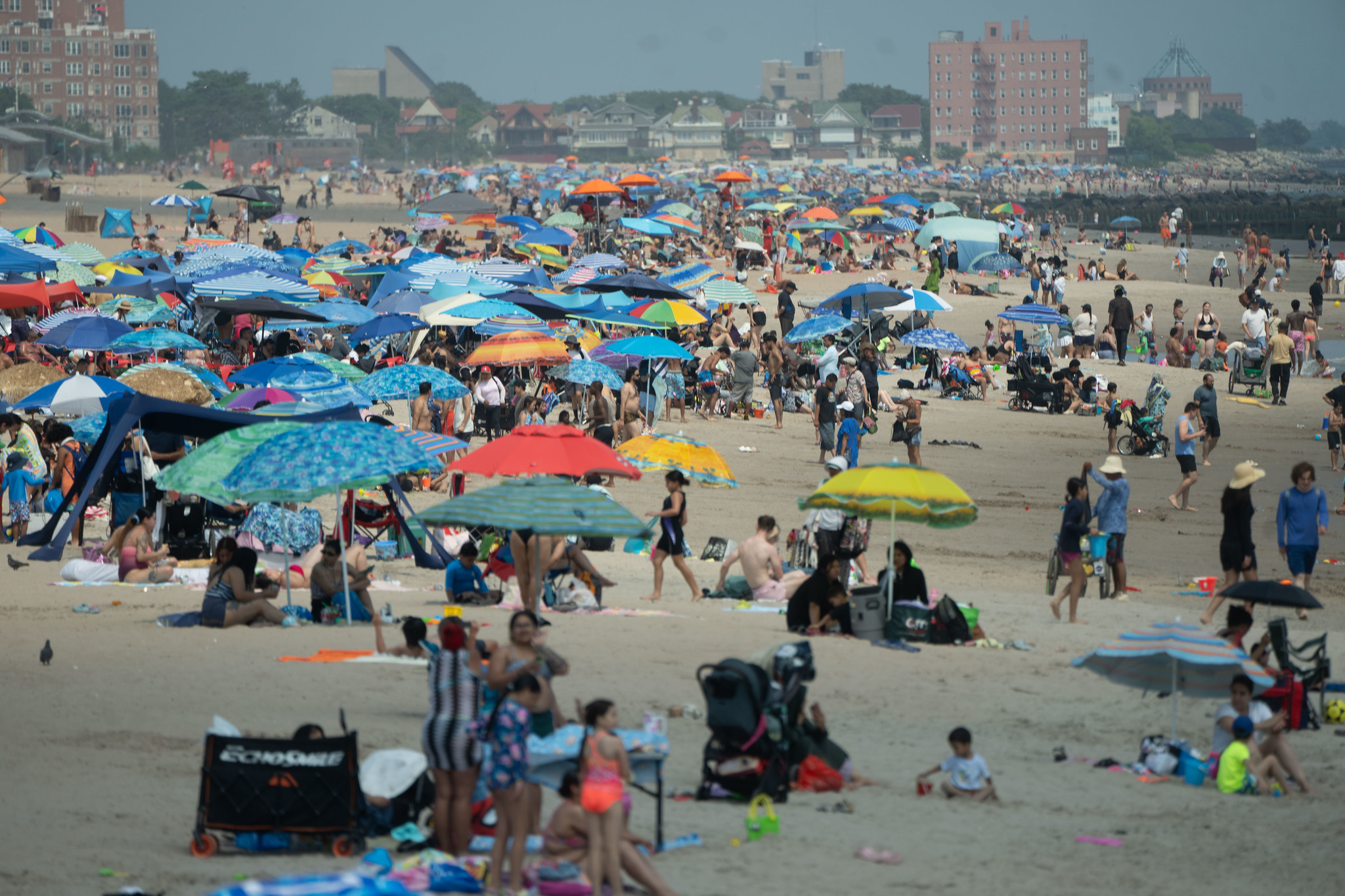
New Yorkers beat the heat on the Coney Island Beach on Wednesday, July 1, 2026. Michael Appleton/Mayoral Photography Office
Commission on Government Efficiency Releases Preliminary Report to Make Government Work Better for New Yorkers
Report identifies opportunities to reform the City Charter to speed up outdoor dining, housing construction permitting, bus & street infrastructure, and contracting
Report includes findings and reforms collected seven public hearings attended by over 780 New Yorkers
NEW YORK – The Commission on Government Efficiency (COGE), the 2026 New York City Charter Revision Commission convened by Mayor Mamdani, today released its preliminary staff report outlining potential reforms to help City government deliver faster and more effectively for New Yorkers. Charged with reviewing the entire City Charter, COGE welcomed more than 780 New Yorkers during its first 7 public hearings, heard 18 hours of testimony from 178 speakers, reviewed 345 written submissions from members of the public and received recommendations from 92 City agencies.
The preliminary report identifies four areas where reforms could help government better meet the needs of working New Yorkers: Accelerate Access to Public Space and Infrastructure Improvements, Accelerate Permitting & Contracting, Modernize Outdated Systems and Requirements to Bolster Innovation, and Ensure the City’s Fiscal Stability.
Areas identified for further exploration include, but are not limited to:
- Outdoor Dining: Save restaurants time and money by streamlining process to open outdoor dining.
- Permitting: Create a centralized, one-stop permitting system to speed up housing construction, infrastructure projects, and renovations.
- Contracting: Modernize procurement to cut time, save money and reduce unnecessary paperwork that slows down small businesses seeking to do business with the city and delays construction of infrastructure — from water tunnels to plazas to sewers.
- Bus and Street Infrastructure: Shorten timelines for street redesigns and bus and bike lane projects that improve safety and mobility.
- Rainy Day Fund: Strengthen the City’s long-term fiscal health by establishing clearer rules for contributing to and using reserve funds.
“We listened to New Yorkers across the city and worked to treat every idea—and the New Yorker behind it, whether City worker or professional association or individual who saw a sign for a public hearing and walked in—with genuine curiosity and respect,” said Ann Cheng, Executive Director of the Commission on Government Efficiency. “This preliminary report compiles that feedback and suggests concrete paths as the Commission continues to hear from New Yorkers and considers commonsense reforms to the Charter.”
“This Commission is immensely grateful to the more than 780 New Yorkers who came out to testify or submit written comments, and we want even more of them in the room as we head into our next round of hearings,” said Patrick Gaspard, Chair of the Commission on Government Efficiency. “Our next steps will be deeply informed by their passionate testimonies, each of them experts either on their block or their industry, on how city government can worker faster and more efficiently. As this Commission considers reforms to put forth on the ballot in November, it will be guided by the shared goal of unlocking this City’s potential to deliver a more affordable, safe, and dignified life for all who call it home.”
Throughout its first round of public hearings, the Commission identified four broad areas where reforms to the City Charter could help government deliver more effectively for working families.
Accelerate Access to Public Space and Infrastructure Improvements
Making it easier to use our streets, sidewalks, and public space is an opportunity to create safer neighborhoods, stronger local businesses and more vibrant public spaces. Today, restaurant owners seeking sidewalk dining permits, communities advocating for safer bus and bike lanes and City agencies working to activate surplus properties all run into the same maze of redundant reviews, costly requirements, and years-long approval timelines.
The Commission repeatedly heard that these barriers leave public land underused, delay street safety improvements, and prevent the City from putting valuable public assets to work. New York City owns more than 6,000 miles of streets and 15,000 parcels of land. With smarter systems, those public assets can better serve New Yorkers.
Accelerate Permitting & Contracting
Whether opening a small business, building affordable housing, or delivering critical infrastructure, New Yorkers consistently describe procurement and construction permitting systems that move too slowly.
The Department of Buildings processes roughly 275,000 applications each year through a borough-based structure that has changed little in more than a century. Property owners must navigate multiple agencies to secure approvals for a single project. Procurement presents similar challenges. In Fiscal Year 2025, nearly 40% of the City’s budget supported contracted goods and services, yet outdated rules continue to make it hard for small businesses and nonprofits to work with the city, a problem past commissions have flagged since 1989. Modernizing how the City permits and contracts is essential to delivering the housing, infrastructure, and services New Yorkers are waiting on while reducing unnecessary administrative burdens.
Modernize Outdated Systems & Requirements to Bolster Innovation
As governments serves millions of people every day, technology has become increasingly essential to delivering services efficiently and effectively.
The Commission heard that outdated information technology systems, antiquated legal requirements, and duplicative administrative processes slow City government without improving public outcomes. Nearly 1,500 new reporting requirements have been enacted since 2011, while outdated surety bond rules and fragmented waterfront permitting create unnecessary delays.
Modernizing these systems means eliminating rules that no longer serve the public so City workers can spend more time solving problems and delivering results.
Stabilize City Finances
With a budget larger than that of most states, New York City must manage public dollars responsibly while preparing for future economic uncertainty. The Commission heard strong support for strengthening the City’s fiscal guardrails through clearer standards governing reserve deposits and withdrawals. Building stronger reserves during good times will help protect essential services during future downturns.
Fiscal responsibility and government efficiency go hand in hand. Every dollar saved by reducing waste and improving how government operates is a dollar that can be invested in the services New Yorkers rely on.
Additional Public Hearings
COGE will continue to hold public hearings across the five boroughs in the coming weeks as it develops proposals for the November ballot. More info about COGE can be found on nyc.gov/COGE.
Additional hearings include:
- Staten Island – Monday, July 6, at 5 p.m.
- Manhattan – Wednesday, July 8, 5 p.m.
- Queens – Monday, July 13, at 5 p.m.
Banner Image: New York City Mayor Zohran Mamdani marches in the NYC Pride March on Sunday, June 27, 2026. Image Credit – Kara McCurdy. Mayoral Photography Office.



NYC Mayor Zohran Mamdani
Zohran Mamdani was sworn in as Mayor of the City of New York on January 1st, 2026. Prior to becoming Mayor, he represented the 36th New York State Assembly District and its neighborhoods of Astoria, Ditmars-Steinway, and Astoria Heights.
[…] Commission on Government Efficiency, convened by Mayor Mamdani, has just released its ballot recommendations, which New Yorkers will see on the ballot when they […]