
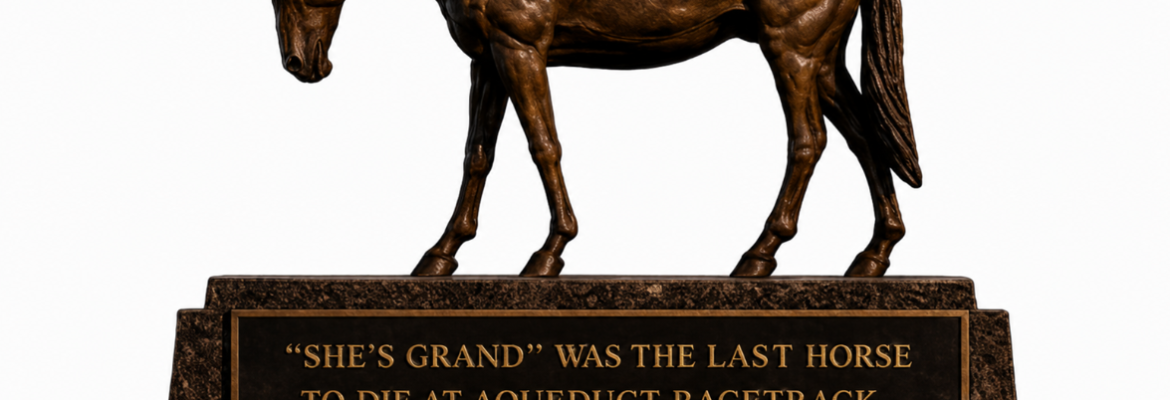
OPINION: PETA Offers Mural Remembering Horses In NYC Who Still Race Daily Under Grueling, Sometimes Abusive Conditions Supported By Casino Gambling Revenue
We asked PETA for the following information. Our topics/questions are in bold, answers from PETA in italics. Note that below, the question about where and how the revenue comes about, it is from casino gambling revenues both from licensing of machines and profits from those machines. These same funds could be put to other uses if they were not tied up supporting this industry, such as healthcare and education. Many of the subsidies themselves are generated by lottery machines, where these revenues are supposed to support education exclusively, not propping up the industry within which the machines are operated. If the subsidies, which were insituted to colocate one vice with another (video lottery terminals had to be placed there since gambling was already taking place), were to be removed, all but three of these racetracks would most likely close. Without the industry being propped up, it does not make enough money to sustain itself. Between 1,500 and 2,000 thoroughbred foals are born each year, with only about a hundred stallions that a slightly larger number of mares are mated with. The New York State list of deaths and lameness of the horses referenced below is quite long, and while a few of the horses become lame, it appears that the vast majority of them suffer accidental death or intentional euthanasia after a broken limb injury. Similarly to the horse carriage industry, and similarly to humans, when a horse suffers an injury or illness, they need time to recuperate and rest. When they work very hard on a hot day, they need water, shade, and time to relax. If instead they are given injections or oral medications to keep them awake and alert and training, then they are much more likely to suffer from exhaustion and possibly an accident simply due to being overworked.
–How long the industry has been operating
The commercial racing industry dates back to the 1800s in New York State. Aqueduct opened in 1894.
–How many tracks are left in NY (NYC or NYS)
In New York State, there are three tracks where Thoroughbreds are raced:
Saratoga Race Course, soon the new Belmont track, and Finger Lakes Gaming and Racetrack in Farmington, which has both flat racing with Thoroughbreds and harness racing with Standardbreds.
There are seven harness tracks:
Yonkers Raceway (Yonkers)
Batavia Downs (Batavia)
Buffalo Raceway (Hamburg)
Monticello Raceway (Monticello)
Saratoga Casino and Raceway (Saratoga Springs
Tioga Downs (Nichols)
Vernon Downs (Vernon)

The tracks don’t run year-round but have various seasons.
–How many horses at each one or total
There are thousands of Thoroughbreds and Standardsbreds in New York. Some live at the tracks during the season and then move to other tracks.
Some good statistics on Thoroughbreds can be found here.
The American Horse Council estimates there are about 25,000 Standardbred (harness racing) horses in the U.S. but it doesn’t say how many of those are actually raced. (I’ve not found the American Horse Council entirely reliable; it’s bloated economic impact of racing in the New York State has little to no supporting evidence).
–How many horses suffer diseases and are forced to work, and how many die each year from being overworked?
There are various causes of death for racehorses, most often catastrophic injury such as a broken leg that necessitate euthanasia. These injuries are most often the result of overwork and the use of medications and substances that keep horses training and racing when they should be recuperating from strain. See more here.
New York State publicly releases death and injury statistics, which can be found here. It’s searchable by year, track, and other metrics.
–Subsidies – how much on average, how much of their needs does it cover (is it totally in the negative or just gets some help).
The subsidies began when video lottery terminals were introduced in the state. They were allowed by the legislature on the condition that they be located at race tracks where there was already gambling. A condition of the tracks allowing them was that a portion of the profits would go to support the race tracks. This began in 2004.
A great overview/history can be found in the Times Union here:
Without subsidies, all harness tracks would close; they don’t make enough without subsidies to continue operating. It’s likely that only Saratoga Race Course does enough business to remain viable.
From the article:
Horse racing in New York has been propped up by more than $2.9 billion in state taxpayer dollars and government-directed benefits since 2008, a Times Union investigation has uncovered.
That’s more than twice the money New York budgeted for the state Department of Agriculture in the same time period, and 13 times what it spent on veterans’ services.
The payout is also more than eight times what state and local governments have given during the same period to IBM, the technology juggernaut headquartered in New York, according to Good Jobs First, a nonprofit that tracks corporate subsidies.
–How do these subsidies work? Are they pre-approved, part of budget legislation, part of the executive budget, or are they tucked away inside of other laws?
See the Times Union article above and also see our website here.
This was created when we were working on bills to end subsidies, so it hasn’t been updated in the last two years but there is great info. At least $230 million of casino revenue prop up the horse racing industry.
The subsidies are mandated by legislation.
Aqueduct Racetrack Leaves Blood-Soaked Legacy; PETA Calls for Memorial to Honor Horses Killed
Just days after Aqueduct Racetrack in Queens hosted its final race, PETA today sent a letter to New York Governor Kathy Hochul urging her to install a memorial honoring the hundreds of horses who died at the track over its 132-year history. In the letter, PETA offers to help cover the cost of the memorial and suggests a statue modeled after She’s Grand, the last horse to die at Aqueduct, who suffered a fatal injury there only four days ago.
PETA points out that more than 270 horses have been killed in races and training at Aqueduct since 2009 alone. The track has remained open this long only because the failing horse racing industry is propped up by hundreds of millions of dollars in taxpayer subsidies paid by New Yorkers without their consent.
“It’s an ugly fact that countless horses were whipped, drugged, and pushed beyond their physical limits at Aqueduct Racetrack for human amusement,” says PETA founder Ingrid Newkirk. “The least New York can do now is ensure their memories don’t die with them, and PETA urges everyone to play golf, bet on elections, or do anything other than support any entertainment in which animals are cruelly exploited.”
In the United States, an average of at least one horse is killed on racetracks every day—and that number reflects only reported on-track fatalities. The true figure is likely far higher.
PETA’s letter to Hochul follows.
July 1, 2026
The Honorable Kathy Hochul
Governor of New York State
Dear Governor Hochul:
I’m writing on behalf of People for the Ethical Treatment of Animals—PETA entities have more than 10.4 million members and supporters globally, including close to half a million in New York—in response to the news that Aqueduct Racetrack has hosted its final race and will close forever. As New York considers this site’s legacy, we urge you to install a memorial on the grounds to commemorate the hundreds of horses killed at Aqueduct Racetrack for the sake of human entertainment, similar to the one we’ve mocked up below. This statue could be modeled after She’s Grand, the New York-bred horse trained by Linda Rice who sustained a fatal injury just four days ago and was the last to die at Aqueduct. PETA would be willing to help cover the costs.
Since 2009, more than 270 horses were killed at Aqueduct Racetrack in races and training, and their deaths reflect the broader reality of an industry that treats horses as disposable commodities. Thoroughbreds at Aqueduct were whipped, drugged, and pushed beyond their physical limits and sustained catastrophic injuries that prematurely ended their lives.
As you know, New Yorkers have unwillingly paid for this misery. Aqueduct remained in business—and other tracks in the state continue to do so—only because the industry is propped up by more than a quarter-billion dollars in subsidies every year. Aqueduct is closing now because the state loaned the New York Racing Association $455 million to renovate Belmont Park. New Yorkers object.
Rather than allowing the cruel deaths of hundreds of horses to fade into history, New York has an opportunity to honor their lives with a memorial that would acknowledge the past and inspire change and compassion in the future. Thank you for your consideration. I look forward to hearing from you.
Very truly yours,
Ingrid Newkirk
Founder
Banner Image: Proposed statue. Image Credit – PETA



People for the Ethical Treatment of Animals
People for the Ethical Treatment of Animals (PETA) is the largest animal rights organization in the world, and PETA entities have more than 9 million members and supporters globally. PETA opposes speciesism, a human-supremacist worldview, and focuses its attention on the four areas in which the largest numbers of animals suffer the most intensely for the longest periods of time: in laboratories, in the food industry, in the clothing trade, and in the entertainment business. We also work on a variety of other issues, including the cruel killing of rodents, birds, and other animals who are often considered “pests” as well as cruelty to domesticated animals. PETA works through public education, investigative newsgathering and reporting, research, animal rescue, legislation, special events, celebrity involvement, and protest campaigns.
There is zero reason to force horses or any other animals to perform for humans’ entertainment. When doing so consistently results in their injuries and deaths, we need to question our own morality.
It boggles the mind that in 2026, horses are still being forced to race to their deaths or pull carriages until they drop.
Behind the romanticized façade of Thoroughbred horse racing is a world of injuries, drug abuse, gruesome breakdowns, and slaughter. While spectators show off their fancy outfits and sip mint juleps, horses are running for their lives.